Registrarse para pujas en directo
Stack’s Bowers and Ponterio Logo
Lote
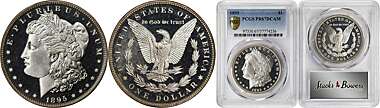
Lote 2103. 1895 Morgan Silver Dollar. JD-3. Rarity-4. Proof-67 Deep Cameo (PCGS). This extremely beautiful 1895 Morgan dollar should be seen to be fully appreciated. The obverse is untoned and presents sharp contrast between satiny devices and deeply mirrored fields. Deep Cameo contrast is also noted for the reverse, where there is also delicate pale silver and gold iridescent toning toward the left border. The detail is razor sharp throughout, smooth and the virtually pristine surfaces will please even the most discerning Morgan dollar enthusiast.The alleged sole Proof-only issue in the popular Morgan silver dollar series, the Philadelphia Mint 1895 has long enjoyed legendary status. Early generations of collectors were puzzled by an entry in Mint records that showed a circulation strike delivery of 12,000 coins for this year, and many theories arose to explain why the only 1895-dated examples found were believed to be survivors of the year's 880-piece Proof issue. Some said the circulation strikes were never made at all and the 12,000-piece figure represented a bookkeeping error. Others suggest that the 12,000-coin mintage reported for 1895 represents an adjustment to the Mint's ledgers to account for a final delivery of 1894-dated silver dollars. Modern numismatic scholarship has not only challenged these traditional theories, but overturned them, in the process going a long way toward finally solving the mystery of the 1895 Philadelphia Mint Morgan dollar issue.In an article titled "King of Morgan Dollars Revisited" (2006, 2018), Roger W. Burdette provides conclusive evidence from available government documents that, indeed, the Philadelphia Mint did produce 12,000 circulation strike Morgan dollars from 1895-dated dies. This conclusion is picked up and expanded upon by John W. Dannreuther in the 2025 volume in his United States Proof Coins reference series:The explanation lies in the retirement of Chief Coiner William S. Steele on May 31 and his planchets-on-hand problem. All 1894 proof and working dies were destroyed per the 1873 coinage act (and subsequent "Section 3550 Revised Statutes") at the beginning of 1895 (on January 2, 1895 per the Mint die use and destruction document). When the order was issued that no circulation strikes were to be struck in Philadelphia, the coiner had a problem.Coiner Steele still had 13,000 unstruck dollar planchets on hand. To balance his books before he left his position, proof dies were prepared and the coins were struck with proof dies - there were no working dies... - thus, proof-only dies struck the on-hand planchets. One can assume he did not disobey the order not to strike circulation strike dollars, as these were technically "Proofs." Only 12,000 coins were of deliverable quality of the 13,000 presumedly struck and they went through the normal channels prescribed by the 1873 coinage act.Indeed, six of the circulation strikes were provided to the Assay Commission (along with four of the Proof 1895 dollars). Since there are upward of 300 circulated 1895 Philadelphia Mint Morgan dollars extant, and neither the Mint nor contemporary collectors would have deliberately disposed of that many Proofs by placing them into circulation, it is likely that somewhere between half a bag and two full 1,000-coin bags of circulation strike 1895 Philadelphia Mint dollars were released into commerce through normal channels. The balance of the 12,000-piece circulation strike mintage is presumed to have been destroyed as part of the 270,232,722 silver dollars melted under provision of the Pittman Silver Purchase Act of 1918.Dannreuther also takes up the challenge as to what to call these circulation strike 1895 Morgan dollars struck from Proof dies - a situation that he believes is unique in American numismatics. Since the 25 trade dollars struck in 1874 from polished working dies (JD-2, No Period) have been classified as "Semi-Proofs" by Dannreuther, and certified as Specimens by PCGS, the author whimsically proposes the term "semi-circulation strikes" for the circulation strike 1895 silver dollars struck from Proof dies.Of the four die marriages confirmed for the 1895 Morgan dollar, JD-1 and JD-2 account for the vast majority of survivors. They are believed to have struck the 790 Proofs delivered for distribution in the year's Proof sets, as well as most of the "semi-circulation strikes" that were released into commercial channels and account for the majority of circulated survivors. JD-3 (as here) and JD-4 are significantly scarcer and, according to Dannreuther, "may constitute the 90 coins delivered in September with the 790 Proofs for sets mostly comprised of the first two varieties [JD-1 and JD-2]." Property from an Alabama Family. Earlier from our sale of the Blue Moon Collection, Part I, March 2017 Baltimore Auction, lot 2617. PCGS# 97330. NGC ID: 27ZR. PCGS Population: 6; 3 finer in this category (Proof-68 Deep Cameo finest). Exquisite Superb Deep Cameo Proof 1895 Silver Dollar The "King of the Morgan Dollars"
  • Precio de salida:
    1 USD
    0 EUR
    0 GBP
    0 CHF

    Importes redondeados, solo aproximadosFecha: 06/11/2026
Lote
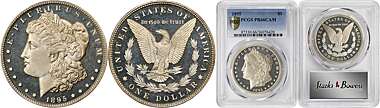
Lote 2104. 1895 Morgan Silver Dollar. JD-2. Rarity-4. Proof-66 Cameo (PCGS). Our multiple offerings in this sale notwithstanding, the Philadelphia Mint 1895 is a legendary rarity in the silver dollar series with an extant population that is in no way sizeable enough to meet strong collector demand. This, in fact, is the undisputed key date issue to completion of a date and mintmark set of the 1878 to 1921 Morgan design type. The present lot showcases a delightful upper end Gem that also offers undeniable strike and condition rarity at the PCGS Proof-66 Cameo level. Dusted with smoky champagne-gold iridescence, the surfaces allow ready appreciation of awesome cameo contrast between deeply mirrored fields and thickly frosted motifs. The strike is razor sharp to full throughout, both sides also expertly preserved with nary a distracting blemish in evidence. A lovely example destined for inclusion in a world-class numismatic cabinet. PCGS# 87330. NGC ID: 27ZR. PCGS Population: 7; 13 finer in this category (Proof-68 Cameo finest). Beautiful Gem Cameo Proof 1895 Dollar Rarity
  • Precio de salida:
    1 USD
    0 EUR
    0 GBP
    0 CHF

    Importes redondeados, solo aproximadosFecha: 06/11/2026
Lote
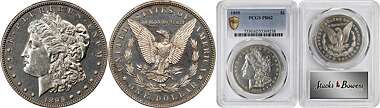
Lote 2105. 1895 Morgan Silver Dollar. JD-2. Rarity-4. Proof-62 (PCGS). A visually appealing coin for the assigned grade, the generally light silver gray surfaces exhibit enhancing blushes of iridescent gold toning that are more pronounced on the reverse. Sharply impressed and frosty in texture, the design elements contrast somewhat with mirror-finish fields. Obverse hairlines and overall muting to the finish serve to limit the grade, but this piece remains a noteworthy survivor of a key Morgan dollar issue. From the Grossman Collection. PCGS# 7330. NGC ID: 27ZR. Legendary 1895 Philadelphia Mint Silver Dollar
  • Precio de salida:
    1 USD
    0 EUR
    0 GBP
    0 CHF

    Importes redondeados, solo aproximadosFecha: 06/11/2026
Lote
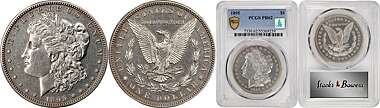
Lote 2106. 1895 Morgan Silver Dollar. JD-3. Rarity-4. Proof-62 (PCGS). CMQ. Along with JD-4, JD-3 is one of the two scarcities among the four die pairings identified for the 1895 Philadelphia Mint Morgan dollar issue. Writing in the 2025 volume in his United States Proof Coins reference series, John W. Dannreuther opines that JD-3 and JD-4 "may constitute the 90 coins delivered in September with the 790 Proofs for sets mostly comprised of the first two varieties [JD-1 and JD-2]." These 880 coins represent the total Proof silver dollar mintage of this date, as distinct from the 12,000-piece "semi-circulation strike" 1895 Philadelphia Mint delivery comprised of circulation strike planchets struck from Proof dies.Magnification readily reveals the primary diagnostic of the JD-3 attribution on the present Proof-62 example: a small gouge within the base of the letter E in LIBERTY on Liberty's headband. Somewhat muted silver-gray surfaces also reveal faint hairlines to account for the grade. The strike is full and there are no singularly distracting marks, however, which features enhance the appeal of this key date Morgan dollar. From the Grossman Collection. PCGS# 7330. NGC ID: 27ZR. Seldom-Encountered 1895 JD-3 Morgan Dollar
  • Precio de salida:
    1 USD
    0 EUR
    0 GBP
    0 CHF

    Importes redondeados, solo aproximadosFecha: 06/11/2026
Lote
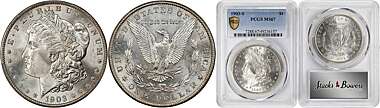
Lote 2107. 1903-S Morgan Silver Dollar. MS-67 (PCGS). Extraordinary quality for this eagerly sought, yet highly elusive entry in the later Morgan dollar series. Highly lustrous with a satin to softly frosted finish, both sides are brilliant with a delightful silver-white appearance. Smartly impressed with razor sharp detail throughout the design.Simply put, the 1903-S is one of the rarest Morgan silver dollars in Mint State. A mintage of 1,241,000 coins is partly to blame for this, but the real culprit is its distribution, or rather lack thereof. With well worn survivors in grades such as Good and VG relatively obtainable, it seems likely that a fair number of 1903-S dollars entered circulation shortly after striking. Later releases of Mint State coins were few and far between, which suggests that much of the mintage succumbed to melting pursuant to the 1918 Pittman Act. This phenomenal Superb Gem ranks among the finest certified examples. Here is a significant and fleeting bidding opportunity for quality conscious Morgan dollar collectors. PCGS# 7288. NGC ID: 256T. PCGS Population: 9; 2 finer (both MS-67+). Key Date 1903-S Silver Dollar Among the Finest Seen by PCGS
  • Precio de salida:
    1 USD
    0 EUR
    0 GBP
    0 CHF

    Importes redondeados, solo aproximadosFecha: 06/11/2026
Lote
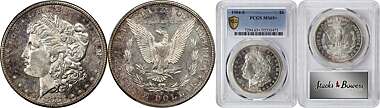
Lote 2108. 1904-S Morgan Silver Dollar. MS-65+ (PCGS). This is an outstanding Gem example of an issue that is scarce even in lower Mint State grades. Dusted with delicate rose-russet iridescence that appears to drift toward the borders, plenty of silvery mint brilliance remains to be appreciated on both sides. Both sides exhibit a smooth frosty texture that is sure to please even the most discerning numismatist. Boldly struck and carefully preserved, this coin belongs in one of the finest silver dollar cabinets. The 1904-S is one of the most elusive Morgan dollars in all grades, as much of the mintage of 2,304,000 pieces was likely melted under the Pittman Act in 1918. Release of coins from federal storage was limited and came to an end during the 1950s; there were none in the Treasury Department releases of 1962 to 1964. As one of the finest examples seen by PCGS, this lovely coin represents a significant find for advanced collectors specializing in this popular series. PCGS# 7294. NGC ID: 256W. PCGS Population: 22; 29 finer in this category (MS-67 finest). Key Date 1904-S Morgan Dollar
  • Precio de salida:
    1 USD
    0 EUR
    0 GBP
    0 CHF

    Importes redondeados, solo aproximadosFecha: 06/11/2026
Lote
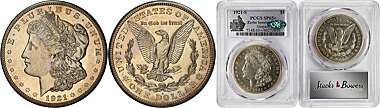
Lote 2109. 1921-S Morgan Silver Dollar. Zerbe Special Strike. JD-1. Rarity-7. Specimen-65+ (PCGS). CAC. This is a superior and unsurpassed example of a fascinating issue, far more carefully produced and attractive than the typically encountered circulation strike 1921-S Morgan dollar. Both sides are minimally toned in the pale golden and rose-russet iridescence with the warmest color confined to isolated peripheral areas. Universally sharp striking detail is also a praiseworthy attribute, as is a finish that is semi-reflective, especially in the fields. Expertly preserved to confirm the premium Gem rating from PCGS, and confirmed by CAC, even the most discerning numismatist will be impressed by this exquisite specimen.The genesis of this issue was the Mint's failure to place the new Peace silver dollar into circulation before the end of 1921. Upset over that fact, Farran Zerbe - the influential ANA member who played a leading role in the Peace dollar project - convinced officials at the San Francisco Mint to strike a few presentation pieces of the outgoing design for his personal distribution. This happened while Zerbe was in California awaiting the arrival of the first 1921-S Peace dollar dies. These, of course, never arrived and were replaced with dies for one final delivery of Morgan dollars from the West Coast branch mint. Per a conversation that Walter Breen had with Wayte Raymond in 1951 (mentioned in Q. David Bowers' 1993 reference Silver Dollars & Trade Dollars of the United States: A Complete Encyclopedia) Zerbe then had special 1921 Morgan dollars made in the Philadelphia Mint to accompany the 1921-S specimens that he already owned.While not true Proofs, the 1921 and 1921-S Zerbe specimens are special presentation strikings from highly polished dies. The present example displays the well known diagnostics of the type with the aforementioned semi-reflective fields and scattered die polish lines from the die preparation process. The exact number of pieces produced for each issue is unknown, for they were made expressly at Zerbe's request and do not constitute regular Mint issues. Based on a survival estimate of 100 to 125 pieces provided by PCGS, it is likely that upward of 150 pieces were struck at the Philadelphia Mint. The 1921-S Zerbe is far rarer with John W. Dannreuther observing that just five or six specimens are known from an estimated mintage of 24 coins in the 2025 volume in his United States Proof Coins reference series. With one 1921-S Zerbe specimen impounded in the ANS Collection, and most others tightly held in private hands, the fleeting opportunity represented by this offering can hardly be overstated. Property from an Alabama Family. Earlier ex our (American Numismatic Rarities') Classic Sale of January 2004, lot 341; our (Bowers and Merena's) Rarities Sale of January 2005, lot 1073; Heritage's sale of the JFS Collection, Part III, January 2006 FUN Signature Auction, lot 3392; Heritage's FUN Signature Auction of January 2007, lot 1149; Bob R. Simpson; Heritage's sale of the Bob R. Simpson Collection, Part III, January 2021 FUN Signature Auction, lot 3032. The plate coin for the issue in the 2025 Dannreuther reference on United States Mint Proof coinage, p. 1201. PCGS# 7348. PCGS Population: 1; 0 finer.CAC Stickered Population: 2; 0. The former total includes coins certified both Specimen-65 and Specimen-65+. Fascinating and Rare Zerbe "Proof" 1921-S Morgan Dollar The Simpson Specimen and Dannreuther Plate CoinFinest Certified at PCGS
  • Precio de salida:
    1 USD
    0 EUR
    0 GBP
    0 CHF

    Importes redondeados, solo aproximadosFecha: 06/11/2026
Lote
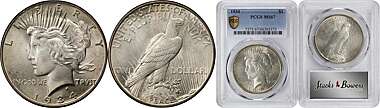
Lote 2110. 1934 Peace Silver Dollar. MS-67 (PCGS). The surfaces of this delightful Superb Gem are essentially perfect, displaying a complexion of soft satin luster and razor sharp strike detail. Delicate tan-gold and pale silver iridescence is present to further enhance the eye appeal, although most viewing angles reveal a virtually brilliant coin. An inspirational specimen that triumphs over most known examples of this penultimate silver dollar issue from the Philadelphia Mint.The 1934 Peace dollar boasts the smallest mintage of any issue in this series from the 1930s. Of the 954,057 dollars struck, PCGS has awarded the MS-67 grade on only 23 occasions, and there are none finer. This is truly an exceptional find for advanced Peace dollar specialists and Set Registry participants. PCGS# 7375. NGC ID: 257X. PCGS Population: 23; 0 finer. Condition Rarity 1934 Peace Dollar
  • Precio de salida:
    1 USD
    0 EUR
    0 GBP
    0 CHF

    Importes redondeados, solo aproximadosFecha: 06/11/2026
Lote
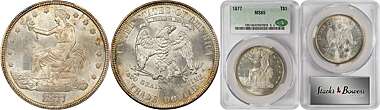
Lote 2111. 1877 Trade Dollar. JK-14. MS-65 (CACG). An enchanting Gem with silky smooth surfaces that present as overall pristine in hand. Largely brilliant, but with iridescent gold and pale orange peripheral toning evident under closer scrutiny. Both sides are intensely lustrous with a strongly frosted texture that includes semi-reflective qualities in the fields. The reverse is sharply struck throughout, the obverse the same in and around the center with minor softness confined to the upper and right peripheral areas. Attractive in all regards, and conditionally rare for both the type and issue.Although a modest success in Far East commerce beginning with its introduction in 1873, the trade dollar suffered a setback in 1876 from which the denomination never recovered. In the latter year silver prices dropped to the point where a trade dollar contained only 91 cents worth of silver, a significant reduction from the $1.02 bullion value of these coins at the series' debut. The federal government reacted quickly and, as one of its provisions, the Act of July 22, 1876, demonetized the trade dollar within the United States and limited its coinage for use in the export trade (the raison d'etre for the denomination, anyhow). Circulation strike production continued apace, as a result, with the 1877-S even setting the mintage record for the series at 9,519,000 pieces.On February 22, 1878, however, Treasury Secretary John Sherman halted trade dollar coinage for commercial use. Brother of the famous Civil War general, Sherman was a foe of the trade dollar and, with the standard silver dollar re-authorized through the Bland-Allison Act of February 28, 1878, western mining interests were more than content that there was still a ready outlet for their precious metal. The Philadelphia Mint struck only Proof trade dollars in 1878, although final circulation strike productions took place in Carson City and San Francisco. Thereafter the trade dollar remained a Proof-only affair at the Philadelphia Mint until the series' official end in 1883.The last of the Philadelphia Mint's circulation strike trade dollar issues, and a plentiful one in an absolute sense, the 1877 registered a generous mintage for the type at 3,039,200 pieces. While survivors are plentiful in circulated grades, and even lower quality Uncirculated coins are readily obtainable by trade dollar standards, the 1877 is a major numismatic rarity in MS-65. This is a significant offering that will surely attract many strong bids when it crosses the auction block. From Heritage's June 2023 U.S. Coins in Early Holders Showcase Auction, lot 52231, as NGC OH/CAC MS-65. PCGS# 7044. NGC ID: 253C. CACG Population: 1; 0 finer. Beautiful 1877 Trade Dollar Rare MS-65 Grade from CACG
  • Precio de salida:
    1 USD
    0 EUR
    0 GBP
    0 CHF

    Importes redondeados, solo aproximadosFecha: 06/11/2026
Lote
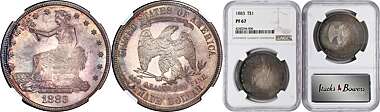
Lote 2112. 1883 Trade Dollar. JD-1, JK-1. Rarity-2. Proof-67 (NGC). One of the most attractive, expertly preserved examples of this extremely popular trade dollar issue that we have offered in recent memory. Both sides are warmly and originally toned with blue, apricot and pink iridescence backlighting sandy-gray, russet and steely-charcoal patina. A lively Proof finish shines forth nicely and all viewing angles display the fully impressed, razor sharp devices.The collectible portion of the trade dollar series passed into history in 1883 with a Proof-only delivery of 979 coins (the 1884 and 1885 trade dollars were produced in extremely limited numbers and rank among the classic rarities of U.S. numismatics). This is actually the sixth in a run of consecutive Proof-only issues from the Philadelphia Mint which began in 1878 when Secretary of the Treasury John Sherman halted circulation strike trade dollar production. (The Carson City and San Francisco mints each managed one final circulation strike delivery in 1878 despite the Treasury secretary's order, these to fulfill bullion deposits that had already been received.) The 1883 has long been popular with both type collectors and series specialists. Rare at the Superb Gem grade level, and even more desirable given its wonderfully original appearance, this lovely specimen would do justice to the finest collection. PCGS# 7063. NGC ID: 27YV. NGC Census: 11; 2 finer in this category (Proof-69 finest). The corresponding PCGS Population is 6/0. Exceptional 1883 Trade Dollar Here you can find the Video-Tour.
  • Precio de salida:
    1 USD
    0 EUR
    0 GBP
    0 CHF

    Importes redondeados, solo aproximadosFecha: 06/11/2026
Lote
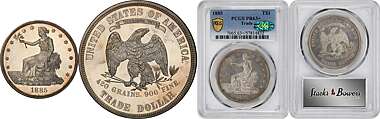
Lote 2113. 1885 Trade Dollar. JD-1, JK-1. Rarity-7+. Proof-63+ (PCGS). CAC. Both sides of this legendary rarity in the trade dollar series are dusted with iridescent antique silver toning. A few blushes of slightly warmer sandy-rose tinting are evident, mostly around the obverse periphery and over the lower right reverse. That side of the coin is fully struck with razor sharp detail from the rim to the center, and every one of the eagle's feathers is crisply delineated. The obverse is fully defined overall with a touch of softness confined to stars 5 and 6, which lack radial lines. The top of Liberty's head and the tip of the coronet are also a bit lightly struck, but we stress that most Proof 1885 trade dollars are softly struck to one degree or another along the upper obverse border. This coin is more sharply struck than the Eliasberg specimen, which is soft from stars 5 to 10. Carefully preserved surfaces approach Choice Proof quality and offer plenty of visual appeal.The 1885 trade dollar is one of the greatest of all American numismatic classics, with a ranking of 15 in the popular and influential book 100 Greatest U.S. Coins (5th Edition, 2019) by Jeff Garrett and Ron Guth. The 1885 trade dollar is rarer than the 1787 Brasher doubloon (seven known), is about three times rarer than the 1804 dollar (16 known), is tied with the 1913 Liberty Head nickel (five known), and is nearly on a par with the 1822 half eagle (three known). It is significant to note that neither the Smithsonian Institution nor the American Numismatic Society, possessors of two of the finest cabinets of American coins ever assembled, have either an 1884 or an 1885 trade dollar. Nor does the American Numismatic Association have one. The same can be said for virtually every other collection in existence, public or private, for apart from the piece offered here, just four coins are believed to exist.Some of the following historical information on the 1885 trade dollar is excerpted and updated from Q. David Bowers' 1997 cataloging of the Eliasberg specimen, incorporating the latest scholarship on this issue.History of the 1885 Trade DollarIn certain ways the story of the 1885 trade dollar parallels that of the 1884, although with several differences. For starters, the 1885 is twice as rare, and considering that aspect, has appeared on the market less often than the mintage of five coins would suggest. Most of America's truly great collections lacked an example, and today, as noted, the great museums have no 1885 trade dollars either.The 1885 trade dollar is not mentioned in the Annual Report of the Director of the Mint for that year. Additionally, while the "Die Record Book," a notebook kept in the Die Department of the Philadelphia Mint from 1880 to 1886 by A.W. Downing (with a few notations by A.W. Straub; both men had the same first two initials), mentions an obverse and reverse die made for the Proof 1884 trade dollar in January of that year, no related notation is given for the 1885 trade dollar. These are significant and potentially revealing omissions, although they are by no means conclusive.Indeed, numismatic scholars are confident that the 1885 trade dollars are products of the United States Mint, and were made in the year indicated. All five coins were certainly struck at the Philadelphia Mint from Proof dies, presumably during a single press run. The obverse and reverse dies for this issue were made from regular Mint master dies and prepared in the normal Proof manner. Apart from the date, a Proof 1885 trade dollar is identical in all aspects to one dated 1884, 1883, or any other earlier date of the Type II/II hub style.We can even narrow down the exact striking period of these coins to the roughly six month period between January 2, 1885, when both the obverse and reverse dies of the Proof 1884 trade dollar were destroyed (as mandated by the Mint Act of 1873), and June 1885, when Archibald Loudon Snowden turned in his resignation as superintendent of the Philadelphia Mint. Snowden enjoyed a long, if interrupted, career at the Mint, first joining its staff in 1857 as a Register under his uncle, Mint Director James Ross Snowden. A. Loudon Snowden's various tenures covered the period of U.S. Mint history when many of the most famous restrikes, patterns and fantasy pieces were clandestinely struck for distribution to contemporary collectors. It is easy to assume that, before his departure in June 1885, Snowden had a hand in the production and/or survival of the five Proof 1885 trade dollars. Conversely, his successor as superintendent of the Philadelphia Mint, Daniel Fox, has no known association with the production or distribution of numismatic rarities and appears to have closely followed the rules that forbade selling patterns, restrikes and similar coins to collectors.While numismatic scholars are confident of their answers to the questions, "When were the 1885 trade dollars made?" and "Where were the 1885 trade dollars made?", why they were made is less clear and still a topic of debate. Traditional numismatic wisdom has it that these coins were struck clandestinely by or, at the very least, at the direction of A. Loudon Snowden for personal gain. Proof for this theory comes from the lack of official documentation regarding the 1885 trade dollar, as related above. Yet it is not necessarily unusual for such mintages to have been omitted from the records, and other instances occur throughout numismatics.Those who ascribe to the clandestine striking theory also point to the fact that the 1885 trade dollars were not generally known to numismatists until early in the 20th century. This also means very little, however, as numerous other 19th century rarities, including many patterns, were not known until after the turn of the century, nor were the 1873-CC No Arrows dime, 1854-S quarter eagle, and certain other coins produced during the 19th century. Augustus G. Heaton, who was one of the most careful students of American coins, was not aware of the existence of the 1870-S Liberty Seated silver dollar when he wrote his Mint Marks book in 1893, and Mint records are silent on that coin's production. New discoveries are always being made and will continue to be made. We note as a more modern example the 1978 discovery of the unique 1870-S half dime, an issue that is also not mentioned in Mint records.That the Mint neither publicized the 1884 and 1885 trade dollars at the time of striking nor made them available on open sale to collectors is not necessarily unusual either. Many highly acclaimed rarities of the era including the 1877 pattern half dollars, the 1872 pattern Amazonian silver coins, the 1879 pattern Schoolgirl dollar, the 1882 pattern Shield Earring dollar, and the Coiled Hair four-dollar gold Stellas of 1879 and 1880 - to give a very short list - were obtained only through dealers who enjoyed special connections at the Mint. We are not stating that this was an excellent practice, for it was not. Yet even so, Mint officials and contemporary dealers can be credited with preserving for posterity coins that might not have survived otherwise.It is highly unlikely that anyone within the Philadelphia Mint in 1884 or 1885 considered these trade dollars to be a significant source of secret profit. First, trade dollars were not popular with numismatists at the time. Second, if they had been made for a profit - as were, for example, restrikes of the 1856 Flying Eagle cent and the 1804 Class III silver dollar - they would have been marketed long before the early 20th century.The Philadelphia Mint had been producing Proof trade dollars for collectors from the start of the series in 1873, and exclusively from 1878 onward. In early 1884, Superintendent Snowden received orders from the Treasury Department to cease production, sale and other distribution of trade dollars. The trade dollar was not officially discontinued until 1887, however, so it is possible that Snowden had his staff once again, as they had done in January 1884, make all of the necessary preparations for the striking of Proof 1885 trade dollars for sale to collectors as part of the year's Proof sets. What could have followed is a repeat of what happened with the 1884 trade dollars: Superintendent Snowden acquired five examples from the initial batch of Proof 1885 trade dollars delivered to the medal clerk. Until the 1930s, it was legal for Mint employees to obtain examples of new coinage in exchange for the equivalent amount of coin or bullion, which is almost certainly how Snowden acquired the 10 Proof 1884 trade dollars, and could also have been how he acquired the five Proofs of 1885. Shortly thereafter, however, Snowden would have been instructed that trade dollars were not to be included in the 1885 Proof sets; no additional coins were struck after that declaration, and any additional specimens that were still with the medal clerk would have been destroyed through melting.While the foregoing scenario makes sense in theory, the exact status of the Proof 1885 trade dollars remains a mystery. They may have been produced clandestinely after all or, like their 1884 counterparts, they could be legitimately produced and obtained survivors from a Proof mintage that was cancelled early in the year, and after Mint employees had already taken the first steps for a large coinage. In the end it matters little, for the extreme rarity of this issue and the desirability of owning an example have been recognized since the early 20th century.For many years it was generally believed that the 1885 trade dollars, along with those dated 1884, were found by John W. Haseltine in 1901 when going through the numismatic estate of his father-in-law, William K. Idler. Apparently, Idler acquired six 1884 trade dollars from Superintendent Snowden shortly after they were struck. These were added by Idler to silver Proof sets of the year. After Idler's passing in 1901, John W. Haseltine fell heir to his numismatic estate. Haseltine confirmed the existence of 1884 trade dollars in his father-in-law's estate during an address to ANA members gathered in convention in Philadelphia in autumn 1908. This was related in the October-November 1908 issue of The Numismatist:One of the old-time dealers, and also a collector, was the late Mr. William Idler of this city at the time when Mr. Cogan was also a dealer in Philadelphia. Mr. Idler was my father-in-law and he was very reticent about his collection. He would seldom show his coins, even for sale. This was partly caused by the fear that the many pattern and experimental coins he possessed might be seized. Hence the many remarkable pieces that have been found in his collection. Some were not known prior to his death, to be in existence, including the 1884 Trade dollar and some unique United States gold pieces.It is significant that Haseltine does not mention the 1885 trade dollar in connection with Idler. While Haseltine and his partner Stephen K. Nagy went on to sell several of the 1884 trade dollars - most notably to Virgil Brand - no sale of any of the five 1885 trade dollars has ever been positively traced to Haseltine or Nagy. Rather, the earliest known sale of an 1885 took place on April 26, 1911. The buyer was Virgil Brand, perhaps not surprisingly, but the seller was Edgar H. Adams, who was probably offering the coin on behalf of his close associate William H. Woodin. (Pattern enthusiasts will immediately recognize Adams as co-author, with Woodin, of the famous Adams-Woodin reference United States Pattern, Trial, and Experimental Pieces, first published in 1913.) An article in the January 1912 edition of The Numismatist reported that Judson Brenner owned examples of both the 1884 and 1885 trade dollars. The first auction appearance of an 1885 trade dollar was lot 392 in B. Max Mehl's July 1913 sale of the H.O. Granberg Collection. Lot 391 in that sale was an 1884 trade dollar. Granberg exhibited another 1885 trade dollar at the 1914 ANS Exhibition as part of a complete set of trade dollars that also included, of course, the 1884. The fifth and final 1885 trade dollar made its debut in the wider numismatic market in March of 1915 when Edgar H. Adams offered both an 1884 and 1885 trade dollar in an ad in The Numismatist.Adams, Brenner and Granberg all had close ties to Woodin, and four of the 10 Proof 1884 trade dollars first surfaced during the four year period from 1912 to 1915, each as part of a two-coin set with an 1885 trade dollar. This presentation was quite different from that of the six 1884 trade dollars that came out through Idler-Haseltine-Nagy, which were part of silver Proof sets - dime, quarter, half dollar, silver dollar and trade dollar - assembled by Idler. Woodin is very likely the key to the initial distribution of the 1885 trade dollars, and what links him to Snowden is his purchase, through Haseltine, of the two 1877 pattern half unions from the former superintendent in 1909. When word of this transaction spread, public opinion came out against the sale with many believing that the coins belonged to the Mint Cabinet and should never have been sold. The results of legal proceedings were avoided by a last minute deal in which Woodin agreed to return the coins in exchange for "several trunks" of patterns and other coins that Snowden had acquired during his years at the Mint. The exchange took place in 1910 and, once back in Snowden's possession, the half unions were either returned to the Mint or confiscated.Given that the 1885 trade dollars first appeared within the five years after the 1910 exchange between Woodin and Snowden, it seems likely that four 1884 trade dollars and all five of the 1885 trade dollars were included in the "several trunks" of coins that Woodin acquired. Four of the 1884 trade dollars were each paired with an 1885 trade dollar and initially sold to or through Edgar H. Adams, Judson Brenner and H.O. Granberg, as above. Adams sold the fifth 1885 trade dollar individually to Virgil Brand (actually the first for which we have a confirmed sale).Registry of 1885 Trade DollarsFive KnownThe following roster of known specimens of the 1885 trade dollar is updated from Q. David Bowers' standard 1993 reference Silver Dollars and Trade Dollars of the United States: A Complete Encyclopedia, with corrections and additions obtained from the PCGS CoinFacts website, research by Heritage, Saul Teichman, Wayne Burt and Ron Guth presented both in Heritage's January 2019 FUN Signature Auction and in Saul Teichman's provenance files on the Newman Numismatic Portal, and the 2025 volume in John W. Dannreuther's United States Proof Coins reference series. The grades are either those currently assigned by PCGS or NGC or, for the single uncertified specimen, an estimated grade based on historic market appearances. Unfortunately, it is no longer possible to determine how the Judson Brenner, one of the H.O. Granberg, and one of the Edgar H. Adams specimens fit into the current provenance chains so, where appropriate, we have used the terminology "unknown intermediaries" after William Woodin, who probably acquired all five examples from Philadelphia Mint Superintendent A. Loudon Snowden in 1910.1 - PCGS Proof-65+ Cameo. The Eliasberg Specimen. Ex Philadelphia Mint Superintendent A. Loudon Snowden, 1885; William H. Woodin, 1910 (probably); unknown intermediaries; William Cutler Atwater; B. Max Mehl's sale of the William Cutler Atwater Collection, June 1946, lot 378; Louis E. Eliasberg, Sr.; our (Bowers and Merena's) sale of the Louis E. Eliasberg, Sr. Collection, April 1997, lot 2354; Jay Parrino; Legend Numismatics; Bruce Morelan, 1999; John Albanese, 2006; Heritage, privately, 2006; private collection; Heritage's sale of the Greensboro Collection, Part VII, January 2019 FUN Signature Auction, lot 4553; D.L. Hansen.2 - PCGS/CAC Proof-63+ Cameo. The Amon G. Carter Specimen. Ex Philadelphia Mint Superintendent A. Loudon Snowden, 1885; William H. Woodin, 1910 (probably); unknown intermediaries; Waldo C. Newcomer (per Carl Carlson), displayed at the 1916 ANA Convention; "Colonel" E.H.R. Green; Burdette G. Johnson; Jack Roe; B. Max Mehl's Ryan, Roe and Waltman Collections sale, June 1945, lot 628; Jerome Kern; B. Max Mehl's sale of the Jerome Kern Collection, May 1950, lot 897; Amon Gamaliel Carter, Sr.; Amon G. Carter, Jr.; our (Stack's) sale of the Amon G. Carter, Jr. Family Collection, January 1984, lot 441; Kevin Lipton; Superior's session of Auction '84, July 1984, lot 192; Fred Fredericks; Superior's L.W. Hoffecker Collection sale, February 1987, lot 1446B; Eugene Worrell; Superior's sale of the Worrell Collection, September 1993, lot 1325; our (Stack's) sale of the L.K. Rudolf Collection, May 2003, lot 2175; Legend Numismatics; Bob R. Simpson; Heritage's sale of the Simpson Collection, January 2021 FUN Signature Auction, lot 3030.3 - PCGS/CAC Proof-63+. The Olsen-French Specimen. Ex Philadelphia Mint Superintendent A. Loudon Snowden, 1885; William H. Woodin, 1910 (probably); unknown intermediaries; B. Max Mehl's sale of the Fred Olsen Collection, November 1944, lot 1767; George Sealy Ewalt; our (Stack's) sale of the George Sealy Ewalt Collection, November 1965, lot 43; Leo A. Young; RARCOA's session of Auction '80, August 1980, lot 1626; Julian Leidman; Mike Follett; private collection; RARCOA's session of Auction '84, July 1984, lot 1810; John N. Rowe, III; L.R. French, Jr.; our (Stack's) sale of the L.R. French, Jr. Collection, January 1989, lot 202; Charles Barasch (International Coins & Currency, Inc.), circa 1992; E. Horatio Morgan Collection; our sale of the E. Horatio Morgan Collection, March 2020 Auction, lot 3216; Rare Coin Wholesalers (Steven & Michael Contursi); An Alabama Family Collection. The present example.4 - PCGS Proof-62. The Farouk-Norweb Specimen. Ex Philadelphia Mint Superintendent A. Loudon Snowden, 1885; William H. Woodin, 1910 (probably); H.O. Granberg; B. Max Mehl's sale of the H.O. Granberg Collection, July 1913, lot 392; Ruth Green, advertised in the December 1941 issue of The Numismatist; King Farouk of Egypt; Sotheby's sale of the Palace Collections of Egypt, February 1954, lot 1680; Ambassador and Mrs. R. Henry Norweb; our (Bowers and Merena's) sale of the Norweb Collection, Part II, March 1988, lot 1848; Dan Drykerman (American Coin Portfolios); private New York Collection; Bowers and Merena Galleries, privately, March 20, 1992; Q. David Bowers (personal collection), March 23, 1992; Richmond Collection; David Lawrence's sale of the Richmond Collection, Part II, November 2004, lot 1569.5 - Brilliant Proof. The Adolphe Menjou Specimen. Ex Philadelphia Mint Superintendent A. Loudon Snowden, 1885; William H. Woodin, 1910 (probably); Edgar H. Adams, sold to the following on April 26, 1911; Virgil Brand; Armin Brand; Burdette G. Johnson, on consignment November 2, 1936, sold November 1937; Clinton Hester; Numismatic Gallery's Adolphe Menjou Collection sale, June 1950, lot 2041; Benjamin Stack (Imperial Coin Company), advertised an 1885 trade dollar in The Numismatic Scrapbook Magazine, March 1955, along with an 1884 trade dollar; W.G. Baldenhofer; our (Stack's) Farish-Baldenhofer Sale, November 1955, lot 1040; private collection; Julian Leidman, Mike Brownlee and Hugh Sconyers, exhibited at Stack's bourse table at the 1974 Miami ANA Convention, and sold immediately thereafter to the following, along with an 1884 trade dollar; James Halperin (New England Rare Coin Galleries), featured in the February 1975 issue of The Numismatist; John Kamin (The Forecaster Moneyletter); private collection.There are several notes concerning 1885 trade dollars which cannot be specifically attributed today to one of the five known specimens, but which, undoubtedly, are part of the registry of this issue:-An article in the January 1912 edition of The Numismatist reported that Judson Brenner owned examples of both the 1884 and 1885 trade dollars. Brenner almost certainly acquired these coins from William H. Woodin; the 1885 is #1, 2 or 3 above.-In addition to the specimen offered as lot 392 in B. Max Mehl's July 1913 sale of the H.O. Granberg Collection (#4 above), Granberg owned a second 1885 trade dollar that he exhibited at the 1914 ANS Exhibition as part of a complete set of trade dollars that also included, of course, the 1884. This 1885 is #1, 2 or 3 above.-The final 1885 trade dollar to make its debut in the wider numismatic market is the specimen that Edgar H. Adams offered in the March 1915 issue of The Numismatist, alongside an 1884 trade dollar. This 1885 is #1, 2 or 3 above.-In The Numismatist, June 1944, p. 546, the Celina Coin Company advertised a complete set of Proof trade dollars, including these listings: "1884 Very Rare" and "1885 Excessively Rare." These were sold by Burdette G. Johnson from the "Colonel" E.H.R. Green estate to the Brandts brothers (Carl and Ted). In a subsequent issue of The Numismatist, only the 1884 was listed, indicating that the 1885 had been sold separately. This 1885 is different from #3 above, which was also owned by "Colonel" Green at one time.-Burdette G. Johnson offered 1885 trade dollars to Stack's on August 23, 1943 and B. Max Mehl on April 3, 1944. Property from an Alabama Family. Earlier ex Philadelphia Mint Superintendent A. Loudon Snowden, 1885; William H. Woodin, 1910 (probably); unknown intermediaries; B. Max Mehl's sale of the Fred Olsen Collection, November 1944, lot 1767; George Sealy Ewalt; our (Stack's) sale of the George Sealy Ewalt Collection, November 1965, lot 43; Leo A. Young; RARCOA's session of Auction '80, August 1980, lot 1626; Julian Leidman; Mike Follett; private collection; RARCOA's session of Auction '84, July 1984, lot 1810; John N. Rowe, III; L.R. French, Jr.; our (Stack's) sale of the L.R. French, Jr. Collection, January 1989, lot 202; Charles Barasch (International Coins & Currency, Inc.), circa 1992; E. Horatio Morgan Collection; our sale of the E. Horatio Morgan Collection, March 2020 Auction, lot 3216; Rare Coin Wholesalers (Steven & Michael Contursi). PCGS# 7065. NGC ID: 27YX. Landmark Rarity 1885 Trade Dollar Only Five Examples KnownThe Olsen-French Specimen
  • Precio de salida:
    1 USD
    0 EUR
    0 GBP
    0 CHF

    Importes redondeados, solo aproximadosFecha: 06/11/2026
Lote
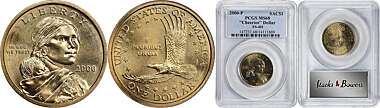
Lote 2114. 2000-P Sacagawea Dollar. Cheerios. FS-902. Boldly Detailed Tail Feathers. MS-68 (PCGS). This dazzling Ultra Gem Mint State example is one of the finest certified Sacagawea "Cheerios" dollar known to PCGS. The surfaces are essentially pristine, satiny, and incredibly lustrous, with a bold strike throughout. The eagle's tail feathers are individually sharp and fully showcase the reverse design detail as intended by Mint engraver Thomas D. Rodgers, Sr.This popular variety of the first year Sacagawea dollar is affectionately known as the "Cheerios" dollar, and it is most readily identifiable by the pronounced enhancement evident to the detail of the eagle's tail feathers. These pieces were struck during the late summer or early fall of 1999, from 2000-dated dies. Only 5,500 examples were distributed by the Mint in boxes of Cheerios cereal as part of a promotional program with General Mills to advertise the new "golden" dollar coin. Each distribution also included an accompanying 2000 Lincoln cent.Numismatists first recognized the "Cheerios" dollar as a distinct variety in June 2005. It is cataloged as the Boldly Detailed Tail Feathers variety in the popular Cherrypickers Guide by Bill Fivaz and J.T. Stanton, in which it is attributed as FS-902. This variety is sometimes referred to as a pattern or prototype since it includes the reverse design detail as intended by Mint engraver Thomas D. Rodgers, Sr. In the event, however, the Mint smoothed out the eagle's tail feathers before commencing regular issue Sacagawea dollar production in November 1999.Given the way they were distributed, it is not surprising that many "Cheerios" dollars were obtained by non-numismatists who eventually spent the coins or otherwise mishandled them. This fact explains the rarity of high-grade examples, with coins certified MS-67 or MS-68 by the leading third-party certification services difficult to come by under normal market conditions. This fleeting offering will see spirited bidding. PCGS# 147231. BASE PCGS# 411990. NGC ID: 282J. PCGS Population: 73; 1 finer (MS-68+). One of the Finest Certified "Cheerios" Dollars
  • Precio de salida:
    1 USD
    0 EUR
    0 GBP
    0 CHF

    Importes redondeados, solo aproximadosFecha: 06/11/2026
Lote
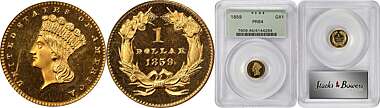
Lote 2115. 1859 Gold Dollar. JD-1. Rarity-6. Centered Date. Proof-64 (PCGS). OGH. The 1859 is the first Proof gold dollar with a reported mintage figure. It is also the highest mintage Proof gold dollar produced up to that point in time. The 80 pieces struck represents a dramatic increase over the estimated mintage of 25 coins for the Proof 1858. The increased production for the Proof 1859 is the result of the Mint's eagerness to share in the profits generated by the first great surge in popularity of numismatics as a hobby in the United States. So eager, in fact, that it widely overshot the mark when it came to anticipated demand for Proof gold coinage in 1859. With only 20 to 30 coins known today (per John W. Dannreuther, 2018), most of the 80 Proofs struck were almost certainly melted as unsold. On the other hand, the 1859 gold dollar exists in (far) greater numbers than the other Proof gold issues of this year, the smaller denomination and, hence, smaller purchasing power of these coins making them more likely to be acquired and preserved by contemporary Americans than the quarter eagle, half eagle, etc.There is no lack of willing buyers for classic Proof gold coins in the numismatic market of the 21st century, for advanced collectors recognize these pieces as defining elements in the finest cabinets. As the earliest date in the Proof gold dollar series that can be considered collectible, and the only realistic candidate to represent the Proof gold coinage of the year as far as most collectors are concerned, the Proof 1859 enjoys particularly strong demand. And this Choice specimen is destined for inclusion in an advanced collection, for it is an attractive example in all regards. Gently contrasted between frosty devices and mirrored fields, this piece is further enhanced by handsome color in deep orange-olive gold. There are no handling marks of note apart from a few wispy hairlines that do little more than help define the Proof-64 numeric grade. A highly desirable coin, historically significant and numismatically rare, this beautiful specimen will surely see spirited bidding. From the Property of a Park Avenue Collector. PCGS# 7609. NGC ID: 25E2. PCGS Population: 4; 2 finer in this category (both Proof-65). Historic and Rare Proof Strike of the 1859 Gold Dollar
  • Precio de salida:
    1 USD
    0 EUR
    0 GBP
    0 CHF

    Importes redondeados, solo aproximadosFecha: 06/11/2026
Lote
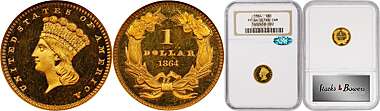
Lote 2116. 1864 Gold Dollar. JD-1. Rarity-6+. Proof-64 Ultra Cameo (NGC). CAC. This beautiful example of the famous 1864 Proof gold dollar rarity is fully defined and has a billowy satin texture to the design elements, which are set apart from deep reflectivity in the fields. The cameo contrast is both pronounced and highly appealing, worthy of the coveted Ultra Cameo designation from NGC. Rich, even color in deep olive-orange gold, this exquisite Choice specimen is sure to see spirited bidding from advanced gold enthusiasts.With the nation locked in the grip of civil war and contemporary Americans preoccupied with more important things than numismatics, it is little wonder that the Philadelphia Mint produced only 50 Proof gold dollars in 1864. Survivors are rare and seldom encountered even as part of famous cabinets. The Eliasberg Collection, for example, did not include a Proof 1864 gold dollar. Fewer than 20 coins are believed extant in all grades, two of which are permanently impounded in the National Numismatic Collection at the Smithsonian Institution, and another in the American Numismatic Society. One of the few examples that we have handled in recent generations, this remarkable rarity is an important highlight of the present sale and is sure to find its way into a fine collection of classic Proof gold coinage. From the Mack C. Chase Collection. PCGS# 97614. NGC ID: 25E7. NGC Census: 2; 2 finer in this category (Proof-66+ * Ultra Cameo finest). The corresponding PCGS Population is 2/5 (Proof-66+ Deep Cameo finest).CAC Stickered Population: 3; 0. Proof 1864 Gold Dollar Rarity
  • Precio de salida:
    1 USD
    0 EUR
    0 GBP
    0 CHF

    Importes redondeados, solo aproximadosFecha: 06/11/2026
Lote
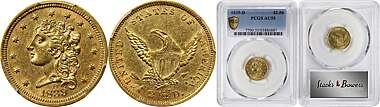
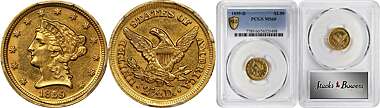
Lote 2117. 1839-D Classic Head Quarter Eagle. HM-2, Winter 1-A. Rarity-4. Weak Berry, No Branch. AU-55 (PCGS). A visually appealing, uncommonly high grade survivor of this historic Southern gold issue. Vivid orange-honey surfaces display subtle olive undertones. The texture is hard and frosty with appreciable semi-reflectivity in the fields. Well struck for the issue, and bold in most areas, with only light handling marks that do not distract during in-hand viewing.1839 was the first year of coinage for quarter eagles at the Dahlonega Mint, the final year of quarter eagle coinage of the design type, and the second of just two years with an obverse mintmark position (the first year, 1838, saw branch mint coinage from only the Charlotte facility). In 1840, Christian Gobrecht's Liberty Head design replaced William Kneass' short-lived Classic Head motif of 1834 to 1839, and the mintmark position was moved to the reverse die.The 1839-D has a modest mintage of 13,674 pieces. The foremost experts in this series agree on the number of coins extant, with Doug Winter (Gold Coins of the Dahlonega Mint: 1838-1861, 2023 edition) estimating 225 to 275 and Daryl J. Haynor (United States Classic Gold Coins of 1834-1839, 2020) stating a more precise and conservative 225. The former author ranks the 1839-D as the 14th rarest of 20 Dahlonega Mint quarter eagle issues. Haynor ranks the 1839-D as the third rarest Classic Head quarter eagle after the 1838-C and 1839. "Compared to the other dates," the author states, "the 1839-D is more proportionally found in the lower grades of Fine and Extremely Fine." It is particularly noteworthy, therefore, that our consignor acquired this impressive Choice AU coin to represent the 1839-D. PCGS# 7700. NGC ID: 25G5. Scarce 1839-D $2.50
  • Precio de salida:
    1 USD
    0 EUR
    0 GBP
    0 CHF

    Importes redondeados, solo aproximadosFecha: 06/11/2026
Lote
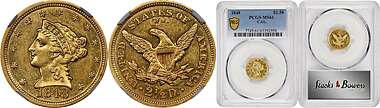
Lote 2118. 1848 Liberty Head Quarter Eagle. CAL. MS-61 (PCGS). A sparkling, vivid and handsome Mint State example, an attractive coin with subtly reflective fields supporting frosty motifs. Warm orange-gold in color with distinctive pinkish-rose highlights. Nicely struck in virtually all areas, though there is some weakness within the eagle's right leg plumage on the reverse, a sticking point with most quarter eagles of the era and hardly detracting given the overall quality of this piece.In 1848 some 230 or so ounces of gold bullion from the recently discovered California gold fields was sent to Secretary of War William L. Marcy by Colonel R.B. Mason, acting military governor of California. Marcy turned the bullion over to the Mint, where it was used to strike 1,389 quarter eagles. In order to denote the origin of the gold used for this special limited mintage, the letters CAL. were punched into the upper reverse field above the eagle's head on all specimens struck. This distinguishing feature marks the 1848 CAL. quarter eagle as our nation's first commemorative issue, produced 44 years prior to the 1892 Columbian Exposition half dollar.Given the popularity of the California Gold Rush era with numismatists and other collectors, the 1848 CAL. has long enjoyed strong demand. Indeed, the acquisition of an 1848 CAL. quarter eagle is a defining moment in the formation of any collection. Survivors are scarce, and appearances on the open market are rare, so much so that even the offering of a lower grade example represents an important opportunity. In PCGS MS-61, the offered coin is one of the finer certified and one of the nicest to appear in our sales in the last decade. Representing a fleeting opportunity for advanced specialists in Liberty Head quarter eagles and the numismatics of the California Gold Rush era, the present coin is sure to see spirited bidding at auction and fetch a strong price. Ranked #70 in the fifth edition (2019) of the influential reference 100 Greatest U.S. Coins by Jeff Garrett and Ron Guth. Property from an Alabama Family. PCGS# 7749. NGC ID: 25HA. PCGS Population: 2; 28 finer (MS-68 finest). Historic 1848 CAL. Quarter Eagle Our Nation's First Commemorative Coin
  • Precio de salida:
    1 USD
    0 EUR
    0 GBP
    0 CHF

    Importes redondeados, solo aproximadosFecha: 06/11/2026
Lote
Lote 2119. 1859-D Liberty Head Quarter Eagle. Winter 22-N. MS-60 (PCGS). As one of the few Mint State examples of the issue certified by PCGS, this superior coin is undoubtedly one of the finest known 1859-D quarter eagles. Both sides display rich deep orange-gold color with blushes of pale rose also very much in evidence. The luster is frosty, strong for the grade, and the strike is sharp apart from isolated softness in and around the centers, typical of the issue. Wispy hairlines and a touch of glossiness to the texture are easily overlooked at the assigned grade level, and do not inhibit what is a pleasing appearance overall.Among the 175 or so coins believed extant (per PCGS CoinFacts), EF and low end AU grades are typical for the 1859-D. Demand for truly high quality survivors such as that offered here far outstrips supply, especially given this issue's historical significance as the final Dahlonega Mint quarter eagle. This impressive condition rarity is sure to see spirited bidding from advanced Southern gold enthusiasts. PCGS# 7789. NGC ID: 25JM. PCGS Population: 3; 11 finer (MS-62 finest). Historic Final Year 1859-D Quarter Eagle Rare Mint State Grade from PCGS
  • Precio de salida:
    1 USD
    0 EUR
    0 GBP
    0 CHF

    Importes redondeados, solo aproximadosFecha: 06/11/2026
Lote
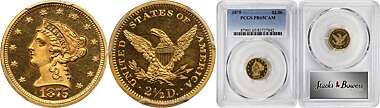
Lote 2120. 1875 Liberty Head Quarter Eagle. JD-1. Rarity-6. Proof-65 Cameo (PCGS). Offered here is a highly significant example of the 1875 quarter eagle, an important date among classic U.S. Mint gold coins. This is a lovely Proof Liberty Head quarter eagle irrespective of date, in fact, with regal color in deep orange-olive gold and lighter pinkish-rose. The devices are fully struck with razor sharp definition on even the most intricate design features. The cameo contrast mentioned on the PCGS insert is expectably strong and visually stunning. The preservation justifies Gem quality with no significant marks or other blemishes to report.Few dates in U.S. coinage history are as desirable as 1875, as it was in that year that the Philadelphia Mint produced some of its rarest gold coins. The circulation strike 1875 gold dollar, quarter eagle, half eagle and eagle all have extremely low mintages, while the three-dollar gold piece of that year was not produced in this format. Proofs for all denominations of the year are universally rare, the mintage for each only 20 pieces. We believe that only 15 or so Proof 1875 quarter eagles are extant in all grades, a total which includes a few pieces that are impaired due to circulation or other factors. The number of unimpaired Proofs is likely fewer than 12 coins. Clearly our offering of this premium PCGS Proof-65 specimen represents a fleeting opportunity not to be missed.Proof 1875 quarter eagles are easily distinguished from the associated 400 circulation strikes by the date placement. For the Proofs, the date is positioned high in the field with the digit 5 nearly touching Liberty's bust. Property from an Alabama Family. Earlier from Kagin's ANA National Money Show Auction of March 2017, lot 1408. PCGS# 87901. NGC ID: 287W. PCGS Population: 2; 0 finer in this category. Exceedingly Rare 1875 Quarter Eagle A Lovely Gem Cameo Proof
  • Precio de salida:
    1 USD
    0 EUR
    0 GBP
    0 CHF

    Importes redondeados, solo aproximadosFecha: 06/11/2026
Lote
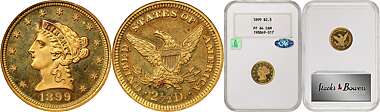
Lote 2121. 1899 Liberty Head Quarter Eagle. JD-1. Rarity-4. Proof-64 Cameo (NGC). CAC. CMQ. OH. Beautiful Cameo Proof qualities are on full display on both sides of this vivid orange-gold specimen. Fully struck and satiny, the design elements contrast markedly with deeply reflective fields. Wisps of silver-olive and pale pinkish-rose tinting further enhance both sides and help to confirm the awesome originality of this piece.This is a highly desirable survivor from a Proof mintage of 150 pieces, one of 90 to 110 believed extant (per John W. Dannreuther, United States Proof Coins, Volume IV: Gold, Part One, 2018). It is a highlight of the classic gold offerings in this sale, and would be ideal for a high quality Proof gold type set. From the Property of a Park Avenue Collector. PCGS# 87925. NGC ID: 288N. Beautiful Choice Cameo Proof 1899 $2.50
  • Precio de salida:
    1 USD
    0 EUR
    0 GBP
    0 CHF

    Importes redondeados, solo aproximadosFecha: 06/11/2026
Lote
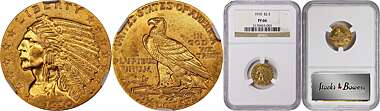
Lote 2122. 1910 Indian Quarter Eagle. JD-1. Rarity-4. Proof-66 (NGC). This exceptional premium Gem specimen readily showcases the fine satin characteristics that this issue is prized for by modern collectors. The pleasing deep golden-orange color is accented by delicate apricot highlights, as well as deeper olive undertones. Fully struck and expertly preserved.The 1910 is the second of only two Satin Proof issues in the Indian quarter eagle series, this finish introduced in 1909 in an effort to improve sales to collectors who did not like the Sandblast Proofs of 1908. In the end the new format proved just as unpopular, and the Mint returned to a modified version of the sandblast finish in 1911, which continued in use with subtle texture changes through the series' conclusion in 1915. The reason for the reversion to the sandblast finish seems to be a vote taken among attendees of the 1910 ANA Convention, which showed that that finish was more popular than its satin counterpart among contemporary numismatists.The reported mintage of 682 pieces for the Proof 1910 bears no relation to the rarity of examples in today's market. Writing in his excellent 2018 reference on U.S. Mint Proof coins, John W. Dannreuther proposes that "a substantial number of the 682 quarter eagles struck in 1910 were likely spent by their buyers. And it [is] unlikely [that] many more than 100 Proof coins are extant today." This is one of the finest certified survivors of this underrated issue, a lovely coin that will please even the most discerning gold enthusiast. PCGS# 7959. NGC ID: 289J. Premium Gem Satin Proof 1910 Quarter Eagle
  • Precio de salida:
    1 USD
    0 EUR
    0 GBP
    0 CHF

    Importes redondeados, solo aproximadosFecha: 06/11/2026
Lote
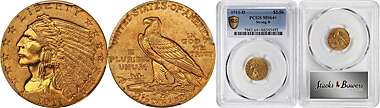
Lote 2123. 1911-D Indian Quarter Eagle. Strong D. MS-64+ (PCGS). The undisputed key issue to the Indian quarter eagle series, this example features handsome reddish-orange gold color that enhances the lovely mint luster on both sides. The strike is razor sharp, including a crisp, fully defined D mintmark.Bela Lyon Pratt's Indian designs for the quarter eagle and half eagle were quite novel when introduced in 1908. The incuse design was never before seen on an American coin and has not been used since on any circulating issue. For many collectors, the Indian quarter eagle series is a straightforward challenge with only 15 issues to obtain, most of which are acquired with only a fair amount of effort depending on the desired grade level. There is one notable exception, the 1911-D. Most mintage figures for the series range between a quarter million to three-quarters of a million pieces. However, at the Denver Mint in 1911, only 55,680 coins were produced. Most were very well struck, though on many the mintmark is weakly defined; these are not nearly as desirable as those with a strong D mintmark, as here.For whatever reason, the limited mintage of the 1911-D quarter eagle was overlooked by contemporary numismatists and many examples disappeared into commerce. As the 20th century progressed the issue's low mintage became an indicator of its scarcity, but only with the advent of third-party certification in 1986/1987 and the population figures published by PCGS and NGC have numismatists gained a clear picture of survival rates and overall rarity. The 1911-D's position as by far the rarest of the series is now firmly established. Fortunately, a significant portion of survivors are in and around Mint State, mostly between AU-55 and MS-63. While Choice MS-64s are important condition rarities in their own right, they appear on the market with some regularity. Near- and full Gems, as here, are quite a bit rarer and significantly more difficult to obtain. Clearly this is a bidding opportunity that deserves the utmost in attention. PCGS# 7943. NGC ID: EG27. PCGS Population: 43; 37 finer (MS-66+ finest). Outstanding Near-Gem 1911-D Quarter Eagle
  • Precio de salida:
    1 USD
    0 EUR
    0 GBP
    0 CHF

    Importes redondeados, solo aproximadosFecha: 06/11/2026
Lote
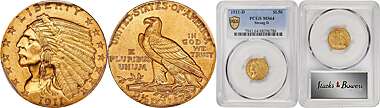
Lote 2124. 1911-D Indian Quarter Eagle. Strong D. MS-64 (PCGS). An Indian quarter eagle set is one of the only gold date and mint collections that can be completed without spending a huge fortune and years and years of time. A complete set of these makes a handsome display, as well. Naturally, there is one difficult key date that presents a challenge to date collectors, and that is the 1911-D, which has the lowest mintage of the series of 55,680 pieces. The Denver mintmark usually comes "strong" as seen here, but can come quite weak - as struck, however, these weak D pieces are less desirable. Notice the full strike and usual wire rim on the right side of the obverse, always found on this issue and one of the diagnostics used to confirm authenticity. Lustrous throughout and free of all but minor signs of handling, this pleasing Choice Mint State 1911-D quarter eagle will become the centerpiece of any set it graces. PCGS# 7943. NGC ID: EG27. Fabled Key Date 1911-D Quarter Eagle Here you can find the Video-Tour.
  • Precio de salida:
    1 USD
    0 EUR
    0 GBP
    0 CHF

    Importes redondeados, solo aproximadosFecha: 06/11/2026
Lote
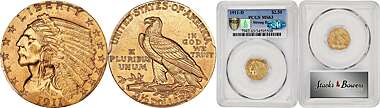
Lote 2125. 1911-D Indian Quarter Eagle. Strong D. MS-63 (PCGS). CAC. CMQ. This is a lovely Select Uncirculated example of a key date issue in the United Stats Mint's celebrated Indian gold coin series of 1907/1908 to 1929/1933. Frosty honey-gold surfaces define this quarter eagle, both sides also with a tinge of light pinkish-apricot that further enhances the eye appeal. The strike detail is razor sharp throughout and includes a fully formed and crisp D mintmark. With few post-production blemishes, this premium example is far smoother in hand than one might expect at the assigned grade level. A very nice piece. PCGS# 7943. NGC ID: EG27. Mint State 1911-D Indian $2 1/2
  • Precio de salida:
    1 USD
    0 EUR
    0 GBP
    0 CHF

    Importes redondeados, solo aproximadosFecha: 06/11/2026
Lote
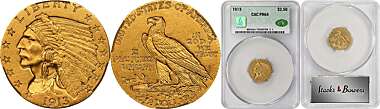
Lote 2126. 1913 Indian Quarter Eagle. JD-1. Rarity-4. Proof-64 (CACG). CMQ. Legacy Holder. Bold honey-gold blankets the surfaces of this lovely premium Choice Proof, with subtle rose-red highlights. The complexion remains impressively composed under a glass, exhibiting an infinitesimal array of dazzling facets sparkling across each side. Well struck and nicely preserved for a coin with the delicate surfaces of a Sandblast Proof.The Proof Indian quarter eagles of 1913 were produced using the finely grained sandblast finish similar to that seen on the Proof 1912. While richer in color and finer in texture than most other Sandblast Proofs in this series, numismatists of the era still did not like these pieces, instead preferring the Brilliant and Cameo Proof coins from the Liberty Head series. Sales of the coins were poor and only 165 Proof quarter eagles were produced in 1913, down from the 197-piece mintage achieved for the 1912. The present Choice Proof specimen numbers among the more desirable of the 100 to 120 pieces believed extant and serves as a magnificent example of both the 1913 issue and the Sandblast Proof Indian quarter eagle series as a whole. PCGS# 7962. NGC ID: 289M. CACG Population: 1; 2 finer (Proof-66+ finest). Richly Original Sandblast Proof 1913 Quarter Eagle
  • Precio de salida:
    1 USD
    0 EUR
    0 GBP
    0 CHF

    Importes redondeados, solo aproximadosFecha: 06/11/2026
Lote
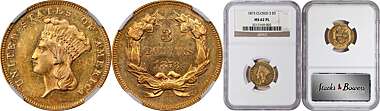
Lote 2127. 1873 Three-Dollar Gold Piece. Close 3. MS-62 PL (NGC). This is a beautiful example of a classic rarity in the challenging three-dollar gold series. Rich color in deep orange-olive gold dominates, enhanced by subtle reddish-rose and silvery highlights. Both sides exhibit a satin finish to the devices that yields to pronounced reflectivity in the fields. Boldly, if not sharply defined over most features, and very attractive at the assigned grade level.The 1873 is one of the more intriguing rarities among three-dollar gold pieces. The mintage figures show only 25 Proof coins were struck and record nothing about circulation strikes. For many years numismatists assumed that was an accurate number, but beginning in the 1920s, questions were raised noting that the number of available specimens certainly exceeded the recorded mintage. Examination of suspected circulation strikes shows areas of weakness atypical of carefully produced Proofs, and many specimens are also prooflike - the present example included - a feature often noted for circulation strikes of low mintage issues. In addition, many of the survivors show obvious signs of wear from normal commercial use. In their 2005 reference on three-dollar gold pieces, Q. David Bowers and Doug Winter concluded:Today, circulation strikes, all of the Close[d] 3 variety, are rare. As nearly all show significant wear, logic suggests that they were issued in one of two ways: (1) Bought at a premium in the East and used in commerce on the West Coast, or (2) Held at the Treasury or by banks and released into circulation after December 17, 1878, when gold and paper achieved parity for the first time since late 1861. As the wear on most pieces is extensive, the West Coast scenario is more likely.While Proof coins were struck with both the Close 3 and Open 3 logotype, circulation strikes were produced using only the Close 3 logotype. This places the production period for these coins in the earliest part of January 1873, before the Close 3 logotype was abandoned in favor of its Open 3 counterpart. Why these coins were not recorded in the official production figures for the year remains unknown, and may merely be a clerical oversight. Since then, many numismatic scholars have attempted to estimate the mintage, quantities that vary from as few as 100 pieces to as many as 1,000. Regardless, survivors are very rare in any grade. With the combination of rarity and mystery, the 1873 Close 3 three-dollar gold piece has long been a favorite of advanced collectors. The PL example offered here will surely see spirited bidding at auction. Property from an Alabama Family. PCGS# 87995. NGC ID: 25MW. NGC Census: 2; with a single MS-63 PL finer in this category. The corresponding PCGS Population is 0/2 (both MS-63 PL). Enigmatic 1873 Close 3 Three-Dollar Gold Piece Rare Prooflike Mint State
  • Precio de salida:
    1 USD
    0 EUR
    0 GBP
    0 CHF

    Importes redondeados, solo aproximadosFecha: 06/11/2026
Lote
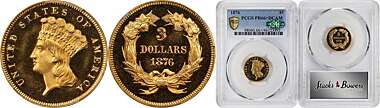
Lote 2128. 1876 Three-Dollar Gold Piece. JD-2. Rarity-6. Proof-66+ Deep Cameo (PCGS). CAC. An awe-inspiring coin with premium technical quality to match its undeniable absolute rarity. The surfaces are expertly preserved with a silky smooth appearance that approaches numismatic perfection. This is also a beautiful coin, as one should expect for the assigned grade, the surfaces bathed in vivid orange-gold color with strong field to device contrast. Sharp strike detail that touches even the most intricate design elements rounds out a truly impressive list of attributes for this phenomenal coin.The Mint produced no circulation strike three-dollar gold coins in 1876, a repeat of 1875, but it did step up Proof production in the later year in anticipation of increased demand associated with the United States Centennial celebration. Officially the Mint struck 45 Proof threes in 1876, 20 coins delivered on February 19 and an additional 25 specimens on June 13. Interestingly, however, two die marriages are known, with different die rotations also known for both varieties. John W. Dannreuther (2018) rightly concludes that this data points to at least four different striking periods, so it is likely that a few additional Proofs of this issue were prepared, either on other dates in 1876 and/or as restrikes sometime after that year.With a higher mintage, it is little wonder than the 1876 three-dollar gold piece is more plentiful in numismatic circles than the 1875, which is also a Proof-only issue, but one with a reported mintage of just 20 coins. As with all classic U.S. Mint Proof gold coins, of course, the 1876 three is a major rarity in an absolute sense. Dannreuther accounts for only 32 to 40 survivors, which total is evenly divided between the JD-1 and JD-2 die pairings. The awesome premium Gem Deep Cameo Proof offered here is an unrivalled and unsurpassed specimen in a PCGS holder, and it is destined for inclusion in an advanced gold cabinet. Property from an Alabama Family. PCGS# 98040. NGC ID: 28AJ. PCGS Population: 1 in all categories; 0 finer.CAC Stickered Population: 2; 0. The former total includes coin certified both Proof-66 Dee Cameo and Proof-66+ Deep Cameo. Famous Proof-Only 1876 Three-Dollar Gold Rarity Unmatched PCGS/CAC Proof-66+ DCAM
  • Precio de salida:
    1 USD
    0 EUR
    0 GBP
    0 CHF

    Importes redondeados, solo aproximadosFecha: 06/11/2026
Lote
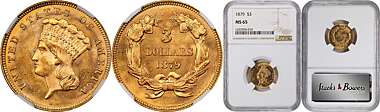
Lote 2129. 1879 Three-Dollar Gold Piece. MS-65 (NGC). A lovely Gem. Vivid golden-rose surfaces exhibit lively frosty to semi-prooflike luster. There are no individually mentionable marks, and few of even a trivial nature. Sharply struck and highly appealing.It soon became evident that, even though the market achieved parity between gold coins and paper currency for the first time since early in the Civil War on December 17, 1878, contemporary Americans had little desire to exchange their bills for three-dollar gold pieces. The year 1879 actually marks the beginning of the end for this commercially unpopular denomination, for after achieving a relatively generous mintage of 82,304 circulation strikes in 1878, production at the Philadelphia Mint plummeted once again in 1879. Only 3,000 coins were delivered for potential commercial use that year, few of which were actually paid out to banks. Several hundred Mint State survivors are known, nonetheless, these likely representing coins that were set aside as numismatic keepsakes or snatched up by dealers and other speculators during the late 19th and early 20th centuries. PCGS# 8001. NGC ID: 25N2. NGC Census: 20; 10 finer (MS-67 finest). Pretty Gem Uncirculated 1879 $3
  • Precio de salida:
    1 USD
    0 EUR
    0 GBP
    0 CHF

    Importes redondeados, solo aproximadosFecha: 06/11/2026
Lote
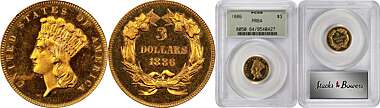
Lote 2130. 1886 Three-Dollar Gold Piece. JD-1. Rarity-4. Proof-64 (PCGS). OGH. This attractive specimen exhibits warm, vivid and even orange-gold color. A cameo finish also greets the viewer from both sides, as do subtle hints of pinkish-silver iridescence, both of which further enhance the visual appeal. There are no singularly mentionable blemishes, and with a full strike and above average eye appeal for the grade, this coin will please many gold enthusiasts.Proof three-dollar gold coinage continued to increase in 1886 with a mintage of 142 coins - the highest for the type up to that year. Upward of 100 examples are believed extant, making this one of the more popular issues in the series for Proof type purposes. From the Property of a Park Avenue Collector. PCGS# 8050. NGC ID: 28AV. PCGS Population: 22; 5 finer in this category (all Proof-65). Premium Choice Proof 1886 $3 Gold Here you can find the Video-Tour.
  • Precio de salida:
    1 USD
    0 EUR
    0 GBP
    0 CHF

    Importes redondeados, solo aproximadosFecha: 06/11/2026
Lote
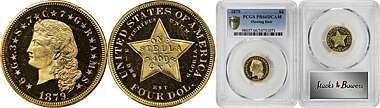
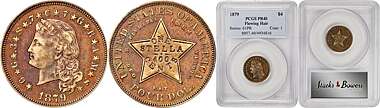
Lote 2131. 1879 Four-Dollar Gold Stella. Flowing Hair. Judd-1635, Pollock-1833, JD-1. Rarity-3. Gold. Reeded Edge. Proof-66 Deep Cameo (PCGS). Obv: The Flowing Hair design by Charles E. Barber. Head of Liberty with flowing hair faces left with the date 1879 below. Liberty is wearing a coronet inscribed LIBERTY, and the inscription * 6 * G * .3 * S * .7 * C * 7 * G * R * A * M * S * encircles the border. Rev: Five-pointed star, or Stella, is inscribed with the denominations ONE STELLA and 400 CENTS. The Latin mottoes E PLURIBUS UNUM and DEO EST GLORIA are above and below the star, respectively. The legend UNITED STATES OF AMERICA is inscribed along the upper border, and another expression of the denomination FOUR DOL. is inscribed along the lower border.This is absolutely one of the finest and most desirable examples of this legendary rarity. Graded Proof-66 Deep Cameo by PCGS, this coin ranks near the very top of the PCGS Population Report in the DCAM category and is one of the best available in today's market. This exceptional grade is quickly confirmed upon reviewing the coin in hand, where pristine surfaces and intense field to device contrast dominate the complexion. Lovely golden-orange color enhances the complexion.The story of the rare and historic four-dollar gold Stellas of 1879 and 1880 begins with the desire in certain government circles to create an international coinage system that would be readily recognized and accepted throughout the world. Although it had surfaced earlier, this idea gained its greatest momentum in 1879 through the efforts of John A. Kasson, the United States' minister plenipotentiary to the Austro-Hungarian Empire and a former chairman of the Congressional Committee on Coinage, Weights and Measures. Kasson urged the federal government to consider creation of a $4 gold coin as the basis for a new international monetary system. Why a $4 gold coin, one might ask, especially considering the widely accepted $5 half eagles and $20 double eagles already in international use? In Kasson's opinion, a $4 gold coin struck in the United States Mint would more closely approximate in value the more widely used and accepted gold coins of several European countries, including Austria's 8 florins, the Dutch 8 florins, France's 20 francs, Italy's 20 lire and Spain's 20 pesetas.Throwing his weight behind Kasson's proposal, serving chairman of the Committee on Coinage, Weights and Measures, Alexander H. Stephens, wrote to Secretary of the Treasury John Sherman requesting that the Mint prepare pattern $4 gold pieces for evaluation by Congress. The Mint eventually prepared two different proposed designs, a flowing hair motif by Charles E. Barber and a coiled hair design by George T. Morgan. The Barber Flowing Hair type was used to prepare only 25 (and possibly as few as 15) examples for distribution to Congressional leaders. Those coins are dated 1879 and, per traditional numismatic wisdom, were struck in a metric alloy of 85.71% gold, 4.29% silver and 10.00% copper.Demand among Congressional and other government officials for examples of the proposed $4 gold Stella proved so great, however, that the Mint eventually prepared perhaps as many as 700 additional specimens in early 1880, still using the 1879-dated Flowing Hair dies. These pieces are struck in standard alloy of 90.00% gold, 10.00% copper on shaved half eagle planchets (per the us.patterns.com website) and, as with their predecessors produced in 1879, were used for presentation and other official purposes as well as for numismatists. Despite its popularity with Congressional leaders and other contemporary politicians, in the end the $4 gold Stella failed to gain authorization for regular issue production and the project ended.Although technically a pattern (as the $4 gold denomination was never authorized for regular issue production), the Stella has long been collected as an integral part of a complete type set of classic United States Mint gold coinage. Its popularity is such that the denomination has been ranked 16th in the 2019 edition of the influential book 100 Greatest U.S. Coins by Jeff Garrett and Ron Guth.All Stellas were struck as Proofs, but because many of the surviving examples were once used as pocket pieces or set into jewelry, they often appear as if they have seen very heavy circulation. Many are damaged with filed rims, scratches, and wear commensurate with long service in necklaces. The present coin is a noteworthy exception. Carefully preserved through the years with not even the barest signs of mishandling, the acquisition of this premium Gem Deep Cameo Proof Stella would be an impressive numismatic achievement for even the most advanced collector. Property from an Alabama Family. PCGS# 98057. NGC ID: 28AZ. PCGS Population: 4; 5 finer in this category (Proof-67 Deep Cameo finest). Superb Deep Cameo Proof 1879 Flowing Hair $4 Stella Ranked #16 Among the 100 Greatest U.S. Coins
  • Precio de salida:
    1 USD
    0 EUR
    0 GBP
    0 CHF

    Importes redondeados, solo aproximadosFecha: 06/11/2026
Lote
Lote 2132. 1879 Four-Dollar Gold Stella. Flowing Hair. Judd-1635, Pollock-1833, JD-1. Rarity-3. Gold. Reeded Edge. Proof-40 (PCGS). Obv: The Flowing Hair design by Charles E. Barber. Head of Liberty with flowing hair faces left with the date 1879 below. Liberty is wearing a coronet inscribed LIBERTY, and the inscription * 6 * G * .3 * S * .7 * C * 7 * G * R * A * M * S * encircles the border. Rev: Five-pointed star, or Stella, is inscribed with the denominations ONE STELLA and 400 CENTS. The Latin mottoes E PLURIBUS UNUM and DEO EST GLORIA are above and below the star, respectively. The legend UNITED STATES OF AMERICA is inscribed along the upper border, and another expression of the denomination FOUR DOL. is inscribed along the lower border. A handsome and desirable example of this iconic rarity among U.S. gold coinage, this is also an intriguing $4 gold Stella due to the PCGS-assigned grade. While we have handled our fair share of mishandled 1879 Flowing Hair Stellas over the years - many coins of this type saw non-numismatic distribution after striking - rarely have we encountered an example with Proof EF details that is wholesome and problem-free, as here. Both sides are deeply and richly toned in copper-rose with hints of underlying pink and blue evident as the surfaces rotate into direct lighting. A faint scratch over and before Liberty's forehead is the only singularly mentionable mark, and it is of no concern during in-hand appreciation. Plenty of bold to sharp strike detail remains, and the eye appeal is exceptional for the grade. All Stellas are trophy coins, and this one would serve nicely in many advanced collections. From the Mack C. Chase Collection. PCGS# 8057. NGC ID: 28AZ. The Barber-Designed Flowing Hair Stella
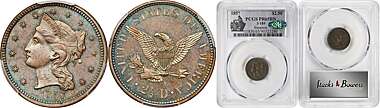
  • Precio de salida:
    1 USD
    0 EUR
    0 GBP
    0 CHF

    Importes redondeados, solo aproximadosFecha: 06/11/2026
Lote
Lote 2133. 1797/5 Capped Bust Right Half Eagle. Heraldic Eagle. BD-7. Rarity-6+. 15-Star Obverse. MS-61 (PCGS). BD Die State a/a. A monumental rarity in the U.S. early gold series offering both numismatic significance and superior quality. The overdate seen on this variety is one of the boldest in the entire realm of American coinage, easily as plain as the 1942/1-D dime, 1918/7-D nickel, 1918/7-S quarter, and other well-known but comparatively common overdates. The 5 underdigit has not been effaced at all, though the flag of the 7 lines up precisely enough with the flag of the 5 to mask it. Well struck with bold definition to all but Liberty's central curls and the junction of the eagle's breast and shield, which areas are quite blunt, reverse with some original planchet roughness retained here. The surfaces are a delight to study with considerable mirror finish in the fields contrasting with an otherwise softly frosted finish. Warm honey-olive gold color overall, blooms of deeper rose-gold patina in the fields add further visual appeal. Free of individually distracting marks with uncommonly pleasing surfaces at the assigned grade level.Three die varieties of 1797 half eagle are known with the Heraldic Eagle reverse, and the BD-7 is the only one that is not unique. The other two known are each unique with both specimens in the National Numismatic Collection in the Smithsonian Institution.Of the 500-1000 coins struck from these dies just 16 to 20 coins survive. David Akers posited that 12 to 15 specimens were known when writing in 1988, while John W. Dannreuther more recently suggested 16 to 20 in 2006. This example numbers among the very finest known, ranked behind only the PCGS MS-62+ Carter-Pogue specimen and numerically tied with the NGC MS-61 Hilt example and the PCGS MS-61 Ferrendelli coin that most recently appeared in our Spring 2019 Baltimore Auction, lot 1141. To date, PCGS records only 11 grading events for this rare issue, with some duplication likely in that total. The 1797/5 $5, BD-7 is one of the most challenging issues for a specialist to obtain, and the present example is one of the most desirable specimens extant. Property from an Alabama Family. Earlier from our (Stack's) sale of the James A. Stack, Sr. Collection, October 1994, lot 1036; Superior's Pittsburgh Elite Coin Auction of August 2004, lot 978; Heritage's Long Beach Signature Auction of June 2019, lot 3210. PCGS# 8077. NGC ID: BFX4. PCGS Population: 2; with a single MS-62+ finer. Incredible Mint State 1797/5 Heraldic Eagle $5 BD-7One of Just 16-20 Known
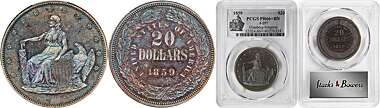
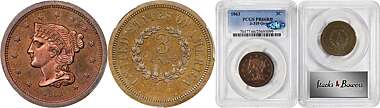
  • Precio de salida:
    1 USD
    0 EUR
    0 GBP
    0 CHF

    Importes redondeados, solo aproximadosFecha: 06/11/2026
Lote
Lote 2134. 1800 Capped Bust Right Half Eagle. BD-2. Rarity-3+. Blunt 1. AU-58+ (PCGS). CAC. CMQ. BD Die State c/e. Just a whisper away from Mint State, this premium quality example will please even the most discerning early gold enthusiasts. It is a near-fully lustrous coin that retains much of the satin to modestly semi-reflective finish. Exceptionally well preserved, we note light olive overtones to dominant medium gold color, the surfaces retaining their original "skin." Boldly to sharply struck and free of troublesome blemishes, only the strongest bids will be competitive when bidding open for this lot.The Blunt 1 variety of the 1800-dated half eagle issue was produced with a single obverse die but four different reverse dies. Mintage figures are not precise for this issue. It is believed that somewhere between 15,000 and 30,000 half eagles were struck bearing the 1800 date. Of these, approximately 7,500 to 12,500 were produced using the BD-2 die pair. Even though the extensive meltings of the 1820s and 1830s thinned out the numbers dramatically, this is one of the more available of the early Capped Bust Right half eagles and is sometimes regarded as a type coin, although by no definition can early U.S. gold coinage be considered common. In fact, no more than 250 examples are thought extant for this variety, and premium About Uncirculated examples such as this enjoy particularly strong demand among knowledgeable collectors.The reverse die state from which this coin was struck is unlisted in the 2006 Bass-Dannreuther reference on U.S. gold coin varieties. Retained cud breaks are evident at the tops of the letters IT in UNITED and MER in AMERICA, with another crack between the words STATES and OF, die rust lumps at the right base of the F in OF and on the upright of the I in AMERICA. From our sale of the Andrew M. Hain Collection, Spring 2022 Auction, April, lot 3129. PCGS# 8082. NGC ID: 25NW. Noteworthy Near-Mint 1800 Half Eagle Here you can find the Video-Tour.
  • Precio de salida:
    1 USD
    0 EUR
    0 GBP
    0 CHF

    Importes redondeados, solo aproximadosFecha: 06/11/2026
Lote
Lote 2135. 1805 Capped Bust Right Half Eagle. BD-2. Rarity-4. Perfect 1, Close Date. EF-40 (PCGS). Gold CAC. CMQ. OGH. BD Die State g/d. Warmly toned in deep honey-gold and mauve, this is a very attractive lightly circulated early half eagle. The strike is well centered with complete denticulation around both sides. Overall detail is suitably bold for this early U.S. Mint design type; Liberty's portrait and much of the eagle's plumage are sharp and most other design elements bold. Softness is confined to the obverse stars, most of which are blunt and lack radial lines, as well as at the eagle's right wing where it meets the shield. Softly frosted with an overall smooth appearance that are enhanced by appreciable remaining luster.This scarce variety has an estimated population of 100 to 150 survivors in all grades (per John W. Dannreuther, 2006). The obverse die was previously used in the 1805 BD-1 pairing, although it shattered in the 1805 BD-2 marriage, the most advanced cracks of which are evident on the present example. The reverse die, however, proved especially hardy and went on to strike the remaining three varieties of the 1805-dated half eagle issue, as well as 1806 BD-1. Although scarce in an absolute sense, as are all early gold coin varieties, 1805 BD-2 is among the more readily obtainable in the Capped Bust Right half eagle series. The present example will be particularly appealing for advanced collectors given its Generation 3.0 PCGS holder and exceedingly rare Gold CAC approval. From the Emerald Coast Collection. PCGS# 8088. NGC ID: 25P4. Gold CAC Stickered Population (all die marriage of the issue): 3 in all grades. Stellar-Quality 1805 Half Eagle One of Only Three Gold CAC Examples
  • Precio de salida:
    1 USD
    0 EUR
    0 GBP
    0 CHF

    Importes redondeados, solo aproximadosFecha: 06/11/2026
Lote
Lote 2136. 1806 Capped Bust Right Half Eagle. BD-1. Rarity-4. Pointed-Top 6, Stars 8x5. AU-55 (PCGS). BD Die State b/e, early. Really a handsome piece, and by far the scarcer of the two Guide Book varieties of the 1806-dated half eagle issue. Nicely preserved surfaces exhibit deep, rich, olive-orange gold color. A concentration of adjustment marks (as made) in the center of the obverse obscures the detail within the center of Liberty's portrait, and also explains the softness seen over and around the eagle's head, within the inside of its wings, and at the top of the shield. Otherwise this is a boldly struck coin by early half eagle standards, the impression nicely centered on both sides and most features sharp. Wispy handling marks include no post-production blemishes worthy of individual mention.As a group, 1806 half eagles of the five Pointed-Top 6, Stars 8x5 die marriages are much scarcer than those of the relatively common Round-Top 6, Stars 7x6 variety (BD-6). BD-1, offered here, is the most frequently encountered variety in the former group, although with fewer than 200 coins extant (perhaps as few as 100 pieces), it is scarce in an absolute sense.The Generation 2.2 PCGS holder uses coin #8089, which is now reserved for the Round-Top 6, Stars 7x6 Guide Book variety of the 1806-dated half eagle issue. PCGS# 8090. NGC ID: 25P7. Scarce 1806 Pointed-Top 6, Stars 8x5 Half Eagle
  • Precio de salida:
    1 USD
    0 EUR
    0 GBP
    0 CHF

    Importes redondeados, solo aproximadosFecha: 06/11/2026
Lote
Lote 2137. 1810 Capped Bust Left Half Eagle. BD-4. Rarity-2. Large Date, Large 5. MS-61 (NGC). CAC. BD Die State a/a. A warmly patinated golden-honey example with a hard frosty texture to both sides. Significant softness concentrates at and around the eagle's talons on the reverse, but otherwise this piece is sharply struck. Both sides exhibit only minor marks to help support the BU grade from NGC, few of which are individually noticeable during in-hand appreciation.Easily identified by the huge round 0 in the date, the reverse of the popular BD-4 Large Date, Large 5 half eagle may also be recognized by the large very round 5 on the reverse that does not touch the border (by comparison, the Tall 5 reverse found on the BD-1 marriage has a much more slender appearance and just barely touches one of the border dentils). Dannreuther estimates that somewhere between 75,000 and 90,000 of the entire mintage of 1810 half eagles are of this variety. Despite the comparatively large mintage for the era, less than 1% are thought to exist today due largely to the mass meltings in the 1820s and 1830s when the intrinsic value of the gold exceeded the face value, making these coins targets for speculators abroad. Fortunately for numismatists, a sizable percentage of these lucky survivors are Mint State examples, making this issue among the most popular of all early gold for high grade type purposes. PCGS# 8108. NGC ID: BFXP. Popular Mint State 1810 Half Eagle Large Date, Large 5
  • Precio de salida:
    1 USD
    0 EUR
    0 GBP
    0 CHF

    Importes redondeados, solo aproximadosFecha: 06/11/2026
Lote
Lote 2138. 1840-O Liberty Head Half Eagle. Winter-2. Narrow Mill, Small O. MS-61 (NGC). A sharply to fully struck half eagle with deep orange-honey gold surfaces. Considerable frosty luster glows from the protected areas and delivers outstanding eye appeal for the assigned grade. Even close inspection with a loupe reveals only small marks, none of which are singularly distracting.An unheralded rarity, as are so many early date Liberty Head half eagles, the 1840-O is easily as rare as its identically dated counterparts from the Charlotte and Dahlonega mints, despite a somewhat higher mintage of 40,120 pieces. Typically found VF to EF, Choice AU coins are rare while Mint State survivors are even more so. This piece is among the finest of only about 250 known, and is worthy of serious pursuit by both half eagle and New Orleans Mint specialists. PCGS# 8200. NGC ID: 25SK. NGC Census: 9; 8 finer (MS-65 finest). The corresponding PCGS Population is 5/6 (MS-63 finest). Condition Rarity 1840-O Half Eagle
  • Precio de salida:
    1 USD
    0 EUR
    0 GBP
    0 CHF

    Importes redondeados, solo aproximadosFecha: 06/11/2026
Lote
Lote 2139. 1852-C Liberty Head Half Eagle. Winter-1. MS-63+ (PCGS). CAC. CMQ. A significant bidding opportunity for advanced Southern gold collectors. This thoroughly PQ 1852-C $5 offers richly original color in a blend of honey-gold and reddish-apricot. Lustrous and frosty with only wispy signs of handling that include no singularly mentionable marks. Winter-1 is the more frequently encountered of the two die pairings known for the issue, although we stress that the 1852-C is as conditionally challenged as one would expect for any pre-Civil War Southern gold issue. Mint State examples, as here, are decidedly rare with Doug Winter (2008) accounting for only 15 to 20 different coins at this level. This important MS-63+ is one of only two certified in this grade by PCGS; the other appeared in our November 2011 Baltimore Auction, lot 9503. Both are certainly among the very finest survivors from a mintage of 72,574 pieces. From Heritage's sale of the Bender Family Collection, January 2023 FUN Signature Auction, lot 3848. PCGS# 8251. NGC ID: 25UB. PCGS Population: 2; 5 finer (all MS-64).CAC Stickered Population: 7; 1. The former total includes coins certified both MS-63 and MS-63+. Impressive Near-Choice Mint State 1852-C Half Eagle
  • Precio de salida:
    1 USD
    0 EUR
    0 GBP
    0 CHF

    Importes redondeados, solo aproximadosFecha: 06/11/2026
Lote
Lote 2140. 1857-O Liberty Head Half Eagle. Winter-1. MS-61 (PCGS). Bright honey-orange gold surfaces are attractive in all regards. Full mint luster remains, and the texture is soft, frosty, and undisturbed by sizeable or otherwise singularly distracting marks. Bold to sharp strike detail further enhances the desirability of this superior quality 1857-O half eagle.This issue is the last in the trio of rare New Orleans Mint fives that commenced with the 1855-O. Although not quite as rare as either the 1855-O or 1856-O, the 1857-O is more challenging to locate in high grades (AU and Mint State). In fact, our online archives going back at least 20 years do not include a Mint State example of this issue. In PCGS MS-61 the offered coin is solidly in the Condition Census for the 1857-O, and is undoubtedly the #3 coin in Doug Winter's list of "Significant Pieces Known" published in the 2025 edition of his Gold Coins of the New Orleans Mint: 1839-1909, in which it is described as "PCGS MS-61: New England Collection, ex Douglas Winter Numismatics." Although PCGS reports three Mint State grading events for this issue in grades from MS-61 to MS-63, astute Liberty Head or Southern gold enthusiasts would be hard pressed to find a nicer survivor that that offered here, and probably not any time in the near future. Ex Doug Winter Numismatics; New England Collection. PCGS# 8274. NGC ID: 25V5. PCGS Population: 1; with a mere two finer (MS-63 finest). Rare and Desirable Mint State 1857-O Half Eagle
  • Precio de salida:
    1 USD
    0 EUR
    0 GBP
    0 CHF

    Importes redondeados, solo aproximadosFecha: 06/11/2026
Lote
Lote 2141. 1861-C Liberty Head Half Eagle. Winter. AU-55 (PCGS). Die State II. Offered is a lovely Choice AU survivor of a rare and historic Southern gold issue. Boldly to sharply struck throughout the design, the more protected elements of Liberty's portrait and the eagle offer impressively full detail. Handsome honey-orange gold color blends with nearly complete luster in a frosty, modestly semi-reflective finish. Most marks are trivial on surfaces that present as pleasingly smooth during in-hand viewing.The Charlotte Mint half eagle series passed into history in 1861 with a mintage of just 6,879 pieces. Of this total, 887 pieces are believed to have been struck in May of that year under the authority of the Confederate States of America. A middle die state example, the present coin was likely struck while the facility remained under Federal control, although there is no way of knowing for sure. The 1861-C is the eighth rarest of 24 dates in the Charlotte Mint half eagle series, there being only 200 or so coins extant in all grades. This PCGS-certified Choice About Uncirculated example is far finer than most and has much to offer advanced Southern gold enthusiasts. PCGS# 8289. NGC ID: 25VL. PCGS Population: 15; 17 finer, just four of which are Mint State (MS-63 finest). Important 1861-C Half Eagle
  • Precio de salida:
    1 USD
    0 EUR
    0 GBP
    0 CHF

    Importes redondeados, solo aproximadosFecha: 06/11/2026
Lote
Lote 2142. 1862 Liberty Head Half Eagle. JD-1. Rarity-6+. Proof-64 Deep Cameo (PCGS). CAC. Significant in both rarity and beauty, this extraordinary Proof half eagle combines outstanding aesthetic quality combined with rarity in a single delightful package. Boasting rich heavily frosted devices surrounded by a sea of deeply reflective mirrored surfaces, all bathed in an even, warm golden-rose color.In the first full year of the Civil War, numerous Union defeats - and extremely costly victories such as Shiloh and Antietam - prompted many to dispense with the idea that the war would be quickly won and accept that it would be a long and difficult slog ahead. This was especially so with the single bloodiest day of the war at Antietam in Maryland, as well as Confederate victories such as those at Second Manassas/Bull Run and Fredericksburg, all locations well under 100 miles from Washington, D.C. This general feeling of pessimism extended into the nation's economy. Gold specie payments by northern banks were suspended on December 30, 1861, and by the early summer of 1862, silver coins, too, disappeared from circulation in the East and Midwest, a situation not fully reversed until over a decade later. Given the overall grim situation facing the Union in 1862, attention was clearly focused on more serious matters than numismatics. Despite all this, the Philadelphia Mint continued to produce Proof coins to sell to collectors, albeit in considerably smaller numbers.On February 16, 1862 the Mint struck and delivered the entire mintage of 35 Proof half eagles from a single pair of dies, markedly reduced from 90 Proofs the year prior. Even with such a tiny production run, sales were no doubt significantly hindered and several coins are thought to have been returned to the melting pot as unsold. Today at best perhaps 10 to 15 examples remain to be appreciated, with at least three of those permanently impounded in institutional collections. The 1862 Proof half eagle appears at auction almost as rarely as the coins themselves, making opportunities such as here truly special indeed. A strong bidding strategy is advisable since it may be quite a while before the next specimen becomes available. PCGS# 98452. NGC ID: 28BX. PCGS Population: 1; 1 finer in this category (Proof-64+ Deep Cameo).CAC Stickered Population: 1; 0. Important Proof 1862 Liberty Half Eagle Fewer than 15 KnownThe Only CAC-Approved Deep Cameo Here you can find the Video-Tour.
  • Precio de salida:
    1 USD
    0 EUR
    0 GBP
    0 CHF

    Importes redondeados, solo aproximadosFecha: 06/11/2026
Lote
Lote 2143. 1864-S Liberty Head Half Eagle. EF-45 (PCGS). CAC. CMQ. Here is a noteworthy rarity from the early San Francisco Mint. Featuring a bold blend of deep honey-rose color and subtle frosty luster, the surfaces are attractively original in preservation. There are no troublesome marks, and the strike is pleasingly bold even with characteristic softness to the top of Liberty's portrait and the bottom of the eagle. Virtually unimprovable in an EF survivor of the issue, and sure to sell for a strong premium to an advanced Liberty Head or Civil War enthusiast.The year 1864 is a magic one within many U.S. coinage series. Not only is it the final full year of conflict in the Civil War, but it also saw the creation of many low mintage issues that now rank among the key dates for their types. The 1864-S half eagle is no exception; the mintage was a paltry 3,888 pieces and survivors number only 30 to 35 coins after the rigors of commercial use took their customary toll. The finest - and only - Mint State survivor is the extraordinary Harry W. Bass, Jr. specimen, now certified MS-65+ by PCGS. The survival of that example is one of the great anomalies of American numismatics. Ranking behind it as CC#2 for the issue is the Fairmont-Hendricks specimen, the only AU-58 certified by PCGS and approved by CAC, which realized $264,000 in our Spring 2022 Auction. Given how few examples CAC has approved throughout the numismatic grading scale, the former JBR specimen offered here is nearly as significant, and is also destined for inclusion in another advanced collection. From our sale of the Fairmont Collection - JBR Set, Summer 2022 Global Showcase Auction, August, lot 3095, where it realized $93,000. PCGS# 8297. NGC ID: 25VV. PCGS Population: 2; 8 finer, including a single MS-65+.CAC Population: 9 in all grades. Landmark 1864-S Half Eagle Rarity
  • Precio de salida:
    1 USD
    0 EUR
    0 GBP
    0 CHF

    Importes redondeados, solo aproximadosFecha: 06/11/2026
Lote
Lote 2144. 1871-CC Liberty Head Half Eagle. EF-45 (PCGS). This is a visually appealing example bathed in a warm blend of golden-honey and rose-orange colors. The surfaces are pleasingly smooth for the assigned grade and reveal ample remnants of frosty mint luster. Bold Choice EF detail throughout.While gold coinage from Carson City in the facility's first year of operation in 1870 was little more than symbolic, production in 1871 was stepped up courtesy of bullion deposits totaling $1,003,810. The first batch of 6,100 half eagles was delivered in January 1871, with the remaining 14,670 pieces delivered in the second half of the year. The use of gold and silver in the West was central to the local economy, especially in the more remote portions of Nevada and neighboring areas. Most of the coins that came off the mint's presses went into immediate use and generally stayed in the region, rather than being exported overseas. Because there were for all intents and purposes no numismatists in the region, survivors exist more by pure happenstance than by intention. The coins saw heavy commercial use and many show the telltale evidence of the rigors of circulation. By the time interest in mintmark collecting began to pick up in the late 1890s and beyond, these coins had already been in use for more than two decades. Carson City Mint expert Rusty Goe (2020) estimates that perhaps only 140 to 180 pieces remain in existence. Unblemished examples of the 1871-CC half eagle are scarce in all grades, which attests to the significance of the present offering for astute Carson City Mint gold collectors. From our Spring 2025 Showcase Auction, April, lot 3149. PCGS# 8323. NGC ID: 25WD. Highly Desirable 1871-CC Half Eagle
  • Precio de salida:
    1 USD
    0 EUR
    0 GBP
    0 CHF

    Importes redondeados, solo aproximadosFecha: 06/11/2026
Lote
Lote 2145. 1876-CC Liberty Head Half Eagle. EF-45 (PCGS). Attractive deep honey-rose surfaces are overall lightly circulated, but retain wisps of frosty luster. Both sides are lightly hairlined and show a touch of glossiness to the texture, although sizeable or otherwise individually mentionable marks are not seen. Softness of strike at the central high points is common for Carson City Mint fives from this era, the overall design suitably bold in the absence of heavy wear.Just 6,887 half eagles were produced at the Carson City Mint in 1876, the lowest output for the denomination at this frontier coinage facility. Widespread use in local commerce claimed most examples, and survivors are scarce to rare in all grades. Estimates for the number of coins extant have varied somewhat in recent decades, with Doug Winter providing a figure of 80 to 90 coins in all grades in the 2001 edition of Gold Coins of the Carson City Mint. Taking a slightly more liberal approach, and based on more modern census data, Rusty Goe provides an estimate of 120 to 140 coins in Volume 2 of his outstanding 2020 reference The Confident Carson City Collector. Both estimates confirm that the 1876-CC is a prime rarity at all levels of preservation and is challenging to locate even in circulated grades. With the vast majority of survivors well worn and in the VF range, even solidly graded, aesthetically pleasing EFs such as this are elusive. PCGS# 8340. NGC ID: 25WX. Low Mintage 1876-CC Half Eagle
  • Precio de salida:
    1 USD
    0 EUR
    0 GBP
    0 CHF

    Importes redondeados, solo aproximadosFecha: 06/11/2026
Lote
Lote 2146. 1900 Liberty Head Half Eagle. JD-1. Rarity-4. Proof-65 Cameo (PCGS). CMQ. This captivating specimen is boldly cameoed in finish with delightful field to device contrast. The former areas are deeply mirrored, while the design elements are softly frosted in texture. Vivid medium gold color and razor sharp strike detail are evident throughout, the surfaces silky smooth in appearance and bordering on pristine.Proof half eagle production jumped dramatically in 1900; the mintage of 230 pieces is the highest for any issue in the Liberty Head series. We suspect that the anticipation of increased collector sales associated with the turn of the century prompted Mint employees to strike more Proof gold coins than usual for the era. If this is true, the anticipated demand failed to materialize for, today, the 1900 is only marginally more available than most other late date Proof half eagles of this type. With only 120 to 150 coins believed extant (per John W. Dannreuther, 2018), much of the mintage was undoubtedly destroyed through melting without ever leaving the Mint. The coin offered here offers superior technical quality and eye appeal and will be just right for inclusion in a high grade Proof gold type or date set. PCGS# 88495. NGC ID: 28D6. PCGS Population: 3; 2 finer in this category (Proof-67 Cameo finest). Awe-Inspiring Gem Cameo Proof 1900 $5 Gold
  • Precio de salida:
    1 USD
    0 EUR
    0 GBP
    0 CHF

    Importes redondeados, solo aproximadosFecha: 06/11/2026
Lote
Lote 2147. 1903 Liberty Head Half Eagle. JD-1. Rarity-4. Proof-64 (PCGS). OGH. The Philadelphia Mint struck 154 Proof half eagles in 1903, one of the more generous totals for the type. However, perhaps only 110 pieces survive from the mintage, and the actual total may be closer to 90 coins. The present specimen is among the more impressive survivors of the issue, with fully Choice surfaces that sport deep, rich, tan-rose and honey-orange color. Fully struck with a lovely all-brilliant finish, this coin's offering represents an important opportunity for the advanced connoisseur of Proof type coins or Liberty Head gold. PCGS# 8498. NGC ID: 28D9. Handsome Choice Proof 1903 Half Eagle
  • Precio de salida:
    1 USD
    0 EUR
    0 GBP
    0 CHF

    Importes redondeados, solo aproximadosFecha: 06/11/2026
Lote
Lote 2148. 1839/8 Liberty Head Eagle. Type of 1838, Large Letters. AU-58 (NGC). This desirable example exhibits subtle olive undertones to dominant bright medium gold color. Traces of prooflike reflectivity are seen in the fields, while the design elements exhibit a more frosty texture. Sharply defined throughout the focal points, only at the obverse stars do we note significant - and expected - softness of strike. The surfaces are lightly hairlined with a touch of glossiness to the texture, but reveal few singularly distracting marks during in-hand viewing.The longest-running $10 gold eagle series produced in the United States Mint, the Liberty Head eagle was struck without interruption from 1838 through early 1907. It is the first eagle produced since 1804, as President Thomas Jefferson halted production of this denomination and the silver dollar that year as rising bullion prices made the coins highly susceptible to exportation and melting. From 1805 through 1837, the largest gold denomination that the United States Mint produced was the $5 half eagle. By 1838, however, two laws had been passed that made it possible for the Mint to resume eagle coinage. The first was the Act of June 28, 1834, which reduced the weight of standard U.S. gold coins and, in so doing, placed the nation's monetary system on a gold standard. The second was the Act of January 18, 1837, a general overhaul of the nation's coinage laws that, among other things, standardized the fineness of gold and silver coins at 900 thousandths.When eagle production finally resumed in 1838, the Mint settled upon the Liberty Head design of Christian Gobrecht, featuring a portrait of Liberty facing left, her hair tied in a bun at the back of her head and wearing a coronet inscribed LIBERTY. Thirteen stars encircle the border, and the date is below the portrait. The initial portrait utilized in 1838 and early 1839 had deeper curvature to the truncation of the bust with Liberty's hair pulled back over her ear. The design was modified slightly in 1839 to create the Liberty Head motif that would remain in use through 1907.The basic reverse design also remained unchanged from 1838 to 1907, featuring an eagle with outstretched wings and a shield on its breast. The eagle clutches a group of three arrows in its left talon and an olive branch in its right talon. The legend UNITED STATES OF AMERICA is around the border and the denomination TEN D. is below the eagle. The reverse was modified in 1866, however, with the addition of the motto IN GOD WE TRUST on a scroll above the eagle. To distinguish them from their No Motto predecessors, the Motto eagles of 1866 to 1907 are known as the Type II Liberty Head design.As above, the first iteration of Christian Gobrecht's new Liberty Head eagle bore a distinctive obverse featuring a sweep of hair completely covering Liberty's ear and a peculiarly deep curve to the bust's truncation. Benjamin West's painting Omnia Vincit Amor ("Love Conquers All") served as Gobrecht's model, even down to the beaded cord and coronet style. The first eagles using this design were struck at the end of 1838, with 7,200 pieces intended for circulation on top of four "specimen" coins presented to Secretary of the Treasury Levi Woodbury. In 1839, the same obverse design was employed for the first 2,801 eagles struck bearing that date before the design was modified.With such a limited mintage, it is little wonder that the 1839 Type of 1838 eagle is a very scarce coin in all grades. Just under 250 examples are known, the vast majority of which are well circulated. While just a hair more available than the first year of issue, there is quite a bit of competition between type collectors and classic period gold specialists when an example appears for sale, regardless of condition. As a visually pleasing AU-58 certified by NGC, this is a numismatically desirable specimen that will attract significant attention from advanced numismatists. PCGS# 8576. NGC ID: 262E. Highly Desirable 1839/8 Eagle
  • Precio de salida:
    1 USD
    0 EUR
    0 GBP
    0 CHF

    Importes redondeados, solo aproximadosFecha: 06/11/2026
Lote
Lote 2149. 1859-O Liberty Head Eagle. Winter-1. AU-55 (NGC). This evenly colored, orange-olive gold example ranks high in the census of certified 1859-O eagles. Striking quality is typical of the issue, the overall detail sharp but with appreciable softness at the obverse stars, the centrils for which are mostly absent. The eagle's plumage on the reverse is crisp where allowed by grade, even over the right leg and talon, and the denticulation is bold to sharp around both sides. Remnants of frosty mint luster flash into view as the surfaces rotate under a light. It is an aesthetically pleasing survivor of this challenging key date issue, and we anticipate keen interest from advanced Southern gold specialists.The rarest New Orleans Mint eagle of the No Motto design type, the 1859-O has a paltry mintage of 2,300 pieces. Fewer than 100 coins are believed extant in all grades, estimates of 60 to 70 pieces from Doug Winter (2025) and 50 to 75 examples from PCGS CoinFacts squaring nicely. The typical survivor of this heavily circulated issue is well worn, usually VF or EF, and many are also impaired due to harsh cleaning or surface damage. In straight-graded Choice AU, as here, the 1859-O is very rare, and such pieces are among the finest obtainable in today's market. Prior to the salvage of the SS Republic treasure the 1859-O was unknown in Mint State, although that shipwreck yielded a single Uncirculated coin that has since been certified MS-62 by NGC. PCGS# 8629. NGC ID: 2642. NGC Census: 6; 3 finer, just one of which is Mint State (MS-62). The corresponding PCGS Population is 8/2 (AU-58 finest at this service). Key Date 1859-O Eagle Rarest No Motto Issue from the New Orleans Mint
  • Precio de salida:
    1 USD
    0 EUR
    0 GBP
    0 CHF

    Importes redondeados, solo aproximadosFecha: 06/11/2026
Lote
Lote 2150. 1864-S Liberty Head Eagle. EF-45 (PCGS). This handsome 1864-S eagle is pleasingly toned in warm honey-rose gold. Traces of frosty luster remain and the strike detail is bold aside from softness confined to the obverse stars and the eagle's neck on the reverse. Wispy handling marks are typical for a circulated San Francisco Mint gold coin from the mid-19th century, and none are sizeable enough to warrant individual attention or undue concern.In a series replete with rarities, the 1864-S stands out as one of the most elusive, and also one of the most underrated, Liberty Head eagles. After only the fabled 1875, this is the rarest circulation strike issue of the type. The San Francisco Mint struck only 2,500 eagles in 1864, at a time when gold coins circulated extensively on the West Coast. This is in sharp contrast to the situation in the East and Midwest, where gold coins had been withdrawn from circulation in late 1861 and continued to be hoarded throughout the Civil War and much of the Reconstruction eras. With no numismatic activity on the West Coast at the time, and no interest in mintmarked United States coinage in general, it is little wonder that not a single Mint State 1864-S has survived to the present day. Even the single example in the National Numismatic Collection at the Smithsonian Institution is a Choice EF. Among those examples in private hands - only 25 to 30 coins - at least half grade no finer than Choice VF. The offered coin, therefore, is both an absolute and condition rarity. Its offering in this sale is a significant one for advanced collectors of Liberty Head gold and/or early date San Francisco Mint coinage. Ex Numismatic Gallery's Adolphe Menjou Catalogue, June 1950, lot 1675; John Jay Pittman; David W. Akers' sale of the John Jay Pittman Collection, Part II, May 1998, lot 1945. PCGS# 8640. NGC ID: 264E. PCGS Population: 5; 9 finer (AU-55+ finest). There are also no Mint State examples listed at NGC or CACG. Exceedingly Rare 1864-S Eagle The Pittman Coin
  • Precio de salida:
    1 USD
    0 EUR
    0 GBP
    0 CHF

    Importes redondeados, solo aproximadosFecha: 06/11/2026
Lote
Lote 2151. 1872 Liberty Head Eagle. JD-1. Rarity-7-. Proof-61 (NGC). Our first offering for a Proof Liberty Head eagle of this date since 2011, and an attractive coin for the assigned grade. Both sides are drenched in richly original color with honey-olive undertones supporting more vivid orange-rose. Scattered marks, wispy hairlines and some associated haziness to the appearance explain the numeric grade assigned by NGC, but the Proof qualities are readily evident as the coin rotates under lighting. These include appreciable mirrored qualities in the fields and fully struck, softly frosted design elements. There are no sizeable or otherwise singularly distracting blemishes.The extreme rarity of this issue is a well-established fact among numismatic scholars. The Proof 1872 eagle entered the annals of numismatic history with a mintage of just 30 coins. A small number of these coins were probably melted in the Mint as unsold, while additional examples undoubtedly found their way into circulation when contemporary collectors either lost the desire or the means to retain the coins as numismatic keepsakes. John W. Dannreuther (2018) suspects that only 10 to 12 specimens have survived into the 21st century, a number that includes three examples impounded in the collections of the Smithsonian Institution and the American Numismatic Society. The number of coins available for private ownership, therefore, is probably not greater than 10 pieces. And to the already impressive rarity of this Proof issue must be added the low mintage, key date status of the circulation strike 1872 eagle - a Philadelphia Mint issue with a mere 1,620 pieces produced and a poor rate of survival in all grades. PCGS# 8812. NGC ID: 28FA. Rare 1872 Proof Liberty Eagle
  • Precio de salida:
    1 USD
    0 EUR
    0 GBP
    0 CHF

    Importes redondeados, solo aproximadosFecha: 06/11/2026
Lote
Lote 2152. 1875-CC Liberty Head Eagle. EF-45 (PCGS). CAC. CMQ. Captivating honey-gold surfaces feature light toning in pretty pinkish-rose. Lustrous for the grade and pleasing overall, with bold detail to all but a few central high points.After a record (for that era) mintage of 16,767 pieces in 1874, the Carson City Mint delivered just 7,715 eagles in 1875, a number more in keeping with annual output from this branch mint throughout the 1870s. With domestic circulation in the western United States claiming most examples, the 1875-CC is now scarce to rare in all grades. Rusty Goe (2020) accounts for just 100 to 135 survivors, in fact, only one or two of which are Mint State. With examples at that level understandably out of reach for most collectors, this premium Choice EF - rare in its own right - is a highly significant find that will certainly appeal to advanced Liberty Head gold collectors and Carson City Mint specialists. From our sale of the Fairmont Collection - Albertine Set, June 2024 Auction, lot 4143. PCGS# 8673. NGC ID: 265B. CAC Stickered Population: 2; 6. Low Mintage 1875-CC Ten-Dollar Gold
  • Precio de salida:
    1 USD
    0 EUR
    0 GBP
    0 CHF

    Importes redondeados, solo aproximadosFecha: 06/11/2026
Lote
Lote 2153. 1875-CC Liberty Head Eagle. EF-40 (PCGS). Suitably bold in a lightly circulated survivor of this challenging issue, both sides exhibit soft olive undertones to dominant honey-gold color. Scattered handling marks are offset by traces of frosty luster, the latter most pronounced when the coin is admired with the aid of direct lighting. As with all early date Carson City Mint eagles the 1875-CC (just 7,715 pieces produced) is scarce to rare at all levels of preservation. This is an esthetically pleasing survivor at the certified EF level that is worthy of serious bidder consideration. PCGS# 8673. NGC ID: 265B. A Second Key Date 1875-CC Eagle
  • Precio de salida:
    1 USD
    0 EUR
    0 GBP
    0 CHF

    Importes redondeados, solo aproximadosFecha: 06/11/2026
Lote
Lote 2154. 1876-CC Liberty Head Eagle. AU-58 (NGC). Offered is a handsome and vividly toned example of this popular Centennial year Carson City Mint issue. A blend of deep honey and reddish-orange colors on both sides supports ample remnants of the original frosty finish. A bit lightly struck toward the top of Liberty's portrait and the bottom of the eagle, the overall appearance is still appreciably bold, especially for an issue that is typically offered in much lower grades.All three coinage facilities that produced eagles in 1876 turned out very small quantities of this denomination. The Specie Payment Resumption Act of January 14, 1875, ensured a focus on subsidiary silver coin production the following year in anticipation of the impending return of such pieces to widespread domestic circulation. Double eagle coinage was also a priority for the United States Mint in 1876, as the nation struggled to increase its gold reserves in competition with Germany and other European nations that had adopted the gold standard early in the 1870s. All of this activity came at the expense of the lower gold denominations as converting a given amount of bullion to double eagles was most efficient. Indeed, the mintage for the 1876-CC ten amounted to just 4,696 pieces, only 130 to 160 examples of which have survived in all grades (per Rusty Goe, 2020). With premium quality AUs exceedingly rare in today's market and Mint State coins unknown, the present offering is sure to be of keen interest to advanced collectors. Ex Julian Leidman, November 21, 1969; Harry W. Bass, Jr.; our (Bowers and Merena's) sale of the Harry W. Bass, Jr. Collection, Part III, May 2000, lot 688, as PCGS AU-55. PCGS# 8675. NGC ID: 265D. NGC Census: 3; 0 finer. The corresponding PCGS Population is also 3/0. Handsome 1876-CC Eagle Ex Bass, and Among the Finest Certified
  • Precio de salida:
    1 USD
    0 EUR
    0 GBP
    0 CHF

    Importes redondeados, solo aproximadosFecha: 06/11/2026
Lote
Lote 2155. 1877 Liberty Head Eagle. AU Details--Cleaned (NGC). Deep honey-orange gold in color with much prooflike reflectivity, particularly in the recessed design areas. Sharply struck. A few scattered marks are noted, as are some light hairlines and overlying haziness, though the in-hand appearance is very pleasing, especially relative to the assigned grade.The ten-dollar gold mintage figure was 797 coins at the Philadelphia Mint in 1877, this being the last in a run of three consecutive dates with fewer than 1,000 circulation strikes delivered. Only 50 to 65 survivors in all grades are estimated by the experts at PCGS CoinFacts. The offering of this significant rarity represents an important bidding opportunity for advanced students of Liberty Head gold coinage. PCGS# 8677. NGC ID: 265F. Key Date Circulation Strike 1877 Eagle Mintage: Just 797 Coins
  • Precio de salida:
    1 USD
    0 EUR
    0 GBP
    0 CHF

    Importes redondeados, solo aproximadosFecha: 06/11/2026
Lote
Lote 2156. 1879 Liberty Head Eagle. JD-1. Rarity-6. Proof-55 (NGC). The rarity of the Proof 1879 eagle is similar to that of the Proof 1872, an example of which issue is also being offered in this sale. Both were produced to the extent of just 30 coins, and while the Proof 1879 is rated slightly lower as Rarity-6 (as opposed to Rarity-7- for the Proof 1872) it is only marginally less available with a mere 12 to 14 coins believed extant (per John W. Dannreuther, 2018). With one example each in the collections of the Smithsonian Institution and American Numismatic Society, any opportunity to acquire a Proof 1879 eagle for private ownership is a significant and fleeting one. This one is almost certainly a coin that was released into circulation by an early owner, for it displays moderately marked surfaces, friction in the fields, and light rub to the high points. Still boldly to sharply defined overall, nonetheless, with hints of reflectivity peering from the protected areas as the coin rotates into direct lighting. Warm, attractive honey-gold color with enhancing blushes of pinkish-apricot and powder blue iridescence. PCGS# 8819. NGC ID: 28FH. Seldom-Offered Proof 1879 Eagle
  • Precio de salida:
    1 USD
    0 EUR
    0 GBP
    0 CHF

    Importes redondeados, solo aproximadosFecha: 06/11/2026
Lote
Lote 2157. 1905 Liberty Head Eagle. JD-1. Rarity-5. Proof-65 Cameo (PCGS). CAC. Sparking and bright with no signs of toning, copper specks, or other blemishes that might inhibit either the technical quality or eye appeal. The light frost on Liberty's portrait and the eagle are undisturbed and offer appreciable contrast with equally delicate mirrored reflectivity in the fields. The Proof $10 gold eagle mintage for the year 1905 came to 86 pieces in all. Survivors number only 40 to 55 coins (per John W. Dannreuther, 2018) and, given this issue's positioning late in the Liberty Head series, few of these possess enough field to device contrast to support a CAM designation from the major third-party grading services. Here, then, is a dazzling strike and condition rarity eagerly awaiting inclusion in another advanced numismatic cabinet. Property from an Alabama Family. PCGS# 88845. NGC ID: 28GC. PCGS Population: 3; 2 finer in this category (Proof-66+ Cameo finest). There are no grading events listed n the PCGS DCAM category.CAC Stickered Population: 3; 2. Dazzling Gem Cameo Proof 1905 $10 Rarity
  • Precio de salida:
    1 USD
    0 EUR
    0 GBP
    0 CHF

    Importes redondeados, solo aproximadosFecha: 06/11/2026
Lote
Lote 2158. 1906-O Liberty Head Eagle. Winter-1. MS-65 (PCGS). Luxurious deep golden-honey color and bountiful mint luster are seen on both sides of this sharply struck, carefully preserved example. Direct lighting also reveals subtle pinkish-rose highlights - very attractive.The 1906-O is the final New Orleans Mint eagle, and the penultimate gold issue from this Southern coinage facility (the final is the 1909-O Indian half eagle). It is among the scarcer New Orleans Mint tens of the Motto design type, although locating an example in the MS-60 to MS-62 grade range should prove fairly easy under normal market conditions. As a solidly graded Gem Uncirculated survivor, the offered coin is very rare from a condition standpoint and would make an impressive addition to an advanced gold cabinet. PCGS# 8761. NGC ID: 2686. PCGS Population: 4; 5 finer (MS-66 finest). Condition Rarity Gem Uncirculated 1906-O $10
  • Precio de salida:
    1 USD
    0 EUR
    0 GBP
    0 CHF

    Importes redondeados, solo aproximadosFecha: 06/11/2026
Lote
Lote 2159. 1907 Liberty Head Eagle. JD-1. Rarity-5. Proof-64 (NGC). CAC. Offered is a noteworthy Choice specimen from the final year of the rare and challenging Proof Liberty Head eagle series. Both sides display deep, vivid, golden-orange color and are fully struck with razor sharp detail to even the most intricate design elements. The finish is brilliant in the fields, although the design elements exhibit a subtle frosty texture that provides a hint of cameo contrast as the surfaces rotate under lighting. It is a highly appealing coin that would do justice to the finest Proof gold type or date set.The long-lived Liberty Head eagle series passed into history in 1907 with circulation strikes produced at the Philadelphia, Denver and San Francisco mints. The first-named facility also struck 74 Proofs, most of which have survived. The 1907 is one of the more available issues in the Proof Liberty eagle series, and its final-year status makes it a favorite among specimen gold type collectors. In an absolute sense, of course, all Proof Liberty Head eagles are rare, and numismatic expert John W. Dannreuther (2018) accounts for just 45 to 55 survivors of the 1907 in all grades. This is a condition rarity Choice specimen with CAC approval that would grace any cabinet with its presence. From the Property of a Park Avenue Collector. PCGS# 8847. NGC ID: 28GE. CAC Stickered Population: 3; 8. Delightful Choice Proof 1907 Liberty Head Eagle
  • Precio de salida:
    1 USD
    0 EUR
    0 GBP
    0 CHF

    Importes redondeados, solo aproximadosFecha: 06/11/2026
Lote
Lote 2160. 1907 Indian Eagle. Wire Rim, Periods. Judd-1901, Pollock-1995. Rarity-3. Raised Stars on Edge. MS-65+ (PCGS). Exceptional Gem quality for this classic rarity in the 20th century gold series. Delightful honey-orange and rose-gold surfaces are satiny in finish with a virtually pristine appearance. The strike is full with crisp detail throughout the design. This is easily one of the most beautiful examples of this historic Indian eagle design type that we have ever had the privilege of bringing to auction.The Saint-Gaudens gold eagle is widely considered one of the high water marks of American numismatic design. President Theodore Roosevelt was a fierce critic of the then-current coin designs and in order to improve them he conspired with Cornish, New Hampshire artist Augustus Saint-Gaudens to redesign the entire series of coins. Saint-Gaudens produced several designs including an obverse he originally intended for the cent. When Roosevelt saw this design, he recommended - ordered, really - that the left facing bust of Liberty should wear a war bonnet instead of a laurel wreath. Saint-Gaudens made the change in February 1907, but thought it should be used for the double eagle rather than the cent. Again Roosevelt objected as he preferred a representation of Liberty walking forward for the largest denomination. Instead the bust of Liberty wearing a feathered headdress would go onto the eagle. The reverse design for the eagle was a modified version of the "defiant eagle" Saint-Gaudens had used on Roosevelt's inaugural medal of 1905.Plaster models were prepared in Saint-Gaudens' studios in Cornish and were sent to Philadelphia on June 1 to be converted into working dies. They encountered immediate opposition from Chief Engraver Charles Barber (no fan of non-Mint personnel designing coins), who felt there were design deficiencies, especially the high relief nature of the design and the lack of a proper coin rim. He was focused more on mass production than coin aesthetics and felt "the models now sent are not coin relief," as he told Mint Superintendent John Landis on June 7. By now, Saint-Gaudens was seriously ill with cancer and did not travel. Instead he worked with the Mint through his assistant, Henry Hering. Hering reworked the models to reduce the relief somewhat and change the date from Roman numerals. The new models were provided to the Mint on June 24 and dies were prepared. By July 19, the dies were ready to strike experimental versions of the new design.The first coins struck were in high relief despite Barber's requirements to the contrary, with the portrait of Liberty set within a concave field similar to how a medal might look. The features were also more sculptural with a distinctive soft texture. In addition, because of the high relief, the coins required several strikes to bring up the design. As a result, a "fin" or "slight burr" on the edge caused the coin to not rest flat, especially since the eagle tended to rise up above the border. Now gravely ill, Saint-Gaudens continued to work through the design difficulties along with his staff. Roosevelt realized that the dream of a very high relief eagle was not feasible, and on July 29 he relented and directed the Mint to work on a lower relief version for mass production. Furthermore, in the same letter advised that:As for the high relief coins, have several hundred struck and allow the collectors of the country to obtain specimens as you suggested, none to be issued until the new issue is out. They should be preserved as the work of a great American artist.Saint-Gaudens never saw his creation as a coin; he died of cancer on August 3 before any could be struck. Barber prepared a version while the Saint-Gaudens studio prepared their own revisions, coordinating with the artist's widow, Augusta. Barber's Rounded Rim version began production on September 13 with the intention of going into circulation. Ultimately neither Saint-Gaudens' original Wire Rim concept nor Barber's Rounded Rim version ended up as a circulating coin. The revision from the Saint-Gaudens studio in lower relief and with no triangular periods was adopted and was struck until 1933. In the meantime, to comply with Roosevelt's July 29 order for several hundred Wire Rim coins, an initial production run of 500 coins took place in late August on the high-pressure medal press, followed by a delivery of 42 coins struck between September and December of that year. The Treasury Department in Washington, D.C. took delivery of the Wire Rim coins and distributed them to government officials, as well as to some of the biggest coin dealers of the day. Seventy examples remained unsold and were sent back to the Mint in 1915 to be melted down, leaving a final net production of 472 pieces.The present specimen is among the finer certified for this iconic issue, the one that most closely represents Saint-Gaudens' and Roosevelt's vision for the $10 gold coin. It is a numismatic treasure set for inclusion in another advanced cabinet. PCGS# 8850. NGC ID: 268B. PCGS Population: 10; 32 finer (MS-67+ finest). Breathtaking 1907 Wire Rim Eagle The Original Concept for the Saint-Gaudens Design
  • Precio de salida:
    1 USD
    0 EUR
    0 GBP
    0 CHF

    Importes redondeados, solo aproximadosFecha: 06/11/2026
Lote
Lote 2161. 1908-D Indian Eagle. No Motto. MS-64 (PCGS). This is a lovely near-Gem 1908-D No Motto eagle. Both sides are fully lustrous and display delightful vivid rose-apricot color enhanced by blushes of powder blue. The strike is suitably bold for the issue, with the reverse sharply defined throughout and the obverse with a touch of characteristic softness to the central high points. With its satiny mint finish and strong eye appeal, this coin is sure to find its way into a high quality collection of 20th century United States gold.As the first Denver Mint Indian eagle, the 1908-D is also the only No Motto issue from this branch mint and the only Indian eagle with the mintmark positioned above the end of the olive branch on the reverse. The mintmark on all other Denver and San Francisco coins is below the end of the olive branch in front of the arrow heads. A mintage of 210,000 pieces is relatively generous by Indian eagle standards, but the 1908-D No Motto is actually one of the rarest issues in this series in finer Mint State grades. Most Mint State survivors grade MS-60 to MS-63, at which levels this issue is fairly scarce. In attractive MS-64 the present example is rare. We anticipate strong competition for this impressive coin when it crosses our auctioneer's block. PCGS# 8854. NGC ID: 28GH. Condition Rarity 1908-D No Motto Eagle
  • Precio de salida:
    1 USD
    0 EUR
    0 GBP
    0 CHF

    Importes redondeados, solo aproximadosFecha: 06/11/2026
Lote
Lote 2162. 1909 Indian Eagle. JD-1. Rarity-5. Satin. Proof-65 (PCGS). CAC. An impressive example of this classic 20th century Proof gold rarity. Fully impressed devices exhibit razor sharp definition that extends to even the most intricate design elements. A lively satin finish mingles with soft, yet vivid honey-orange gold color to provide outstanding visual appeal. Nicely preserved, and more carefully so than many examples of this challenging issue, this coin will please the most discerning gold enthusiast.Commencing in 1908 with a mintage of 116 pieces, the regular issue Proof Indian eagle series at first featured a dark sandblast finish that had earlier been adopted by several European mints for special coins and medals. The United States Mint had used this finish during the late 19th century in the production of certain medals. The new gold coin designs introduced in 1907 and 1908 for the quarter eagle, half eagle, eagle and double eagle did not lend themselves to the die preparation required to produce Cameo and Brilliant Proofs as had been produced for the Liberty Head series. In the words of Acting Superintendent of the Philadelphia Mint Albert Norris from November 1908:The designs of the new gold coins are such that the dies cannot be polished, therefore we could not make proofs...with a polished surface, so the Engraver has finished these proofs similar to medals with a dull finish.Specifically, the extreme curvature of these dies and the texture of the fields prevented the necessary polishing to produce cameo and brilliant finish Proofs. Unfortunately, the contemporary public neither understood the situation facing the Mint nor were they willing to accept an alternative. Contemporary sales of 1908-dated Proof gold coins proved disappointing, the coins themselves were criticized for their "dull" appearance, and the Mint had to seek an alternative method of manufacture to garner public acceptance.The solution chosen by the Mint was the satin finish evident on the coin presented here. In reality, the method of manufacture is surprisingly similar for these Satin Proofs and their Sandblast predecessors. Both were struck from new dies in the Mint's medal press, but whereas the satin pieces were left as is, the other pieces were sandblasted after striking. As much as it is appreciated today, the satin finish used on regular issue Proof 1909 and 1910 Indian eagles proved just as unpopular with the contemporary public as its predecessor. While much brighter and more vibrant, the Satin Proofs too closely resembled circulation strike coins. In use for just two years, the satin finish in turn yielded to variations of the sandblast process that would continue until the Mint ceased striking Proof gold coins after 1915.The unpopularity of the Satin Proof 1909 Indian eagle with contemporary collectors can be seen in the number of coins extant. The mintage is just 74 pieces. While we have seen some estimates for the number of coins extant as low as 30 to 35 pieces (Indian Gold Coins of the 20th Century, 2010, by Mike Fuljenz), we place greater stock in the more liberal estimate of 55 to 65 coins provided by John W. Dannreuther in his 2018 reference United States Proof Coins. This is still a limited number in an absolute sense, of course, and often years can pass between our offerings of individual specimens. An important rarity in an absolute sense, this Gem deserves equal recognition as a condition rarity. The delicate surfaces of these Satin Proofs were easily marred. The present specimen is a lovely example of coinage art from the early 20th century United States Mint that belongs in an advanced cabinet. Property from an Alabama Family. PCGS# 8891. NGC ID: 28HF. PCGS Population: 9; 5 finer (Proof-68 finest).CAC Stickered Population: 4; 2. Pretty Gem Satin Proof 1909 Eagle
  • Precio de salida:
    1 USD
    0 EUR
    0 GBP
    0 CHF

    Importes redondeados, solo aproximadosFecha: 06/11/2026
Lote
Lote 2163. 1912 Indian Eagle. JD-1. Rarity-5. Proof-64 (NGC). This is the only Proof 1912 Indian eagle that have brought to auction since 2014, a testament to the elusiveness of specimens in numismatic hands and the infrequency with which they are released from tightly held collections. Delectable honey-orange and rose-gold colors blend seamlessly over both sides and deliver strong eye appeal. The coarse-grain sandblast finish for which this issue is known is fully appreciable at all angles, the individual sparkling facets of which it is comprised best appreciated with the aid of magnification. Fully struck, as befits the method of manufacture, with only a few tiny obverse handling marks preluding an even higher numeric grade. A lovely Proof Indian eagle irrespective of date that will please an advanced collector.The year 1912 was filled with rich history. The European countries were pressing into areas of extreme tensions and the first World War would soon erupt in 1914, a conflict that lasted four long years. On the more peaceful side of things, a great ship was launched on April 10, 1912, the RMS Titanic, but whose brief career ended in tragedy when it struck a massive iceberg on its maiden voyage from England to New York and sank on April 15 that year. This event still effects the safety of ocean voyages and the many maritime laws that govern the safety of passengers. There was great loss of life as there we not enough life boats to hold the passengers and crew of the fast sinking ship, and many perished in the icy waters that night. Meanwhile, many new inventions began to appear and take hold with new ideas on how to do things. The automobile started to become more mainstream, airplanes began to be more commonly seen in the skies, and new farming equipment mechanized many jobs that had been drudgery, while also greatly increasing crop yields.At the United States Mint in Philadelphia, 144 examples of the coiner's art were produced in the form of the Proof 1912 Indian eagle, only 83 of which were reported sold; the remainder were presumably melted in the Mint. With 60 to 70 specimens believed extant, this is an understandably rare issue in today's market. It is also a historic one, as are all classic U.S. Mint coins, as holding this majestic Sandblast Proof will elicit many thoughts and events of the era from which it came, and all the generations that it has since witnessed. From our November 2025 Showcase Auction, lot 3156. PCGS# 8894. NGC ID: 26YD. Seldom-Offered Proof 1912 Indian Eagle
  • Precio de salida:
    1 USD
    0 EUR
    0 GBP
    0 CHF

    Importes redondeados, solo aproximadosFecha: 06/11/2026
Lote
Lote 2164. 1914 Indian Eagle. JD-1. Rarity-5+. Proof-67 (NGC). This sale represents only our fourth offering for this rare and conditionally challenged 20th century Proof gold issue since 2013, two of which represent this same coin. It is an awe-inspiring Superb Gem that boasts beautiful golden-honey color on fully impressed surfaces. The appearance is a bit lighter than typically seen in examples of this Proof Indian eagle issue, yet no less attractive. The characteristic coarse grain sandblast finish is readily evident, but not even close inspection with a loupe reveals a detracting contact mark, "shiny spot," or other blemish. A virtually pristine Superb Gem that belongs in the finest cabinet of classic Proof gold coinage.This is a prized rarity, as the mintage in Proof for the year fell to the lowest number of this series - a total of just 50 pieces were struck. Most of these survived to today, but of the 35 to 40 believed extant (per John W. Dannreuther, 2018), only a few can offer the Superb Gem grade level of the present condition rarity. From our sale of the Hough Family Collection, November 2025 Showcase Auction, lot 3158. PCGS# 8896. NGC ID: 26YE. NGC Census: 9; with a single Proof-68 finer. The corresponding PCGS Population is 1/0. Superb Gem Proof 1914 Indian Eagle Rarity
  • Precio de salida:
    1 USD
    0 EUR
    0 GBP
    0 CHF

    Importes redondeados, solo aproximadosFecha: 06/11/2026
Lote
Lote 2165. 1857-O Liberty Head Double Eagle. Winter-1. EF-45 (PCGS). CAC. CMQ. OGH. This is an exceptionally attractive, very scarce Choice EF example of an issue that is elusive even in lower circulated grades. Beautiful original color blankets both sides. Ample evidence of a prooflike finish can be seen, reflectivity most pronounced in the protected areas around the devices. Although most survivors of this issue are softly struck, this piece is well produced by early New Orleans Mint standards. Overall detail is bold, and the O mintmark is fully appreciable, if a tad faint. A premium quality coin for both the issue and the assigned grade that stands tall among the classic U.S. Mint gold coinage offered in this sale.The 1857-O and 1858-O are anomalies among New Orleans Mint double eagles from the late 1850s, being the only two issues from that era with mintages in excess of 10,000 coins. For the 1857-O, government records provide a figure of 30,000 pieces struck. This is still a paltry total in an absolute sense, of course, the New Orleans Mint receiving very little gold bullion from California after the San Francisco Mint commenced coinage operations in 1854. Additionally, the Louisiana facility was closed in the early part of 1857 due to repair work to the building.The 1857-O is in the fourth rarity tier among New Orleans Mint double eagles, ranking alongside the 1858-O. Examples are elusive in all grades, Douglas Winter (Gold Coins of the New Orleans Mint: 1839-1909, 2025) providing for just 250 to 300 coins extant. Q. David Bowers takes a stricter approach with an estimate of 90 to 150 survivors in his Guide Book of Double Eagle Gold Coins, although that reference was published earlier (2004). Both authors are in agreement that fewer than 10 Mint State coins are extant. This is one of our very few offerings at the CAC-approved Choice EF in recent decades. Interested parties are urged to pursue this coin with vigor for, once it finds its way into an advanced double eagle collection, it may be many years before an example of comparable rarity and quality appears on the market. From the Mack C. Chase Collection. PCGS# 8921. NGC ID: 2694. CAC Stickered Population: 29 in all grades. Original Choice EF 1857-O Double Eagle A Noteworthy Condition Rarity
  • Precio de salida:
    1 USD
    0 EUR
    0 GBP
    0 CHF

    Importes redondeados, solo aproximadosFecha: 06/11/2026
Lote
Lote 2166. 1857-S Liberty Head Double Eagle. Variety-20B. Bold S. MS-66 (PCGS). With One Pinch of California Gold Dust. SS Central America Label. This is an exceptional example of the popular 1857-S Liberty Head double eagle. The finish is frosty with faint traces of semi-reflectivity in the fields, providing a slight contrast with the design elements. Fully struck and displaying rich, vivid color on each side. A simply gorgeous example of this historic issue that will certainly elicit strong bids from a wide variety of collectors. This coin is housed in a special large size PCGS holder that also includes one pinch of California gold dust. The back of the PCGS insert features the signature of Bob Evans, chief scientist and historian of the SS Central America treasure. Under Evans' signature is the note: "I certify this coin and gold dust were recovered from the S.S. Central America." Ex SS Central America. PCGS# 670715. BASE PCGS# 8922. NGC ID: 2696. PCGS Population (PCGS coin #670715 only): 3; with a single MS-66+ finer. Premium Gem Uncirculated 1857-S Double Eagle Ex SSCA, With Pinch of Gold Dust
  • Precio de salida:
    1 USD
    0 EUR
    0 GBP
    0 CHF

    Importes redondeados, solo aproximadosFecha: 06/11/2026
Lote
Lote 2167. 1861-S Liberty Head Double Eagle. A.C. Paquet Reverse. AU-53 (PCGS). A noteworthy offering for this fabled rarity, this 1861-S Paquet Reverse double eagle stands tall among the gold highlights in our current sale. Awash in rich honey-color, the surfaces also sport an extensive intermingling of deep olive patina. Remnants of a frosty mint finish flash into view as the coin rotates under a light. There is some glossiness to the texture, as well as faint hairlines and scattered marks, but a thin gaze in the obverse field off Liberty's nose is the only singularly mentionable blemish. Boldly defined through the centers.Believed to be the son of bronze-worker Toussaint Francois Paquet, Anthony C. Paquet was born in Hamburg, Germany on December 5, 1814, and arrived in Philadelphia in 1848. At some point in the mid-1850s, Paquet opened an engraving business in New York, during which time he is believed to have struck several medals, apparently all unsigned, except for THE ROCKY MOUNTAINS ECHO BACK FREMONT campaign medal. In early 1857, Paquet took up contract work for the Philadelphia Mint before finally being hired on as an assistant engraver. Among his projects at the Mint were mostly pattern coins, once again unsigned, including a fascinating copper double eagle pattern, Judd-257.By far his most well known work is that of the United States military's highest decoration for valor, the Medal of Honor instituted by President Abraham Lincoln on July 12, 1861, the pattern for which bears Paquet's script signature on the obverse. He is also thought to have prepared a set of letter punches that were used on several patterns, but also are believed to have been planned for use on regular circulation dimes, quarters, and half dollars, though this never came to fruition. To this day, the reverse dies he prepared for the 1861 double eagles remain the only coin designs that have been positively attributed to Paquet, who left the Mint in 1864 and returned to private business, though he continued to take on government work periodically. Anthony Paquet died in Philadelphia in 1882.One of the defining features of Paquet's double eagle reverse is the tall and thin logotype style he preferred as compared to the rather squat font employed by Chief Engraver James Barton Longacre. The most readily apparent diagnostic between the Paquet reverse and the regular Longacre reverse may be found with the letter O in OF. The Paquet logotype has an extremely thin space between the uprights on the letter, while Longacre's is significantly wider and much more of a circle. Another defining indicator is how the central halo of stars above the eagle interacts with the rays; they are separate on the Paquet reverse but are nestled in with the rays on the Longacre reverse dies. Paquet prepared four sets of dies using his distinctive lettering for use at the Philadelphia Mint, as well as the branch mints at New Orleans and San Francisco. In early December the dies were shipped to San Francisco, and to New Orleans a few days later, along with a note instructing the coiner that they "will require the modification of the milling to suit the border." On January 5, 1861, production with the new reverse dies began at the Philadelphia Mint and was almost immediately halted after concerns were raised that the narrow rim of the reverse design would lead to poor wearing characteristics. Mint Director James Ross Snowden sent directives to New Orleans and San Francisco to cease use of the new dies and return to using the original Longacre dies. New Orleans received this message with ample time for the branch mint's officials to withdraw the new dies from service and no 1861-O double eagles were struck with the Paquet reverse. The story was different with the directive sent to San Francisco. Messages sent to the West Coast required using telegraph and overland express and took a very long time to reach their intended destination. Snowden's directive did not reach the San Francisco Mint until early February, and only after 19,250 double eagles with Paquet's reverse were struck and subsequently issued before the cease order could be implemented.Only two confirmed examples of the Philadelphia Mint Paquet Reverse double eagle are known, making it one of the greatest American numismatic rarities. The 1861-S Paquet Reverse exists in somewhat larger numbers, although with estimates ranging from as few as 100 coins to nearly 275 surviving examples it is still one of the rarest and most coveted issues in the Liberty Head double eagle series. As with much of the early products of the San Francisco Mint, most examples of this issue that were released into commerce stayed there and saw heavy use. The typical survivor is well worn, if not also impaired, and to this day, only a few problem free Mint States example have been confirmed by PCGS and NGC. As an attractive PCGS-certified AU, the coin offered here would serve as a highlight in any advanced double eagle set. PCGS# 8936. NGC ID: 269L. Legendary 1861-S Paquet Reverse Double Eagle Rarity
  • Precio de salida:
    1 USD
    0 EUR
    0 GBP
    0 CHF

    Importes redondeados, solo aproximadosFecha: 06/11/2026
Lote
Lote 2168. 1861-S Liberty Head Double Eagle. A.C. Paquet Reverse. EF-40 (PCGS). OGH. A formidable rarity that ranks among the most desirable Liberty Head double eagles in this sale. This coin retains sharp to full strike detail to most design elements, those that are not still presenting as bold. Traces of original luster persist, especially in the more protected areas around the devices, and pleasing honey-orange and olive-gold color further enhances the eye appeal. A tiny nick off Liberty's nose is the only singularly mentionable mark, the wispy hairlines that are also present not unusual in a survivor of this challenging issue.As with much of the early products of the San Francisco Mint, most examples of this issue that were released into commerce stayed there and saw heavy use. The typical survivor is well worn, if not also impaired, and as of this writing, only three grading events for Mint State coins are listed across PCGS and NGC combined. As an overall boldly defined EF, the coin offered here is sure to catch the eye of advanced double eagle enthusiasts. From Heritage' Boston ANA Signature Auction of August 2010, lot 3573. PCGS# 8936. NGC ID: 269L. Remarkable Second 1861-S Paquet $20
  • Precio de salida:
    1 USD
    0 EUR
    0 GBP
    0 CHF

    Importes redondeados, solo aproximadosFecha: 06/11/2026
Lote
Lote 2169. 1862 Liberty Head Double Eagle. JD-1. Rarity-7-. Proof-65 Cameo (NGC). An elegant example of a very rare classic Proof gold issue. The eye appeal is superior, as expected at the assigned grade level, the surfaces with bold cameo contrast between mirror fields and fully impressed, softly frosted motifs. No sizable marks are present, and even trivial signs of handling are virtually nonexistent. The coin's color is delightful and combines subtle pinkish-rose highlights with dominant orange-gold and deep olive.In deference to the fact that some of the 66 Proofs struck in 1861 were melted as unsold in January 1862, the Mint reduced its output of Proof double eagle to 35 coins in the latter year. The Civil War raged through its first full year in 1862, however, a year that would see the first of the conflict's truly cataclysmic battles both in the West and in the East, at Shiloh (April 6-7, 1862) and Antietam (September 17, 1862), respectively. As these and other battles made it clear to Americans what they had signed up for with this war, those in the North found little time (and even less disposable income) for pleasurable pursuits such as numismatics. As in the previous year, it seems that fewer than 15 Proof double eagles were actually sold in 1862, the remaining coins eventually melted in the Mint; several of the distributed pieces may have been spent by early owners when confronted by the economic realities of the Civil War and Reconstruction eras, further reducing the population available to later collectors.The modern census for confirmed Proof 1862 double eagles put forth by John W. Dannreuther in his 2018 reference United States Proof Coins includes only nine specimens, two of which are impounded in the National Numismatic Collection at the Smithsonian Institution, with a third in the collection of the American Numismatic Society. The author also provides a list of "Additional Appearances" in early auctions that cannot be reconciled with any of the pieces seen in the modern market.It is with great pleasure that we present this extraordinary absolute and condition rarity in NGC Proof-65 Cameo for the consideration of advanced bidders. It is a lovely specimen that would serve as a highlight of any collection in which it is included. Property from an Alabama Family. PCGS# 89074. NGC ID: 26DD. NGC Census: 1; 0 graded higher in any category. PCGS reports no grading events for this issue in the CAM category finer than Proof-64. Celebrated Proof 1862 Double Eagle Rarity
  • Precio de salida:
    1 USD
    0 EUR
    0 GBP
    0 CHF

    Importes redondeados, solo aproximadosFecha: 06/11/2026
Lote
Lote 2170. 1864 Liberty Head Double Eagle. AU-58 (PCGS). CAC. CMQ. A premium quality Choice AU example of this key date. Lovely honey-orange color blankets both sides, the surfaces near-fully lustrous with strong eye appeal. Bold to sharp in strike and remarkably well preserved.Federal records report that 204,235 circulation strike double eagles were coined at the Philadelphia Mint during 1864, and due to the continued problem with hoarding - which lasted until late December 1879 - none were used in regular transactions in the eastern half of the United States. It seems that many were exported, and most were likely melted into bullion, as examples have not turned up in European bank hoards to any great extent. We estimate a surviving population of between 300 to 450 circulated pieces, most of which grade VF or EF. Dave Bowers, in his study of the series, estimated a Mint State population of only between three and five pieces. David Akers, writing in 1982, stated: "I have never personally examined a true Mint State piece, and despite the rather numerous auction records, have seen relatively few that could even be graded AU." Jeff Garrett and Ron Guth (2008) commented: "There were 42 examples of the 1864 Philadelphia issue on board the S.S. Republic, but this is very small in comparison to the large number of double eagle collectors." Not all of these coins were Uncirculated or choice. As a non-shipwreck example with superior surface preservation and eye appeal, the ex Fairmont Collection specimen offered here is one of the most desirable 1864 double eagles available to today's collectors. From our sale of the Fairmont Collection - Riviera Set, February 2025 Showcase Auction, lot 2175. PCGS# 8941. NGC ID: 269S. Exceptional Near-Mint 1864 Double Eagle
  • Precio de salida:
    1 USD
    0 EUR
    0 GBP
    0 CHF

    Importes redondeados, solo aproximadosFecha: 06/11/2026
Lote
Lote 2171. 1864-S Liberty Head Double Eagle. MS-62 (PCGS). CAC. CMQ. A remarkable example with few peers, and even fewer superiors among 1864-S double eagles certified by PCGS. Warm color in deep rose-gold blankets both sides and confirms the coin's original preservation. The surfaces also offer softly frosted luster and overall sharp striking detail, and they are exceptionally smooth.The San Francisco Mint produced 793,660 double eagles in 1864 and these circulated extensively on the Pacific Coast and it is believed that many were exported overseas. The 1864-S once ranked as a foremost rarity in Mint State; indeed, David W. Akers listed just four auction appearances of Uncirculated examples in his 1982 tome on double eagles. Since that time, additional Mint State examples have entered the market. In 1999, as a consequence of the underwater excavation of the wreck of the SS Brother Jonathan, which sank in 1865, newly discovered Mint State examples were added to the roster of known specimens, followed by more from the SS Republic treasure. It is known that even more Mint State examples came from other sources and, presently, the Uncirculated population is estimated at 225 to 250 coins. This total is still small when compared to the strong demand that Mint State double eagles enjoy in today's market. Not a shipwreck find, and a formidable rarity as such, the ex Fairmont specimen offered here is one of the finest examples of the issue that we have ever offered. From our sale of the Fairmont Collection - Mont Blanc Set, Spring 2024 Auction, April, lot 6256. PCGS# 8942. NGC ID: 269T. PCGS Population: 24; 9 finer (finest MS-63).CAC Stickered Population: 5; 3. Exquisite 1864-S Liberty Head Twenty Among the Finest Certified at PCGS
  • Precio de salida:
    1 USD
    0 EUR
    0 GBP
    0 CHF

    Importes redondeados, solo aproximadosFecha: 06/11/2026
Lote
Lote 2172. 1866-S Liberty Head Double Eagle. No Motto. AU-58 (PCGS). CAC. As one of the finest examples of this classic Liberty Head double eagle rarity that we have ever offered, this coin is extremely significant. It is a beautiful piece, with richly original surfaces that retain abundant mint luster. Well struck for this challenging issue and exceptionally well preserved in all regards.The story of the 1866-S No Motto double eagle starts five years earlier with the outbreak of the Civil War. The nation's morale was severely wounded and as an appeal during this time of national crisis, Reverend M.R. Watkinson of Ridleyville, Pennsylvania petitioned Secretary of the Treasury Salmon P. Chase urging the placement of a motto acknowledging "Almighty God in some form in our coins." Approving of this request, Chase instructed the director of the Mint to create designs and prepare patterns with various versions of the motto that he could take to Congress. Congress also thought kindly of the change and on April 22, 1864, they passed a law that specified the addition of the motto IN GOD WE TRUST on the newly created two-cent coin. The following year, Congress instructed that the motto be added to all gold coins of suitable size - half eagles and larger - starting in 1866.The Philadelphia Mint began preparations in late 1865 for the change to the Motto reverse. The reverse dies were then shipped to San Francisco but because overland transit took over two months during that era, they did not arrive there until March. In the meantime, because the demand for coins, especially the double eagle, was strong on the West Coast, the San Francisco Mint went ahead with production of 1866 half dollars, half eagles, eagles, and double eagles using the older No Motto reverse dies on hand. Once the new dies arrived the old ones were swiftly retired, but not before somewhere around 120,000 No Motto double eagles were struck and released into circulation, where they remained for many years. This issue suffered a very high attrition rate and now the 1866-S No Motto double eagle is widely considered the second rarest San Francisco Mint issue of this denomination, ranking behind only the legendary 1861-S with Paquet Reverse. The 200 or so known pieces are primarily in VF or EF condition, often with significant impairments or otherwise limited eye appeal. The issue is all but unknown in Mint State. As an original and aesthetically pleasing Choice AU, the opportunity to acquire this coin may very well be a once in a lifetime event for the advanced double eagle collector. From our sale of the Fairmont Collection - CAG Set, Spring 2023 Auction, March, lot 5304. PCGS# 8945. NGC ID: 269W. PCGS Population: 14; 8 finer (MS-62 finest).CAC Population: 5; 3. Landmark 1866-S No Motto Double Eagle
  • Precio de salida:
    1 USD
    0 EUR
    0 GBP
    0 CHF

    Importes redondeados, solo aproximadosFecha: 06/11/2026
Lote
Lote 2173. 1870-CC Liberty Head Double Eagle. EF-40 (NGC). An attractive and highly desirable example of one of the most eagerly sought issues in the entire double eagle series. In addition to being the rarest Carson City Mint double eagle, the 1870-CC is also the most difficult to locate with strong eye appeal. The obverse is always softly impressed to one degree or another, especially at stars 1 to 7 and the high points of Liberty's portrait. The present example, while lacking centrils to some of the stars around the obverse periphery, is suitably bold throughout Liberty's portrait, especially relative to the EF grade assigned by NGC. The central reverse offers bold to sharp definition, as well as a fully legible legend UNITED STATES OF AMERICA and denomination TWENTY D. around the border. The typical 1870-CC is very heavily abraded, often with numerous large, detracting marks, which should be expected for an early CC-Mint issue that served as a workhorse in commerce. The offered coin is overall lightly abraded from commercial use, but amazingly none of the individual marks are sizable enough to catch the eye in-hand. Faint traces of the original mint finish remain, including flashes of prooflike reflectivity in the protected areas around and among the reverse elements. The color is a deep, rich honey-olive gold that provides pleasing eye appeal. This coin is certainly the equal of, if not more attractive than, most certified 1870-CC twenties in today's market, which are clustered within the two Extremely Fine grades. A smaller number of About Uncirculated examples have been certified by PCGS and NGC; the 1870-CC is unknown in Mint State.The double eagle is the fourth denomination produced by the fledgling Carson City Mint in 1870, following silver dollars, eagles and half eagles. The mintage is 3,789 pieces, which Rusty Goe (The Confident Carson City Coin Collector, 2020) divides into five monthly deliveries:-March = 1,332 coins-April = 398 coins-May = 1,137 coins-June = 462 coins-August = 460 coinsThis is the lowest yearly production figure among the 19 Carson City double eagle issues. Since there was no contemporary numismatic interest in this issue, it entered commerce and suffered the expected attrition. The 1870-CC is not only the rarest Carson City Mint double eagle, as above, but also one of the rarest in the entire Liberty Head series. It is every bit as desirable as the fabled 1854-O and 1856-O duo, the low mintage 1881, 1882, 1885, 1886 and 1891 circulation strikes, and the intriguing 1861-S A.C. Paquet Reverse - perhaps even more so, since no other coinage facility in U.S. history is as storied or romanticized as that which operated at Carson City from 1870 to 1893.The rarity of the 1870-CC has long been established, and to this day it remains part of that select group of condition rarities within the U.S. series which are unknown in Mint State. Recent survival estimates put forth by numismatic researchers have been fairly tight, ranging from a low of 35 to 45 coins from Douglas Winter in the 2001 reference Gold Coins of the Carson City Mint, to a high of 55 to 65 coins proffered by Rusty Goe in his aforementioned book The Confident Carson City Coin Collector. Other sources have advanced similar estimates during the opening decades of the 21st century:- Q. David Bowers, A Guide Book of Double Eagle Gold Coins, 2004 = fewer than 50 coins-Jeff Garrett and Ron Guth, Encyclopedia of U.S. Gold Coins: 1795-1933, 2008 edition = 35 to 50 coins-PCGS CoinFacts = 40 to 50 coinsApproximately half of the extant population, or 30 to 39 coins per Rusty Goe, grades EF to AU. Those certified AU-50 or finer by PCGS or NGC constitute much of the Condition Census for the issue. Choice coins in EF-45 also deserve inclusion in this group, such as the Fairmont Collection - Hendricks Set coin in PCGS/CAC EF-45 that realized an extraordinary (for the grade) $810,000 in our Spring 2022 Auction.The record price at auction for the 1870-CC was achieved by the PCGS AU-53 coin - currently the second finest certified by that service - that traded hands for $1,620,000 in Heritage's November 2021 Signature Auction. The Winter plate coin, it was formerly part of the Isaac Edmunds, Donald E. Bently and Prestwick Collections.PCGS and NGC each list a single AU-55 example as their finest certified, the PCGS coin bringing $1,440,000 in our November 2024 Showcase Auction. The NGC AU-55 last appeared at auction in our (Bowers and Merena's) March 2009 Baltimore Auction. In December 2014, the Heritage catalogers described an NGC AU-58 example as: "The finest-known specimen, recently discovered and shortly thereafter stolen during a Brinks transport on October 19, 2011. Unrecovered." As of this writing, that coin no longer appears on the NGC Census.The ownership of any 1870-CC is a mark of distinction for a numismatist, and this handsome piece is certainly worthy of serious bidder consideration. It is sure to sell for a strong bid to an astute Carson City Mint and/or double eagle enthusiast.Ranked #75 in the fifth edition (2019) of the influential reference 100 Greatest U.S. Coins by Jeff Garrett and Ron Guth. Ex Avalon Collection. PCGS# 8958. NGC ID: 26A8. Legendary 1870-CC Double Eagle Rarity Fewer than 70 Coins ExtantUnknown in Mint State
  • Precio de salida:
    1 USD
    0 EUR
    0 GBP
    0 CHF

    Importes redondeados, solo aproximadosFecha: 06/11/2026
Lote
Lote 2174. 1871-CC Liberty Head Double Eagle. AU-53 (NGC). A lustrous and attractive About Uncirculated example of this challenging key date entry in the Carson City Mint double eagle series. Central striking detail is sharp and, in the absence of all but light wear, the focal features are fully appreciable. Warm pinkish-honey color overall, direct lighting calls forth plenty of semi-reflectivity from the original mint finish. This early date CC-Mint issue is among the rarest in the double eagle series, and this is certainly an above average survivor worthy of inclusion in an advanced cabinet.The 1871-CC double eagle is one of the principle rarities of the denomination struck at Carson City, second only to the vaunted 1870-CC. The 174,387 coins produced at the Nevada facility that year were destined for immediate use in commerce, where gold was the vastly preferred medium of exchange. Thanks to its somewhat remote location in regard to other population centers at the time, the coins were heavily used in local circulation for many years. There were essentially no numismatists in the region, hence nobody had the interest or wherewithal to set aside an example at the time. Very few escaped extensive circulation, and when available at all, the 1871-CC is usually found damaged and heavily abraded. The present example represents a significant find for the advanced numismatist seeking one of the early historic double eagles from this perennially popular western mint. It is among the finer certified of only 100 to 135 coins believed extant in EF and AU grades (per Rusty Goe, 2020). From our sale of the Cooperstown Collection of Carson City Gold, November 2024 Showcase Auction, lot 3200. PCGS# 8961. NGC ID: 26AB. Rare 1871-CC Double Eagle
  • Precio de salida:
    1 USD
    0 EUR
    0 GBP
    0 CHF

    Importes redondeados, solo aproximadosFecha: 06/11/2026
Lote
Lote 2175. 1872-CC Liberty Head Double Eagle. EF-45 (PCGS). CAC. CMQ. Warmly patinated in a blend of deep honey-gold, this minimally circulated example retains ample evidence of a frosty finish. Overall striking detail remains bold, although we note characteristic softness of definition in and around the obverse center. The appearance is sharper than one might expect for an early date Carson City Mint double eagle at the EF grade level, and this is clearly a superior example of a key date issue.The 1872-CC is the third double eagle issue from this frontier era branch mint, the mintage a modest 26,900 pieces. In the first three years of coinage operations at the Carson City Mint - 1870, 1871, and 1872 - it seems that the gold coins were used regionally and, indeed, we suspect that the 1872-CC double eagle helped form the backbone of the economy in and around Carson City. Beginning in 1873, however, quantities of gold coins were more widely distributed, including in shipments sent to foreign banks. Today, the first three CC-Mint gold issues across all three denominations - $5, $10, and $20 - are true classics. Grades for surviving 1872-CC double eagles are often VF to EF. This lovely CAC-approved Choice Extremely Fine offering formerly from the Fairmont holdings is exceptional and, considering the rarity of the issue in Mint State, it is sure to be of particular interest to quality conscious collectors. From our sale of the Fairmont Collection - Riviera Set, February 2025 Showcase Auction, lot 2182. PCGS# 8964. NGC ID: 26AE. Richly Original 1872-CC Twenty
  • Precio de salida:
    1 USD
    0 EUR
    0 GBP
    0 CHF

    Importes redondeados, solo aproximadosFecha: 06/11/2026
Lote
Lote 2176. 1877-CC Liberty Head Double Eagle. AU-58 (NGC). CAC. Vivid honey-orange gold surfaces make a lovely impression. Smartly impressed with sharp to nearly full strike detail throughout the design, and with abundant mint frost that enhances the coin's appeal.The mintage for this scarce issue is just 42,565 pieces, a figure reduced by nearly 96,000 coins from the previous year's relatively high production mark at the Carson City Mint. Many were shipped overseas after they had circulated in regional commerce. Some 1,100 to 1,300 examples of the 1877-CC are known in all grades, per Rusty Goe (2020), who also asserts that just 20 to 25 of those are Mint State. This is one of our finest offerings for the issue at the Choice AU level in recent years, and it is a coin destined for an advanced collection of Carson City Mint or Liberty Head gold. PCGS# 8983. NGC ID: 26AZ. Highly Desirable Choice AU 1877-CC Double Eagle
  • Precio de salida:
    1 USD
    0 EUR
    0 GBP
    0 CHF

    Importes redondeados, solo aproximadosFecha: 06/11/2026
Lote
Lote 2177. 1888 Liberty Head Double Eagle. MS-63 (PCGS). This is only the second certified MS-63 that we have offered for this low mintage, conditionally challenged Philadelphia Mint double eagle issue over the last two decades. Wisps of iridescent pinkish-rose and powder blue patina are seen on otherwise orange-gold surfaces that offer exceptionally vivid color. The strike is razor sharp, all design elements crisply rendered. Full satiny mint luster rounds out an impressive list of physical attributes, ensuring that this lovely piece will endear itself to even the most discerning gold enthusiast.226,161 double eagles were coined at the Philadelphia Mint in 1888, the largest production at this facility during the 1880s. Many served in commerce and others were used to make gold payments overseas. Back in 1982, when David W. Akers wrote his reference book on double eagles, he characterized the 1888 as "very scarce in full Mint State." Repeating a familiar refrain, in subsequent years as European gold reserves were examined in detail, many previously unknown examples were uncovered, and the Mint State population surged from dozens to thousands. Current high-end estimates place the Mint State supply in excess of 3,500 pieces, although few have been certified above the MS-62 grade level. Here, then, is a significant condition rarity that will serve with distinction in an advanced double eagle collection. PCGS# 9008. NGC ID: 26BT. PCGS Population: 45; 10 finer (MS-65 finest). Uncommonly High Grade 1888 Double Eagle
  • Precio de salida:
    1 USD
    0 EUR
    0 GBP
    0 CHF

    Importes redondeados, solo aproximadosFecha: 06/11/2026
Lote
Lote 2178. 1891-CC Liberty Head Double Eagle. MS-60 (PCGS). Displaying deep golden-wheat color with intermingled apricot highlights, this is a beautiful and conditionally rare example of a key date Carson City Mint double eagle. Sharply to fully struck with bountiful, nicely frosted mint luster. Uncommonly smooth and inviting for the assigned grade, and worthy of a strong premium.With just 5,000 pieces produced, the 1891-CC is the lowest mintage Carson City Mint double eagle of the 1889 to 1893 era. Circulation on the West Coast was immediate and extensive, although a couple of thousand examples were probably exported after acquiring wear. Most of those coins were melted overseas, although a few hundred have been repatriated in recent decades, to the delight of collectors who would otherwise not be able to obtain an example of this key date $20. The majority of the repatriated coins are worn to one degree or another, and Mint State survivors number only 26 to 35 examples (per Rusty Goe, 2020). This is one of the few examples at this level that we have offered in recent decades, and it remains a leading highlight of our extensive double eagle offerings from the Fairmont Collection. From our sale of the Fairmont Collection - Kronen Set, November 2023 Auction, lot 5355. PCGS# 9017. NGC ID: 26C3. PCGS Population: 10; 23 finer (MS-63 finest). Eagerly Sought Low Mintage 1891-CC Double Eagle Rare Mint State Quality
  • Precio de salida:
    1 USD
    0 EUR
    0 GBP
    0 CHF

    Importes redondeados, solo aproximadosFecha: 06/11/2026
Lote
Lote 2179. MCMVII (1907) Saint-Gaudens Double Eagle. High Relief. Wire Rim. MS-65 (PCGS). This captivating Gem possesses the quality and eye appeal so eagerly sought for this classic gold issue, yet which most survivors fail to deliver. Satin to softly frosted surfaces are adorned with vivid warm golden-orange and lighter pinkish-rose. Full in striking detail with generally smooth, highly appealing surfaces that will please discerning gold enthusiasts.The 1907 High Relief Saint-Gaudens double eagle is widely considered one of the most beautiful coins ever produced by the United States Mint. Never a man to shrink from a challenge or get bogged down in bureaucratic red tape, President Theodore Roosevelt engaged sculptor Augustus Saint-Gaudens to replace what Roosevelt referred to as the "atrocious hideousness" of the coin designs then in use. He and Saint-Gaudens bypassed Chief Engraver Charles E. Barber, numerous committees, and Congress to create some of the most inspired coin designs in America's history. The obverse was modeled after Saint-Gaudens' Winged Nike figure on the General William Tecumseh Sherman Memorial in New York City's Central Park and is paired with an elegant, if not entirely realistic rendition of a flying eagle on the reverse.In order to bring up the three dimensional nature of the design, each coin required at a minimum three to five strikes, as well as inspection after each impression. As a result, only 12,367 coins were struck for circulation in the High Relief format. Of those, at least two-thirds are of the Wire Rim variety offered here. The Wire Rim was actually not intended as part of the overall design but rather was an artifact of the striking process. During striking, if the collar was not sufficiently tightened, metal would be pushed to where the coin's edge and collar meet. Even the slightest misalignment of the obverse and reverse dies would force metal into the gap, forming the "fin" (as the Mint referred to this feature). A second collar was employed that largely eliminated the Wire Rim, but the slow nature of the minting process eventually necessitated a reworking of the entire design to reduce the relief.We estimate that perhaps 6,000 are known for both varieties of the 1907 High Relief double eagle combined, or about half the mintage, as these were appreciated in their own time and many were saved. However, few can match the quality of this Gem MS-65 example.Ranked #25 in the fifth (2019) edition of the popular reference 100 Greatest U.S. Coins by Jeff Garrett and Ron Guth. Property from an Alabama Family. PCGS# 9135. NGC ID: 26F2. Stunning High Grade MCMVII Saint-Gaudens Double Eagle
  • Precio de salida:
    1 USD
    0 EUR
    0 GBP
    0 CHF

    Importes redondeados, solo aproximadosFecha: 06/11/2026
Lote
Lote 2180. MCMVII (1907) Saint-Gaudens Double Eagle. High Relief. Wire Rim. MS-64 (NGC). An elegant example of one of the most legendary issues in U.S. numismatics, this piece offers hard frosty luster and vivid medium gold color with a tinge of pale olive. The strike is expertly rendered, with Liberty's portrait and the eagle fully pronounced and intricate. Fine swirling die polish imparts a rich, matte-like texture to the surfaces. This Choice Mint State example represents one of the finer certified survivors of the High Relief Saint-Gaudens, Wire Rim design type currently available. Well composed and visually stunning.In 1905 and 1906, Augustus Saint-Gaudens prepared sketches and models, including for the cent, $10 and $20. However, he was in failing health, and when he passed away on August 3, 1907, his work was unfinished. The cent never went beyond the concept stage, but the Indian Head $10 and the High Relief $20 were essentially done, with finishing details provided by Saint-Gaudens' assistant, Henry Hering. Fortunately for numismatists today, the MCMVII High Relief was a sensation when examples were first released to the public in December 1907. Bank tellers and others saved all they could find, and soon they sold at a premium, $25 and then $30. Years later, as the passion faded, many were turned in and spent, including in the 1930s when the government called in all gold coins. Today, Mint State examples in all grades are eagerly sought; the inclusion of such a coin is sufficient to confirm the significance of any numismatic cabinet. PCGS# 9135. NGC ID: 26F2. Legendary High Relief Saint-Gaudens $20 Wire Rim Variant
  • Precio de salida:
    1 USD
    0 EUR
    0 GBP
    0 CHF

    Importes redondeados, solo aproximadosFecha: 06/11/2026
Lote
Lote 2181. MCMVII (1907) Saint-Gaudens Double Eagle. High Relief. Wire Rim. MS-62 (PCGS). CMQ. Attractive surfaces exhibit subtle olive and pinkish-rose highlights to otherwise honey-gold color. Lustrous with a softly frosted texture, both sides are well composed and very smooth in overall appearance relative to the assigned grade. With crisp, fully rendered design elements, this is desirable Mint State High Relief double eagle. PCGS# 9135. NGC ID: 26F2. Uncirculated High Relief Saint-Gaudens $20 Here you can find the Video-Tour.
  • Precio de salida:
    1 USD
    0 EUR
    0 GBP
    0 CHF

    Importes redondeados, solo aproximadosFecha: 06/11/2026
Lote
Lote 2182. 1911 Saint-Gaudens Double Eagle. JD-1. Rarity-5. Proof-65+ (PCGS). A fully original piece that displays the characteristic finish of this Sandblast Proof issue, both sides exhibit a coarse grain matte-like texture comprised of myriad sparkling facets. The color is a deep mustard-yellow with a tinge of rose, also characteristic of the issue, and the devices are fully defined from a razor sharp strike. Free of distracting "shiny spots" or other blemishes, and in fact overall smooth, this solidly graded Gem has some legitimate claim to an even higher grade.Of the 1911 Proof double eagle only 100 were made. The Mint called these Sandblast Proofs at the time, but collectors often refer to them as "Matte Proofs." They were fashioned by taking a 1911 double eagle carefully struck on a hydraulic medal press and blasting it with a stream of tiny sand particles. This process was popularized at the Paris Mint in the 1890s and attracted the attention of artists and medalists in America, inspiring the Mint to use it for certain products such as Assay Commission medals.As desired as Sandblast Proofs are by today's discerning numismatists, in their era they were not widely sought by collectors. Either not all of the 100 pieces struck were distributed, or most were later spent. John W. Dannreuther (2018) estimates that no more than 75 of the 1911 date survive today. Proof gold double eagles had little resale value and both B. Max Mehl and Henry Chapman stated that as they could only be sold for $21 or so, they often turned them in to the banks! Incredible to contemplate today. (Mehl once told Dave Bowers that he was in the dining car of a train, had left his wallet in the sleeping car, so spent a Proof Barber half dollar he had in his pocket).In his May 1915 sale of the B.W. Smith Collection Mehl offered lot 13: "1911 Sandblast Proof. Very scarce, as but few Proofs were struck." It realized $20.60.Beginning in a very significant way in the 1970s, the long-overlooked Sandblast Proofs achieved great market demand, which has continued ever since. We anticipate a great deal of excitement as this wonderful Gem crosses the auction block. Property from an Alabama Family. PCGS# 9208. NGC ID: 26GY. PCGS Population: 1; 9 finer (Proof-67+ finest).CAC Stickered Population: 2; 4. The former total includes coins certified both Proof-65 and Proof-65+. Handsome and Fully Original Sandblast Proof 1911 Double Eagle
  • Precio de salida:
    1 USD
    0 EUR
    0 GBP
    0 CHF

    Importes redondeados, solo aproximadosFecha: 06/11/2026
Lote
Lote 2183. 1912 Saint-Gaudens Double Eagle. JD-1. Rarity-5. Proof-65 (NGC). Offered is a fascinating Gem example of a Proof double eagle type that Walter Breen once described as the caviar of numismatics. The particular sandblast technique that the Mint used to produce this coin imparted a soft golden-honey color, with a tinge of pale rose evident under a light. Close inspection with a loupe reveals a fine grain texture, characteristic of Sandblast Proofs with lighter color, as here. Fully struck without so much as a single detracting blemish, even the most discerning numismatist will be impressed by this stunning rarity.Mintage of Proof double eagles in 1912 amounted to just 74 coins. This is the first issue in the Saint-Gaudens series with a slightly modified obverse design that includes two additional stars around the obverse periphery, in recognition of two more states (New Mexico and Arizona) joining the Union. Some of these coins likely failed to sell, while a few others may have suffered other ill effects associated with the contemporary public's disenchantment with the sandblast style of Proof production (much preferred were the Brilliant and Cameo Proofs struck as part of the earlier Liberty Head double eagle series). Even so, enough Proof 1912 coins were distributed, and subsequently preserved, that John W. Dannreuther (2018) considers this to be one of the more readily obtainable issues in the Saint-Gaudens double eagle series. The term "readily obtainable" is relative, of course, since in an absolute sense all Sandblast Proof gold coins are rare. This specimen is among the finer certified of only 40 to 50 coins believed extant (per Dannreuther), and it is an outstanding representative of both the Saint-Gaudens double eagle type and Sandblast Proof coinage in general. PCGS# 9209. NGC ID: 26GZ. Regal Sandblast Proof 1912 Double Eagle
  • Precio de salida:
    1 USD
    0 EUR
    0 GBP
    0 CHF

    Importes redondeados, solo aproximadosFecha: 06/11/2026
Lote
Lote 2184. 1916-S Saint-Gaudens Double Eagle. MS-66+ (NGC). A flashy and impressively preserved example of this challenging issue. The complexion is overall satiny, the surfaces dressed in a blend of warm orange-gold and more subtle pinkish-apricot colors. Well produced and visually stunning.One of the more underrated mintmarked issues among pre-1920 Saint-Gaudens double eagles, the 1916-S is rarer than the 1911-D, 1914-D, 1914-S and 1915-S. This despite the fact that thousands of Mint State examples have been repatriated since the 1970s, including a particularly impressive bounty of more than 4,000 coins located in El Salvador in 1983. Although underrated, the 1916-S is still obtainable with ease in most Uncirculated grades, to include even MS-65. In MS-66 the conditionally challenging nature of the issue comes to the fore. Only four coins rank finer than the present MS-66+ example at NGC, all in MS-67. This is definitely a rare offering that represents a significant bidding opportunity for the quality-conscious gold enthusiast. PCGS# 9169. NGC ID: 26FX. NGC Census: 13; 4 finer (all MS-67). The corresponding PCGS Population is 7/0. Virtually Unsurpassable 1916-S Double Eagle
  • Precio de salida:
    1 USD
    0 EUR
    0 GBP
    0 CHF

    Importes redondeados, solo aproximadosFecha: 06/11/2026
Lote
Lote 2185. 1928 Hawaiian Sesquicentennial. MS-67 (PCGS). Uncommonly vivid toning for the type, the typical originally preserved example of which shows muted, often streaky patina on one or both sides. Here we note lovely reddish-russet peripheral iridescence on the obverse, the reverse with a few faint suggestions of similar color. Otherwise silver-tinged surfaces are lustrous and expectably smooth for the assigned grade. Worthy of a strong premium.Among design types of classic commemorative half dollars, the 1928 Hawaiian Sesquicentennial is the rarest and most desired. More than half of these were sold to residents of the Hawaiian Islands and thus passed into non-numismatic hands, resulting in many becoming impaired or damaged. In contrast, the other two key types of the commemorative series - the 1935 Hudson Sesquicentennial and the 1935 Old Spanish Trail - were nearly all sold to numismatists who preserved them carefully. The present piece is significant for both is technical quality and eye appeal, and is sure to sell for a premium bid. PCGS# 9309. NGC ID: BYGR. PCGS Population: 5; 4 finer (all MS-67+). Awe-Inspiring 1928 Hawaiian Sesquicentennial Commemorative
  • Precio de salida:
    1 USD
    0 EUR
    0 GBP
    0 CHF

    Importes redondeados, solo aproximadosFecha: 06/11/2026
Lote
Lote 2186. 1936-D Rhode Island Tercentenary. MS-67+ (PCGS). CAC. Delightful frosty surfaces are dressed in vivid target toning that includes steel-mauve, reddish-orange, powder blue and pinkish-silver colors. An expertly preserved and visually stunning Superb Gem that ranks among the finest known to PCGS and CAC for this Denver Mint commemorative silver issue.Commemorating the 300th anniversary of the founding of Providence, Rhode Island, half dollars of this type were authorized by act of Congress dated May 2, 1935. Designed by Arthur Graham Carey & John Howard Benson, the 1936-D issue has a smaller mintage than the 1936 by about 25%, yet it is just slightly more difficult to come by. Of course at this level of preservation any Rhode Island half is as rare as the proverbial hen's tooth. PCGS# 9364. NGC ID: BYHU. PCGS Population: 23; 3 finer (MS-68+ finest).CAC Stickered Population: 56; 2. The former total includes coins certified both MS-67 and MS-67+. Dazzling 1936-D Rhode Island Half Dollar Here you can find the Video-Tour.
  • Precio de salida:
    1 USD
    0 EUR
    0 GBP
    0 CHF

    Importes redondeados, solo aproximadosFecha: 06/11/2026
Lote
Lote 2187. 1915-S Panama-Pacific Exposition $50. Round. Unc Details--Tooled (PCGS). With Leather Case. If higher grade examples of this type are too rich for one's blood, this offering for a more affordable Mint State Panama-Pacific $50 in round format will certainly appeal to a wider range of potential buyers. It is a vivid olive-orange gold example whose surfaces present quite well given the assigned grade. Some smoothing and light tooling to Athena's cheek at central obverse explain the PCGS qualifier but, again, the eye appeal is rather strong.The rare Panama-Pacific $50 commemoratives are featured in the popular reference 100 Greatest U.S. Coins by Jeff Garrett and Ron Guth, where they are ranked #29 in the fifth (2019) edition. The obverse of this type depicts Liberty as Athena with her helmet pitched up upon her head in the fashion of the ancient Greeks, surrounded by the legend UNITED STATES OF AMERICA above, and the denomination FIFTY DOLLARS below. The motto IN GOD WE TRUST is located in the upper left field. For the reverse the designer, Robert Aitken, featured a large owl facing nearly forward, perched on a thick pine branch, with large pine cones below and in the background. The motto E PLURIBUS UNUM is tucked into the field behind the owl. Matching the obverse is a round band at the perimeter which notes the name and place of the Exposition. On the similar octagonal $50 pieces (but not the round), an extra border with dolphins symbolize the continuous waterway created by the opening of the Panama Canal.The round version of the Panama-Pacific Exposition $50s did not sell as well as the octagonal style at the time of issue in 1915, hence a greater percentage of this type was returned to the Mint for melting. Of the 1,500 round examples struck, only 483 were distributed, making it the rarest collectible U.S. Mint commemorative coin. A good number of those sold, perhaps the majority, went into non-numismatic hands and as a result, they are occasionally seen with quite a bit of handling or other surface problems, as here.This lot includes what we believe to be a replacement black leather exterior, purple plush and silk interior case for this coin. It does not match the style seen on original cases, as pictured on page 98 of Anthony J. Swiatek's indispensable reference Encyclopedia of the Commemorative Coins of the United States. There are other differences, but most noticeably, the writing on the inside of the lid is not present. (Total: 1 coin; 1 case) PCGS# 7451. NGC ID: BYLU. Classic Panama-Pacific $50 Round Commemorative
  • Precio de salida:
    1 USD
    0 EUR
    0 GBP
    0 CHF

    Importes redondeados, solo aproximadosFecha: 06/11/2026
Lote
Lote 2188. 1915-S Panama-Pacific Exposition Half Dollar. MS-66 (NGC). CAC. This wonderfully original coin exhibit a halo of powder blue peripheral toning around an otherwise silver-apricot obverse. The reverse is more boldly patinated in rich steel-blue and charcoal gray. As nice as one could hope for in an example of this key date classic commemorative.On April 8, 1906, an estimated magnitude 7.9 earthquake struck San Francisco in the early morning hours, causing widespread damage and igniting many devastating fires that ravaged the city. Over the next several years, the city rallied and its resurrection is one of the early twentieth century's great triumphs. To celebrate the city's recovery along with the opening of the Panama Canal, the Panama-Pacific International Exposition was held in 1915 to great fanfare. As part of the celebrations, the Mint was authorized by the Act of June 16, 1915, to issue a series of commemorative coins from the half dollar all the way up to two $50 gold pieces. The push to have these made was spearheaded by well-known numismatic promoter and ANA president Farran Zerbe.For the half dollar, Chief Engraver Charles Barber designed the obverse while his assistant George Morgan was tasked with creating the reverse. Up to 200,000 half dollars were authorized to be produced at the San Francisco Mint, but only 60,030 were actually coined, with 30 reserved for the annual assay. Ultimately, only 27,134 were sold at $1 apiece or 6 for $5, and the balance of 32,866 pieces were melted. Most examples are Mint State, though a few did see some brief time in circulation. Gem specimens are scarce and are eagerly sought, especially since the toning and surfaces can be of somewhat variable quality. Only a few can match the outstanding quality of the offered example.This half dollar is from an original five-piece set of Panama-Pacific Exposition commemorative silver and gold coins sold by Farran Zerbe on July 29, 1915. The buyer at that time was a Robert O. Fleming(?) of Oswego, Kansas, who ordered the coins from Zerbe on June 24, 1915, and acquired them in an original case. This set's next documented sale was on June 8, 1940, when it was sold by renowned Fort Worth, Texas coin dealer B. Max Mehl to a Mr. W.C. Mullendore of Los Angeles, California. By that time the original box had apparently been lost and was replaced by an original Shreve & Co. copper frame. While we have seen copies of the two sales receipts confirming these early sales for this set, neither is included with this lot. The original box and frame are also not included. The remaining four coins in this original set are also being offered in this sale, each individually. Property from an Alabama Family. Earlier ex Farran Zerbe, July 29, 1915; Robert O. Fleming(?), Oswego, Kansas; B. Mex Mehl, June 8, 1940; Mr. W.C. Mullendore, Los Angeles, California. PCGS# 9357. NGC ID: BYHP. Superior Gem 1915-S Panama-Pacific Half Dollar From an Original Set Sold by Farran Zerbe in 1915Later Handled by B. Max Mehl
  • Precio de salida:
    1 USD
    0 EUR
    0 GBP
    0 CHF

    Importes redondeados, solo aproximadosFecha: 06/11/2026
Lote
Lote 2189. 1915-S Panama-Pacific Exposition Gold Dollar. MS-67 * (NGC). CAC. An incredible survivor from this coveted issue, displaying iridescent pinkish-rose highlights to dominant color in deep, warm golden-apricot. Sharply struck with universal satin luster and freedom from grade-limiting blemishes. This piece is one of the very finest examples of the type endorsed by CAC.The Congressional Act of January 16, 1915, called for the production of special half dollars, gold dollars, quarter eagles and $50 gold pieces to commemorate the historic Panama-Pacific Exposition. The Act specified the maximum number of examples of each denomination to be struck, including 25,000 pieces for the gold dollar. Due to its proximity to the Expo, the San Francisco Mint produced all of the commemoratives, including the authorized 25,000 gold dollars, plus an additional 34 coins for assay purposes. Sales to the public both at the Exposition and through other venues proved somewhat disappointing, however, and in due course 10,000 examples were returned to the Mint and melted, leaving a net distribution of 15,000 pieces. Most examples remain in Mint State, but very few are left in Superb Gem. The present example is one of the most exceptional specimens extant and simply cannot be improved upon.This gold dollar is from an original five-piece set of Panama-Pacific Exposition commemorative silver and gold coins sold by Farran Zerbe on July 29, 1915. The buyer at that time was a Robert O. Fleming(?) of Oswego, Kansas, who ordered the coins from Zerbe on June 24, 1915, and acquired them in an original case. This set's next documented sale was on June 8, 1940, when it was sold by renowned Fort Worth, Texas coin dealer B. Max Mehl to a Mr. W.C. Mullendore of Los Angeles, California. By that time the original box had apparently been lost and was replaced by an original Shreve & Co. copper frame. While we have seen copies of the two sales receipts confirming these early sales for this set, neither is included with this lot. The original box and frame are also not included. The remaining four coins in this original set are also being offered in this sale, each individually. Property from an Alabama Family. Earlier ex Farran Zerbe, July 29, 1915; Robert O. Fleming(?), Oswego, Kansas; B. Mex Mehl, June 8, 1940; Mr. W.C. Mullendore, Los Angeles, California. PCGS# 7449. NGC ID: BYLH. CAC Stickered Population: 26; 0. Beautiful Panama-Pacific Commemorative Gold Dollar From an Original Set Sold by Farran Zerbe in 1915Later Handled by B. Max Mehl
  • Precio de salida:
    1 USD
    0 EUR
    0 GBP
    0 CHF

    Importes redondeados, solo aproximadosFecha: 06/11/2026
Lote
Lote 2190. 1915-S Panama-Pacific Exposition Quarter Eagle. MS-67 (NGC). CAC. A premium survivor from this coveted issue, displaying warm golden-apricot coloration and uniform softly frosted luster. Boldly struck and temptingly close to perfection. From an authorized mintage of 10,000 quarter eagles of this commemorative design type, plus an additional 17 coins for assay purposes. Sales to the public both at the Exposition and through other venues proved somewhat disappointing, however, and in due course 3,251 examples were returned to the Mint and melted, leaving a net distribution of just 6,749 pieces for this denomination. Most examples remain in Mint State, but very few are left in Superb Gem. The present example is one of the most exceptional specimens extant and would be difficult to improve upon.This quarter eagle is from an original five-piece set of Panama-Pacific Exposition commemorative silver and gold coins sold by Farran Zerbe on July 29, 1915. The buyer at that time was a Robert O. Fleming(?) of Oswego, Kansas, who ordered the coins from Zerbe on June 24, 1915, and acquired them in an original case. This set's next documented sale was on June 8, 1940, when it was sold by renowned Fort Worth, Texas coin dealer B. Max Mehl to a Mr. W.C. Mullendore of Los Angeles, California. By that time the original box had apparently been lost and was replaced by an original Shreve & Co. copper frame. While we have seen copies of the two sales receipts confirming these early sales for this set, neither is included with this lot. The original box and frame are also not included. The remaining four coins in this original set are also being offered in this sale, each individually. Property from an Alabama Family. Ealier ex Farran Zerbe, July 29, 1915; Robert O. Fleming(?), Oswego, Kansas; B. Mex Mehl, June 8, 1940; Mr. W.C. Mullendore, Los Angeles, California. PCGS# 7450. NGC ID: BYLP. CAC Stickered Population: 46; 0. Challenging Panama-Pacific Exposition $2.50 From an Original Set Sold by Farran Zerbe in 1915Later Handled by B. Max Mehl
  • Precio de salida:
    1 USD
    0 EUR
    0 GBP
    0 CHF

    Importes redondeados, solo aproximadosFecha: 06/11/2026
Lote
Lote 2191. 1915-S Panama-Pacific Exposition $50. Round. MS-67 (NGC). Here is an outstanding Superb Gem survivor of this legendary commemorative issue. Vivid orange-gold surfaces are uncommonly attractive in preservation. The texture is uniformly satiny and fully untroubled throughout the fields. This is a wonderful representative of this large and impressive gold coin, one that will please even the most discriminating bidder.The rare Panama-Pacific $50 commemoratives are featured in the popular reference 100 Greatest U.S. Coins by Jeff Garrett and Ron Guth, where they are ranked #29 in the fifth (2019) edition. The obverse of this type depicts Liberty as Athena with her helmet pitched up upon her head in the fashion of the ancient Greeks, surrounded by the legend UNITED STATES OF AMERICA above, and the denomination FIFTY DOLLARS below. The motto IN GOD WE TRUST is located in the upper left field. For the reverse the designer, Robert Aitken, featured a large owl facing nearly forward, perched on a thick pine branch, with large pine cones below and in the background. The motto E PLURIBUS UNUM is tucked into the field behind the owl. Matching the obverse is a round band at the perimeter which notes the name and place of the Exposition. On the similar octagonal $50 pieces (but not the round), an extra border with dolphins symbolize the continuous waterway created by the opening of the Panama Canal.The round version of the Panama-Pacific Exposition $50s did not sell as well as the octagonal style at the time of issue in 1915, hence a greater percentage of this type was returned to the Mint for melting. Of the 1,500 round examples struck, only 483 were distributed, making it the rarest collectible U.S. Mint commemorative coin. A good number of those sold, perhaps the majority, went into non-numismatic hands and as a result, they are occasionally seen with quite a bit of handling or other surface problems. Precious few remain in full Superb Gem Mint State preservation, as here, making this a significant opportunity for discerning collectors.This $50 is from an original five-piece set of Panama-Pacific Exposition commemorative silver and gold coins sold by Farran Zerbe on July 29, 1915. The buyer at that time was a Robert O. Fleming(?) of Oswego, Kansas, who ordered the coins from Zerbe on June 24, 1915, and acquired them in an original case. This set's next documented sale was on June 8, 1940, when it was sold by renowned Fort Worth, Texas coin dealer B. Max Mehl to a Mr. W.C. Mullendore of Los Angeles, California. By that time the original box had apparently been lost and was replaced by an original Shreve & Co. copper frame. While we have seen copies of the two sales receipts confirming these early sales for this set, neither is included with this lot. The original box and frame are also not included. The remaining four coins in this original set are also being offered in this sale, each individually. Property from an Alabama Family. Earlier ex Farran Zerbe, July 29, 1915; Robert O. Fleming(?), Oswego, Kansas; B. Mex Mehl, June 8, 1940; Mr. W.C. Mullendore, Los Angeles, California. PCGS# 7451. NGC ID: BYLU. NGC Census: 4; 0 finer. The corresponding PCGS Population is 0/1 (MS-67+ finest). Exquisite Superb Gem 1915-S Panama-Pacific $50 RoundOnly 483 Coins Distributed From an Original Set Sold by Farran Zerbe in 1915Later Handled by B. Max Mehl
  • Precio de salida:
    1 USD
    0 EUR
    0 GBP
    0 CHF

    Importes redondeados, solo aproximadosFecha: 06/11/2026
Lote
Lote 2192. 1915-S Panama-Pacific Exposition $50. Octagonal. MS-65 (NGC). CAC. Boldly lustrous medium gold surfaces with lively highlights, a coin that will pass muster on any close-in inspection. Easily the ready equal of any other Gem example of the issue in numismatic hands, certainly just as lovely and just as desirable.One of five issues struck in association with the Panama-Pacific International Exposition celebrating the opening of the Panama Canal, the octagonal variant of the $50 gold shares the same basic design as its round counterpart. Both were designed by Robert I. Aitken, the obverse depicting Minerva, goddess of wisdom, skill, contemplation, spinning, weaving, agriculture, and horticulture. A helmet is pushed back over the top of her head, while at her shoulder is the top of a shield inscribed with the date, MCMXV (1915), in Roman numerals. The motto IN GOD WE TRUST is in the upper left field, the legend UNITED STATES OF AMERICA lines the upper border, and the denomination FIFTY DOLLARS is below. Aitken's reverse features Minerva's sacred owl perched on a branch of Western pine, complete with large cones and needles. The Latin motto E PLURIBUS UNUM is in the right field, while the inscription PANAMA-PACIFIC EXPOSITION / SAN FRANCISCO encircles the border. The octagonal variant, represented here, includes an extra outer border on both sides, each with eight dolphins that symbolize the uninterrupted waterway created by the opening of the Panama Canal.The San Francisco Mint struck 1,500 examples of each variant of Panama-Pacific $50 for sale at the Exposition. Due to their different shape and the addition of the symbolic dolphin border, the octagonal pieces proved more popular with contemporary buyers, resulting in a greater distribution than the $50 round. In truth, sales for both were disappointing, the original asking price of $100/coin proving too steep for most contemporary Americans. Attempts to increase sales by discounting the price of the $50s when offered as part of sets with the smaller denomination Panama-Pacific coins did little to improve the situation, and in the end most examples of both varieties were melted as unsold. The distribution for the octagonal proved to be just 645 pieces, greater than that of 483 coins for its round counterpart, but still a small total that explains the scarcity of survivors in today's market. Eagerly sought in all grades, and understandably so, we anticipate keen interest for this remarkable condition rarity in Gem Mint State preservation.This $50 is from an original five-piece set of Panama-Pacific Exposition commemorative silver and gold coins sold by Farran Zerbe on July 29, 1915. The buyer at that time was a Robert O. Fleming(?) of Oswego, Kansas, who ordered the coins from Zerbe on June 24, 1915, and acquired them in an original case. This set's next documented sale was on June 8, 1940, when it was sold by renowned Fort Worth, Texas coin dealer B. Max Mehl to a Mr. W.C. Mullendore of Los Angeles, California. By that time the original box had apparently been lost and was replaced by an original Shreve & Co. copper frame. While we have seen copies of the two sales receipts confirming these early sales for this set, neither is included with this lot. The original box and frame are also not included. The remaining four coins in this original set are also being offered in this sale, each individually. Property from an Alabama Family. Earlier ex Farran Zerbe, July 29, 1915; Robert O. Fleming(?), Oswego, Kansas; B. Mex Mehl, June 8, 1940; Mr. W.C. Mullendore, Los Angeles, California. PCGS# 7452. NGC ID: BYLX. NGC Census: 47; 13 finer (MS-67 finest).CAC Stickered Population: 13; 2. Impressive Octagonal 1915-S Panama-Pacific Gold $50 From an Original Set Sold by Farran Zerbe in 1915Later Handled by B. Max Mehl
  • Precio de salida:
    1 USD
    0 EUR
    0 GBP
    0 CHF

    Importes redondeados, solo aproximadosFecha: 06/11/2026
Lote
Lote 2193. 1838 Pattern Liberty Seated Half Dollar. Restrike. Judd-77, Pollock-85. Rarity-7+. Copper. Plain Edge. Proof-65 BN (NGC). CAC. The reverse is rotated approximately five degrees clockwise from medallic alignment, with Liberty's head opposite the second letter T in STATES. Obv: Very similar to the design adopted for regular issue Liberty Seated half dollar coinage in 1839, of the No Drapery type, but with some differences. The letters in the word LIBRTY on the scroll are incuse, and the date is straight. Rev: An upright eagle with spread wings clutches an olive branch in its right talon and a group of three arrows in its left. The legend UNITED STATES OF AMERICA is around the border and the denomination HALF DOLLAR is below. Wonderfully original surfaces are toned in a gentle mottling of steel-blue and golden-copper on the obverse, the reverse with plenty of faded pinkish-orange mint color blanketed in copper-rose and antique gold patina. An exacting strike has brought forth fully even the most trivial elements of the design, the dies also imparting subtle cameo-like contrast between reflective field and softly frosted motifs. A few inoffensive carbon flecks are scattered about, more so on the obverse, one in the field inside stars 12 and 13 particularly useful as an identifier for provenance purposes."Patterns" of this design come in four metallic composition and edge type combinations; all are restrikes from the 1870s and best described as fantasy pieces made for the numismatic trade. The present example shows considerable evidence of die rust around the reverse periphery. Judd-77 struck in copper with a plain edge is known to the extent of just four pieces, per the uspatterns.com website, this being the first specimen that we have brought to auction since 2012. In that earlier year the Lemus Collection coin sold in our August 2012 Philadelphia ANA Auction, lot 11592, as NGC Proof-66 RB. Ex Numismatics, Ltd., August 12, 1974, from an unspecified trade; Harry W. Bass Research Foundation; Heritage's sale of Selections from the Harry Bass, Jr. Foundation's A.N.A. Museum Display, August 2014 Chicago ANA Signature Auction, lot 5793; Legend Rare Coin Auctions' sale of the Steven Cook Collection, Part II, July 2018 Regency Auction 27, lot 505. PCGS# 11309. NGC ID: 296W. Combined PCGS and NGC Population: just 1 in all grades in the BN category.CAC Stickered Population: 2 in all grades. Lovely and Rare Judd-77 Pattern Liberty Seated Half Dollar A Restrike from the 1870sOnly Four Known
  • Precio de salida:
    1 USD
    0 EUR
    0 GBP
    0 CHF

    Importes redondeados, solo aproximadosFecha: 06/11/2026
Lote
Lote 2194. 1852 Pattern Annular, or Ring-Form Gold Half Dollar. Judd-135, Pollock-162. Rarity-7+. Gold. Reeded Edge. Proof-66 (PCGS). Obv: The reverse design of the regular issue Liberty Seated half dime of the Laurel Wreath type, struck with a large central perforation so that only the legend UNITED STATES OF AMERICA and the base of the wreath and ribbon ends are visible. Rev: Blank except for denticulation around the border. A beautiful medium gold specimen with lively satin to semi-reflective surfaces. This is the only pattern type for a gold half dollar, the proposal for such a coin resulting from the disappearance of silver coins from circulation after the influx of immense quantities of gold bullion from the California gold fields into the world market. Since the gold dollar, introduced in 1849, proved popular, and silver half dollars were no longer seen in commerce by 1852, it was thought by some that a gold half dollar would find ready acceptance in circulation. In the end, however, the concept proved unfeasible and was dropped. The Mint did, however, produce a limited number of patterns in a rushed manner, as indicated in a letter dated January 27, 1852 from Mint Director George N. Eckert to Senator R.M.T. Hunter (quoted in Pollock, 1994):In reply to your letter of the 17th, I herewith enclose planchets of perforated or annulated dollars and half dollars in gold, with such rude designs as was possible without the construction of new dies. The planchets are rather lager, & the perforation consequently wider, than I think desirable for the piece, but we are limited by the time and means at our disposal, and have struck them with dime and half dime dies.Rare today, only nine to 12 specimens of Judd-135 are believed extant, just five of which are positively confirmed per Saul Teichman's research published on the uspatterns.com website. Two of the confirmed pieces are impounded in the National Numismatic Collection at the Smithsonian Institution, leaving perhaps as few as seven pieces in private hands. This is the only the second example of the type that we have handled since our first offering of the E. Horatio Morgan specimen in our (Bowers and Merena's) Tower Hill Collection sale of September 1993 - 33 years ago. Both rank among the very finest examples known and are tied as Proof-66 at PCGS with none finer. NGC lists a single example at the Proof-66 level, though this may be a duplicate listing. This piece is an important rarity that is sure to see spirited bidding among astute pattern collectors. Ex William H. Woodin; Major Lenox Lohr; our (Stack's) sale of the Cox Collection, April 1962, lot 2193; Dr. Wilkison; Paramount; A-Mark; Paramount's session of Auction '79, July 1979, lot 171; Paramount's session of Auction '82, August 1982, lot 1810; Bob R. Simpson; Heritage's sale of the Bob R. Simpson Collection, February 2021 Signature Auction, lot 3133. PCGS# 11575. NGC ID: 298Z. PCGS Population: 2; 0 finer. Fascinating and Rare 1852 Pattern Annular Gold Half Dollar Tied for Finest KnownJudd-135
  • Precio de salida:
    1 USD
    0 EUR
    0 GBP
    0 CHF

    Importes redondeados, solo aproximadosFecha: 06/11/2026
Lote
Lote 2195. 1857 Pattern Quarter Eagle. Judd-189, Pollock-226. Rarity-7-. Copper. Reeded Edge. Proof-65 BN (PCGS). CAC. Obv: High Date variety. Liberty head faces left with 13 stars around the border and the date 1857 below. Liberty is wearing a coronet inscribed LIBERTY, and her hair is tied back with a ribbon. The portrait is almost identical to that used on the regular issue nickel three-cent piece of 1865 to 1889. Rev: An eagle with upraised wings and a shield on its breast clutches three arrows in its left talon and an olive branch in its right talon. The legend UNITED STATES OF AMERICA is around the border and the denomination 2 1/2 D. is below. Fully struck with lovely color, this is about as nice as toned copper can be. The dominant color is a ich tobacco brown, but with vivid cobalt blue undertones shining forth powerfully as the surfaces rotate into direct lighting. The strike is mostly razor sharp on softly frosted devices, the fields modestly semi-reflective and filled with faint die polish lines.An important and rare type, this is the first U.S. Mint pattern for a gold denomination other than the dollar or double eagle. The uspatterns.com website lists only eight specimens, only two of which are of the High Date variety offered here. Ex possibly Dr. J. Hewitt Judd, per the uspatterns.com website; unknown intermediaries; Superior's Pre-Long Beach Sale of September 2002, lot 1554, as NGC Proof-65 BN; Bob R. Simpson Collection; Heritage's sale of Important Selections from the Bob R. Simpson Collection, Part I, September 2020, lot 10181. PCGS# 11830. NGC ID: 29B8. PCGS Population: just 1 in all grades, all categories.CAC Stickered Population: 1 in all grades, all categories. Rare and Historic 1857 Judd-189 Pattern Quarter Eagle The Only Example Certified by PCGS and CAC
  • Precio de salida:
    1 USD
    0 EUR
    0 GBP
    0 CHF

    Importes redondeados, solo aproximadosFecha: 06/11/2026
Lote
Lote 2196. 1859 Pattern Double Eagle. Judd-257, Pollock-305. Rarity-6+. Copper. Reeded Edge. Proof-66+ BN (PCGS). Obv: Liberty is seated left with 13 stars around the border. Liberty's outstretched right hand supports a fasces, her left hand rests atop a shield. An olive spring and three arrows are at the base of the shield, and an eagle is standing behind. Rev: A heavy wreath of oak and (possibly) laurel leaves encircles the legend UNITED STATES OF AMERICA, denomination 20 DOLLARS, and date 1859. Beautiful antique copper-brown surfaces are handsomely original. Direct lightly also reveals strong underlying cobalt blue iridescence on both sides, as well as traces of faded pinkish-red mint color in the protected areas around the design elements on the reverse. Frosty to semi-reflective in texture and free of distracting blemishes, as befits the assigned grade. Fully struck.This is assistant engraver Anthony C. Paquet's popular Liberty Seated motif. According to the uspatterns.com website, only 20 or so examples of this pattern double eagle type are known with a reeded edge, some of which have been gilt. There is also a unique plain edge impression (Pollock-306), ex Farouk-Gaston DiBello-Harry W. Bass, Jr. Research Foundation. Ex S.H. and H. Chapman's sale of the McCabe Collection, June 1905, lot 97; J.M. Clapp; Clapp estate, 1942; Louis E. Eliasberg, Sr.; our (Bowers and Merena's) sale of the Louis E. Eliasberg, Sr. Collection, May 1996, lot 312; Heritage's FUN Signature Auction of January 2008, lot 3468, as NGC Proof-66 RB; Bob R. Simpson Collection; Heritage's sale of the Bob R. Simpson Collection, February 2021 Signature Auction, lot 3154. PCGS# 12024. NGC ID: 29D6. PCGS Population (all categories): 1; 0 finer. Beautiful and Rare Judd-257 Pattern 1859 Double Eagle Paquet's Liberty Seated Design
  • Precio de salida:
    1 USD
    0 EUR
    0 GBP
    0 CHF

    Importes redondeados, solo aproximadosFecha: 06/11/2026
Lote
Lote 2197. 1863 Pattern Three-Cent Piece. Original. Judd-319, Pollock-384. Rarity-5. Bronze. Plain Edge. Proof-66 RB (PCGS). CAC. Obv: Liberty head faces left with 13 stars around the border and the date 1863 below. Liberty is wearing a coronet inscribed LIBERTY. This design is very similar to that used for regular issue Braided Hair cent production from 1843 to 1857. Rev: A laurel wreath surrounds the denomination 3 CENTS with the legend UNITED STATES OF AMERICA around the border. Pinkish and magenta iridescence saturates the familiar obverse facade, complimented by olive and pale sky-blue notions on the opposite side. Masterfully rendered and fully intricate, with glassy, virtually pristine fields throughout.Patterns of this type were produced in response to a proposal to make bronze three-cent pieces at a time when all silver and gold coins were absent from circulation in the East and Midwest and before the two-cent, nickel three-cent and nickel five-cent coins had become a reality. The median grade for certified examples is Proof-64 to 65. PCGS has never certified an example above the Proof-66 level. Judd-319 was produced having a greater range in weights than just about any other variety in the U.S. pattern series. Pollock recognized seven different weight classes from 119 grains up to 158 grains. The majority of examples have weights between 136 and 144 grains. As summed up by the uspatterns.com website: "They were made at numerous times on planchets of various thicknesses." Unfortunately, due to encapsulation, the weights of most specimens can no longer be determined. From our (American Numismatic Auctions') New York Connoisseur's Collection sale, March 2006, lot 1340; our Baltimore Auction of March 2015, lot 7450. PCGS# 70477. NGC ID: 29EX. PCGS Population: 2; 0 graded higher in any category. PCGS lists only a single grading event for this Judd number in the RD category, at Proof-65.CAC Stickered Population: 2; 0. Interesting 1863 Pattern Three-Cent Piece Judd-319 Original
  • Precio de salida:
    1 USD
    0 EUR
    0 GBP
    0 CHF

    Importes redondeados, solo aproximadosFecha: 06/11/2026
Lote
Lote 2198. 1863 Pattern Liberty Seated Half Dollar. Judd-342, Pollock-414. Rarity-7-. Silver. Reeded Edge. Proof-66+ Cameo (PCGS). CAC. Obv: The same design that the Mint used to strike regular issue 1863 Liberty Seated half dollars. Rev: The With Motto design adopted for regular issue Liberty Seated half dollar coinage in 1866. A bright, virtually brilliant Gem Cameo Proof that allows full appreciation of razor sharp strike detail and bold field to device contrast. Expertly preserved with nary a detracting blemish to pristine-looking surfaces.The earliest auction appearance for a pattern of this type was in Captain Haseltine's April 1870 sale of patterns from the William Idler Collection. Although traditionally regarded as transitional patterns, these are now regarded as restrikes (or fantasy pieces) made circa 1869 for the numismatic trade. Judd-342 in silver, offered here, is rare with only a dozen or so examples known, per the uspatterns.com website. In PCGS/CAC Proof-66+ Cameo this is one of the absolute finest. Ex our (American Numismatic Rarities') Drew St. John Sale, June 2005, lot 412, as NGC Proof-67; Bob R. Simpson; Heritage's sale of the Bob Simpson Collection, August 2010 Boston ANA Signature Auction, lot 3704, as NGC Proof-67+ * Cameo; Heritage' Denver ANA Signature Auction of August 2017, lot 5396, as NGC Proof-67+ * Cameo; Legend Rare Coin Auction's sale of the Boylston Collection, Part III, Regency Auction 48, October 2021, as NGC Proof-67+ * Cameo; Legend Rare Coin Auctions' Regency Auction 52, May 2022, lot 324. PCGS# 503305. NGC ID: 29FW. PCGS Population: 1; 1 finer in this category (Proof-67 Cameo). There are no grading events in the PCGS DCAM category.CAC Stickered Population: 1; 1. The former total includes coins certified both Proof-66 Cameo and Proof-66+ Cameo. Dazzling Gem Cameo Proof 1863 Judd-342 With Motto Half Dollar
  • Precio de salida:
    1 USD
    0 EUR
    0 GBP
    0 CHF

    Importes redondeados, solo aproximadosFecha: 06/11/2026
Lote
Lote 2200. 1864 Pattern Liberty Seated Half Dollar. Judd-393, Pollock-461. Rarity-8. Aluminum. Reeded Edge. Proof-67 (PCGS). OGH. Obv: The same design that the Mint used to produce regular issue 1864 Liberty Seated half dollars. Rev: Similar to the regular issue design of 1864, but with the addition of a scroll inscribed with the motto IN GOD WE TRUST in the field above the eagle. This is the design that the Mint adopted for regular issue Liberty Seated half dollar production in 1866. Medium silver gray with frosty motifs and reflective fields. Sharply struck and aesthetically appealing, free of unsightly blemishes and absolutely choice for the grade, as such. As the uspatterns.com website notes:These and the other 'with motto' patterns of this date and also 1863 and possibly 1865 are actually restrikes made circa 1869 and into the early 1870s and were offered with restrikes of the other denominations in complete sets.These sets were either in silver, copper, nickel, or aluminum. This half dollar is one of just two examples of the Judd-393 attribution known to exist, the other being the Simpson coin, earlier ex Kagin's January 1975 sale, among other auction appearances. From the Mack C. Chase Collection. Earlier ex Empire Coin Company's fixed price sale of the Major Lenox R. Lohr Collection of patterns, 1961; Stack's sale of the R.E. Cox, Jr. Collection, April 1962, lot 2217; William Mitkoff, May 1974; James Bennett Pryor; our (Bowers and Merena's) sale of the James Bennett Pryor Collection, January 1996, lot 186; our (Bowers and Merena's) Rarities Sale of August 1998, lot 2051; Superior's September 19, 20, 21, 1999 Pre-Long Beach Sale, lot 1423; Superior's Pre-Long Beach Sale of February 2000, lot 855; Heritage's November 2003 Signature Sale, lot 11055; our (American Numismatic Rarities') Medio and Da Costa Gomez Collections sale, June 2004, lot 1674. PCGS# 60564. NGC ID: 29HF. Exceedingly Rare Judd-393 Half Dollar in Aluminum Only Two Known
  • Precio de salida:
    1 USD
    0 EUR
    0 GBP
    0 CHF

    Importes redondeados, solo aproximadosFecha: 06/11/2026
Lote
Lote 2201. 1865 Pattern Liberty Seated Quarter. Judd-423, Pollock-495. Rarity-7-. Silver. Reeded Edge. Proof-67 Deep Cameo (PCGS). CAC. Obv: The same design that the Mint used to strike regular issue 1865 Liberty Seated quarters. Rev: An eagle with outstretched wings and a shield on its breast clutches an olive branch and a group of three long, slender arrows in its talons. The legend UNITED STATES OF AMERICA is above and the denomination QUARTER DOLLAR is below. This is an awe-inspiring Superb Gem that surely ranks as the finest known for the type. Otherwise brilliant, the surfaces reveal delicate champagne-pink peripheral highlights as the coin rotates under a light. Cameo contrast is deep and awesome, providing outstanding visual appeal alongside full strike detail and virtually pristine surfaces.The uspatterns.com website calls Judd-423:Paquet's reverse design with tall letters. It is very likely these were struck deliberately for sale to collectors circa 1868 as opposed to being true patterns. Its first sales occurrence was in the October 1870 Mason & Company sale of the Fewsmith Collection.According to the same source, fewer than 10 specimens are confirmed. Ex possibly Dr. J. Hewitt Judd; Abe Kosoff's "Illustrated History", lot 293; Abe Kosoff, August 3, 1971; Harry W. Bass, Jr.; our (Bowers and Merena's) sale of the Harry W. Bass, Jr. Collection, Part I, May 1999, lot 1124, as PCGS Proof-67; our (Bowers and Merena's) American Numismatic Association Sale of the Millennium, August 2000, lot 4085, as NGC Proof-67; Teletrade's sale of December 27, 2000, as ICG Proof-68; Teletrade's sale of July 23, 2001, as ICG Proof-68; Teletrade's sale of December 24, 2001, as ICG Proof-68; Heritage's FUN Signature Sale of January 2004, lot 2251, as NGC Proof-67 Ultra Cameo; Heritage's July 6, 2004 Exclusively Internet Auction, lot 12251, as NGC Proof-67 Ultra Cameo; Heritage's Pittsburgh Signature Sale of August 2004, lot 791, as NGC Proof-67 Ultra Cameo; Heritage's October 12, 2004 Exclusively Internet Auction, lot 12771, as NGC Proof-67 Ultra Cameo; Heritage's November 23, 2004 Exclusively Internet Auction, lot 12062, as NGC Proof-67 Ultra Cameo; Heritage's Long Beach Signature Sale of February 2005, lot 9837, as NGC Proof-67 Ultra Cameo; Bob R. Simpson; Heritage's sale of the Bob R. Simpson Collection, January 2021 FUN Signature Auction, lot 3122. PCGS# 534970. NGC ID: 29JB. PCGS Population: just 1 in all grades in the DCAM category.CAC Stickered Population: 1 in all grades; all categories. Unrivalled 1865 Judd-423 Liberty Seated Quarter
  • Precio de salida:
    1 USD
    0 EUR
    0 GBP
    0 CHF

    Importes redondeados, solo aproximadosFecha: 06/11/2026
Lote
Lote 2202. 1865 Pattern Liberty Seated Silver Dollar. Judd-434, Pollock-507. Rarity-7-. Silver. Reeded Edge. Proof-66+ Cameo (PCGS). CAC. Obv: The same design that the Mint used to strike regular issue 1865 Liberty Seated silver dollars. Rev: The With Motto design adopted for regular issue Liberty Seated silver dollar coinage in 1866. An old friend of our firm, and displaying the distinct pattern of toning seen on many of the Amon Carter Family's Liberty Seated dollars. The obverse of this piece exhibits vivid cobalt blue and reddish-apricot peripheral toning that yields to lighter iridescent gold toward the center. The more boldly toned reverse is dressed in dominant rose-gray patina with blushes of cobalt blue at the border. Strike detail is full throughout, the expertly preserved and pristine-looking surfaces revealing a boldly cameoed finish as the coin rotates under lighting. Beautiful!Unlike most other "transitional" With Motto Liberty Seated types of 1863-1865, the Judd-434 silver dollar seems to have been struck as early as December 1865; the uspatterns.com website notes in this regard: "there are several December 1865 requests to James Pollock by collectors requesting examples in both silver and copper." Nevertheless, most extant examples are restrikes made circa 1869 and into the early 1870s for distribution to contemporary collectors as part of complete sets. Slightly more than a dozen examples of this Judd number are believed extant, and among those in private hands this one is unsurpassed in terms of both quality and eye appeal. Ex our (Stack's) sale of the Amon G. Carter, Jr. Family Collection, January 1984, lot 278; our (Bowers and Merena's) Set Shahbabian, M.D. Collection sale, January 1996, lot 2382, as NGC Proof-66; Bob R. Simpson; Heritage's sale of the Bob R. Simpson Collection, January 2021 FUN Signature Auction, lot 3125. PCGS# 860619. NGC ID: 26VM. PCGS Population: 1; 0 graded higher in any category.CAC Stickered Population: 1; 0. The former total includes coins certified both Proof-66 Cameo and Proof-66+ Cameo. The Amon Carter-Simpson 1865 Judd-434 With Motto Seated Dollar
  • Precio de salida:
    1 USD
    0 EUR
    0 GBP
    0 CHF

    Importes redondeados, solo aproximadosFecha: 06/11/2026
Lote
Lote 2203. 1866 Pattern Lincoln Five Cents. Judd-486, Pollock-575, Cunningham 15-510N, King-525. Rarity-7-. Nickel. Plain Edge. Proof-64 (PCGS). CAC. CMQ. OGH. Obv: A bearded bust of Abraham Lincoln faces right with the legend UNITED STATES OF AMERICA around the border and the date 1866 below. Rev: A laurel wreath surrounds the denomination 5 CENTS with the motto IN GOD WE TRUST inscribed along the upper border. Frosty to semi-reflective surfaces are further enhanced by delicate iridescent toning in pinkish-silver. Some light porosity in the planchet is as made and only identifiable under close inspection with a loupe. No significant post-production blemishes are seen, and the strike detail is sharp throughout the design.This die pairing is the only U.S. Mint pattern type that features "Honest Abe" Lincoln, and important as such. Examples were also struck in copper, Judd-487, and bronze, Judd-488 - all are rare, with Judd-486 in nickel offered here having an extant population of only nine or 10 specimens. Appealing to both pattern specialists and advanced Lincolniana collectors, this fleeting opportunity will result in spirited bidding and a strong price. Ex RARCOA's Central States Numismatic Society Convention Sale of April 1972, lot 1050; Steve Ivy's Fixed Price List of 1975; our (Bowers and Ruddy's) Scott Collection sale, June 1975, lot 1250; our (Bowers and Ruddy's) Rare Coin Review #25, 1976; our (Bowers and Ruddy's) Rare Coin Review #30, 1978; Virginia collection; Heritage's FUN Signature Auction of January 2017, lot 6158; our sale of the Seven Lions Collection, sold to benefit the Higgins Museum of National Bank Notes, Summer 2025 Global Showcase Auction, August, lot 3454. PCGS# 60682. NGC ID: 29KP. PCGS Population: 5; 0 graded higher in any category.CAC Stickered Population: 1 in all grades; all categories. The Only Lincoln Portrait U.S. Mint Pattern Judd-486 Nickel Five-Cent Piece
  • Precio de salida:
    1 USD
    0 EUR
    0 GBP
    0 CHF

    Importes redondeados, solo aproximadosFecha: 06/11/2026
La configuración de privacidadLa configuración de privacidad