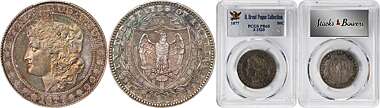
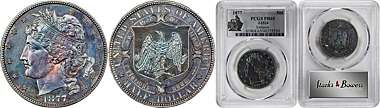
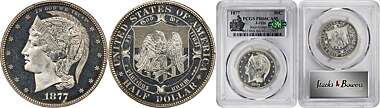
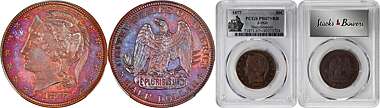
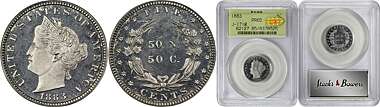
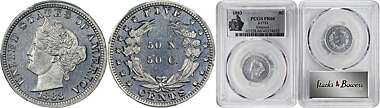
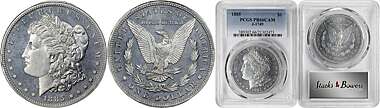
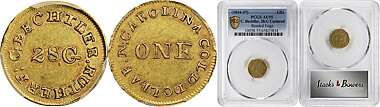
Registrarse para pujas en directo
Stack’s Bowers and Ponterio Logo
Lote
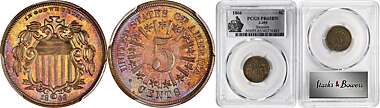
Lote 2204. 1866 Pattern Shield Nickel. Judd-499, Pollock-584. Rarity-7+. Bronze. Plain Edge. Proof-65 BN (PCGS). Obv: Similar to the adopted Shield nickel design, but the date is divided by the ball of the shield and the motto IN GOD WE TRUST is expressed in tiny letters. The remnants of an errant T can be seen in the field slightly past the final letter T in TRUST. Rev: The With Rays design that the Mint used for regular issue Shield nickel coinage in 1866 and early 1867. One of only half a dozen or so examples of this Judd number extant, and a superior example in terms of both quality and eye appeal. The beautifully toned surfaces are dressed in dominant walnut and antique copper brown patina, backlit by intensely vivid multicolored iridescence in antique gold, champagne-apricot, salmon-pink and lilac-blue. Fully struck and expertly preserved, provenance concerns alone compel us to mention trivial carbon spots on the reverse within the bottom of the digit 5 in the denomination, against the ball, and at the border before the word CENTS.This type was a favorite with pattern specialist Dr. Walter Lee Crouch, who had three impressions from these dies struck in either copper or bronze. They appeared together at auction in three consecutive lots in Superior Galleries' sale of June 1977. Offered here is one of the Crouch coins, lot 197 in the Superior sale. Ex Superior's sale of the Dr. Walter Lee Crouch Collection, June 1977, lot 197; our (Bowers and Ruddy's) Rare Coin Review No. 30, p. 67; Bowers and Ruddy, March 1978; our (Bowers and Merena's) sale of the J.E. Drew Collection, March 1996 Collections of Thomas H. Sebring and Gunther P. Garbe sale, lot 2023; our (American Numismatic Rarities') C.L. Lee Sale, September 2005, lot 970, as NGC Proof-65 BN; Heritage's Milwaukee ANA Signature Auction of August 2007, lot 2179, as NGC Proof-65 BN; our (Stack's) Samuel Berngard and S.S. New York Collections sale, July 2008, lot 4189, as NGC Proof-65 BN; Bob R. Simpson; Heritage's sale of the Bob R. Simpson Collection, January 2021 FUN Signature Auction, lot 3134. PCGS# 60695. NGC ID: 29L2. PCGS Population: 1; 0 finer in this category. There are no grading events reported in the PCGS RB or RD categories. Vividly Toned 1866 Pattern Shield Nickel Judd-499 in BronzeEx Crouch-Simpson
  • Precio de salida:
    1 USD
    0 EUR
    0 GBP
    0 CHF

    Importes redondeados, solo aproximadosFecha: 06/11/2026
Lote
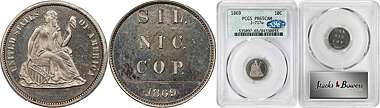
Lote 2205. 1869 Pattern Liberty Seated Dime. Judd-717a, Pollock-798. Rarity-7+. Nickel Alloy. Reeded Edge. Proof-65 Cameo (PCGS). CAC. Retro Doily Holder. Obv: Similar design to that used for the regular issue 1869 Liberty Seated dime, but without the date at the base. Rev: The inscription SIL. / NIC. / COP. in large letters, with the date 1869 below in exergue, in a smaller font, and slightly curved. Both sides exhibit a dusting of pale silvery tinting to otherwise pewter gray surfaces, the obverse with bold field to device contrast that supports the desirable CAM designation from PCGS.Although traditionally known as the "Koulz" alloy patterns, the uspatterns.com website states that research by David Cassel has identified Montchal Ruolz as the party responsible for this alloy. Only half a dozen or so specimens are believed extant in this variant nickel alloy, and this Gem Cameo Proof is certainly among the finest. From Ira & Larry Goldberg's Pre-Long Beach Auction of June 2020, lot 660; our June 2024 Auction, lot 3226; our sale of the Seven Lions Collection, sold to benefit the Higgins Museum of National Bank Notes, Summer 2025 Global Showcase Auction, August, lot 3457. PCGS# 535097. NGC ID: 29S2. PCGS Population: 1; 1 finer in this category (Proof-66 Cameo).CAC Stickered Population: 1; 1. Interesting 1869 Ruolz Pattern Dime in Nickel Judd-717a
  • Precio de salida:
    1 USD
    0 EUR
    0 GBP
    0 CHF

    Importes redondeados, solo aproximadosFecha: 06/11/2026
Lote
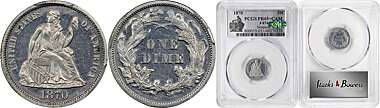
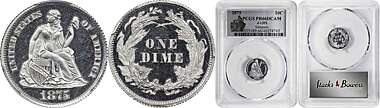
Lote 2206. 1870 Pattern Liberty Seated Dime. Judd-874, Pollock-971. Rarity-8. Aluminum. Reeded Edge. Proof-65+ Cameo (PCGS). CAC. The obverse and reverse designs are the same that the Mint used to strike regular issue 1870 Liberty Seated dimes. Glowing silver gray surfaces are decidedly reflective in the fields, satiny across the design elements. The high points at the top and bottom of the wreath on the reverse are a bit soft, but otherwise the strike is sharply to fully executed. Untoned and virtually blemish-free, tiny carbon spots at the first letter T in STATES and the E in AMERICA require intent to discern and are mentioned here solely as identifiers for provenance purposes.A "regular die trials strike" per traditional numismatic wisdom, the Judd-874 was probably struck deliberately for sale to contemporary collectors as part of off-metal Proof sets. This attribution is very rare - a key type in the wider pattern dime series - with just two specimens positively confirmed through Saul Teichman's research published at the uspatterns.com website. That offered here is the only certified specimen, and the only one to have appeared in the modern numismatic market. The other was last seen at auction in Superior's L. W. Hoffecker Collection sale of February 1987, lot 953C. Ex probably from Kagin's 295th Mail Sale, November 1971, lot 44, per the uspatterns.com website; Heritage's ANA Sale of August 1995, lot 8268, as PCGS Proof-64; Bob R. Simpson; Heritage's sale of the Bob R. Simpson Collection, February 2021 Signature Auction, lot 3229. PCGS# 800019. PCGS Population: just 1 in all grades, all categories.CAC Stickered Population: 1 in all grades, all categories. Rarity-8 1870 Liberty Seated Dime in Aluminum Judd-874The Only Certified Specimen
  • Precio de salida:
    1 USD
    0 EUR
    0 GBP
    0 CHF

    Importes redondeados, solo aproximadosFecha: 06/11/2026
Lote
Lote 2207. 1870 Pattern Quarter Dollar. Judd-881, Pollock-979. Rarity-8. Aluminum. Plain Edge. Proof-66 Cameo (PCGS). CAC. Obv: Standard Silver design with a stylized Liberty Seated portrait to left with liberty pole and cap behind. Liberty is holding an olive branch in her left hand, and her right hand supports a shield over which a scroll inscribed LIBERTY is draped. There are 13 stars around the border, and the date 1870 is below. Rev: The denomination 25 CENTS is within a wreath of cotton and corn with the word STANDARD above. This glowing Gem Cameo Proof exhibits untoned platinum-white surfaces that allow full appreciation of bold field to device contrast. Strike detail is razor sharp throughout, the surfaces silky smooth in texture with awesome eye appeal.The awesome rarity of this Judd number complements the technical quality and eye appeal of the present example. This is one of only two or three coins known for Judd-881, per the uspatterns.com website, with Saul Teichman's census work published therein positively identifying only two specimens. Offred here is the CC#1 coin; the CC#2 coin has apparently not been seen since our (Stack's) sale of May 1975. Ex Steve Ivy Numismatic Auctions, Inc.'s 1980 American Numismatic Association Auction, August, lot 814; Herbert I. Melnick's Leon Goodman Collection sale, July 1982, lot 975; (possibly) RARCOA's session of Auction '89, July 1989, part of lot 362, a "Possibly Unique Set of 1870 Quarters;" Bob R. Simpson; Heritage's sale of the Bob R. Simpson Collection, February 2021 Signature Auction, lot 3230. PCGS# 800011. Exceedingly Rare Judd-881 Pattern Quarter in Aluminum Finest of Just Two or Three Known
  • Precio de salida:
    1 USD
    0 EUR
    0 GBP
    0 CHF

    Importes redondeados, solo aproximadosFecha: 06/11/2026
Lote
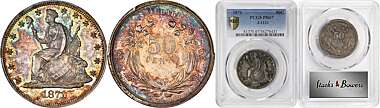
Lote 2208. 1870 Pattern Half Dollar. Judd-934, Pollock-1040. Rarity-7-. Silver. Plain Edge. Proof-66 (PCGS). CAC. CMQ. Obv: William Barber's seated Liberty facing left, an olive branch in her left hand, her right hand supporting a federal shield with a ribbon inscribed LIBERTY crossing the shield. LIBERTY is expressed in raised letters, as always seen on examples of this type despite the notation in the 1994 Pollock pattern reference to the contrary (incuse letters). A liberty pole with cap is behind the portrait, 13 stars encircle the periphery, and the date 1870 is below. Rev: The same design that the Mint used to produce regular issue 1870 Liberty Seated half dollars. A gorgeous Gem Proof with a silver gray center on the obverse that contrasts with champagne-pink, cobalt blue and olive-gray patina elsewhere. The visual effect is stunning, enhanced by the pleasantly reflective fields. Only a dozen of these are known per the uspatterns.com website, confirming the scarcity of Judd-934 in numismatic circles. This is one of the absolute finest, and it has an outstanding provenance, as well. From the Mack C. Chase Collection. Earlier from our (Bowers and Merena's) sale of the Louis E. Eliasberg, Sr. Collection, May 1996, lot 267; our (American Numismatic Rarities') Thomas H. Sebring Collection sale, January 2004, lot 70, as NGC Proof-66; our (American Numismatic Rarities') Robert Michael Prescott Collection sale, lot 910, as NGC Proof-66. PCGS# 61180. NGC ID: 29Y6. PCGS Population: 1; 0 finer in this category.CAC Stickered Population: 1; 0. The Eliasberg Judd-943 Pattern Half Dollar
  • Precio de salida:
    1 USD
    0 EUR
    0 GBP
    0 CHF

    Importes redondeados, solo aproximadosFecha: 06/11/2026
Lote
Lote 2209. 1871 Pattern Quarter Dollar. Judd-1096, Pollock-1232. Rarity-7. Silver. Reeded Edge. Proof-66 (PCGS). CAC. Obv: Longacre's seated Indian Princess design with flags, globe, and Liberty cap on pole, 13 stars around the periphery, and the date 1871 below. Rev: Standard Silver design with the denomination 25 CENTS within an open-topped wreath of cotton and corn. The word STANDARD is inscribed along the upper border. Deep champagne mirrors and frosty motifs display a scattering of delicate neon blue, violet, and pinkish-rose iridescence.Much like the transitional 1860 half dime, this is a "coin without a country" and lacks UNITED STATES OF AMERICA on either side. It was designed by James Barton Longacre but was executed by William Barber after Longacre's death on New Year's Day 1869. These dies were also struck in copper (Judd-1097, Rarity-7) and aluminum (Judd-1098, Rarity-8). It is thought that about a dozen or so silver examples of Judd-1099 currently exist. This is the Harry W. Bass, Jr. specimen, a coin that we have had the privilege of bringing to auction two other times in the past. Ex Stanley I. Kesselman, November 11, 1971; Harry W. Bass, Jr.; our (Bowers and Merena's) sale of the Harry W. Bass, Jr. Collection, Part I, May 1999, lot 1139; Heritage's Baltimore Signature Sale of July 2003, lot 10024; Heritage's Baltimore ANA Signature Auction of July-August 2008, lot 2742; our (Stack's) Orlando Sale of January 2009, lot 813; Heritage's Summer FUN Signature Auction of July 2009, lot 1252; Heritage's FUN Signature Auction of January 2010, lot 2370; Heritage's Boston ANA Signature Auction of August 2010, lot 3721. PCGS# 61355. NGC ID: 2A3X. PCGS Population: 3; 0 finer in this category.CAC Stickered Population: 2; 1. The Bass Specimen of Judd-1096 1871 Standard Silver Pattern Quarter
  • Precio de salida:
    1 USD
    0 EUR
    0 GBP
    0 CHF

    Importes redondeados, solo aproximadosFecha: 06/11/2026
Lote
Lote 2210. 1871 Pattern Half Dollar. Judd-1111, Pollock-1247. Rarity-7-. Silver. Reeded Edge. Proof-67 (PCGS). Obv: Liberty is seated facing left with the date 1871 below. She wears a Native American headdress, supports a liberty pole with her right hand, and her left hand rests on a globe inscribed LIBERTY. Thirteen stars encircle the border, and two flags are behind the portrait. Rev: A wreath of corn and cotton surrounds the denomination 50 / CENTS with the word STANDARD above. This wonderfully original Superb Gem Proof exhibits iridescent undertones of gold, blue, rose and orange-apricot to rich pewter gray, steel-olive and russet patina. A smartly impressed and visually stunning specimen, a coin for which the overall quality and appearance is easily equivalent to the assigned grade.This type combines the Longacre "Indian Princess" obverse design with stars with the Standard Silver reverse design of 1870. The uspatterns.com website suggests that this combination was implemented by William Barber, as Longacre died in 1869, and notes that examples were originally sold as part of complete sets from the half dime to the silver dollar. The census listing on that site includes only 11 specimens of Judd-1111, two of which are permanently impounded in museum collections. Possibly from our (Bowers and Ruddy's) Armand Champa Collection sale, May 1972, lot 1051. PCGS# 61370. NGC ID: 2A4D. PCGS Population (all categories): 1; 0 finer. There are no grading events listed in the PCGS DCAM category. Magnificent 1871 Judd-1111 Pattern Half Dollar Popular Indian Princess Design
  • Precio de salida:
    1 USD
    0 EUR
    0 GBP
    0 CHF

    Importes redondeados, solo aproximadosFecha: 06/11/2026
Lote
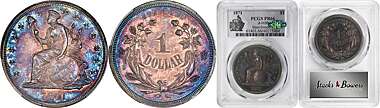
Lote 2211. 1871 Pattern Dollar. Judd-1139, Pollock-1281. Rarity-7+. Silver. Reeded Edge. Proof-66 (PCGS). CAC. Obv: Liberty is seated left with 13 stars around the border and the date 1871 below. She is wearing a Native American headdress, her right hand supports a liberty pole, and her left hand rests atop a globe inscribed LIBERTY. Two flags are behind the portrait, one of which displays 22 stars. The arrangement of the stars around the border, with stars 1 and 13 more distant from the base of the central design, is very similar to that seen on the posthumous 1870 pattern dollars of the Longacre Indian Princess type. Longacre died on January 1, 1869, but his legacy lived on. Unlike the 1870 issues, however, the obverse of Judd-1139 does not include the designer's name at the lower right corner of the central design. Rev: A wreath of cotton and corn encircles the denomination 1 DOLLAR with the word STANDARD inscribed along the upper border. A splendid Gem specimen, a coin of exquisite beauty from a design standpoint and also from the aspect of preservation. Both sides display a stunning blend of iridescent toning ranging from light gold to magenta, to electric blue - just about all the shades one might find in the prettiest of summer sunsets. Indeed, just gazing upon this coin gives a sense of numismatic joy and tranquility.Offered here is one of only three specimens of Judd-1139 traced by Saul Teichman, whose excellent and exhaustive research is published at the uspatterns.com website. One of these is impounded in the collection of the American Numismatic Society; the other is the CC#2 PCGS Proof-65 Deep Cameo specimen, also ex Simpson. Ex Numismatics, Ltd., August 12, 1974; Harry W. Bass, Jr.; our (Bowers and Merena's) sale of the Harry W. Bass, Jr. Collection, Part I, May 1999, lot 1260, as PCGS Proof-66; our (American Numismatic Rarities') Classics Sale of September 2003, lot 73, as NGC Proof-66; Bob R. Simpson; Heritage's sale of the Bob R. Simpson Collection, November 2020 Signature Auction, lot 3208. PCGS# 61401. NGC ID: 26W7. PCGS Population: 2; 0 graded higher in any category. The former total represents two separate grading events for the coin offered here.CAC Stickered Population: 1; 0. Incredible Gem 1871 Judd-1139 Silver Dollar Finest of Only Three KnownVividly Toned and Exquisite
  • Precio de salida:
    1 USD
    0 EUR
    0 GBP
    0 CHF

    Importes redondeados, solo aproximadosFecha: 06/11/2026
Lote
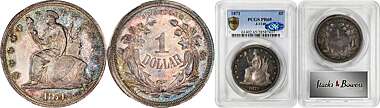
Lote 2212. 1871 Pattern Dollar. Judd-1140, Pollock-1282. Rarity-8. Silver. Plain Edge. Proof-65 (PCGS). CAC. Obv: Liberty is seated left with 13 stars around the border and the date 1871 below. She is wearing a Native American headdress, her right hand supports a liberty pole, and her left hand rests atop a globe inscribed LIBERTY. Two flags are behind the portrait, one of which displays 22 stars. The arrangement of the stars around the border, with stars 1 and 13 more distant from the base of the central design, is very similar to that seen on the posthumous 1870 pattern dollars of the Longacre Indian Princess type. Longacre died on January 1, 1869, but his legacy lived on. Unlike the 1870 issues, however, Judd-1140 does not include the designer's name at the lower right corner of the central design. Rev: A wreath of cotton and corn encircles the denomination 1 DOLLAR with the word STANDARD inscribed along the upper border.It is not often in numismatics that one has the chance to purchase a beautiful Gem that is by far the finest of just three known of the variety. Here is such an opportunity and a simply outstanding piece. Both sides are exceptionally vibrant with lovely iridescent toning of olive-gray and tannish-silver. Vivid undertones of gold, blue and pinkish-apricot are seen as is modest field to device contrast. The preservation easily justifies the Gem rating from PCGS.Judd-1140 is at once a prime rarity among pattern dollars and one of the most enigmatic coins in this highly specialized series. For many years, pattern specialists believed that only one example of Judd-1140 was known to exist. The excellent 1994 book United States Patterns and Related Issues by Andrew W. Pollock III records only a single auction appearance of this type (for the present example, in fact), as does the indispensable reference United States Pattern Coins, 10th edition, by Dr. J. Hewitt Judd, edited by Q. David Bowers, 2009 (also for the present coin). While the extreme rarity of this type has long been recognized, the existence of a second example in numismatic hands remained unknown until our offering of this coin in August 2014, and for a very simple reason. This coin had been off the market for more than 40 years prior to that, having last appeared at auction in Kagin's Sale of the '70s. Since that event, conducted in November 1973, only one other example of Judd-1140 had been offered for sale - the Farouk specimen that reappeared in Spink Smythe's May 2011 sale of the Magnolia Collection. The Farouk-Magnolia specimen current resides in a PCGS Proof-62+ holder. This coin is also finer than a third specimen, prior provenance unknown, that appeared at auction in January 2017.The complete provenances for the three known examples of Judd-1140 are as follows:1 - PCGS/CAC Proof-65. Ex Kagin's Sale of the '70s, November 1973, lot 806, off the market for 40 years thereafter; our Chicago ANA Sale of August 2014, lot 13289; Heritage's Denver ANA Signature Auction of August 2017, lot 4254; Ira & Larry Goldberg's Pre-Long Beach Auction of February 2018; our ANA Auction of August 2018, lot 1402. The present example.2 - NGC/CAC Proof-63. Ex Kentucky collection; Great Collections' sale of January 2017; Heritage's CSNS Signature Auction of April 2020, lot 3910; Heritage's September 2020 Signature Auction, lot 3871.3 - PCGS Proof-62+ Cameo. Ex King Farouk of Egypt; Sotheby's sale of the Palace Collections of Egypt, 1954; Spink Smythe's sale of the Magnolia Collection, May 2011, lot 18, as PCGS Proof-61, where it realized $54,625; Bob R. Simpson; Heritage's sale of the Bob R. Simpson Collection, August 2021 ANA Signature Auction, lot 3158. The Spink Smythe catalogers contributed to the belief that only one example of Judd-1140 was extant with the following statement in their description: "While one specimen is traced to an 11/73 Kagin's sale, it is quite likely that example and the present are the same." We now know that this statement is false and that the PCGS Proof-65 and Proof-62+ Cameo specimens are different coins.The opportunity to acquire the finest known example of the beautifully designed and exceedingly rare 1871 Judd-1140 Indian Princess pattern dollar is likely to be a once in a lifetime opportunity for most specialists. This is a highlight of the Stack's Bowers Galleries November 2026 August Showcase Auction, and one of our most important pattern offerings in recent years. This pattern is sure to spark spirited bidder competition among advanced collectors. From Kagin's Sale of the '70s, November 1973, lot 806, off the market for 40 years thereafter; our Chicago ANA Sale of August 2014, lot 13289; Heritage's Denver ANA Signature Auction of August 2017, lot 4254; Ira & Larry Goldberg's Pre-Long Beach Auction of February 2018; our ANA Auction of August 2018, lot 1402. PCGS# 61402. NGC ID: C73M. Exceedingly Rare 1871 Judd-1140 Pattern Indian Princess Dollar By Far the Finest of Only Three Known
  • Precio de salida:
    1 USD
    0 EUR
    0 GBP
    0 CHF

    Importes redondeados, solo aproximadosFecha: 06/11/2026
Lote
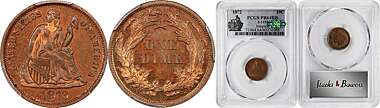
Lote 2213. 1872 Pattern Liberty Seated Dime. Judd-1193, Pollock-1333. Rarity-8. Copper. Reeded Edge. Proof-64 RB (PCGS). CAC. The obverse and reverse designs are the same that the Mint used in production of 1872 Liberty Seated dimes. Lightly toned in olive and rose-brown, both sides retain abundant mint orange color that shines forth powerfully as the surfaces rotate into direct lighting. There are expectably few blemishes at the Choice Proof grade level, both sides with a few small carbon spots that include a particularly useful one for provenance purposes on the obverse at the letter A in STATES. Sharply struck from dies that were rotated a few degrees counterclockwise from coin alignment.Not a regular die trials strike, per traditional numismatic wisdom, Judd-1193 is actually a deliberate numismatic strike to sell to contemporary collectors as part of off-metal Proof sets. Only two are known, per Saul Teichman's census research published at the uspatterns.com website, and that offered here is finer than the NASCA 11/77 coin, now in a PCGS Proof-63 BN holder. Ex (probably) our (Stack's) A.N.A. Convention Auction Sale of August 1971, lot 416; Kagin's 295th Mail Sale, November 1971, lot 47; Heritage's sale of the Lynch Collection, March 2003 Charlotte ANA National Money Show Auction, lot 6560; Bob R. Simpson; Heritage's sale of the Bob R. Simpson Collection, February 2021 Signature Auction, lot 3264. The plate coin for the type on the uspatterns.com website. PCGS# 71464. NGC ID: 2A66. The Finer of Only Two Confirmed Examples of Judd-1193 1872 Liberty Seated Dime in Copper
  • Precio de salida:
    1 USD
    0 EUR
    0 GBP
    0 CHF

    Importes redondeados, solo aproximadosFecha: 06/11/2026
Lote
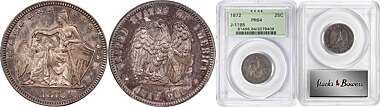
Lote 2214. 1872 Pattern Amazonian Quarter Dollar. Judd-1195, Pollock-1335. Rarity-7-. Silver. Reeded Edge. Proof-64 (PCGS). OGH. Obv: William Barber's famous Amazonian design. Liberty is seated left with 13 stars around the border and the date 1872 below. Liberty's right hand nearly rests on top of an eagle's head, her left hand holds a sword and her left arm rests atop a shield. Rev: A spread wing eagle clutches a group of three arrows in its right talon and its left talon supports a shield. A scroll crossing the shield is inscribed with the motto IN GOD WE TRUST. The legend UNITED STATES OF AMERICA is above and the denomination QUAR. DOL. is below. Of all pattern coins, the Amazonian issues are among the most desired. We offer a beautiful example of this popular and rarely available pattern. Soft blue-gray and russet toning is gently mottled across both sides, while strong mirrors in the fields create a nice contrast to the frosty devices. Sharply struck and beautifully preserved, with a very pleasing appearance.While the toning has changed a little over time, this piece can be successfully plate matched to the January 1980 Robert Hughes auction, lot 39, and as far as we are aware, that was its last auction appearance prior to appearing in our August 2017 ANA Auction. The Amazonian patterns designed by William Barber are highly prized by collectors and have long been counted among the most desirable pattern issues. They were struck in silver, copper and aluminum and in three denominations, the quarter, half dollar and dollar. Any appearance of one generates enthusiasm, while opportunities to acquire any of the denominations tend to be few and far between.According to the uspatterns.com website, the best source for updated research information on U.S. pattern and related coinage, there are perhaps only 10 examples of this quarter dollar issue known in silver, the most prized of the metals in which they were struck. As noted, this one seems to have been off the market for many years prior to 2017, even decades. Also noted on the uspatterns.com site is the conventional wisdom that the Amazonian name traces back to New York Stamp and Coin's sale of the famed Lorin G. Parmelee Collection in 1890, cataloged by David Proskey. That extraordinary sale included a three-piece set of this issue in silver which brought $13.50, a princely sum for these pieces which were then just 18 years old. In the same sale, at lot 577, a 1776 Continental dollar, E.G. FECIT, called "sharp, uncirc" sold for fifty cents less, putting this price record into better perspective. This Choice Proof pattern quarter represents an important opportunity for the pattern specialist. From Robert L. Hughes Enterprises' sale of the Phillip Warner Collection, January 1980, lot 39; our sale of the Collection of Carril Valparaiso, August 2017 ANA Auction, lot 2245; our sale of the Seven Lions Collection, sold to benefit the Higgins Museum of National Bank Notes, Summer 2025 Global Showcase Auction, August, lot 3461. PCGS# 61466. NGC ID: 2A67. Famous and Rare Pattern 1872 Amazonian Quarter Dollar Judd-1195 Struck in Silver
  • Precio de salida:
    1 USD
    0 EUR
    0 GBP
    0 CHF

    Importes redondeados, solo aproximadosFecha: 06/11/2026
Lote
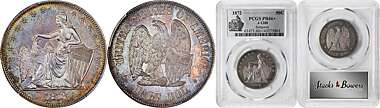
Lote 2215. 1872 Pattern Amazonian Half Dollar. Judd-1200, Pollock-1340. Rarity-7-. Silver. Reeded Edge. Proof-66+ (PCGS). Obv: William Barber's famed Amazonian design. Seated figure of Liberty left with standing eagle, her right hand upon its head, her left hand and arm supporting a sword and shield. Thirteen stars are arranged around the border seven left, six right, and the date 1872 is below. Rev: An eagle with spread wings clutches three arrows in its right talon and supports a shield with its left talon. An olive branch is in front of the shield, and a scroll inscribed with the motto IN GOD WE TRUST is draped across the shield. The legend UNITED STATES OF AMERICA encircles the periphery and the denomination HALF DOL. is below. This gorgeous premium Gem is fully struck with handsome toning in dominant pewter gray and olive-russet. Direct lighting calls forth vivid undertones of reddish-gold, lilac-blue and pinkish-apricot, as well as modest contrast between lightly frosted design elements and mirrored fields. The surfaces are free of significant post-production blemishes and offer superior quality as well as outstanding eye appeal.The uspatterns.com website notes:William Barber's 'Amazonian' design [is] considered to be one of the most beautiful ever made by the US Mint. This design was issued in sets of the quarter dollar, half dollar and silver dollar in silver, copper....and aluminum.The Amazonian name dates to the 1890 New York Coin and Stamp auction of the Lorin G. Parmelee collection and was probably given by David Proskey.Only 10 specimens in silver are positively confirmed to exist, although the actual total may be as high as 12 or 13 pieces. Judd-1200 is rare in either case, of course, the beauty and popularity of the Amazonian design resulting in extremely strong demand among pattern enthusiasts. The lovely specimen offered here is the highest graded at PCGS, a highlight of this sale, and is sure to have no difficulty finding its way into another significant cabinet. Property from an Alabama Family. Earlier from our (Stack's) sale of the Thomas A. Bergin Collection of U.S. Pattern Coins, June 1984, lot 1239; Superior's Pre-Long Beach Auction of September 2008, lot 793, as NGC Proof-65; Heritage's sale of the Bob R. Simpson Collection, January 2021 FUN Signature Auction, lot 3204. PCGS# 61471. NGC ID: 2A6C. PCGS Population: 1 in all categories; 0 graded higher. Elegant 1872 Pattern Amazonian Half Dollar Judd-1200 in SilverEx Simpson
  • Precio de salida:
    1 USD
    0 EUR
    0 GBP
    0 CHF

    Importes redondeados, solo aproximadosFecha: 06/11/2026
Lote
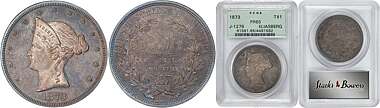
Lote 2216. 1873 Pattern Trade Dollar. Judd-1276, Pollock-1418. Rarity-5. Silver. Reeded Edge. Proof-65 (PCGS). OGH. Obv: A bust of Liberty faces left with 13 stars around the border and the date 1873 below. Liberty wears a coronet inscribed LIBERTY, and her hair is tied in a knot by a band of pearls. Rev: The inscription TRADE / DOLLAR / 420 GRAINS / 900 FINE is surrounded by an olive wreath, at the base of which is a scroll with the motto IN GOD WE TRUST. The legend UNITED STATES OF AMERICA is inscribed along the upper border. Softly toned in olive and mauve-gray patina with underlying cobalt blue iridescence enhancing the reverse periphery. Both dies for this elegant type are credited to William Barber.One of an extensive suite of pattern trade dollars produced in 1873, Judd-1276 was made available to contemporary collectors as part of six-piece pattern Proof sets at the price of $30 per set. The present example is actually directly traceable back to one of those sets, which first appeared at auction in S.H. and H. Chapman's 1895 sale of the celebrated Richard B. Winsor Collection. The set was acquired by J.M Clapp through that sale, went to Louis E. Eliasberg, Sr., and most recently appeared at auction in Legend Rare Coin Auctions' February 2023 sale of the Terra Pistacia Collection. The coins have remained together despite being offered individually in the past, which is also the case in this sale, and we sincerely hope that another collector will recognize the significance of this set by buying all six of the coins. In addition to Judd-1276, offered in this lot, the other coins in this set are Judd-1281, Judd-1293, Judd-1310, Judd-1315, and Judd-1322. Ex S.H. and H. Chapman's sale of the Richard B. Winsor Collection, December 1895, lot 1135, part of a six-piece set that also included the Judd-1281, Judd-1293, Judd-1310, Judd-1315 and Judd-1322 specimens offered in this sale; J.M. Clapp; Clapp estate, 1942, via Stack's; Louis E. Eliasberg, Sr.; our (Bowers and Merena's) sale of the Louis E. Eliasberg, Sr. Collection, May 1996, lot 302; Legend Rare Coin Auctions' sale of the Terra Pistacia Collection, February 2023 Regency Auction 57, lot 10. PCGS# 61561. NGC ID: 2A88. PCGS Population: 6; with a single Proof-66 finer in this category. Significant 1873 Judd-1276 Trade Dollar Ex Winsor-EliasbergFrom an Original Pattern Proof Set
  • Precio de salida:
    1 USD
    0 EUR
    0 GBP
    0 CHF

    Importes redondeados, solo aproximadosFecha: 06/11/2026
Lote
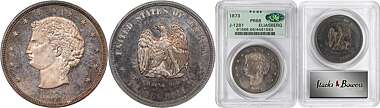
Lote 2217. 1873 Pattern Trade Dollar. Judd-1281, Pollock-1423. Rarity-4. Silver. Reeded Edge. Proof-66 (PCGS). CAC. OGH. Obv: Bust of Liberty faces left with 13 stars around the border and the date 1873 below. Liberty is wearing a wreath of leaves, her hair coiled and braided at the back of her head. Rev: An eagle with spread wings supports a shield with its left talon and clutches a group of three arrows in its right talon. A scroll crossing the shield carries the motto IN GOD WE TRUST, while the Latin motto E PLURIBUS UNUM is inscribed in the field above the eagle. The legend UNITED STATES OF AMERICA is inscribed along the upper border, the inscription 420 GRAINS, 900 FINE is in the field below the eagle, and the denomination TRADE DOLLAR is inscribed along the lower border. Sharply defined in virtually all areas, both sides of this delightful Gem Proof specimen are toned in slightly mottled champagne-gold and olive-gray iridescence that is a bit bolder on the reverse.One of an extensive suite of pattern trade dollars produced in 1873, Judd-1281 was made available to contemporary collectors as part of six-piece pattern Proof sets at the price of $30 per set. The present example is actually directly traceable back to one of those sets, which first appeared at auction in S.H. and H. Chapman's 1895 sale of the celebrated Richard B. Winsor Collection. The set was acquired by J.M Clapp through that sale, went to Louis E. Eliasberg, Sr., and most recently appeared at auction in Legend Rare Coin Auctions' February 2023 sale of the Terra Pistacia Collection. The coins have remained together despite being offered individually in the past, which is also the case in this sale, and we sincerely hope that another collector will recognize the significance of this set by buying all six of the coins. In addition to Judd-1281, offered in this lot, the other coins in this set are Judd-1276, Judd-1293, Judd-1310, Judd-1315, and Judd-1322. Ex S.H. and H. Chapman's sale of the Richard B. Winsor Collection, December 1895, lot 1135, part of a six-piece set that also included the Judd-1276, Judd-1293, Judd-1310, Judd-1315 and Judd-1322 specimens offered in this sale; J.M. Clapp; Clapp estate, 1942, via Stack's; Louis E. Eliasberg, Sr.; our (Bowers and Merena's) sale of the Louis E. Eliasberg, Sr. Collection, May 1996, lot 303; Legend Rare Coin Auctions' sale of the Terra Pistacia Collection, February 2023 Regency Auction 57, lot 11. PCGS# 61566. NGC ID: 2A8B. PCGS Population: 2; 0 graded higher in any category.CAC Stickered Population: 3; 0. Handsome Gem Proof 1873 Judd-1281 Pattern Trade Dollar The Winsor-Eliasberg SpecimenNumismatic Provenance to 1895
  • Precio de salida:
    1 USD
    0 EUR
    0 GBP
    0 CHF

    Importes redondeados, solo aproximadosFecha: 06/11/2026
Lote
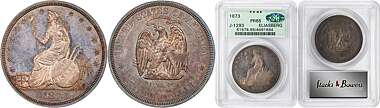
Lote 2218. 1873 Pattern Trade Dollar. Judd-1293, Pollock-1435. Rarity-4. Silver. Reeded Edge. Proof-65 (PCGS). CAC. OGH. Obv: Liberty is seated left, her left hand resting atop a globe inscribed LIBERTY and her right hand holding a liberty pole. A cotton bale is at Liberty's feet, wheat sheaf and plow handles behind. Thirteen stars are arranged around the border, seven left and six right, and the date 1873 is below. Rev: An eagle with outstretched wings supports a shield with its left talon, over which is a ribbon inscribed with the motto IN GOD WE TRUST, while its right talon clutches a group of three arrows. A ribbon in the eagle's beak is inscribed with the Latin motto E PLURIBUS UNUM, the legend UNITED STATES OF AMERICA is above, the inscription 420 GRAINS, 900 FINE is below, and the denomination TRADE DOLLAR is at the lower border. Beautifully toned surfaces are dusted with sandy-gold and silver-apricot patina that is a bit bolder on the reverse. Both sides are a tad lightly struck at the central high points, to little effect as the overall appearance is one of razor sharp to full detail. This is an elegant Gem, expertly preserved since distribution from the Mint in 1873, and boasting a cameo finish from the dies that is not mentioned on the Generation 3.1 PCGS insert.One of an extensive suite of pattern trade dollars produced in 1873, Judd-1293 was made available to contemporary collectors as part of six-piece pattern Proof sets at the price of $30 per set. The present example is actually directly traceable back to one of those sets, which first appeared at auction in S.H. and H. Chapman's 1895 sale of the celebrated Richard B. Winsor Collection. The set was acquired by J.M Clapp through that sale, went to Louis E. Eliasberg, Sr., and most recently appeared at auction in Legend Rare Coin Auctions' February 2023 sale of the Terra Pistacia Collection. The coins have remained together despite being offered individually in the past, which is also the case in this sale, and we sincerely hope that another collector will recognize the significance of this set by buying all six of the coins. In addition to Judd-1293, offered in this lot, the other coins in this set are Judd-1276, Judd-1281, Judd-1310, Judd-1315, and Judd-1322. Ex S.H. and H. Chapman's sale of the Richard B. Winsor Collection, December 1895, lot 1135, part of a six-piece set that also included the Judd-1276, Judd-1281, Judd-1310, Judd-1315, and Judd-1322 specimens offered in this sale; J.M. Clapp; Clapp estate, 1942, via Stack's; Louis E. Eliasberg, Sr.; our (Bowers and Merena's) sale of the Louis E. Eliasberg, Sr. Collection, May 1996, lot 304; Legend Rare Coin Auctions' sale of the Terra Pistacia Collection, February 2023 Regency Auction 57, lot 12. PCGS# 61578. NGC ID: 2A8G. PCGS Population: 3; with a single Proof-65 finer in this category.CAC Stickered Population: 3; 1. The Winsor-Eliasberg 1873 Judd-1293 Trade Dollar From an Original Six-Piece Pattern Proof Set
  • Precio de salida:
    1 USD
    0 EUR
    0 GBP
    0 CHF

    Importes redondeados, solo aproximadosFecha: 06/11/2026
Lote
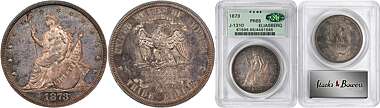
Lote 2219. 1873 Pattern Trade Dollar. Judd-1310, Pollock-1453. Rarity-4. Silver. Reeded Edge. Proof-65 (PCGS). CAC. OGH. Obv: Barber's Indian Princess design with Liberty seated on a rock facing left. Her right hand supports a liberty pole while her left hand rests atop a globe inscribed LIBERTY. A pair of flags is behind the portrait, one of which is ornamented with stars. Thirteen stars encircle the border and the date 1873 is below. Rev: A small eagle with outstretched wings clutches an olive branch in its left talon and a group of three arrows in its right talon. A scroll above the eagle is inscribed with the Latin motto E PLURIBUS UNUM, the motto IN GOD WE TRUST is on a scroll in the lower field, and immediately below the eagle is the inscription 420 GRAINS / 900 FINE. The legend UNITED STATES OF AMERICA lines the upper border and the denomination TRADE DOLLAR is at the lower border. This is a wonderful, original example of this popular pattern trade dollar type, with gently mottled champagne-pink and olive-gray patina adorning both sides. Boldly to sharply struck throughout with good reflectivity to the finish.One of an extensive suite of pattern trade dollars produced in 1873, Judd-1310 was made available to contemporary collectors as part of six-piece pattern Proof sets at the price of $30 per set. The present example is actually directly traceable back to one of those sets, which first appeared at auction in S.H. and H. Chapman's 1895 sale of the celebrated Richard B. Winsor Collection. The set was acquired by J.M Clapp through that sale, went to Louis E. Eliasberg, Sr., and most recently appeared at auction in Legend Rare Coin Auctions' February 2023 sale of the Terra Pistacia Collection. The coins have remained together despite being offered individually in the past, which is also the case in this sale, and we sincerely hope that another collector will recognize the significance of this set by buying all six of the coins. In addition to Judd-1310, offered in this lot, the other coins in this set are Judd-1276, Judd-1281, Judd-1293, Judd-1315, and Judd-1322. Ex S.H. and H. Chapman's sale of the Richard B. Winsor Collection, December 1895, lot 1135, part of a six-piece set that also included the Judd-1276, Judd-1281, Judd-1293, Judd-1315, and Judd-1322 specimens offered in this sale; J.M. Clapp; Clapp estate, 1942, via Stack's; Louis E. Eliasberg, Sr.; our (Bowers and Merena's) sale of the Louis E. Eliasberg, Sr. Collection, May 1996, lot 305; Legend Rare Coin Auctions' sale of the Terra Pistacia Collection, February 2023 Regency Auction 57, lot 13. PCGS# 61596. NGC ID: 2A8R. PCGS Population: 3; 2 finer (both Proof-66). There are no grading events listed in the PCGS CAM and DCAM categories.CAC Stickered Population: 3; 1. Exceptional Gem Proof 1873 Judd-1310 Pattern Trade Dollar From the Winsor and Eliasberg Collections
  • Precio de salida:
    1 USD
    0 EUR
    0 GBP
    0 CHF

    Importes redondeados, solo aproximadosFecha: 06/11/2026
Lote
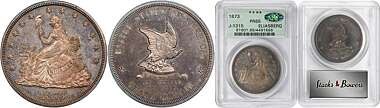
Lote 2220. 1873 Pattern Trade Dollar. Judd-1315, Pollock-1458. Rarity-4. Silver. Reeded Edge. Proof-65 (PCGS). CAC. OGH. Obv: Liberty is seated left with 13 stars around the border and the date 1873 below. Liberty's right hand supports a liberty pole and her left hand rests atop a globe inscribed LIBERTY. Two bales of cotton and a tobacco plant are present at Liberty's feet, and a sheaf of wheat is behind the portrait. Rev: A small eagle facing right is perched atop a shield with an olive branch in its right talon and three arrows in its left talon. The motto IN GOD WE TRUST is on a scroll below the shield, below which are the inscriptions 420 GRAINS and 900 FINE. The Latin motto E PLURIBUS UNUM is in the field above the eagle. The legend UNITED STATES OF AMERICA is inscribed along the upper border while the denomination TRADE DOLLAR is at the lower border. Attractive Gem surfaces are dressed in champagne-pink and olive-gray iridescence.One of an extensive suite of pattern trade dollars produced in 1873, Judd-1315 was made available to contemporary collectors as part of six-piece pattern Proof sets at the price of $30 per set. The present example is actually directly traceable back to one of those sets, which first appeared at auction in S.H. and H. Chapman's 1895 sale of the celebrated Richard B. Winsor Collection. The set was acquired by J.M Clapp through that sale, went to Louis E. Eliasberg, Sr., and most recently appeared at auction in Legend Rare Coin Auctions' February 2023 sale of the Terra Pistacia Collection. The coins have remained together despite being offered individually in the past, which is also the case in this sale, and we sincerely hope that another collector will recognize the significance of this set by buying all six of the coins. In addition to Judd-1315, offered in this lot, the other coins in this set are Judd-1276, Judd-1281, Judd-1293, Judd-1310, and Judd-1322. Ex S.H. and H. Chapman's sale of the Richard B. Winsor Collection, December 1895, lot 1135, part of a six-piece set that also included the Judd-1276, Judd-1281, Judd-1293, Judd-1310, and Judd-1322 specimens offered in this sale; J.M. Clapp; Clapp estate, 1942, via Stack's; Louis E. Eliasberg, Sr.; our (Bowers and Merena's) sale of the Louis E. Eliasberg, Sr. Collection, May 1996, lot 306; Legend Rare Coin Auctions' sale of the Terra Pistacia Collection, February 2023 Regency Auction 57, lot 14. PCGS# 61601. NGC ID: 2A8V. PCGS Population: 2; 2 finer in this category (Proof-67 finest).CAC Stickered Population: 4; 3. Handsome Gem Proof Judd-1315 Pattern Trade Dollar From an Original Pattern Trade Dollar Proof SetEx Winsor-Eliasberg
  • Precio de salida:
    1 USD
    0 EUR
    0 GBP
    0 CHF

    Importes redondeados, solo aproximadosFecha: 06/11/2026
Lote
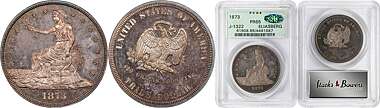
Lote 2221. 1873 Pattern Trade Dollar. Judd-1322, Pollock-1465. Rarity-4. Silver. Reeded Edge. Proof-65 (PCGS). CAC. OGH. Obv: Very similar to the design that the Mint adopted for regular issue trade dollar coinage, although the right base of the portrait is longer and joins the adjacent border. Rev: A small eagle with outstretched wings clutches an olive branch in its right talon, three arrows in its left talon, and a scroll inscribed E PLURIBUS UNUM with its beak. The legend UNITED STATES OF AMERICA is above, the inscription 420 GRAINS, 900 FINE is immediately below the eagle, and the denomination TRADE DOLLAR is inscribed along the lower border. This smartly impressed and crisply defined example exhibits warm iridescent toning in champagne-pink and olive-gray.One of an extensive suite of pattern trade dollars produced in 1873, Judd-1322 was made available to contemporary collectors as part of six-piece pattern Proof sets at the price of $30 per set. The present example is actually directly traceable back to one of those sets, which first appeared at auction in S.H. and H. Chapman's 1895 sale of the celebrated Richard B. Winsor Collection. The set was acquired by J.M Clapp through that sale, went to Louis E. Eliasberg, Sr., and most recently appeared at auction in Legend Rare Coin Auctions' February 2023 sale of the Terra Pistacia Collection. The coins have remained together despite being offered individually in the past, which is also the case in this sale, and we sincerely hope that another collector will recognize the significance of this set by buying all six of the coins. In addition to Judd-1322, offered in this lot, the other coins in this set are Judd-1276, Judd-1281, Judd-1293, Judd-1310, and Judd-1315. Ex S.H. and H. Chapman's sale of the Richard B. Winsor Collection, December 1895, lot 1135, part of a six-piece set that also included the Judd-1276, Judd-1281, Judd-1293, Judd-1310, and Judd-1315 specimens offered in this sale; J.M. Clapp; Clapp estate, 1942, via Stack's; Louis E. Eliasberg, Sr.; our (Bowers and Merena's) sale of the Louis E. Eliasberg, Sr. Collection, May 1996, lot 307; Legend Rare Coin Auctions' sale of the Terra Pistacia Collection, February 2023 Regency Auction 57, lot 15. PCGS# 61608. NGC ID: 2A8Z. The Winsor-Eliasberg 1873 Judd-1322 From an Original Pattern Proof Trade Dollar Set
  • Precio de salida:
    1 USD
    0 EUR
    0 GBP
    0 CHF

    Importes redondeados, solo aproximadosFecha: 06/11/2026
Lote
Lote 2222. 1875 Pattern Liberty Seated Dime. Judd-1391, Pollock-1534. Rarity-8. Aluminum. Reeded Edge. Proof-66 Deep Cameo (PCGS). The obverse and reverse designs are the same that the Mint used to coin regular issue 1875 Liberty Seated dimes. A virtually as-struck beauty with razor sharp detail to frosty motifs that appear to float atop deep pools of reflectivity in the fields. It is an exquisite Gem Deep Cameo Proof and formidable numismatic rarity.This is one of several off-metal "patterns" from the late 19th century U.S. Mint that we are offering in this sale. We have placed the word "patterns" in quotes here because these pieces were actually deliberately struck for sale to contemporary collectors as part of off-metal Proof sets. The 1875 Judd-1391 Liberty Seated dime in aluminum has an extant population of just two coins, per the uspatterns.com website, and that offered here is finer that the example that last appeared in our (Bowers and Ruddy's) sale of April 1981. An exceedingly rare bidding opportunity worthy of the undivided attention of advanced numismatists. Ex King Farouk of Egypt; Sotheby's sale of The Palace Collections of Egypt, 1954, lot 1948; Heritage's sale of the Gene Wolfe Collection of Pattern Coinage, January 2000 FUN Signature Sale, lot 7465, as PCGS Proof-64; Heritage's FUN Signature Sale of January 2001, lot 8553, as PCGS Proof-64; Bob R. Simpson; Heritage's sale of the Bob R. Simpson Collection, January 2021 FUN Signature Auction, lot 3225. PCGS# 535189. NGC ID: 2AAW. 1875 Judd-1391 Rarity Aluminum Liberty Seated DimeFiner of Just Two Known
  • Precio de salida:
    1 USD
    0 EUR
    0 GBP
    0 CHF

    Importes redondeados, solo aproximadosFecha: 06/11/2026
Lote
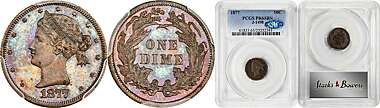
Lote 2223. 1877 Pattern Dime. Judd-1498, Pollock-1651. Rarity-7-. Copper. Reeded Edge. Proof-65 BN (PCGS). CAC. Obv: Bust of Liberty faces left with 13 stars around the border and the date 1877 below. Liberty is wearing a coronet inscribed LIBERTY, and her hair is tied back with a ribbon. This motif is similar to William Barber's famous Sailor Head design of 1875. Rev: The same design that the Mint used to strike regular issue 1877 Liberty Seated dimes. Fully original in preservation with dominant copper-brown patina, both sides also exhibit vivid undertones of powder blue and/or champagne-pink iridescence as the surfaces dip into a light. Reflective fields support satiny, sharply struck design elements. A few faint spots and wispy marks over and around the obverse portrait serve as useful provenance markers, but the in-hand appearance is generally smooth, and the Gem grade from PCGS is fully justified, as verified by CAC. In fact, this is the finer of only two examples of Judd-1498 that have been verified by CAC, confirming the significance of this offering for collectors of the finest U.S. Mint pattern and related coinage. The uspatterns.com website reports that only eight specimens of this Judd number are confirmed, including the present Gem Proof example, which is the fifth coin in the website's census listing. Ex our (Bowers and Ruddy's) River Oaks & C.W. Krugjohann Part II Collections sale, November 1976, lot 945; New England Rare Coin Auctions' Metropolitan New York Sale of March-April 1978, lot 528; Superior's Baltimore '93 Auction, July 1993, lot 664; Superior's Elite Coin Auction of July 2003, lot 489; Heritage's Signature Sale of November 2003, lot 11210; Heritage's CSNS Signature Sale of May 2004, lot 10643; Robert L. Hughes, November 2012; Heritage's New York Signature Auction of February 2014, lot 5533; Heritage's FUN Signature Auction of January 2015, lot 6756; Legend Rare Coin Auctions' sale of the Steven Cook Collection of Patterns, Part I, May 2018 Regency Auction 26, lot 836; our Baltimore Auction of November 2021, lot 4144. PCGS# 61833. NGC ID: 2ADM. PCGS Population: 2; with a single Proof-66+ BN finer in this category.CAC Stickered Population: 1; 0. Gem Proof 1877 Judd-1498 Pattern Dime Rarity Just Eight ConfirmedThe Finer of Only Two CAC-Verified Specimens
  • Precio de salida:
    1 USD
    0 EUR
    0 GBP
    0 CHF

    Importes redondeados, solo aproximadosFecha: 06/11/2026
Lote
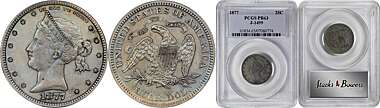
Lote 2224. 1877 Pattern Quarter Dollar. Judd-1499, Pollock-1652. Rarity-8+. Silver. Reeded Edge. Proof-63 (PCGS). Obv: Bust of Liberty faces left with the motto IN GOD WE TRUST along the upper border, in small letters, 13 stars arranged around much of the rest of the border, seven left, six right, and the date 1877 below. Liberty is wearing a coronet inscribed LIBERTY, and her hair is tied back with a ribbon. This motif is similar to William Barber's famous Sailor Head design of 1875. Rev: The same design that the Mint used to strike regular issue 1877 Liberty Seated quarters. As the only known example of this Judd number, the quality of this unique coin takes a back seat to its rarity. This is perhaps fortunate, for the quality of this piece is somewhat of a mixed bag. It has unfortunately been cleaned at some time in the past, the surfaces noticeably subdued overall. The in-hand appearance benefits from a lack of distracting marks and hairlines, however, and both sides have been retoned in muted pewter-olive gray with underlying lilac-blue and antique gold iridescence that further elevates the eye appeal. Strike detail is razor sharp to full throughout. Close inspection with a loupe is required to discern some ancient surface build up nestled among some of the obverse motifs; a tiny carbon spot low on Liberty's neck is the most obvious identifier to distinguish this coin in the unlikely event that a second example of Judd-1499 surfaces at some point in the future.This die pairing is also known in copper, Judd-1500, of which eight examples are confirmed per the uspatterns.com website. While obviously rare, that is only metallic composition that most collectors can hope to use to represent this design type in an advanced pattern collection. For those seeking either the utmost in rarity or absolute completion of their Judd number set, our offering of the unique Judd-1499 pattern quarter dollar in silver represents what could very well be a once in a lifetime bidding opportunity, and one that deserves the most aggressive strategy. Ex William Woodin Collection; 1914 ANS Catalogue, page 91, listed as A.W. 1541; Waldo C. Newcomer; J.C. Morgenthau & Co., Inc.'s Sale Number 444, June 1942, lot 1331; unknown intermediaries; Ed Rector; Heritage's FUN Signature Auction of January 2017, withdrawn; Heritage's FUN Signature Auction of January 2018, lot 5239; Heritage's sale of the Dornoch Collection, January 2019 FUN Signature Auction, lot 4811. PCGS# 61834. The Unique Judd-1499 Pattern Quarter Dollar
  • Precio de salida:
    1 USD
    0 EUR
    0 GBP
    0 CHF

    Importes redondeados, solo aproximadosFecha: 06/11/2026
Lote
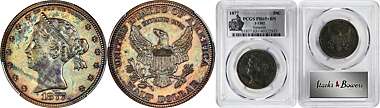
Lote 2225. 1877 Pattern Half Dollar. Judd-1502, Pollock-1655. Rarity-7-. Copper. Reeded Edge. Proof-65+ BN (PCGS). Obv: Bust of Liberty faces left with the motto IN GOD WE TRUST along the upper border, in small letters, 13 stars arranged around much of the rest of the border, seven left, six right, and the date 1877 below. Liberty is wearing a coronet inscribed LIBERTY, and her hair is tied back with a ribbon. This motif is similar to William Barber's famous Sailor Head design of 1875. Rev: A heraldic eagle with upraised wings and a shield on its breast is the focal device at center, with the Latin motto E PLURIBUS UNUM in the field immediately above. The legend UNITED STATES OF AMERICA is inscribed along the upper border, the denomination HALF DOLLAR along the lower border. Richly toned in dominant olive-copper, direct lighting calls forth vivid undertones of iridescent antique gold, champagne-apricot and powder blue. A couple of streaks of the final-listed color are seen at and around the base of Liberty's portrait - the most useful identifiers for provenance purposes. This lovely coin is fully struck throughout with glowing fields and carefully preserved surfaces.Judd-1502 is one of numerous pattern rarities of the year 1877, with the uspatterns.com website tracing only seven distinct examples in copper. This die pairing also exists in silver, Judd-1501, which is even rarer with a mere two specimens confirmed. Ex "Colonel" E.H.R. Green; Burdette G. Johnson; Gaston DiBello; our (Stack's) sale of the Gaston DiBello Collection, Part II, May 1970, lot 382; Stack's, to the following, via private treaty transaction; Heritage's sale of The Lemus Collection, Queller Family Collection, Part II, January 2009 FUN Signature Auction, lot 1869, as NGC Proof-66 BN; Bob R. Simpson; Heritage's sale of Important Selections from the Bob R. Simpson Collection, Part I, September 2020, lot 10317. Earlier, possibly the property of William Woodin. PCGS# 61837. NGC ID: 2ADP. PCGS Population: 1; 0 finer in this category. Rare 1877 Judd-1502 Pattern Half Dollar in Copper Only Seven KnownThe DiBello-Lemus-Simpson Specimen
  • Precio de salida:
    1 USD
    0 EUR
    0 GBP
    0 CHF

    Importes redondeados, solo aproximadosFecha: 06/11/2026
Lote
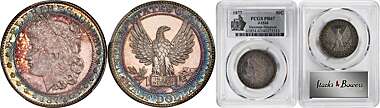
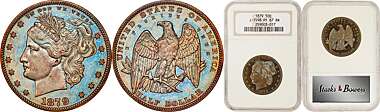
Lote 2226. 1877 Pattern Morgan Half Dollar. Judd-1514, Pollock-1678. Rarity-7-. Silver. Reeded Edge. Proof-66 Deep Cameo (PCGS). CAC. Obv: Liberty head faces left, surrounded by a beaded circle, with the Latin motto E PLURIBUS UNUM inscribed along the upper border and the date 1877 at the lower border. Thirteen stars are arranged around the border between the motto and date, six left, seven right. Liberty is wearing a cap, the band of the cap ornamented with ears of wheat, cotton leaves and bolls. The portrait is virtually identical to that which the Mint used for regular issue Morgan dollar production beginning in 1878. Rev: An eagle with raised wings is perched atop a scroll inscribed with the motto IN GOD WE TRUST. Behind the scroll are an olive branch and three arrows. The central design is surrounded by a beaded circle, the legend UNITED STATES OF AMERICA around the border and the denomination HALF DOLLAR below. Glowing surfaces readily reveal strongly reflective fields and softly frosted motifs through an overlay of golden-orange iridescence. The toning deepens to more of a reddish-gold tinge at the borders, where it is joined by wisps of powder blue. An elegant Gem Deep Cameo Proof, well struck, expertly preserved, and visually stunning. According to research by R.W. Julian, the obverse and reverse dies of Judd-1514 represent the first of four designs that George T. Morgan prepared for pattern half dollars in 1877. Only seven specimens are known in silver, the present example only the second that we have brought to auction since 2011. Ex Waldo C. Newcomer; F.C.C. Boyd; Dr. J. Hewitt Judd; Coronet Coin Fixed Price List; our (Stack's) sale of March 80, lot 716; Steve Ivy Numismatic Auctions, Inc.'s Boston ANA Auction of August 1982, Catalog II, lot 2891; Virginia collection; Heritage's FUN Signature Auction of January 2017, lot 6168, as PCGS/CAC Proof-65 Deep Cameo; Legend Rare Coin Auctions' Regency Auction XXIII, October 2017, lot 432. The plate coin for the type in the Judd reference on U.S. pattern coinage, first through seventh editions. PCGS# 134084. NGC ID: 2ADX. PCGS Population: 2; with a single Proof-66+ Deep Cameo finer in all categories.CAC Stickered Population: 2; 0. Exquisite 1877 Pattern Morgan Half Dollar Judd-1514 in Silver
  • Precio de salida:
    1 USD
    0 EUR
    0 GBP
    0 CHF

    Importes redondeados, solo aproximadosFecha: 06/11/2026
Lote
Lote 2227. 1877 Pattern Morgan Half Dollar. Judd-1516, Pollock-1680. Rarity-7+. Silver. Reeded Edge. Proof-67 (PCGS). Obv: Liberty head that is similar to that adopted for the regular issue Morgan silver dollar in 1878, modified in size to fit this planchet stock. There is an inner beaded circle around Liberty, within which is the date below, the Latin motto E PLURIBUS UNUM above, and 13 stars arranged six left, seven right. Rev: Engraver George T. Morgan's spread wing eagle with large feathers. The eagle stands upon a scroll inscribed with the motto IN GOD WE TRUST, from which extends an olive branch and lightening bolt arrows. Surrounding the eagle is a beaded peripheral circle with the legend UNITED STATES OF AMERICA above and the denomination HALF DOLLAR below. This is a richly and attractively toned specimen with direct lighting calling forth the most vivid iridescence of gold, blue and pinkish-rose. There is some light striking at the centers, typical of this variety, and detracting little from the quality or eye appeal of this lovely Superb Gem Proof. The uspatterns.com website accounts for only six silver examples from these dies. Rare. Ex possibly "Colonel" E.H.R. Green; Eric P. Newman Numismatic Education Society; Heritage's sale of the Eric P. Newman Collection, Part I, April 2013 CSNS Signature Auction, lot 4012, as NGC/CAC Proof-67+; Bob R. Simpson; Heritage's sale of the Bob R. Simpson Collection, January 2021 FUN Signature Auction, lot 3231. PCGS# 61854. NGC ID: 26X4. PCGS Population: just 1 in Proof-67 in all categories; 0 finer. A Second 1877 Pattern Morgan Half Dollar Judd-1516 in SilverThe Newman-Simpson Coin
  • Precio de salida:
    1 USD
    0 EUR
    0 GBP
    0 CHF

    Importes redondeados, solo aproximadosFecha: 06/11/2026
Lote
Lote 2228. 1877 Pattern Morgan Half Dollar. Judd-1520, Pollock-1684. Rarity-8+. Silver. Reeded Edge. Proof-65 (PCGS). Obv: Liberty head faces left, surrounded by a beaded circle, with the Latin motto E PLURIBUS UNUM inscribed along the upper border and the date 1877 at the lower border. Thirteen stars are arranged around the border between the motto and date, six left, seven right. Liberty is wearing a cap, the band of the cap ornamented with ears of wheat, cotton leaves and bolls. The portrait is virtually identical to that which the Mint used for regular issue Morgan dollar production beginning in 1878. Rev: An eagle displayed on a spade-shaped shield clutches three arrows in its left talon and an olive branch in its right. The shield partially overlaps a band inscribed with the motto IN GOD WE TRUST. A laurel wreath encircles the shield and band, the legend UNITED STATES OF AMERICA is above, and the denomination HALF DOLLAR is below. This is a wonderfully original Gem, the obverse toned in blended olive, pearl gray and rose-russet patina. The reverse exhibits antique gold and steel-olive peripheral colors around a mauve-gray center. Direct lighting brings out vivid undertones of champagne-pink, powder blue and pale gold - very attractive. A modestly cameo finish is not mentioned on the PCGS holder, but the fields are semi-reflective and support frosty, smartly impressed design elements. The simply outstanding quality and eye appeal are fitting complements to this coin's great rarity.For many years the 1877 pattern half dollar series has been the Holy Grail of specialists. Although there are many favorites, it is generally agreed that the designs by George T. Morgan are especially beautiful. According to the uspatterns.com website, research by R.W. Julian confirms that this is the first of four half dollar obverse dies prepared by Morgan, the patterns themselves struck in February 1877. Specimens that combine this obverse with the spade-shaped shield reverse are exceedingly rare. Only three or four copper impressions (Judd-1521) are known, one of which sold as lot 4224 in our March 2012 sale of the Samuel J. Berngard Collection. The silver striking offered here is unique, as confirmed by the Pollock reference, the 10th edition of Judd, and the uspatterns.com website. We (as Bowers and Ruddy) offered this coin in November 1979 as part of the fabulous Garrett Collection, then sold it in March 2020 as part of the world class Pogue cabinet, and are pleased to be bringing this unique rarity to auction for a third time through this current offering. It remains one of the most significant and desirable of all 1877 pattern Morgan half dollars, and should find a new home in another fine collection. Ex George W. Cogan, March 17, 1883; T. Harrison Garrett, to Robert and John Work Garrett, by descent, 1888; Robert Garrett interest to John Work Garrett, 1919, transfer completed 1921; John Work Garrett to The Johns Hopkins University, by gift, 1942; our (Bowers and Ruddy's) sale of the Garrett Collection for The Johns Hopkins University, Part I, November 1979, lot 386; Ken Goldman; D. Novoselsky; Kagin's; Superior's Elite Coin Auction of July 2003, lot 462; our sale of the D. Brent Pogue Collection, Part VII, March 2020 Auction, lot 7373. PCGS# 61858. NGC ID: 2AE5. Unique 1877 Judd-1520 Pattern Morgan Half Dollar With Provenance to George W. Cogan, 1883
  • Precio de salida:
    1 USD
    0 EUR
    0 GBP
    0 CHF

    Importes redondeados, solo aproximadosFecha: 06/11/2026
Lote
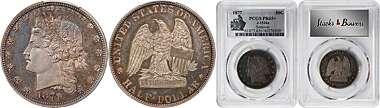
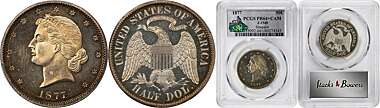
Lote 2229. 1877 Pattern Half Dollar. Judd-1524, Pollock-1692. Rarity-7-. Silver. Reeded Edge. Proof-65 (PCGS). Obv: Designed by William Barber, a Liberty head faces left with 13 stars around the border and the date 1877 below; the second digit 7 in the date is close to the denticles. Liberty is wearing a cap inscribed LIBERTY and decorated with ears of wheat, cotton leaves and bolls. Rev: A small eagle with spread wings is displayed on a shield with an olive sprig in its right talon and three arrows in its left talon. Around the shield is a band inscribed with the mottos IN GOD WE TRUST above, E PLURIBUS UNUM below. The legend UNITED STATES OF AMERICA is inscribed along the upper border and the denomination HALF DOLLAR is at the lower border. This striking Gem Proof is toned in dominant steely-olive gray patina, the obverse with enhancing golden-blue and pinkish-rose iridescence, the reverse with soft underlying champagne-gold and powder blue. Well struck, if trivially soft at the central obverse high points, with strong reflectivity shining forth from smooth surfaces as the coin rotates under a light. The design is attributed to William Barber, and the obverse also appears on the pattern goloid dollars of 1878 to 1880. Two die varieties are known, distinguished primarily by the distance of the second digit 7 in the date from the denticles. The Rarity-7- rating for the basic Judd-1524 attribution is due to the fact that there are seven specimens confirmed for Pollock-1690, the second die prepared by Barber (per the uspatterns.com website), with the digit 7 distant from the denticles. Pollock-1692, Barber's first die, with the second digit 7 in the date close to the denticles, is unique in silver, offered here, and also unique in copper, Judd-1525/Pollock1693. A fantastic opportunity for the advanced collector that may not come along again for many years, if not decades. Ex Dr. Edward Maris, June 1886; T. Harrison Garrett, to Robert and John Work Garrett, by descent, 1888; Robert Garrett interest to John Work Garrett, 1919, transfer completed 1921; John Work Garrett to The Johns Hopkins University, by gift, 1942; our (Bowers and Ruddy's) sale of the Garrett Collection for The Johns Hopkins University, Part I, November 1979, lot 388; Harry W. Bass, Jr.; our (Bowers and Merena's) sale of the Harry W. Bass, Jr. Collection, Part I, May 1999, lot 1228, as PCGS Proof-64; Bob R. Simpson; Heritage's sale of the Bob R. Simpson Collection, January 2021 FUN Signature Auction, lot 3232. PCGS# 61864. NGC ID: 2AE9. PCGS Population (all categories): 1; 0 finer. Stunning Judd-1524 Pattern Liberty Head Half Dollar Unique First Obverse Die Strike in Silver, Pollock-1692
  • Precio de salida:
    1 USD
    0 EUR
    0 GBP
    0 CHF

    Importes redondeados, solo aproximadosFecha: 06/11/2026
Lote
Lote 2230. 1877 Pattern Half Dollar. Judd-1526, Pollock-1694. Rarity-7+. Silver. Reeded Edge. Proof-66 Cameo (PCGS). CAC. Obv: William Barber's Helmeted Liberty Head design. Liberty head faces left with the motto IN GOD WE TRUST above, the date 1877 below, and 13 stars arranged around the border, seven left, six right. Liberty is wearing a crested helmet embossed with an eagle motif, and the word LIBERTY on the visor. Rev: A small eagle with spread wings is displayed on a shield with an olive sprig in its right talon and three arrows in its left talon. Around the shield is a band inscribed with the mottos IN GOD WE TRUST above, E PLURIBUS UNUM below. The legend UNITED STATES OF AMERICA is inscribed along the upper border and the denomination HALF DOLLAR is at the lower border. This is a bright and virtually brilliant example, dipped long ago, but with subtle retoning in champagne-gold, and highly attractive. An otherwise razor sharp strike comes up just a tad soft in the centers, also to no detriment. Carefully preserved surfaces are solidly in the Gem Cameo Proof category, confirming this as an elegant example of a rare and seldom-offered design among pattern half dollars.Only four examples of this die pairing in silver are known, per the uspatterns.com website. Andy Pollock observes that William Barber's Helmeted Liberty design was inspired by a drawing that Christian Gobrecht prepared in the late 1830s. Ex William H. Woodin; Waldo C. Newcomer; "Colonel" E.H.R. Green; Burdette G. Johnson, to the following, via December 13, 1944 invoice; New Netherlands' sale of the Taylor Collection, 61st Sale, June 1970, lot 63; Harry W. Bass, Jr.; our (Bowers and Merena's) sale of the Harry W. Bass, Jr. Collection, Part I, May 1999, lot 1230, as PCGS Proof-65; Bob R. Simpson; Heritage's sale of Important Selections from the Bob R. Simpson Collection, Part I, September 2020, lot 10319. The plate coin for the type in both the Adams-Woodin and Pollock references on pattern coinage. PCGS# 861866. NGC ID: 2AEB. PCGS Population (all categories): 1; 1 finer (Proof-66+ Cameo).CAC Stickered Population: 2; 0. One of Only Four Judd-1526 Pattern Half Dollars Known Barber's Helmeted Liberty Head ObverseThe Bass-Simpson Specimen
  • Precio de salida:
    1 USD
    0 EUR
    0 GBP
    0 CHF

    Importes redondeados, solo aproximadosFecha: 06/11/2026
Lote
Lote 2231. 1877 Pattern Half Dollar. Judd-1531, Pollock-1699. Rarity-7+. Copper. Reeded Edge. Proof-67+ RB (PCGS). Medallic alignment. Obv: William Barber's Helmeted Liberty Head design. Liberty head faces left with the motto IN GOD WE TRUST above, the date 1877 below, and 13 stars arranged around the border, seven left, six right. Liberty is wearing a crested helmet embossed with an eagle motif, and the word LIBERTY on the visor. Rev: An eagle with spreads wings is perched on a tablet inscribed with the Latin motto E PLURIBUS UNUM. The eagle clutches an olive branch in its right talon and three arrows in its left talon. The legend UNITED STATES OF AMERICA is inscribed along the upper border, the denomination HALF DOLLAR along the lower border. An outstanding example, this premium Superb Gem Proof retains considerable mint orange color. Warmly toned in medium brown, as well, with enhancing blushes of iridescent salmon-pink and lilac-blue. Both sides are sharply struck and have very pleasing surfaces.A mere six specimens of this die pairing in copper are confirmed, per the uspatterns.com website. That offered here is the finest known, outranking a second ex Simpson specimen graded slightly lower in PCGS Proof-67 RB, and lacquered. This one is truly outstanding, and we are honored to once again bring it to auction. Ex Abner Kreisberg's sale of November 1970, lot 1304; Harry W. Bass, Jr.; our (Bowers and Merena's) sale of the Harry W. Bass, Jr. Collection, Part I, May 1999, lot 1233, as PCGS Proof-66 RB; Heritage's Long Beach Signature Auction of February 2001, lot 7482, as PCGS Proof-66 RB; Bob R. Simpson; Heritage's sale of the Bob R. Simpson Collection, November 2020 Signature Auction, lot 3251. PCGS# 71871. NGC ID: 2AEF. PCGS Population (all categories): 1; 0 finer. Finest Known 1877 Judd-1531 Half Dollar One of Barber's Helmeted Liberty Head Patterns in Copper
  • Precio de salida:
    1 USD
    0 EUR
    0 GBP
    0 CHF

    Importes redondeados, solo aproximadosFecha: 06/11/2026
Lote
Lote 2232. 1877 Pattern Half Dollar. Judd-1534a, Pollock-1701. Rarity-8+. Silver. Reeded Edge. Proof-65+ (PCGS). Medallic alignment. Obv: Liberty head faces left with the motto IN GOD WE TRUST above, date 1877 below, and 13 stars arranged around the border seven left, six right. Liberty is wearing a coronet inscribed LIBERTY in raised letters and decorated with wheat ears, cotton leaves and bolls. Rev: An eagle with upraised wings is perched on a tablet on which is inscribed the Latin motto E PLURIBUS UNUM. The eagle clutches an olive branch and three arrows in its right talon and supports a shield with its left talon. The legend UNITED STATES OF AMERICA is inscribed along the upper border, the denomination HALF DOLLAR along the lower border. Delight surfaces are originally toned in steel gray and russet patina backlit by vivid iridescence in antique gold, apricot and powder blue. Smartly impressed and crisp, with expectably smooth surfaces at the premium Gem grade level. Although the depth of toning precludes appreciation of this feature at most viewing angles, the finish is cameoed with softly frosted motifs set against reflective fields.This is one of numerous extremely rare die pairings of pattern 1877 half dollars. In this case only two are known in copper, Judd-1534, with the Judd-1534a specimen in silver offered here unique. Given the number of similar offerings in this sale, this is certainly a major numismatic event for advanced pattern enthusiasts. Ex George W. Cogan; T. Harrison Garrett, to Robert and John Work Garrett, by descent, 1888; Robert Garrett interest to John Work Garrett, 1919, transfer completed 1921; John Work Garrett to The Johns Hopkins University, by gift, 1942; our (Bowers and Ruddy's) sale of the Garrett Collection for The Johns Hopkins University, Part I, November 1979, lot 390; our (Bowers and Merena's) Aubrey Bebee Collection sale, August 1987, lot 1503; Superior's Jascha Heifetz Collection sale, October 1989, lot 3277; D. Novoselsky; Superior's Elite Coin Auction of July 2003, lot 467, as NGC Proof-65; Bob R. Simpson; Heritage's sale of the Bob R. Simpson Collection, January 2021 FUN Signature Auction, lot 3234. PCGS# 61875. NGC ID: 2AEJ. The Garrett-Simpson Judd-1534a Pattern Half Dollar Unique
  • Precio de salida:
    1 USD
    0 EUR
    0 GBP
    0 CHF

    Importes redondeados, solo aproximadosFecha: 06/11/2026
Lote
Lote 2233. 1877 Pattern Half Dollar. Judd-1540, Pollock-1711. Rarity-7+. Silver. Reeded Edge. Proof-64+ Cameo (PCGS). CAC. Obv: Bust of Liberty faces left, with hair in a bun and wearing a star tiara inscribed LIBERTY. Thirteen stars encircle the border with the date 1877 below. Notably the truncation line shows more curvature than commonly seen, and the face of Liberty is more expressive, both confirming the hand of Anthony C. Paquet, as opposed to George T. Morgan or William Barber. Rev: A simple eagle with outstretched wings and boxy shield on its breast, grasping a scroll inscribed E PLURIBUS UNUM in its beak and clutching an olive branch and three arrows in its right and left talon, respectively. The legend UNITED STATES OF AMERICA is above, the denomination HALF DOL. below. Delightful reddish-gold iridescence adorns the obverse and periphery on the reverse, yielding to virtual brilliance toward the center on the latter side. The strike is full in virtually all areas, the surfaces with just a few faint lines from ancient numismatic handling that do no more than preclude a full Gem Proof numeric grade. The eye appeal is outstanding.The first pair of dies for Judd-1540 broke quickly and all known examples from those dies display a prominent die crack extending from stars 5 through 1, the date, and extending into stars 12 and 13. Aside from the absence of the die crack, the date positioning relative to the point of the bust is also different between the two sets of dies. The present example is one of just five known from the first die pairing, per the uspatterns.com website, and it is the only one to have secured coveted CAC approval at any grade level. We expect pattern collectors will eagerly pursue this impressive specimen with a robust pedigree. Ex: "Colonel" E.H.R. Green; Burdette G. Johnson, April 12, 1946; Gaston DiBello; our (Stack's) sale of the Gaston DiBello Collection, Part II, May 1970, lot 396; Robert L. Hughes Enterprises' Byron Johnson Collection sale, January 1979, lot 73; our (Bowers and Merena's) sale of the Morris Evans Collection, August 1998 Rarities Sale, lot 2093; Superior's Baltimore Elite Sale of July 2003, lot 469; Heritage's November 2003 Signature Sale, lot 11213, as NGC Proof-65; Heritage's December 16, 2003 Exclusively Internet Auction, lot 13724, as NGC Proof-65; Heritage's July 6, 2004 Exclusively Internet Auction, lot 12284, as NGC Proof-65; Heritage's Pittsburgh Signature Sale of August 2004, lot 8010, as NGC Proof-65; Bob R. Simpson; Heritage's sale of the Bob R. Simpson Collection, April 2021 CSNS Signature Auction, lot 4277. The uspatterns.com website plate coin, PCGS# 535092. NGC ID: 2AEP. PCGS Population (all categories): just 2 in all grades: Proof-62, and the present example in Proof-64+ Cameo.CAC Stickered Population: 1 in all grades. Cracked Die Obverse Judd-1540 Pattern Half Dollar Just Five KnownThe Only CAC Example
  • Precio de salida:
    1 USD
    0 EUR
    0 GBP
    0 CHF

    Importes redondeados, solo aproximadosFecha: 06/11/2026
Lote
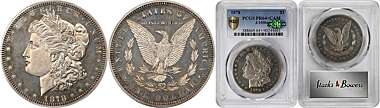
Lote 2234. 1878 Pattern Morgan Dollar. Judd-1550a, Pollock-1723. Rarity-6-. Silver. Reeded Edge. Proof-64+ Cameo (PCGS). CAC. Obv: Essentially the same design that the Mint adopted for regular issue Morgan silver dollar production in 1878. On examples of Pollock-1723, as represented by the coin in this lot, the point of the truncation of Liberty's neck is centered between star 1 and the digit 1 in the date. Additionally, the wheat ear at the top of Liberty's cap touches the right tip of the base of the letter R in PLURIBUS. Rev: Also very similar in design to that adopted for the regular issue Morgan dollar series, but there are two important differences. First, there are no notches on the undersides of the eagle's wings where they join the torso. Second, there are three leaves on the branch in the eagle's right talon, all of which are clustered at the end of the branch. This Choice Cameo Proof specimen is a real delight to behold, what with delicate toning in golden-olive iridescence that gives way to gently speckled russet undertones as the surfaces rotate into direct lighting. The strike is razor sharp throughout and there are few blemishes in evidence. A highly significant pattern featuring Morgan's famous design, this coin is sure to see spirited bidding.The Judd-1550 and Judd-1550a patterns represent the first silver strikings of the design that would eventually develop into the regular issue Morgan silver dollar. Approximately 50 specimens were struck in the Mint from December 1, 1877 to January 2, 1878, using several different die pairings. Given the extreme popularity of the Morgan dollar with collectors, these patterns enjoy an equally strong following among advanced specialists.A rare type, the die variety represented by the Pollock-1723 attribution has an extant population of "over a dozen known (actually 15) including one in the Smithsonian" (per the uspatterns.com website). PCGS# 388669. NGC ID: 2AF2. PCGS Population: 1; 3 finer in this category (Proof-66 Cameo finest).CAC Stickered Population: 1; 1. The former total includes coins certified both Proof-64 Cameo and Proof-64+ Cameo. Rare and Exciting Judd-1550a Pattern Morgan Dollar
  • Precio de salida:
    1 USD
    0 EUR
    0 GBP
    0 CHF

    Importes redondeados, solo aproximadosFecha: 06/11/2026
Lote
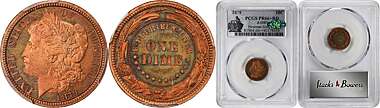
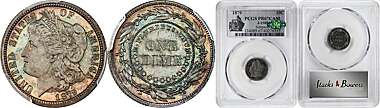
Lote 2235. 1879 Pattern Morgan Dime. Judd-1587, Pollock-1780. Rarity-6+. Copper. Reeded Edge. Proof-66+ RD (PCGS). CAC. Obv: Head of Liberty facing left with the legend UNITED STATES OF AMERICA around the border and the date 1879 below. The portrait is essentially a miniature of that featured on the regular issue Morgan silver dollar introduced in 1878. Rev: The motto E PLURIBUS UNUM, denomination ONE DIME, and an arc of 13 stars are inscribed within a dotted circle. Surrounding the circle is a wreath of corn, tobacco, cotton, and wheat. Glorious premium Gem surfaces exhibit full mint color in orange-olive that assume a rose-orange tint as the coin rotates into direct lighting. The fields are gently reflective and support smartly impressed, softly frosted design elements. A few tiny carbon specks on and before Liberty's portrait are easily overlooked during most viewing situations but are significant as provenance markers, nonetheless. Among the finest, most visually appealing of just 12 to 15 examples of Judd-1587 believed extant per the uspatterns.com website. Beautiful! From Heritage's sale of the Eric P. Newman Collection, April 2013 CSNS Signature Auction, lot 4017, as NGC/CAC Proof-66 RD; Heritage's sale of the Bob R. Simpson Collection, January 2021 FUN Signature Auction, lot 3242. PCGS# 81964. NGC ID: 2AGD. PCGS Population: 1; 0 finer in this category.CAC Stickered Population: 2; 0. The former total includes coins certified both Proof-66 RD and Proof-66+ RD. Eagerly Sought 1879 Pattern Morgan Dime Judd-1587 in CopperEx Newman-Simpson
  • Precio de salida:
    1 USD
    0 EUR
    0 GBP
    0 CHF

    Importes redondeados, solo aproximadosFecha: 06/11/2026
Lote
Lote 2236. 1879 Pattern Morgan Dime. Judd-1588, Pollock-1781. Rarity-6+. Silver. Reeded Edge. Proof-67 Cameo (PCGS). CAC. Obv: George T. Morgan's famed Liberty head used on the silver dollar of that year, with the legend UNITED STATES OF AMERICA surrounding and the date 1879 below. Rev: A continuous wreath of laurel with berries encircles an inner beaded border, in which are the Latin motto E PLURIBUS UNUM, the denomination ONE DIME, and 13 small stars. This beautifully toned jewel exhibits a mottling of antique gold, power blue and pale pink beneath warm steely-olive pewter patina. An exacting strike has called forth even the most intricate elements of the design. Boldly cameoed in finish with outstanding surface preservation that approaches numismatic perfection.An elusive and highly prized rarity from the Morgan pattern series. Somewhat more than a dozen specimens of Judd-1588 in silver are known, and with most in lower grades, the fleeting nature of this offering cannot be overstated. Ex Superior's Rare Coin Auction Sale of December 1972, lot 2190; Hank Rodgers, February 24, 1973; David Faraday; Heritage's ANA Sale of August 1994, lot 6151; Heritage's Summer FUN Signature Auction of June 2008, lot 1757, as NGC/CAC Proof-67; Heritage's FUN Signature Auction of January 2010, lot 2379, as NGC/CAC Proof-67; Heritage's FUN Signature Auction of January 2011, lot 5387, as NGC/CAC Proof-67; Bob R. Simpson; Heritage's sale of the Bob R. Simpson Collection, January 2021 FUN Signature Auction, lot 3243. PCGS# 134089. NGC ID: 2AGE. PCGS Population: just 1; 0 finer in this category.CAC Stickered Population: 1; 0. Highly Desirable 1879 Judd-1588 Dime Pattern Morgan Design
  • Precio de salida:
    1 USD
    0 EUR
    0 GBP
    0 CHF

    Importes redondeados, solo aproximadosFecha: 06/11/2026
Lote
Lote 2237. 1879 Pattern Morgan Quarter Dollar. Judd-1593, Pollock-1787. Rarity-7-. Silver. Reeded Edge. Proof-65 (PCGS). OGH. Obv: Liberty head that is essentially a miniature version of that which the Mint used for regular issue Morgan silver dollar production, 1878 to 1921. The periphery in inscribed ** E PLURIBUS ******* UNUM **** with the date 1879 below. Rev: An eagle with spread wings clutches an olive sprig in its right talon, a group of three arrows in its left. The legend UNITED STATES OF AMERICA is inscribed along the upper border, the motto IN GOD WE TRUST curves through the lower field around the eagle, and the denomination QUARTER DOLLAR is inscribed along the lower border. Delicate iridescent toning in champagne-pink and olive-gray adorns fully impressed, appreciably reflective surfaces.Slightly over a dozen of these are known, per the uspatterns.com website, which is far too small of a number to meet demand from pattern enthusiasts and advanced Morgan dollar collectors. We expect this delightful Gem to see spirited bidding and sell for a nice premium. From our (Bowers and Merena's) Ebenezer Milton Saunders Collection sale, November 1987, lot 454; Heritage's sale of the Klamath Mountain Collection, Part II, January 2014 FUN Signature Auction, lot 5639; our sale of the Seven Lions Collection, sold to benefit the Higgins Museum of National Bank Notes, Summer 2025 Global Showcase Auction, August, lot 3478. PCGS# 61970. NGC ID: 2AGJ. The first generation PCGS insert uses coin #11970, seemingly a typo for what should be 61970. PCGS Population: 2; with a single Proof-68 finer in this category. Intriguing 1879 Morgan Quarter Dollar Judd-1593 in Silver
  • Precio de salida:
    1 USD
    0 EUR
    0 GBP
    0 CHF

    Importes redondeados, solo aproximadosFecha: 06/11/2026
Lote
Lote 2238. 1879 Pattern Washlady Half Dollar. Judd-1597, Pollock-1791. Rarity-6+. Silver. Reeded Edge. Proof-67 Cameo (PCGS). CAC. Obv: Chief Engraver Charles E. Barber's Washlady or Society Lady motif with a left facing head of Liberty. Liberty is wearing a headband inscribed LIBERTY and ornamented with ears of wheat, cotton leaves and bolls. Thirteen stars are arranged around the border seven left, six right with the motto IN GOD WE TRUST above and the date 1879 below. Rev: An eagle with outstretched wings clutches an olive branch in its right talon and three long arrows in its left talon. The Latin motto E PLURIBUS UNUM is inscribed in the field directly above the eagle, the legend UNITED STATES OF AMERICA is above the motto, and the denomination HALF DOLLAR is inscribed along the lower border. Crescents of cobalt blue decorate the peripheries and give way to lighter, somewhat mottled, yet equally attractive champagne-pink iridescence elsewhere. Although there is a touch of softness to the high points in and around the centers, this as a well struck, overall sharply defined example of this perennially popular pattern type. Boldly cameo in finish with expertly preserved, virtually pristine surfaces. This silver striking of the Washlady half dollar is rare and there are just 12 to 15 examples known per the uspatterns.com website. This one is among the absolute finest. From New Netherlands' sale of the Taylor Collection, 61st Sale, June 1970, lot 73; Legend Rare Coin Auctions' Regency Auction XXIII, October 2017, lot 433. PCGS# 389268. NGC ID: 2AGM. PCGS Population: 2; 0 graded higher in any category.CAC Stickered Population: 1; 0. Beautiful Washlady Pattern Half Dollar by Charles Barber Judd-1597 Silver
  • Precio de salida:
    1 USD
    0 EUR
    0 GBP
    0 CHF

    Importes redondeados, solo aproximadosFecha: 06/11/2026
Lote
Lote 2239. 1879 Pattern Washlady Half Dollar. Judd-1598, Pollock-1792. Rarity-6+. Copper. Reeded Edge. Proof-67 BN (NGC). Obv: Chief Engraver Charles E. Barber's Washlady or Society Lady motif with a left facing head of Liberty. Liberty is wearing a headband inscribed LIBERTY and ornamented with ears of wheat, cotton leaves and bolls. Thirteen stars are arranged around the border seven left, six right with the motto IN GOD WE TRUST above and the date 1879 below. Rev: An eagle with outstretched wings clutches an olive branch in its right talon and three long arrows in its left talon. The Latin motto E PLURIBUS UNUM is inscribed in the field directly above the eagle, the legend UNITED STATES OF AMERICA is above the motto, and the denomination HALF DOLLAR is inscribed along the lower border. A wonderfully original Superb Gem, both sides exhibit vivid cobalt blue and antique gold undertones to rich copper-rose patina. Direct lighting also calls forth modest semi-reflective tendencies from the fields - very attractive. Sharply struck throughout with expectably smooth and attractive surfaces for the assigned grade.The Washlady design is widely considered to be one of the most beautiful ever produced by the United States Mint and is one of the most eagerly sought patterns in today's market. At the time of their creation, however, the Washlady pieces were not held in as high esteem by contemporary collectors. The style of Liberty's hair, in particular, was widely criticized in that it gave the portrait a somewhat disheveled appearance. David Proskey is credited with the Washlady name as an expression of contemporary ridicule for this design, its first known use coming as part of New York Stamp and Coin's April 1891 sale of the F.W. Doughty Collection. The modern term "Society Lady" is a more elegant description for this motif, but examples of this type continue to be most widely known by their traditional name.The Washlady motif appears on pattern dimes, quarters, half dollars and dollars of 1879, generally in either silver or copper, although unique white metal impressions are also known for the three largest denominations. Copper strikings of the Washlady half dollar, as here, are rare with just 12 to 15 examples known per the uspatterns.com website. From the Mack C. Chase Collection. Earlier from Heritage's sale of the Harold Hoogasian Collection, January 2003 FUN Signature Sale, lot 9942. PCGS# 61976. NGC ID: 2AGN. NGC Census: 1 in all grades in the BN category. The higher of two coins graded in the PCGS Brown category is at Proof-66 BN. Celebrated Pattern Washlady Half Dollar by Charles Barber Judd-1598 in Copper
  • Precio de salida:
    1 USD
    0 EUR
    0 GBP
    0 CHF

    Importes redondeados, solo aproximadosFecha: 06/11/2026
Lote
Lote 2240. 1879 Pattern Standard Dollar. Judd-1605, Pollock-1801. Rarity-7-. Silver. Reeded Edge. Proof-64 Cameo (PCGS). CAC. Obv: Liberty head faces left, the design reminiscent of the popular Washlady motif of the year, although the hair is arranged differently and is much shorter at the back. The motto IN GOD WE TRUST is above, 13 stars are arranged at the border, seven left and six right, and the date 1879 is below. Rev: An eagle with spread wings clutches an olive branch in its right talon and three arrows in its left talon. A laurel wreath tied with a bow at its base encircles the lower portion of the eagle with the Latin motto E PLURIBUS UNUM inscribed directly in the field above the head. The legend UNITED STATES OF AMERICA is above and the denomination ONE DOLLAR is below. Delicately toned in champagne-pink and cobalt blue iridescence that finds greatest expression at the borders. Sharply struck with bold field to device contrast.Patterns of this type are attributed to Chief Engraver William Barber with examples known in silver, copper and white metal, the final-listed variant of which is unique. Silver and copper impressions are of similar rarity with approximately 12 to 15 specimens known for each, as related by the uspatterns.com website. Ex Kentucky collection, via Jeff Garrett, as NGC Proof-64; Heritage's sale of the Pacific Rim Collection, January 2022 FUN Signature Auction, lot 4791. PCGS# 624016. NGC ID: 2AGW. PCGS Population: 1; graded higher in any category. There are no grading events listed in the PCGS DCAM category.CAC Stickered Population: 1; 0. Lovely 1879 Pattern Liberty Head Standard Dollar by William Barber Judd-1605 in Silver
  • Precio de salida:
    1 USD
    0 EUR
    0 GBP
    0 CHF

    Importes redondeados, solo aproximadosFecha: 06/11/2026
Lote
Lote 2241. 1879 Pattern Schoolgirl Standard Dollar. Judd-1608, Pollock-1804. Rarity-6+. Silver. Reeded Edge. Proof-65 (PCGS). CAC. Obv: George T. Morgan's famous Schoolgirl design. Bust of Liberty faces left with the Latin motto and stars arranged **E PLURIBUS *******UNUM**** around the border and the date 1879 below. Liberty's hair is combed straight back and tied with a ribbon, a hairband inscribed LIBERTY crossing the top of her head and a string of pearls around her neck. Rev: A defiant eagle strides left atop a scroll with the motto IN GOD WE TRUST. An olive branch and three arrows are behind the scroll. The legend UNITED STATES OF AMERICA is above, the denomination ONE DOLLAR below. The obverse is beautifully toned in a mixture of electric blue, magenta, gold and other light iridescent hues. The more reserved reverse displays warm charcoal-steel with a few intermingled swirls of pearl gray. There is some evidence of light striking at the centers, particularly on the flank of the eagle, although most design elements are razor sharp.In February and March 1878, George T. Morgan's Liberty Head dollar (today's popular "Morgan dollar") design was rushed into production following the February 28 passage of the Bland-Allison Act. The obverse and reverse designs were taken from the memorable series of pattern half dollars that Morgan had prepared in 1877. Several of these pattern Morgan half dollars are also being offered in this sale.As time went on, it was felt that the design could be improved, and several varieties of patterns were made during the next few years. The 1879 Schoolgirl dollar pattern was created by Morgan, and was made only in small numbers. In the same vein, Morgan created the 1882 Shield Earring pattern dollar. Whatever the circumstances may have been, neither the Schoolgirl nor Shield Earring dollar was ever seriously considered for circulating coinage. No doubt the criticism of Chief Engraver William Barber, himself the creator of several unadopted varieties of pattern dollars of this era, played a part.Today the 1879 Schoolgirl dollar is considered by many to be the capstone of the United States pattern dollar series or, at the very least, among the top several American coinage motifs in this denomination. The uspatterns.com website has confirmed the existence of just 15 silver impressions from these dies, three of which are held by museum and research collections: two in the Smithsonian and one by the American Numismatic Society. In addition, several others have been dipped, if not abrasively cleaned. This fully original, aesthetically pleasing specimen clearly represents an important bidding opportunity for advanced pattern or silver dollar enthusiasts. Ex Harlan P. Smith; Henry Chapman's sale of the John Story Jenks Collection, December 1921, lot 5697; Clapp estate; Louis E. Eliasberg, Sr.; our (Bowers and Merena's) sale of the Louis E. Eliasberg, Sr. Collection, May 1996, lot 288; our sale of the D. Brent Pogue Collection, Part VII, March 2020 Auction, lot 7377. Possibly also from New York Coin and Stamp's sale of the F.W. Doughty Collection, April 1891, per the uspatterns.com website. PCGS# 61986. NGC ID: 2AGY. PCGS Population: 4; 3 finer in this category (all Proof-65+).CAC Stickered Population: 3; 2. Classic 1879 Pattern Schoolgirl Dollar in Silver The Jenks-Eliasberg-Pogue Specimen
  • Precio de salida:
    1 USD
    0 EUR
    0 GBP
    0 CHF

    Importes redondeados, solo aproximadosFecha: 06/11/2026
Lote
Lote 2242. 1881 Pattern Liberty Head Nickel. Judd-1673, Pollock-1874. Rarity-7-. Aluminum. Reeded Edge. Proof-66 Cameo (PCGS). CAC. Obv: Similar to that of the regular issue Liberty Head nickel introduced in 1883, except the legend UNITED STATES OF AMERICA is around the border in place of 13 stars and the date, of course, is 1881. Rev: A Roman numeral V for the denomination is set within a wreath of corn, wheat, and cotton. Bright silver gray mirrors support frosted design motifs in a heavily contrasting manner, with a nuance of pale champagne adding greatly to the overall appeal. A simply gorgeous coin for the assigned grade, one with strong physical character and equally strong eye appeal. Slightly more than half a dozen examples of this Judd number are known, this being one of the finest. Ex our (American Numismatic Rarities') Red Bank Collection sale, December 2003, lot 275, as PCGS Proof-64; Bob R. Simpson; Heritage's sale of the Bob R. Simpson Collection, February 2021 Signature Auction, lot 3305. PCGS# 534936. NGC ID: 2AJY. PCGS Population: just 1 in all grades in the CAM category.CAC Stickered Population: 1; 0. Gem Cameo Proof 1881 Judd-1673 Five-Cents Pattern Liberty Head Design
  • Precio de salida:
    1 USD
    0 EUR
    0 GBP
    0 CHF

    Importes redondeados, solo aproximadosFecha: 06/11/2026
Lote
Lote 2243. 1882 Pattern Liberty Head Nickel. Judd-1690, Pollock-1892. Rarity-5. Nickel. Plain Edge. Proof-67 Deep Cameo (PCGS). CAC. Obv: Similar to the design that the Mint adopted for regular issue Liberty Head nickel production in 1883, although the stars around the border are arranged in a somewhat different manner. Rev: The No CENTS design that the Mint adopted for regular issue Liberty Head nickel production in 1883. This is a sharply struck, strongly cameo specimen that contrasts frosty motifs with reflective fields. Both sides are untoned apart from the lightest golden-champagne iridescence.A popular precursor to the regular issue Liberty Head nickel of 1883 to 1912, Judd-1690 enjoys strong demand among both series specialists and pattern enthusiasts. The uspatterns.com website accounts for just two or three dozens examples in numismatic hands, and we believe that tis is the finest known. From our (American Numismatic Rarities') William H. LaBelle, Sr. Collection sale, July 2005, lot 53; Heritage's sale of the Bob R. Simpson Collection, August 2021 ANA Signature Auction, lot 3226. PCGS# 826016. NGC ID: 2AKC. PCGS Population: just 1 in all grades in the DCAM category.CAC Stickered Population: 1; 0. Perennially Popular Pattern 1882 Liberty Head Nickel Finest Known
  • Precio de salida:
    1 USD
    0 EUR
    0 GBP
    0 CHF

    Importes redondeados, solo aproximadosFecha: 06/11/2026
Lote
Lote 2244. 1882 Pattern Shield Nickel. Judd-1693, Pollock-1895. Rarity-7-. Nickel. Plain Edge. Proof-67 Deep Cameo (PCGS). Obv: Similar to the design of the regular issue 1882 nickel, but modified to omit the ornamental ball at the base of the shield. Rev: The same design that the Mint used to strike regular issue 1882 Shield nickels. Lightly toned in golden iridescence, this fully impressed, nicely cameoed example makes a lovely impression in all regards.This is an elusive pattern in all metallic compositions, nickel specimens, as here, with an extant population of only a dozen or so coins. This unimprovable Superb Gem will appeal to pattern specialists as well as advanced Shield nickel enthusiasts. Ex Dr. J. Hewitt Judd; Abe Kosoff's C.S.N.A. Convention Auction Sale of October-November 1968, lot 1229; Robert L. Hughes Enterprises' Phillip Warner Sale, January 1980, lot 19; our (Bowers and Merena's) sale of Rare Coins from the Abe Kosoff Estate, November 1985, lot 1120; Mid-American Rare Coin Auctions' F.U.N. Sale of January 1989, lot 2986; Heritage's ANA Signature Sale of August 1996, lot 5047, as PCGS Proof-65; our (Bowers and Merena's) sale of the Waterbury Collection, January 2003 Rarities Sale, lot 977, as PCGS Proof-65; our (American Numismatic Rarities') Thomas H. Sebring Collection sale, January 2004, lot 28, as PCFGS Proof-65; Heritage's Pittsburgh Signature Sale of August 2004, lot 8024, as PCGS Proof-65; Heritage's September 28, 2004 Exclusively Internet Auction, lot 13409, as PCGS Proof-65; our (American Numismatic Rarities') Robert Michael Prescott Collection, January 2006, lot 877, as PCGS Proof-65; Heritage's FUN Signature Auction of January 2007, lot 1608, as PCGS Proof-65; Bob R. Simpson; Heritage's sale of the Bob R. Simpson Collection, February 2021 Signature Auction, lot 3307. PCGS# 535022. NGC ID: 2AKF. PCGS Population: just 1 in all grades in the DCAM category. Exquisite DCAM Proof Judd-1693 Pattern Shield Nickel
  • Precio de salida:
    1 USD
    0 EUR
    0 GBP
    0 CHF

    Importes redondeados, solo aproximadosFecha: 06/11/2026
Lote
Lote 2245. 1883 Pattern Liberty Head Nickel. Judd-1709, Pollock-1913. Rarity-7-. Aluminum. Plain Edge. Proof-67 Cameo (PCGS). Obv: Charles E. Barber's Liberty Head portrait, used on the regular issue nickel five-cent piece from 1883 to 1912. The legend UNITED STATES OF AMERICA is around the border, and the date 1883 is below. Rev: The composition 75 N. / 25 C. is centered within a wreath of corn and cotton. The denomination is divided FIVE above, CENTS below, with 13 stars arranged around the border, seven left and six right. As described by the uspatterns.com website: "This is one of 4 patterns for this year using different alloys of nickel and/or copper showing their composition on the reverse within the wreath." Judd-1709, offered here, is the aluminum striking, and it is a significant numismatic rarity with only about a half dozen specimens known. This the Simpson coin, the finest certified at PCGS, and a dazzling Superb Gem with fully struck motifs and bold field to device contrast. Ex Steve Ivy Numismatic Auctions, Inc.'s American Numismatic Association Auction of August 1982, Catalog II, lot 2904; our (Bowers and Merena's) sale of the Waterbury Collection, January 2003 Rarities Sale, lot 981, as PCGS Proof-66; Bob R. Simpson Collection; Heritage's sale of the Bob R. Simpson Collection, April 2021 CSNS Signature Auction, lot 4307. PCGS# 411247. NGC ID: 2AKX. PCGS Population: 1; 0 graded higher in any category. There are no grading events listed in the PCGS DCAM category. Awe-Inspiring 1883 Pattern Liberty Head Nickel in Aluminum
  • Precio de salida:
    1 USD
    0 EUR
    0 GBP
    0 CHF

    Importes redondeados, solo aproximadosFecha: 06/11/2026
Lote
Lote 2246. 1883 Pattern Liberty Head Nickel. Judd-1710, Pollock-1914. Rarity-5. Nickel. Plain Edge. Proof-65 (PCGS). Gold CAC. OGH. Obv: Barber's Liberty head, as adopted in 1883 for the regular issue Liberty Head nickel, but with the legend UNITED STATES OF AMERICA around the border in lieu of stars. The date 1883 is below. Rev: An open-topped wreath of corn and cotton with the denomination FIVE above, CENTS below. Peripheral stars are arranged seven left, six right, and the composition 50 N. / 50 C. is within the wreath. This is one of several five-cent patterns for this year using different alloys of nickel and/or copper showing their composition on the reverse within the wreath. Heavily frosted motifs and nicely mirrored fields are virtually untoned to allow ready appreciation of a boldly cameoed finish that goes unmentioned on the Generation 3.0 PCGS holder. A handsome piece, and especially desirable as the only Gold CAC example for this Judd number. From Heritage's FUN Signature Auction of January 2021, lot 4914. PCGS# 62127. NGC ID: 2AKY. PCGS Population: 11; 5 finer in this category (Proof-67 finest).Gold CAC Stickered Population: just 1 in all grades, all categories. The Only Gold CAC Judd-1710 Pattern Nickel Barber's Liberty Head Motif
  • Precio de salida:
    1 USD
    0 EUR
    0 GBP
    0 CHF

    Importes redondeados, solo aproximadosFecha: 06/11/2026
Lote
Lote 2247. 1883 Pattern Liberty Head Nickel. Judd-1711, Pollock-1915. Rarity-7-. Aluminum. Plain Edge. Proof-66 (PCGS). Obv: Barber's head of Liberty, as adopted in 1883 for the regular issue Liberty Head nickel, but with the legend UNITED STATES OF AMERICA around the border in lieu of stars. The date 1883 is below. Rev: An open-topped wreath of corn and cotton with the denomination FIVE above, CENTS below. Peripheral stars are arranged seven left, six right, and the composition 50 N. / 50 C. is within the wreath. The rare aluminum counterpart to the Judd-1710 pattern nickel offered above, this is a silver-tinged beauty with some semblance of cameo contrast between reflective fields and lightly frosted motifs. Fully struck and so carefully preserved as to border on pristine. A mere half dozen or so of these are known, per the uspatterns.com website, and this finest seen by PCGS. From Heritage's sale of the Bob R. Simpson Collection, January 2021 FUN Signature Auction, lot 3268. PCGS# 62128. NGC ID: 2AKZ. PCGS Population: 1; 0 finer. There are no grading events listed in the PCGS CAM or DCAM categories. Stellar-Quality Judd-1711 Pattern Liberty Head Nickel Finest PCGS-Certified Aluminum StrikingEx Simpson
  • Precio de salida:
    1 USD
    0 EUR
    0 GBP
    0 CHF

    Importes redondeados, solo aproximadosFecha: 06/11/2026
Lote
Lote 2248. 1885 Pattern Morgan Dollar. Judd-1749, Pollock-1961. Rarity-7-. Aluminum. Lettered Edge. Proof-66 Cameo (PCGS). Struck from the same dies that the Mint used in the production of regular issue 1885 Morgan silver dollars, although with the edge lettered as follows: * * * * * * E * / PLURIBUS * / UNUM * * * * *. The collar containing the edge lettering was comprised of three segments, each equal to one third the circumference of the coin. A lovely platinum-white Gem with a full strike, brilliant surfaces and an overall pristine appearance.This intriguing and popular pattern type owes its existence to Archibald Loudoun Snowden who, as superintendent of the Philadelphia Mint, felt that raised edge lettering would offer enhanced protection from counterfeiters for U.S. gold and silver coins. Actually, the third side of a coin - its edge - had long played a key role in frustrating the attempts of counterfeiters, as well as protecting against defacement through clipping and filing. The earliest known use of raised edge lettering was in 1658 when the English government of Oliver Cromwell issued silver half crowns and crowns with this feature. Early U.S. Mint gold and silver coinage opted for either sunken relief lettering or reeding on the edge. By 1860, however, counterfeiting and filing had become such a severe problem that additional means were being sought to protect our nation's coinage. As early as 1867 Snowden, then serving as chief coiner, recommended using raised edge lettering, although it was not until 1885 that this proposal was pursued with vigor.The catalyst for serious experimentation with raised edge lettering during the mid 1880s was the arrest in 1884 of two skilled counterfeiters. Their work so worried Snowden that he set about developing a mechanism that would allow for the efficient production of coins with raised edge letters. Although his efforts met with initial success, as evidenced by the existence of patterns such as that offered here, the project was abandoned when Snowden resigned his position as superintendent before the end of 1885. It was not until the introduction of Augustus Saint-Gaudens' eagle and double eagle in 1907 that raised edge lettering was adopted for use on regular issue U.S. coinage.In 1885, under Snowden's supervision, the Mint struck pattern Morgan dollars with raised edge lettering in silver, copper and aluminum. The silver and copper impressions are of roughly equal rarity today with 15 to 20 examples known in each metallic composition. Aluminum impressions are even more elusive, the present specimen one of just eight to 10 known per the uspatterns.com website. From our (Bowers and Merena's) Lexington Collection sale, January 1994, lot 1604, as PCGS Proof-65; Ira & Larry Goldberg's Pre-Long Beach Auction of September 2003, lot 1035; Heritage's sale of the David Cassel Collection, August 2015 Chicago ANA Signature Auction, lot 4575; Heritage's FUN Signature Auction of January 2021, lot 4915. PCGS# 389302. NGC ID: 2ALV. PCGS Population: 1; 3 finer in this category (Proof-68 Cameo). Highly Significant Pattern 1885 Morgan Dollar with Raised Edge Lettering Rare Judd-1749 Variety in Aluminum
  • Precio de salida:
    1 USD
    0 EUR
    0 GBP
    0 CHF

    Importes redondeados, solo aproximadosFecha: 06/11/2026
Lote
Lote 2249. Undated (1835-1837) Christopher Bechtler $1. K-3. Rarity-6. 28.G. Centered, No Star. Reeded Edge. AU-55 (PCGS). An elusive variety, this is the first example of the C. Bechtler K-3 gold dollar that we have offered in nearly a decade. Attractive Choice AU preservation for a Christopher Bechtler gold dollar irrespective of variety, both sides are dressed in deep olive-gold color with enhancing highlights of iridescent pinkish-rose. The strike is well centered and bold on both sides. Accuracy compels us to mention several wispy pin scratches in the expansive field areas on both sides, but the in-hand appearance is pleasingly smooth in the absence of sizeable marks.Christopher Bechtler and his son Augustus and nephew Christopher, Jr. operated their own private mint in Rutherfordton, North Carolina from 1830 to 1852. The coins were struck at two sites: at their home in Rutherfordton and near their mine just north of town. Originally housed at the American Numismatic Society Museum, the coin press and several of the dies are currently on display at the Bechtler House Museum in Rutherfordton. The family was among the earliest private minters servicing the nation's first major gold rush in the Piedmont region of North Carolina and Georgia. Kagin-3, offered here, is one of Christopher Bechtler, Sr.'s rarer gold dollars and is seen far less often than the popular N Reversed variety (K-4). This offering represents an excellent opportunity for advanced territorial gold type collectors and Bechtler coin specialists. PCGS# 10058. NGC ID: 2B96. PCGS Population: 3; 9 finer, just two of which are Mint State (both MS-61). Seldom Offered Kagin-3 Bechtler Gold Dollar
  • Precio de salida:
    1 USD
    0 EUR
    0 GBP
    0 CHF

    Importes redondeados, solo aproximadosFecha: 06/11/2026
Lote
Lote 2250. Undated (1835-1837) Christopher Bechtler $1. K-3. Rarity-6. 28.G. Centered, No Star. Reeded Edge. AU-53 (PCGS). Given the elusiveness of this variety and the infrequency with which we have offered examples in years past, you can imagine your cataloger's surprise when he was given the opportunity to present multiple examples in this sale. The PCGS AU-53 offered here boasts handsome surfaces that exhibit mottled coppery highlights to otherwise dominant honey-gold color. Boldly defined with only light wear, direct lighting also calls forth glints of original mint finish from the protected areas around the devices. A few light scrapes and wispy pin scratches in the fields are noted for accuracy, more so for the obverse. PCGS# 10058. NGC ID: 2B96. Rare Second Offering for a K-3 Bechtler G$1 Here you can find the Video-Tour.
  • Precio de salida:
    1 USD
    0 EUR
    0 GBP
    0 CHF

    Importes redondeados, solo aproximadosFecha: 06/11/2026
Lote
Lote 2251. Undated (late 1834-1842) Christopher Bechtler $2.50. K-13. Rarity-5+. 70.G:, 20 CARATS. MS-62 (NGC). Exceptional frosty to modestly semi-reflective surfaces are further enhanced by vivid colors in bright golden-olive and honey-rose. The surfaces are remarkably smooth for both the type and the assigned grade, accuracy alone compelling us to mention a thin reverse scruff in the field between the letter H in BECHTLER and the digit 2 in 250. With a sharp strike throughout, as well, this is one of several desirable Bechtler gold coin rarities that we are offering in this sale. Kagin-13 is a fifth issue C. Bechtler variety, without the first initial C in the legend. Our offerings for this variety in recent decades have been few and far between, some of which have been for impaired coins. The quality conscious collector would be hard pressed to improve upon this pretty Mint State survivor. PCGS# 10070. NGC ID: 2B9J. NGC Census: 5; 1 finer (MS-63). The corresponding PCGS population is 6/2 (MS-63 also finest). Noteworthy Mint State C. Bechtler K-13 $2.50 Rarity
  • Precio de salida:
    1 USD
    0 EUR
    0 GBP
    0 CHF

    Importes redondeados, solo aproximadosFecha: 06/11/2026
Lote
Lote 2252. 1851 Augustus Humbert $50. Lettered Edge. K-4. Rarity-5. 50 DC, 887 THOUS., 50 on Reverse. MS-61 (PCGS). A highly significant offering for the specialist, and even more so as one of the finest Lettered Edge Humbert "slugs" known to PCGS. Handsome surfaces display pleasing deep honey-olive gold color with iridescent reddish-rose highlights. Surprisingly well preserved with mostly small, singularly inconspicuous handling marks scattered about - far from serious and far less obtrusive than typically seen for the issue. We're certain that in-hand inspection will convince you this specimen is entirely deserving of the coveted Mint State rating assigned by PCGS. The edge of this elusive variety reads AUGUSTUS HUMBERT UNITED STATES ASSAYER OF GOLD CALIFORNIA 1851, while the reverse exhibits a sunken 50 at the center of the design.James Wilson Marshall's discovery of gold in California's American River on January 24, 1848 kicked off one of the largest, and certainly the most romanticized gold rush in United States history. As news of this discovery spread, 300,000 people from both the Eastern United States and abroad would eventually make their way to California seeking wealth and prosperity. Some did strike it rich, although the majority bettered themselves little, either financially or otherwise. A small settlement of 200 souls in 1846, San Francisco had grown exponentially into a city of 36,000 people by 1852.Such a tremendous surge in population in a short period of time resulted in an acute shortage of circulating currency. Gold dust, which was quickly adopted as a medium of exchange, proved difficult to work with in this regard and little more than a stopgap measure. Then there was the additional problem of what to do with all of the gold that was being mined. Clearly it needed to be converted into a form that was universally acceptable so that it could not only be used in commerce in California, but could also be transported to major economic centers so as to contribute to the nation's larger economy.As early as 1849 proposals were introduced both in the California Legislature and United States Congress calling for the establishment of an assay office or branch mint in California. Competing political interests delayed action on the federal government's part, and most Californians wanted more than simply a state-run assay office. To meet the immediate economic needs of Gold Rush California while final action on the part of the state and/or federal government was awaited, various private minting firms sprang up in and around San Francisco. The firm of Moffat & Co., however, became the most important private minter serving the California Gold Rush; its successors Curtis, Perry and Ward eventually sold their facility to the United States government, which reopened it as the San Francisco Mint in March 1854.While still under the auspices of Moffat & Co., the firm's reputation caught the eye of the federal government when the latter was finally able to take action in the establishment of a local coinage facility to service the Gold Rush. Unfortunately, however, Californians did not initially get the branch mint they desired, due to competing political interests. Rather, a compromise bill passed through Congress on September 30, 1850, and established the United States Assay Office, to be located in San Francisco. Moffat & Co. received the contract to operate as the United States Assay Office, with New York watchmaker Augustus Humbert appointed as United States Assayer. Humbert arrived in San Francisco on January 30, 1851, bringing with him the first dies for coinage that had been prepared by Charles C. Wright. The first coins - $50 gold pieces - were issued under Humbert's authority the following day, with ingots following on February 14. The United States Assay Office continued to operate with these principals until the dissolution of Moffat & Co. in early 1852, after which the federal contract was assumed by Curtis, Perry & Ward under the name of the United States Assay Office of Gold. Humbert remained as assayer under the successor firm until it ceased operations on December 14, 1853.Nearly a branch mint in its own right, the operations of the United States Assay Office in 1851 and 1852 represent an important and defining chapter in the coinage history of the California Gold Rush and, indeed, the nation as a whole. One of Humbert's $50 gold pieces from his first year as assayer in California, this virtually About Uncirculated coin offers the advanced collector with an important opportunity to own a truly memorable memento of this widely studied and avidly collected era in United States frontier history.While all Lettered Edge slugs are early productions of Humbert's United States Assay Office of Gold, the 2023 Kagin and McCarthy book suggests the Kagin-4 variety represented here was actually struck earlier than its K-2 counterpart. This variety, like Kagin-1, includes the denomination 50 at the center of the reverse. Kagin and McCarthy suggest, sensibly, that the slugs with a denomination were likely struck during the first two months of 1851 when the assay office was manufacturing ingots of substantially higher values. Once the U.S. Assay Office was out of that business, "sometime before March 1," they could safely leave off the denomination and likely struck the $50 slugs after that date with no reverse denomination. This explains why some slugs have the stamped 50 and some lack it; it also explains why this variety is so rare while the 880 THOUS / No 50 variety (Kagin-2) is somewhat more common. Property from an Alabama Family. Earlier from Heritage's sale of the Bob R. Simpson Collection, Part III, January 2021 FUN Signature Auction, lot 3053. PCGS# 10208. NGC ID: ANH4. PCGS Population: 6; 2 finer (MS-62+ finest). Superior Quality 1851 K-4 Humbert Octagonal $50 "Slug" Lettered Edge, 887 THOUS, 50 on Reverse
  • Precio de salida:
    1 USD
    0 EUR
    0 GBP
    0 CHF

    Importes redondeados, solo aproximadosFecha: 06/11/2026
Lote
Lote 2253. 1851 Augustus Humbert $50. Lettered Edge. K-4. Rarity-5. 50 DC, 887 THOUS., 50 on Reverse. EF-45 (PCGS). Gold CAC. CMQ-X. OGH. Here is a thoroughly PQ example of this legendary and imposing issue. Vivid honey-gold surfaces are enhanced by delicate, iridescent overtones of pinkish-rose that gravitate toward the protected areas around the design elements. Strike detail is soft at the central obverse high points, typical of the type, yet sharper elsewhere including a sharp and fully legible inscription around the obverse periphery, bold and clear 50 at central reverse. Scattered marks are noted, again commensurate with the type, but amazingly none warrant individual attention. Both the quality and eye appeal of this piece are far superior to what is typically seen for this type both in certified EF-45 and, indeed, at all lightly circulated levels of preservation. Sure to sell for a very strong premium to a discerning numismatist. From Heritage's sale of the Klamath Mountain Collection, January 2012 FUN Signature Auction, lot 5145, where it realized $184,000. PCGS# 10208. NGC ID: ANH4. Gold CAC Stickered Population: just 1 in all grades. Premium 1851 Kagin-4 Humbert $50 Historic Gold Rush Era IssueThe Only Gold CAC Example
  • Precio de salida:
    1 USD
    0 EUR
    0 GBP
    0 CHF

    Importes redondeados, solo aproximadosFecha: 06/11/2026
Lote
Lote 2254. 1851 Augustus Humbert $50. Reeded Edge. K-6. Rarity-5-. 887 THOUS., First Target Reverse. AU Details--Damage (PCGS). The large octagonal $50 "slugs" of Augustus Humbert are among the first to come to mind when many collectors think about the numismatic heritage of the California Gold Rush. Issued for only a few years starting in 1851, the huge coins have become symbols of the exploration of vast riches that lay within the rocks of Northern California. The earliest $50 pieces came from the United States Assayer of Gold, Augustus Humbert, who in 1851 joined up with Moffat & Co. to produce large denomination ingots using obverse dies prepared by Charles Cushing Wright. The earlier issues in two purity levels, 0.880 fine and 0.887 fine, all bore an intricate geometric design on the reverse, reminiscent of a target. The denomination, while large for the time, proved to be popular and saw extensive use in commerce. While initially accepted at the Customs House, a law passed in August 1852 forbade the use of gold of purity lower than the statutory 0.900 fine to pay customs dues. Many of the lower fineness slugs ended up being recoined into 0.900 fine $50 pieces. Ultimately, when the United States Mint at San Francisco opened in 1854, even the high purity coins ended up in the melting pots, leaving few survivors for collectors to enjoy today. This is certainly a desirable PCGS-certified example of an important type that is often found at the top of many collectors' want lists. PCGS# 10214. NGC ID: ANH9. AU 1851 K-6 Humbert $50
  • Precio de salida:
    1 USD
    0 EUR
    0 GBP
    0 CHF

    Importes redondeados, solo aproximadosFecha: 06/11/2026
Lote
Lote 2255. 1851 Augustus Humbert $50. Reeded Edge. K-6. Rarity-5-. 887 THOUS., First Target Reverse. EF-45 (NGC). A pleasing example of this classic $50 gold type from the California Gold Rush. Rich honey-rose color blankets both sides, the surfaces of which also reveal hints of frosty luster as the coin rotates under a light, as well as subtle pinkish-rose highlights. Peripheral strike detail is typical of the type and comes up short most significantly on the obverse, where portions of the legend are difficult to discern. High point softness to the eagle is also typical for both the issue and the assigned grade, as are scattered handling marks which include several prominent edge bruises. The surfaces have a curious, somewhat matte-like texture that we mention for accuracy, but are visually appealing in a circulated survivor of this large and impressive type. This coin will certainly have no difficulty finding its way into an advanced collection, be it a Territorial gold type set or one focused on California Gold Rush issues. PCGS# 10214. NGC ID: ANH9. Handsome EF Augustus Humbert $50 "Slug" Kagin-6 887 THOUS Target Variety
  • Precio de salida:
    1 USD
    0 EUR
    0 GBP
    0 CHF

    Importes redondeados, solo aproximadosFecha: 06/11/2026
Lote
Lote 2256. 1851 Augustus Humbert $50. Reeded Edge. K-6. Rarity-5-. 887 THOUS., First Target Reverse. VF-35 (PCGS). Offering bold detail to the focal features in and around the centers, as well as warm color in even golden-olive, this coin has much to recommend it to advanced collectors in the territorial gold discipline. The obverse periphery is expectably soft for a Humbert $50 in Choice VF, especially at bottom and right, where little detail is seen, including a just barely perceptible date. Lightly bruised at left reverse, scattered marks are also consistent with both the type and grade. All California Gold Rush era $50 slugs are prized numismatic properties, and this Kagin-6 Humbert is no exception. PCGS# 10214. NGC ID: ANH9. Nice Mid-Grade Kagin-6 Humbert $50
  • Precio de salida:
    1 USD
    0 EUR
    0 GBP
    0 CHF

    Importes redondeados, solo aproximadosFecha: 06/11/2026
Lote
Lote 2257. 1852 United States Assay Office of Gold $50. K-13. Rarity-4+. 887 THOUS. EF-45 (PCGS). Scarce in an absolute sense, this is among the most historic and coveted issues of the California Gold Rush. Warm honey-gold and deeper olive colors blanket both sides and provide strong visual appeal. The strike is pleasing for the type, with bold central elements and the usual weakness at the borders. The edges are fairly well preserved, and the surfaces reveal only the expected small and moderate size handling marks that often mar these hefty "slugs".The earliest of the $50 pieces were produced in 1851 under Augustus Humbert's name at a non-federal .880 fine standard, which quickly rose to 0.887 fine. In 1852, Humbert's name was entirely removed and the slugs were then struck under the name of the United States Assay Office of Gold, but still at the same 0.887 standard. Things proceeded well for the Assay Office and even smaller denomination coins were struck. An unexpected blow came in the form of legislation passed in August 1852 that suddenly forbade the Customs Office from accepting any gold coin not struck at the federally-mandated 0.900 purity. This legislation resulted in the replacement of the 887 THOUS pieces, Kagin-13 represented here, with the K-14 900 THOUS type. Today, perhaps a few hundred of these impressive $50 gold "slugs" of all types are extant, most of which are well worn and also impaired due to cleaning, significant edge and/or surface damage. Problem free and attractive EF examples, like the present, are highly desirable. PCGS# 10016. NGC ID: ANHG. Handsome 1852 K-13 Assay Office of Gold $50 Slug
  • Precio de salida:
    1 USD
    0 EUR
    0 GBP
    0 CHF

    Importes redondeados, solo aproximadosFecha: 06/11/2026
Lote
Lote 2258. 1855 Wass, Molitor & Co. $50. K-9. Rarity-5. AU-58 (PCGS). Truly memorable quality for this visually striking, eagerly sought, yet extremely challenging California Gold Rush issue. Survivors of Wass, Molitor & Co.'s $50 issue are usually heavily marked, at least moderately worn, and all too often outright impaired due to surface damage, repairs, and the like. Remarkably, none of these or any other significant detractions are seen here. Thoroughly PQ for the type, this piece carries evidence of minimal commercial use that takes the form of trivial high point wear to the design motifs and a few generally minor marks. Overall detail is sharp and allows full appreciation of this classic motif. The only mark that is worthy of individually attention - and then again only for provenance purposes - is a dull nick on Liberty's chin. The ubiquitous hairlines are seen on both sides, but they are light, minimally distracting, and represent a combination of light commercial and minimal numismatic handling. Considerable frosty luster and faint semi-reflective tendences persist, and they are joined by handsome color in light, even olive-gold. Extremely limited PCGS certification totals at both the Choice AU and Mint State grade levels solidifies the awesome condition rarity of this highly significant coin.The story of Wass, Molitor & Company has its beginnings in the Austro-Hungarian Empire and the 1848-1849 war for Hungarian independence. Born in Hungary, Count Samuel C. Wass and Agoston P. Molitor both studied metallurgy in Germany before returning to their native country to pursue their careers in the Hungarian mining regions. There they remained until the winds of revolution that had been swirling around Europe swept into Hungary, culminating in a declaration of independence from the Austro-Hungarian Empire on April 18, 1848. Quickly Poland allied with the Hungarian revolutionaries and war against Austria and the Hapsburg emperor spread throughout the region. The war was finally suppressed in October of 1849, and many of the pro-Hungarian independence revolutionaries were forced into exile, including both Wass and Molitor. Seeing opportunity in North America, many Hungarian expatriates arrived in the United States just as the California Gold Rush was gathering momentum.Arriving in California from the Old World, these immigrants found a booming economy struggling to cope with explosive growth. Within two years of the discovery of gold, the population in Northern California had quadrupled and continued to grow every day. Unfortunately, the money supply did not grow at the same rate and coinage of any sort was scarce. Transporting freshly mined gold to the mints back East was a long and arduous process and repeated petitions for a branch mint made to Congress back in Washington were met with opposition and would be held up for several years. While other parts of the country would address such monetary crises with currency, in the West paper was met with almost universal distrust. Indeed this was codified into Article IV section 34 of the 1849 California Constitution which forbade any bank to "make, issue, or put in circulation, any bill, check, ticket, certificate, promissory note, or other paper, or the paper of any bank, to circulate as money." Gold dust proved useful as a stop-gap measure but could be easily adulterated and its purity could not be consistently assured. Many local jewelers and assayers attempted to fill the need for coins but these efforts met with varying degrees of success.Samuel Wass arrived in San Francisco in October 1850 and set immediately to work in the California gold fields. He produced a detailed geological report of the region which was published in the Alta California on January 13, 1851. Wass prefaced his report with the following explanation as to his reasoning behind his journey to the West:Gentlemen-As a native of a mining country in Europe I have felt a great deal of interest in all that I have heard and read about this country. My curiosity was highly excited during my sojourn in the States, having received so many accounts of the extraordinary formations and riches of nature in California. I made up my mind to visit the place in the company with two friends…Wass quickly established a reputation as a highly regarded expert in metallurgy and the latest mining technology from Europe. Sometime in early 1851, Molitor arrived to California and soon joined his fellow expatriate. On October 14, 1851, the pair announced the formation of Wass, Molitor & Co. as an assay office located in San Francisco on Montgomery Street below Bush Street. Success came quickly to the firm and they relocated to the fireproof building formerly occupied by banker and Civil War general Henry M. Naglee, on the corner of Montgomery and Merchant streets. There, they set up an extensive smelting operation and assay laboratory that was widely praised in the local newspapers for its modernity. At least one newspaper noted that the firm did not endeavor to produce their own coins but rather used whatever was on hand to pay depositors. This may have been the impetus for the assayers to contemplate entering the coining business. In January 1852, Wass, Molitor & Co. announced that they were prepared to begin producing what they referred to as "small coin" in $5 and $10 denominations. The purity levels fell below federal standard, so to compensate, the coins were made slightly heavier. Their coins soon fetched a premium in circulation and were eagerly accepted in trade. The amount of these coins that were struck is not known, but may have been sufficient that no further coining operations were required for the next two years.In the meantime, Congress finally granted approval for a branch mint to be established in San Francisco which commenced operations in 1854. The difficulty of acquiring the necessary parting acids for refining raw gold meant that it would be some time before the San Francisco Mint would be able to strike enough coins to relieve the region's monetary shortages. After an especially lengthy layoff at the Mint, in March 1855 a group of prominent merchants and bankers petitioned Wass, Molitor & Co. to resume coining operations. The firm responded in the Alta California that it was prepared to do so within a week. Shortly thereafter, Wass, Molitor & Co. resumed striking coins and produced $10, $20, and round $50 gold pieces. These, too, proved to be popular and circulated widely until the San Francisco Mint was able to produce the much-needed federal coins in a more consistent manner.The design of the $50 piece is more functional than artistic. The bust on the obverse is small, seemingly more befitting a $20 coin. The reverse with its simple wreath surrounding the denomination resembles the contemporary fractional gold pieces. The May 16, 1855, Alta California reported that "Wass, Molitor & Co. have commenced issuing their fifty and twenty dollar pieces, at the rate of $38,000 per day. The coin is above the U.S. standard and is confidently received in trade throughout the State." The round shape also seems to have helped acceptance of the coins since they were easier to handle than their octagonal counterparts from the United States Assay Office of Gold. Despite their brief tenure in circulation at the tail end of the private gold issuing period, the $50 coins were readily absorbed into trade. By late 1855 Wass, Molitor & Co.'s coins were no longer required. Sometime in late 1855 or early 1856, Wass, Molitor & Co. dissolved and reorganized as Wass, Usznay & Co. Around this time, Wass left the region but eventually returned to continue the assay business with his son. Agoston Molitor left for London in 1856 and did not return to the United States. Property from an Alabama Family. PCGS# 10363. NGC ID: ANJU. PCGS Population: 3; 3 finer (MS-63 finest). Exquisite 1855 Wass, Molitor & Co. $50 Classic California Gold Rush Era Rarity
  • Precio de salida:
    1 USD
    0 EUR
    0 GBP
    0 CHF

    Importes redondeados, solo aproximadosFecha: 06/11/2026
Lote
Lote 2259. 1861 Clark, Gruber & Co. $10. K-7. Rarity-4. AU-50 (PCGS). Attractive deep honey-olive color is enhanced by exceptionally vivid reddish-rose iridescence that is most pronounced in the protected areas around the design elements. The surfaces are remarkably smooth for a lightly circulated example of this type, and both the rims and devices remain incredibly attractive. Appreciable frosty luster remains to further tempt the advanced territorial gold collector.While the California Gold Rush steals much of the limelight, the discovery of gold in Colorado in the late 1850s is no less important. As prospectors returned eastward from the Colorado gold fields, they brought with them tales of the challenges in conducting any form of trade in gold dust, a common complaint during the earlier California and Appalachian gold rushes. Three enterprising merchants in Leavenworth, Kansas, brothers Austin and Milton Clark and merchant Emmanuel Gruber, heard these stories and decided that a profitable enterprise could be had providing banking and assay services in the gold fields and in early 1860 formed Clark, Gruber & Company as a bank, assay office, and mint. In mid 1860, the firm was able to commence striking coins in $2.50, $5, $10, and $20 denominations using gold dust of high purity. The coins were quickly accepted by the miners and soon Clark, Gruber & Co. became the most prolific of the comparatively few Colorado coiners. The high purity of the locally mined alloy proved to be a detriment in circulation since the coins wore easily, so the following year Clark, Gruber & Co. added a higher concentration of silver to the alloy, all the while keeping the total gold content roughly 1% higher than their federal equivalents to ensure continued use. In 1862, the company ceased coining operations after producing just under $600,000 face value in their coins. The federal government took notice of the operation and in April of 1863 bought the Clark, Gruber & Co. facility and equipment. The government converted the facility to an assay office before finally converting it to a branch mint in 1906. The coins were widely accepted in local commerce for many years and as a result most observed specimens are often found in very low grades. Lightly worn and with exceptional eye appeal, this 1861 $10 would be an important addition to any advanced gold cabinet. PCGS# 10141. NGC ID: ANK4. Historic 1861 Clark, Gruber & Co. $10
  • Precio de salida:
    1 USD
    0 EUR
    0 GBP
    0 CHF

    Importes redondeados, solo aproximadosFecha: 06/11/2026
Lote
Lote 2260. 1883 Hawaii Dollar. Medcalf-Russell 2CS-5. MS-65+ (CACG). Outstanding technical quality and visual appeal in an example of this extremely challenging issue, this awe-inspiring dollar would serve as the undisputed centerpiece of even the finest collection of Kingdom of Hawaii silver coinage being assembled in today's market. Both sides are strikingly original with rich cobalt blue peripheral toning that yields to gently mottled rose and apricot iridescence toward the centers. The obverse is the more boldly and extensively toned of the two sides, but both are equally lustrous with an intensely frosted finish from the dies. The dollar displays the least amount of intricate definition of the four silver denominations struck for circulation for the Kingdom of Hawaii, as designed, but superior striking quality for the present example has resulted in uncommonly sharp definition. The strike is full, in fact, and we note particularly intricate detail to the hair and beard on the obverse portrait. Surfaces that are remarkably smooth in a Hawaii dollar round out an impressive list of attributes for this conditionally rare upper end Gem.The initiative to have the United States produce circulating silver coinage for the Kingdom of Hawaii came from Claus Spreckels, banker, sugar tycoon and the power behind the sovereign King Kalakaua I. The United States government accepted this proposal in 1883, as part of an ongoing initiative to improve friendly relations and economic links with the Hawaiian Islands. Using dies created by Charles E. Barber at the Philadelphia Mint, the San Francisco Mint struck $1,000,000 worth of silver coinage for circulation in four denominations: dime, quarter, half dollar and dollar. The coins circulated extensively at first, but their legal tender status was short-lived. On January 14, 1903, President Theodore Roosevelt approved an act of Congress to redeem the Hawaiian silver coins at par with United States coinage. Most examples were redeemed and melted, in fact, and by January 1, 1904 the Hawaiian coins were no longer legal tender. No more than $200,000 worth of coins was left outstanding from the original face value mintage of $1,000,000, with the larger denominations from the quarter through dollar being hardest hit by the redemption. Out of a mintage of 500,000 pieces, for example, all but 46,348 of the dollar coins were redeemed and destroyed. Among the survivors, worn condition is far more the norm than Mint State, and most pieces are also impaired due to cleaning, damage, etc. Attractive, original and problem free Gems such as that offered here are very rare and, on the few occasions when they appear at auction, represent a fleeting bidding opportunity for the quality conscious collector.The truly outstanding quality and special nature of this coin were instantly recognized by John Albanese when the coin was submitted to CACG for certification. In an Instagram post by cacgrading on April 15, 2025, John stated: "When this 1883 Hawaiian Dollar came into the grading room, everyone needed a look. This piece is one of the better examples we have seen, period." PCGS# 10995. NGC ID: 2C5D. CACG Population: 1; 0. Finest CACG-Certified 1883 Hawaii Dollar John Albanese: "One of the Better Examples We Have Seen, Period" Here you can find the Video-Tour.
  • Precio de salida:
    1 USD
    0 EUR
    0 GBP
    0 CHF

    Importes redondeados, solo aproximadosFecha: 06/11/2026
Lote
Lote 3001. DE-83. Delaware. May 1, 1777. 6 Pence. PCGS Banknote Superb Gem Uncirculated 68 PPQ. No. 50805. A downright exceptional Colonial-era piece from Delaware dating to the 1770s. This example represents a small assortment of Colonial-era notes from Delaware that somehow survived at this grade level for the benefit of collectors here in the present. Assigned a grade of Superb Gem Uncirculated 68 PPQ by PCGS Banknote, bidders are left with nothing to doubt that distinction. Superb registration and bold inks complement crisp boardwalk-like margins while the penned elements remain as sharp as one would expect for the grade assigned and deftly exemplified by the signature of Richard Lockwood.
  • Precio de salida:
    600 USD
    537 EUR
    448 GBP
    491 CHF

    Importes redondeados, solo aproximadosFecha: 06/11/2026
Lote
Lote 3002. DE-91. Delaware. May 1, 1777. 10 Shillings. PCGS Banknote Superb Gem Uncirculated 67 PPQ. No. 37460. Burdened with the penned signatures of J. Laws and J. Witbank, bidders are met here with a truly fine sight to behold in technical terms. Graded Superb Gem Uncirculated 67 PPQ by PCGS Banknote, this Colonial-era note from Delaware does offer more than simply a numerical grade of "67" and the margins and registrations typical of this grade assigned. Here one may look upon the format of this denomination which is much larger than the "change notes" from this emission which disproportionately account for the high-grade survivors from this emission often seen at the Superb Gem Uncirculated grade level. PCGS Banknote Pop 1/None Finer.
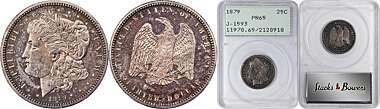
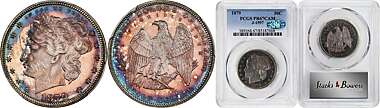
  • Precio de salida:
    1'200 USD
    1'074 EUR
    896 GBP
    982 CHF

    Importes redondeados, solo aproximadosFecha: 06/11/2026
Lote
Lote 3003. MD-73. Maryland. July 26, 1775. $1 1/3. PCGS Banknote Fine 12 Details. Edge Splits and Tears; Mounting Remnants on Back. No. 7089. Signed by Brice and Duckett. Elaborate vignette of Britannia receiving a petition of the Continental Congress from a female figure representing America. America is seen here trampling on a scroll marked "Slavery" and holding a Liberty Cap in front of American troops carrying the flag of liberty at right. At left, George III is trampling on the Magna Carta and setting fire to an American city under attack by a British fleet. Side border cuts show "AN APPEAL TO HEAVEN" and "PRO ARIS ET FOCIS," the latter translates to "For Altars and the Hearth." Looking to the back design one observe another very elaborate vignette where America and Britannia achieve peace while a ribbon emblazoned "PAX TRIUMPHIS POTIOR" which translates to "Peace is Preferable to Victory" can be observed above the bottom margin. The emission of July 26, 1775 was part of £100,000 authorized by the Maryland Convention to promote the manufacture of gunpowder per available reference material and examples from this series are always a solid four-figure proposition with tonight's handsome offering no exception among its peers. PCGS Banknote comments "Edge and Internal Damage, Mounting Remnants."
  • Precio de salida:
    900 USD
    806 EUR
    672 GBP
    737 CHF

    Importes redondeados, solo aproximadosFecha: 06/11/2026
Lote
Lote 3004. NJ-159CT. New Jersey. December 31, 1763. 3 Pounds. PMG Choice Very Fine 35 Contemporary Counterfeit. No. 268. Plate B. Printed in red and black. "T" in box at left. Radiant sun in the middle of text. New Jersey Arms at lower left with intricate trio of border designs evident. False signatures of Richard Smith, Jonathan Johnston and S. Skinner stacked at right. Printed on slightly thinner paper than the genuine notes. Imprint of Woodbridge, New Jersey/Printed by James Parker with "nature leaf" vignette pioneered by Franklin bold and surprisingly detailed. Ironic admonition at top "To Counterfeit is Death." The Newman counterfeit appendix notes the following diagnostics within the red text: a lower "d" at the end of "and," a higher "D" in "December," and a thicker right upright of "H" in "THREE" (compared to the left). There were a mere 1,000 genuine notes printed for this higher denomination and as with many of these Colonial-era Contemporary Counterfeits, the false notes are far scarcer than the genuine ones. The Newman note was a vastly inferior PCGS Currency Very Fine 20 Apparent that sold for $1,175 in 2017. This seemingly under graded example should have no problem scaling the four-figure plateau as seasoned collectors of Colonials weigh in with their bidder paddles and electronically placed bids.
  • Precio de salida:
    480 USD
    429 EUR
    358 GBP
    393 CHF

    Importes redondeados, solo aproximadosFecha: 06/11/2026
Lote
Lote 3005. NJ-177. New Jersey. March 25, 1776. 3 Shillings. PMG Choice Very Fine 35. John Hart Signature. No. 18095. Plate B. Signed by Jonathan Deare, John Hart, and John Stevens (Jr.) at right. Wide margins seen at both right and bottom borders. This crisp 1776 3 Shillings note is darkly printed and bears the bold penned signature of John Hart who signed the Declaration of Independence as a delegate from New Jersey in the Second Continental Congress. Due to the rising historical interest of famous signers in recent years, it takes little to figure that notes signed by John Hart and other signers such as Francis Hopkinson and John Morton have dramatically increased in value for even circulated examples. PMG comments "Previously Mounted."
  • Precio de salida:
    600 USD
    537 EUR
    448 GBP
    491 CHF

    Importes redondeados, solo aproximadosFecha: 06/11/2026
Lote
Lote 3006. SC-158. South Carolina. February 8, 1779. $90. PMG Extremely Fine 40. No. 9472. Boldly signed by John Smyth, John Scott, and Theodore Gaillard (Jr.) at right below the guarantee text. Printed by Thomas Coram with a vignette of a warrior seen at left accompanied by a ribbon with Latin phrase, "ARMISA CONCURRITE CAMPO" which translates to "Assemble the Field of Arms." Back vignette of Hercules strangling the Nemean Lion. In all, $1,000,000 in Bills of Credit were authorized by the February 8, 1779 ordinance with the original denominations set to be $40, $60, $80, and $100 while the $50, $70, and $90 denominations were later added. Here bidders have for their consideration a fully margined note with nary a problem to be mentioned. The most recent example we sold was an example graded About Uncirculated 53 that realized $4,320 (Lot 97236) amidst a significantly weaker 2025 market.
  • Precio de salida:
    600 USD
    537 EUR
    448 GBP
    491 CHF

    Importes redondeados, solo aproximadosFecha: 06/11/2026
Lote
Lote 3007. VT-1. Vermont. February 1781. 1 Shilling. PMG Very Fine 25 Net. Severed & Reattached, Repaired. No. 2622. Serial number in cartouche along the top margin. Signatures of both Walbridge and Fasset penned distinctly in a stacked arrangement. The signature of Walbridge is notably thicker than that of Fasset which appears along the bottom margin. Dimensions are 71mm by 90mm with some roughness evident while the basic design resembles that of the notes issued by both Connecticut and Rhode Island during the period. Border cuts at left and right depicting thin vines which Ford dubbed the "simple swaying vine" which support a keystone-like frieze emblazoned "VERMONT CURRENCY" with both the serial number and denomination below. Text and obligation may be seen at center with a Fugioesque chain with 14 links encircled by motto "VERMONT CALLS FOR JUSTICE" which is largely unobscured by the repairs best observed on the verso. A similar arrangement is noticed on the verso with the denomination stacked above the counterfeit warning and imprint for Judah P. Spooner along with a date of "1781." The aforementioned repairs are best observed along the left and right margins with stiff paper strips applied to reinforce the brittle paper body while a similar repair has been applied to mitigate the split evident along the horizontal crease. Some minor chips may be observed along the margins but are noted for the sake of posterity as this is one of the finest Vermont Colonials that was once part of the John J. Ford, Jr. Collection. To emphasize and to paraphrase the description from Ford III, this example is very likely one of the finest known for its type and denomination and vastly superior to many of its known counterparts. For the collector looking to acquire a quality Vermont Colonial for their own collection this is an opportunity not to be missed as opportunities comparable to Ford are rare even among exceptional auctions. PMG comments "Severed & Reattached, Repaired." Ex. F.C.C. Boyd, Stack's sale of the John J. Ford, Jr. Collection, Part III, May 2004, Lot 842. A Rarely Seen and Evenly Circulated Vermont Colonial A Technical Paragon Among the Survivors
  • Precio de salida:
    6'000 USD
    5'373 EUR
    4'480 GBP
    4'914 CHF

    Importes redondeados, solo aproximadosFecha: 06/11/2026
Lote
Lote 3008. Windsor, Vermont. Treasurer's Office. September 22, 1785 6 Pounds, 2 Shillings. PMG Very Fine 30. Ira Allen Signature. No. 2917. Technically speaking in technical terms, this Treasury Certificate issued by the State of Vermont offers testament to circulation consistent with the middle of the grading spectrum. Yet this consideration is arguably secondary against the signature penned at right. Endorsed by Ira Allen who served as the state's Treasurer from 1778 to 1786, Allen was a member of the Green Mountain Boys along with his brother Ethan who is best remembered for his exploits during the American Revolutionary War including the Capture of Fort Ticonderoga in 1775 which secured important artillery pieces for the Continental Army which were later used to defend Boston. PMG comments "Stains, Split, Pinholes."
  • Precio de salida:
    600 USD
    537 EUR
    448 GBP
    491 CHF

    Importes redondeados, solo aproximadosFecha: 06/11/2026
Lote
Lote 3009. Tinmouth, Vermont. Treasurer's Office. March 3, 1787 5 Pounds, 15 Shillings, 4 Pence. PMG Choice Extremely Fine 45. No. 42. A fine counterpoint to the Colonial-era pieces issued under the emission dated 1781. This Treasury Certificate issued by the State of Vermont has been graded Choice Extremely Fine 45 by the likes of PMG and offers a particularly pleasing sight for the grade assigned where the "Pinholes" mentioned by PMG should be of little concern to the specialist. The penned signature of Treasurer Samuel Mattlocks who held the position from 1786 to 1800 may also be noticed at right and speaks to a distinct level of originality that should readily impress. PMG comments "Pinholes."
  • Precio de salida:
    900 USD
    806 EUR
    672 GBP
    737 CHF

    Importes redondeados, solo aproximadosFecha: 06/11/2026
Lote
Lote 3010. VA-156. Virginia. October 5, 1778. $1. PMG Very Fine 25. No. 799. Signed by Wood. Printed on thin laid paper and quite rare in all grades and unpriced in both the Newman and Friedberg references. The small notes of this emission date are rarely seen. Only the two highest denominations ($50 and $100) in larger format style are readily encountered. This lower denomination notes have the same border cuts as the previous May 4, 1778, emission while the two-letter control system was reused on this denomination with the control letters and date both typeset. At left, one may observe "Virginia" encircled by the motto "SIC SEMPER TYRANNIS" which translates to "Ever Thus to Tyrants." We have only sold a single $1 note from this emission and that was two decades ago in a group lot of Ford/Boyd offerings. For decades, it takes little to reason that undervalued and underappreciated colonials have been the red-headed stepchild of the paper money hobby, but tonight this note gets its due and may very well command a strong bid from the assembled bidders. PMG comments "Repaired, Stains, & Pinholes."
  • Precio de salida:
    480 USD
    429 EUR
    358 GBP
    393 CHF

    Importes redondeados, solo aproximadosFecha: 06/11/2026
Lote
Lote 3011. CC-3. Continental Currency. May 10, 1775. $3. PCGS Banknote About Uncirculated 50. No. 38650. Signed by Thomas Barton, Jr. and Samuel Morris. Rounded vignette of an eagle and heron fighting at right with a skeletonized leaf on the back with the Hall & Sellers imprint seen below just above the top margin. Latin motto "EXITUS IN DUBIO EST" on face encircling the rounded vignette which Newman translates "The Outcome is in Doubt." In all, this is a really scarce example at this grade level with both services having graded only a handful of examples comparable to this grade level. To that end, in our Summer 2026 Global Showcase Auction we sold an example graded About Uncirculated 53 EPQ by PMG (Lot 93005) for barely a hair over $1,700 by the time bidding had ended.
  • Precio de salida:
    600 USD
    537 EUR
    448 GBP
    491 CHF

    Importes redondeados, solo aproximadosFecha: 06/11/2026
Lote
Lote 3012. CC-20. Continental Currency. February 17, 1776. $1/3. PCGS Currency Choice About New 58 PPQ. No. 387023. Plate B. Burdened with even and balanced margins seen in company of excellent eye appeal. The fractional denominations issued under the Resolution of February, 17 1776 are a particularly popular entry in the numismatic canon owing to the use of Franklin's sundial rebus accompanied by the phrase "MIND YOUR BUSINESS" that would later be reused for the Fugio Cents of 1787 along with the 13 interlocking rings on the back. Also of interest is the misspelling of the word "CURRENCEY" seen at right along the margin that demonstrates the fallibility of period printers. Yet to the collector, the attractive nature of the design is what matters and this is undoubtedly the perfect example for the collector looking to represent this popular design that oozes with symbolic associations. From the Emerald Coast Collection. Iconic Fugio and Sundial Motif
  • Precio de salida:
    1'200 USD
    1'074 EUR
    896 GBP
    982 CHF

    Importes redondeados, solo aproximadosFecha: 06/11/2026
Lote
Lote 3013. CC-33. Continental Currency. May 9, 1776. $3. PCGS Currency Superb Gem New 67 PPQ. No. 88013. Preserved in a state of preservation that speaks to the very day this note was printed roughly 250 years ago. Bidders should rightly be taken aback by the assigned grade of Superb Gem New 67 PPQ applied by the likes of PCGS Currency which speaks to a degree of technical sophistication that utterly distinguishes both the penned elements and plate impression. Here the circular vignette of an eagle and heron locked in mortal combat radiates with color and detail that amplifies the Latin phrase "EXITUS IN DUBIO EST" which roughly translates to "The Outcome is in Doubt" per Newman. Held together with the exceptionally detailed skeletonized leaf imprint on the back which speaks to the prowess of contemporary anti-counterfeiting methods pioneered by Franklin, it takes little to figure that bidders have here a truly exceptional opportunity that will again readily demonstrate the popularity of high-grade Continentals that represent a small cadre of exceptional survivors. An Exceptional $3 Continental
  • Precio de salida:
    3'600 USD
    3'224 EUR
    2'688 GBP
    2'948 CHF

    Importes redondeados, solo aproximadosFecha: 06/11/2026
Lote
Lote 3014. CC-35. Continental Currency. May 9, 1776. $5. PCGS Currency Gem New 66 PPQ. No. 88014. Offered here is a well-printed Continental that offers a wonderful contrast between the bold design elements and period pen signatures. Here bidders are met with the rounded vignette seen at left encircled by the Latin motto "SUSTINE VEL ABSTINE" which roughly translates to "Either Survive or Give Up" which does well to capture the period sentiment alongside the border cut seen along the top margin that reads "THE UNITED COLONIES." Yet the message of this item is secondary when held against its material condition as full margins and bold detail evocative of the day this note was printed collectively set a technical norm impossible to overlook and stand guaranteed to command the attention of bidders. A Technical Paragon from the 1770s
  • Precio de salida:
    3'000 USD
    2'686 EUR
    2'240 GBP
    2'457 CHF

    Importes redondeados, solo aproximadosFecha: 06/11/2026
Lote
Lote 3015. T-4. Confederate Currency. 1861 $50. PCGS Currency Fine 15 Apparent. Cross-Cut Cancelled; Cancellations Closed; Major Repairs. Penned Agent Endorsement. "Anthony J. Guirot - Assistant Treasurer, Confederate States Department of the Treasury." No. 394. Plate A. Among a limited number of notes issued from the provisional capital of the Confederate States of America during the opening stages of the conflict. This well-circulated T-4 $50 represents the lowest denomination from that emission and stands as an honest survivor that offers much despite the grade assigned. Here a rich complexity of color and detail speaks to the technical prowess of the National Bank Note Company while simultaneously demonstrating a level of sophistication that went unmatched as the war progressed. Looking to the back, one may observe a pair of distinct penned endorsements. The first of these is the penned endorsement of Anthony J. Guirot who served as Assistant Treasurer of the Confederate States of America, but after New Orleans fell to Union occupation in 1862, Guirot relocated to Jackson and ultimately to Mobile where his tenure in Confederate service ended when the city fell in 1864. The second endorsement is something of a mystery but provides something worthy of further research for the specialist making this a note bound to please whoever may place the winning bid. PCGS Currency comments "Cross-Cut Cancelled; Cancellations Closed; Major Repairs." T-4 1861 $50
  • Precio de salida:
    1'800 USD
    1'612 EUR
    1'344 GBP
    1'474 CHF

    Importes redondeados, solo aproximadosFecha: 06/11/2026
Lote
Lote 3016. T-5. Confederate Currency. 1861 $100. PCGS Currency Extremely Fine 40 Apparent. Minor Restorations. Penned Military Endorsement. "M.L. Smith, Major of Engineers - C.S.A. Corps of Engineers." No. 2626. Plate B. To the collector concerned with building a complete 72-note set of notes issued under the Confederate States of America, this example is already a premium example by virtue of the grade assigned while the "Minor Restorations" noted by PCGS Currency are inconsequential. Yet these distinctions are arguably amplified by the penned endorsement seen on the back as the endorsement of Major M.L. Smith may be observed. Now among the endorsements seen on surviving T-5 $100s, Smith a northerner by birth, is rarely ever seen compared to the likes of Molloy and Anderson. He served with the Corps of Engineers in the Confederate Army and took a leading role in building defenses in the vicinity of Vicksburg before taking command of the Corps in 1864 after both a prisoner exchange and a stint as a prisoner of war for seven months. Smith ultimately surrendered in May 1865 and found work as an engineer in Georgia but died an unfortunate and untimely death in 1866 at the age of 46. PCGS Currency comments "Minor Restorations."
  • Precio de salida:
    900 USD
    806 EUR
    672 GBP
    737 CHF

    Importes redondeados, solo aproximadosFecha: 06/11/2026
Lote
Lote 3017. T-5. Confederate Currency. 1861 $100. PMG Choice Very Fine 35 EPQ. No. 2780. Plate B. Technically speaking this is a very solid and uncommonly original note for the grade assigned. Here signs of moderate circulation may be observed in the company of plain originality that can be seen throughout. Absent are the cancellations which are often encountered on other T-5s at this grade level while negative comments in the vein of "Repaired" or "Previously Mounted" are conspicuously absent and help to underscore the application of PMG's EPQ designation for "Exceptional Paper Quality." Held together with the innate desirability of early Confederate issues produced by the Southern Bank Note Company of New Orleans and it takes little to figure that this would make an exceptional addition to a complete 72-note collection of Confederate issues.
  • Precio de salida:
    1'200 USD
    1'074 EUR
    896 GBP
    982 CHF

    Importes redondeados, solo aproximadosFecha: 06/11/2026
Lote
Lote 3018. T-5. Confederate Currency. 1861 $100. PMG Choice Very Fine 35. Triple Civilian and Military Manuscript Endorsements. No. 4081. Plate B. Already a superb note by virtue of the grade assigned. This T-5 $100 issued under the authority of the Confederate States of America led an unusual life relative to the majority of surviving peers thanks to a prolonged stint in commercial channels which is spoken to by three distinct penned endorsements. The earliest of these endorsements were applied by the likes of Ferdinand Molloy and W.J. Anderson around 1861 whereas the third and final endorsement is by far the most unusual. Applied by Thaddeus Sanford who had originally been appointed the Collector of Customs for the Mobile district, Sanford ultimately relocated to Montgomery where he endorsed this note on March 13, 1865 less than a month before the city fell to Union forces making this a decidedly rare item that certainly circulated longer than most of its peers. PMG comments "Cancellation Repairs."
  • Precio de salida:
    900 USD
    806 EUR
    672 GBP
    737 CHF

    Importes redondeados, solo aproximadosFecha: 06/11/2026
Lote
Lote 3019. T-5. Confederate Currency. 1861 $100. PMG Very Fine 25 Net. Repaired, Annotation. Penned Civilian Endorsement. "William J. Bromwell, Clerk - CSA Department of State." No. 5777. Plate B. An evenly circulated product of the Southern Bank Note Company out of New Orleans. This T-5 $100 is a particularly historic example of this tough design issued during the early stages of the conflict. Here a level of detail that would later be lost as the Confederacy's strategic position worsened as a result of major defeats on the battlefield may be noticed, but looking to the back one may notice the impetus behind the "Annotation" comment from PMG which also makes this note a noted rarity among known survivors. Penned in red ink, the penned endorsement of William J. Bromwell who had worked as a Clerk at the Confederate State Department can be seen in the company of three additional endorsements dating to 1864 and 1865. Now Bromwell is a particularly significant endorsement and one that can be considered rare as only two other notes with his endorsement can be traced back to 2009 while his shrewd actions at the end of the war ensured the survival of countless primary source documents that detailed the innerworkings and dealings of the Confederate State Department. PMG comments "Repaired, Annotation."
  • Precio de salida:
    480 USD
    429 EUR
    358 GBP
    393 CHF

    Importes redondeados, solo aproximadosFecha: 06/11/2026
Lote
Lote 3020. T-7. Confederate Currency. 1861 $100. PMG About Uncirculated 53. No. 28307. Plate C. A product of Hoyer & Ludwig born from punctuated circumstance during the early stages of the conflict. This note represents one of the earliest issues from Richmond and lacks much in quality and detail compared to the Montgomery issues and the pieces produced by the Southern Bank Note Company out of New Orleans. At center, is a vignette depicting Ceres and Proserpine while a portrait of George Washington can be observed in the lower left corner along the margin. A trio of "100" denomination counters account for the balance of the design and are seen in the remaining corners while a pair of secretarial signatures may be noticed alongside "For" in each panel which was added to plate to abbreviate the issuing process. PMG comments "Previously Mounted."
  • Precio de salida:
    480 USD
    429 EUR
    358 GBP
    393 CHF

    Importes redondeados, solo aproximadosFecha: 06/11/2026
Lote
Lote 3021. T-11. Confederate Currency. 1861 $5. PCGS Currency Fine 15 Apparent. Splits Repaired. No. 22370. Plate B. A major rarity at any grade level among the notes issued under the authority of the Confederate States of America during the 1860s. This well-circulated T-11 is relatively intact and has seen its share of repair work that ultimately warranted from PCGS Currency a comment that states "Splits Repaired." This work is nonetheless best observed when one looks to the back of the note, but overall, this example has it where it counts in aesthetic terms making it a survivor that offers more in eye appeal terms than what is typically encountered at this grade level. PCGS Currency comments "Splits Repaired."
  • Precio de salida:
    600 USD
    537 EUR
    448 GBP
    491 CHF

    Importes redondeados, solo aproximadosFecha: 06/11/2026
Lote
Lote 3022. T-23. Confederate Currency. 1861 $10. PMG Very Fine 30. No. 9421. Plate A1. Here is a mid-grade example of a well-made design produced under the authority of the Confederate States of America. This note bears a strong resemblance to the Obsoletes of the 1850s with regards to the composition as the design of this piece was adapted from a plate supplied by Mechanics Savings Bank of Savannah that had been used during the late 1850s. A vignette depicting a wagon loaded with cotton being brought to market accounts for the primary focus of the viewer's attention while a pair of subsidiary vignettes may be observed at left and right along the margins. At left, a portrait of John Elliot Ward who left the South upon succession to practice law in New York may be seen opposite a vignette entitled The Corn Gatherer which had been used or at least sampled by a number of banks in the North. Good eye appeal is retained, and an apparent lack of oxidation may be observed as the underprint retains its original coloration. Furthermore, one may observe that no cancellations are noticed making this a fine example for the collector looking to build a complete set of notes issued under the authority of the Confederate States of America. PMG comments "Stains, Annotations."
  • Precio de salida:
    900 USD
    806 EUR
    672 GBP
    737 CHF

    Importes redondeados, solo aproximadosFecha: 06/11/2026
Lote
Lote 3023. T-32. Confederate Currency. 1861 $5. PMG Very Fine 20. No. 3067. Plate A. Printed in the closing weeks and months of 1861 by Leggett, Keatinge & Ball. The T-32 bears a strong resemblance to the $5 Obsolete issued by the Mechanics Savings Bank of Savannah in 1855 and offers a well-made composition compared to most of the notes issued under the authority of the Confederate States of America. A portrait of a young boy may be seen at left below a rounded "V" denomination counter opposite a depiction of a blacksmith wielding the implements of his trade at right. This particular specimen comes printed on plain paper absent the presence of any fibers and features a rudimentary orange underprint similar to what was favored by the Southern Bank Note Company on issues such as the T-15, T-19, T-22, and T-31 before New Orleans fell to Union forces in May 1862. The underprint on this specimen does show some signs of oxidation, but good color is retained throughout lending this note a strong degree of eye appeal for the grade assigned that should readily appeal to collectors.
  • Precio de salida:
    480 USD
    429 EUR
    358 GBP
    393 CHF

    Importes redondeados, solo aproximadosFecha: 06/11/2026
Lote
Lote 3024. T-43. Confederate Currency. 1862 $2. PMG About Uncirculated 55. No. 50552. Plate 4. A true outlier compared to the vast majority of surviving T-43s issued under the authority of the Confederate States of America. This example is a particularly attractive and premium example of this short-lived design produced by Blanton Duncan that found no love at the Confederate Treasury Department. Here light circulation that is further reflected by the grade assigned may be noticed, but overall the note is a technical exemplar that effortlessly lives up to the grade assigned by PMG while the design itself remains bold and utterly replete with crisp detail. That uncommon level of detail is nonetheless exemplified by the portrait of Judah P. Benjamin, the Confederate Secretary of State whose portrait can be seen at left along with the allegorical representation seen at center which echoes a level of crude clarity that provides silent testament to Duncan's lack of resources and the popularity that readily follows these notes at higher grade levels. A Lightly Circulated T-43 Confederate $2
  • Precio de salida:
    2'400 USD
    2'149 EUR
    1'792 GBP
    1'965 CHF

    Importes redondeados, solo aproximadosFecha: 06/11/2026
Lote
Lote 3025. T-43. Confederate Currency. 1862 $2. PMG Choice Extremely Fine 45 EPQ. No. 50520. Plate 4. Although readily encountered towards the middle of the condition spectrum. This short-lived design produced by Blanton Duncan circulated heavily and is today a rare sight in the company of light circulation and premium qualities as this individual specimen is an outlier among its peers and boasts an assigned grade of Choice Extremely Fine 45 EPQ assigned by PMG. Here bidders may observe with great appreciation the green underprint that the Confederate government was unwilling to pay for while design elements such as the portrait of Confederate Secretary of State Judah P. Benjamin and the allegorical representation of the South striking down the North at center help this note effortlessly defy the aesthetic and technical norm set by most surviving T-43s. Bidders should no doubt expect this note to provoke a competitive bidding process as exceptional Confederate notes are held tight by collectors and rarely traded. A Technical Exemplar Among Surviving T-43s
  • Precio de salida:
    1'800 USD
    1'612 EUR
    1'344 GBP
    1'474 CHF

    Importes redondeados, solo aproximadosFecha: 06/11/2026
Lote
Lote 3026. T-47 (XX-2). Confederate Currency. 1862 $20. PMG Fine 12. No. 5747. Plate N. Although imperfect with damage evident along the margins, this note represents a scarce fantasy issue that's traditionally still counted among a complete 72-note set of Confederate issues. Despite their inclusion, little is known as to what these notes actually are other than that they are accepted as fantasies by collectors and reference material. This specimen is nonetheless imperfect as mentioned above but remains an attractive example with good eye appeal despite the obvious and should please the collector concerned with being a completionist without spending a sum typical of your average specimen seen towards the middle of the grading spectrum. PMG comments "Edge Damage." An Enigmatic Confederate Rarity
  • Precio de salida:
    1'200 USD
    1'074 EUR
    896 GBP
    982 CHF

    Importes redondeados, solo aproximadosFecha: 06/11/2026
Lote
Lote 3027. Fr. 1298. 25 Cents. Third Issue. PCGS Currency Gem New 66 PPQ. A tough note among Third Issue Fractionals. This Gem New example denominated at 25 Cents offers a truly impeccable sight to behold. Anchored by a portrait of William P. Fessenden at center who briefly served as Treasury Secretary from 1864 to 1865, Fessenden's portrait is met by a bronzed overprint that was a favorite of Spencer M. Clark who served as the Superintendent of the National Currency Bureau during the 1860s. Here the bronzed overprint offers a truly exceptional sight that reacts to any nearby light source and is sure to command the interest of a Fractional Currency specialist.
  • Precio de salida:
    1'200 USD
    1'074 EUR
    896 GBP
    982 CHF

    Importes redondeados, solo aproximadosFecha: 06/11/2026
Lote
Lote 3028. Military Payment Certificate. Series 521. $5. PCGS Banknote Gem Uncirculated 65 PPQ. First Printing. No. E05189968E. Plate 49. A tough note for the collector who specializes in Military Payment Certificates. Reference material such as the Comprehensive Catalog of Military Payment Certificate records that 6,000,000 non-Replacement $5s were printed under the First Printing but this fails to account for the fact that the $5 denomination is the toughest denomination of Series 521 especially at higher grade levels. Yet scarcely do we ever encounter comparable examples of Series 521 $5s and this example is nothing short of a stunner in terms of color and eye appeal that should easily inspire a strong bid levied at the proverbial hands of a discerning MPC specialist. PCGS Banknote Pop 2/1 Finer.
  • Precio de salida:
    1'200 USD
    1'074 EUR
    896 GBP
    982 CHF

    Importes redondeados, solo aproximadosFecha: 06/11/2026
Lote
Lote 3029. Lot of (9) Heath's Infallible Counterfeit Detector Books. 1860s-70s. Reflective of the plague of counterfeits that contaminated commercial channels during the 1860s and 1870s. This lot contains a total of (9) Counterfeit Detectors contemporary to the period that were produced by Laban Heath. A total of (4) "Pocket-Sized" editions are included alongside a total of (5) regular editions which contain full-sized engraved reproductions of contemporary National Bank Notes and Legal Tender Notes that were popular targets of period counterfeiters. Foxing and tears may be observed when looking through individual editions while general wear consistent with age may be noticed with regards to individual detectors.
  • Precio de salida:
    600 USD
    537 EUR
    448 GBP
    491 CHF

    Importes redondeados, solo aproximadosFecha: 06/11/2026
Lote
Lote 3030. Lot of (8) Counterfeit Detector Books. 1860s-70s. Offered here is a lot of (8) Counterfeit Detectors contemporary to the 1860s and 1870s. These editions do represent "Pocket-Sized" and regular editions of the popular detectors produced by Laban Heath. Each edition features no shortage of reproduced vignettes made with the blessing of the Treasury Department that speak to the details inherent to contemporary Legal Tender Notes and National Bank Notes. Foxing and tears may be observed when looking through individual editions while general wear consistent with age may be noticed with regards to individual detectors.
  • Precio de salida:
    480 USD
    429 EUR
    358 GBP
    393 CHF

    Importes redondeados, solo aproximadosFecha: 06/11/2026
Lote
Lote 3031. The American Bond Detector Book. 1869. Rebound. A fine addition to any numismatic library that's sure to be appreciated by the student of government securities and historic bond programs. This lot offers bidders the chance to consider a rebound copy of The American Bond Detector from 1869. Looking within, bidders and collectors alike are met with superb engraved reproductions of design elements such as counters and portraits contemporary to period securities and coupons that are practically unobtainable in issued form while impressions of various American and international coins may be found in the back of the text.
  • Precio de salida:
    480 USD
    429 EUR
    358 GBP
    393 CHF

    Importes redondeados, solo aproximadosFecha: 06/11/2026
Lote
Lote 3032. Little Rock, Arkansas. State of Arkansas. Treasury Warrant. 1862 $1. PMG Gem Uncirculated 65 EPQ. No. 122707/29258. Plate A. A veritable survivor that survived overwhelming odds to grade the way it did with PMG. This Arkansas Treasury Warrant issued in 1862 is arguably the finest that a collector could hope to find from this emission where wretched examples with numerous impairments are readily encountered. Held together strong originality and ample margins that betray the grade assigned by PMG, it takes little to infer that bidders certainly have a rare opportunity for their consideration especially if they hold an interest in numismatic material from Arkansas. PMG Pop 1/None Finer.
  • Precio de salida:
    480 USD
    429 EUR
    358 GBP
    393 CHF

    Importes redondeados, solo aproximadosFecha: 06/11/2026
Lote
Lote 3033. Cokedale, Colorado. Gottlieb Mercantile Company. 1911 5 Cents. PMG Very Good 10. No. 73177. Little more than a company town that was once home to about 1,500 individuals at its peak. Cokedale was originally established by the American Smelting And Refining Company (ASARCO) in 1906 and area mines produced about 1,500 tons of coal per day while 350 coke ovens produced 800 tones of coke daily through the 1940s. In 1947, ASARCO shuttered its mines and pulled out of Cokedale and the town's residents were given the opportunity to buy company homes which saw about 50 local families stay after ASARCO's withdrawal which directly preceded the town's incorporation in 1948. PMG comments "Rust Stains, Tape."
  • Precio de salida:
    420 USD
    376 EUR
    313 GBP
    343 CHF

    Importes redondeados, solo aproximadosFecha: 06/11/2026
Lote
Lote 3034. Cokedale, Colorado. Gottlieb Mercantile Company. 1911 10 Cents. PMG Fine 12. No. 63868. In the present, Cokedale is home to roughly 120 individuals while remnants of its past as a company town can still be observed. The ruins of 350 coke ovens can still be found to the southeast of the townsite while the old Gottlieb Mercantile Building has been repurposed as the town's administrative center and post office after functioning as a general goods store during the town's heyday long before ASARCO withdrew in 1947. Today aside from ruins and various buildings that speak to Cokedale's past, scrip notes like this one provide a tangible connection to the daily realities of life in Cokedale and hundreds of similar company towns spread across the United States. PMG comments "Minor Repairs."
  • Precio de salida:
    480 USD
    429 EUR
    358 GBP
    393 CHF

    Importes redondeados, solo aproximadosFecha: 06/11/2026
Lote
Lote 3035. Denver, Colorado. Rocky Mountain Stores Company. 1908 5 Cents. PMG Fine 12. No. Unknown. An enigmatic item from Colorado dating to the early 1900s. This well-circulated piece of scrip issued by the Rocky Mountain Stores Company represents one of the many Colorado-based issuers that favored similar scrip notes like the Denver-based Colorado Supply Company or the Victor Coal & Coke Company in Trinidad. To that end, individual notes regardless of the issuer are often scarce to excessively rare in numismatic terms and this piece from Denver is no exception to the apparent norm making this a rare opportunity for the specialist who specializes in these financial relics that were "Not Intended to be Used as Money" per the guarantee text.
  • Precio de salida:
    420 USD
    376 EUR
    313 GBP
    343 CHF

    Importes redondeados, solo aproximadosFecha: 06/11/2026
Lote
Lote 3036. Fort Lyon, Colorado Territory. Sutler's Check. 1860s 10 Cents. PMG Choice Very Fine 35. Remainder. Durand COT-11, Listed as Rarity 7 (1-5 known). Uniface and printed on bond paper without an imprint. "SUTLER'S CHECK" curved as an undertint at center and executed in red. "GOOD FOR/TEN CENTS,/PAYABLE IN MERCHANDISE" across center and enclosed by a plain blue perimeter along the margins. "FORT LYON, COL. TER." in bold lettering below the top margin. Just below it the serial number space and partly printed date "186_". Large block counter "10 Cts" at bottom left. There is space to sign the note along the bottom at the lower left, but we have only seen notes from this series as unsigned Remainders and we believe that no issued examples exist. Fort Lyon is the name of two different U.S. Army forts that operated in eastern Colorado beginning around 1860. The first fort was originally named for Virginia governor Henry Wise but was renamed in 1862 in honor of Union General Nathaniel Lyon who was killed at the Battle of Wilson's Creek in Missouri in 1861. The fort operated in its original location until a newly constructed Fort Lyon opened near Las Animas in 1867. Our research leads us to believe these notes likely date to the first location. Part of the history of Fort Lyon is the notorious Sand Creek Massacre in which militiamen from Fort Lyon, led by Colonel John Chivington, attacked and destroyed a Native American village that was under the impression of being protected by their very attackers. The assault killed as many as 160 Cheyenne and Arapaho with mostly women and children accounting for the dead. We originally sold this same note for $4,830 as part of the John J. Ford Jr. Collection almost 20 years ago making this an impeccable treat for the specialist who recognizes this as a truly rare opportunity to be had. Ex. John J. Ford Jr. Collection An Unissued Remnant of the Frontier
  • Precio de salida:
    900 USD
    806 EUR
    672 GBP
    737 CHF

    Importes redondeados, solo aproximadosFecha: 06/11/2026
Lote
Lote 3037. Pueblo, Colorado. Herman & Shloss. ND 5 Cents. PMG Very Fine 30. No. 5647. Imprint of Bankers Supply Co. Denver. Ornate border prints with a portrait of a young girl at left opposite three miners seen at right."5c" in red counter at top right. Large "5c" outlined protector executed in red at center beneath guarantee text. Printed back with "GOOD FOR 5c IN MERCHANDISE" enclosed at center with ornate decorative prints surrounding the design. Mining scenes at base of decorative columns at left and right.Henry Herman and Julius Shloss founded their business in 1889 and operated a storefront on Northern Avenue in Pueblo. They handled a wide range of items to include general merchandise and groceries and through the 1890s their business grew accordingly before Shloss decided to retire and relocate to Connecticut roughly a decade afterwards. Puebloans remembered him as a "very portly man with a remarkably genial disposition and a wide circle of friends." When he retired the business was renamed Herman Mercantile Company and this undated piece and the one that follows date to between 1889-1898. In all, these pieces are incredibly rare, and the only examples printed on blue paper per available records. We first sold this note in 2017 as part of our August ANA Auction (Lot 10017) for $705. PMG comments "Previously Mounted, Minor Rust." A Scrip Rarity from Colorado
  • Precio de salida:
    600 USD
    537 EUR
    448 GBP
    491 CHF

    Importes redondeados, solo aproximadosFecha: 06/11/2026
Lote
Lote 3038. Pueblo, Colorado. Herman & Shloss. ND 10 Cents. PMG Choice Fine 15. No. 3818. Imprint of Bankers Supply Co. Denver. Ornate border prints with a portrait of a young girl at left opposite three miners seen at right. "10c" in red counter at top right. Large "10c" outlined protector executed in red at center beneath the guarantee text. Printed back with "GOOD FOR 10c IN MERCHANDISE" in circle at center and accompanied by ornate decorative prints. Mining scenes at base of decorative columns at left and right. Essentially identical to the previous lot in terms of design and layout. The history of this note can be found in the prior lot description while both stand as extremely rare pieces of early Colorado scrip that are seldom traded. PMG comments "Piece Attached, Minor Rust."
  • Precio de salida:
    480 USD
    429 EUR
    358 GBP
    393 CHF

    Importes redondeados, solo aproximadosFecha: 06/11/2026
Lote
Lote 3039. Walsenburg, Colorado. Pinon Supply Company. ND 5 Cents. PMG Very Fine 25. No. 23341. Printed on bond paper and lithographed on both sides with the imprint of Gast Bank Note Co. St. Louis evident in the bottom margin. Red protector "5" at center with ornate font used for the title across top center with Justice standing at left. The designation "This is not Intended to be Used as Money" may be seen below the top margin in small text. Engraved signature and machine-printed serial numbers evident at left and right. The back features a circular "5" counter and "GOOD FOR IN MERCHANDISE" clause set within a larger circle set upon a blue pattern back. This is a very rare issuer with a population that can likely be counted upon a single hand. To that end, we have only sold two examples previously that were denominated at "10 Cents."
  • Precio de salida:
    480 USD
    429 EUR
    358 GBP
    393 CHF

    Importes redondeados, solo aproximadosFecha: 06/11/2026
Lote
Lote 3040. Washington, District of Columbia. Arlington Bank. 1854 $5. PMG Very Fine 25. No. 156. Plate C. Offered here is an evenly circulated "obligation" of a fraudulent bank that first emerged during the mid-1850s. Described by the Evening Star as a "bogus concern from first to last," offices were advertised briefly with endorsements made by "two papers of significance" per the Whitman Encyclopedia of Obsolete Paper Money Vol. 8. The bank later failed by 1856 and issued notes are extremely rare as alluded to by the description which accompanied this piece when it sold as part of the Capital City Sale in 2007 where it was quoted as a "discovery note" in the words of Tom Denly of Massachusetts. From the Caine Collection. Earlier ex. Stack's Capital City Sale of October 2007, Lot 1198. Whitman Plate Note. District of Columbia
  • Precio de salida:
    600 USD
    537 EUR
    448 GBP
    491 CHF

    Importes redondeados, solo aproximadosFecha: 06/11/2026
Lote
Lote 3041. Tallahassee, Territory of Florida. Treasury Office. 1829 50 Cents. PMG Choice Very Fine 35. No. 61. Issued less than a decade after the Territory of Florida was first organized in 1822. The "First Issue" of notes issued under the authority of Florida's Territorial government were little more than crude compositions printed on thin paper without a vignette or even a printer's imprint. Notes were first issued in 1829 and bore the penned signature of Davis Floyd who served as Treasurer of the Florida Territorial Council and bear dates that range from January to June 1829 per Benice in Florida Paper Money: An Illustrated History 1817 - 1834. This specimen bears a date of January 16, 1829 and presumably comes from an early delivery of these notes, but owing to the lack of historical records regarding serial numbers or even quantities issued, such a finding is impossible to ascertain. The piece plated in the Benice text bears the same date as this specimen, but whether that note comes from the same run of notes is likewise impossible to ascertain owing to the serial numbering practices that would be used for the "Second Issue" of notes that reset with each new batch. Even so this represents one of the rarest of all issues issued during Florida's Territorial period. We have only offered one other note from this issue going back to 2005 discounting this note's appearance in 2025. Pedigreed to the Harley L. Freeman Collection, that note was offered alongside this one as Lot 914 in the RARCOA sale and represents one of at least two $5s from this issue known to have survived. That piece managed to sell for $20,700 after bidding had ended and the auction also references this very specimen which is mentioned as being one of the finest survivors (if not the finest) representative of its denomination and reflects a distinction that remains true here in the present. Indeed, it takes little to reason that this is a major rarity for the collector who specializes in Florida Obsoletes and one not to be missed or overlooked as we last sold this same piece for a sum of $6,000 against an estimate that proved to be rather conservative in 2025. PMG comments "Previously Mounted." PMG comments "Previously Mounted." Ex. Harvey L. Freeman Collection; Stacks Bowers Galleries Spring 2025 Showcase Auction, Lot 20171. Extremely Rare First Issue Florida Territorial Note
  • Precio de salida:
    2'400 USD
    2'149 EUR
    1'792 GBP
    1'965 CHF

    Importes redondeados, solo aproximadosFecha: 06/11/2026
Lote
Lote 3042. Geneva, Illinois. Kane County Bank. 18xx $5. PMG Choice Uncirculated 64 EPQ. Remainder. No. None. Plate A. Absent any trace of technical circulation that may be observed under close examination. Little is known about this institution other than it operated between 1857 and 1861 and ultimately failed as a result of the loose "Free Banking" laws in effect in Illinois during the period. It is nothing short of remarkable that this piece managed to avoid such an inglorious end typical of many period Remainders. Easy to see how our estimate could be proven academic once bidding ends especially when one considers the Gem Uncirculated $2 Remainder that sold in our Summer 2026 Global Showcase Auction (Lot 20083) for $2,318 by the time bidding had ended. From the Caine Collection.
  • Precio de salida:
    600 USD
    537 EUR
    448 GBP
    491 CHF

    Importes redondeados, solo aproximadosFecha: 06/11/2026
Lote
Lote 3043. Taylorville, Plowmans Bank. 1860 $3. PMG Very Fine 25 Net. Annotation, Minor Edge Damage & Paper Pulls. No. 1853. Plate B. Contemporary to the Illinois bond troubles of the early 1860s which claimed scores of banks across the state due thanks to the deficiencies of the state's "Free Banking" system. The Plowmans Bank of Taylorville is nonetheless a great example having organized in 1860 before ultimately failing the following year in 1861 leaving behind a numismatic legacy spoken to by not only a superb agricultural title, but also the technical sophistication of the National Bank Note Company during the early 1860s. Here lovely orange protectors and scrollwork contrast nicely against dark cycloidal counters and subsidiary vignettes lending this note a quality sure to please those who collect. PMG comments "Annotation, Minor Edge Damage & Paper Pulls." From the Caine Collection.
  • Precio de salida:
    480 USD
    429 EUR
    358 GBP
    393 CHF

    Importes redondeados, solo aproximadosFecha: 06/11/2026
La configuración de privacidadLa configuración de privacidad