Se connecter pour des enchères en direct
Numismatica Ars Classica, Zurich Logo
Lot
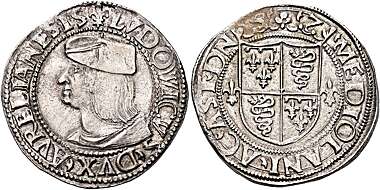
Lot 1800. Asti.   Ludovico II, duke of Orléans and lord of Milan and Asti, 1465–1498. Testone ca. 1491-1498, AR 9.62 g. ø 30 mm. Lily LVDOVICVS DVX AVRELIANENSIS Bust l., wearing cap. Rev. 'MEDIOLANI AC AST DN Crowned coat of arms, quartered of France and Milan, flanked by two lilies. MIR 60. MEC 12, 98. Very rare and in exceptional condition for the issue, among the finest specimens in private hands. Light iridescent tone and extremely fine Ex Künker sale 233, 2013, 2366. On succeeding Charles VIII in 1498, Louis XII continued French expansion in Italy, asserting his claim to the Duchy of Milan through the rights of succession inherited from his grandmother, Valentina Visconti. In 1499 he occupied Milan, consolidating French control over northern Italy. Asti, already closely connected with the French monarchy, became one of the principal centres of French administration and presence in Italy. The mint of Asti accordingly continued to strike coins in the name of Louis XII, following the established local monetary types and thereby providing significant numismatic evidence of French rule in the city. Please find here the video of the coin
  • Mise à prix:
    8'000 CHF
    8'740 EUR
    7'286 GBP
    9'824 USD

    Valeurs approximatives et arrondiesDate: 05/11/2026
Lot
Lot 1801. Bologna.   Benedetto XIV (Prospero Lambertini), 1740–1758. Scudo of 80 bolognini struck in gold year XVII, AV 37.20 g. ø 39 mm. BEDEDECT XIV P M BONON A XVII Bust r., wearing camauro, mozzetta and stole decorated with heraldic devices. Rev. VNVM / OMNIVM VOTVM / SALVS / PRINCIPIS / S.P.Q.B. Muntoni – (cf. 228, see note p. 273). Berman –. Chimienti – (cf. note p. 421 no. 883). MIR 2635/3. Of the highest rarity, possibly the only specimen in private hands. An issue of great importance and fascination perfectly struck. Minor scratches on obverse field and two small edge nicks, otherwise extremely fine Benedict XIV (Bologna, 1675 – Rome, 1758), Archbishop of Bologna from 1731, was elected pope on 17 August 1740. His connection to his native city remained strong even after his election to the papal throne, so much so that the pontiff retained the title and governance of the Archdiocese of Bologna until 1754. The Bologna mint celebrated the election of the pope with several commemorative issues. Particularly significant is the coinage, consisting of silver scudi, minted to commemorate the decision of Benedict XIV to retain the Archdiocese of Bologna even after his elevation to the papacy. The issue, characterized by a design more properly medallic than monetary, represents one of the most interesting testimonies of the special relationship between the pope and his native city. The legend on these specimens significantly emphasizes the dual dignity of Benedict XIV as pope and Archbishop of Bologna, while the dedication by the Senate of Bologna reflects his privileged relationship with the city. These issues belong to the production of the Bologna mint during the pontificate of this pope, in which monetary function was joined with a commemorative purpose, giving rise to specimens of notable historical and numismatic interest. The scudi were struck in gold to be presented as gifts to the pope and his nephew. Please find here the video of the coin
  • Mise à prix:
    60'000 CHF
    65'554 EUR
    54'648 GBP
    73'681 USD

    Valeurs approximatives et arrondiesDate: 05/11/2026
Lot
Lot 1802. Casale.   Guglielmo IX Paleologus, 1494–1518. First period: 1499/1505 – circa 1509. Double ducat, AV 6.89 g. ø 29 mm. GVLIELMVS MAR MONT FER 7 C' Armoured and draped youthful bust l., wearing cap. Rev. SACRI RO IMP PRINC VICQ P P Quartered coat of arms with the small shield of Montferrat in heart. CNI –. Bernareggi 31. Ravegnani Morosini 3 (this coin illustrated). MIR 177. Friedberg 165a. Extremely rare and in exceptional condition for the issue, possibly the finest of very few specimens known in private hands. A portrait of excellent style and a lovely reddish tone. Extremely fine Son of Marquis Boniface III and Maria Branković, he succeeded his father upon the latter's death. William protected the French army during its retreat from Milan in 1513 and, to avoid reprisals by Massimiliano Sforza, was forced to pay him 30,000 scudi. The agreements with Massimiliano were not respected, and his troops entered Montferrat, bringing death and destruction. At the same time, having learned of the attempt by his distant relative Oddone, Marquis of Incisa, to have himself crowned Marquis of Montferrat, William marched against his kinsman and occupied the town of Incisa in 1514, annexing the territories of the marquisate and sentencing Oddone and his son Badone to death. However, this execution drew the wrath of the Empire upon William, which, while decreeing the annexation of the territory of Incisa, ordered Paleologus to stand trial. The subsequent bureaucratic proceedings ended in William's favour. The portrait of the marquis, shown in profile and rendered with crisp, incisive modelling, displays a remarkable Renaissance character, reflecting a taste directly derived from the tradition of  Italian medallic art of the fifteenth and early sixteenth centuries. Particularly refined is the treatment of the hair, neatly emerging from beneath the headdress, while the latter, broad and slightly inclined, helps to define the contours of the bust. The clothing, with the rich folds of the garment and the detailed rendering of the shoulder, is treated in a manner reminiscent of Renaissance commemorative portraiture.Enclosed by the legend and set against a relatively broad field, the effigy acquires a particular monumentality, characteristic of the visual culture of the period. Taken as a whole, this magnificent coin becomes a veritable portrait in miniature, conveying the prestige and elegance of the die engraving. Please find here the video of the coin
  • Mise à prix:
    80'000 CHF
    87'406 EUR
    72'864 GBP
    98'241 USD

    Valeurs approximatives et arrondiesDate: 05/11/2026
Lot
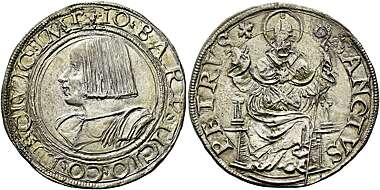
Lot 1803. Desana.   Giovan Bartolomeo Tizzone, 1525–1533. Testone, AR 8.76 g. ø 31 mm. IO BART' TICIO CODECI VIC IMP Armoured bust l. Rev. SANCTVS – PETRVS St. Peter nimbate and mitred, seated facing on throne, holding crosier and giving blessing. Ravegnani Morosini 2. MIR 459. Very rare and in exceptional condition for the issue, possibly the finest specimen in private hands. A portrait of excellent style and unusually well struck, good extremely fine / extremely fine Ex Santamaria sale 17 October 1959, 219. The history of the small Piedmontese lordship of Desana and the Tizzoni (or Tizzone) family represents one of the most fascinating and characteristic examples of "coin-striking" imperial fiefs in north-western Italy between the 16th and 17th centuries. Located in the Vercelli plain, the territory of Desana originally belonged to the bishops of Vercelli. During the 14th and 15th centuries, the Tizzoni family – a powerful Ghibelline aristocratic house – progressively established its economic and political control over the area. The institutional turning point for the house and the territory occurred in 1510, when Emperor Maximilian I of Habsburg invested Ludovico Tizzoni with the title of Count of Desana, elevating the fief to an Imperial County. Giovan Bartolomeo Tizzone succeeded Ludovico, ruling the county during a historically complex and turbulent period marked by the conflict between Francis I's France and Charles V's Empire for hegemony over the Peninsula. Please find here the video of the coin
  • Mise à prix:
    20'000 CHF
    21'851 EUR
    18'216 GBP
    24'560 USD

    Valeurs approximatives et arrondiesDate: 05/11/2026
Lot
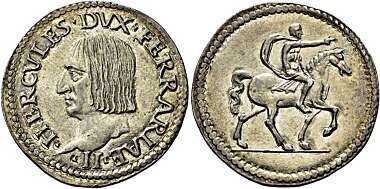
Lot 1804. Ferrara.   Ercole I d'Este, 1471–1505. Quarto, AR 9.67 g. ø 30 mm. HERCVLES DVX FERRARIAE Head l. Rev. Horseman walking r., his r. arm outstretched. CNI 25. Ravegnani Morosini 6 (testone). MIR 254. Rare and in exceptional condition for the issue. A superb Renaissance portrait of fine style, wonderful iridescent tone and good extremely fine The son of Niccolò III, Ercole was educated at the Aragonese court in Naples from 1445 to 1460. Following the death of his half-brother Borso in 1471, he became Duke of Ferrara and married Eleonora of Aragon, daughter of Ferdinand I of Naples. Through the marriages of his daughters, the Este family established ties with two of the most prominent families in Italy: Beatrice married Ludovico il Moro, while Isabella married Francesco II Gonzaga. The expansionist ambitions of Girolamo Riario, lord of Forlì and Imola and nephew of Pope Sixtus IV, together with the rivalry with the Republic of Venice – arising from both territorial disputes and the struggle for the monopoly of the salt trade – led Ercole, in the 1480s, to fight the War of Ferrara against Riario, the Venetians, and the Pope. Under the terms of the Peace of Bagnolo in 1484, Ercole was forced to cede Polesine and Rovigo to Venice, territories that had been seized from him during the first phase of the war, which had begun in 1482. Girolamo Riario, for his part, failed to obtain the advantages he had hoped for. Under his rule, Ferrara became one of the leading cities of Europe. Ercole died in 1505, and his son Alfonso I d’Este succeeded him as Duke in the same year. Please find here the video of the coin
  • Mise à prix:
    12'000 CHF
    13'110 EUR
    10'929 GBP
    14'736 USD

    Valeurs approximatives et arrondiesDate: 05/11/2026
Lot
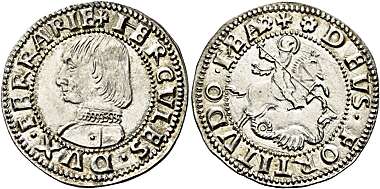
Lot 1805. Ferrara.   Grossone, AR 3.85 g. ø 26 mm. HERCVLES DVX FERRARIE Armoured bust l. Rev. DEVS FORTITVDO MEA St. George on horseback r., slaying the dragon. Ravegnani Morosini 10. MIR 257. In exceptional condition for the issue. Good extremely fine Please find here the video of the coin
  • Mise à prix:
    1'200 CHF
    1'311 EUR
    1'092 GBP
    1'473 USD

    Valeurs approximatives et arrondiesDate: 05/11/2026
Lot
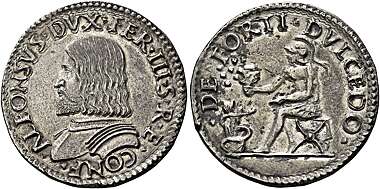
Lot 1806. Ferrara.   Alfonso I d'Este, 1505–1534.  Quarto di scudo,  AR 9.60 g. ø 29 mm. ALFONSVS DVX FER III  Armoured bust l.  Rev. DE FORTI DVLCEDO  Samson helmeted and in military attire, seated l., holding in r. hand a lion's head from whose jaws bees emerge; at his feet, a serpent coiled around a trunk.  Ravegnani Morosini 4 (testone).  MIR 271. Rare and in exceptional condition for the issue, undoubtedly the finest specimen known. A Renaissance portrait of enchanting beauty, work of a very talented master-engraver. Wonderful old cabinet tone, good extremely fine / extremely fine The son of Duke Ercole I d’Este and Princess Eleonora of Aragon, he married in 1491 Anna Maria Sforza, sister of Duke Gian Galeazzo Maria Sforza, who died six years later, in 1497. In 1502, he married the noblewoman Lucrezia Borgia, illegitimate daughter of Pope Alexander VI. Upon the death of his father in 1505, he inherited his duchies. The following year, he suppressed the conspiracy plotted by his brothers Ferrante and Giulio d’Este. In 1508, he joined the League of Cambrai against the Republic of Venice. After refusing to adhere to the peace agreement between the Papacy and Venice in 1510, he was excommunicated and deprived of his possessions. He subsequently took part in the War of the Holy League on the side of France, playing a prominent role in the Battle of Ravenna, where his artillery enabled the French forces to prevail over the Papal troops. His excommunication was lifted, but his territories were not restored to him; he regained possession of them only in 1530, through the intervention of Emperor Charles V. The following year, an imperial decree confirmed his possession of Modena, Reggio and Rubiera. In November 1526, in opposition to Pope Clement VII, he supplied the Landsknechts with several falconets (small cannon). A shot fired from one of these guns wounded the condottiero Giovanni dalle Bande Nere during the Battle of Governolo. The German troops were thereby given free passage, and in May 1527 they proceeded to sack Rome. Alfonso died in 1534. The reverse legend DE FORTI DVLCEDO, “From the strong comes sweetness”, derives from the riddle of Samson in Judges 14:14. It accompanies the dramatic representation of Samson holding the head of the lion from whose jaws a swarm of bees emerges. The biblical imagery was adopted by the Este as an emblem of strength giving rise to prosperity and beneficence. On Alfonso I’s quarto, the device has been interpreted as an allusion to the duke himself, whose strength and authority were intended to bring relief and prosperity to his subjects. Please find here the video of the coin
  • Mise à prix:
    28'000 CHF
    30'592 EUR
    25'502 GBP
    34'384 USD

    Valeurs approximatives et arrondiesDate: 05/11/2026
Lot
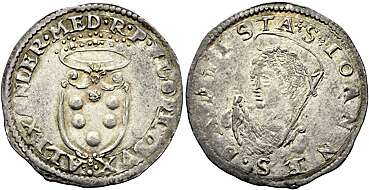
Lot 1807. Firenze.   Alessandro de’Medici duke of the Florentine Republic, 1532-1537; second period, 1533-1537. Mezzo giulio dies by Benvenuto Cellini, AR 1.69 g. ø 24 mm. ALEXANDER MED R P FLOREN DVX Crowned Medici arms. Rev. S IOANNES BAPTISTA Nimbate half figure of St. John, slightly to l., holding a long cross. Galeotti XXVIII/1. MIR 105 (R3). Very rare and in exceptional condition for the issue, possibly the finest specimen in private hands. Light iridescent tone and good extremely fine Alessandro de’ Medici, traditionally regarded as the illegitimate son of Lorenzo de’ Medici, Duke of Urbino, became ruler of Florence in 1530 after the restoration of Medici authority. In 1532 Emperor Charles V formally invested him with the title of Duke of the Florentine Republic. His coinage reflects the transition from the republican monetary tradition to the new Medici ducal regime. Alessandro employed the celebrated Florentine goldsmith and sculptor Benvenuto Cellini at the mint, entrusting him with the engraving of dies for several denominations, including the 40 soldi, giulio and half-giulio. Cellini's coins are notable for their sophisticated portraiture and Renaissance artistry. Alessandro's short and troubled rule ended with his assassination in Florence in 1537, after which he was succeeded by his cousin Cosimo, of a junior branch of the Medici family. Please find here the video of the coin
  • Mise à prix:
    4'000 CHF
    4'370 EUR
    3'643 GBP
    4'912 USD

    Valeurs approximatives et arrondiesDate: 05/11/2026
Lot
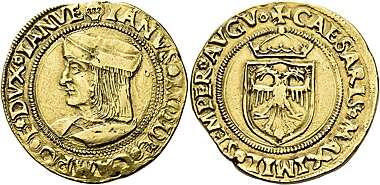
Lot 1808. Genova.   Republic, 1139 – 1339. Second period: Life-Tenured Doges and Foreign Dominations, 1339-1528. Giano II di Campofregoso, 1512-1513. 10 scudi, AV 34.42 g. ø 37 mm. Campofregoso coat of arms IANVS II DE CAMPO F DVX IANVE Male bust l., wearing cap (Maximilian I or Giano II?). Rev. + CAESARIS MAXIMIL SEMPER AVGV Crowned coat of arms, charged in centre with double-headed eagle. L. Travaini-B. Prokisch, QT XXXIX, 2010, p. 417, pl. I, 1 (this coin illustrated). MEC 12, p. 300. Friedberg 395a (this coin illustrated). Apparently unique and a numismatic riddle of the greatest historical interest. An issue of tremendous importance and fascination with a very interesting portrait of the Emperor of fine style struck on a very broad flan. About extremely fine From the collection of the City of Leipzig deaccessioned in 1840 to a Viennese dealer and eventually sold to William Albert, Prince of Montenuovo. Ex Dura-Sambon 6th December 1880 and ff. days, Rossi 1529 (erroneously attributed to Giano I) and Stack’s 7th March, session I, 2006, 834 (also erroneously attributed to Giano I) sales. The Italian Wars, 1494–1559 The Italian Wars, which began with the invasion of Italy by Charles VIII of France in 1494 and continued, with varying intensity, for more than six decades, profoundly affected the political and monetary landscape of the Italian peninsula. The major powers—France, the Habsburgs, Spain and the principal Italian states—fought repeatedly for control of Milan, Genoa, Naples and other strategic territories. The wars brought about frequent changes of sovereignty and, consequently, of monetary types and minting authorities. French, Spanish and Imperial issues circulated alongside the coinages of the established Italian states, while newly occupied territories sometimes saw the introduction of foreign denominations or the continuation of local types in the name of the new ruler. Milan in particular changed hands repeatedly between the Sforza, the French and the Habsburgs, while Naples passed from the Aragonese to the French and subsequently to Spanish rule. The period also witnessed a marked increase in the production of large gold and silver denominations, reflecting both the financial demands of prolonged warfare and the growing importance of international monetary circulation. Along with those, a number of unusual and extremely interesting presetation issues were produced and the one presented here belongs to this extremely interesting and fascinating group, which are in some cases medals as they lack a logical metrological pattern. In this auction are present some of this medals (lots 1036, 1038, 1037, 1028 and 1034) A study by Lucia Travaini and Bernhard Prokisch, published in Quaderni Ticinesi (XXXIX, 2010), examines the extraordinary example of the 10 scudi gold multiple attributed questionably to Giano II Campofregoso, building upon the earlier research of Giovanni Pesce (1979), who regarded it as a commemorative medal. The authors discuss the piece from the perspectives of Renaissance portraiture, the mint at which it was struck, and its historical and political context. In June 1512, following the withdrawal of the troops of Louis XII of France from northern Italy after the defeat at Ravenna, Genoa succeeded in freeing itself from French rule established in 1499. Giano II Campofregoso was elected Doge on 29 June 1512, in a markedly anti-French and pro-Imperial political climate. It is precisely in this context, we believe, that this issue should be placed. Contrary to the interpretation proposed by Pesce Prokisch we don’t disregard the possibility that the portrait on the obverse could be that of the Emperor Maximilian I rather than Giano II Campofregoso. It would in fact have been most unlikely, within the context of the Genoese Republic, for a Doge to place his own effigy on a coin, whether an official issue or merely a piece intended for presentation. Moreover, although less refined in execution, the portrait recalls that on the quarter-guldiner of Maximilian I struck at the Hall mint, the work of the Mantuan engraver Gian Marco Cavalli. Prokisch takes a different view, suggesting that the portrait may be that of Giano II, on the grounds that the figure does not wear imperial vestments. It is worth noting, however, that the Emperor is likewise not shown in imperial dress on the quarter-guldiner. The possible effigy of Maximilian I on the obverse, together with the legend referring to Doge Giano II Campofregoso, and the reverse bearing the Imperial arms and the legend CAESARIS MAXIMIL SEMPER AVGV, would appear to confirm the restoration of Genoese independence and of its rights to strike coinage freely under Imperial authority. We presume that the MVNVS found, for example, on the coinage of Bologna under Giovanni II Bentivoglio, may be implicitly understood in the reverse legend here: the Bolognese coins bear the legend MAXIMILIANI MVNVS, confirming that the rights of these mints to strike coinage had been authorised by the Emperor. This coin may plausibly have been conceived as an extremely limited issue intended for presentation rather than circulation, to be presented to high-ranking dignitaries and used as an instrument of diplomacy and political propaganda. It would thus have served to proclaim the gratitude and loyalty of Giano II's Genoa towards the Empire at a moment when the Republic, having just freed itself from French domination, was reasserting its traditional relationship with the Emperor. An especially interesting piece of evidence is provided by a decree reproduced in extenso by Gaetano Avignone in his Medaglie dei Liguri e della Liguria, published in the proceedings of the Società Ligure di Storia Patria. The decree records that Giano II asked the Council of Elders to reproduce the Campofregoso arms on the coins to be issued in his name. It should be remembered that Giano II's predecessors had used the compass as their family emblem. The present coin, however, bears the Campofregoso arms and must therefore have been struck after this authorisation had been granted, although in a context quite different from that of an issue intended for circulation. The period during which this coin could have been produced was extremely short. Following a conspiracy by the Fieschi and Adorno families, which once again brought the Republic under the influence of the French king Louis XII, Giano II was forced to leave Genoa by ship on 25 May 1513. He subsequently entered the service of the rival Republic of Venice as a military commander during the Italian Wars. In the course of these campaigns, he defeated the army of Emperor Maximilian I at the battle of Rocca d’Anfo, near Brescia. Contrary to the medals produced in the same period, the weight of this coin is a multiple of 10 scudi del sole, the denomination which was circulating in Genoa at the time, which makes in our view incorrect the definition given by Pesce of a medal. This circumstance might suggest that the piece was a product of the Genoese mint, but the complete absence of official documentation confirming its issue, together with the exceptional nature of the type, makes such a hypothesis impossible to establish. The fact nevertheless remains that the coin must necessarily be described as a 10 scudi multiple of the scudo del sole, since its weight is incontrovertible. Another element which could point at a Genoese mint production is the poor quality of the portrait on the obverse and the coat of arms on the reverse since the engraver employed by the mint were neither used to portraiture nor to reproduce the Imperial Eagle. In conclusion, determining the mint of production beyond reasonable doubt is extremely difficult in the absence of documentary evidence. The question is nevertheless closely connected with the history and political circumstances of the Genoese Republic, as well as those of the Empire at the time. The identity of the personage depicted on the coin likewise remains uncertain: there are arguments in support of both identifications, and only the fortuitous discovery of new documentary evidence may ultimately resolve this intriguing question. Please find here the video of the coin
  • Mise à prix:
    100'000 CHF
    109'258 EUR
    91'080 GBP
    122'801 USD

    Valeurs approximatives et arrondiesDate: 05/11/2026
Lot
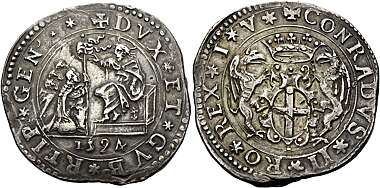
Lot 1809. Genova.   Biennial Doges, third period, 1528–1797. Series of phase II: 1541-1637. Ducatone della Benedizione 1594, AR 31.92 g. ø 42 mm. + DVX ET GVB' REIP' GEN' The Redeemer, seated on throne, blessing the doge holding banner and the governors kneeling before him; in exergue, 1594. Rev. + CONRADVS II RO' REX I V (Ieronimus Viglevanus, mintmaster) Crowned coat of arms supported by two griffins. CNI 7. Davenport 8399. Lunardi 224. MIR 222/3. Extremely rare. Lovely old cabinet tone and about extremely fine From the collection of Druso and Bartolomeo Franceschi. Please find here the video of the coin
  • Mise à prix:
    4'000 CHF
    4'370 EUR
    3'643 GBP
    4'912 USD

    Valeurs approximatives et arrondiesDate: 05/11/2026
Lot
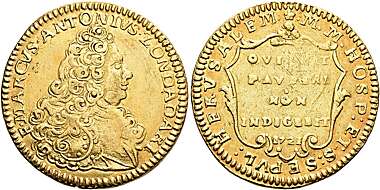
Lot 1810. Malta.   Fra Marcantonio Zondadari, 1720-1722. 4 zecchini 1721, AV 13.83 g. ø 30 mm. F MARCVS ANTONIVS ZONDADARI Cuirassed bust r. Rev. M M HOSP ET S SEPVL HERVSALEM Ornamented cartouche containing legend in six lines: QVI DAT / PAVPERI / NON / INDIGEBIT / 1721. Restelli-Sammut. 1. Gatt 22, 01/01. Friedberg 21. Extremely rare. Good very fine NGC AU details rev cleaned (8910538-001). Ex NAC sale 58, 2011, Restelli, 250. The figure of Marc'Antonio Zondadari (1720–1722), Grand Master of the Sovereign Military Order of Malta, represents a moment of great diplomatic prestige and administrative rigour for the island of Malta in the early eighteenth century, despite his very brief magistracy. Born in Siena in 1658 into an illustrious patrician family whose ancestors included Pope Alexander VII Chigi, Zondadari joined the Knights of St. John at a very young age, gaining extensive military experience in naval operations in the Mediterranean and holding the post of General of the Galleys from 1709. Upon the death of Grand Master Ramon Perellos y Roccaful, Zondadari was elected head of the Order on 13 January 1720. Zondadari died suddenly on 16 June 1722, and his remains lie in the majestic Baroque bronze and marble tomb inside St. John's Co-Cathedral in Valletta. Please find here the video of the coin
  • Mise à prix:
    12'000 CHF
    13'110 EUR
    10'929 GBP
    14'736 USD

    Valeurs approximatives et arrondiesDate: 05/11/2026
Lot
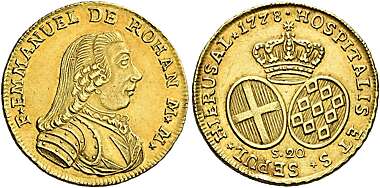
Lot 1811. Malta.   Fra Emmanuel de Rohan, 1775-1797. 20 scudi 1778, AV 16.39 g. ø 30 mm. F EMMANUEL DE ROHAN M M Cuirassed and draped bust r., with Malta Cross on the breast plate. Rev. HOSPITALIS ET S SEPUL HIERUSAL 1778 Arms of the Order and the Rohan, side-by-side, surmounted by crown; below, S.20. Restelli-Sammut 29. Gatt 27, 05/05. Friedberg 43. About extremely fine Ex NAC sale 58, 2011, Restelli, 385. Please find here the video of the coin
  • Mise à prix:
    2'400 CHF
    2'622 EUR
    2'185 GBP
    2'947 USD

    Valeurs approximatives et arrondiesDate: 05/11/2026
Lot
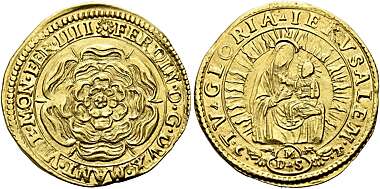
Lot 1812. Mantova.   Ferdinando Gonzaga, 1612-1626. Zecchino della rosa, AV 3.34 g. ø 22 mm. FERDIN D G DVX MANT VI E MON FER IIII Rose. Rev. TV GLORIAM IERVSALEM The Blessed Virgin with Child, within a radiant ellipse; below, within cartouche, M / D S and, at sides in outer field, C – T (Carlo Torre, mintmaster). CNI 89. MIR 586. Friedberg 566. Very rare. About extremely fine From the collection of Druso and Bartolomeo Franceschi. Ferdinando Gonzaga (1587–1626), Duke of Mantua and Montferrat, 1612–1626. The sixth Duke of Mantua, Ferdinando succeeded his elder brother Francesco IV in 1612. Originally destined for an ecclesiastical career, he abandoned the Church and assumed the ducal succession. His reign was marked by financial difficulties and the political tensions surrounding the Gonzaga succession. He married Camilla Faà di Bruno morganatically in 1616, although the marriage was not recognised as dynastically valid; in 1621 he married Caterina de’ Medici, daughter of Ferdinand I, Grand Duke of Tuscany. Ferdinando died in 1626 without legitimate issue and was succeeded by his younger brother Vincenzo II. His coinage reflects the continued monetary traditions of the Gonzaga state, with issues struck for Mantua and Montferrat bearing his titles and heraldic devices. His relatively brief reign makes his coins of particular interest to collectors of early seventeenth-century Mantuan and Montferrat coinage. Please find here the video of the coin
  • Mise à prix:
    2'400 CHF
    2'622 EUR
    2'185 GBP
    2'947 USD

    Valeurs approximatives et arrondiesDate: 05/11/2026
Lot
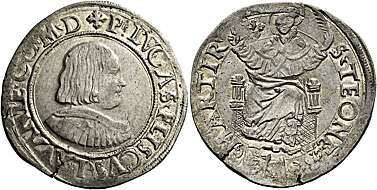
Lot 1813. Messerano.   Pier Luca II Fieschi, 1528-1548. Testone, AR 9.36 g. ø 30 mm. P LVCAS FLISCVS LAVANIE CO M D Mantled bust r. Rev. S THEONES MARTIR St. Theonestus nimbate, seated facing, giving blessing and holding palm branch in l. hand. Ravegnani Morosini 3. MIR 709. Rare. A pleasant portrait and a lovely iridescent tone, minor flan crack at seven o’clock on obverse, otherwise extremely fine Please find here the video of the coin
  • Mise à prix:
    4'000 CHF
    4'370 EUR
    3'643 GBP
    4'912 USD

    Valeurs approximatives et arrondiesDate: 05/11/2026
Lot
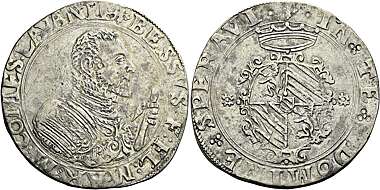
Lot 1814. Messerano.   Besso Ferrero Fieschi, 1559-1584. Tallero, AR 28.12 g. ø 41 mm. + BESSVS F FL MAR M COMES LAVANIE Armoured bust r., holding sceptre in l. hand. Rev. IN TE DOMINE SPERAVI Crowned coat of arms within an elaborately ornate frame, charged at the centre with the Fieschi inescutcheon. Unrecorded in all consulted bibliography. Apparently unique. A very interesting and unusual portrait, light iridescent tone and good very fine Ex Hess 261, 1992, 1664 and NAC 32, 2006, 46 sales. The mint of Messerano was active from the early sixteenth century until 1690. Very few issues of Besso Ferrero Fieschi are known, all of high rarity. Ravegnani Morosini reports, in volume I on page 332, a tallero similar to this one in legend and obverse typology (CNI 97), but featuring on the reverse a crowned double-headed eagle instead of the baroque quartered oval coat of arms. A similar coat of arms is known on the lira struck in 1566. The title of Counts of Lavagna was one of the most cherished by the Fieschi, who acquired the fiefdom from the Commune of Genoa in the 12th century. It is probable that the tallero was issued during the early years of his rule, as this title no longer appears in subsequent issues. The proposed specimen closely approaches in weight and fineness the talleri struck by Emmanuel Philibert of Savoy, with whom the Fieschi were allied and for whom the same die engravers may have worked. Please find here the video of the coin
  • Mise à prix:
    16'000 CHF
    17'481 EUR
    14'572 GBP
    19'648 USD

    Valeurs approximatives et arrondiesDate: 05/11/2026
Lot
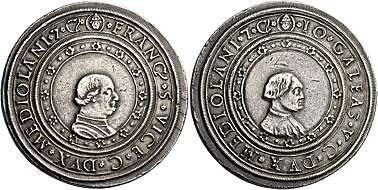
Lot 1815. Milano.   Francesco I Sforza, 1450-1466. Medal, AR 33.52 g. ø 42 mm. Small head of St. Ambrose FRANC' S VICE C DVX MEDIOLANI 7 C' Armoured bust r. of Francesco Sforza, within border of rosettes. Rev. Small head of St. Ambrose IO GALEA3 V C DVX MEDIOLANI 7 C' Armoured bust r. of Gian Galeazzo Visconti, within border of rosettes. CNI 29 (multiple of lira). Hill 674. Ravegnani Morosini 5. Crippa 28. MIR first edition p. 166, M1. Of the highest rarity. Two interesting portraits and a wonderful old cabinet tone. Good very fine Ex Leu sale 74, 1998, 412. From the Pietro Verri collection. A distinctive group of Milanese medallic pieces, struck during the sixteenth century, bears the portraits of earlier rulers of Milan, including members of the Visconti and Sforza dynasties, as well as Louis XII of France. The pieces are in silver, with the notable exception of the gold medal bearing the portrait of Louis XII. The persons represented were no longer living when these pieces were produced. They therefore belong not to the commemorative medallic tradition of contemporary events, but to a retrospective dynastic series, conceived as a gallery of the rulers who had successively held the duchy of Milan. The dies show significant links and repetitions from one piece to another, indicating that the medals were conceived as part of a unified undertaking rather than as isolated issues. The series has traditionally been associated with the later Sforza period, although its precise date and patron remain uncertain. The Gnecchi suggested either Ludovico Maria Sforza or, more cautiously, Francesco II Sforza as possible patrons, while acknowledging the difficulties involved in assigning the series to either ruler. We believe that it is high unlikely that Ludovico il Moro could have authorised these issues, as both the medals of Louis XII and Maximilian were struck after his death. The inclusion of Louis XII is particularly noteworthy. Although he was a foreign king who occupied the duchy, his portrait belongs naturally within a retrospective succession of the rulers of Milan. The series should therefore be understood principally as an expression of Milanese dynastic and historical memory, rather than as a group of medals commemorating individual events. Please find here the video of the coin
  • Mise à prix:
    12'000 CHF
    13'110 EUR
    10'929 GBP
    14'736 USD

    Valeurs approximatives et arrondiesDate: 05/11/2026
Lot
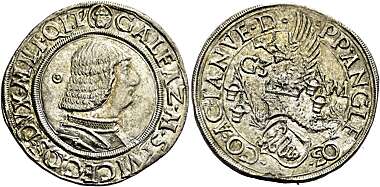
Lot 1816. Milano.   Galeazzo Maria Sforza, 1466-1476. Testone, AR 9.54 g. ø 29 mm. Small head of St. Ambrose GALEAZ M SF VICECOS DVX MLI QIT' Armoured bust r.; behind, stud. Rev. PP ANGLE Q3 CO AC IANVE D Coat of arms surmounted by ducal crest with winged dragon, flanked by G3 – M; at sides, fire-brands with buckets. Ravegnani Morosini 8. Crippa 6/A. MIR 201/2. In exceptional state of preservation. Light iridescent tone, virtually as struck and almost Fdc Please find here the video of the coin
  • Mise à prix:
    2'000 CHF
    2'185 EUR
    1'821 GBP
    2'456 USD

    Valeurs approximatives et arrondiesDate: 05/11/2026
Lot
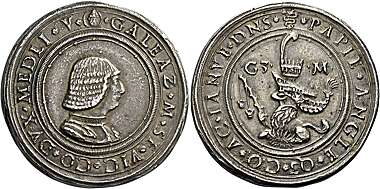
Lot 1817. Milano.   Medal, AR 35.92 g. ø 41 mm. GALEAZ M SF VIC CO DVX MEDLI V Armoured bust r.. Rev. Viper PAPIE ANGLE Q3 CO AC IANVE DNS Crowned crest surmounted by winged dragon with fire-brands and buckets; above, G3 – M. CNI 35. Hill 675. Ravegnani Morosini 17. Crippa 24. MIR p. 179, M2. MIR p. 203, MED VI. Very rare. Wonderful old cabinet tone and good very fine Ex Leu sale 74, 1998, 413. Please find here the video of the coin
  • Mise à prix:
    6'000 CHF
    6'555 EUR
    5'464 GBP
    7'368 USD

    Valeurs approximatives et arrondiesDate: 05/11/2026
Lot
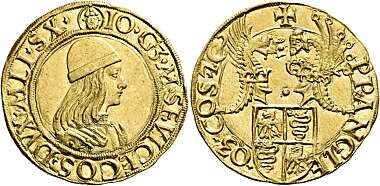
Lot 1818. Milano.   Gian Galeazzo Maria Sforza, 1476-1494. Issues without the regents’ names. Double ducat 1476–1478, AV 6.98 g. ø 28 mm. IO G3 M SF VICECOS DVX MLI SX Armoured bust r. Rev. P P ANGLIE – Q3 COS 7C Quartered coat of arms surmounted on the l. by a crest decorated with a crested dragon with a child in its jaws, and on the r. by a crest decorated with a winged monster with an old man's head clutching a ring in its talons. Bernareggi 93. Ravegnani Morosini 2. Crippa 1. MIR 215/1. MEC 12, 745. Friedberg 693. Very rare and in exceptional condition for the issue, possibly the finest specimen known. A superb portrait of excellent style, virtually as struck and almost Fdc The figure of Gian Galeazzo Maria Sforza (1469–1494) embodies one of the most complex and dramatic phases in the history of Milan, suspended between the peak of artistic splendour in the Renaissance and the political fragility that would lead to the Italian Wars. Eldest son of Galeazzo Maria Sforza and Bona of Savoy, Gian Galeazzo inherited the title of sixth Duke of Milan in 1476, at the age of only seven, following the dramatic assassination of his father at the hands of a conspiracy of Milanese nobles. Given the sovereign's very young age, the government was initially assumed by his mother, the regent duchess Bona of Savoy, assisted by the able and faithful ducal secretary Cicco Simonetta. The stability of the regency was soon undermined by the ambitions of the young Duke's uncles, in particular Ludovico Maria Sforza, known as "il Moro". In 1480, through a political coup, Il Moro succeeded in having Cicco Simonetta executed, removing the regent Bona of Savoy, and assuming guardianship of his nephew as well as effective control of the Duchy. Please find here the video of the coin
  • Mise à prix:
    40'000 CHF
    43'703 EUR
    36'432 GBP
    49'120 USD

    Valeurs approximatives et arrondiesDate: 05/11/2026
Lot
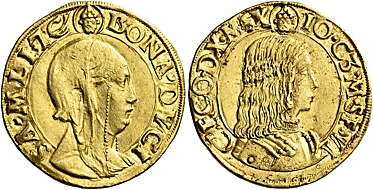
Lot 1819. Milano.   Gian Galeazzo Maria Sforza, regency of his mother Bona of Savoy, 1476-1480. Double ducat 1479–1480, AV 6.93 g. ø 24 mm. Small head of St. Ambrose BONA’DVCI – SA’MLI’7C' Veiled bust of Bona r. Rev. Small head of St. Ambrose IO’G3 M SF VI – CECO DVX M SX Armoured bust of Gian Galeazzo r. Bernareggi 91. Ravegnani Morosini 2. Crippa 1. MIR 217/1. MEC 12, unlisted. Friedberg 690. Extremely rare and in exceptional condition for the issue, possibly the finest specimen in private hands. Two very elegant portraits of fine style perfectly centred on a full flan. Good extremely fine Ex Leu sale 68, 1996, 360 Bona of Savoy assumed the regency of the duchy in 1477, following the recognition of her son Gian Galeazzo Maria as the VI Duke of Milan. Following the assassination of her husband, the V Duke Galeazzo Maria, the regent had to navigate numerous pitfalls, and thanks to the great mediation work conducted by the ducal councillor Francesco "Cicco" Simonetta, she managed to have her regency recognized. In 1481, under pressure from the ambitious and cunning uncle of the young duke, Ludovico Maria, the duchess was exiled to the castle of Pavia and the government was assumed by Il Moro. During the regency of Bona, doppio ducati and testoni were issued, all of which are today extremely rare; in particular, the gold denominations display remarkable artistic quality. For example, the subtle rendering of the string of pearls falling along the duchess's head expresses the high, almost painterly execution of the work. Regarding the author of these beautiful dies, Ravegnani hypothesizes that it might be Ambrogio di Matteo da Clivate, who had already worked for Galeazzo Maria Sforza, creating his doppio ducato (cf. lot 192). Finally, this coin is among the few of the Renaissance to feature a female portrait. Please find here the video of the coin
  • Mise à prix:
    60'000 CHF
    65'554 EUR
    54'648 GBP
    73'681 USD

    Valeurs approximatives et arrondiesDate: 05/11/2026
Lot
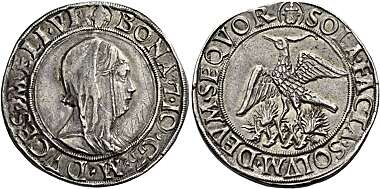
Lot 1820. Milano.   Bona of Savoy regent for Gian Galeazzo Maria Sforza, 1476-1480. Testone 1479-1480, AR 9.61 g. ø 29 mm. BONA 7 IO G3 M DVCES MELI VI Veiled head r. of Bona. Rev. SOLA FACTA SOLVM DEVM SEQVOR The Phoenix on burning fire-brands. Ravegnani Morosini 6. Crippa 2/A. MIR 218/1 (R3). MEC 12, 746. Very rare and in unusual condition for this very difficult issue. Old cabinet tone, minor marks on obverse field, otherwise good very fine / about extremely fine Please find here the video of the coin
  • Mise à prix:
    8'000 CHF
    8'740 EUR
    7'286 GBP
    9'824 USD

    Valeurs approximatives et arrondiesDate: 05/11/2026
Lot
Lot 1821. Milano.   Ludovico Maria Sforza called il Moro, 1494-1499. Special issue of the testone, AR 19.59 g. ø 28 mm. Small head of St. Ambrose LVDOVICVS M – SF ANGLVS DVX MLI Armoured bust r. Rev. Small head of St. Ambrose PP ANGLE Q3 CO AC IANVE D 7 C’ Coat of arms surmounted by crown with palm and olive branches; at sides, fire-brands with buckets. Ravegnani Morosini 5. Crippa 6. MIR 229/3 (R5). MEC 12, 763. Of the highest rarity, only two specimens listed by Crippa. Lovely iridescent tone and good very fine Ex NGSA 8, 2014, 510 Among the most unusual issues of the Milanese mint under Ludovico Maria Sforza, known as il Moro, are the special testoni struck at double weight. These exceptional pieces reproduce the types of the regular testone but, as their name indicates, were struck on planchets approximately twice the normal weight. The standard testone of Ludovico weighed about 9.5 g, whereas the double-weight specimens approach 19 g. Their purpose remains uncertain. As noted by Crippa, the Milanese archival records contain no explanation for the reason or occasion of their production, and they therefore cannot be securely connected with any specific monetary reform, ceremonial event, or payment. Their exceptional weight and rarity, however, clearly distinguish them from ordinary currency issues. The production of pieces of double weight thus appears to have been an intentional departure from the normal monetary standard rather than a simple variation in striking. In the absence of documentary evidence, their function can only be approached by comparison with similar exceptional pieces known from other Italian mints. Such heavy specimens may have been produced for presentation, ceremonial or diplomatic purposes, or as prestigious pieces intended to commemorate a particular occasion. Their size and weight would have made them unsuitable for ordinary transactions, while their close correspondence with the regular testone types suggests that they remained conceptually linked to the monetary series rather than being conceived as medals in the strict sense. It is therefore preferable to regard these pieces as special issues of the testone, rather than to assign them a specific commemorative purpose for which no contemporary evidence survives. Their existence nevertheless illustrates the flexibility of Renaissance minting practice and the importance attached to the testone as both a monetary denomination and an expression of princely portraiture and political representation. The absence of archival documentation is itself significant: unlike formally recorded monetary issues, these exceptional pieces appear to have left little or no documentary trace concerning their intended use. Their precise purpose must consequently remain open, although their exceptional weight and extreme rarity strongly suggest that they were not intended for normal circulation. Please find here the video of the coin
  • Mise à prix:
    6'000 CHF
    6'555 EUR
    5'464 GBP
    7'368 USD

    Valeurs approximatives et arrondiesDate: 05/11/2026
Lot
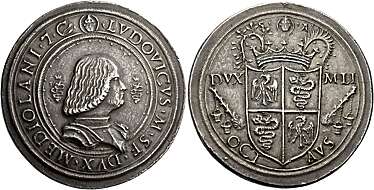
Lot 1822. Milano.   Medal, AR 40.36 g. ø 43 mm. LVDOVICVS M SF DVX MEDIOLANI 7 C' Small head of St. Ambrose Armoured bust r.; at sides, crowned vipers. Rev. S Small head of St. Ambrose A Crowned coat of arms with, at sides, fire-brands with buckets and DVX – MLI; below, in legend, OCT – AVS. CNI 15 (multiple of testone). Hill 679. Ravegnani Morosini 7. Crippa 8/A (this coin illustrated). MIR p. 227, MXVIII (this coin illustrated). Of the highest rarity, the finest of the very few specimens known. A very fascinating issue struck on a very broad flan, old cabinet tone and about extremely fine Ex Leu sale 74, 1998, 414. From the Pietro Verri collection. Please find here the video of the coin
  • Mise à prix:
    16'000 CHF
    17'481 EUR
    14'572 GBP
    19'648 USD

    Valeurs approximatives et arrondiesDate: 05/11/2026
Lot
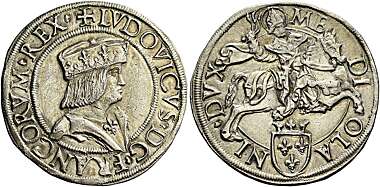
Lot 1823. Milano.   Louis XII king of France and duke of Milan, 1499-1512. Testone 1499–1505, AR 9.59 g. ø 29 mm. LVDOVIC' D G FRANCORVM REX Bust r., wearing cap adorned with lilies; lily on breast. Rev. ME – DI – OLA – NI – DVX St. Ambrose, nimbate and mitred, galloping r., holding whip in r. hand; the Saint's cloak blowing in the wind. Below, crowned shield of France. Crippa 3/A. MIR 236/1. MEC 12, 769. In exceptional condition for the issue, possibly the finest specimen in private hands. A very elegant portrait of fine style and a lovely iridescent tone, extremely fine Please find here the video of the coin
  • Mise à prix:
    8'000 CHF
    8'740 EUR
    7'286 GBP
    9'824 USD

    Valeurs approximatives et arrondiesDate: 05/11/2026
Lot
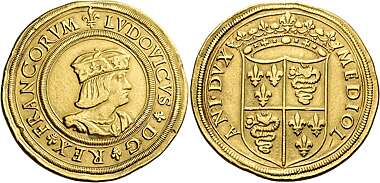
Lot 1824. Milano.   Medal of 10 ducats (after 1521), AV 34.27 g. ø 40 mm. Lily LVDOVICVS lily REX lily FRANCORVM Bust r., wearing cap adorned with lilies. Rev. MEDIOLA – NI DVX Crowned coat of arms, quartered of France and Milan. CNI 1. Hill 686. Crippa 24. MIR p. 228, XX (this coin illustrated). Of the highest rarity, apparently only five specimens known. A very interesting and fascinating issue struck on an impressive module. Traces of mounting, otherwise good very fine Ex Kunst und Münzen 13, 1974, 1132 (weight erroneously given as 34.75 g.) and Maison Palombo 10, 2011, 767 sales. Following his conquest of the Duchy of Milan in 1499, Louis XII became an important subject of Milanese medallic art. His portrait was treated in the distinctive Renaissance manner established by the great Italian medallists of the fifteenth century, transforming the ruler’s likeness into an instrument of dynastic and political representation. This gold commemorative medal, struck at the Milanese mint in the early sixteenth century, belongs to the remarkable group of medallic productions associated with French rule in Milan. The choice of gold, together with the large format and refined portraiture, indicates that it was intended as a prestigious commemorative or presentation. The sharply modelled profile and carefully rendered costume reflect the continuing vitality of the Milanese Renaissance tradition, now employed to celebrate the French sovereign. Please find here the video of the coin
  • Mise à prix:
    32'000 CHF
    34'962 EUR
    29'145 GBP
    39'296 USD

    Valeurs approximatives et arrondiesDate: 05/11/2026
Lot
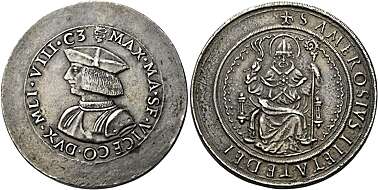
Lot 1825. Milano.   Massimiliano Maria Sforza, 1512-1515. Medaglia, AR 33.98 g. ø 39 mm. Viper MAX MA SF VICECO DVX MLI VIII C3 Armoured bust l., wearing cap. Rev. + S AMBROSIVS IIETATE DEI St. Ambrose, seated on cathedra, holding whip in his l. hand and crosier in the r.; all within wreath. CNI 2. Hill 688. Ravegnani Morosini 2 (this medal illustrated). Crippa 8 (this medal illustrated). MIR p. 238, XXIII (this medal illustrated). Apparently unique. A very interesting and unusual medal. Wonderful old cabinet tone and about extremely fine/good very fine Ex Leu 74, 1998, 416 and Hess-Divo 320, 2011, 827 sales. From the Pietro Verri collection. Massimiliano Maria Sforza was Duke of Milan from 1512 to 1515, ruling during one of the most turbulent periods of the Italian Wars. His restoration to the Milanese duchy was supported by the Swiss Confederacy after the expulsion of the French. His coinage reflects the traditional monetary types of the Duchy of Milan, combining the heraldic symbols of the Sforza dynasty with the titles and insignia of the duke. Issues were struck in silver and billon, including commemorative medals. His relatively brief reign, lasting only three years, gives the coinage considerable historical and numismatic interest. The coins are tangible evidence of the temporary restoration of Sforza rule in Milan before Francis I of France reconquered the duchy in 1515. Consequently, Sforza coins of this period are particularly evocative of the political instability of early sixteenth-century Milan. Please find here the video of the coin
  • Mise à prix:
    16'000 CHF
    17'481 EUR
    14'572 GBP
    19'648 USD

    Valeurs approximatives et arrondiesDate: 05/11/2026
Lot
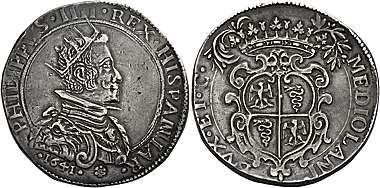
Lot 1826. Milano.   Philip IV of Spain duke of Milan, 1621-1665. Double ducaton 1641, AR 63.8 g. ø 50 mm. PHILIPPVS· IIII·REX· HISPANIAR· Radiate and armoured bust r., wearing Spanish ruff collar and Order of the Golden Fleece; lion mask on shoulder piece. Below, in legend, ·1641. Rev. MEDIOLANI – DVX·ET·C· Coat of arms quartered with eagles and vipers, surmounted by crown from which emerge a palm and an olive branch. CNI 82. Crippa 32. MIR 361/13. Davenport 4002. Extremely rare. Wonderful old cabinet tone, minor marks, otherwise good very fine Ex Nomisma 53, 2015, 1059 and NGSA 12, 2019, 840 sales. During the reign of Philip IV, the Duchy of Milan represented the imperial strategic pivot of the Spanish Crown in continental Europe. Known as the keystone of the so-called "Camino Español" (the Spanish Road), Milan served as a crucial logistical and military hub for the passage of troops, funding, and supplies from the Iberian peninsula to Flanders and the theatres of war in Northern Europe. In the monetary sphere, the Milan mint reflected the formal grandeur of Habsburg power. Under Philip IV, coins of exceptional prominence were struck, such as silver ducatoni and double ducatoni, in addition to gold multiples (doppie and quadruple). The coinage iconography of Philip IV celebrates kingship and dynastic legitimacy: the sovereign is portrayed wearing the typical Spanish ruff collar and military armour. Please find here the video of the coin
  • Mise à prix:
    20'000 CHF
    21'851 EUR
    18'216 GBP
    24'560 USD

    Valeurs approximatives et arrondiesDate: 05/11/2026
Lot
Lot 1827. Modena.   Alfonso I d'Este, 1505–1510 and 1527–1534. Ducato, AV 3.44 g. ø 24 mm. ALFONS – DVX MVT III Armoured bust l.; below, wedge. Rev. S GEMINI – MVT PON St. Geminianus nimbate and mitred, seated facing with crosier and giving blessing. Bernareggi 127. Ravegnani Morosini 12. MIR 635 (R5). Friedberg 759. Of the highest rarity, the finest of only three specimens known. A portrait of enchanting beauty, work of a very talented master-engraver. Minor areas of weakness, otherwise good extremely fine Ex Renaissance sale 2, 2000, 419. Alfonso I inherited the title of Duke of Ferrara, Modena and Reggio in 1505 upon the death of his father Ercole I. An able prince, endowed with exceptional military acumen and a great patron of the arts (patron of artists and poets such as Ludovico Ariosto and Titian), Alfonso found himself ruling a linchpin State situated between the Papal States, the Republic of Venice, and the French and Imperial domains. The government of Alfonso I laid the foundations for the institutional consolidation of the Este Duchy. Modena, although remaining secondary during this period compared to the capital Ferrara, strengthened its defences and economic structure. Decades later, with the Devolution of Ferrara to the Papacy in 1598, Modena would become the new and definitive capital of the Este Duchy. Please find here the video of the coin
  • Mise à prix:
    48'000 CHF
    52'443 EUR
    43'718 GBP
    58'944 USD

    Valeurs approximatives et arrondiesDate: 05/11/2026
Lot
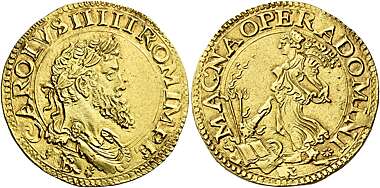
Lot 1828. Napoli.   Charles of Habsburg, king of Spain, Naples etc. 1516–1554, V as emperor from 1519. 4 scudi or quadrupla, AV 13.38 g. ø 30 mm. CAROLVS IIII ROM IMPE Laureate and draped bust r.; below, in legend, IBR in monogram (Giovan Battista Ravaschieri, mintmaster, 1548–1567). Rev. MAGNA OPERA DOMINI Pax, standing l., holding a cornucopia with l. hand and setting fire to a pile of arms and books with r. hand. Pannuti-Riccio 1a. MIR 124/1. Friedberg 830. Extremely rare and in superb condition with the portrait of the emperor exceptionally sharp and well-struck. Good extremely fine / extremely fine The reverse of this extremely rare coin commemorates the pardon granted by Charles V to the Neapolitans who had rebelled in 1547 against the viceroy Pedro de Toledo, following his attempt to introduce the Tribunal of the Inquisition in Naples. Violent clashes broke out between the populace and the Spanish troops, but ultimately good sense prevailed, and a delegation of Neapolitan nobles travelled to Madrid to seek the emperor’s clemency. The pardon was granted by an act dated 23 October 1547. As a penalty, however, the city was required to pay a fine of 100,000 gold ducats, in return for which Charles V undertook that the Inquisition would never be introduced in Naples. Please find here the video of the coin
  • Mise à prix:
    28'000 CHF
    30'592 EUR
    25'502 GBP
    34'384 USD

    Valeurs approximatives et arrondiesDate: 05/11/2026
Lot
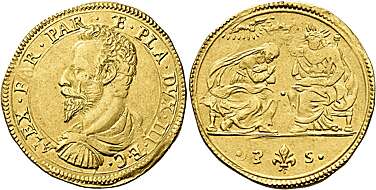
Lot 1829. Parma.   Alessandro Farnese, 1586–1592. 2 doppie or quadrupla, AV 13.14 g. ø 30 mm. ALEX FAR PAR [ET] PLA DVX III [ET] C Armoured bust l. Rev. The Redeemer, seated r., crowns the Blessed Virgin radiated by the dove of the Holy Spirit. In exergue, P (cherub's head) S (unknown mintmaster). CNI –. Ravegnani Morosini 5 (this coin illustrated). MIR 959 (R5, this coin illustrated). Friedberg 899a. Apparently unique. A wonderful portrait of fine style, minor areas of weakness on reverse, otherwise extremely fine Ex Ratto sale 25th November 1972, Curatolo IV part 104. Alessandro Farnese, duke of Parma and Piacenza, was one of the most prominent military commanders of late sixteenth-century Europe and served as governor of the Spanish Netherlands from 1578. Coins bearing his name and arms were struck in the Duchy of Parma and Piacenza during his rule. The coinage of Alessandro Farnese follows the monetary traditions of the Farnese state, combining his personal heraldry with the arms of Parma and Piacenza. Issues include gold, silver, and billon denominations, with designs typically featuring the ducal arms, a portrait or symbolic device, and Latin inscriptions identifying the duke and his titles. Farnese coinage is of particular numismatic interest because it reflects the political consolidation and dynastic ambitions of the Farnese family during a period of intense military and political activity in Italy and the Low Countries. His relatively short reign also makes coins from this period useful markers for the chronology of Farnese monetary issues. Please find here the video of the coin
  • Mise à prix:
    28'000 CHF
    30'592 EUR
    25'502 GBP
    34'384 USD

    Valeurs approximatives et arrondiesDate: 05/11/2026
Lot
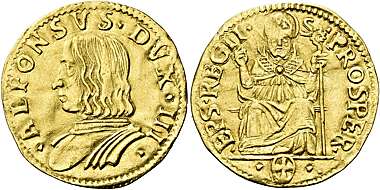
Lot 1830. Reggio Emilia.   Alfonso I d'Este, 1505–1512 and 1523–1534. First period: 1505–1512. Ducato, AV 3.42 g. ø 24 mm. ALFONSVS DVX III Armoured bust l. Rev. S PROSPER – EPS REGII St. Prosper, seated facing on throne, giving blessing and holding crosier; in exergue, coat of arms of the City. CNI 1. Bernareggi 209 (this coin illustrated). Ravegnani Morosini 22. MIR 1271 (R4). Friedberg 980. Extremely rare, only very few specimens known. A portrait of superb style, slightly wavy flan, otherwise good very fine From the Ernesto Bernareggi collection. The coinage of Alfonso I d’Este struck at Reggio Emilia is notably rare, particularly when compared with the more extensive series produced at the Este mints of Ferrara and Modena. One important reason is the limited activity of the Reggio mint under Alfonso I. Reggio Emilia was not the principal centre of Este monetary production, and its output was considerably smaller than that of Ferrara. Moreover, the Reggio issues appear to have been produced in relatively restricted quantities and for specific monetary requirements rather than as a continuous series. The political and economic circumstances of Reggio also played a role. During Alfonso's reign, the Este territories were affected by the Italian Wars with changes in political control, military expenditure and local economic conditions influencing minting activity. Consequently, surviving examples of Reggio coinage are scarce, while many specimens that were originally struck have presumably been lost through normal circulation, melting and later recoinage. Please find here the video of the coin
  • Mise à prix:
    24'000 CHF
    26'221 EUR
    21'859 GBP
    29'472 USD

    Valeurs approximatives et arrondiesDate: 05/11/2026
Lot
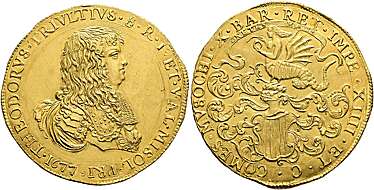
Lot 1831. Retegno.   Antonio Teodoro Trivulzio, 1676–1678. 10 zecchini 1677, AV 34.57 g. ø 50 mm. THEODORVS TRIVLTIVS S R I ET VAL MISOL PRI 1677 Cuirassed bust r. with lace jabot, draped mantle, and the collar of the Order of the Golden Fleece. Rev. COMES MVSOCHI X BAR RET IMPE XIIII ET C Helmeted coat of arms of Trivulzio with large crest and sphinx holding a ring and a broken file in its hands, above it a ribbon with the inscription: * NETES - MAI *. Gnecchi 1. MIR 893. Friedberg 986. Extremely rare and in exceptional condition for the issue, possibly the finest specimen in private hands. A masterpiece of the Italian numismatic baroque with a wonderful portrait and a superb reverse composition. Good extremely fine NGC MS 62 Top Pop (2190890-001) Antonio Teodoro Trivulzio was Governor of the Duchy of Milan from 1676 until his death in 1678, serving on behalf of the Spanish monarchy. A member of the distinguished Trivulzio family, he belonged to one of Milan's most prominent aristocratic dynasties. The coinage associated with his administration is part of the later Spanish-Milanese monetary series. Trivulzio's tenure was exceptionally brief, and this short period contributes to the scarcity and numismatic interest of pieces associated with his administration. Such coins are especially valuable as historical documents, illustrating the continued Spanish presence in Milan during the final decades of the seventeenth century and the role played by the great Milanese aristocratic families in the government of the duchy.
  • Mise à prix:
    120'000 CHF
    131'109 EUR
    109'297 GBP
    147'362 USD

    Valeurs approximatives et arrondiesDate: 05/11/2026
Lot
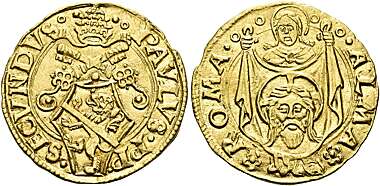
Lot 1832. Roma.   Paolo II (Pietro Barbo), 1464–1471. Ducato papale, AV 3.49 g. ø 21 mm. PAVLVS PP SECVNDVS Coat of arms surmounted by tiara and keys in saltire with cords. Rev. ALMA ROMA The Veronica. Muntoni 7. Berman 395. MIR 400. Friedberg 20. Very rare and in unusually fine condition for the issue. About extremely fine Please find here the video of the coin
  • Mise à prix:
    10'000 CHF
    10'925 EUR
    9'108 GBP
    12'280 USD

    Valeurs approximatives et arrondiesDate: 05/11/2026
Lot
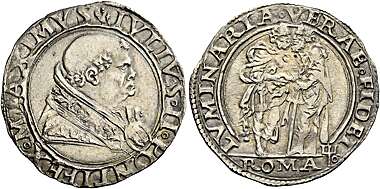
Lot 1833. Roma.   Giulio II (Giuliano della Rovere), 1503–1513. Giulio (1504), AR 3.83 g. ø 27 mm. IVLIVS II PONTIFEX MAXIMVS Bust r., wearing cope decorated with two Saints' heads and fastened by a buckle with triple human face. Rev. LVMINARIA VERA FIDEI St. Peter and St. Paul standing facing and turned towards each other, shaking r. hands. Below to r., trident (mark of the Fugger Bank) and, in exergue, ROMA. Muntoni 24. Berman 570. MIR 558 ( R3, this coin illustrated). Very rare and in exceptional condition for the issue. A very elegant Renassaince portrait, superb old cabinet tone and extremely fine Ex Santamaria 27 April 1942, Gili, 220; Santamaria 4 June 1956, Magnaguti, 90 and Leu 74, 1998, 583 sales. Elected to the papacy in 1503, Julius II was one of the most forceful figures of the Italian Renaissance. A man of strong character and considerable political ability, he sought to strengthen the Papal States and recover territories under papal rule, intervening directly in the political and military affairs of the Italian peninsula. His pontificate was also marked by important artistic patronage: he commissioned Michelangelo to decorate the ceiling of the Sistine Chapel and promoted the rebuilding of St Peter’s Basilica, begun in 1506. In numismatic terms, his coinage reflects the prestige and political programme of the Church at the beginning of the sixteenth century. Many of his coin portraits convey the energetic character of the pope; like other rulers of the Italian states, he entrusted the execution of his dies to accomplished engravers, among them  Pier Maria da Pescia. Please find here the video of the coin
  • Mise à prix:
    8'000 CHF
    8'740 EUR
    7'286 GBP
    9'824 USD

    Valeurs approximatives et arrondiesDate: 05/11/2026
Lot
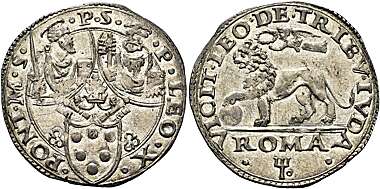
Lot 1834. Roma.   Leone X (Giovanni de’ Medici), 1513–1521. Giulio, AR 3.97 g. ø 28 mm. LEO X – PONT M Coat of arms surmounted by tiara and keys in saltire; above, half-figures of St. Peter and St. Paul and, in legend, S – P S – P. Rev. VICIT LEO DE TRIBV IVDA Lion walking l., crowned by a Victory. In exergue, ROMA and, below, mark of the Fugger Bank. Muntoni 27. MIR 629. Berman 644. Virtually as struck and almost Fdc Ex Nomisma sale 47, 2013, 1505. Please find here the video of the coin
  • Mise à prix:
    1'200 CHF
    1'311 EUR
    1'092 GBP
    1'473 USD

    Valeurs approximatives et arrondiesDate: 05/11/2026
Lot
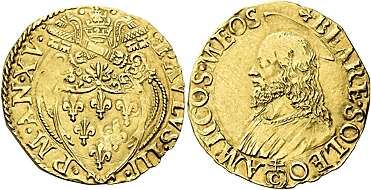
Lot 1835. Roma.   Paolo III (Alessandro Farnese), 1534–1549. Scudo year XV, AV 3.29 g. ø 23 mm. PAVLVS III – P M AN XV Coat of arms surmounted by tiara and keys in saltire with cords. Rev. BEARE SOLEO sign of Girolamo Ceuli, mintmaster AMICOS MEOS Nimbate bust of Christ l. Muntoni –. Berman –. MIR –. Friedberg 64a. Apparently unique. Minor areas of weakness, otherwise extremely fine Ex NGSA sale 5, 2008, 885. Of particular interest is this scudo, struck in the final year of the pontificate of Paul III Farnese. The coin is unknown to the principal reference works on Papal coinage and was recorded by Friedberg only after its appearance on the market. The type also represents an innovation within the gold coinage of Paul III: the previously known gold scudi depict Saint Paul standing on the reverse, whereas the bust of Christ would be adopted more frequently by his successor, Julius III, with varied legends. This specimen is of further particular interest on account of the mintmaster’s mark of Girolamo Ceuli, a merchant of Pisan origin who in 1549 obtained the contract to operate the mint of Rome. Until now, coins bearing his mark were known from the issues of the lengthy Sede Vacante of 1549–1550, which began with the death of Paul III and ended with the election, in the Jubilee Year 1550, of Giovanni Maria Ciocchi del Monte as Julius III. The MIR – Stato Pontificio, vol. II, specifies that Ceuli’s contract commenced on 1 July 1549. Since Paul III died on 10 November of the same year, this scudo constitutes particularly significant evidence, documenting an issue struck during Ceuli’s tenure at the Roman mint in the final approximately four months of the Farnese pope’s pontificate. The coin therefore makes an important contribution to our knowledge of the coinage of Paul III and, more generally, to the history of the contractors of the Papal mint, filling a chronological gap between the end of this pontificate and the beginning of the Sede Vacante administered by the Camerlengo Guido Ascanio Sforza. It provides evidence of Girolamo Ceuli’s activity during a still relatively little-known phase of his long career, when his connections with the Farnese milieu must have been of particular importance. Ceuli remained active, albeit intermittently, in the management of the Roman mint until the first year of the pontificate of Gregory XIII. Please find here the video of the coin
  • Mise à prix:
    20'000 CHF
    21'851 EUR
    18'216 GBP
    24'560 USD

    Valeurs approximatives et arrondiesDate: 05/11/2026
Lot
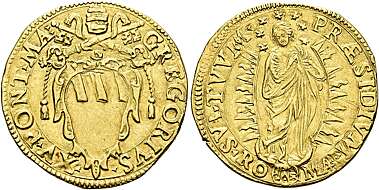
Lot 1836. Roma.   Gregorio XV (Alessandro Ludovisi), 1621–1623. Doppia, AV 6.22 g. ø 25 mm. GREGORIVS – XV PONT MA Coat of arms surmounted by tiara and keys in saltire with cords and tassels. Rev. SVB TVVM – PRÆSIDIVM The Blessed Virgin on crescent, with halo of stars, within radiant elipse; below, RO coats of arms of Bonanni, Pagliari and Martelli MA. Muntoni 4. Berman 1645. MIR 1618/1. Friedberg 112. Extremely rare, possibly the finest in private hands, only very few specimens known. About extremely fine Please find here the video of the coin
  • Mise à prix:
    8'000 CHF
    8'740 EUR
    7'286 GBP
    9'824 USD

    Valeurs approximatives et arrondiesDate: 05/11/2026
Lot
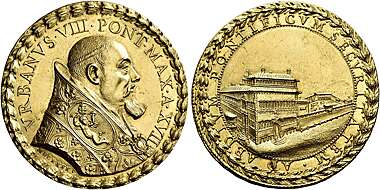
Lot 1837. Roma.   Urbano VIII (Maffeo Barberini), 1623-1644. Medal year XVII/1644, AV 37.74 g. ø 43,3 mm. For the restoration and embellishment of the Quirinale Palace (opus: Gaspare Morone). VRBANVS VIII PONT MAX A XVII Bare-headed bust r., wearing cope decorated with cherubs and floral patterns; in the shoulder truncation, G.M.F. and, below, MDXXXX. All within laurel wreath. Rev. AD AEDIVM PONTIFICVM SECVRITATEM View of the Quirinale Palace, all within laurel wreath. Mazio 212. Bartolotti E640. Extremely rare. Good extremely fine NGC MS 63 (8913895-005) Ex NAC sale 60, 2011, 158. During the pontificate of Urban VIII the Quirinal Palace underwent important works of restoration, enlargement and embellishment, contributing significantly to the development of the complex as a papal residence. The gardens were extended towards the Quattro Fontane, enclosed by a new perimeter wall and enriched with fountains, while the quarters of the Swiss Guard were enlarged and the palace strengthened with defensive works. Urban VIII also commissioned Gian Lorenzo Bernini to design the Loggia delle Benedizioni, completed in 1638 above the principal entrance to the palace. The pope further had his summer apartments refurbished, incorporating Barberini emblems and a passage decorated with views of the principal architectural enterprises of his pontificate. These interventions transformed the Quirinal into a setting that combined papal residence, ceremonial representation and the architectural language of the early Baroque. Please find here the video of the coin
  • Mise à prix:
    6'000 CHF
    6'555 EUR
    5'464 GBP
    7'368 USD

    Valeurs approximatives et arrondiesDate: 05/11/2026
Lot
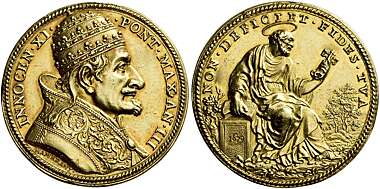
Lot 1838. Roma.   Innocenzo XI (Benedetto Odescalchi), 1676–1689. Medaglia year III/1679, AV 23.55 g. ø 33,3 mm. For the Peace of Nijmegen (opus: Giovanni Hamerani). INNOCEN XI – PONT MAX AN III Bust r., wearing tiara and decorated cope; below, HAMERANI. Rev. NON DEFICIET FIDES TVA St. Peter nimbate, seated r., with book in his r. hand and keys in the l.; on the pedestal, 1679. Bartolotti E679. Extremely rare. A magnificent portrait of fine style struck in high relief and a lovely reddish tone. Minor edge marks, possibly traces of mounting, otherwise extremely fine Ex NAC sale 121, 2020, 1. In the Dutch city of Nijmegen, on 10 August 1678, peace was stipulated between France, the United Provinces of Holland, Spain, and the Holy Roman Empire, ending the war between these nations that had begun in 1672. The Pope, through his legate, acted as the promoter of energetic mediation efforts among the belligerent powers, above all with an anti-Turkish focus. He considered that the greatest danger for Europe – as would indeed occur a few years later – was an increasingly foreseeable Ottoman invasion of the West, and that a lack of unity would prove disastrous for the European States. Only through a prospective European alliance would the Western nations possess the necessary forces to counter the armies of the Sultan; thus, thanks also to the diplomatic mediation of the Holy See, the signing of the peace treaty was achieved. Innocent XI was greatly relieved by this, seeing his justified concerns regarding the Turkish threat recede. Please find here the video of the coin
  • Mise à prix:
    6'000 CHF
    6'555 EUR
    5'464 GBP
    7'368 USD

    Valeurs approximatives et arrondiesDate: 05/11/2026
Lot
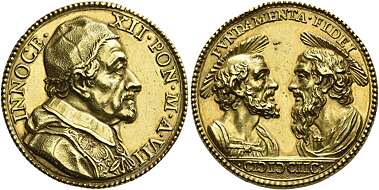
Lot 1839. Roma.   Innocenzo XII (Antonio Pignatelli), 1691-1700. Medaglia year VII/1698, AV 26.70 g. Ø 35.3 mm. The Apostles Peter and Paul, foundation of the Church (opus: Giovanni Hamerani). INNOCE – XII PON M A VII Bust r., wearing camauro, mozzetta, and stole; on the shoulder truncation, HAMERANVS. Rev. FVNDAMENTA FIDEI Confronted nimbate busts of St. Peter and St. Paul; in exergue, CiC(retrograd)IC(retrograd)CIDC. Bartolotti E698. Very rare. A medal of great beauty struck in very high relief. Minor marks and an edge nick at eleven o’clock on reverse, otherwise extremely fine NGC MS 61 (8913895-004) Ex NAC sale 121, 2020, 3. Please find here the video of the coin
  • Mise à prix:
    6'000 CHF
    6'555 EUR
    5'464 GBP
    7'368 USD

    Valeurs approximatives et arrondiesDate: 05/11/2026
Lot
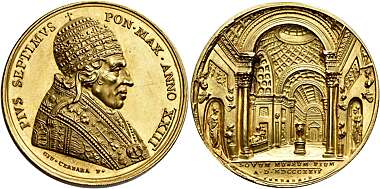
Lot 1840. Roma.   Pio VII (Barnaba Chiaramonti), 1800-1823. Medaglia year XXIII/1822, AV 43.43 g. Ø 42 mm. For the expansion of the Vatican Museum (opus: Giuseppe Cerbara). PIVS SEPTIMVS – PON MAX ANNO XXIII Bust r., wearing tiara and cope decorated with heraldic devices; below, in legend, GIU CERBARA F. Rev. The interior of the Braccio Nuovo of the Museum called "Chiaramonti"; in exergue, NOVUM MUSEUM PIUM / A D MDCCCXXII and below, in legend, CERBARA F. Bartolotti E822. Extremely rare. A medal of enchanting beauty with an impressive reverse. Almost invisible mark on obverse field, otherwise virtually as struck and almost Fdc Ex NAC sale 121, 2020, 20. Of this medal 33 specimens were struck in gold and 2033 in silver. During the pontificate of Pius VII, the papal museum complex was significantly enlarged with the establishment of the Museo Chiaramonti, intended primarily to house ancient sculpture. Arranged under the direction of Antonio Canova, the museum formed part of a broader programme to enhance the papal collections following the substantial losses of works of art resulting from the Napoleonic requisitions. This commemorative medal records this important cultural initiative of Pius VII’s pontificate, celebrating the continuity of the papal tradition of antiquarian scholarship and artistic patronage. Please find here the video of the coin
  • Mise à prix:
    16'000 CHF
    17'481 EUR
    14'572 GBP
    19'648 USD

    Valeurs approximatives et arrondiesDate: 05/11/2026
Lot
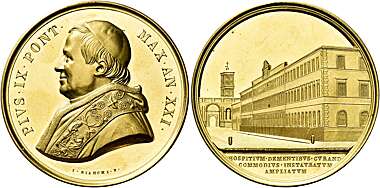
Lot 1841. Roma.   Pio IX (Giovanni Maria Mastai Ferretti), 1846-1878. Medaglia year XXI (1866), AV 52.68 g. Ø 43.5 mm. For the new building of the Psychiatric Hospital (opus: Ignazio Bianchi). PIVS IX PONT – MAX AN XXI Bust l., wearing skullcap, mozzetta, and decorated stole; below, I BIANCHI F. Rev. The building of the Psychiatric Hospital at the Lungara; on the exergual line, F AZZURRI ARCH – I BIANCHI S and, in exergue, HOSPITIVM DEMENTIBVS CVRAND / COMMODIVS INSTAVRATVM / AMPLIATVM. Bartolotti E866. Extremely rare. Virtually as struck and almost Fdc NGC MS 63 DPL (8913892-001) Ex NAC sale 121, 2020, 36. Of this medal 37 specimens were struck in gold. During the pontificate of Pius IX, important reforms were undertaken in the organization and accommodation of Rome’s psychiatric care. In 1850, the Roman hospitals were placed under a single administrative commission, while efforts were made to provide the psychiatric hospital with a more suitable hospital structure. The existing facilities were subsequently enlarged and reorganized, culminating in the construction of a new hospital complex at the Lungara. This annual medal commemorates this important undertaking and records an important aspect of Pius IX’s programme of institutional and charitable works in Rome. Please find here the video of the coin
  • Mise à prix:
    4'800 CHF
    5'244 EUR
    4'371 GBP
    5'894 USD

    Valeurs approximatives et arrondiesDate: 05/11/2026
Lot
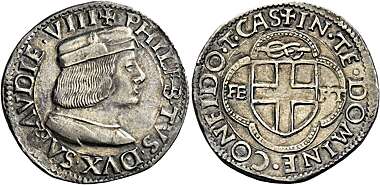
Lot 1842. Savoia.   Filiberto II, 1497–1504. Testone first type, Cornavin 1497–1500, AR 9.53 g. ø 30 mm. PHILIBTVS DVX SABAVDIE VII Bust r. wearing cap. Rev. IN·TE·DOMINE·CONFIDO·T·CAS· (Giacoma Casino mint­master) Savoy coat of arms flanked by FE – RT and surmounted by a love knot; all within a quadrilobed border. Ravegnani Morosini 4. MIR 300b (R/6). Of the highest rarity and possibly the finest specimen in private hands. Wonderful old cabinet tone and extremely fine Ex NAC sale 81, 2014, GdF, 276. Born on 10 April 1480 to Philip II and Margaret of Bourbon, at barely fourteen years old he accompanied his father following the King of France, Charles VIII, on the expedition to conquer the Kingdom of Naples. In 1496 he received Bresse as an appanage from his father and, upon the latter's death, ascended the throne under the regency of Bianca of Montferrat. Son of Philip II (known as Landless) and Margaret of Bourbon, Philibert ascended the ducal throne in 1497, at just seventeen years of age, following the premature passing of his father. Educated at the French court under the guidance of King Charles VIII, Philibert came to power during a time of severe geopolitical instability, marked by the beginning of the Italian Wars. The true turning point in Philibert II's reign came in 1501 with his second marriage to Margaret of Austria, daughter of Emperor Maximilian I of Habsburg and sister of Philip the Handsome. Under her guidance, the Savoyard State enjoyed a rare period of peace and economic prosperity, with the court becoming a refined center of Renaissance patronage. Please find here the video of the coin
  • Mise à prix:
    24'000 CHF
    26'221 EUR
    21'859 GBP
    29'472 USD

    Valeurs approximatives et arrondiesDate: 05/11/2026
Lot
Lot 1843. Savoia.   Carlo Emanuele III, 1755–1773. Carlino of 5 doppie 1756, AV 48.05 g. ø 42 mm. CAR EM D G REX SAR CYP ET IER Head l.; below, 1756. Rev. DVX SAB ET MONTISFER PRINC PED & Crowned arms surrounded by the collar of the Annunziata; below, D – 5. MIR 941b. Friedberg 1103. Extremely rare and in exceptional condition for the issue, the highest graded specimen. Virtually as struck and almost Fdc NGC MS 62 Top Pop (8913896-001)) Ex Gadoury sale 2016, 761. Please find here the video of the coin
  • Mise à prix:
    60'000 CHF
    65'554 EUR
    54'648 GBP
    73'681 USD

    Valeurs approximatives et arrondiesDate: 05/11/2026
Lot
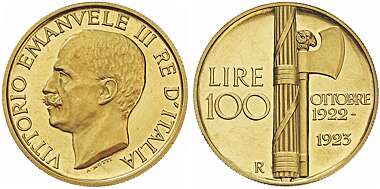
Lot 1844. Savoia.   Vittorio Emanuele III re d’Italia, 1900-1946. 100 lire 1923 with mirror-finish surfaces, AV 32.25 g. ø 35 mm. VITTORIO EMANVELE III RE D’ITALIA Bare head l.; below A MOTTI. Rev. Lictor's fasces with axe r.; at sides, LIRE / 100 – OTTOBRE / 1922 / 1923. In lower l. field, R. Pagani 644a. MIR 1116b. Friedberg unlisted. Of the highest rarity, four specimens known, of which only two are in private hands. Virtually as struck and Fdc NGC PF 61 Cameo (2414738-002). The 100 Lire issue commemorating the first anniversary of the “March on Rome” in October 1922, which effectively marked the advent of Fascism in Italy, was intended purely for the numismatic market, having been sold by the Mint from the outset at 400 Lire each. The Mint’s intention was to produce all 20,000 specimens with a proof finish. For reasons that remain unknown to this day, the obverse dies proved defective, and scratches were already visible in the mirrored fields behind the King’s head on the very first specimen struck. After the fourth specimen was minted, it was decided to suspend production. As it was impossible to continue striking the coins with the damaged die, it was decided, once the flan had been struck, to give it a matte finish to hide the scratches on the obverse field. This explains why all specimens currently on the market, apart from the four mentioned above, have a sandblasted finish. It is believed that, of these four specimens, two were retained by Engineer Mario Lanfranco, Director of the Mint from 1910 to 1929. At the sale of Coins of the Kingdom of Italy and the Italian Colonies held by P. & P. Santamaria in Rome on 28 May 1926, featuring the collection belonging to Engineer Lanfranco, a proof specimen was offered at lot 266. This is the first and only time in numismatic history that a 100 lire proof finish has been offered in a public auction and it realised 1,300 lire which was a very substantial amount. This specimen is the second one to appear in the numismatic over 100 years after the first one. The issue with the proof finish is well documented in the literature on the coinage of the Kingdom of Italy: Simonetti 15/a; Pagani, Prove 644a; Cudazzo 1229b. Please find here the video of the coin
  • Mise à prix:
    60'000 CHF
    65'554 EUR
    54'648 GBP
    73'681 USD

    Valeurs approximatives et arrondiesDate: 05/11/2026
Lot
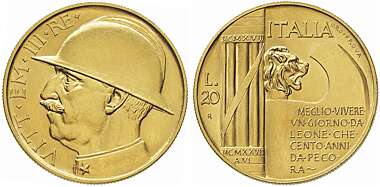
Lot 1845. Savoia.   20 lire 1928, AV 32.25 g. ø 35 mm. VITT EM III RE Helmeted head l.; below, in two lines, G ROMAGNOLI / A MOTTI INC. Rev. ITALIA Lictor's fasces with lion head and axe r.; on the upper binding MCMXVIII, on the lower one MCMXXVIII / A•VI – L• - 20 / R. In field above, to r., ORO PROVA. Inscribed on axe MEGLIO / VIVERE UN / GIORNO DA / LEONI CHE / CENTO ANNI / DA PECO / RA. Pagani Prove 202. Luppino 144. Of the highest rarity, only fifteen specimens minted. Virtually as struck and Fdc NGC MS 62 (2414738-003). Exceptional and extremely rare gold issue of the 20 lire of 1928, struck in the sixth year of the Fascist Era on the occasion of the tenth anniversary of the Victory. The type, known in the numismatic literature as the “Marshals” type, uses the dies of the contemporary silver coin, with the helmeted head of Vittorio Emanuele III on the obverse and, on the reverse, the fasces with axe and lion, accompanied by the motto MEGLIO VIVERE UN GIORNO DA LEONE CHE CENTO ANNI DA PECORA (“Better to live one day as a lion than a hundred years as a sheep”). The gold issue was not intended for monetary circulation but was produced in a very limited number of specimens to be presented to the highest-ranking figures of the State. Among the recipients were the King, the seven Marshals of Italy, the Grand Admiral, and other senior institutional figures. Of extraordinary rarity, with only a very few specimens known, it ranks among the most prestigious and sought- after rarities of the gold coinage of Vittorio Emanuele III. Particularly significant is the different arrangement of the motto, in six lines, compared with the corresponding silver issue, an important diagnostic feature for the identification of genuine specimens. Please find here the video of the coin
  • Mise à prix:
    200'000 CHF
    218'516 EUR
    182'161 GBP
    245'603 USD

    Valeurs approximatives et arrondiesDate: 05/11/2026
Lot
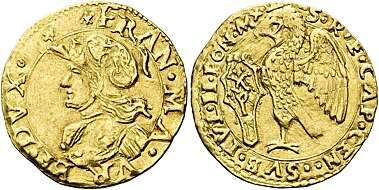
Lot 1846. Urbino.   Francesco Maria I della Rovere, 1508-1516 and 1521-1538. Ducato, AV 3.42 g. ø 22 mm. FRAN MA – RI – VR DVX Armoured bust r., with long hair. Rev. S R E CAP GEN SVB IVL II PON MX Crowned eagle, standing l. with wings spread, holding with r. talon the della Rovere coat of arms. Bernareggi 240. Ravegnani Morosini 1 (ER). Cavicchi Urbino 61. Friedberg 1197. Extremely rare, only very few specimens known. A portrait of great beauty struck on a full flan. About extremely fine Ex Baranowsky sale 2 February 1932, Antica e Nobile Famiglia, 3170. From the Ernesto Bernareggi collection. Born at Senigallia, Francesco Maria was the son of Giovanni della Rovere and Giovanna da Montefeltro, daughter of Federico III da Montefeltro. He was also the nephew of Giuliano della Rovere, who became Pope Julius II. In 1504 his uncle Guidobaldo I, the last Montefeltro Duke of Urbino, designated him as his successor, and on Guidobaldo's death in 1508 Francesco Maria inherited the duchy. A distinguished condottiero, he was appointed Captain-General of the Papal forces by Julius II and fought in the Italian Wars against Venice and Ferrara. In 1508 he married Eleonora Gonzaga, daughter of Francesco II Gonzaga, Marquess of Mantua, and Isabella d'Este. In 1513 Julius II also granted him Pesaro. His position depended heavily upon papal favour. After the death of Julius II in 1513, relations with the new Medici pope, Leo X, deteriorated. In 1516 Francesco Maria was deprived of Urbino, which was granted to Lorenzo de' Medici. He attempted to recover the duchy by force in 1517 and held out for several months before withdrawing to Mantua. On the death of Leo X in 1521 he recovered Urbino, and in 1523 received formal papal investiture. He subsequently continued his military career, serving with the Venetian and imperial forces in the Italian Wars. His later career was complicated by the struggle between the papacy, France, Venice and the Emperor Charles V. He died in 1538 and was succeeded by his son Guidobaldo II della Rovere. Please find here the video of the coin
  • Mise à prix:
    40'000 CHF
    43'703 EUR
    36'432 GBP
    49'120 USD

    Valeurs approximatives et arrondiesDate: 05/11/2026
Lot
Lot 1847. Venezia.   Francesco Erizzo, 1631-1646. Osella of 4 zecchini year II (1632), AV 14.05 g. ø 37 mm. Winged and nimbate lion facing, standing on hind legs, holding with front paws an ornate shield inscribed FRANCIS / ERICIO / V D / MVNVS / ANNO / II; in exergue, D M (Domenico Michini, mintmaster). Rev. DEDI SVAVITATEM ODORIS The Blessed Virgin with the Child on the foliage of a tree, from whose trunk and branches drops of myrrh fall to the ground; at sides, in the sky, two cherubs blowing towards the tree. Paolucci II – (cf. 115 for the silver). Apparently unique and unrecorded. Minor marks, otherwise extremely fine From the collection of Druso and Bartolomeo Franceschi. Francesco Erizzo assumed the dogeship in 1631, when Venice was still marked by the devastating plague of 1630. This osella therefore belongs to the early years of his government and reflects the atmosphere of renewed confidence that followed the end of the epidemic: as early as November 1631, the Doge was able officially to proclaim the city free from the plague. The type thus provides significant evidence of the devotional culture of the Serenissima, in which the osella, besides serving as the Doge’s annual gift, became an elegant means of commemorating events and celebrating the fortunes of the Republic. The choice of the Lion of St Mark further underscores the distinctly civic and institutional character of the issue. Please find here the video of the coin
  • Mise à prix:
    12'000 CHF
    13'110 EUR
    10'929 GBP
    14'736 USD

    Valeurs approximatives et arrondiesDate: 05/11/2026
Lot
Lot 1848. Venezia.   Alvise IV Mocenigo, 1763-1778. Tallero for the Levant 1768 of 10 zecchini, AV 34.75 g. ø 41 mm. ALOYSIO MOCENICO DUCE Winged and nimbate lion, seated and facing r., holding open book in front paws; on exergual line, A – S (Antonio Schabel, engraver) and, below, 1768. Rev. RESPUBLICA – VENETA Bust of Venice r. Paolucci II –. An apparently unique and unrecorded date of an extremely rare type. A coin of great beauty in exceptional condition, virtually as struck and almost Fdc NGC MS 61 (8910539-003). The tallero for the Levant belongs to the final series of Venetian trade coinage intended for circulation in the eastern Mediterranean during the dogeship of Alvise IV Mocenigo (1763–1778). Talleri of this type were normally struck in silver and formed part of Venice’s long-established monetary relationship with the Levant. The present specimen is of exceptional interest as an 10-zecchini gold striking of the tallero type, rather than the customary silver issue. Apparently unique and unrecorded in the published literature, it represents an extraordinary adaptation of a denomination normally associated with silver to a high-value gold format. Its combination of rarity, unusual metal and denomination makes it a particularly remarkable product of the Venetian mint in the final decades of the Republic. Please find here the video of the coin
  • Mise à prix:
    60'000 CHF
    65'554 EUR
    54'648 GBP
    73'681 USD

    Valeurs approximatives et arrondiesDate: 05/11/2026
Lot
Lot 1849. Venezia.   Osella of 4 zecchini year XII/1774, AV 13.82 g. ø 33 mm. S MARCUS – VENETUS Shield with the lion of St. Mark. Rev. ALOYSII / MOCENICI / PRINCIPIS / MUNUS AN XII / 1774 / G M B (Giustinian Maria Badoer massaro). The whole within laurel wreath. Paolucci 476. Very rare and in exceptional condition for the issue. Virtually as struck and almost Fdc NGC MS 61 (8913895-003). Ex NAC sale 147, 2024, 287. Please find here the video of the coin
  • Mise à prix:
    10'000 CHF
    10'925 EUR
    9'108 GBP
    12'280 USD

    Valeurs approximatives et arrondiesDate: 05/11/2026
Lot
Lot 1850. Venezia.   Paolo Renier, 1779-1789. 40 zecchini, AV 139.01 g. ø 51 mm. PAVL RAINER – S M VENET St. Mark nimbate, standing l., handing the banner to the kneeling Doge; along the shaft, D V X. Rev. SIT T XPE DAT Q TV – REGIS ISTE DVCA The Redeemer standing facing within an elliptical halo studded with stars. Paolucci 3. Friedberg 1434. Of the highest rarity. An impressive multiple struck on a very thick flan. An edge nick at eleven o’clock on obverse and several minor marks, otherwise, good very finePreviously encapsulated by PCGS as EF-45. Ex Stack’s Bowers 11 January 2018, 21136. From the Anne and Daniel Aghion family collection. Born in Venice in 1711 into an ancient patrician family, Paolo Renier was elected Doge on 14 January 1779. His dogeship took place during a period of the Serenissima’s progressive political decline, marked by economic difficulties and increasing pressure from the great European powers. During his government, however, Venice maintained its traditional commercial and diplomatic activities. Renier died on 13 February 1789 and was buried in the church of San Nicolò dei Tolentini. The principal functions of these multiples appear to have been: presentation and diplomatic gifts – enormous gold pieces made particularly impressive gifts to important persons; commemorative and or ceremonial purposes – they could mark a doge's accession, important state occasions or the prestige of the Republic; display of the Republic's wealth and the Doge's magnificence – very much part of the visual and ceremonial language of late Venetian government. Please find here the video of the coin
  • Mise à prix:
    60'000 CHF
    65'554 EUR
    54'648 GBP
    73'681 USD

    Valeurs approximatives et arrondiesDate: 05/11/2026
Lot
Lot 1851. Venezia.   Ludovico Manin, 1789-1797. Scudo della croce of double weight, AR 62.84 g. ø 44 mm. LUDOVICVS MANIN DVX VENETIAR Ornate and foliated cross, cantoned by four vine leaves. In exergue, G F (Giacomo Foscarini, massaro). Rev. SANCTVS MARCVS VENET Lion in soldo, within ornate shield; in exergue, 140. Paolucci p. 141, 13. Davenport 1569. Extremely rare and in exceptional state of preservation. A perfect Fdc NGC MS 65 (8905347-002). Ex NAC sale 30, 2005, 1180, Please find here the video of the coin
  • Mise à prix:
    8'000 CHF
    8'740 EUR
    7'286 GBP
    9'824 USD

    Valeurs approximatives et arrondiesDate: 05/11/2026
Paramètres de confidentialitéParamètres de confidentialité