Se connecter pour des enchères en direct
Numismatica Genevensis SA Logo
Lot
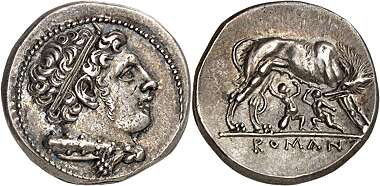
Lot 51. Anonymous. Didrachm 269-266 BC, Rome. Diademed head of Herakles right with club and lion skin / Shewolf right, head turned back, suckling twins Romulus and Remus. In exergue, ROMAN[O]. 7,06g. BMCRR Romano-Campanian 28; Crawford 20/1; RSC 8. A beautiful specimen. Extremely fine. Provenance: Count Ivan Ivanovich Tolstoi Collection (1858-1916), Hess (11 March 1912), 586. Sternberg XXII (20-21 November 1989), 166. Privately purchased from Tradart in 2008. Baron Lorne Thyssen-Bornemisza Collection. Crawford places the beginnings of Roman silver coinage in 269–268 BC. Among the earliest didrachm issues, he identifies this type as the first to display imagery that is unmistakably Roman in character. The reverse seems to reproduce the statue set up in 269 BC by the curule aediles and brothers Gnaeus and Quintus Ogulnius at the foot of the Palatine Hill, and the head of Hercules on the obverse may represent Hercules Victor — an especially fitting choice for a coinage produced from the wealth acquired after Rome’s victories over Pyrrhus. In this light, the type stands not merely as a monetary innovation but as a visual affirmation of Rome’s military success and its emerging civic identity.
  • Mise à prix:
    10'000 CHF
    10'910 EUR
    9'099 GBP
    12'246 USD

    Valeurs approximatives et arrondiesDate: 05/11/2026

Veuillez noter que la soumission d'offres n'est possible que dans le cadre des étapes d'enchères définies par la maison de vente aux enchères.

  • 0 CHF - 200 CHF : 10 CHF étapes
  • 200 CHF - 500 CHF : 20 CHF étapes
  • 500 CHF - 1'000 CHF : 50 CHF étapes
  • 1'000 CHF - 2'000 CHF : 100 CHF étapes
  • 2'000 CHF - 5'000 CHF : 200 CHF étapes
  • 5'000 CHF - 10'000 CHF : 250 CHF étapes
  • 10'000 CHF - 20'000 CHF : 500 CHF étapes
  • 20'000 CHF - 50'000 CHF : 2'000 CHF étapes
  • 50'000 CHF - 100'000 CHF : 5'000 CHF étapes
  • 100'000 CHF - 200'000 CHF : 10'000 CHF étapes
  • 200'000 CHF - 500'000 CHF : 20'000 CHF étapes
  • 500'000 CHF - 1'000'000 CHF : 50'000 CHF étapes
  • > 1'000'000 CHF    : 100'000 CHF étapes
Lot
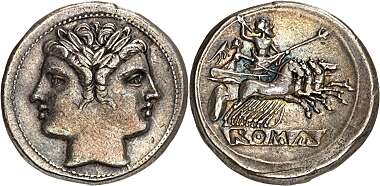
Lot 52. Anonymous. Didrachm or Quadrigatus 225-214 BC, Rome. Laureate Janiform head of Dioscuri / Jupiter holding sceptre and thunderbolt in quadriga right driven by Victory. In exergue, ROMA. 6,69g. Crawford 29/3; HNI 334; RSC 23/24. Nice patina. An extremely fine specimen of elegant style. Provenance: Jascha Heifetz Collection (1899-1987), Superior Galleries (9-10 December 1989), 3053. NFA 29 (13 August 1992), 244. Privately purchased from NGSA in 2011. Baron Lorne Thyssen-Bornemisza Collection.
  • Mise à prix:
    5'000 CHF
    5'455 EUR
    4'549 GBP
    6'123 USD

    Valeurs approximatives et arrondiesDate: 05/11/2026

Veuillez noter que la soumission d'offres n'est possible que dans le cadre des étapes d'enchères définies par la maison de vente aux enchères.

  • 0 CHF - 200 CHF : 10 CHF étapes
  • 200 CHF - 500 CHF : 20 CHF étapes
  • 500 CHF - 1'000 CHF : 50 CHF étapes
  • 1'000 CHF - 2'000 CHF : 100 CHF étapes
  • 2'000 CHF - 5'000 CHF : 200 CHF étapes
  • 5'000 CHF - 10'000 CHF : 250 CHF étapes
  • 10'000 CHF - 20'000 CHF : 500 CHF étapes
  • 20'000 CHF - 50'000 CHF : 2'000 CHF étapes
  • 50'000 CHF - 100'000 CHF : 5'000 CHF étapes
  • 100'000 CHF - 200'000 CHF : 10'000 CHF étapes
  • 200'000 CHF - 500'000 CHF : 20'000 CHF étapes
  • 500'000 CHF - 1'000'000 CHF : 50'000 CHF étapes
  • > 1'000'000 CHF    : 100'000 CHF étapes
Lot
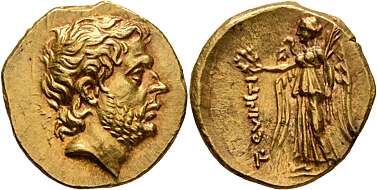
Lot 53. Titus Quinctius Flamininus. Gold stater circa 196 BC, Chalcis (?). Bearded head right / T QVINCTI Nike standing left, holding palm branch in left hand and wreath in right hand. 8,43g. Bahrfeldt 9.2 (same dies); Biaggi 9; Calicò 29; Crawford 548/1b. Extremely rare and of the greatest historical importance. The finest specimen known. Exceptional. Provenance: Leu 81 (16 may 2001), 187. Leu 93 (10 May 2005), 1. NGSA 4 (11 December 2006), 130. Baron Lorne Thyssen-Bornemisza Collection. This gold stater is one of the most important coins in Roman numismatics. For the first time, a living Roman is represented on a coin. Until then, Roman coinage had been reserved for deities and mythological heroes, as the Republic sought to avoid any cult of personality that might lead to a concentration of power in the hands of a single man. It should also be emphasized that this issue provides us with the only certain portrait of Titus Quinctius Flamininus. Flamininus (c. 229 - c. 174 BC) was a talented Roman general and was elected consul in 198 BC. He is chiefly remembered for his victories over King Philip V of Macedon, whom he defeated with the support of the Achaean League, first at the Battle of the Aous in 198 BC and then, decisively, at the Battle of Cynoscephalae in 197 BC. Following his victory, Flamininus compelled Philip V to withdraw his garrisons and recognize the freedom of the Greek cities. Philip V was also required to pay a ransom of 1,000 talents following his defeat, and it is possible that this gold was used, at least in part, for this issue. In 196 BC, at the Isthmian Games at Corinth, an event that attracted Greeks from cities throughout the Greek world, Flamininus famously proclaimed the freedom of the Greek cities. Yet Flamininus was far more than a successful general. A committed philhellene, he subsequently travelled throughout Greece, visiting its cities and making magnificent offerings at sanctuaries. His generosity and admiration for Greek culture made him immensely popular among the Greeks. Plutarch even reports that, among the many honours bestowed upon him, Flamininus was deified during his lifetime at Chalcis in Euboea, in gratitude for his support during the invasion of Antiochos III of Syria. Chalcis possessed an active mint, making it a possible location for the striking of these gold staters. The final great episode in Flamininus’ career was connected to his old enemy, Hannibal, who had threatened Rome at the time when Flamininus was beginning his military career. Hannibal, Rome’s greatest enemy, had taken refuge in Bithynia with King Prusias I. Persuaded by the skilled diplomat Flamininus, Prusias I eventually betrayed Hannibal and promised to hand him over to the Romans. Hannibal, however, committed suicide before Flamininus could arrive. The choice to depict Flamininus bare-headed, without a wreath or diadem, deserves particular emphasis. Unlike the traditional portraits of Hellenistic kings, this image would have been understood by the Greeks as a symbol of their freedom: Flamininus is presented as an individual, rather than as a ruler. The portrait itself is deeply influenced by Hellenistic artistic conventions, with its flamboyant, tousled hair and strongly aquiline nose. The reverse, meanwhile, recalls the gold staters of Alexander the Great, which were still circulating extensively in Greece in the 2nd century BC. This issue was probably intended to circulate in Greece rather than in Rome. For Roman audiences, the representation of a living Roman on a coin would have been deeply controversial, whereas the Greeks were accustomed to seeing the portraits of living Hellenistic kings on their coinage. Furthermore, no example has been found in Rome or its immediate surroundings. This coin may have been struck in connection with the three-day triumph celebrated by Flamininus at Rome in 194 BC. During the triumph, Livy records a substantial distribution of money to the veterans of the Macedonian campaign. It is therefore tempting to wonder whether this type might have formed part of the coinage distributed on that extraordinary day in Roman and Greek history. Whatever its precise circumstances of production and distribution, this gold stater opened the way to a monetary tradition that would endure for more than five centuries, in which Roman emperors would routinely have their portraits represented on their coinage. Roman numismatics offers an extraordinary gallery of portraits spanning centuries of Roman history—and, remarkably, it all begins with Titus Quinctius Flamininus.
  • Mise à prix:
    400'000 CHF
    436'423 EUR
    363'983 GBP
    489'876 USD

    Valeurs approximatives et arrondiesDate: 05/11/2026

Veuillez noter que la soumission d'offres n'est possible que dans le cadre des étapes d'enchères définies par la maison de vente aux enchères.

  • 0 CHF - 200 CHF : 10 CHF étapes
  • 200 CHF - 500 CHF : 20 CHF étapes
  • 500 CHF - 1'000 CHF : 50 CHF étapes
  • 1'000 CHF - 2'000 CHF : 100 CHF étapes
  • 2'000 CHF - 5'000 CHF : 200 CHF étapes
  • 5'000 CHF - 10'000 CHF : 250 CHF étapes
  • 10'000 CHF - 20'000 CHF : 500 CHF étapes
  • 20'000 CHF - 50'000 CHF : 2'000 CHF étapes
  • 50'000 CHF - 100'000 CHF : 5'000 CHF étapes
  • 100'000 CHF - 200'000 CHF : 10'000 CHF étapes
  • 200'000 CHF - 500'000 CHF : 20'000 CHF étapes
  • 500'000 CHF - 1'000'000 CHF : 50'000 CHF étapes
  • > 1'000'000 CHF    : 100'000 CHF étapes
Lot
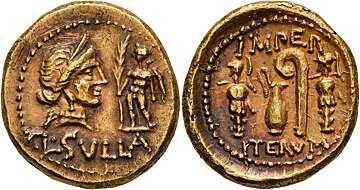
Lot 54. Lucius Cornelius Sulla. Aureus 84-82 BC, moving mint. Diademed head of Venus right. In front, Cupid standing left and holding palm branch. In exergue, L · SVLLA / IMPER Jug and lituus between two trophies. In exergue, ITERVM. 10,77g. Bahrfeldt 11.3 and pl. III, 2 (this coin); Calicó 11; Crawford 359/1; Sydenham 760. Very rare. Minor scratches above head. The finest known. An exceptional specimen with a beautiful patina. Provenance: Consul E. Weber Collection, Hirsch 24 (10 May 1909), 329. Th. Prowe Collection, Hess (20 May 1912), 641. A. Bally-Herzog Collection, Münzen & Medaillen 93 (16 December 2003), 33. From the William H. Williams Collection. NAC 46 (2 April 2008), 372. Baron Lorne Thyssen-Bornemisza Collection. Sulla (138–78 BC) was one of the most prominent figures of the Roman Republic. His career illustrates the first tensions that would eventually lead to the end of the Republic and the establishment of the Empire. His career began in North Africa. While still serving as a cavalry commander, Sulla covered himself in glory by capturing the Numidian king Jugurtha, bringing to an end a war that had lasted for more than seven years. His diplomatic talents then enabled him to conclude the first treaty ever signed between Rome and the powerful Parthians. Having become extremely powerful and wealthy, Sulla was elected consul in 88 BC and soon entered into open conflict with the man who had once been his superior in Africa: Caius Marius. Marius was the leader of the Populares, supporters of a reorganisation of the republican institutions that would diminish the power of the traditional aristocracy. Sulla, by contrast, led the Optimates, the aristocratic faction opposed to any change that might limit the power of Rome’s great families. After two civil wars between these two factions, Sulla emerged victorious in 82 BC and concentrated all power in his hands. He was appointed dictator by the Senate and carried out purges that created a deeply troubled atmosphere in Rome. Many people were forced into hiding to save their lives. Sulla soon abdicated in 81 BC and definitively withdrew from public life in 79 BC. He died a year later, in 78 BC, at his villa in Campania. This rare aureus is a witness to this troubled period. The obverse of this coin emphasises the connection between Sulla and Venus, his protective deity, who is represented accompanied by her son and messenger Cupid, holding a laurel branch, a symbol of victory. The result of her intervention is symbolised on the reverse by two trophies, which flank a lituus and a jug. These were cult objects used during rituals performed before battle, when Sulla consulted the auspices based on the observation of birds to determine whether the gods were willing to grant him victory. According to Plutarch, Sulla was deeply religious and attached great importance to omens and signs. Through its imagery, Sulla presents his military success as the result not only of his own abilities, but also of the divine favour that accompanied him. This aureus thus forms an integral part of Sulla’s propaganda at a time when he was attempting to seize power.
  • Mise à prix:
    200'000 CHF
    218'211 EUR
    181'991 GBP
    244'938 USD

    Valeurs approximatives et arrondiesDate: 05/11/2026

Veuillez noter que la soumission d'offres n'est possible que dans le cadre des étapes d'enchères définies par la maison de vente aux enchères.

  • 0 CHF - 200 CHF : 10 CHF étapes
  • 200 CHF - 500 CHF : 20 CHF étapes
  • 500 CHF - 1'000 CHF : 50 CHF étapes
  • 1'000 CHF - 2'000 CHF : 100 CHF étapes
  • 2'000 CHF - 5'000 CHF : 200 CHF étapes
  • 5'000 CHF - 10'000 CHF : 250 CHF étapes
  • 10'000 CHF - 20'000 CHF : 500 CHF étapes
  • 20'000 CHF - 50'000 CHF : 2'000 CHF étapes
  • 50'000 CHF - 100'000 CHF : 5'000 CHF étapes
  • 100'000 CHF - 200'000 CHF : 10'000 CHF étapes
  • 200'000 CHF - 500'000 CHF : 20'000 CHF étapes
  • 500'000 CHF - 1'000'000 CHF : 50'000 CHF étapes
  • > 1'000'000 CHF    : 100'000 CHF étapes
Lot
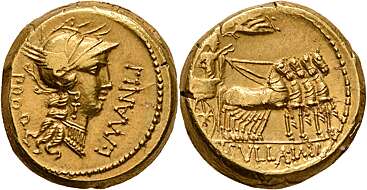
Lot 55. Lucius Cornelius Sulla and Lucius Manlius Torquatus. Aureus 82-81 BC, moving mint. L · MANLI – PRO Q Helmeted head of Roma right / Triumphator (Sulla) in quadriga right, holding reins and caduceus, crowned by flying Victory left. In exergue, L SVLLA · IMP. 10,82g. Bahrfeldt 13.5 (this coin); Biaggi 11; Calicó 17; Crawford 367/4; Sydenham 765a. Rare. Good extremely fine. Provenance: H. Montagu Collection (1844-1895), Rollin & Feuardent (20-28 April 1896); 17. A. Bally-Herzog Collection, Münzen & Medaillen 93 (16 December 2003), 36. NAC 51 (5 March 2009), 25. Baron Lorne Thyssen-Bornemisza Collection. Sulla established himself as one of the most brilliant military commanders in Roman history. He defeated Jugurtha, Rome’s rebellious allies, Marius and his supporters, and, in the East, Mithradates VI, king of Pontus and the Bosphorus. The latter had taken advantage of Rome’s internal troubles to attack its eastern provinces and massacre several tens of thousands of inhabitants. Despite his conflict with Marius, Sulla was forced to respond and protect these distant territories. He defeated Mithradates VI and compelled him to sign the Peace of Dardanos. In order to enhance his popularity and reputation as a talented military commander, Sulla had a triumph organised in 81 BC to celebrate his victory in the East. It is probable that the reverse of this aureus, struck between 82 and 81 BC, represents this very moment. It may either be an imagined vision of a scene that was yet to come, or a remarkable snapshot of this historic event. The inscription in the exergue leaves no doubt: the figure in the triumphal chariot is indeed Sulla. This is therefore one of the earliest representations of a living Roman, although, unlike the stater of Titus Quinctius Flamininus, the individual’s facial features cannot be recognised. The coin thus served to remind everyone of Sulla’s glory and military successes, making it a powerful instrument of propaganda. As for Lucius Manlius Torquatus, mentioned on the obverse, he was Sulla’s proquaestor in 81 BC and consul in 65 BC. Very little is known about this loyal ally of Sulla.
  • Mise à prix:
    50'000 CHF
    54'552 EUR
    45'497 GBP
    61'234 USD

    Valeurs approximatives et arrondiesDate: 05/11/2026

Veuillez noter que la soumission d'offres n'est possible que dans le cadre des étapes d'enchères définies par la maison de vente aux enchères.

  • 0 CHF - 200 CHF : 10 CHF étapes
  • 200 CHF - 500 CHF : 20 CHF étapes
  • 500 CHF - 1'000 CHF : 50 CHF étapes
  • 1'000 CHF - 2'000 CHF : 100 CHF étapes
  • 2'000 CHF - 5'000 CHF : 200 CHF étapes
  • 5'000 CHF - 10'000 CHF : 250 CHF étapes
  • 10'000 CHF - 20'000 CHF : 500 CHF étapes
  • 20'000 CHF - 50'000 CHF : 2'000 CHF étapes
  • 50'000 CHF - 100'000 CHF : 5'000 CHF étapes
  • 100'000 CHF - 200'000 CHF : 10'000 CHF étapes
  • 200'000 CHF - 500'000 CHF : 20'000 CHF étapes
  • 500'000 CHF - 1'000'000 CHF : 50'000 CHF étapes
  • > 1'000'000 CHF    : 100'000 CHF étapes
Lot
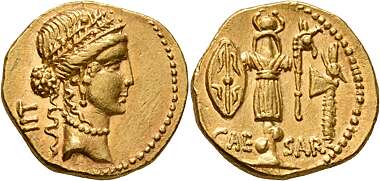
Lot 56. Julius Caesar.  Aureus 50-47 BC, mint moving in Gaul. Laureate head of Venus right. In left field, ⊥II / CAE - SAR Trophy with shield and carnyx. On right, axe. 8,70g. Bahrfeldt 17; Biaggi 26; Calicó 40; Crawford 452/1; Sear 10; Sydenham 1008. Rare and a superb specimen. Good extremely fine. Provenance: Tkalec (26 October 2007), 125. Baron Lorne Thyssen-Bornemisza Collection. Around 60 BC, Rome was dominated by three powerful men: Pompey, a talented general crowned with military glory; Caesar, a politician who was both popular and ambitious; and Crassus, the richest man in Rome. Together, they concentrated much of Rome’s power in their hands and decided to form an alliance known as the First Triumvirate. However, a few years later, while Caesar was in Gaul, their individual ambitions brought an end to the alliance. We may recall the famous phrase attributed to Caesar by Plutarch: “I would rather be the first man in a village than the second in Rome.” In the meantime, Crassus was killed during his disastrous campaign against the Parthians. Pompey and Caesar eventually came into open conflict, forcing Caesar to cross the Rubicon and march on Rome with his army. The decisive confrontation took place in Thessaly at the Battle of Pharsalus in 48 BC. Pompey was defeated and fled to Egypt, where Ptolemy XIII, the brother of Cleopatra, had him executed, provoking Caesar’s anger. This aureus was struck during this period, around 50 BC, by Julius Caesar. This is the first gold issue struck by Caesar. On the obverse is the head of Venus, whom Caesar claimed as his divine ancestor. Indeed, he traced his family, the Iulii, back to Iulus (also called Ascanius), the son of Aeneas, who was himself the son of Venus. Venus was therefore the protector and emblem of the Iulii. Beside her head is the numeral II⊥, which would correspond to Caesar’s age at the time the coin was struck: 52 years old. However, since we do not know exactly which year Caesar was born, between 102 or 100 BC, this does not allow us to date the aureus precisely. On the reverse, the military trophy evokes Caesar’s successes during the Gallic Wars and thus draws attention away from the civil war, a less honourable conflict that Caesar was waging against another Roman, Pompey.
  • Mise à prix:
    100'000 CHF
    109'105 EUR
    90'995 GBP
    122'469 USD

    Valeurs approximatives et arrondiesDate: 05/11/2026

Veuillez noter que la soumission d'offres n'est possible que dans le cadre des étapes d'enchères définies par la maison de vente aux enchères.

  • 0 CHF - 200 CHF : 10 CHF étapes
  • 200 CHF - 500 CHF : 20 CHF étapes
  • 500 CHF - 1'000 CHF : 50 CHF étapes
  • 1'000 CHF - 2'000 CHF : 100 CHF étapes
  • 2'000 CHF - 5'000 CHF : 200 CHF étapes
  • 5'000 CHF - 10'000 CHF : 250 CHF étapes
  • 10'000 CHF - 20'000 CHF : 500 CHF étapes
  • 20'000 CHF - 50'000 CHF : 2'000 CHF étapes
  • 50'000 CHF - 100'000 CHF : 5'000 CHF étapes
  • 100'000 CHF - 200'000 CHF : 10'000 CHF étapes
  • 200'000 CHF - 500'000 CHF : 20'000 CHF étapes
  • 500'000 CHF - 1'000'000 CHF : 50'000 CHF étapes
  • > 1'000'000 CHF    : 100'000 CHF étapes
Lot
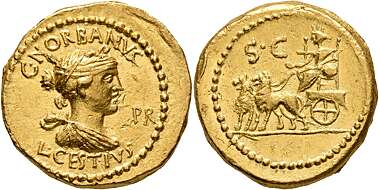
Lot 57. Lucius Sestius and Gaius Norbanus. Aureus 44-43 BC, Rome. C · NORBANVS - L· CESTIVS Draped bust of Venus right. In field right, PR / Cybele holding patera in right hand, in biga left drawn by two lions, S · C above. 8,09g. Bahrfeldt 26; Biaggi 25; Calicó 5; Crawford 491/2; Sydenham 1155. Extremely fine. Provenance: Leu 72 (12 May 1998), 398. Baron Lorne Thyssen-Bornemisza Collection. Following the assassination of Julius Caesar on 15 March 44 BC, Mark Antony initially appeared to be Caesar’s natural heir. He had accompanied Caesar throughout his military campaigns and was widely regarded as his right-hand man. However, the reading of Caesar’s will on 20 March came as a surprise: Caesar had posthumously adopted his great-nephew Octavian, making him his principal heir. Mark Antony therefore found himself facing a powerful new rival and attempted to undermine Octavian politically. Octavian responded by forming an alliance with Cicero and the Senate. Meanwhile, Mark Antony launched a military campaign against Decimus Junius Brutus Albinus, a former ally of Caesar who had taken part in his assassination. Brutus refused to submit to Mark Antony and withdrew to Mutina, where Antony besieged him. Allied with the Senate, Octavian thus found himself in the absurd position of having to help defend one of Caesar’s assassins in order to oppose Mark Antony. Mark Antony was eventually defeated, but despite this military success, Octavian became increasingly isolated within the Senate. He therefore moved closer to Mark Antony, broke with Cicero, and in November 43 BC this rapprochement culminated in the creation of the Second Triumvirate, which divided power between Octavian, Mark Antony, and Lepidus. Thus began the collaboration between two of Rome’s future dominant figures. Together, they would eventually defeat the assassins of Caesar. It was in this turbulent context that this rare aureus was struck by Lucius Cestius and Gaius Norbanus, two supporters of Octavian who had been elected praetors for 43 BC. In that same year, Octavian entered Rome and seized the public treasury, using it to strike these remarkable aurei in order to pay his army. The coin is therefore particularly fascinating: it was issued at the very beginning of the civil wars, at a moment when the later binary confrontation between the Caesarians and Caesar’s assassins had not yet fully taken shape. Instead, it belongs to an earlier stage of the conflict—the struggle among Caesar’s former allies over who would emerge as the leader of the Caesarian faction and ultimately inherit Caesar’s political legacy. In this sense, this rare aureus reflects the early political career of Octavian. The female figure on the obverse is probably Venus, from whom Octavian claimed descent and whose protection he sought to emphasize. However, some scholars believe that the figure could instead be the Cumaean Sibyl, a legendary prophetess whose predictions, recorded in three books kept at the Temple of Jupiter on the Capitoline Hill, were consulted in times of crisis. During the Second Punic War (218–201 BC), these prophecies were consulted and were said to have recommended the establishment at Rome of a cult dedicated to the Phrygian goddess Cybele, who is represented on the reverse. This interpretation seems plausible, especially considering Octavian’s political position at the time. He was still seeking support within the Senate and had not yet openly turned against Caesar’s assassins. It would therefore have been politically unwise for him to display on his coinage such an explicit Caesarian symbol as Venus.
  • Mise à prix:
    10'000 CHF
    10'910 EUR
    9'099 GBP
    12'246 USD

    Valeurs approximatives et arrondiesDate: 05/11/2026

Veuillez noter que la soumission d'offres n'est possible que dans le cadre des étapes d'enchères définies par la maison de vente aux enchères.

  • 0 CHF - 200 CHF : 10 CHF étapes
  • 200 CHF - 500 CHF : 20 CHF étapes
  • 500 CHF - 1'000 CHF : 50 CHF étapes
  • 1'000 CHF - 2'000 CHF : 100 CHF étapes
  • 2'000 CHF - 5'000 CHF : 200 CHF étapes
  • 5'000 CHF - 10'000 CHF : 250 CHF étapes
  • 10'000 CHF - 20'000 CHF : 500 CHF étapes
  • 20'000 CHF - 50'000 CHF : 2'000 CHF étapes
  • 50'000 CHF - 100'000 CHF : 5'000 CHF étapes
  • 100'000 CHF - 200'000 CHF : 10'000 CHF étapes
  • 200'000 CHF - 500'000 CHF : 20'000 CHF étapes
  • 500'000 CHF - 1'000'000 CHF : 50'000 CHF étapes
  • > 1'000'000 CHF    : 100'000 CHF étapes
Lot
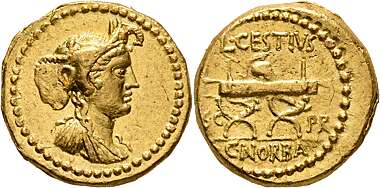
Lot 58. Lucius Sestius and Gaius Norbanus. Aureus 44-43 BC, uncertain mint. Draped bust of Africa right, wearing elephant’s skin / L · CESTIVS Helmet on a curule chair. On left, S · C and, on right, PR. In exergue, C · NORBA. 8,12g. Bahrfeldt 24; Biaggi 24; Calicó 3; Chastel 341; Crawford 491/1a; Sear 11; Sydenham 1153. Extremely fine. Provenance: Stack’s Bowers & Ponterio (11 January 2013), 5419. Baron Lorne Thyssen-Bornemisza Collection. This aureus was also struck in the context of the brief civil war at Mutina, which pitted Mark Antony against Decimus Junius Brutus, who was supported by the Senate and Octavian. It was also probably struck using gold from the public treasury seized by Octavian in 43 BC to pay his army. His forces numbered at least eight legions, or around 40,000 men, and two of these legions had come from Africa, which may explain the personification of Africa on the obverse. As was often the case in antiquity, Africa is represented through its characteristic fauna: here, an elephant, a symbol of strength. On the reverse, the presence of the Corinthian helmet is more puzzling. Sear suggested that it might be a reference to Minerva, the goddess of war, which would seem plausible given the military context in which the coin was struck. The two curule chairs may allude to the Mutina campaign, during which the two consuls, Aulus Hirtius and Caius Vibius Pansa, were killed, leaving their curule seats vacant. It is tempting, although impossible to state with certainty, to interpret the reverse as a kind of political metaphor: war, symbolized by Minerva’s helmet, has claimed the lives of the two consuls, leaving their seats vacant for the return of Octavian and for the man with whom he was rapidly moving toward an alliance: Mark Antony.
  • Mise à prix:
    8'000 CHF
    8'728 EUR
    7'279 GBP
    9'797 USD

    Valeurs approximatives et arrondiesDate: 05/11/2026

Veuillez noter que la soumission d'offres n'est possible que dans le cadre des étapes d'enchères définies par la maison de vente aux enchères.

  • 0 CHF - 200 CHF : 10 CHF étapes
  • 200 CHF - 500 CHF : 20 CHF étapes
  • 500 CHF - 1'000 CHF : 50 CHF étapes
  • 1'000 CHF - 2'000 CHF : 100 CHF étapes
  • 2'000 CHF - 5'000 CHF : 200 CHF étapes
  • 5'000 CHF - 10'000 CHF : 250 CHF étapes
  • 10'000 CHF - 20'000 CHF : 500 CHF étapes
  • 20'000 CHF - 50'000 CHF : 2'000 CHF étapes
  • 50'000 CHF - 100'000 CHF : 5'000 CHF étapes
  • 100'000 CHF - 200'000 CHF : 10'000 CHF étapes
  • 200'000 CHF - 500'000 CHF : 20'000 CHF étapes
  • 500'000 CHF - 1'000'000 CHF : 50'000 CHF étapes
  • > 1'000'000 CHF    : 100'000 CHF étapes
Lot
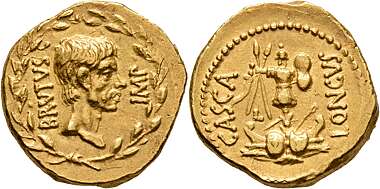
Lot 59. Brutus and Publius Servilius Casca Longus. Aureus 43-42 BC, moving mint in Northern Greece or Asia Minor. Within a wreath, BRVTVS - IMP inscribed on either side of the bare head of Brutus right / CASCA - LONGVS Trophy consisting of breastplate, helmet, shields and spears on two prows back to back. Small L between spears. 8,06g. Babelon (Junia) 46; Bahrfeldt 65b.5 (same dies); Biaggi 40; BMCRR (East) 62 (same dies); Calicó 56; Cohen 14; Crawford 507/1b (same dies); CRI 211 (this coin), Kent & Hirmer 99 (same dies); Sear 1430 (this coin); Sydenham 1297 (same dies). One of the most important and infamous coins in Roman numismatics. Extremely rare and Superb. Provenance: Vinchon (2-3 December 1975), 192. Nelson Bunker Hunt Collection, Sotheby's (19 June 1990), 118. Leu 52 (15 May 1991), 148. NGSA 4 (11 December 2006), 143. Baron Lorne Thyssen-Bornemisza Collection. Brutus was one of the leading conspirators against Julius Caesar. Yet Caesar had regarded him almost as a son, owing to his close relationship with Brutus’ mother, Servilia. Brutus had betrayed Caesar once before, siding with Pompey during the conflict between the two men. After the disaster of Pharsalus in 48 BC, however, he returned to Caesar’s favour. Caesar entrusted him with the government of Cisalpine Gaul in 47 BC and appointed him urban praetor in 45 BC. Despite this remarkable clemency, Brutus once again conspired against his benefactor and joined the group of conspirators who assassinated Caesar on the Ides of March, 15 March 44 BC. Deeply committed to republican values, Brutus could no longer tolerate Caesar’s concentration of power and his dismantling of the traditional republican institutions. Forced to flee Rome, he withdrew to Macedonia with Cassius and the principal leaders of the Republican cause. At first sight, the personalisation of his coinage may seem at odds with the Republican values that Brutus claimed to defend. Yet the portrait was undoubtedly intended to rally the troops and supporters of the Republican cause around his person. It also constituted a direct response to his Caesarian opponents, Octavian and Mark Antony, who had already placed their own portraits on their coinage. The portrait itself is strikingly realistic, presenting Brutus with his characteristic features. The reverse combines land and naval elements in a trophy commemorating the recent victories of Brutus in Thrace and Lycia, as well as Cassius’ naval victory over the Rhodians. It thus served both as a celebration of military success and as a powerful reminder of the strength of the Republican armies. The tiny letter L on the reverse may refer either to Libertas, one of the fundamental ideals of the tyrannicides, who believed that they had liberated the Roman people, or to Lycia, where Brutus had achieved a military victory. The name Publius Servilius Casca Longus, which appears on the reverse, adds another deeply personal connection to the assassination of Caesar. He was himself one of the conspirators and is traditionally regarded as the first man to strike Caesar during the attack on the Ides of March. Interestingly, while Brutus ultimately accepted the use of his own portrait, Cassius appears to have refused to do so. The absence of Cassius’ portrait may reflect his more uncompromising Republican principles: to him, placing a living Roman’s portrait on a coin may have seemed too closely associated with the Caesarian practice that the conspirators claimed to have destroyed. This aureus was therefore struck at a decisive moment, only shortly before Brutus and Cassius were defeated by Mark Antony and Octavian at the Battle of Philippi in 42 BC. It stands as a remarkable testament to the final struggle of the Roman Republic.
  • Mise à prix:
    750'000 CHF
    818'293 EUR
    682'469 GBP
    918'517 USD

    Valeurs approximatives et arrondiesDate: 05/11/2026

Veuillez noter que la soumission d'offres n'est possible que dans le cadre des étapes d'enchères définies par la maison de vente aux enchères.

  • 0 CHF - 200 CHF : 10 CHF étapes
  • 200 CHF - 500 CHF : 20 CHF étapes
  • 500 CHF - 1'000 CHF : 50 CHF étapes
  • 1'000 CHF - 2'000 CHF : 100 CHF étapes
  • 2'000 CHF - 5'000 CHF : 200 CHF étapes
  • 5'000 CHF - 10'000 CHF : 250 CHF étapes
  • 10'000 CHF - 20'000 CHF : 500 CHF étapes
  • 20'000 CHF - 50'000 CHF : 2'000 CHF étapes
  • 50'000 CHF - 100'000 CHF : 5'000 CHF étapes
  • 100'000 CHF - 200'000 CHF : 10'000 CHF étapes
  • 200'000 CHF - 500'000 CHF : 20'000 CHF étapes
  • 500'000 CHF - 1'000'000 CHF : 50'000 CHF étapes
  • > 1'000'000 CHF    : 100'000 CHF étapes
Lot
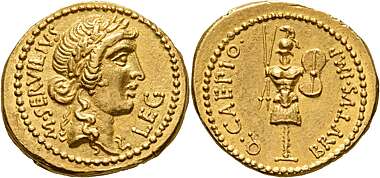
Lot 60. Brutus and Marcus Servilius. Aureus 43-42 BC, moving mint in Asia Minor. M · SERVILIVS – LEG Laureate head of Libertas right / Q · CAEPIO · – BRVTVS · IMP Trophy composed of a helmet, a cuirass, two spears and a shield. 7,90g. Bahrfeldt 66; Calicó 61a; Crawford 505/4; CRI 206; Sydenham 1314. Rare. Good extremely fine. Provenance: Hess-Leu (27 March 1956), 351. NFA XXV (29 November 1990), 101. Gilbert Steinberg Collection (1920-2008), NAC (16 November 1994), 101. Triton IV (5 December 2000), 420. Baron Lorne Thyssen-Bornemisza Collection. While Plutarch portrays Brutus as a man of principle, motivated by his ideals of liberty, Cassius is presented as a man driven by ambition and self-interest. After fleeing Rome, these two men of very different character gathered their armies in the East, where tensions and rivalries quickly emerged. Sear believes that this aureus was struck on the occasion of the second meeting between Brutus and Cassius at Sardis in 42 BC, where the two generals were planning the next stage of the war. Plutarch relates that tensions erupted during this meeting: mutual accusations were exchanged, and at one point it was feared that the two men might even come to blows. Nevertheless, such divisions could not be allowed to become public. This aureus therefore features a portrait of Libertas, a shared ideal that was supposed to unite the two leaders of the Liberators. Libertas was consequently a recurring figure in the coinage of the Liberators, embodying the cause for which they claimed to be fighting. The trophy depicted on the reverse recalls Brutus’ military victories in Thrace and Lycia. This aureus also bears the name of the legate responsible for the issue, Marcus Servilius, who had taken part in the campaigns in Lycia. At their meeting in Sardis, the two men also made a series of poor strategic decisions. They refused to march on Italy and realised too late that they needed to be in Macedonia to prevent the Caesarian forces from landing. These disastrous decisions may well have been the result of the tensions within the Republican high command.
  • Mise à prix:
    50'000 CHF
    54'552 EUR
    45'497 GBP
    61'234 USD

    Valeurs approximatives et arrondiesDate: 05/11/2026

Veuillez noter que la soumission d'offres n'est possible que dans le cadre des étapes d'enchères définies par la maison de vente aux enchères.

  • 0 CHF - 200 CHF : 10 CHF étapes
  • 200 CHF - 500 CHF : 20 CHF étapes
  • 500 CHF - 1'000 CHF : 50 CHF étapes
  • 1'000 CHF - 2'000 CHF : 100 CHF étapes
  • 2'000 CHF - 5'000 CHF : 200 CHF étapes
  • 5'000 CHF - 10'000 CHF : 250 CHF étapes
  • 10'000 CHF - 20'000 CHF : 500 CHF étapes
  • 20'000 CHF - 50'000 CHF : 2'000 CHF étapes
  • 50'000 CHF - 100'000 CHF : 5'000 CHF étapes
  • 100'000 CHF - 200'000 CHF : 10'000 CHF étapes
  • 200'000 CHF - 500'000 CHF : 20'000 CHF étapes
  • 500'000 CHF - 1'000'000 CHF : 50'000 CHF étapes
  • > 1'000'000 CHF    : 100'000 CHF étapes
Lot
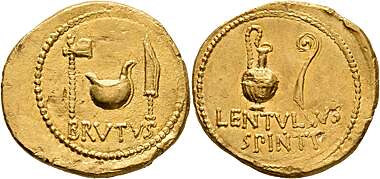
Lot 61. Brutus and Publius Cornelius Lentulus Spinther. Aureus 43-42, mint moving in Asia Minor. Axe, culullus and knife. In exergue, BRVTVS / Jug and lituus. In exergue, LENTVLVS - SPINT. 7,67g. Bahrfeldt 61.3; Biaggi 36; Calicó 59a; Crawford 500/6; Sydenham 1309. Rare. Minor marks on edge. Extremely fine. Provenance: NAC 18 (29 March 2000), 343. Baron Lorne Thyssen-Bornemisza Collection. This aureus was struck shortly after the assassination of Caesar and Brutus escape to Asia Minor, where he assembled his army to confront the Caesarian forces commanded by Mark Antony and Octavian. On the obverse, the axe, culullus, and knife refer to the pontificate held by Brutus since around 51 BC. The reverse features a lituus and a jug, recalling the fact that Publius Cornelius Lentulus Spinther, Cassius’ loyal lieutenant who issued this coin, was a member of the college of augurs. The depiction of these religious symbols on this aureus served to emphasize that the Liberators possessed the religious legitimacy that the Caesarians lacked. In contrast to Brutus and his allies, the Caesarians could therefore be portrayed as usurpers, without institutional or religious legitimacy. Struck in the context of the civil wars, this aureus served to finance the Republican cause by paying the troops. A coin of such high value was likely intended for an officer or a veteran. The gold used to strike it probably came from forced contributions imposed on the cities of Asia Minor or from temple treasures melted down to finance the war, notably at Rhodes or Tarsus.
  • Mise à prix:
    30'000 CHF
    32'731 EUR
    27'298 GBP
    36'740 USD

    Valeurs approximatives et arrondiesDate: 05/11/2026

Veuillez noter que la soumission d'offres n'est possible que dans le cadre des étapes d'enchères définies par la maison de vente aux enchères.

  • 0 CHF - 200 CHF : 10 CHF étapes
  • 200 CHF - 500 CHF : 20 CHF étapes
  • 500 CHF - 1'000 CHF : 50 CHF étapes
  • 1'000 CHF - 2'000 CHF : 100 CHF étapes
  • 2'000 CHF - 5'000 CHF : 200 CHF étapes
  • 5'000 CHF - 10'000 CHF : 250 CHF étapes
  • 10'000 CHF - 20'000 CHF : 500 CHF étapes
  • 20'000 CHF - 50'000 CHF : 2'000 CHF étapes
  • 50'000 CHF - 100'000 CHF : 5'000 CHF étapes
  • 100'000 CHF - 200'000 CHF : 10'000 CHF étapes
  • 200'000 CHF - 500'000 CHF : 20'000 CHF étapes
  • 500'000 CHF - 1'000'000 CHF : 50'000 CHF étapes
  • > 1'000'000 CHF    : 100'000 CHF étapes
Lot
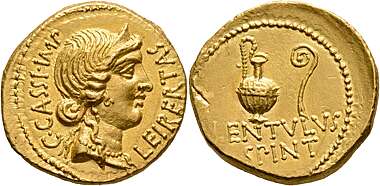
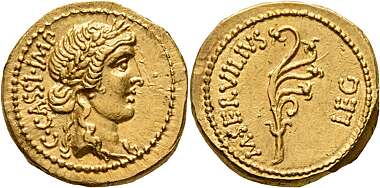
Lot 62. Gaius Cassius Longinus and Publius Cornelius Lentulus Spinther. Aureus 43-42 BC, mint moving in Asia Minor. C·CASSI·IMP – LEIBERTAS Diademed head of Libertas right, wearing a necklace / Jug and lituus. In exergue, LENTVLVS - SPINT. 8,15g. Bahrfeldt 59; Biaggi 45; Calicó 65; Chastel 349; Crawford 500/2; Sear 220; Sydenham 1304. Small mark on edge on the reverse at 9 o’clock. Good extremely fine. Provenance: NAC 15 (18 May 1999), 220. Baron Lorne Thyssen-Bornemisza Collection. One of the most influential senators in the Roman Senate, Cassius was, alongside Brutus, one of the leading figures in the conspiracy against Caesar. Yet Cassius, a loyal supporter of Pompey during the Civil War, had been spared by Caesar after his victory, just like Brutus, another former supporter of Pompey. Caesar’s clemency would ultimately contribute to his own downfall... Shortly after Caesar’s assassination, Cassius went to Greece, where he joined Brutus to prepare for war against Mark Antony and Octavian. To pay his army, Cassius issued coins struck in the pure Republican tradition: without his own portrait. No bust or statue survives that can tell us what Cassius looked like: Cassius seemed determined to avoid repeating the behavior of Caesar that had ultimately led to his downfall. To strike this gold, Cassius probably used either gold looted from Rhodes and Syria or contributions forcibly extracted from the wealthy cities of Asia Minor. The obverse depicts Libertas, the personification of Liberty. The assassins of Caesar called themselves the Liberatores, claiming that they had restored the freedom of the Roman people by killing the tyrant Caesar. The figure of Libertas therefore appears repeatedly on the coinage issued by the tyrannicides and served as a central symbol of their political cause. The reverse refers to Cassius’s lieutenant, who was responsible for issuing this aureus. He was a member of the college of augurs, as indicated by the lituus and the jug. This may have been a way for the tyrannicides to claim religious legitimacy - something that Mark Antony and Octavian did not possess to the same extent. In these times of civil war, it was useful to remind the Roman people that the Gods were on their side.
  • Mise à prix:
    20'000 CHF
    21'821 EUR
    18'199 GBP
    24'493 USD

    Valeurs approximatives et arrondiesDate: 05/11/2026

Veuillez noter que la soumission d'offres n'est possible que dans le cadre des étapes d'enchères définies par la maison de vente aux enchères.

  • 0 CHF - 200 CHF : 10 CHF étapes
  • 200 CHF - 500 CHF : 20 CHF étapes
  • 500 CHF - 1'000 CHF : 50 CHF étapes
  • 1'000 CHF - 2'000 CHF : 100 CHF étapes
  • 2'000 CHF - 5'000 CHF : 200 CHF étapes
  • 5'000 CHF - 10'000 CHF : 250 CHF étapes
  • 10'000 CHF - 20'000 CHF : 500 CHF étapes
  • 20'000 CHF - 50'000 CHF : 2'000 CHF étapes
  • 50'000 CHF - 100'000 CHF : 5'000 CHF étapes
  • 100'000 CHF - 200'000 CHF : 10'000 CHF étapes
  • 200'000 CHF - 500'000 CHF : 20'000 CHF étapes
  • 500'000 CHF - 1'000'000 CHF : 50'000 CHF étapes
  • > 1'000'000 CHF    : 100'000 CHF étapes
Lot
Lot 63. Gaius Cassius Longinus and Marcus Servilius. Aureus 43-42 BC, mint moving in Asia Minor. C · CASSI · IMP Laureate head of Libertas right / SERVILIVS – LEG Aplustre with each branch ending in a flower. 8,01g. Bahrfeldt 60; Calicó 67; Crawford 505/1; Syndenham 1311. Rare. Good extremely fine. Provenance: Patrick Doheny Collection (1923-2014), Sotheby's (20 June 1979), 70. Spink 5014 (28 September 2005), 389. NAC 62 (6 October 2011), 2004. Baron Lorne Thyssen-Bornemisza Collection. As his relationship with Brutus deteriorated day by day, Cassius still refused to march on Italy and instead decided to launch a punitive expedition against Rhodes, which had supported Publius Cornelius Dolabella, a partisan of Mark Antony. In an attempt to appease Cassius, Rhodes sent an embassy accompanied by Archelaus, a Rhodian and, above all, Cassius’ former Greek teacher. But nothing could dissuade him: Cassius, whom Plutarch describes as a brutal and impulsive man, sailed towards Rhodes. The naval battle of Myndos sealed the fate of the island. Cassius landed on Rhodes and took the city, but spared it from complete destruction. Purges were carried out among the elite, and the city was forced to pay a ransom. This was a remarkable military achievement for Cassius, as it was the first time that the city of Rhodes had ever been captured. Both Demetrius Poliorcetes, in 305 BC, and Mithradates VI Eupator, in 88 BC, had previously failed in their attempts. Cassius therefore chose to proclaim this achievement through one of the most widely circulated objects in the ancient world: coins. On the obverse, the title imperator proclaims Cassius’ victory, while on the reverse, the aplustre evokes his naval triumph. The aplustre was decorated with roses, the emblem of Rhodes, a symbol also found in his coinage.
  • Mise à prix:
    50'000 CHF
    54'552 EUR
    45'497 GBP
    61'234 USD

    Valeurs approximatives et arrondiesDate: 05/11/2026

Veuillez noter que la soumission d'offres n'est possible que dans le cadre des étapes d'enchères définies par la maison de vente aux enchères.

  • 0 CHF - 200 CHF : 10 CHF étapes
  • 200 CHF - 500 CHF : 20 CHF étapes
  • 500 CHF - 1'000 CHF : 50 CHF étapes
  • 1'000 CHF - 2'000 CHF : 100 CHF étapes
  • 2'000 CHF - 5'000 CHF : 200 CHF étapes
  • 5'000 CHF - 10'000 CHF : 250 CHF étapes
  • 10'000 CHF - 20'000 CHF : 500 CHF étapes
  • 20'000 CHF - 50'000 CHF : 2'000 CHF étapes
  • 50'000 CHF - 100'000 CHF : 5'000 CHF étapes
  • 100'000 CHF - 200'000 CHF : 10'000 CHF étapes
  • 200'000 CHF - 500'000 CHF : 20'000 CHF étapes
  • 500'000 CHF - 1'000'000 CHF : 50'000 CHF étapes
  • > 1'000'000 CHF    : 100'000 CHF étapes
Lot
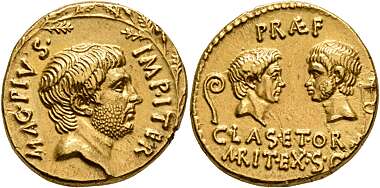
Lot 64. Sextus Pompeius, 44-35 BC. Aureus 42-38 BC, uncertain mint in Sicily. MAG · PIVS · – IMP · ITER Bare head of Sextus Pompeius right within oak wreath / PRÆF – CLAS · ET · OR – MARIT · EX · S · C Confronted heads of Pompey the Great on left and Gnaeus Pompey on right. On left, lituus; on right, tripod. 8,31g. Babelon (Pompeia) 24; Bahrfeldt 87.1 (this coin); Biaggi 48 (same dies); BMCRR 14 (this coin); Calicó 71a (same dies); Crawford 511/1; Evans 3h (this coin); Hurter 1 (this coin); Sydenham 1346a (this coin). Rare and a splendid specimen. Extremely fine. Provenance: Possibly purchased by the 2nd Duke of Devonshire (1672-1729). 6th Duke of Devonshire Collection, Christie’s (18 March 1844), 184. Prosper Dupré Collection, purchased in the 1850s. Privately purchased from the Wigan collection in 1872 by Rollin et Feuardent. Leu 25 (23 April 1980), 212. Sold as duplicates of the British Museum, Leu 50 (25 April 1990), 263. LHS 97 (10 May 2006), 1. Baron Lorne Thyssen-Bornemisza Collection. This aureus is a remarkable family portrait of the Pompeii, a family that played an extremely important role in the final decades of the Roman Republic. At the reverse is Pompey the Great, one of the most talented generals of his generation. He initially allied himself with Julius Caesar and Crassus to form the First Triumvirate, but his relationship with Caesar eventually deteriorated into open conflict. Pompey was defeated by Caesar at the Battle of Pharsalus in 48 BC and fled to Egypt, where he was assassinated on the orders of Ptolemy XIII. Facing his father’s portrait is Gnaeus Pompeius, the elder son of Pompey the Great. After his father’s defeat, Gnaeus Pompeius continued the Republican resistance, first in North Africa alongside Cato of Utica and later in Hispania with Titus Labienus. Caesar eventually defeated him at the decisive Battle of Munda, and Gnaeus was killed shortly afterwards. His younger brother Sextus Pompeius, however, managed to escape and continued the fight. Sextus, the second son of Pompey the Great whose portrait appears on the obverse of this aureus, continued the fight in Hispania until Caesar’s assassination in 44 BC. The Senate then appointed him commander of the fleet. But when the Second Triumvirate was formed between Octavian, Mark Antony and Lepidus, Sextus Pompeius was declared a public enemy and his name was placed on the proscription lists. Sextus subsequently took refuge in Sicily with his fleet, seizing the island in 44–43 BC. He went on to capture Sardinia and Corsica, seriously threatening Rome’s grain supply and, consequently, the survival of its population of around one million inhabitants. For almost eight years, Sextus Pompeius was able to maintain his domination of Sicily and the two major western Mediterranean islands, posing a serious threat to Rome. He even issued his own coinage, today extremely rare and highly sought after by collectors. It was not until 36 BC that the triumvirs finally succeeded in destroying Sextus’ fleet at the Battle of Naulochus. Sextus fled to Asia, where he was handed over to Mark Antony by the king of Galatia and was subsequently executed in circumstances that remain somewhat obscure. This aureus carries a remarkable message of legitimacy and strength. On the obverse, Sextus Pompeius’ portrait is surrounded by a wreath of oak leaves, a distinction traditionally awarded to a Roman who had saved the life of a fellow citizen. Sextus was probably referring here to the Roman citizens proscribed by Octavian and Antony whom he had rescued by welcoming them to Sicily. The obverse also bears the title Imperator, which refers to Sextus’ victory over Salvidienus Rufus, the commander sent against him by Octavian in 42 BC. On the reverse, Sextus reinforces his legitimacy by displaying not only the portrait of his illustrious father, Pompey the Great, but also his title granted by the Senate shortly after Caesar’s assassination: parefectvs classis et orae maritimae ex senatvs consvlto, meaning “Commander of the fleet and of the maritime coast, by decree of the Senate.” The portrait of Sextus, the oak wreath, his imperator title, the authority granted to him by the Senate, and the portrait of his illustrious father all combine to construct a powerful political message. Beyond its exceptional historical significance, this aureus is also extremely rare. In 1987, Evans recorded just 37 known examples, of which only 12 were held in museums.
  • Mise à prix:
    100'000 CHF
    109'105 EUR
    90'995 GBP
    122'469 USD

    Valeurs approximatives et arrondiesDate: 05/11/2026

Veuillez noter que la soumission d'offres n'est possible que dans le cadre des étapes d'enchères définies par la maison de vente aux enchères.

  • 0 CHF - 200 CHF : 10 CHF étapes
  • 200 CHF - 500 CHF : 20 CHF étapes
  • 500 CHF - 1'000 CHF : 50 CHF étapes
  • 1'000 CHF - 2'000 CHF : 100 CHF étapes
  • 2'000 CHF - 5'000 CHF : 200 CHF étapes
  • 5'000 CHF - 10'000 CHF : 250 CHF étapes
  • 10'000 CHF - 20'000 CHF : 500 CHF étapes
  • 20'000 CHF - 50'000 CHF : 2'000 CHF étapes
  • 50'000 CHF - 100'000 CHF : 5'000 CHF étapes
  • 100'000 CHF - 200'000 CHF : 10'000 CHF étapes
  • 200'000 CHF - 500'000 CHF : 20'000 CHF étapes
  • 500'000 CHF - 1'000'000 CHF : 50'000 CHF étapes
  • > 1'000'000 CHF    : 100'000 CHF étapes
Lot
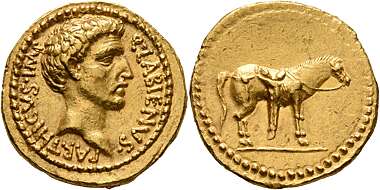
Lot 65. Quintus Labienus. Aureus 40-39 BC, mint moving in Asia Minor. Q · LABIENVS · – PARTHICVS · IMP Bare head right / Horse right, with bridle and saddle to which bow case and quiver are attached. 8,04g. Bahrfeldt 69; Calicó 70 (this coin); Crawford 524/1; CRI 340 (this coin); C. Hersh, SNR 59, 1980, p. 46, 3 (this coin); CNR 1 (this coin); Kent-Hirmer 101 (this coin); Sydenham 1356. Of the highest rarity, apparently only five specimens known. Struck in high relief on a full flan with a magnificent portrait. Good extremely fine. Provenance: Münzen & Medaillen 43, (12-13 November 1970), 242. Leu 48 (10 May 1989), 299. NFA XXV (29 November 1990), 313. Sotheby's (26 October 1993), 91. NAC 70 (16 May 2013), 192. Baron Lorne Thyssen-Bornemisza Collection. Quintus Labienus was the son of Titus Labienus, one of Caesar’s closest commanders in Gaul before becoming a leading cavalry commander under Pompey. A supporter of Brutus and Cassius, Quintus was sent to the Parthian court in 43–42 BC to seek military assistance for the Republican cause. Following their defeat at Philippi, he found himself stranded in Parthia and unable to return to Rome. He therefore allied himself with King Orodes II and, commanding some 20,000 Parthian cavalry alongside Pacorus, invaded Syria and Asia Minor, initially defeating the Romans. Mark Antony eventually sent Ventidius Bassus with eleven legions to restore Roman control. Labienus was defeated and killed in 39 BC. This exceptionally rare aureus – only five specimens known – bears Labienus’ portrait and title on the obverse: Labienus adopted the title Parthicus to emphasize his diplomatic achievement in turning the Parthians from enemies of Rome into allies of the Republican cause. The reverse depicts a fully equipped cavalry horse, unmistakably evoking the famous Parthian mounted archers. This fascinating coin thus combines a distinctly Roman portrait with Parthian imagery, reflecting its intended circulation among both Roman and Parthian populations. Its extreme rarity suggests that most examples were melted down following Labienus’ defeat and death.
  • Mise à prix:
    500'000 CHF
    545'529 EUR
    454'979 GBP
    612'345 USD

    Valeurs approximatives et arrondiesDate: 05/11/2026

Veuillez noter que la soumission d'offres n'est possible que dans le cadre des étapes d'enchères définies par la maison de vente aux enchères.

  • 0 CHF - 200 CHF : 10 CHF étapes
  • 200 CHF - 500 CHF : 20 CHF étapes
  • 500 CHF - 1'000 CHF : 50 CHF étapes
  • 1'000 CHF - 2'000 CHF : 100 CHF étapes
  • 2'000 CHF - 5'000 CHF : 200 CHF étapes
  • 5'000 CHF - 10'000 CHF : 250 CHF étapes
  • 10'000 CHF - 20'000 CHF : 500 CHF étapes
  • 20'000 CHF - 50'000 CHF : 2'000 CHF étapes
  • 50'000 CHF - 100'000 CHF : 5'000 CHF étapes
  • 100'000 CHF - 200'000 CHF : 10'000 CHF étapes
  • 200'000 CHF - 500'000 CHF : 20'000 CHF étapes
  • 500'000 CHF - 1'000'000 CHF : 50'000 CHF étapes
  • > 1'000'000 CHF    : 100'000 CHF étapes
Lot
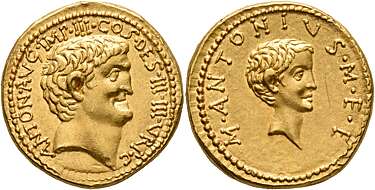
Lot 66. Mark Antony and Mark Antony the Younger. Aureus 34 BC, mint moving in Asia Minor. ANTON · AVG · IMP · COS · DES · III · III · V R P · C Bare head of Mark Antony right / M · ANTONIVS · M · F · F Bare head of Mark Antony the Younger right. 8,09g. Calicó 118a; Crawford 541/2; Sear 1514 (this coin); Sydenham 1207. Very rare and the finest specimen known. Splendid. Provenance: Kastner 4 (27 November 1973), 212. Collection Nelson Bunker Hunt, Sotheby's 6043 (19 June 1990), 120. Leu 52 (15 May 1991), 150. NAC 54 (24 March 2010), 285. Baron Lorne Thyssen-Bornemisza Collection. In the aftermath of Caesar’s assassination, Mark Antony became one of the most powerful men in Rome. Together with Octavian, Caesar’s official heir, he led the Caesarian forces against the assassins, Brutus and Cassius, until their decisive victory at Philippi in 42 BC. By this time, it had become clear that the Republic, as it had existed, would never be restored. Since Caesar’s rise to power, authority in Rome was increasingly destined to be concentrated in the hands of a single man. Mark Antony was one of those who could plausibly aspire to become that man. This coin is therefore an assertion of power. It shows that the period when the Republic had refused to allow a living Roman to be celebrated on its coinage—and thus the beginning of a true cult of personality—had definitively passed. More significantly, the reverse depicts Mark Antony’s eldest son and designated heir, introducing an explicitly dynastic element. Born from Mark Antony’s marriage to Fulvia around 43 BC, Marcus Antonius Antyllus, known as “Marcus Antonius the Younger”, would not have the opportunity to pursue a genuine political career, because shortly after Octavian’s victory at Actium, he was executed on Octavian’s orders in 30 BC, at the age of sixteen or seventeen. On the reverse of this coin, this young man of tragic destiny is therefore still very young, approximately ten years old. Yet one can already notice an amusing resemblance to his illustrious father. This aureus is thus a witness to the final years of the Roman Republic: a period in which the most powerful men in Rome fought for supremacy and, in doing so, were already presenting and promoting their designated heirs.
  • Mise à prix:
    300'000 CHF
    327'317 EUR
    272'987 GBP
    367'407 USD

    Valeurs approximatives et arrondiesDate: 05/11/2026

Veuillez noter que la soumission d'offres n'est possible que dans le cadre des étapes d'enchères définies par la maison de vente aux enchères.

  • 0 CHF - 200 CHF : 10 CHF étapes
  • 200 CHF - 500 CHF : 20 CHF étapes
  • 500 CHF - 1'000 CHF : 50 CHF étapes
  • 1'000 CHF - 2'000 CHF : 100 CHF étapes
  • 2'000 CHF - 5'000 CHF : 200 CHF étapes
  • 5'000 CHF - 10'000 CHF : 250 CHF étapes
  • 10'000 CHF - 20'000 CHF : 500 CHF étapes
  • 20'000 CHF - 50'000 CHF : 2'000 CHF étapes
  • 50'000 CHF - 100'000 CHF : 5'000 CHF étapes
  • 100'000 CHF - 200'000 CHF : 10'000 CHF étapes
  • 200'000 CHF - 500'000 CHF : 20'000 CHF étapes
  • 500'000 CHF - 1'000'000 CHF : 50'000 CHF étapes
  • > 1'000'000 CHF    : 100'000 CHF étapes
Lot
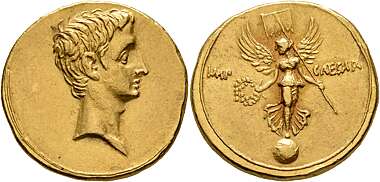
Lot 67. Octavian. Aureus 29-28 BC, Nicomedia or Nicaea. Bare head right / IMP CAESAR Victory facing, standing on globe and holding wreath and standard. 8,17g. Bahrfeldt 109; Calicó 205; Cohen 113; RIC 268. Nice extremely fine. Provenance: Sternberg 14 (24-25 May 1984), 250. Baldwin's & Münzen & Medaillen, New York sale III (7 December 2000), 609. Baron Lorne Thyssen-Bornemisza Collection. This aureus was struck during the very last years of the Roman Republic, when Octavian had just defeated Mark Antony and Cleopatra, establishing himself as the master of Rome and consolidating his power after decades of civil war. The Victory on the reverse evokes his triumph, while her standing upon a globe alludes to his dominion over the world. It is therefore a representation of Octavian’s final victory, having overcome all his enemies and transformed the Mediterranean into Mare Nostrum. This aureus recalls an issue of denarii struck in 31–30 BC (RIC 254–255). However, on this aureus, Victory holds a vexillum, a military standard with a flag attached to the end of its pole. This particular representation has been identified as the same Victory that stood atop the pediment of the Curia Julia, the new Senate House commissioned by Caesar, whose construction began in 44 BC, shortly before his assassination, and which was not completed until after Actium. This aureus was issued to pay the veterans. Following the civil wars, around sixty Roman legions remained mobilised, representing an extraordinarily heavy burden for the state. Augustus therefore demobilised the majority of his legions and distributed substantial sums of money to more than 100,000 veterans. They also received land throughout the Empire, contributing to the Romanisation of certain regions as the soldiers brought with them Roman ways of life and values. In this way, they also helped to stabilise the Empire. With Octavian, a new era began after years of civil war: the Pax Romana. From a numismatic perspective, this also marked the beginning of a new era. From the first appearance of a living Roman on coinage, with Titus Quinctius Flamininus, to Octavian’s victory issues, Roman coinage had undergone a profound transformation. From this point onward, every gold, silver, or bronze coin would bear the image of the reigning emperor or a member of his family. What had begun as an exceptional and controversial practice under the Republic had now become the defining principle of the imperial monetary system. Coins had become a permanent vehicle for imperial power and political messaging.
  • Mise à prix:
    20'000 CHF
    21'821 EUR
    18'199 GBP
    24'493 USD

    Valeurs approximatives et arrondiesDate: 05/11/2026

Veuillez noter que la soumission d'offres n'est possible que dans le cadre des étapes d'enchères définies par la maison de vente aux enchères.

  • 0 CHF - 200 CHF : 10 CHF étapes
  • 200 CHF - 500 CHF : 20 CHF étapes
  • 500 CHF - 1'000 CHF : 50 CHF étapes
  • 1'000 CHF - 2'000 CHF : 100 CHF étapes
  • 2'000 CHF - 5'000 CHF : 200 CHF étapes
  • 5'000 CHF - 10'000 CHF : 250 CHF étapes
  • 10'000 CHF - 20'000 CHF : 500 CHF étapes
  • 20'000 CHF - 50'000 CHF : 2'000 CHF étapes
  • 50'000 CHF - 100'000 CHF : 5'000 CHF étapes
  • 100'000 CHF - 200'000 CHF : 10'000 CHF étapes
  • 200'000 CHF - 500'000 CHF : 20'000 CHF étapes
  • 500'000 CHF - 1'000'000 CHF : 50'000 CHF étapes
  • > 1'000'000 CHF    : 100'000 CHF étapes
Lot
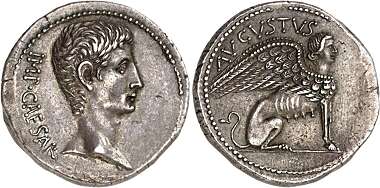
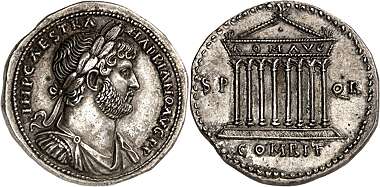
Lot 68. Augustus, 27 BC - 14 CE. Cistophorus 27-26 BC, Ephesus or Pergamon. IMP CAESAR Bare head of Augustus right / AVGVSTVS Sphinx with raised wings seated right. 12,10g. BMC 702; RIC 492; Sutherland Group IV, 121 (this coin). An extraordinary specimen in perfect state of conservation. Good extremely fine. Provenance: Certainly from the Auguste de Belfort Collection (1824-1907), Henri Hoffmann (20-26 February 1888), 163, Pl. I. Vicomte Louis de Sartiges Collection (1859-1924), Naville XVIII (10 October 1938), 37. UBS 78 (9-10 September 2008), 1246. Baron Lorne Thyssen-Bornemisza Collection. According to Suetonius, Augustus used a sphinx as the symbol on his signet ring, perhaps reflecting the creature’s reputation as an imposing and vigilant guardian. His seal was impressed upon all his private correspondence and official documents. Both Pliny and Dio Cassius recount that Octavian entrusted a duplicate of this ring to Agrippa and Maecenas, enabling them to issue edicts and letters with his delegated authority whenever he was absent. Two sphinxes are also depicted on the famous Augustus of Prima Porta statue (Vatican Museums), positioned on the emperor’s cuirass at the shoulders. Sutherland considers it highly probable that the Sphinx depicted on this cistophorus was directly inspired by the sphinx of Augustus’ signet ring. On this coin, the sphinx is depicted according to the Greek tradition: a female creature with majestic wings. It was a feared creature that killed those who failed to answer its riddles. The episode of Oedipus, who solves the sphinx’s riddle, underscores the terrifying nature of this mythological being. In the Greco-Roman world, the sphinx was associated with Apollo, God of the sun and the arts, but also the protective deity of Augustus. The Greek sphinx thus differed from the Egyptian sphinx, which was represented with the body of a lion and a human head, often that of the pharaoh. In this form, Egyptian sphinxes were guardian spirits associated with the solar deity Sekhmet. Only 13 specimens known according to the Roman Provincial Coinage (RPC).
  • Mise à prix:
    100'000 CHF
    109'105 EUR
    90'995 GBP
    122'469 USD

    Valeurs approximatives et arrondiesDate: 05/11/2026

Veuillez noter que la soumission d'offres n'est possible que dans le cadre des étapes d'enchères définies par la maison de vente aux enchères.

  • 0 CHF - 200 CHF : 10 CHF étapes
  • 200 CHF - 500 CHF : 20 CHF étapes
  • 500 CHF - 1'000 CHF : 50 CHF étapes
  • 1'000 CHF - 2'000 CHF : 100 CHF étapes
  • 2'000 CHF - 5'000 CHF : 200 CHF étapes
  • 5'000 CHF - 10'000 CHF : 250 CHF étapes
  • 10'000 CHF - 20'000 CHF : 500 CHF étapes
  • 20'000 CHF - 50'000 CHF : 2'000 CHF étapes
  • 50'000 CHF - 100'000 CHF : 5'000 CHF étapes
  • 100'000 CHF - 200'000 CHF : 10'000 CHF étapes
  • 200'000 CHF - 500'000 CHF : 20'000 CHF étapes
  • 500'000 CHF - 1'000'000 CHF : 50'000 CHF étapes
  • > 1'000'000 CHF    : 100'000 CHF étapes
Lot
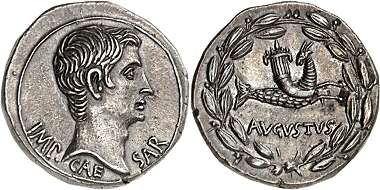
Lot 69. Augustus, 27 BC - 14 CE. Cistophorus circa 25 BC, Ephesus. IMP - CAE - SAR Bare head right / AVGVSTVS Capricorn right, head turned back to left, cornucopia on its back; all within wreath. 11,97g. Cohen 16; RIC 477; Sutherland Group V. Good extremely fine. Provenance: Künker 243 (21 November 2013), 4751. Baron Lorne Thyssen-Bornemisza Collection. The Capricorn is one of the most recurrent motifs in Augustan coinage, traditionally understood as Augustus’ zodiac sign. Born on 23 September 63 BC, Augustus was therefore conceived under the sign of Capricorn. Some scholars have instead suggested that the Capricorn may have referred to the beginning of his principate in January 27 BC. However, coins associating Octavian with the Capricorn are known from before 27 BC, making this interpretation less convincing. On this coin, the Capricorn is paired with a cornucopia, symbolizing the prosperity and abundance restored after decades of devastating civil wars. This remarkable coin evokes Augustus’ personal destiny while simultaneously presenting his rise to power as the dawn of a new era of peace, stability, and prosperity for Rome.
  • Mise à prix:
    6'000 CHF
    6'546 EUR
    5'459 GBP
    7'348 USD

    Valeurs approximatives et arrondiesDate: 05/11/2026

Veuillez noter que la soumission d'offres n'est possible que dans le cadre des étapes d'enchères définies par la maison de vente aux enchères.

  • 0 CHF - 200 CHF : 10 CHF étapes
  • 200 CHF - 500 CHF : 20 CHF étapes
  • 500 CHF - 1'000 CHF : 50 CHF étapes
  • 1'000 CHF - 2'000 CHF : 100 CHF étapes
  • 2'000 CHF - 5'000 CHF : 200 CHF étapes
  • 5'000 CHF - 10'000 CHF : 250 CHF étapes
  • 10'000 CHF - 20'000 CHF : 500 CHF étapes
  • 20'000 CHF - 50'000 CHF : 2'000 CHF étapes
  • 50'000 CHF - 100'000 CHF : 5'000 CHF étapes
  • 100'000 CHF - 200'000 CHF : 10'000 CHF étapes
  • 200'000 CHF - 500'000 CHF : 20'000 CHF étapes
  • 500'000 CHF - 1'000'000 CHF : 50'000 CHF étapes
  • > 1'000'000 CHF    : 100'000 CHF étapes
Lot
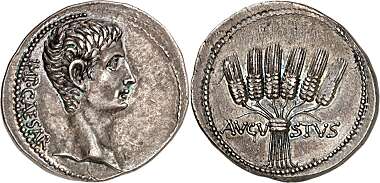
Lot 70. Augustus, 27 BC - 14 CE. Cistophorus 25-20 BC, Ephesus. IMP CAESAR Bare head right / AVGV - STVS Six bunched corn-ears. 11,70g. Cohen 32; RIC 494; Sutherland Group IV. A splendid specimen. Good extremely fine. Provenance: Sternberg XIV (24 May 1984), 258. Privately purchased from Vinchon in October 1985. Lanz 94 (22 November 1999), 5. Privately purchased from NGSA in 2008. Baron Lorne Thyssen-Bornemisza Collection. The reverse of this cistophorus conveys a particularly interesting message of propaganda: the emperor emphasizes his ability to feed and provide for his people. To achieve this, Pompey and later Augustus had fought for years to suppress piracy in the Mediterranean, thereby securing the vital supply routes between Rome and the fertile provinces of the East. By guaranteeing the food supply of Rome and its population of nearly one million inhabitants, the emperor could secure social stability and preserve peace.
  • Mise à prix:
    20'000 CHF
    21'821 EUR
    18'199 GBP
    24'493 USD

    Valeurs approximatives et arrondiesDate: 05/11/2026

Veuillez noter que la soumission d'offres n'est possible que dans le cadre des étapes d'enchères définies par la maison de vente aux enchères.

  • 0 CHF - 200 CHF : 10 CHF étapes
  • 200 CHF - 500 CHF : 20 CHF étapes
  • 500 CHF - 1'000 CHF : 50 CHF étapes
  • 1'000 CHF - 2'000 CHF : 100 CHF étapes
  • 2'000 CHF - 5'000 CHF : 200 CHF étapes
  • 5'000 CHF - 10'000 CHF : 250 CHF étapes
  • 10'000 CHF - 20'000 CHF : 500 CHF étapes
  • 20'000 CHF - 50'000 CHF : 2'000 CHF étapes
  • 50'000 CHF - 100'000 CHF : 5'000 CHF étapes
  • 100'000 CHF - 200'000 CHF : 10'000 CHF étapes
  • 200'000 CHF - 500'000 CHF : 20'000 CHF étapes
  • 500'000 CHF - 1'000'000 CHF : 50'000 CHF étapes
  • > 1'000'000 CHF    : 100'000 CHF étapes
Lot
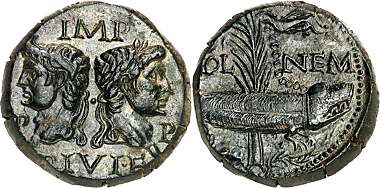
Lot 71. Augustus, 27 BC - 14 CE. Dupondius 9-3 BC, Nemausus (Nîmes). IMP - DIVI F Laureate heads of Augustus and Agrippa back to back, flanked by P - P / COL - NEM Crocodile right in chains with palm branch behind. Behind palm, wreath with long ties. 12,98g. Cohen 10; RIC 160. A superb specimen with perfect portraits. Provenance: Tkalec (18 February 2002), 126. NAC 46 (2 April 2008), 486. Baron Lorne Thyssen-Bornemisza Collection. The colony of Nemausus, one of the major cities of Gallia Narbonensis, was established by Octavian to settle veterans of his Egyptian campaign. The crocodile, an emblematic animal of Egypt, consequently became the symbol of the city and remains so to this day. For this reason, the mint of Nemausus featured a crocodile on the reverse of its coinage.
  • Mise à prix:
    5'000 CHF
    5'455 EUR
    4'549 GBP
    6'123 USD

    Valeurs approximatives et arrondiesDate: 05/11/2026

Veuillez noter que la soumission d'offres n'est possible que dans le cadre des étapes d'enchères définies par la maison de vente aux enchères.

  • 0 CHF - 200 CHF : 10 CHF étapes
  • 200 CHF - 500 CHF : 20 CHF étapes
  • 500 CHF - 1'000 CHF : 50 CHF étapes
  • 1'000 CHF - 2'000 CHF : 100 CHF étapes
  • 2'000 CHF - 5'000 CHF : 200 CHF étapes
  • 5'000 CHF - 10'000 CHF : 250 CHF étapes
  • 10'000 CHF - 20'000 CHF : 500 CHF étapes
  • 20'000 CHF - 50'000 CHF : 2'000 CHF étapes
  • 50'000 CHF - 100'000 CHF : 5'000 CHF étapes
  • 100'000 CHF - 200'000 CHF : 10'000 CHF étapes
  • 200'000 CHF - 500'000 CHF : 20'000 CHF étapes
  • 500'000 CHF - 1'000'000 CHF : 50'000 CHF étapes
  • > 1'000'000 CHF    : 100'000 CHF étapes
Lot
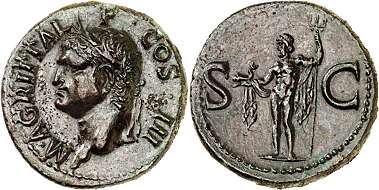
Lot 72. Agrippa, died 12 BC. As struck under Caligula 37-41, Rome. M · AGRIPPA L - F · COS III Head left wearing corona navalis / Neptune standing left, between S -C, and holding dolphin and trident. 11,17g. Cohen 3; RIC 58. Good extremely fine. Provenance: Nomos & CNG FPL (Winter-Spring 2008), 77. Baron Lorne Thyssen-Bornemisza Collection.
  • Mise à prix:
    2'000 CHF
    2'182 EUR
    1'819 GBP
    2'449 USD

    Valeurs approximatives et arrondiesDate: 05/11/2026

Veuillez noter que la soumission d'offres n'est possible que dans le cadre des étapes d'enchères définies par la maison de vente aux enchères.

  • 0 CHF - 200 CHF : 10 CHF étapes
  • 200 CHF - 500 CHF : 20 CHF étapes
  • 500 CHF - 1'000 CHF : 50 CHF étapes
  • 1'000 CHF - 2'000 CHF : 100 CHF étapes
  • 2'000 CHF - 5'000 CHF : 200 CHF étapes
  • 5'000 CHF - 10'000 CHF : 250 CHF étapes
  • 10'000 CHF - 20'000 CHF : 500 CHF étapes
  • 20'000 CHF - 50'000 CHF : 2'000 CHF étapes
  • 50'000 CHF - 100'000 CHF : 5'000 CHF étapes
  • 100'000 CHF - 200'000 CHF : 10'000 CHF étapes
  • 200'000 CHF - 500'000 CHF : 20'000 CHF étapes
  • 500'000 CHF - 1'000'000 CHF : 50'000 CHF étapes
  • > 1'000'000 CHF    : 100'000 CHF étapes
Lot
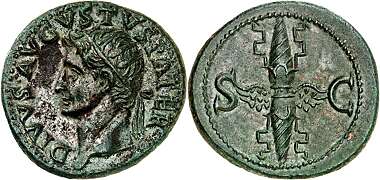
Lot 73. Divus Augustus, after 14 CE. As struck under Tiberius 34-37, Rome. DIVVS AVGVSTVS PATER Radiate head left / Winged thunderbolt upright, between S - C. 11,02g. Cohen 249; RIC 83. Extremely fine. Provenance: Rauch 67 (26 February 2001), 301. NAC (2 April 2008), 488. Baron Lorne Thyssen-Bornemisza Collection.
  • Mise à prix:
    2'000 CHF
    2'182 EUR
    1'819 GBP
    2'449 USD

    Valeurs approximatives et arrondiesDate: 05/11/2026

Veuillez noter que la soumission d'offres n'est possible que dans le cadre des étapes d'enchères définies par la maison de vente aux enchères.

  • 0 CHF - 200 CHF : 10 CHF étapes
  • 200 CHF - 500 CHF : 20 CHF étapes
  • 500 CHF - 1'000 CHF : 50 CHF étapes
  • 1'000 CHF - 2'000 CHF : 100 CHF étapes
  • 2'000 CHF - 5'000 CHF : 200 CHF étapes
  • 5'000 CHF - 10'000 CHF : 250 CHF étapes
  • 10'000 CHF - 20'000 CHF : 500 CHF étapes
  • 20'000 CHF - 50'000 CHF : 2'000 CHF étapes
  • 50'000 CHF - 100'000 CHF : 5'000 CHF étapes
  • 100'000 CHF - 200'000 CHF : 10'000 CHF étapes
  • 200'000 CHF - 500'000 CHF : 20'000 CHF étapes
  • 500'000 CHF - 1'000'000 CHF : 50'000 CHF étapes
  • > 1'000'000 CHF    : 100'000 CHF étapes
Lot
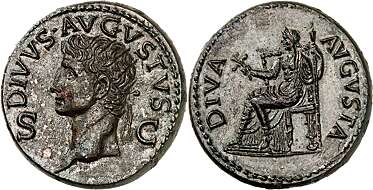
Lot 74. Divus Augustus, after 14 CE. Dupondius struck under Claudius circa 41-50, Rome. DIVVS · AVGVSTVS Radiate head left between S - C / DIVA – AVGVSTA Livia seated left on throne, holding corn-ears and sceptre. 15,89g. Cohen 93; RIC 101. A perfect specimen. Provenance: NGSA 5 (3 December 2008), 212. Baron Lorne Thyssen-Bornemisza Collection. Although it bears the portrait of Augustus, this dupondius was struck under Claudius, around thirty years after Augustus’s death. It can be seen as a form of monetary homage to the first Roman emperor. For an emperor with a fragile claim to legitimacy like Claudius—who had come to the throne through the support of the Praetorian Guard following a conspiracy—it was politically useful to associate his image with that of an emperor as popular and prestigious as Augustus. Just as interesting is the representation of Livia on the reverse. If Augustus was one of Rome’s greatest emperors, Livia was arguably the greatest empress in Roman history, embodying the traditional ideal of the Roman woman. She was one of her husband’s most important advisers and was even deified after her death, like Augustus. By issuing this coin, Claudius was therefore placing himself under the protection of this deified couple, who embodied the ideal Roman marriage. There is a certain irony in this when we consider Claudius’s own disastrous love life. He renounced his first wife, who was accused of adultery; he divorced his second wife after less than two years of marriage; his third wife openly cheated on him and, according to the ancient sources, even prostituted herself and remarried another man while still married to Claudius; and his fourth wife, Agrippina, is said by the ancient sources to have had him poisoned. This dupondius may perhaps reflect something Claudius wished he had but never did: a happy marriage, perhaps one of the few things an emperor could not buy.
  • Mise à prix:
    12'000 CHF
    13'092 EUR
    10'919 GBP
    14'696 USD

    Valeurs approximatives et arrondiesDate: 05/11/2026

Veuillez noter que la soumission d'offres n'est possible que dans le cadre des étapes d'enchères définies par la maison de vente aux enchères.

  • 0 CHF - 200 CHF : 10 CHF étapes
  • 200 CHF - 500 CHF : 20 CHF étapes
  • 500 CHF - 1'000 CHF : 50 CHF étapes
  • 1'000 CHF - 2'000 CHF : 100 CHF étapes
  • 2'000 CHF - 5'000 CHF : 200 CHF étapes
  • 5'000 CHF - 10'000 CHF : 250 CHF étapes
  • 10'000 CHF - 20'000 CHF : 500 CHF étapes
  • 20'000 CHF - 50'000 CHF : 2'000 CHF étapes
  • 50'000 CHF - 100'000 CHF : 5'000 CHF étapes
  • 100'000 CHF - 200'000 CHF : 10'000 CHF étapes
  • 200'000 CHF - 500'000 CHF : 20'000 CHF étapes
  • 500'000 CHF - 1'000'000 CHF : 50'000 CHF étapes
  • > 1'000'000 CHF    : 100'000 CHF étapes
Lot
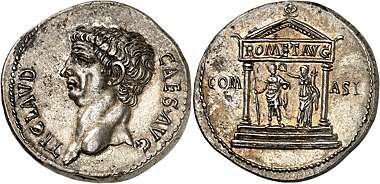
Lot 75. Claudius, 41-54. Cistophorus 41-42, Ephesus or Pergamon. TI CLAVD CAES · AVG Bare head left / COM - ASI Temple with two columns, containing figure of Claudius on the left, holding spear in right hand, being crowned by female figure on the right, holding cornucopia in left. On frieze: ROM ET AVG. 11,50g. Cohen 3; RIC 120. A spectacular specimen of beautiful style. Good extremely fine. Provenance: Sternberg VIII (16-17 November 1978), 476. Vinchon (25 November 1994), 404. Privately purchased from NGSA in 2008. Baron Lorne Thyssen-Bornemisza Collection. More than sixty years after the remarkable cistophori of Augustus, the Romans once again minted cistophori in Asia Minor under Claudius, likely intended for commemorative purposes rather than general circulation. This magnificent cistophorus depicts either the Temple of Roma and Augustus at Pergamum or the Temple of Diana at Ephesus, reflecting the close connection between imperial power and the great religious centers of Asia Minor.
  • Mise à prix:
    20'000 CHF
    21'821 EUR
    18'199 GBP
    24'493 USD

    Valeurs approximatives et arrondiesDate: 05/11/2026

Veuillez noter que la soumission d'offres n'est possible que dans le cadre des étapes d'enchères définies par la maison de vente aux enchères.

  • 0 CHF - 200 CHF : 10 CHF étapes
  • 200 CHF - 500 CHF : 20 CHF étapes
  • 500 CHF - 1'000 CHF : 50 CHF étapes
  • 1'000 CHF - 2'000 CHF : 100 CHF étapes
  • 2'000 CHF - 5'000 CHF : 200 CHF étapes
  • 5'000 CHF - 10'000 CHF : 250 CHF étapes
  • 10'000 CHF - 20'000 CHF : 500 CHF étapes
  • 20'000 CHF - 50'000 CHF : 2'000 CHF étapes
  • 50'000 CHF - 100'000 CHF : 5'000 CHF étapes
  • 100'000 CHF - 200'000 CHF : 10'000 CHF étapes
  • 200'000 CHF - 500'000 CHF : 20'000 CHF étapes
  • 500'000 CHF - 1'000'000 CHF : 50'000 CHF étapes
  • > 1'000'000 CHF    : 100'000 CHF étapes
Lot
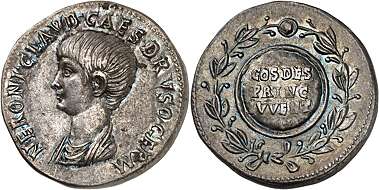
Lot 76. Nero, as Caesar, 50-54. Cistophorus 51, Ephesus or Pergamon. NERONI · CLAVD · CAES · DRVSO · GERM Draped bust left / COS DES - PRINC - IVVENT Inscribed round shield enclosed by laurel wreath. 11,53g. Cohen 82; RIC 121. A beautiful specimen. Extremely fine. Provenance: Leu 22 (8-9 May 1979), 213. Leo Benz Collection (1906-1996), Lanz 94 (22 November 1999), 238. Privately purchased from Tradart in 2008. Baron Lorne Thyssen-Bornemisza Collection. When Nero was born in 37, he was not destined to become emperor. He was simply Lucius Domitius Ahenobarbus, the son of Agrippina the Younger, herself a member of the prestigious family of Germanicus, and Gnaeus Domitius Ahenobarbus, consul in 32. It was his mother’s extraordinary ambition that would transform his destiny. In 49, Agrippina married her uncle, the emperor Claudius, and in 50 secured the adoption of her son by the emperor. Nero thus entered the imperial family under the name Nero Claudius Caesar Drusus Germanicus, displayed on the obverse of this cistophorus. From that moment, Agrippina methodically worked to establish her son as Claudius’ successor, at the expense of the emperor’s own son, Britannicus. Nero received an education befitting a future ruler, notably under the guidance of Seneca. He was presented to the Senate by Claudius, received the proconsulare imperium in 51, and, most importantly, was granted the prestigious title of princeps iuventutis, the title recorded on the reverse of this cistophorus. He was also placed prominently in public ceremonies and, in 53, married to Octavia, the daughter of Claudius. The political message was unmistakable: Nero was no longer simply Agrippina’s son; he had become Claudius’ designated heir. In 54, Claudius died suddenly, reportedly poisoned according to the ancient sources, with tradition attributing the organization of the crime to Agrippina. Nero, then only sixteen, succeeded him as emperor. There remained only one serious obstacle to the new emperor’s position: Britannicus, the natural son of Claudius. In 55, Nero had him poisoned, removing the most obvious rival to his authority. This cistophorus, depicting the young Nero, is therefore a striking witness to his extraordinarily rapid rise to supreme power. At just fourteen, as represented here, he appears at a decisive moment in his career: the age at which Claudius emancipated him politically and granted him his first important offices and honours, establishing him as his heir. The coinage itself played an important role in this process. By placing the young Nero’s name and titles on the coins, Claudius promotes his chosen successor, legitimizes his position and spreads his image throughout the Empire: it was a carefully constructed political message. In this sense, the cistophorus captures a fascinating moment in the Julio-Claudian dynasty: Nero is not yet the cruel and infamous emperor portrayed by the ancient sources, but a young prince carefully guided by his mother toward becoming the most powerful man in the world.
  • Mise à prix:
    20'000 CHF
    21'821 EUR
    18'199 GBP
    24'493 USD

    Valeurs approximatives et arrondiesDate: 05/11/2026

Veuillez noter que la soumission d'offres n'est possible que dans le cadre des étapes d'enchères définies par la maison de vente aux enchères.

  • 0 CHF - 200 CHF : 10 CHF étapes
  • 200 CHF - 500 CHF : 20 CHF étapes
  • 500 CHF - 1'000 CHF : 50 CHF étapes
  • 1'000 CHF - 2'000 CHF : 100 CHF étapes
  • 2'000 CHF - 5'000 CHF : 200 CHF étapes
  • 5'000 CHF - 10'000 CHF : 250 CHF étapes
  • 10'000 CHF - 20'000 CHF : 500 CHF étapes
  • 20'000 CHF - 50'000 CHF : 2'000 CHF étapes
  • 50'000 CHF - 100'000 CHF : 5'000 CHF étapes
  • 100'000 CHF - 200'000 CHF : 10'000 CHF étapes
  • 200'000 CHF - 500'000 CHF : 20'000 CHF étapes
  • 500'000 CHF - 1'000'000 CHF : 50'000 CHF étapes
  • > 1'000'000 CHF    : 100'000 CHF étapes
Lot
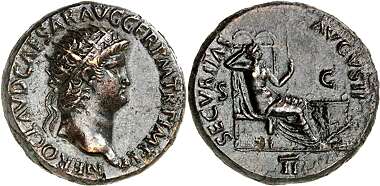
Lot 77. Nero, 54-68. Dupondius 64, Rome. NERO CLAVD CAESAR AVG GER P M TR P IMP PP Radiate head right / SECVRITAS AVGVSTI Securitas seated right, holding sceptre, between S - C. Altar and torch at her feet. In exergue, II (value). 14,70g. Cohen 326 var.; RIC 191 var. Extremely fine. Provenance: Privately purchased from NGSA in 2008. Baron Lorne Thyssen-Bornemisza Collection.
  • Mise à prix:
    3'000 CHF
    3'273 EUR
    2'729 GBP
    3'674 USD

    Valeurs approximatives et arrondiesDate: 05/11/2026

Veuillez noter que la soumission d'offres n'est possible que dans le cadre des étapes d'enchères définies par la maison de vente aux enchères.

  • 0 CHF - 200 CHF : 10 CHF étapes
  • 200 CHF - 500 CHF : 20 CHF étapes
  • 500 CHF - 1'000 CHF : 50 CHF étapes
  • 1'000 CHF - 2'000 CHF : 100 CHF étapes
  • 2'000 CHF - 5'000 CHF : 200 CHF étapes
  • 5'000 CHF - 10'000 CHF : 250 CHF étapes
  • 10'000 CHF - 20'000 CHF : 500 CHF étapes
  • 20'000 CHF - 50'000 CHF : 2'000 CHF étapes
  • 50'000 CHF - 100'000 CHF : 5'000 CHF étapes
  • 100'000 CHF - 200'000 CHF : 10'000 CHF étapes
  • 200'000 CHF - 500'000 CHF : 20'000 CHF étapes
  • 500'000 CHF - 1'000'000 CHF : 50'000 CHF étapes
  • > 1'000'000 CHF    : 100'000 CHF étapes
Lot
Lot 78. Titus, as Caesar, 69-79. As 72, Rome. T CAES VESPASIAN IMP P TR P COS II Laureate head right / PAX - AVGVST Pax standing left, leaning on column, holding caduceus in right hand and branch in left hand, between S - C. 10,68g. Cohen 43 var.; RIC 446. Of beautiful style and extremely fine. Provenance: Privately purchased from NGSA in 2008. Baron Lorne Thyssen-Bornemisza Collection.
  • Mise à prix:
    4'000 CHF
    4'364 EUR
    3'639 GBP
    4'898 USD

    Valeurs approximatives et arrondiesDate: 05/11/2026

Veuillez noter que la soumission d'offres n'est possible que dans le cadre des étapes d'enchères définies par la maison de vente aux enchères.

  • 0 CHF - 200 CHF : 10 CHF étapes
  • 200 CHF - 500 CHF : 20 CHF étapes
  • 500 CHF - 1'000 CHF : 50 CHF étapes
  • 1'000 CHF - 2'000 CHF : 100 CHF étapes
  • 2'000 CHF - 5'000 CHF : 200 CHF étapes
  • 5'000 CHF - 10'000 CHF : 250 CHF étapes
  • 10'000 CHF - 20'000 CHF : 500 CHF étapes
  • 20'000 CHF - 50'000 CHF : 2'000 CHF étapes
  • 50'000 CHF - 100'000 CHF : 5'000 CHF étapes
  • 100'000 CHF - 200'000 CHF : 10'000 CHF étapes
  • 200'000 CHF - 500'000 CHF : 20'000 CHF étapes
  • 500'000 CHF - 1'000'000 CHF : 50'000 CHF étapes
  • > 1'000'000 CHF    : 100'000 CHF étapes
Lot
Lot 79. Domitian, as Caesar, 69-81. As 73-74, Rome. CAESAR AVG F DOMITIAN COS II Laureate and draped bust right / PRINCIP · IV - VENT Domitian riding left with right hand raised, holding sceptre in left hand, between S - C. 12,69g. Cohen 400; RIC 662. Of beautiful style. Extremely fine. Provenance: Privately purchased from NGSA in 2013. Baron Lorne Thyssen-Bornemisza Collection.
  • Mise à prix:
    3'000 CHF
    3'273 EUR
    2'729 GBP
    3'674 USD

    Valeurs approximatives et arrondiesDate: 05/11/2026

Veuillez noter que la soumission d'offres n'est possible que dans le cadre des étapes d'enchères définies par la maison de vente aux enchères.

  • 0 CHF - 200 CHF : 10 CHF étapes
  • 200 CHF - 500 CHF : 20 CHF étapes
  • 500 CHF - 1'000 CHF : 50 CHF étapes
  • 1'000 CHF - 2'000 CHF : 100 CHF étapes
  • 2'000 CHF - 5'000 CHF : 200 CHF étapes
  • 5'000 CHF - 10'000 CHF : 250 CHF étapes
  • 10'000 CHF - 20'000 CHF : 500 CHF étapes
  • 20'000 CHF - 50'000 CHF : 2'000 CHF étapes
  • 50'000 CHF - 100'000 CHF : 5'000 CHF étapes
  • 100'000 CHF - 200'000 CHF : 10'000 CHF étapes
  • 200'000 CHF - 500'000 CHF : 20'000 CHF étapes
  • 500'000 CHF - 1'000'000 CHF : 50'000 CHF étapes
  • > 1'000'000 CHF    : 100'000 CHF étapes
Lot
Lot 80. Trajan, 98-117. As 104-111, Rome. IMP CAES NERVAE TRAIANO AVG GER DAC P M TR P COS V P P Laureate bust right / SPQR OPTIMO PRINCIPI Oval shield with two spears, sword, vexillum and oblong shield. Below, S C. 10,70g. Cohen 569; RIC 584 var. A rare coin with nice green patina. Extremely fine. Provenance: NAC 46 (2 April 2008), 558. Baron Lorne Thyssen-Bornemisza Collection.
  • Mise à prix:
    3'000 CHF
    3'273 EUR
    2'729 GBP
    3'674 USD

    Valeurs approximatives et arrondiesDate: 05/11/2026

Veuillez noter que la soumission d'offres n'est possible que dans le cadre des étapes d'enchères définies par la maison de vente aux enchères.

  • 0 CHF - 200 CHF : 10 CHF étapes
  • 200 CHF - 500 CHF : 20 CHF étapes
  • 500 CHF - 1'000 CHF : 50 CHF étapes
  • 1'000 CHF - 2'000 CHF : 100 CHF étapes
  • 2'000 CHF - 5'000 CHF : 200 CHF étapes
  • 5'000 CHF - 10'000 CHF : 250 CHF étapes
  • 10'000 CHF - 20'000 CHF : 500 CHF étapes
  • 20'000 CHF - 50'000 CHF : 2'000 CHF étapes
  • 50'000 CHF - 100'000 CHF : 5'000 CHF étapes
  • 100'000 CHF - 200'000 CHF : 10'000 CHF étapes
  • 200'000 CHF - 500'000 CHF : 20'000 CHF étapes
  • 500'000 CHF - 1'000'000 CHF : 50'000 CHF étapes
  • > 1'000'000 CHF    : 100'000 CHF étapes
Lot
Lot 81. Trajan, 98-117. As 99-100, Rome. IMP CAES NERVA TRAIA - N AVG GERM P M Laureate head right / TR POT - COS III P P Victory, between S - C, advancing left and holding in right hand shield inscribed SP - QR. 13,67g. Cohen 628; RIC 417. Splendid. Provenance: Privately purchased from NGSA in 2008. Baron Lorne Thyssen-Bornemisza Collection.
  • Mise à prix:
    2'000 CHF
    2'182 EUR
    1'819 GBP
    2'449 USD

    Valeurs approximatives et arrondiesDate: 05/11/2026

Veuillez noter que la soumission d'offres n'est possible que dans le cadre des étapes d'enchères définies par la maison de vente aux enchères.

  • 0 CHF - 200 CHF : 10 CHF étapes
  • 200 CHF - 500 CHF : 20 CHF étapes
  • 500 CHF - 1'000 CHF : 50 CHF étapes
  • 1'000 CHF - 2'000 CHF : 100 CHF étapes
  • 2'000 CHF - 5'000 CHF : 200 CHF étapes
  • 5'000 CHF - 10'000 CHF : 250 CHF étapes
  • 10'000 CHF - 20'000 CHF : 500 CHF étapes
  • 20'000 CHF - 50'000 CHF : 2'000 CHF étapes
  • 50'000 CHF - 100'000 CHF : 5'000 CHF étapes
  • 100'000 CHF - 200'000 CHF : 10'000 CHF étapes
  • 200'000 CHF - 500'000 CHF : 20'000 CHF étapes
  • 500'000 CHF - 1'000'000 CHF : 50'000 CHF étapes
  • > 1'000'000 CHF    : 100'000 CHF étapes
Lot
Lot 82. Trajan, 98-117. As 116, Rome. IMP CAES · NER TRAIANO OPTIMO AVG GERM Radiate and draped bust right / DAC PARTHICO P M TR POT XX COS VI P P Within oak wreath, S · C. 8,73g. Cohen 123; RIC 647. An exceptional specimen. Good extremely fine. Provenance: CNG Triton XI (8 January 2008), 921. Baron Lorne Thyssen-Bornemisza Collection.
  • Mise à prix:
    2'000 CHF
    2'182 EUR
    1'819 GBP
    2'449 USD

    Valeurs approximatives et arrondiesDate: 05/11/2026

Veuillez noter que la soumission d'offres n'est possible que dans le cadre des étapes d'enchères définies par la maison de vente aux enchères.

  • 0 CHF - 200 CHF : 10 CHF étapes
  • 200 CHF - 500 CHF : 20 CHF étapes
  • 500 CHF - 1'000 CHF : 50 CHF étapes
  • 1'000 CHF - 2'000 CHF : 100 CHF étapes
  • 2'000 CHF - 5'000 CHF : 200 CHF étapes
  • 5'000 CHF - 10'000 CHF : 250 CHF étapes
  • 10'000 CHF - 20'000 CHF : 500 CHF étapes
  • 20'000 CHF - 50'000 CHF : 2'000 CHF étapes
  • 50'000 CHF - 100'000 CHF : 5'000 CHF étapes
  • 100'000 CHF - 200'000 CHF : 10'000 CHF étapes
  • 200'000 CHF - 500'000 CHF : 20'000 CHF étapes
  • 500'000 CHF - 1'000'000 CHF : 50'000 CHF étapes
  • > 1'000'000 CHF    : 100'000 CHF étapes
Lot
Lot 83. Hadrian, 117-138. Cistophorus circa 136, Nicomedia in Bithynia. IMP CAES TRA - HADRIANO AVG P P Laureate, draped and cuirassed bust right / SP - QR Temple with eight columns. On frieze, ROM AVG. In exergue, COM BIT. 11,34g. Cohen -; RIC -; Metcalf, "The Cistophori of Hadrian", 1980, B 15.36 (this coin); SNG von Aulock 6606 (this coin). Very rare. An extraordinary specimen of the finest style. The best known. A portrait of enchanting beauty struck in high relief. Extremely fine. Provenance: H. von Aulock Collection (1906-1980), published in 1964. Leu 48 (10 May 1989), 347. JDL Collection, assembled between 1977 and 2013, NAC 74 (18 November 2013), 307. Baron Lorne Thyssen-Bornemisza Collection. This is one of the finest cistophori to have survived, a coin that perfectly illustrates the refinement of Roman coinage under Hadrian. The obverse bears a portrait of the emperor, rendered with remarkable finesse and precision. The quality of the engraving, the delicacy of the features, and the profusion of detail testify to the exceptional skill of the die engravers employed for this issue. At a time when Hadrian himself was deeply passionate about art, Greek culture, and architecture, it is particularly fitting to see his portrait appear on a coin that itself achieves such a high degree of artistic excellence. The inscription on the reverse identifies the mint as Nicomedia, the capital of the province of Bithynia and one of the Empire’s prosperous cities. Around 28 BC, the city erected a temple dedicated to Roma and Augustus. No trace of the building survives today, making the reverse of this cistophorus one of the few surviving sources of information about its monumental architecture. It is likely that the temple was restored under Hadrian, which may explain its representation on this issue. This cistophorus was struck as part of a major monetary programme intended to introduce cistophoric coinage into Bithynia. Some scholars view this as an expression of Hadrian’s philhellenic policies and his desire to promote the Greek cities of Asia Minor. Others favour a more economic explanation: the melting of older cistophori and their replacement with this new issue may have allowed their value to be reassessed, from three to four denarii. Whatever the precise motivation behind the programme, this cistophorus is far more than a mere monetary instrument: it is a true miniature work of art, reflecting the tastes and cultural ambitions of Hadrian.
  • Mise à prix:
    200'000 CHF
    218'211 EUR
    181'991 GBP
    244'938 USD

    Valeurs approximatives et arrondiesDate: 05/11/2026

Veuillez noter que la soumission d'offres n'est possible que dans le cadre des étapes d'enchères définies par la maison de vente aux enchères.

  • 0 CHF - 200 CHF : 10 CHF étapes
  • 200 CHF - 500 CHF : 20 CHF étapes
  • 500 CHF - 1'000 CHF : 50 CHF étapes
  • 1'000 CHF - 2'000 CHF : 100 CHF étapes
  • 2'000 CHF - 5'000 CHF : 200 CHF étapes
  • 5'000 CHF - 10'000 CHF : 250 CHF étapes
  • 10'000 CHF - 20'000 CHF : 500 CHF étapes
  • 20'000 CHF - 50'000 CHF : 2'000 CHF étapes
  • 50'000 CHF - 100'000 CHF : 5'000 CHF étapes
  • 100'000 CHF - 200'000 CHF : 10'000 CHF étapes
  • 200'000 CHF - 500'000 CHF : 20'000 CHF étapes
  • 500'000 CHF - 1'000'000 CHF : 50'000 CHF étapes
  • > 1'000'000 CHF    : 100'000 CHF étapes
Lot
Lot 84. Hadrian, 117-138. Dupondius 132-134, Rome. HADRIANVS - AVGVSTVS Laureate and draped bust right / FELICTATI AVG Galley left with a steersman and five rowers, between S - C. In exergue, COS III PP. 14,28g. Cohen 691 var.; RIC 718 var. A splendid portrait. Good extremely fine. Provenance: Privately purchased from Tradart in 2008. Baron Lorne Thyssen-Bornemisza Collection.
  • Mise à prix:
    3'000 CHF
    3'273 EUR
    2'729 GBP
    3'674 USD

    Valeurs approximatives et arrondiesDate: 05/11/2026

Veuillez noter que la soumission d'offres n'est possible que dans le cadre des étapes d'enchères définies par la maison de vente aux enchères.

  • 0 CHF - 200 CHF : 10 CHF étapes
  • 200 CHF - 500 CHF : 20 CHF étapes
  • 500 CHF - 1'000 CHF : 50 CHF étapes
  • 1'000 CHF - 2'000 CHF : 100 CHF étapes
  • 2'000 CHF - 5'000 CHF : 200 CHF étapes
  • 5'000 CHF - 10'000 CHF : 250 CHF étapes
  • 10'000 CHF - 20'000 CHF : 500 CHF étapes
  • 20'000 CHF - 50'000 CHF : 2'000 CHF étapes
  • 50'000 CHF - 100'000 CHF : 5'000 CHF étapes
  • 100'000 CHF - 200'000 CHF : 10'000 CHF étapes
  • 200'000 CHF - 500'000 CHF : 20'000 CHF étapes
  • 500'000 CHF - 1'000'000 CHF : 50'000 CHF étapes
  • > 1'000'000 CHF    : 100'000 CHF étapes
Lot
Lot 85. Pescennius Niger, 193-194. Tetradrachm 193-194, Antioch. Laureate, draped and cuirassed bust right / Eagle standing facing, head right, talons grasping palm branch. 11,67g. Prieur 177 var. One of the finest coins known from this rare emperor. Perfectly struck on a large flan. Nice dark patina. Good extremely fine. Provenance: Barry Feirstein Collection, assembled between 1994 and 2007, NAC 39 (16 May 2007), 132. Baron Lorne Thyssen-Bornemisza Collection. In 193, the emperor Pertinax was assassinated by the Praetorian Guard, who then proclaimed Didius Julianus emperor after he had promised them enormous sums of money. The scandal that followed was immediate, and the news provoked revolts throughout the Empire. In Pannonia, the legions proclaimed Septimius Severus emperor, while the armies in Britain acclaimed Clodius Albinus. In Syria, the legions proclaimed Pescennius Niger, soon joined by those of Cappadocia, Egypt, and Arabia. Pescennius Niger left remarkably few traces in the surviving sources, yet he appears to have been a talented and capable military commander. He established his headquarters at Antioch, where he also struck coinage, as this magnificent tetradrachm demonstrates. Its reverse legend alludes to the belief that Pescennius Niger enjoyed the favor of the Gods and would therefore emerge victorious from the fight for the throne. This tetradrachm is of the greatest rarity. Butcher records only six specimens, noting that each was struck from a different pair of dies, while Prieur lists seven, with each of the five specimens he illustrates having been struck from a different obverse die.
  • Mise à prix:
    50'000 CHF
    54'552 EUR
    45'497 GBP
    61'234 USD

    Valeurs approximatives et arrondiesDate: 05/11/2026

Veuillez noter que la soumission d'offres n'est possible que dans le cadre des étapes d'enchères définies par la maison de vente aux enchères.

  • 0 CHF - 200 CHF : 10 CHF étapes
  • 200 CHF - 500 CHF : 20 CHF étapes
  • 500 CHF - 1'000 CHF : 50 CHF étapes
  • 1'000 CHF - 2'000 CHF : 100 CHF étapes
  • 2'000 CHF - 5'000 CHF : 200 CHF étapes
  • 5'000 CHF - 10'000 CHF : 250 CHF étapes
  • 10'000 CHF - 20'000 CHF : 500 CHF étapes
  • 20'000 CHF - 50'000 CHF : 2'000 CHF étapes
  • 50'000 CHF - 100'000 CHF : 5'000 CHF étapes
  • 100'000 CHF - 200'000 CHF : 10'000 CHF étapes
  • 200'000 CHF - 500'000 CHF : 20'000 CHF étapes
  • 500'000 CHF - 1'000'000 CHF : 50'000 CHF étapes
  • > 1'000'000 CHF    : 100'000 CHF étapes
Lot
Lot 86. Julia Domna, wife of Septimius Severus, 193-217. As 211-217, Rome. IVLIA PIA - FELIX AVG Diademed and draped bust right / VES - TA Four Vestals sacrificing in front of round temple of Vesta. In exergue, S - C. 12,27g. Cohen 234; RIC 607. Possibly the finest bronze of Julia Domna ever struck. A perfect specimen. Provenance: A. Trampitsch Collection (1890-1975), Vinchon (14 November 1986), 761. CNG Triton IX (10 January 2006), 1518. Baron Lorne Thyssen-Bornemisza Collection.
  • Mise à prix:
    8'000 CHF
    8'728 EUR
    7'279 GBP
    9'797 USD

    Valeurs approximatives et arrondiesDate: 05/11/2026

Veuillez noter que la soumission d'offres n'est possible que dans le cadre des étapes d'enchères définies par la maison de vente aux enchères.

  • 0 CHF - 200 CHF : 10 CHF étapes
  • 200 CHF - 500 CHF : 20 CHF étapes
  • 500 CHF - 1'000 CHF : 50 CHF étapes
  • 1'000 CHF - 2'000 CHF : 100 CHF étapes
  • 2'000 CHF - 5'000 CHF : 200 CHF étapes
  • 5'000 CHF - 10'000 CHF : 250 CHF étapes
  • 10'000 CHF - 20'000 CHF : 500 CHF étapes
  • 20'000 CHF - 50'000 CHF : 2'000 CHF étapes
  • 50'000 CHF - 100'000 CHF : 5'000 CHF étapes
  • 100'000 CHF - 200'000 CHF : 10'000 CHF étapes
  • 200'000 CHF - 500'000 CHF : 20'000 CHF étapes
  • 500'000 CHF - 1'000'000 CHF : 50'000 CHF étapes
  • > 1'000'000 CHF    : 100'000 CHF étapes
Lot
Lot 87. Geta, 209-212. Dupondius 211, Rome. P SEPTIMIVS GETA - PIVS AVG BRIT Radiate head right / FORT RED TR P III COS II Fortuna seated left, holding rudder and cornucopia. Wheel under chair. In exergue, S - C. 10,69g. Cohen 61; RIC 173a. A splendid specimen with a superb malachite patina. Provenance: NGSA 5 (2-3 December 2008), 273. Baron Lorne Thyssen-Bornemisza Collection.
  • Mise à prix:
    4'000 CHF
    4'364 EUR
    3'639 GBP
    4'898 USD

    Valeurs approximatives et arrondiesDate: 05/11/2026

Veuillez noter que la soumission d'offres n'est possible que dans le cadre des étapes d'enchères définies par la maison de vente aux enchères.

  • 0 CHF - 200 CHF : 10 CHF étapes
  • 200 CHF - 500 CHF : 20 CHF étapes
  • 500 CHF - 1'000 CHF : 50 CHF étapes
  • 1'000 CHF - 2'000 CHF : 100 CHF étapes
  • 2'000 CHF - 5'000 CHF : 200 CHF étapes
  • 5'000 CHF - 10'000 CHF : 250 CHF étapes
  • 10'000 CHF - 20'000 CHF : 500 CHF étapes
  • 20'000 CHF - 50'000 CHF : 2'000 CHF étapes
  • 50'000 CHF - 100'000 CHF : 5'000 CHF étapes
  • 100'000 CHF - 200'000 CHF : 10'000 CHF étapes
  • 200'000 CHF - 500'000 CHF : 20'000 CHF étapes
  • 500'000 CHF - 1'000'000 CHF : 50'000 CHF étapes
  • > 1'000'000 CHF    : 100'000 CHF étapes
Lot
Lot 88. Macrinus, 218. As 218, Rome. IMP CAES M OPEL SEV MACRINVS AVG Laureate and cuirassed bust right / PONTIF MAX TR P II - C Macrinus driving a triumphal quadriga left and holding laurel branch in his right hand and eagle tipped sceptre in his left hand. Behind, Victory crowns him. In exergue, COS II PP. 11,85g. Cohen 107; RIC 162. Rare. Extremely fine. Provenance: Münzen & Medaillen 79 (28 February 1994), 587. Münzen & Medaillen 92 (22 November 2002), 148. NAC 80 (20 October 2014), 141. Baron Lorne Thyssen-Bornemisza Collection.
  • Mise à prix:
    4'000 CHF
    4'364 EUR
    3'639 GBP
    4'898 USD

    Valeurs approximatives et arrondiesDate: 05/11/2026

Veuillez noter que la soumission d'offres n'est possible que dans le cadre des étapes d'enchères définies par la maison de vente aux enchères.

  • 0 CHF - 200 CHF : 10 CHF étapes
  • 200 CHF - 500 CHF : 20 CHF étapes
  • 500 CHF - 1'000 CHF : 50 CHF étapes
  • 1'000 CHF - 2'000 CHF : 100 CHF étapes
  • 2'000 CHF - 5'000 CHF : 200 CHF étapes
  • 5'000 CHF - 10'000 CHF : 250 CHF étapes
  • 10'000 CHF - 20'000 CHF : 500 CHF étapes
  • 20'000 CHF - 50'000 CHF : 2'000 CHF étapes
  • 50'000 CHF - 100'000 CHF : 5'000 CHF étapes
  • 100'000 CHF - 200'000 CHF : 10'000 CHF étapes
  • 200'000 CHF - 500'000 CHF : 20'000 CHF étapes
  • 500'000 CHF - 1'000'000 CHF : 50'000 CHF étapes
  • > 1'000'000 CHF    : 100'000 CHF étapes
Lot
Lot 89. Postumus, 259-268. Sestertius circa 260-268, Lugdunum (Lyon). VIRTVS POS - TVMI AVG Helmeted and cuirassed bust right / LAETITIA Galley right with three or four rowers and steersmen. In exergue, AVG. 17,14g. Cohen 181; RIC 145 var. Struck on a large flan. Good very fine. Provenance: Privately purchased from Tradart in 2008. Baron Lorne Thyssen-Bornemisza Collection.
  • Mise à prix:
    5'000 CHF
    5'455 EUR
    4'549 GBP
    6'123 USD

    Valeurs approximatives et arrondiesDate: 05/11/2026

Veuillez noter que la soumission d'offres n'est possible que dans le cadre des étapes d'enchères définies par la maison de vente aux enchères.

  • 0 CHF - 200 CHF : 10 CHF étapes
  • 200 CHF - 500 CHF : 20 CHF étapes
  • 500 CHF - 1'000 CHF : 50 CHF étapes
  • 1'000 CHF - 2'000 CHF : 100 CHF étapes
  • 2'000 CHF - 5'000 CHF : 200 CHF étapes
  • 5'000 CHF - 10'000 CHF : 250 CHF étapes
  • 10'000 CHF - 20'000 CHF : 500 CHF étapes
  • 20'000 CHF - 50'000 CHF : 2'000 CHF étapes
  • 50'000 CHF - 100'000 CHF : 5'000 CHF étapes
  • 100'000 CHF - 200'000 CHF : 10'000 CHF étapes
  • 200'000 CHF - 500'000 CHF : 20'000 CHF étapes
  • 500'000 CHF - 1'000'000 CHF : 50'000 CHF étapes
  • > 1'000'000 CHF    : 100'000 CHF étapes
Lot
Lot 90. Victorinus, 268-270. Aureus mounted 268-270, Cologne or Treveri. IMP VICTORINVS PF AVG. Laureate head right / GAVDIA PVBLICA Four women standing, two facing right, two left, holding between them cornucopia. 11,16g. Calicò -; Biaggi 1551 (this coin); RIC -; Schulte 49a (this coin). Exceptional and in a perfect state of conservation. Provenance: Found in the hoard of Planches in 1889. Published in Revue Numismatique 7, 1889, p. 515-538, pl. X, 2. L. Biaggi de Blasys Collection (1906-1979), 1551. Baron Lorne Thyssen-Bornemisza Collection. Very few Roman emperors could be considered paragons of virtue, but even fewer seem to have excelled in crime and debauchery to the extent that Victorinus allegedly did—at least according to the Historia Augusta. Yet Victorinus had loyally served for several years under a remarkable man, Postumus, the emperor of the Gallic Empire. Having unexpectedly ascended to the throne following the death of Laelianus, Victorinus wasted no time in harassing the women around him. Eventually, however, a jealous husband put an end to his reign—and in doing so, made Victorinus’s gold coinage among the rarest of the Roman imperial series.
  • Mise à prix:
    100'000 CHF
    109'105 EUR
    90'995 GBP
    122'469 USD

    Valeurs approximatives et arrondiesDate: 05/11/2026

Veuillez noter que la soumission d'offres n'est possible que dans le cadre des étapes d'enchères définies par la maison de vente aux enchères.

  • 0 CHF - 200 CHF : 10 CHF étapes
  • 200 CHF - 500 CHF : 20 CHF étapes
  • 500 CHF - 1'000 CHF : 50 CHF étapes
  • 1'000 CHF - 2'000 CHF : 100 CHF étapes
  • 2'000 CHF - 5'000 CHF : 200 CHF étapes
  • 5'000 CHF - 10'000 CHF : 250 CHF étapes
  • 10'000 CHF - 20'000 CHF : 500 CHF étapes
  • 20'000 CHF - 50'000 CHF : 2'000 CHF étapes
  • 50'000 CHF - 100'000 CHF : 5'000 CHF étapes
  • 100'000 CHF - 200'000 CHF : 10'000 CHF étapes
  • 200'000 CHF - 500'000 CHF : 20'000 CHF étapes
  • 500'000 CHF - 1'000'000 CHF : 50'000 CHF étapes
  • > 1'000'000 CHF    : 100'000 CHF étapes
Lot
Lot 91. Julian of Pannonia, 284-285. Antoninianus 284-285, Siscia. IMP C M AVR IVLIANVS P F AVG Radiate, draped and cuirassed bust right / PAN - NONIAE - AVG Two Pannoniae standing, one looking right, one left, right hands outstretched left. Pannonia on right holding standard. In exergue, XXIIS. 3,62g. Cohen 5; RIC 4. Good extremely fine. Provenance: Tkalec (22 April 2007), 331. Gemini IV (8 January 2008), 495. Baron Lorne Thyssen-Bornemisza Collection.
  • Mise à prix:
    3'000 CHF
    3'273 EUR
    2'729 GBP
    3'674 USD

    Valeurs approximatives et arrondiesDate: 05/11/2026

Veuillez noter que la soumission d'offres n'est possible que dans le cadre des étapes d'enchères définies par la maison de vente aux enchères.

  • 0 CHF - 200 CHF : 10 CHF étapes
  • 200 CHF - 500 CHF : 20 CHF étapes
  • 500 CHF - 1'000 CHF : 50 CHF étapes
  • 1'000 CHF - 2'000 CHF : 100 CHF étapes
  • 2'000 CHF - 5'000 CHF : 200 CHF étapes
  • 5'000 CHF - 10'000 CHF : 250 CHF étapes
  • 10'000 CHF - 20'000 CHF : 500 CHF étapes
  • 20'000 CHF - 50'000 CHF : 2'000 CHF étapes
  • 50'000 CHF - 100'000 CHF : 5'000 CHF étapes
  • 100'000 CHF - 200'000 CHF : 10'000 CHF étapes
  • 200'000 CHF - 500'000 CHF : 20'000 CHF étapes
  • 500'000 CHF - 1'000'000 CHF : 50'000 CHF étapes
  • > 1'000'000 CHF    : 100'000 CHF étapes
Lot
Lot 92. Licinius II, as Caesar, 317-324. Follis 321-324, Alexandria. D N VAL LICIN LICINIVS NOB C Helmeted and cuirassed bust left, holding spear across right shoulder and shield on left arm / IOVI CONS - ERVATORI Jupiter nude standing left holding Victory on globe in right hand and leaning on sceptre with eagle with left hand. To left, eagle with wreath and to right, captive and X IIΓ. In exergue, mintmark SMALB. 3,56g. RIC 30. A miniature work of art. Splendid. Provenance: Privately purchased in 2004. Baron Lorne Thyssen-Bornemisza Collection.
  • Mise à prix:
    200 CHF
    218 EUR
    181 GBP
    244 USD

    Valeurs approximatives et arrondiesDate: 05/11/2026

Veuillez noter que la soumission d'offres n'est possible que dans le cadre des étapes d'enchères définies par la maison de vente aux enchères.

  • 0 CHF - 200 CHF : 10 CHF étapes
  • 200 CHF - 500 CHF : 20 CHF étapes
  • 500 CHF - 1'000 CHF : 50 CHF étapes
  • 1'000 CHF - 2'000 CHF : 100 CHF étapes
  • 2'000 CHF - 5'000 CHF : 200 CHF étapes
  • 5'000 CHF - 10'000 CHF : 250 CHF étapes
  • 10'000 CHF - 20'000 CHF : 500 CHF étapes
  • 20'000 CHF - 50'000 CHF : 2'000 CHF étapes
  • 50'000 CHF - 100'000 CHF : 5'000 CHF étapes
  • 100'000 CHF - 200'000 CHF : 10'000 CHF étapes
  • 200'000 CHF - 500'000 CHF : 20'000 CHF étapes
  • 500'000 CHF - 1'000'000 CHF : 50'000 CHF étapes
  • > 1'000'000 CHF    : 100'000 CHF étapes
Paramètres de confidentialitéParamètres de confidentialité