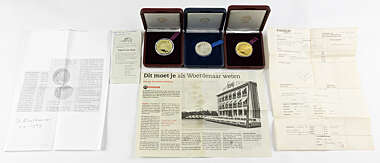
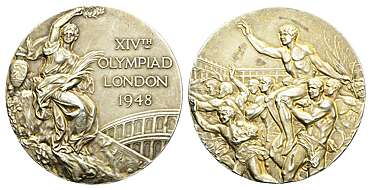
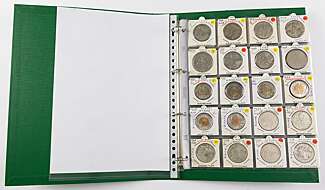
拍品 3554. Olympische Spelen - The 1948 London Olympic Gold Winners’ medal and estate archive of ‘forgotten’ Dutch Olympic champion Xenia ‘klein duimpje’ Stad-De Jong (1922-2012), won at the legendary 4x100 meters relay together with Nettie Witziers-Timmer, Gerda van der Kade-Koudijs & Fanny Blankers-Koen Silver-Gilt winners medal for the 1948 Olympics (Gad. 1), design by G. Cassioli & executed by John Pinches ltd. – Obv. Nike seated with palm branch and laurel wreath ‘XIVth OLYMPIAD LONDON 1948’ / Rev. Triumphant athlete with palm branch carried by competitors – only 138 pieces struck – AR Silver Gilt, 51 mm & 69.63 gram – Gilding somewhat worn – extremely rare and historically of the highest importance; A medal witness to Dutch Olympic legend! Presented together with Stad-De Jong’s participation medal in bronze (Gad. 2, by B. Mackennal), her Olympic winners’ diploma signed by the IOC President Edström, President of the Games Mr. Portal and Lord Burghley, two highly unique KNAU awards, over 50 medals and awards won at various Dutch and European championships and an extensive archive of personal letters, (press) photos, posters and newspaper clippings. A fascinating and utterly unique ensemble, exceptional in its completeness. After the highly political 1936 games in Nazi Berlin, the second world war saw the IOC forced to cancel both the 1940 and 1944 games. London had tentatively been selected to host the 1944 games and after the war the blitz-marked city was a logical symbolical choice for the return of Olympic sportsmanship. And while many thought it still too early and the scars of the war still too deep, the city commenced and hosted what would become known as the ‘Austerity Games’. Early postwar economic hardships, as half of London still lay in ruin, saw the games come back in a more sober fashion that exemplified the spirit at the time. There was no Olympic village (the British athletes even commuted from their homes), and ceremonies were much less extensive than during the prewar games. Sporting-wise, the absolute stars of these sober London Olympics and responsible for a bewildering number of international headlines, was the Dutch female athletics team. Especially famous is ‘flying housewife’ Fanny Blankers-Koen, who made Olympic history by winning no less than 4 gold medals that Olympiad, breaking many barriers and challenging notions of (married) women and mothers in sport. Naysayers had proclaimed her too old and the media had immediately assumed that after her first child, her career was over. The London games saw her immortalized as perhaps one of the greatest female Dutch athletes of the generation. Yet amongst those four medals is one won as part of a relay team, which reveals the largely forgotten story of three further female Olympic champions, overshadowed though undoubtedly of great importance to Dutch Olympic Athletic history. Xenia De Jong was born in Semerang in the then Dutch Indies on the 4th of march 1922, as the passports contained in this lot testify. In 1940, eighteen years of age, she came to the Netherlands and joins the athletics team Celebes in the Hague, with which she would book her first successes in several disciplines, though excelling at sprinting. Her small stature yet explosive running meant she was a force to be reckoned with and challenged Fanny Blankers-Koen on many occasions at national and international championships. During the war she and her fiancé Mike Stad both played roles in the resistance against German occupation and Mike would even be apprehended and sent to concentration camp Buchwald. After surviving the horrors of the war, Mike and Xenia married in 1946 and one year later would see the birth of their first child. Naysayers would perhaps have proclaimed her too old and motherly for any Olympic aspirations as well. That same year, the Dutch women had won the 4x100 relay titel at the European championships. Gré de Jongh had been the starting runner during this success, but due to difficulties with baton changing, coach Jan Blankers, somewhat surprisingly, selected Xenia, with her small stature and explosive starting, as the new member of the quartet. Nettie Witziers-Timmer and Gerda van der Kade-Koudijs completed the lineup and after intense training in the winter of 1947, the quartet would travel to London as strong favorites. Stad-De Jong would also compete in the individual 100 metres sprint at these games but unfortunately would be eliminated in the semifinals. The 7th of august 1948 would be the day of the relay races and the internal team dynamic at that day is perhaps best exemplified by the fact that as the three women were already warming up for the series, Fanny Blankers-Koen was nowhere to be seen. She had gone shopping for a raincoat in the city and while running back out of the metro, barely arrived on time for the start. ‘It was such a lovely coat’, would be Fanny’s comment. There were certainly some tensions. An explosive start as promised by Xenia kept the Dutch women towards the front of the pack in the finale race and with a swift baton change with Nettie Witziers-Timmers, her job was done. By the time of the last change however, the Netherlands was in fourth position and the chance at a medal seemed slim. Out of nowhere, last hope Fanny miraculously overtakes the English, Canadian and Australian runners in a frenzied dash and would ensure the Dutch flag would be hoisted above the top step of the podium. A gold medal for the quartet that would enter Olympic legend. There had always been tensions between Xenia and the KNAU. The KNAU, of which some senior members had collaborated with the occupying Germans. The fact that Jan Blankers, the husband of Fanny Blankers-Koen, was also the coach and was exceptionally influential within the organization, also meant that her best interests were kept at heart at all times. Further tensions arose after the three other Olympic champions were virtually ignored at their return to the Netherlands, while Fanny was received with festivities and a brand-new bike ‘So she wouldn’t have to run so hard’. These tensions would further escalate after the ‘Foekje Dillema affair’, where Xenia was firmly outraged by the permanent suspension of her teammate for refusing a genital inspection to verify her sex. Her convictions and firm anti-fascist stand also withheld her from participating in ceremonial parades in Germany. Before the 1952 Helsinki Olympics she was practically shunned by the KNAU and it has been said she was deliberately hindered during the qualifying runs for her second Olympics. A very personal letter included in this lot hints at the injustice done to Xenia. She would eventually receive a formal apology from the KNAU and receive the highly prestigious ‘Unie-erekruis’ in gold in 1955. Naturally, also included in this lot. Though Xenia would subsequently focus herself on other sports and disciplines, as evidenced by the many medals contained in this archive, until a torn Achilles tendon brought an end to her athletic career. She would however continue to be involved in athletics training at club level and in 2004 was chosen to carry the torch during the Dutch leg of the Olympic torch relay. The star of her archive is clearly her Olympic gold medal. With the number of medals produced at these sober games being much lower than those for the prewar games and subsequent Olympiads (only 138 gold medals as opposed to more than 300 for Paris 1924 for example), they appear on the market quite infrequently. Heritage auctions, neither in the US nor in Europe, has ever had the pleasure of selling a medal from the London Olympics, let alone of such fine provenance. In fact, in recent years, only a handful of London gold medals have been sold; several without provenances at RR auctions (Selling for $25,000, $37,816 & $34,534 respectively), while the only example provenanced to an individual athlete belonged to African American legend Harrison Dillard (which realized $120.000 in 2022).
 consentmanager.net