实时出价注册
Stack’s Bowers and Ponterio Logo
拍品
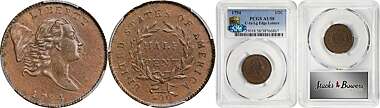
拍品 2003. 1794 Liberty Cap Half Cent. C-1a. Rarity-3. Normal Head. Large Edge Letters. AU-58 (PCGS). CAC. Manley Die State 3.0, Fuhrman Die State 2. Rich caramel hues dominate the patina of this exceptional Choice AU survivor. An ancient scratch follows the truncation of Liberty's portrait but the surfaces are otherwise free from notable marks. True friction is difficult to encounter and the overall complexion certainly teases at Mint State preservation. Intensely lustrous and glossy, with a pronounced rim of denticles surrounding each side.The 1794 is properly considered a distinct type within the half cent series, as even a casual comparison with the Small Head style of 1795 to 1797 will reveal a dramatic difference. It has been our experience that of all the half cent types, the 1794 is far and away the most difficult to obtain in high grades, handily eclipsing the even more famous 1793 Head Left, and by a large factor. Indeed, although the 1794 is not rare as a date in comparison to the famous 1793, all bets are off when it comes to pieces such as this, offering a combination of high grade, nicely preserved surfaces, and excellent eye appeal. Using these criteria, the 1794 Large Head type is the most difficult to obtain in the entire series. A type collector would be hard pressed to find a nicer example in a Choice AU holder, especially with approval by CAC.Copper supplies for the early Philadelphia Mint were from many different sources and the quality and purity of the metal varied. For 1794 the metal, after refining at the Mint, remained generally unsatisfactory, probably due to impurities and other unwanted elements, although we are not aware of any analysis that has ever been done. Not generally known is the fact that copper half cents and cents were usually profitable for the Mint to produce, as after the early years the amount of copper needed to make these coins was less than face value. This in contrast to the full or nearly full weight of metal required for silver and gold coins which, in any event, were struck at the request of bullion depositors and not on government account. From the Alan J. Harlan Collection. Earlier from our March 2020 Auction, lot 3091. The primary plate coin for the 1794 C-1a attribution in the 1998 Manley reference on half cent die states, p. 9. PCGS# 35018. BASE PCGS# 35015. NGC ID: 2223. PCGS Population (C-1a attribution only): 4; 3 finer (MS-64+ BN finest).CAC Stickered Population (all die marriages of the issue): 26 in all AU grades. Near-Mint State 1794 C-1a Half Cent The Manley Plate Coin
  • 起拍价:
    1 USD
    0 EUR
    0 GBP
    0 CHF

    仅取整数近似值日期: 2026/11/06
拍品
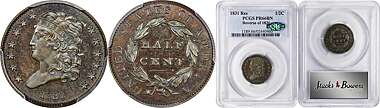
拍品 2004. 1831 Classic Head Half Cent. First Restrike. B-2. Rarity-5. Large Berries, Reverse of 1836. Proof-66 BN (PCGS). CAC. One of the finest examples of this rare date to survive from this early period at the Philadelphia Mint. The toning ranges through a blend of milk to dark chocolate, with satin smooth texture and a trace of original mint red near the rims, soft cobalt blue undertones discernible throughout with the aid of direct lighting. A strong loupe will reveal the stunning quality of the devices and fields, as they are both utterly free of signs of contact, and just as importantly spotting of any consequence. The strike is razor sharp throughout with each star showing full radial lines, and the hair curls on Liberty's portrait with the highest level of separation. On the reverse the leaves and lettering are also full and completely struck up by the die. The eye appeal is outstanding.According to the Guide Book, 2,200 half cents were struck in 1831, this despite a backlog of undistributed half cents from previous years' coinage. In truth, there is likely no such thing as a circulation strike 1831 half cent, though a few somewhat worn pieces have been certified, including the ESM Collection specimen in PCGS EF-45 and another in the Missouri Cabinet that was assigned a grade of AU-55 by PCGS. Instead, there are three varieties of Proofs that collectors can choose among to own an example of this date. Original 1831 half cents, struck in Proof finish in 1831, are extreme rarities, with perhaps a dozen known. The 1831 half cents with the reverse type of 1840 were coined much later, perhaps as late as the 1870s, and are also extremely rare. Just six are known. Most date collectors end up acquiring an example of the B-2 variety like this, if they ever find one at all. The 1831 First Restrikes use a reverse from 1836 and were likely coined in the late 1850s, when interest in numismatics in the United States first began to blossom. From the Alan J. Harlan Collection. Earlier from our Baltimore Auction of March 2011, lot 257; Legend Rare Coin Auctions' Regency Auction 30, January 2019, lot 1; Legend Rare Coin Auctions' Regency Auction 33, June 2019, lot 43. PCGS# 1189. NGC ID: 2237. PCGS Population: 2; 2 finer in this category (Proof-67 BN finest).CAC Stickered Population: 4; 0. Exceptional Gem Proof 1831 First Restrike Half Cent Reverse of 1836 Style
  • 起拍价:
    1 USD
    0 EUR
    0 GBP
    0 CHF

    仅取整数近似值日期: 2026/11/06
拍品
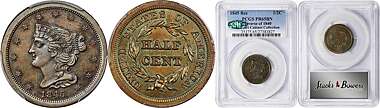
拍品 2005. 1845 Braided Hair Half Cent. Second Restrike. B-3. Rarity-6-. Small Berries, Reverse of 1840. Proof-65 BN (PCGS). CAC. An old friend of our firm which we (as Stack's) first handled via private treaty sale in 1969. Nearly six decades later, it remains one of the most outstanding survivors of this issue. Iridescent antique gold, powder blue and pinkish-apricot undertones light up otherwise olive- and walnut brown surfaces as the coin rotates into direct lighting. Incredibly sharp throughout and overall frosty, with subtle reflectivity dancing across the fields. Just a single example ranks finer at PCGS in the BN category, with few stickered by CAC at any grade level.Of the approximately two dozen extant Restrike Proof 1845 half cents, this piece is among the finest known. Hairlines and carbon spots limit most examples to grades of Proof-64 and lower, leaving Gem survivors like this Proof-65 specimen highly elusive. For collectors of early American copper, half cent enthusiasts, and specialists in early U.S. Mint Proof coinage, the significance of the present offering is irrefutable. From the Alan J. Harlan Collection. Earlier ex Philip M. Showers, 1969, privately via Stack's; Willis H. DuPont; Fred S. Werner, February 1976; Superior Stamp and Coin Co., February 1976; Joe Flynn and Son Rare Coins, April 20, 1976; R. Tettenhorst (Bernard Edison); Eric P. Newman Numismatic Education Society; Ira & Larry Goldberg's sale of the Missouri Cabinet, January 2014 Pre-Long Beach Auction, lot 174; Heritage's sale of the Poulos Family Collection, Part II, September 2019 Long Beach Signature Auction, lot 4591. PCGS# 35375. BASE PCGS# 1281. NGC ID: 26ZD. PCGS Population: 1; 1 finer in this category (Proof-66 BN).CAC Stickered Population (both die marriage of the Restrike Proof 1845): 2; 2. The Missouri Cabinet Proof 1845 B-3 Half Cent Second Restrike Here you can find the Video-Tour.
  • 起拍价:
    1 USD
    0 EUR
    0 GBP
    0 CHF

    仅取整数近似值日期: 2026/11/06
拍品
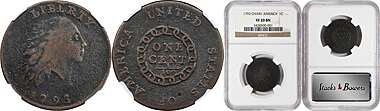
拍品 2006. 1793 Flowing Hair Cent. Chain Reverse. S-2, B-2. Rarity-4+. AMERICA, Without Periods. VF-20 BN (NGC). Breen Die State II. The otherwise charcoal-copper surfaces exhibit lighter golden-brown patina on most of the deign elements, the interplay between the two providing some semblance of a circulated cameo appearance. The sharpest features are the chain motif and denominations ONE CENT and 1/100, as usual for the type, but the legend UNITED STATES OF AMERICA, the word LIBERTY and the date are fully legible with most letters/digits suitably bold for the assigned grade. Liberty's portrait is a bit soft, yet fully outlined, and the details of her profile are crisp. The in-hand appearance is quite smooth for a mid-grade Chain cent, with no sizeable marks or other significant blemishes, although accuracy compels us to mention universal granularity in the fields, as well as a concentration of faint pin scratches on the portrait at central obverse. This is a pleasing VF for a challenging one-year design type from the early United States Mint, a coin that has much to offer both type collectors and early copper enthusiasts. PCGS# 1341. NGC ID: 223F. Classic VF 1793 Chain Cent Sheldon-2
  • 起拍价:
    1 USD
    0 EUR
    0 GBP
    0 CHF

    仅取整数近似值日期: 2026/11/06
拍品
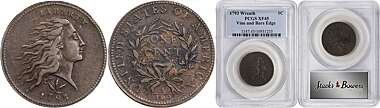
拍品 2007. 1793 Flowing Hair Cent. Wreath Reverse. S-8, B-13. Rarity-3. Vine and Bars Edge. EF-45 (PCGS). Breen Die State II. This overall boldly defined example has much to offer high grade collectors in both the type and early copper disciplines. The otherwise evenly toned olive and tobacco brown surfaces exhibit an irregular swirl of deeper charcoal color near the center of the reverse. Nicely centered on the obverse, the reverse impression is off center to 1 o'clock, although the beading is essentially complete all the way around the border. Close inspection with a loupe reveals just a hint of microroughness, to no detriment, and there are no flan flaws or sizeable marks to detract from a pleasing smooth in-hand appearance.Historically 1793 large cents have been one of the most coveted of collector coins. These impressive copper pieces were the first coins the new Philadelphia Mint issued in quantity as coinage first began in the United States. The first cents display the Flowing Hair, Chain Reverse motif launched on March 1, 1793 with 36,101 coins struck of that type before public outcry over the design forced a change in mid 1793 to an entirely new design. This is when the 1793 Wreath cents were launched, with the output reaching 63,353 pieces before the public cried out once again and a third revision to the large cent design was undertaken late that year. The resulting Liberty Cap design proved more agreeable to contemporary Americans than its Chain Reverse and Wreath Reverse predecessors with coinage of that design type lasting into 1796.Sheldon-8 is one of the more frequently encountered die marriages of the 1793 Wreath cent, Walter Breen (Encyclopedia of United States Large Cents: 1793-1814, 2000) asserting that production of this variety was included among the 6,112 cents that the Mint delivered on April 13, 1793. This variety is most readily identifiable by the curved stem in the sprig that parallels the date on the obverse and the heavy, triangular bow at the base of the wreath on the reverse. As a one year design type from the first year of U.S. large cent production, of course, all 1793 Wreath cents are scarce to rare from a market availability standpoint. As an attractive PCGS-certified Choice Extremely Fine survivor the present example is destined to perform well at auction. From the Alan J. Harlan Collection. Earlier from Heritage's sale of the Kerry Rudin Collection, January 2018 FUN Signature Auction, lot 4739; Heritage's CSNS Signature Auction of May 2023, lot 3010; Heritage's Long Beach/Summer FUN Signature Auction of July 2023, lot 3008. PCGS# 1347. NGC ID: 223H. Nice Choice EF 1793 Sheldon-8 Cent
  • 起拍价:
    1 USD
    0 EUR
    0 GBP
    0 CHF

    仅取整数近似值日期: 2026/11/06
拍品
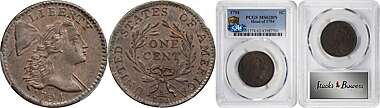
拍品 2008. 1794 Liberty Cap Cent. S-59, B-57. Rarity-3. Head of 1794. MS-62 BN (PCGS). CAC. Breen Die State V, Heck DS6. Offered is one of the finest, best known survivors from the 1794 Sheldon-59 dies. It is a frosty, hard, generally tight example with light olive tinting to otherwise tan-brown patina. Hints of pale pink from faded down mint color are discernible here and there around and within many of the design elements, more prominently on the reverse. The strike is nicely centered and sharply executed for all major design elements, both sides free of wear to readily uphold the validity of the PCGS-assigned, CAC-endorsed grade. There are some blemishes, nonetheless, and these include a thin, meandering planchet fissure from behind Liberty's eye down into the cheek, an even thinner fissure behind the bottom of the cap, a few planchet voids in the date area, and a tiny, dull nick in the field off Liberty's nose. Earlier catalogers referenced a few shallow rim bruises on both sides - these are barely perceptible through the PCGS holder, which is helped by the fact that a few of these have been lightly smoothed to improve the already overall strong eye appeal of this coin. Bill Noyes assigned an EAC grade of AU55, net VF30 for this piece, and ranks it tied for CC#10 in his census; Del Bland calls it EAC AU55, net EF40, tied for CC#5. Ex our (Bowers & Ruddy's) sale of the Kensington Collection, December 1975, lot 407; Julian Leidman; Robert L. Hughes Enterprises; our (Bowers & Ruddy's) River Oaks and C.W. Krugjohann, Part II Collections sale, November 1976, lot 407; Robert L. Hughes Enterprises' Pacific Collection sale, February 1978, lot 56; Robert L. Hughes Enterprises; Anthony J. Terranova; our (Stack's) sale of the Magnificent Herman Halpern Collection of United States Large Cents, March 1988, lot 81; Julian Leidman; Heritage's 1988 A.N.A. Auction, July, lot 48; Andrew P. Lustig; our (Stack's) sale of January 1989, lot 235; Andrew P. Lustig; Mid-American Rare Coin Auctions' 1989 G.N.A. Sale, May, lot 6; Martin Paul (The Rarities Group); Superior's Jascha Heifetz Collection sale, October 1989, lot 3424; Martin Paul (The Rarities Group); unknown intermediary/intermediaries; Heritage's Atlanta Signature Sale of March 1995, lot 5011; Superior's New York ANA Sale of August 2002, lot 209; Superior's Pre-Long Beach Elite Coin Auction of May 2003, lot 382; COL Steven K. Ellsworth; Heritage's sale of the COL Steven Ellsworth Collection of U.S. Large Cents 1793-1796, January 2026 FUN Signature Auction, lot 2064. PCGS# 901374. NGC ID: 223M. Famous 1794 S-59 Cent
  • 起拍价:
    1 USD
    0 EUR
    0 GBP
    0 CHF

    仅取整数近似值日期: 2026/11/06
拍品
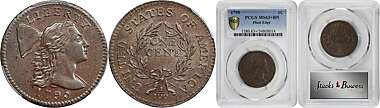
拍品 2009. 1795 Liberty Cap Cent. S-76b, B-4b. Rarity-1. Plain Edge. MS-63+ BN (PCGS). Breen Die State V. This 1795 cent offers simply outstanding quality and eye appeal for a Liberty Cap cent irrespective of date or variety. Both sides are ideally centered on the planchet with essentially complete denticulation around both sides, although it is soft in areas, including at upper obverse, upper left and lower reverse. Warm medium brown patina dominates, although we do note glints of faded mint orange color on both sides that are appreciable with the aid of direct lighting. This impressively smooth coin offers great eye appeal and will be just right for an advanced cabinet.Sheldon-76b is the most available variety in the entire Liberty Cap cent series of 1793 to 1796. It is likely the first cent struck to Mint Director Elias Boudinot's reduced weight standard of 10.89 grams approved by President Washington on December 27, 1795. According to numismatic researcher R.W. Julian, approximately half of the 501,500 Plain Edge cents of the 1795 date were struck on planchets cut from sheet copper purchased from various sources. The initial delivery for the issue, 20,000 coins struck on December 27 and probably all of the S-76b variety, are on blanks cut from John Anthony's shipment received in the Mint the previous day. Coinage of 1795-dated Plain Edge examples continued through March 12, 1796, using both rolled copper sheets and planchets made from remelted clippings. The former are usually of much higher quality and free of significant planchet defects, as here.While a number of Mint State S-76b cents have survived, they are rare in an absolute sense and hold tremendous appeal for high grade type and variety purposes. The present example is among the finest that we have had the privilege of bringing to auction. From the Alan J. Harlan Collection. PCGS# 1380. NGC ID: 223T. PCGS Population (all attributions of the Plain Edge variety): 3; 12 finer in this category (MS-66 BN finest). Gorgeous Mint State Liberty Cap Cent 1795 S-76b with Plain Edge
  • 起拍价:
    1 USD
    0 EUR
    0 GBP
    0 CHF

    仅取整数近似值日期: 2026/11/06
拍品
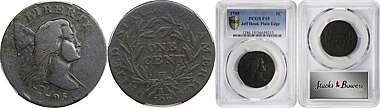
拍品 2010. 1795 Liberty Cap Cent. S-80, B-11b. Rarity-5-. Jefferson Head, Plain Edge. Fine-15 (PCGS). An inviting example of this enigmatic rarity from the early large cent series. Deep copper-rose patina blankets both sides, the detail of which is bold for the grade apart from minor softness along the upper and lower right reverse border. The surfaces are uniformly microporous with light olive-russet encrustation that is largely confined to the protected areas around the devices. There are few sizeable marks, however, a few shallow scuffs at the digit 1 in the date and a tiny void on the liberty cap being the most useful identifying features.This variety was coined outside the United States Mint by John Harper in an attempt to win a private coining contract. Harper's name is well known to numismatists, as his humble saw shop (sometimes mistakenly called a "cellar") is thought to have been where the first 1792 half dismes were struck, standing in for the still-unfinished United States Mint building nearby. Harper's talents as a blacksmith and machinist were well known to the Mint when Elias Boudinot, then a congressman, sought advice from Mint assayer Albion Cox on how to improve the Mint's processes and production. Cox recommended he talk to "John Harper, now very extensively in the saw-making business near the iron works at Trenton." According to Pete Smith, Joel J. Orosz, and Leonard Augsburger in the book 1792: Birth of a Nation's Coinage, Harper "visited the Mint on January 23, 1795, and suggested improvements but [Director David] Rittenhouse and the staff of the Mint were not impressed." Rittenhouse resigned the following June, followed in the director's office by Henry deSaussure, who lasted until just October. The next Mint director was Elias Boudinot. Harper reached out to Boudinot almost immediately after his appointment and, attempting to display what he could do, Harper made dies and struck the coins that we today call Jefferson Head cents. Elias Boudinot reported to Congress on Harper's work on February 3, 1796. A few weeks later, according to Smith et al.:Without Congressional authority, Harper produced dies, built a press, and invited the committee [of the House of Representatives] to observe his ability to produce cents faster and more efficiently than the Mint. The committee was impressed and dug into their own pockets to reimburse Harper for the copper used. Perhaps they took home a few of his cents as mementos.It made Boudinot nervous that Harper had dies that looked so much like federal cents, so he informed Congress that when he "found the dies used by the memorialist [Harper] still in his possession and conceiving this to be very improper [he] took them into the Mint." When he realized that he had no power to reimburse Harper for the dies or his other labors, Boudinot offered him a job as assistant coiner. Harper declined.Within 70 years, Harper's cents were valuable collectibles. The origin of the name is unknown. The first reference to the "Jefferson Head" of which we are aware is Edward Cogan's sale of June 1864, where one was listed under the heading of "Fabrications." The desirability of the "Jefferson Head" cents is noted in W. Elliot Woodward's sale of October of that same year, where lot 617 was described as "1795 Sometimes called the Jefferson Head, in rather poor condition but an extremely rare type." If Cogan could simply call it a "Jefferson Head" and Woodward could use the same name just a few months later, it implies that the name was enough in use that bidders would recognize what was being described.By the 20th century, the Jefferson Head cent was revered as a distinctive rarity in the early copper series. Initially dismissed as a counterfeit intended for circulation, Walter Breen appears to have been the first to make the connection between these cents and John Harper's experiment. Nearly all surviving specimens are heavily circulated, and many are impaired. Three varieties are known: Sheldon-80, as here, with a plain edge; 1795 NC-1, with a different reverse die and a lettered edge; and 1795 NC-4, from the same dies as Sheldon-80 but with a lettered edge. Among the three varieties, not a single example exceeds Very Fine and, indeed, survivors are highly prized regardless of level of preservation. The present example would certainly serve as a centerpiece in an advanced numismatic cabinet. Property from an Alabama Family. Earlier from our sale of the Collection of Thaddeus A. Tatum III, August 2018 ANA Auction, lot 1024. PCGS# 1386. NGC ID: 2722. Intriguing 1795 Jefferson Head Cent Rarity
  • 起拍价:
    1 USD
    0 EUR
    0 GBP
    0 CHF

    仅取整数近似值日期: 2026/11/06
拍品
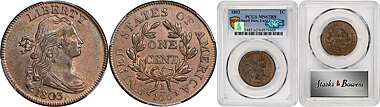
拍品 2011. 1803 Draped Bust Cent. S-258, B-17. Rarity-1. Small Date, Large Fraction. MS-62 BN (PCGS). CAC. CMQ. Breen Die State II. A superior example of the type, issue and die pairing. We note an abundance of mint color on both sides, nicely faded down to autumn-orange, with deeper steel-brown toning on the obverse over and behind much of Liberty's portrait. The strike is well centered and, while a bit soft throughout the wreath on the reverse, offers bold to sharp definition elsewhere. A bit of light carbon on Liberty's neck, within the hair curls behind the cheek and at the digit 0 in the date is noted, but the in-hand appearance is exceptionally smooth and well composed for the assigned grade.The mintage of 3,131,691 coins that the Guide Book provides for the 1803 Draped Bust cent corresponds to the Mint's deliveries for this denomination during calendar year 1803 - 2,471,353 coins - plus all but 96,500 of the 756,838 cents (660,338) delivered during calendar year 1804. While many 1803-dated cents were certainly struck during calendar year 1804 (and possibly as late as 1806), the mintage of this issue remains an estimate since we do not know exactly how many 1804-dated cents were struck, or even when all of those coins were produced (they may also have been delivered during calendar year 1805, possibly even 1806).Sheldon-258 is one of the varieties of the 1803-dated cent issue that Breen believes may have been delivered during calendar year 1804. A popular die pairing for type purposes, not only are circulated examples plentiful, but enough Mint State coins are extant to suggest that a small hoard existed at one time. If so, the coins have long since been widely dispersed, for market appearances are usually few and far between, certainly not frequent enough to meet demand from high grade type collectors and advanced early copper enthusiasts. PCGS# 1485. NGC ID: 224G. CAC Stickered Population: 5; 10. Premium Mint State 1803 Sheldon-258 Cent
  • 起拍价:
    1 USD
    0 EUR
    0 GBP
    0 CHF

    仅取整数近似值日期: 2026/11/06
拍品
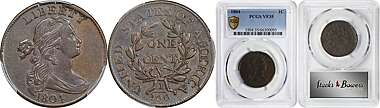
拍品 2012. 1804 Draped Bust Cent. S-266, B-1. Rarity-2. VF-35 (PCGS). Breen Die State IV. Many 1804 large cents have come down to today's collecting community in well-worn grades or with heavy surface roughness or other problems, but we are pleased to report the present example of this highly desirable key date issue is essentially problem free to the unaided eye. In fact, there are no marks, spots, or other blemishes worthy of concern, and those trivial ones that are present are well within the context of the assigned grade. The color is pleasing, generally medium steely-olive brown with faded down mint color in the right obverse field. Upper reverse a bit soft, although the words STATES OF are still legible, otherwise we note universally bold detail for the assigned grade.The scarcity of 1804-dated cents relative to most other issues in the Draped Bust series has led numismatists to theorize that most of the coins struck during calendar year 1804 were from 1803-dated dies. This is probably true, although the mintage of 96,500 coins for the 1804-dated issue provided in many numismatic references is also conjecture and based on Breen's assumption that the final delivery of the year - on December 31 - represents the Mint's only delivery from the 1804-dated die pairing. There is no documentary evidence to support this mintage and, indeed, it is listed in italics in the Guide Book to denote that it is an estimate. Some or all 1804-dated cents may have even been struck during calendar year 1805, and possibly even in 1806.Cents of 1804 have long been famous, and perceptions of the issue's rarity date to the 1840s, if not earlier. In 1841 James Morris, a storekeeper in Morgantown, Pennsylvania, recorded that he had "put away...a collection of cents beginning at 1793 and from thence to 1841 inclusive excepting only those of 1804 and 1815." Morris did not know that no such thing as an 1815 cent existed. For as rarely as they came over his store counter, 1804 cents might as well have not existed either, despite the fact that his business was located only 40 or so miles west of the Mint in Philadelphia. Morris was both a coin collector and an avid diarist. Though his numismatic activities have attracted little attention, Morris' diary is famous for one reason: it records the first observance of Groundhog Day known in the United States.By the late 1850s, when numismatics in the United States experienced its first great surge in popularity, the perceived rarity of the 1804 cent had become so entrenched that a privately produced "restrike" was made to satisfy collector demand. The dies that produced this so-called "restrike" were initially used at the Philadelphia Mint to produce the obverse of 1803 Sheldon-261 and the reverse of 1820 Newcomb-12. They were found on the location of the First Philadelphia Mint "among general rubbish when the basement was cleaned" years after the Mint's 1833 departure from the site, probably in the mid 1850s according to a recollection published in the December 1910 issue of The Numismatist. These "restrikes," attributed as Breen-1761 in the author's Encyclopedia, were struck privately circa 1860, are not products of the United States Mint, and bear no relation to the regular issue 1804 cent. They remain popular, nonetheless, and are avidly collected today alongside the Draped Bust cent series.Interest in the regular issue 1804 cent continued to grow throughout the late 19th century and, by the 1880s, numismatists had confirmed that the single die marriage of the issue came in three die states. That discovery is credited to David U. Proskey in the January 1881 installment of his "Coins of the United States" in The Coin Collector's Journal, the house organ of Scott Stamp and Coin Company. Proskey, considered the most knowledgeable cent specialist of his generation, correctly noted, "The pair of dies just described were new and the only dies from which cents were struck during 1804, and owing to both breaking, they were not used in any succeeding year." The familiar nomenclature attached to the die states of 1804 cents - Sheldon-266a, 266b, 266c - was introduced later, however, specifically in Charles McGirk's large cent attribution guide, published serially in The Numismatist in 1913 and 1914. McGirk's system forced collectors to measure spatial relationships and then check them against a columnar chart, dooming it to failure from the start. Perhaps the only relic of McGirk's system is the aforementioned description of 1804 cents as S-266a, 266b, or 266c. McGirk 1804 1A was the unbroken early die state, 1804 1B represented the scarce state with an obverse die break but no reverse die break, and 1804 1C referred to the state with breaks on both sides, as seen on the present example.The fame and popularity of the 1804 cent continues the grow in the modern numismatic market, where it is firmly entrenched as a key date Draped Bust cent. At least part of the appeal of the 1804 cent stems from its association by date with some other key date issues from the early United States Mint, including both Guide Book varieties of the 1804 dime, the 1804 quarter and, most famously, the "King of American Coins," the 1804-dated dollar. Although much more is known about the 1804 cent today than when James Morris made his diary entry in 1841, the rarity is still sometimes exaggerated by overzealous catalogers and other numismatic writers. With upward of 1,000 coins extant in all grades, Sheldon-266 is not a rare die marriage in an absolute sense. Since it is the only one known for the date, however, an extant population of 1,000 coins or so confirms the scarcity of the 1804, especially when compared to most others in the Draped Bust cent series. From the American Legacy Collection. PCGS# 1504. NGC ID: 224H. Eagerly Sought 1804 Cent Here you can find the Video-Tour.
  • 起拍价:
    1 USD
    0 EUR
    0 GBP
    0 CHF

    仅取整数近似值日期: 2026/11/06
拍品
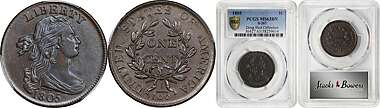
拍品 2013. 1805 Draped Bust Cent. S-267, B-1. Rarity-1. MS-63 BN (PCGS). Breen Die State III, with clash marks on each side, faint reverse die cracks, and flowlines drawing the peripheral detail towards the rims. An alluring specimen with lustrous, deep brown surfaces and overtones of silver-blue and light olive. Frosty flowline luster covers the fields and imparts outstanding eye appeal. Only microscopic contact marks can be found, including a few over and around Liberty's chin, although none distract the naked eye. The toning is quite even and attractive overall, mottled undertones of reddish-tan are noted on the portrait and near the borders. Nicely struck for the date and variety with excellent definition throughout the entire portrait and only modest weakness on the upper leaves of the wreath, an unavoidable characteristic of this date.This is a lovely example at the MS-63 grade level, prefect for inclusion in a high grade date or variety set. The fine, old provenance only adds to the desirability, conveying the appreciation that many generations of numismatists have had for this impressive 1805 cent. From the Alan J. Harlan Collection. Earlier from S.H. & H. Chapman's sale of the M.A. Brown Collection, April 1897, lot 806; S.H. & H. Chapman; Henry Chapman's sale of the Allison W. Jackman Collection, June 1918, lot 721; Wayte Raymond; Charles J. DuPont; our (Stack's) Anderson-DuPont Catalogue, Part I, September 1954, lot 486; our (Stack's) sale of the TAD Collection, February 1976, lot 75; Larry Whitlow; New England Rare Coin Auctions' November 1978 sale, lot 51; Wayne Rattray, December 1982; Doug Bird; Ira & Larry Goldberg's sale of the Doug Bird Collection, February 2020, lot 119; our March 2021 Auction, lot 4020. PCGS# 36427. BASE PCGS# 1510. NGC ID: 224K. Choice Mint State 1805 Cent Provenance to 1897 Here you can find the Video-Tour.
  • 起拍价:
    1 USD
    0 EUR
    0 GBP
    0 CHF

    仅取整数近似值日期: 2026/11/06
拍品
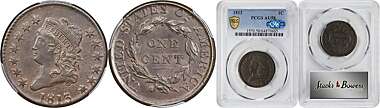
拍品 2014. 1813 Classic Head Cent. S-292, B-2. Rarity-2. AU-58 (PCGS). CAC. Breen Die State V. Deep walnut and olive-brown patina with a slightly glossy appearance. The obverse is struck off center to the 5 o'clock position, not unusual for the date or variety, with the border at lower right engaging the date digits and stars 12 and 13. Reverse better centered, both sides with peripheral softness due to advanced die fatigue. The central devices are boldly defined for the die state and grade, surfaces nicely composed with no marks or other blemishes of note.The 1813 Classic Head has always been considered a semi-key date, perhaps not comparable to the 1799, 1804, or 1793, but certainly among the more challenging cents to find for a date collector. As with some of the other Classic Head dates, condition sensitivity and planchet issues are also a concern for 1813. Breen speculates that some of the planchets used for the 1813 S-292 and S-293 varieties may have been damaged by bilge water and/or salt spray during transit from England to America. If so, the casks containing the planchets eventually used for the 1812 and 1814 issues - all of which were in the same shipment from Boulton - were not affected to the same degree since they are seen less frequently than the 1813 with pitted or similarly impaired surfaces.The offered example, with coveted CAC endorsement at the PCGS AU-58 grade level - is a pleasant exception to the trend of flawed examples of the date. It is worthy of a premium bid. PCGS# 1570. NGC ID: 224X. CAC Stickered Population (both die marriages of the issue): 11 in all AU grades. Pleasing Choice AU 1813 Cent Sheldon-292
  • 起拍价:
    1 USD
    0 EUR
    0 GBP
    0 CHF

    仅取整数近似值日期: 2026/11/06
拍品
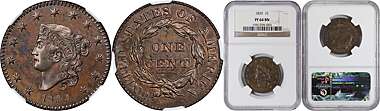
拍品 2015. 1829 Matron Head Cent. N-6. Rarity-7- as an Unbronzed Proof. Large Letters. Proof-64 BN (NGC). Noyes Die State A/A. Deep olive and warmer autumn-orange patina is mottled over both sides of this handsomely original piece. Direct lightly calls forth hints of original pinkish-red mint color that are most pronounced in the protected areas around many of the design elements on the reverse. A trivial spot is noted at the bridge of Liberty's nose, just a little ways above the tip. There are few identifiers beyond this, other than what is seen in the distinctive toning pattern. A well made cent, sharply struck in most areas, but a tad at the stars along the upper obverse border and within the wreath at lower right. The former is the same softness seen on the uppermost stars on other Proofs of this die pairing. Nicely aligned on the planchet, with even dentils that are well defined all around. Soft reflectivity in the fields, while the devices are frosty and lustrous.PCGS estimates that just 10 or so examples of the Bronzed Proof 1829 cents are known. Denis Loring's list of known Proof examples for the date includes about seven different coins without the bronzed finish, with several old appearances that have yet to be attached to known coins and may or may not be in addition. The number of references suggests that the unbronzed coins are more common, but the appearances in the market suggest otherwise, as does the PCGS population data. Our expectation is that further research will prove both finishes to be about equal in rarity, but perhaps favoring the finish offered here. This is our first offering for a Proof 1829 cent since our March-April 2017 Pogue V sale, which included a bronzed specimen, and our first offering for an unbronzed example since our July 2015 sale of the Twin Leaf coin in PCGS Proof-64 BN. From the Alan J. Harlan Collection. Earlier from Heritage's CSNS Signature Auction of April 2011, lot 5022. PCGS# 407648. NGC ID: 272C. Proof 1829 Large Cent Rarity Newcomb-6Without Bronzed Finish
  • 起拍价:
    1 USD
    0 EUR
    0 GBP
    0 CHF

    仅取整数近似值日期: 2026/11/06
拍品
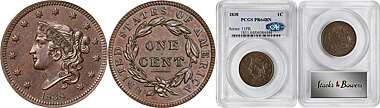
拍品 2016. 1838 Modified Matron Head Cent. N-11, 13. Rarity-6- as a Proof. Proof-64 BN (PCGS). CAC. Noyes Die State A/A. An endearing Proof with softly reflective mirrors in the fields of both sides that give the piece a jewel-like aesthetic quality. The central devices stand out nicely from the fields with bold strike detail and a lightly frosted finish. The portrait also has an extensive series of sharp die finishing lines over much of the neck and face. Both sides are awash with warm autumn-orange and olive-brown toning with subtle iridescent undertones of pink and blue.This is the final year from which Middle Date Proofs are known, and there was seemingly a flurry of production, all from one die pair. Howard Newcomb reported that the N-8 variety included "Brilliant Proofs," but Walter Breen questioned that, and none is known today. Breen included a single "N-1" as ex "Miller:922," based on Tom Elder's cataloging of the coin as "A.1," but that is the Twin Leaf N-11 that appeared in our July 2015 Baltimore Auction. Breen listed 10 specimens of the N-11, and estimated that the number known was likely closer to 12 than to the previously thought eight. Today, closer to two dozen have been confirmed than to one dozen. Still, all Proof large cents are rare and this one is no exception. From the Alan J. Harlan Collection. Earlier from Superior's Pre-Long Beach Auction of September 2008, lot 67; Ira & Larry Goldberg's Pre-Long Beach Auction of February 2009, lot 714; Heritage's sale of the Gibney Family Collection, April 2021 CSNS Signature Auction, lot 4979. PCGS# 1811. NGC ID: 272M. PCGS Population: 3; 3 finer in this category (Proof-65+ BN finest). Seldom Offered Proof 1838 Cent Newcomb-11
  • 起拍价:
    1 USD
    0 EUR
    0 GBP
    0 CHF

    仅取整数近似值日期: 2026/11/06
拍品
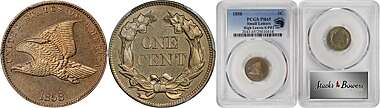
拍品 2017. 1858 Flying Eagle Cent. Snow-PR1. Small Letters, High Leaves (Style of 1857), Type I. Proof-65 (PCGS). Eagle Eye Photo Seal. This Proof is one of only a handful of survivors from the Snow-PR1 die marriage of the 1858 Small Letters cent, an issue that is also rare in an absolute sense. It is a lovely Gem specimen, with wisps of pale blue-gray patina on a base of warm tan-olive color, the entire package backlit by iridescent pinkish-apricot and antique gold. The fields are semi-reflective and the devices have a softly frosted texture. The strike is razor sharp and the visual appeal is outstanding.Although the Small Letters variant of the 1858 Flying Eagle cent is most readily attributable by the separation between the bases of the letters AM in AMERICA, the entire design is actually in lower relief than its 1858 Large Letters counterpart. This modification could have been carried out by Engraver James Barton Longacre or Assistant Engraver Anthony C. Paquet; Rick Snow (2014) favors the latter. The lettering in the legend UNITED STATES OF AMERICA on Small Letters examples matches the style seen on the 1859 James Ross Snowden Mint medal prepared by Paquet.Proof 1858 Small Letters cents are underrated rarities, especially when compared to the more highly publicized Proof 1856 Flying Eagle cents. Whereas restrikes from the 1858 to 1860 era swelled the total number of Proof 1856 small cents produced to approximately 1,500, the Proof 1858 Small Letters has a mintage that Snow estimates at just 120 pieces. Survivors are elusive and market appearances are usually few and far between.Both Snow and Q. David Bowers suggest that the Mint may have initially prepared the Small Letters variety as a pattern, placing it into regular issue production alongside its Large Letters counterpart after the modified design was found acceptable. Snow has identified four die marriages of the Proof 1858 Small Letters cent, and he has also assigned the PR1 variety an alternate attribution of PT10 in deference to the issue's possible status as a pattern. Of this variety the author also states, "These could have been issued in very limited quantities to persons requesting proof year sets prior to the issuance of the pattern sets." With only 10 to 20 specimens believed extant, Snow-PR1 is one of the rarer varieties of the Proof 1858 Small Letters cent, the issue itself a notable rarity with an estimated mintage of just 120 coins from all die pairings. As one of the most significant Proof Flying Eagle cents of any date or variety that we have brought to auction in recent years, here is an important opportunity for advanced collectors. From the Alan J. Harlan Collection. PCGS# 926671. BASE PCGS# 2043. NGC ID: 227D. PCGS Population: 11; 4 finer in this category (Proof-66+ finest). Very Significant Proof 1858 Small Letters Cent
  • 起拍价:
    1 USD
    0 EUR
    0 GBP
    0 CHF

    仅取整数近似值日期: 2026/11/06
拍品
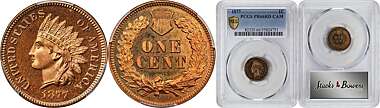
拍品 2018. 1877 Indian Cent. Snow-PR3. Proof-66 RD Cameo (PCGS). This is an incredible strike and condition rarity that will nicely represent this eagerly sought issue in the Proof Indian cent series. Both sides are wonderfully original with vivid color. The obverse displays even rose-orange and the reverse exhibits a medium orange and olive with hints of silvery tinting. Otherwise highly reflective in finish, a soft satin texture to the devices provides appreciable cameo contrast. The strike is full and the surfaces are silky smooth and virtually pristine.With a mintage of 852,500 pieces and a low rate of survival in high grades, the circulation strike 1877 is the key date in the Indian cent series. Consequently, survivors of the year's Proof mintage enjoy heightened demand. The United Sates Mint did not begin recording the number of Proof minor coins struck each year until 1878, so there is no way of knowing exactly how many Proof cents were produced in 1877. In his 1977 Encyclopedia of U.S. and Colonial Proof Coins, Walter Breen estimated the mintage of the 1877 at 510+ pieces, but more recent research by R.W. Julian confirmed that Breen's figure represented only the total number of silver and minor coin Proof sets sold. According to Rick Snow (2014), a more accurate estimate for the distribution of this issue is 910 coins, which takes into account the fact that the Mint also sold at least 400 minor coin Proof sets that year. It is thought that upward of 1,500 Proof 1877 cents were actually struck, the unsold pieces destroyed in the Mint.The 1877 Proof cent commands a significant premium in all grades due to the rarity of the circulation strike 1877 in Mint State. On the other hand, most Proofs are in lower grades through Proof-64 RB. The present full Red Cameo Gem is a significant strike and condition rarity in its own right and numbers among the finest examples of the date available. PCGS# 82320. NGC ID: 229W. PCGS Population: 4; 0 finer in this category. There are no grading events reported in the PCGS DCAM category. Extraordinary Gem Proof 1877 Indian Cent None Graded Finer by PCGS in the CAM Category
  • 起拍价:
    1 USD
    0 EUR
    0 GBP
    0 CHF

    仅取整数近似值日期: 2026/11/06
拍品
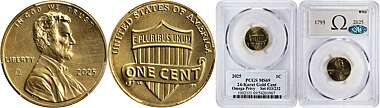
拍品 2019. Omega Privy Mark 2025 Lincoln Cents Three-Coin Set. The Last Circulating Cents. Set Number 33 of 232. (PCGS). All examples are individually graded and encapsulated by PCGS, as follows:-2025 24 Karat Gold Cent. Omega Privy Mark. MS-69 (PCGS). CAC.-2025 Circulating Cent. Omega Privy Mark. MS-64 RD (PCGS).-2025-D Circulating Cent. Omega Privy Mark. MS-65 RD (PCGS). CAC.This set is one of just 232 produced by the United States Mint to mark the end of the circulating one-cent coin, all of which were featured in our special December 2025 Auction - The Very Last Omega Pennies Including the 24 Karat Gold Penny sold on behalf of The United States Mint. This set was offered as lot 10033, and it realized $52,500 during a session marked by intense collector interest and bidder competition. Since many bidders went home empty handed and disappointed as a result, the second chance represented by the unexpectedly early return to market of set #33 offered here is a fleeting one that deserves the utmost in bidder attention. This is one of the sets submitted to CAC after our December 2025 Auction event, with two of the coins securing CAC approval at their PCGS-assigned grades, enhancing its desirability this second time around.This lot does not include the original U.S. Mint Certificate of Authenticity for set 033 of 232.(Total: 3 coins) From our December 2025 Auction - The Very Last Omega Pennies Including the 24 Karat Gold Penny sold on behalf of The United States Mint, lot 10033, where it realized $52,500. The Historic Omega Privy Mark 2025 Lincoln CentsIncluding the 24 Karat Gold Cent Set Number 33 of Only 232 Three-Coin Sets ProducedThe Capstone to a Legacy Spanning Two Centuries
  • 起拍价:
    1 USD
    0 EUR
    0 GBP
    0 CHF

    仅取整数近似值日期: 2026/11/06
拍品
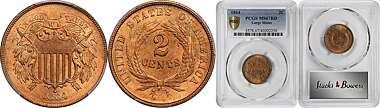
拍品 2020. 1864 Two-Cent Piece. Large Motto. MS-67 RD (PCGS). Fiery orange-red surfaces are boldly lustrous and betray only the most delicate iridescent pink and olive highlights. Well struck up, the details are crisp and the surfaces smooth to remain free of detracting blemishes.The two-cent piece made its debut in 1864 at a time when gold and silver coinage had long since been absent from circulation in the Eastern and Midwestern states due to the economic turmoil and uncertainty brought about by the Civil War. Struck in bronze, the new denomination was not subject to hoarding and, as such, initially proved popular in commercial channels. Mintages were correspondingly high in 1864 and 1865, but with the end of the Civil War in the latter year, production fell off rapidly through the series' end in 1873. The 1864 Lage Motto is the most plentiful issue in this series, and also as a first year issue it is understandably popular for type purposes. Enough were saved at the time and subsequently preserved with enough care that even full Red Gems in MS-65 are easily obtained under normal market conditions. The same cannot be said of coins at the MS-67 RD level, however, for the awe-inspiring Superb Gem offered here is one of the six finest known to PCGS. A phenomenal condition rarity set for inclusion in the finest type set of classic U.S. Mint coinage. Property of a Texas Gentleman. PCGS# 3578. NGC ID: 22N9. PCGS Population: 6; 0 finer. Phenomenal 1864 Two-Cent Piece PCGS MS-67 RD with a Pop of 6/0
  • 起拍价:
    1 USD
    0 EUR
    0 GBP
    0 CHF

    仅取整数近似值日期: 2026/11/06
拍品
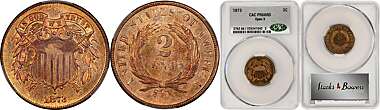
拍品 2021. 1873 Two-Cent Piece. Open 3. Proof-66 RD (CACG). A breathtakingly beautiful example of this scarce and enigmatic issue. Both sides are dressed in original mint orange color with soft olive undertones and, on the reverse, delicate silvery highlights. Fully defined from the rims to the centers with a smooth, virtually pristine mint finish that combines subtly reflective fields with softly frosted motifs.This is the more elusive of the two date logotypes of the final year Proof-only 1873 two-cent piece, survivors approximately two and a half times rarer than their Close 3 counterparts. Traditional numismatic wisdom has it that the Close 3 examples are originals and the Open 3 specimens restrikes, although there is no documentary evidence to support this theory. The Open 3 is a significant condition rarity above the Proof-65 level of preservation, the premium Gem offered here is of further desirability given the fully original mint color that it retains. It is one of the two finest full Red specimens evaluated by CACG and is sure to see spirited bidding among astute collectors. PCGS# 3656. NGC ID: 2754. CACG Population: 2; 0 graded higher in this category. Premium Gem Full Red Proof 1873 Open 3 Two-Cent Piece
  • 起拍价:
    1 USD
    0 EUR
    0 GBP
    0 CHF

    仅取整数近似值日期: 2026/11/06
拍品
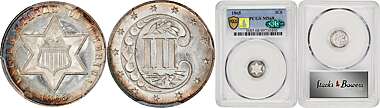
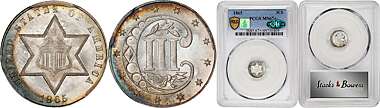
拍品 2022. 1865 Silver Three-Cent Piece. MS-68 (PCGS). CAC. CMQ-X. A significant condition rarity for both the issue and type that boasts virtually pristine surfaces and wonderful originality. This exquisite Ultra Gem in PCGS/CAC MS-68 is silky smooth in texture with hardly even a single detracting blemish. The fields are decidedly semi-reflective and host clash marks (as made), which are present on most examples of the issue with which we are familiar and suggest early clashing of the dies. Satiny and fully impressed, the devices are set apart in a manner that provides some semblance of cameo contrast as the coin dips into a light. Otherwise brilliant, blushes of reddish-gold and powder blue iridescence engage the peripheries, more so on the obverse. To see this coin is to admire it for both its exceptional eye appeal and awesome technical quality.The trend of limited circulation strike silver three-cent issues that began early in the Civil War reached a low for the era of 8,000 pieces in 1865. Survivors are elusive even in worn condition, while Mint State examples are scarce to rare in all grades. Near the pinnacle of numismatic preservation, this pristine-looking beauty is of the utmost desirability. A stellar-quality type coin, and a significant condition rarity for the issue as well as the silver three-cent series in its entirety, the fleeting nature of this offering can hardly be overstated. PCGS# 3685. NGC ID: 22ZF. PCGS Population: 5; 3 finer (MS-69 finest).CAC Stickered Population: 5; 1. Breathtaking 1865 Three-Cent Silver High Condition Census PCGS/CAC MS-68 Grade
  • 起拍价:
    1 USD
    0 EUR
    0 GBP
    0 CHF

    仅取整数近似值日期: 2026/11/06
拍品
拍品 2023. 1865 Silver Three-Cent Piece. MS-67+ (PCGS). CAC. CMQ. Our multiple offerings for high grade examples in recent sales should not obscure the fact that the circulation strike 1865 silver three-cent piece is traditionally a highly elusive Civil War era issue. Indeed, the present Superb Gem is a Condition Census survivor from a scant mintage of 8,000 circulation strikes. It is also a breathtakingly beautiful coin with intense frosty to semi-reflective luster on smooth, predominantly brilliant surfaces. Peripheral toning is noted, however, and it takes the form of lovely steel-blue and reddish-gold halos that are bolder on the obverse. Fully struck and virtually pristine, this is an advanced type coin and also a strong candidate for inclusion in a stellar-quality set of this challenging 19th century odd denomination series. Outstanding! PCGS# 3685. NGC ID: 22ZF. PCGS Population: 7; 8 finer (MS-69 finest).CAC Stickered Population: 11; 6. The former total includes coins certified both MS-67 and MS-67+. A Second Stunning 1865 Trime Wonderfully Original Premium Superb Gem Uncirculated
  • 起拍价:
    1 USD
    0 EUR
    0 GBP
    0 CHF

    仅取整数近似值日期: 2026/11/06
拍品
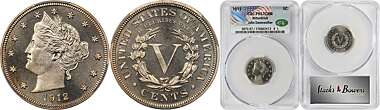
拍品 2024. 1912 Liberty Head Nickel. JD-1. Rarity-1. Proof-67 Cameo (CACG). Legacy Holder. Beautiful surfaces are lightly and attractively toned in delicate champagne-gold iridescence. Both sides are fully struck with a virtually pristine appearance that will please even the most discerning numismatist.The 1912 is the final Proof in the regular issue Liberty Head nickel series, the mintage 2,145 pieces. Survivors are scarce in an absolute sense, but when offered, "are usually very attractive," as observed by Q. David Bowers in his Guide Book of Shield and Liberty Head Nickels (2006). These factors help to explain why the 1912 is one of the more desirable type issues in this Proof series. For the collector assembling an ultimate set, only a top-pop condition rarity such as this exquisite CACG Proof-67 Cameo specimen will do. Ex Witterbrick / John Dannreuther, per the CACG insert. PCGS# 83910. NGC ID: 278N. CACG Population: 1; 0 finer, with no grading events in any grade in the CACG DCAM category. Dazzling Cameo Proof 1912 Nickel
  • 起拍价:
    1 USD
    0 EUR
    0 GBP
    0 CHF

    仅取整数近似值日期: 2026/11/06
拍品
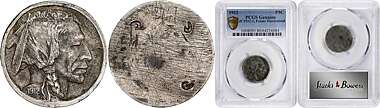
拍品 2025. Two-Piece Set of 1912 Pattern Buffalo Nickels. Uniface Obverse and Reverse Electrotrials. Design by James Earle Fraser. White Metal. Plain Edge. Genuine (PCGS). Both coins are individually encapsulated by PCGS, in two separate holders. Included are: Uniface Obverse, Judd-C1912-1, Pollock-5165, 3.62 grams, 55.9 grains, similar to the adopted regular issue Buffalo nickel design, but with smaller-size date digits and no designer's initial; and Uniface Reverse, Judd-C1912-2, Pollock-5170, 4.13 grams, 63.8 grains, similar to the Type I design adopted for regular issue coinage in 1913, but with smaller letters in the denomination FIVE CENTS, hyphens instead of periods between the words in the legend UNITED STATES OF AMERICA, tiny letters in the Latin motto E PLURIBUS UNUM, and minor differences in the design of the bison.This offering follows on our recent sale of another two-piece electrotrial set of this same type, PCGS MS-64, which realized an outstanding $122,000 in our August 2026 Global Showcase Auction, lot 2048. That set has since been donated to a museum, meaning that the set offered here is likely to be the only one available for private ownership for the foreseeable future.These items may appear unusual at first glance, but they are important part of the design process that led to the popular Buffalo nickel that made its debut as a regular U.S. Mint issue in 1913. These electrotrials were made by Medallic Art Company at the request of Buffalo nickel designer James Earle Fraser to illustrate what some of his early sketch models would look like in coin form. As explained by Roger W. Burdette in his 2007 reference Renaissance of American Coinage: 1909-1915:Fraser's next step, as has been mentioned elsewhere in the Buffalo nickel story, was unusual: he had reductions of some of the sketch models made by Medallic Art Company to make coin-size "electroshells" or electrotypes (also called galvanos). The thin metal shell was filled with tin or type-metal to give it strength and sometimes painted or plated to simulate its final color. It was these small metal pieces that substituted for mint-struck pattern coins, and which are important in the final evolution of the Buffalo nickel design.Once Fraser had captured the imagination of secretary [of the Treasury] MacVeagh, and director [of the Mint] Roberts by showing them what the Buffalo nickel would look like, he could then proceed to make more finished models that would eventually be used to cut reductions and coinage hubs.Since they were made from reductions of sketch models, these electrotypes were not intended to show full design detail and, instead, are characterized by overall soft design elements.The two-piece uniface obverse and reverse set offered here was obtained from the estate of James Earle and Laura Gardin Fraser prior to our (Bowers and Ruddy's) July 1981 William R. Sieck Collection sale. This provenance proves conclusively that these are legitimate pattern electrorials made at James Earle Fraser's request. In email correspondence with Stack's Bowers Galleries prior to preparation of our August 2026 Global Showcase Auction, Roger W. Burdette offered a few more insights into these intriguing pieces:None of the electrotypes were precise. Fraser's purpose in using them was to keep MacVeagh interested and involved until he was committed. They served the purpose of pattern pieces without all the delay, and interference. (We sometimes forget how radical the Buffalo nickel was back then.) Then Fraser had a design accepted and could complete models quickly and efficiently...Both examples have been plated or painted to simulate nickel five-cent pieces. Some light carbon build up is noted for the generally charcoal-gray uniface obverse piece, the lighter uniface reverse piece in pewter-olive gray. An exciting offering - one that will appeal to both pattern specialists and advanced Buffalo nickel enthusiasts.The uniface obverse is accompanied by ANACS Photo Certificate No. E-9230-H dated April 2, 1981, and registered to Bowers & Ruddy Galleries. The certificate describes this piece as "genuine original" and "USA 1912 Five Cents - Private Pattern Electrotype by J.E. Fraser."(Total: 2 coins; 1 ANACS Photo Certificate) From the Charles "Cheech" Litman Collection. Earlier ex James Earle and Laura Gardin Fraser estate; Fred Weinberg, Numismatics Ltd.; our (Bowers and Ruddy's) William R. Sieck Collection sale, July 1981, lots 2420 and 2422, respectively.The two-piece set of these uniface electrotrials that sold as lot 2048 in our Summer 2026 Global Showcase Auction were traced back to Bowers and Ruddy's July 1981 sale in Stack's October 1988 sale. After we received the present two-piece set on consignment, however, plate matching allowed us to determine that the examples sold in our Summer 2026 Global Showcase Auction are not ex Bowers and Ruddy's July 1981 sale. Rare and Intriguing Two-Piece 1912 Pattern Buffalo Nickel Electrotrial Set From the Estate of James Earle Fraser
  • 起拍价:
    1 USD
    0 EUR
    0 GBP
    0 CHF

    仅取整数近似值日期: 2026/11/06
拍品
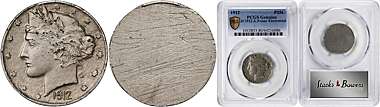
拍品 2026. 1912 Pattern Quarter Dollar. Uniface Obverse Electrotrial. Design by James Earle Fraser. Judd-C1912-3, Pollock-5175. Rarity-8+. White Metal. Plain Edge. Genuine (PCGS). Liberty head left, similar in some respects to that by Charles E. Barber seen on the regular issue Liberty Head nickel of 1883 to 1913, but less refined. Thirteen stars encircle the periphery, and the date 1912 is below. Several adjustment marks or similar as-made features on seen on the blank reverse. Both sides with uniform pewter gray color, and essentially as made.This obverse electrotrial is privately made, by James Earle Fraser, who is best known among today's collectors as designer of the Buffalo nickel, 1913 to 1938. As reported when we (as Bowers and Ruddy) offered this piece in our July 1981 sale:No pattern coins made from this design. Researcher William S. Nawrocki claims to have found an obscure reference in the Fraser files, of this as the design for a silver dollar. No plasters of this design in the Lepczyk sale.It is believed unique, and this is the plate coin for the type in both the Judd (10th edition) and Pollock (1994) references on pattern and related coinage, pp. 319 and 442, respectively, and is also plated on the uspatterns.com website. An intriguing piece for the advanced collector of Fraser's extensive and much-admired work. From the Charles "Cheech" Litman Collection. Earlier ex James Earle and Laura Gardin Fraser estate; Fred Weinberg, Numismatics Ltd.; our (Bowers and Ruddy's) William R. Sieck Collection sale, July 1981, lot 2424; our (Bowers and Ruddy's) Michael Steig Collection sale, September 1982, lot 1813; our (Bowers and Ruddy's) Rare Coin Review, No. 44, 1982, p. 9; Dave Berg Rare Coin Investments, Ltd. The plate coin for the type in both the Judd (10th edition) and Pollock (1994) references on pattern and related coinage, pp. 319 and 442, respectively, and is also plated on the uspatterns.com website. PCGS# 1012853. Unique and Intriguing 1912 Pattern Quarter Dollar ElectrotrialBy James Earle Fraser, of Buffalo Nickel Fame Judd-C1912-3
  • 起拍价:
    1 USD
    0 EUR
    0 GBP
    0 CHF

    仅取整数近似值日期: 2026/11/06
拍品
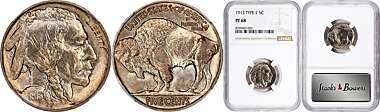
拍品 2027. 1913 Buffalo Nickel. Type II. JD-1. Rarity-1+. Proof-68 (NGC). A blemish-free and highly attractive Ultra Gem Proof that boasts delicate champagne-gold iridescence, commingling nicely with the intricate devices in a harmonious arrangement. No carbon flecks or even trivial handling issues, and this one has the quality that is virtually identical to when it left the dies, save for the graceful addition of the toning.The Buffalo nickel was designed in 1912 by artist James E. Fraser and launched for coinage in 1913. The rounded knoll on the reverse upon which the bison stands was found to be unfriendly to coinage by mid-1913, so the design was altered to a straight and defining line sturdy enough to support the beast. New Proofs were issued late in the year with this new design, and are designated as the Type II pieces. Therefore, the Type I is a one-year design and a necessary type coin to obtain. The Type II 1913 nickels were coined in relatively limited numbers in Proof, just 1,514 pieces, and while most are extant (John W. Dannreuther, 2023, states 1,200 or more), Ultra Gems like this are exceedingly rare. This is one of the finest certified examples in today's market, an American classic and of one of the most popular coin designs of the 20th century. PCGS# 3990. NGC ID: 278S. NGC Census: 9; with a single Proof-68+ finer. The corresponding PCGS Population is 12/1 (Proof-68+ finest). Awe-Inspiring Proof 1913 Type II Nickel
  • 起拍价:
    1 USD
    0 EUR
    0 GBP
    0 CHF

    仅取整数近似值日期: 2026/11/06
拍品
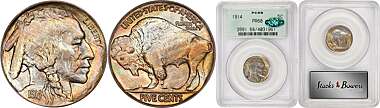
拍品 2028. 1914 Buffalo Nickel. JD-1. Rarity-2. Proof-68 (PCGS). CAC. OGH. A simply outstanding Buffalo nickel in Satin Proof format. Razor sharp definition is seen on even the most intricate design elements and both sides also exhibit lovely, vivid toning. Golden-apricot and autumn-orange colors dominate, but we also note mottled silver and ice blue shades in and around the centers. The surfaces are expertly preserved and virtually pristine, accenting the characteristic soft satin texture of the issue.1914 was the second year of production for the series, and the third Proof delivery following the 1913 Type I and II issues. The issue as a whole is uncommonly well made by the standards of the type, adding to its popularity. For the collector who desires only the finest in technical quality and eye appeal, this remarkable Ultra Gem will certainly satisfy. One of the very finest seen by both PCGS and CAC from a mintage of 1,275 pieces, this is a glorious example of both the type as a whole and the individual issue. Ex Heritage's Long Beach Signature Auction of September 2003, lot 6249; Heritage's sale of the Greensboro Collection, Part XI, November 2024 Signature Auction, lot 3687; Yellowstone Collection. PCGS# 3991. NGC ID: 278T. PCGS Population: 20; with a single Proof-68+ finer.CAC Stickered Population: 8; 0. Breathtaking Ultra Gem Proof 1914 Nickel
  • 起拍价:
    1 USD
    0 EUR
    0 GBP
    0 CHF

    仅取整数近似值日期: 2026/11/06
拍品
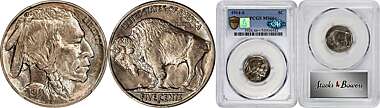
拍品 2029. 1914-S Buffalo Nickel. MS-66+ (PCGS). CAC. CMQ. A delicately, yet beautifully toned Gem displaying soft gold, powder blue and champagne-pink iridescence across each side. Fully struck with matte-like luster, and free from distractions of any sort.Although the 1914-S is readily available in Mint State despite a limited mintage of 3,470,000 pieces, premium quality Gems such as this are highly elusive and always in demand among quality-conscious Buffalo nickel enthusiasts. This example ranks among the finest survivors of this issue, especially since none of the few MS-67s listed at PCGS and NGC have met with CAC approval, which is also true of the single MS-68 reported by NGC. For the most discerning collectors, it does not get any better for the 1914-S Buffalo nickel than this outstanding PCGS/CAC MS-66+ example. PCGS# 3926. NGC ID: 22R6. PCGS Population: 16; 7 finer (MS-67+ finest).CAC Stickered Population: 28; 0. The former total includes coins certified both MS-66 and MS-66+. Exceptional Gem 1914-S Buffalo Nickel
  • 起拍价:
    1 USD
    0 EUR
    0 GBP
    0 CHF

    仅取整数近似值日期: 2026/11/06
拍品
拍品 2030. 1918/7-D Buffalo Nickel. FS-101. MS-65+ (PCGS). Here is an amazing condition rarity that ranks among the very finest certified for the elusive 1918/7-D Buffalo nickel overdate. Gorgeous target toning in golden-apricot, powder blue and salmon-pink moves from the rims to the centers. Highly lustrous, both sides are frosty and the strike is sharp to full, exceptional for the variety. This is an outstanding example!This overdate was a result of the United States' insatiable demand for circulating minor coins during the final two years of World War I. There was a nationwide shortage of cents and nickels in 1917 and 1918 that resulted in large output of these denominations. During the final quarter of 1917 the engraving department at the Philadelphia Mint was busy producing dies for both 1917- and 1918-dated coinage. One of the obverse dies for the Buffalo nickel received its first impression from a 1917-dated hub, but the second impression came from a 1918-dated hub. This die was then shipped west for use in the Denver Mint, where it produced an unknown, yet presumably small number of 1918/7-D nickels.With the vast majority of examples grading no finer than MS-64, this premium quality upper end Gem would serve as a highlight in even the finest Buffalo nickel set or variety collection. Property from an Alabama Family. PCGS# 3939. NGC ID: 22RJ. PCGS Population: 4; 0 finer. Landmark Gem Uncirculated 1918/7-D Nickel One of the Finest Known to PCGS
  • 起拍价:
    1 USD
    0 EUR
    0 GBP
    0 CHF

    仅取整数近似值日期: 2026/11/06
拍品
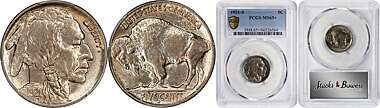
拍品 2031. 1921-S Buffalo Nickel. MS-65+ (PCGS). Smartly impressed with virtually full striking detail throughout the design. Softly frosted and smooth, the surfaces are further enhanced by pretty iridescent toning in even champagne-apricot. No marks or other blemishes distract the eye or inhibit the quality of this condition rarity premium Gem.The 1921-S is one of the most difficult Buffalo nickels to locate in high grades and with strong aesthetic appeal. For starters this is a scarce issue due to a mintage of 1,557,000 pieces and a high rate of attrition suffered through circulation. Indeed, most survivors are well worn and grade no finer than VG. Perhaps surprisingly, low end Mint State examples are more available than those in EF and AU grades, but the former are usually poorly struck with other unappealing attributes such as planchet laminations, toning streaks and/or heavy flowlines. All of these attributes point to the use of worn dies and otherwise poor workmanship on the part of San Francisco Mint personnel. Interested parties are urged to bid strongly as the opportunity to acquire a superior quality Gem 1921-S nickel usually comes along only once in a long while. PCGS# 3948. NGC ID: 22RU. PCGS Population: 17; 23 finer (MS-66+ finest). Premium Gem 1921-S Buffalo Nickel
  • 起拍价:
    1 USD
    0 EUR
    0 GBP
    0 CHF

    仅取整数近似值日期: 2026/11/06
拍品
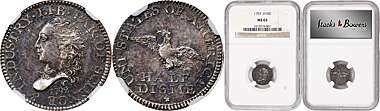
拍品 2032. 1792 Half Disme. LM-1, Judd-7, Pollock-7. Rarity-4. MS-65 (NGC). Smith-Orosz-Augsburger Coin 65-2. Die Sate 1-A, with no damage to the reverse die. Obv: A bust of Liberty with short, curly hair faces left, the date 1792 in small digits immediately below the curved truncation of the bust. The legend LIB. PAR. OF SCIENCE & INDUSTRY is around the border, an abbreviation of "Liberty, parent of science and industry." Rev: A small eagle with spread wings faces to the left with the denomination HALF DISME and a single star below. The legend UNI. STATES OF AMERICA encircles most of the reverse periphery. All 1792 half dimes except for the unique copper impression (Judd-8) are struck in silver with a diagonally reeded edge, and a single set of dies was used to complete the entire mintage of approximately 1,500 pieces. The coins were struck with medallic alignment.This is one of the most famous, and currently also one of the finest certified examples of the scarce and historically significant 1792 half disme. The strike is uncommonly well executed for a type that often displays blunt central definition and/or incomplete denticulation around the borders. On the obverse of this coin, all focal design elements are sharp except for a few of the highest curls of Liberty's hair. The strike at central reverse is more typical for the type, the eagle's breast, inner left wing and left leg missing all but a trace of feather detail, although we stress that all other features on this side are sharply rendered. Centering is also superior for the issue, the obverse trivial aligned to 7:30, but with complete, nearly uniform border denticulation framing this side of the coin. The reverse impression is more significantly off center to 10:30, and while the denticulation is still complete, it is noticeably thinner at upper left than elsewhere, thin area of smooth field outside the denticles from 12:30 to 6:30. The impressive features of this coin are fully appreciable given the superior level of preservation at the desirable Gem Mint State grade level as assigned by NGC. Free of wear, the surfaces retain full frosty to modestly semi-prooflike luster that is most intense in direct lighting. Several crisscrossing adjustment marks within Liberty's portrait at central obverse are as made and serve as useful provenance markers alongside a minor scratch on the reverse angling down from the back of the eagle's head along the top of its left wing and a faint hairline in the upper field on this side, curving below the letters in the word OF. The entire coin is draped in rich steely olive-charcoal gray that lightens a bit in and around the central reverse, both sides with soft underlying champagne-pink and powder blue undertones appreciable with the aid of direct lighting.Following passage of the Mint Act of April 2, 1792, the Treasury Department made arrangements to set up a mint. Although there had been private mints in America dating back to the days of the Massachusetts Bay Colony, this was to be the first federal institution. Dr. David Rittenhouse, an eminent scientist and craftsman, was named director. By mid-July of the same year a press was on hand and stored in the shop of John Harper at the corner of Sixth and Cherry streets, not far from where the Mint would be erected. That awaited the laying of a foundation stone on July 31 and work after that time, including rehabilitation of a large existing structure and the building of new ones. At the time Philadelphia was the seat of the federal government and it was only logical that the Mint be located there. The Federal City, as it was first known, was in the planning stage. It was not until 1800 that the government was moved there, by that time known as Washington City or simply Washington.On October 15, 1792, George Washington received a report from Secretary of State Thomas Jefferson noting that there has been a small beginning in the coinage of the half dismes, and included this milestone in his Annual Address to Congress that November. Struck from $75 of silver bullion deposited by Jefferson, the coins were produced in the cellar of John Harper's shop several blocks from where the first United States Mint was still being readied. Jefferson took delivery of 1,500 half dismes on July 13, 1792, his last day in Philadelphia that summer, and it appears he spent them on his trip back to Monticello, largely as tips for the servants he encountered along the way. At Chester, Christiana, Elkton, Bushtown, Baltimore, Elkridge, Bladensburg, Georgetown, Elkrun Church, and Orange, Jefferson recorded tips to servants all in neat multiples of five cents. While the quartered pistareen (also worth 5 cents) was the coin of the realm in the Chesapeake colonies, they were also difficult to carry in quantities for one simple reason: they were pointy and inconvenient (this is why folks in the Ohio Valley called them "sharp money"). The very first payment of precisely $0.05 Jefferson recorded in his Memorandum Book after receiving the half dismes took place in Virginia on July 19, 1792. The recipient was recorded as, simply, "a child." It's a moment anyone can imagine - dropping a bright shiny new coin in a tiny hand. Over the next 24 hours, Jefferson delivered two more half dismes into the hands of children he encountered. These were not pattern coins. They were spending money that Jefferson, then a man approaching 50, was enjoying handing out on his long trip home. One wonders if the upcoming arrival of his first grandchild was turning him into a softy. Thomas Jefferson Randolph was born on September 12, 1792, just two months later.Although 1,500 pieces is generally regarded as the entire mintage for this issue, research published by Pete Smith, Dr. Joel Orosz and Leonard Augsburger in their excellent reference 1792: Birth of a Nation's Coinage (2017) confirms a second striking period in October 1792. The authors believe that the 1,500 coins from the July strike were made on Harper's press while the October striking utilized the Mint press. A third striking period is also discussed, the dies having been removed from the press after the second striking period to create an interruption in coinage. Exactly how much time elapsed between the second and third striking periods is unknown.The uncommonly well centered, universally bold to sharp strike of this coin and Die State 1-A attribution confirm it as one of the earliest impressions from the first striking period in July 1792. The Smith-Orosz-Augsburger study concluded that this die state accounts for approximately 57.7% of 1792 half dismes extant in all grades, and 41.2% of the Mint State survivors. As with their less widely recognized counterparts from the second striking period, these earlier pieces were widely distributed beginning with Jefferson, and many did yeoman's work in circulation for many years, as evidenced by the fact that most survivors irrespective of striking period or die state are in low grades and often damaged. Indeed, many have been found throughout the Eastern Seaboard, including heavily worn examples found in New Jersey as well as Washington's and Jefferson's home state of Virginia.Ever since the very beginnings of American numismatics, the 1792 half dismes with their direct connections to the nation's Founding Fathers have been among the most coveted of all federally issued coins regardless of condition. Steeped in history, this Mint State example of one of the most significant American issues would make an impressive addition to any advanced collection. Property from an Alabama Family. Earlier ex Henry Chapman's sale of June 1914, lot 1692; James W. Ellsworth, March 1923, via Wayte Raymond; John Work Garrett, to The Johns Hopkins University, by gift, 1942; our (Bowers and Ruddy's) sale of the Garrett Collection for The Johns Hopkins University, Part IV, March 1981, lot 2351; Superior's Jascha Heifetz Collection sale, October 1989, lot 891; Superior's The Father Flanagan's Boys Home Sale, May 1990, lot 3350; our (Stack's) sale of October 1995, lot 267; our (Bowers and Merena's) Rarities Sale of August 2004, lot 1383; our (Bowers and Merena's) Rarities Sale of August 2009, lot 677; Rare Coin Wholesalers (Steven L. Contursi); offered on eBay, September 2012-January 2013; offered by U.S. Rare Coin Investments (Tom Pilitowski), 2015, reported sold May 22, 2015; offered on eBay, June 2015; Rare Coin Wholesalers (Steven L. Contursi), August-November 2015; offered on eBay March-May 2016. PCGS# 11020. NGC ID: 22ZS. NGC Census: 1; 0 finer. The corresponding PCGS Population is 0/5 (including the Specimen-67 coin; MS-68 finest). Historic 1792 Half Disme The Famous Garrett SpecimenNGC MS-65
  • 起拍价:
    1 USD
    0 EUR
    0 GBP
    0 CHF

    仅取整数近似值日期: 2026/11/06
拍品
拍品 2033. 1802 Draped Bust Half Dime. LM-1, V-1. Rarity-5. EF-45 (PCGS). Amato-109. A boldly and evenly toned example of this fabled Draped Bust silver rarity. As one of the very finest known, we expect this coin to be one of the most dynamic entries in our current sale. Our congratulations in advance to the successful bidder.Displaying sandy golden-gray patina, there are also faint powder blue and golden-apricot undertones evident as the surfaces dip into a light. A bit uneven in strike, typical of the issue and probably not worth mentioning, but we note softness at and near the lower left obverse border and on the reverse in and above the star field. It is boldly defined otherwise and is very attractive. Some scattered marks are typical for the AU grade, the most useful for provenance purposes a tiny nick in the right obverse field before Liberty's nose and a thin, faint scratch slanting down to the right within the upper right portion of the shield on the reverse.Second only to the 1870-S half dime in desirability for the denomination, the 1802 half dime has captivated numismatists and scholars since the mid to late 19th century. The story of this legendary rarity goes back to the earliest days of the United States Mint. The half dime denomination has the distinction of being the first coin struck by the fledgling United States Mint, and while this achievement was heralded by George Washington as "a small beginning," the coin struggled to find an audience in commerce. Over 86,000 half dimes were produced from late 1794 through 1795, but this would be by far the largest mintage for the denomination in all its earliest years. Yellow fever was an ongoing concern in Philadelphia at the end of the 18th century and it took a toll on the quantity of coins struck as well as their quality. Focus was placed on cents and half dollars, and the half dime was relegated somewhat as an ancillary denomination.After a three-year hiatus, in 1800 the Draped Bust Heraldic Eagle half dime design by Robert Scot was introduced. Modest quantities of the 1800 and 1801 issues were struck in roughly comparable amounts to their bigger cousins, the dimes. Then came 1802. A single pair of dies - the Logan McCloskey-1 pair - was used to produce the entire reported mintage of 3,060 half dimes of that date. The obverse die employed a distinctive logotype and placement for the date: the 1 is just free of Liberty's lowest curl, the 8 has a thick center bar and is the largest of the four digits, a very wide 0 that is more oval than it is round, and a small 2 that is tilted upwards toward the right and just about but not quite touches the base of Liberty's drapery. The reverse die was a workhorse that was first used in 1801 to coin the LM-1 and 2 die marriages and then again in 1803 for the LM-1 and LM-2 pairings. Three times as many dimes were recorded as made in 1802 and multiples of half dollars and dollars (no quarters were struck that year). In 1803, the mintage increased twelve-fold to nearly 38,000 half dimes, leaving the 1802 half dime as an anomalous dip in an otherwise steady if not generally impressive production of early half dimes. The Mint experienced some difficulties in striking the denomination throughout its early years. The Spanish colonial half real served much of the commercial needs for a small silver coin, so in 1805 the Mint suspended production of half dimes and would not resume until 24 years later in 1829.The 1802 half dimes entered circulation unceremoniously and with few - if any - numismatists around to appreciate the rarity of the issue, there they stayed. Through normal wear and meltings (especially after the 1853 reduction in weight standards for silver coins), the number of survivors in change dropped. By the late 1850s, American numismatics had started to take root and in December 1859, the first recorded appearance of an 1802 half dime at auction was made in an Edward Cogan sale. In December 1863, the William A. Lilliendahl Collection specimen sold for $340, an astonishing price for a coin during the depths of the Civil War. By 1883, this issue's scarcity was readily recognized, so much so that Harold P. Newlin devoted nearly a third of his landmark monograph on the series, A Classification of the Early Half Dimes of the United States, to the 1802 half dime. Of this issue, Newlin wrote that, "Upon these facts I base my opinion, that the half-dime of 1802 is the most desirable of the silver series." The Newlin monograph served as the primary reference for half dime collectors until Dr. Daniel W. Valentine's 1931 work, The United States Half Dimes, where this issue is listed as V.1. In 1998, Russell J. Logan and John W. McCloskey published Federal Half Dimes 1792-1837, regarded as the definitive work on the subject.Ever since Newlin's treatise, the 1802 half dime gained considerable fame. Augustus G. Heaton, one-time president of the American Numismatic Association, referenced the coin as "his 'better half' / The Little 1802" in his 1894 poem, "The Convention of the Thirteen Silver Barons." B. Max Mehl thought so highly of the issue that in his 1947 W. W. Neil sale, he not only allocated a full page for the half dime - something he usually reserved for 1804 dollars - but he also noted that "the 1802 half-dime has always been considered as one of our very rarest of all U.S. silver coins, nearly in the same category as the 1804 dollar." It was not be until the 1978 discovery of an 1870-S half dime that the 1802 faced any competition as the most celebrated issue of the denomination.As a type, Draped Bust half dimes are rare, generally weakly struck, and mostly in low grade. This situation is compounded by the overall rarity of the 1802 issue. Numismatists have tried to assemble complete census of these coins ever since Newlin's first attempt in his monograph, where he was able to record 16 auction appearances. Today, estimates vary widely as to how many individual examples remain extant. Walter Breen, in his 1988 Encyclopedia, gave an estimate of between 35 and 45 pieces, in part based on an earlier 1935 claim by James G. MacAllister, a coin dealer and cataloger for Wayte Raymond. However, in Logan and McCloskey's 1998 book, researcher David J. Davis concluded that 35 specimens would be an optimistic guess for surviving genuine examples. Indeed, the word "genuine" is crucial here; several previous auction offerings plus a couple of examples in institutional holdings have since been found to have altered dates.The 2017 reference Numismatic Background and Census of 1802 Half Dimes authored by the late Jon P. Amato lists 32 distinctly separate 1802 half dimes - the definitive census for the issue as of this writing. Even at the high end of that range, the 1802 half dime poses other challenges, especially for numismatists desiring Mint State examples; simply put, there are none. Most are between Fair and VG, with a few mid-grade pieces known. The Condition Census for the issue starts at VF-30 and tops out at AU-55 with the Newlin-Garrett coin, which was submitted twice to PCGS, both times receiving that grade determination. So elusive is the 1802 half dime that an AU-50 specimen was featured in the superlative D. Brent Pogue Collection.Logan and McCloskey rightly labeled the 1802 half dime "One of the classic rarities of U.S. numismatics." As we wrote in our 2015 sale of the Pogue specimen, "Beyond its status as the key date among all issues of the denomination, the 1802 half dime is a classic, the object of many collectors' quests, and an epic destination unto itself." The present offering is an important opportunity to arrive at that destination with this exceptional once in a lifetime coin. Again, we congratulate the winner. Property from an Alabama Family. Earlier ex our (Stack's) Anderson-Dupont Catalogue, Part II, November 1954, lot 1357; our (Stack's) sale of the R.L. Miles, Jr. Collection, Part II, April 1969, lot 398; Robert L. Hughes Enterprises' sale of the Pacific Collection, February 1978; Ed Price; our August 2021 Auction, lot 4048, as NGC AU-50. PCGS# 4268. NGC ID: 2328. PCGS Population: 2; 4 finer (AU-55 finest). The finest grading events for this issue at NGC are a pair of AU-50s. Legendary 1802 Half Dime Rarity Ex Anderson-Dupont, Miles, Price
  • 起拍价:
    1 USD
    0 EUR
    0 GBP
    0 CHF

    仅取整数近似值日期: 2026/11/06
拍品
拍品 2034. 1846 Liberty Seated Half Dime. JD-1. Rarity-7-. Proof-65 (NGC). This elegant specimen is dressed in golden-apricot iridescence that, when more closely examined, reveals intermingled blushes of pale reddish-rose. Reflective fields support lightly frosted, smartly impressed design elements. Free of significant handling marks, as one should expect given the assigned grade, provenance concerns alone compel us to mention a thin, shallow graze low in the right obverse field, between Liberty's knee and star 13. A visually appealing and numismatically significant example of a date in the half dime series that is rare in both Proof and circulation strike format.Since the United States Mint did not start recording the number of Proof silver coins struck each year until 1859, there is no way for today's numismatists to know how many half dimes were produced in this format in 1846. There could not have been many, for sure, since numismatics as a hobby had yet to gain wide popularity in this country. Writing in his 2016 Guide Book of Liberty Seated Silver Coins, Q. David Bowers estimates the mintage at 10 to 20 pieces, a range with which John W. Dannreuther concurs given the estimate of 15 struck put forth in the 2025 volume in his United States Proof Coins series. The later author accounts for only nine or 10 survivors in all grades.This is our first offering for the Proof 1846 half dime issue since 2021; prior to that we had not handled one for auction since 2013. If one were to own just one Proof Liberty Seated half dime from the 1840s, they should unhesitatingly pick the 1846. Some might be rarer, but the reputation of the 1846 as the key date of the decade, based upon the elusive quality of circulation strikes (just 27,000 pieces struck), gives it a special cachet. The present piece is outstanding, and we expect a lot of competition when it crosses the block. Property from an Alabama Family. Earlier ex RARCOA, January 1997, privately; Eugene H. Gardner; Heritage's sale of the Eugene H. Gardner Collection, Part IV, October 2015, lot 98195, as NGC Proof-64. PCGS# 4422. NGC ID: 235E. NGC Census: 2; 4 finer (Proof-67 finest). The corresponding PCGS Population is 1/1 (Proof-66 finest). Magnificent Proof 1846 Liberty Seated Half Dime Rarity Ex Gene Gardner
  • 起拍价:
    1 USD
    0 EUR
    0 GBP
    0 CHF

    仅取整数近似值日期: 2026/11/06
拍品
拍品 2035. 1796 Draped Bust Dime. JR-1. Rarity-3. MS-62 (NGC). OH. Vividly toned and lustrous Uncirculated preservation for this historically significant early U.S. Mint issue. Both sides are frosty in texture with considerable semi-reflective qualities shining through dominant toning in steely-olive gray. Direct lighting also calls forth playful iridescent undertones in vivid antique gold, powder blue and salmon pink. There is a concentration of rather heavy adjustment marks at central obverse, as made, and largely explaining the softness of strike detail both there and at central reverse. The strike is otherwise bold for the type, centering good, overall design fully appreciable. With no marks of consequence, this flashy and colorful BU example would make an impressive addition to a Mint State type set.As the inaugural issue of both the design type and the denomination, the 1796 Draped Bust dime is a highly sought issue. As is the case with numerous first year issues in U.S. coinage history, many 1796 dimes were saved as mementos and, as such, Mint State survivors are among the most available in the Draped Bust series. Even so, demand for examples for type, date and variety purposes is high and attractive examples like this NGC MS-62 coin rarely remain on the open market for long. From the Property of a Park Avenue Collector. PCGS# 4461. NGC ID: 236B. Popular First Year 1796 Dime
  • 起拍价:
    1 USD
    0 EUR
    0 GBP
    0 CHF

    仅取整数近似值日期: 2026/11/06
拍品
拍品 2036. 1838 Liberty Seated Dime. No Drapery. Fortin-113. Rarity-4. Large Stars. MS-67 (PCGS). Thickly frosted surfaces are untoned apart from blushes of deep olive-russet iridescence at the obverse border. Both sides are fully struck and approach numismatic perfection. The inaugural issue of the With Stars design type, the 1838 dime has the highest mintage figure of the denomination up until that point, with nearly two million coins struck. The 14 distinct marriages identified for the issue provide specialists with interesting varieties to pursue, as well. In PCGS MS-67, the offered example is a significant condition rarity irrespective of variety and an excellent candidate to represent the brief Liberty Seated, No Drapery dime design in a stellar quality Mint State type set. PCGS# 4568. NGC ID: 237U. PCGS Population (all varieties of the issue): 6; with a single MS-67+ finer. All but one of these grading events are associated with Large Stars examples. Exceptional 1838 Large Stars Liberty Seated Dime
  • 起拍价:
    1 USD
    0 EUR
    0 GBP
    0 CHF

    仅取整数近似值日期: 2026/11/06
拍品
拍品 2037. 1846 Liberty Seated Dime. JD-1, Fortin-102. Rarity-7. Proof-65 (NGC). The history and rarity of the Proof 1846 dime mirror that of its Proof half dime, quarter, half dollar and silver dollar counterparts of the year, examples of which are also being offered in this sale. The mintages of all these issues are unknown, having been unrecorded by Mint personnel in an era that preceded the beginning of wholesale marketing of Proof coinage to collectors by more than a decade. During the 1840s, in contrast, these special coins were prepared in (extremely) limited numbers, and almost exclusively at the request of government officials for presentation or other official purposes, and to fill orders by the few numismatists active in the Northeast at that time. Writing in the 2025 volume of his United States Proof Coins reference series John W. Dannreuther provides slightly different estimates for the mintages of the Proof silver issues of this date, ranging from 12 to 16 coins; while virtually all of these coins were distributed as part of complete Proof sets, a few Proof singles may have been made of one denomination or another to meet numismatic demand. Regardless, the actual mintages for each of the Proof 1846 silver coin denominations were extremely limited. Given their special nature and the manner in which they were distributed, most of the coins produced have survived, but with so few struck to begin with, examples are understandably rare today.Offered is the Pittman-Kaufman specimen of the Proof 1846 dime, one of just nine or 10 coins believed extant for the issue (per Dannreuther). It is a handsome Gem warmly toned in soft dove gray with a hint of mauve. The reverse periphery is further enhanced by blushes of deeper steel-olive, both sides with pretty champagne-pink and/or cobalt blue undertones discernible with the aid of direct lighting. The fields glow with subtle reflectivity as the coin rotates under a strong light source, the design elements lightly frosted in finish and fully struck. The rims are broad, squared off, and display a partial wire rim on both sides. Close inspection with a loupe finds no post-production blemishes of note. A few tiny lint marks and related strike throughs are evident here and there around the obverse periphery, most noticeably at stars 6 and 7, while a tiny spot in the field below the inside lower right point of star 3 is the most useful identifier for provenance purposes. Property from an Alabama Family. Earlier ex "Probably from Ed Frossard's November 4, 1892 sale which contained a complete 1846 Proof set with gold, the only such set known to have been offered at auction in the past," per David W. Akers; Numismatic Gallery (Abe Kosoff and Abner Kreisberg), July 20, 1949; John Jay Pittman; David W. Akers' sale of the John Jay Pittman Collection, Part II, May 1998, lot 1712, part of a complete original cased 1846 Proof set, half cent through $10 eagle; Mark Yaffee and Ken Goldman; Phil Kaufman, who acquired the silver coins in this set (the gold coins were sold separately); Heritage's sale of the Phil Kaufman Collection of Early Seated Proof Sets, Part III, April 2008 CSNS Signature Auction, lot 2384, which contained just the dime from the original set; Greensboro Collection; Heritage's sale of the Greensboro Collection, Part I, October 2012 Dallas ANA Signature Auction, lot 3945; Heritage's March 2013 Dallas Signature Auction, lot 3306. PCGS# 4733. NGC ID: 23C2. NGC Census: 3; 0 finer. The corresponding PCGS Population is 0/1 (Proof-65+ finest). The Pittman-Kaufman Proof 1846 Dime From an Estimated Mintage of Just 12 Coins
  • 起拍价:
    1 USD
    0 EUR
    0 GBP
    0 CHF

    仅取整数近似值日期: 2026/11/06
拍品
拍品 2038. 1859 Liberty Seated Dime. Transitional. Judd-233, Pollock-280. Rarity-6+. Silver. Reeded Edge. Proof-65 (PCGS). CAC. CMQ. Obv: The Liberty Seated, Stars Obverse, With Drapery design that the Mint used for regular issue dime production from 1840 through 1860. Rev: The Liberty Seated dime reverse without legend that the Mint used for regular issue dime production from 1860 through 1891. A splendid Gem having satiny motifs and glittering mirror fields, although there's no Cameo designation recorded on the PCGS insert, and probably because the viewer's eye more readily focuses on the rich toning that bathes both sides. Blended blue, gold and heather colors are seen and not only provide strong eye appeal, but speak volume's about this coin's originality. Sharply struck virtually everywhere except some of the tiny details on the top tassel on the left side of the wreath. Liberty's drapery and tresses are all bold and the obverse stars are each fully formed with complete centrils.Long ago adopted by serious students of the Liberty Seated dime discipline, this transitional type was produced in the era when the legend UNITED STATES OF AMERICA was being moved from the reverse to the obverse where it would replace the familiar Stars Obverse design, thus creating the so-called "dime without a country." A significant rarity, there are fewer than two dozen distinct specimens of Judd-233 known, according to the authoritative uspatterns.com website. From Heritage's FUN Signature Auction of January 2007, lot 877; Samuel Berngard Collection; our (Stack's) Franklinton Collection, Part II Sale, January 2008, lot 279; our (Stack's) Nashville Sale, May 2010, lot 4273; Heritage's sale of the Poulos Family Collection, Part II, September 2019 Long Beach Signature Auction, lot 4707; our Summer 2025 Global Showcase Auction, August, lot 3033. PCGS# 4749. NGC ID: 23CH. PCGS Population: 5; 2 finer in this category (both Proof-66).CAC Stickered Population: 1; 0. Rare 1859 Judd-233 Dime Popular Transitional Striking
  • 起拍价:
    1 USD
    0 EUR
    0 GBP
    0 CHF

    仅取整数近似值日期: 2026/11/06
拍品
拍品 2039. 1894-O Barber Dime. MS-66 (PCGS). CAC. This impressive condition rarity from the early Barber dime series is very well produced for a New Orleans Mint coin of this type. The striking detail on both sides is actually very close to full. The surfaces are fully lustrous with a smooth, softly frosted finish. Original toning features a blend of rich olive-gray, powder blue, salmon pink and champagne-gold and adds to the appeal of this highly desirable coin.The 1894-O has a low mintage (720,000) that, like most New Orleans Mint Barber coins, suffered a high rate of attrition through circulation. It is the second rarest Barber dime from this mint in terms of total number of Mint State examples known, and it is actually the rarest in MS-65 and higher grades, surpassing even the more highly regarded 1895-O. (These rankings are per Jeff Ambio in his 2009 book Collecting & Investing Strategies for Barber Dimes.) A highlight of the extensive Barber coinage offerings in this sale, and a perfect choice for another highly regarded cabinet. From our sale of the Larry H. Miller Collection, December 2020 Auction, lot 1226. PCGS# 4804. NGC ID: 23DU. PCGS Population: 6; 5 finer (MS-67+ finest).CAC Stickered Population: 3; 1. Seldom Offered Premium Gem 1894-O Dime
  • 起拍价:
    1 USD
    0 EUR
    0 GBP
    0 CHF

    仅取整数近似值日期: 2026/11/06
拍品
拍品 2040. 1895 Barber Dime. MS-67+ (PCGS). CAC. Fully struck with strong luster, the surfaces are as nice as would be expected at the premium Superb Gem grade level. They are also richly and originally toned in a delightful blend of reddish-gold, antique gold, cobalt blue and steel gray. Both sides approach perfection in an example of this key date issue.With a mintage of a mere 690,000 pieces, the 1895 Barber dime is the only issue produced at the Philadelphia Mint with a production figure below 1 million coins, making it one of the most desirable issues of the entire series. Coming on the heels of a major economic panic just two years prior, the 1895 issue slipped quietly into circulation with little fanfare. The numismatists of the era were content to order a Proof example of the date and largely ignored the coins that did enter circulation. By the time interest in the Barber series began to pick up, by far the vast majority of examples that remained had seen extensive use in trade, so much so that even coins at the very lowest levels of preservation can prove challenging to locate, a situation no doubt exacerbated by the mass silver meltings in the early 1980s. Fortunately, a small number of Uncirculated examples have managed to escape the rigors of commercial use, but even there primarily at the lower to middle Mint State levels. While perhaps a couple hundred Uncirculated examples may survive, PCGS suggests that only 60 or so coins may still exist at or above the Gem level, with the lion's share clustered around MS-65. The original toning combined with the exceptional strike serves to identify this PCGS/CAC MS-67+ as a significant find for the Barber specialist seeking the very pinnacle of perfection. From Legend Rare Coin Auctions' Regency Auction XXI, May 2017, lot 180. PCGS# 4806. NGC ID: 23DV. PCGS Population: 6; 0 finer.CAC Stickered Population: 4; 0. The former total includes coins certified both MS-67 and MS-67+. Exceptional Superb Gem 1895 Dime Key Date Philadelphia Mint Barber Issue
  • 起拍价:
    1 USD
    0 EUR
    0 GBP
    0 CHF

    仅取整数近似值日期: 2026/11/06
拍品
拍品 2041. 1895-O Barber Dime. MS-66 (PCGS). CAC. An outstanding Condition Census example of this legendary condition rarity in the Barber dime series. Virtually full in strike, and significantly so for the issuing mint, both sides also possess full mint luster in a billowy satin to softly frosted texture. Warmly and attractively toned, as well, both sides are dressed in even golden-champagne that delivers strong eye appeal. Silky smooth in appearance with eye appeal to spare, this coin would do justice to the finest collection of Barber coinage.The low mintage, 440,000-piece 1895-O is the rarest issue of this type in terms of total number of Mint State examples known. With even BU and Choice survivors elusive in today's market, we can hardly overstate the fleeting bidding opportunity that this premium quality Gem represents for the advanced specialist. Ex Simpson Collection. PCGS# 4807. NGC ID: 23DW. PCGS Population: just 3; with a single MS-67 finer.CAC Stickered Population: 1; 0. Gem 1895-O Dime The Rarest Barber Issue in Mint StateFinest CAC-Approved Example
  • 起拍价:
    1 USD
    0 EUR
    0 GBP
    0 CHF

    仅取整数近似值日期: 2026/11/06
拍品
拍品 2042. 1896-O Barber Dime. MS-66 (PCGS). CAC. This handsome piece sports richly original toning in a blend of steel-olive gray, golden-rose and powder blue, with the most vivid and varied colors evident when the surfaces rotate into direct lighting. Lustrous and satiny throughout, and sharply to fully struck at all design elements. Carefully preserved, as well, there is certainly much to recommend this impressive condition rarity to the advanced Barber dime enthusiast.The 1896-O is a popular semi-key date issue that saw a production run of just 610,000 pieces, the sixth lowest mintage figure for the design type. It is the third rarest New Orleans Mint Barber dime after the 1894-O and 1895-O, and is scarce even in lower Mint State grades. Gems are highly elusive, even in MS-65, and the present example is one of the finest available to discerning collectors of Barber coinage. From Heritage sale of the Collection of Dr. Steven L. Duckor, January 2009 FUN Signature Auction, lot 982. PCGS# 4810. NGC ID: 23DZ. PCGS Population: 5; 3 finer (all MS-66+).CAC Stickered Population: 6; 0. Richly Toned Gem 1896-O Dime Key Date Barber IssueEx Duckor
  • 起拍价:
    1 USD
    0 EUR
    0 GBP
    0 CHF

    仅取整数近似值日期: 2026/11/06
拍品
拍品 2043. 1904-S Barber Dime. MS-66+ (PCGS). CAC. Tremendous eye appeal and outstanding condition rarity in an example of this challenging San Francisco Mint Barber dime issue. Both sides are exquisitely toned in a target-like distribution of reddish-rose, steel-lilac, antique gold and/or powder blue colors that deliver truly memorable eye appeal. Lustrous and satiny, the surfaces are also boldly to sharply defined to further tempt the discerning collector.The 1904-S is the only mintmarked dime issue of its date, and it has a mintage of just 800,000 pieces. With Gems "not often seen in the marketplace," per Q. David Bowers (2019), this premium MS-66+ with CAC approval represents a fleeting opportunity not to be missed. PCGS# 4834. NGC ID: 23ES. PCGS Population: 4; with a single MS-67 finer.CAC Stickered Population: 4; 0. The former total includes coins certified both MS-66 and MS-66+. Condition Census 1904-S Dime PCGS/CAC MS-66+
  • 起拍价:
    1 USD
    0 EUR
    0 GBP
    0 CHF

    仅取整数近似值日期: 2026/11/06
拍品
拍品 2044. 1912 Barber Dime. JD-1. Rarity-2+. Proof-67+ Cameo (PCGS). CAC. Brilliant silver-white centers are framed in mottled halos of cobalt blue, steel-olive and pinkish-apricot peripheral iridescence. This pattern of toning is visually desirable and allows ready appreciation of bold cameo contrast between reflective fields and softly frosted motifs. With silky smooth surfaces, as well, this is one of the absolute finest certified survivors from a mintage of 700 pieces for the Proof 1912 Barber dime. PCGS# 84896. NGC ID: 23GT. PCGS Population: 3; 0 graded higher in any category. There are no grading events listed in the PCGS DCAM category.CAC Stickered Population: 6; 0. The former total includes coins certified both Proof-67 Cameo and Proof-67+ Cameo. Awe-Inspiring Superb Gem Cameo Proof 1912 Dime
  • 起拍价:
    1 USD
    0 EUR
    0 GBP
    0 CHF

    仅取整数近似值日期: 2026/11/06
拍品
拍品 2045. 1931-S Mercury Dime. MS-67 FB (PCGS). CAC. This dreamy Superb Gem is fully struck from the rims to the centers to justify the coveted FB designation from PCGS. Bathed in billowy mint frost, the silky smooth surfaces are delicately toned in pearl gray and pinkish-silver that enhance the eye appeal while confirming the originality. A delight to behold, and destined for inclusion in a high ranked Mercury dime set on the Set Registry.The final San Francisco Mint issue in the early portion of the Mercury dime series, the 1931-S is actually the final S-Mint dime struck prior to 1935. No dimes were struck at all during 1932 or 1933 as the nation struggled through two of the worst years of the Great Depression. When coinage of this denomination resumed in 1934, mintages were forthcoming from only the Philadelphia and Denver mints. The economic crisis of the early 1930s explains why only 1.8 million 1931-S dimes were produced, a limited total by the standards of the Mercury type. The effects of the Great Depression also resulted in much of the mintage for this issue remaining in government vaults until the mid 1930s. When the 1931-S was finally released in quantity beginning in 1934, the limited mintage immediately attracted the attention of contemporary numismatists, who set aside sufficient numbers of Mint State coins to satisfy today's less discerning collectors. On the other hand, "the percentage of full band specimens for this [issue] is notably low" (per David W. Lange, The Complete Guide to Mercury Dimes, 2005 edition). Combining full striking detail and virtually pristine surfaces, the present Superb Gem is a true wonder coin in a 1931-S dime. PCGS# 4987. NGC ID: 23J9. PCGS Population: 14; 2 finer in this category (both MS-67+ FB).CAC Stickered Population: 6; 0. Superb Full Bands 1931-S Mercury Dime Impressive Strike and Condition Rarity
  • 起拍价:
    1 USD
    0 EUR
    0 GBP
    0 CHF

    仅取整数近似值日期: 2026/11/06
拍品
拍品 2046. 1796 Draped Bust Quarter. B-2. Rarity-3. MS-60 (PCGS). OGH. Tompkins Die Stage 1/1, Rea et al. Die State P. Offered is an impressive condition rarity for this one year design type that is eagerly sought even in the lowest circulated grades. This 1796 quarter is boldly toned with surfaces that exhibit mottled tannish-silver, steely-olive gray and cobalt blue shades. Direct lighting calls forth more vivid undertones of golden-apricot, cobalt blue and deep mauve that are richer on the reverse. The strike is expertly centered with most design elements sharply defined; softness to the eagle's head, breast and legs is typical of most examples. It is smooth in-hand for the grade with a frosty to faintly semi-reflective finish.The 1796 quarter has long been an object of desire for all who form type sets of American coinage. Struck only in this single year, the Draped Bust obverse in combination with the Small Eagle reverse is very rare relative to the demand for it, as no type set can be complete without an example. Survivors are scarce as the mintage was just 6,146 pieces. The Mint required two obverse dies and one reverse to achieve this mintage, with Browning-2, as offered here, the more frequently encountered by a small margin. This is the High 6 variety of the issue, so named because the digit 6 in the date is closer to the bust than on the B-1 Low 6 variety.While a number of Mint State 1796 quarters are extant from both die marriages, the vast majority of survivors are circulated to one degree or another. Demand for high grade coins is particularly intense and, indeed, the offered coin is an ideal example - the very best that most collectors could realistically hope for in a 1796 quarter. Worthy of a strong bid, and destined for inclusion in another fine cabinet. From the Property of a Park Avenue Collector. PCGS# 5310. NGC ID: 23RA. PCGS Population (both die marriages of the issue): 3; 40 finer in both categories (MS-67 finest). Landmark Mint State 1796 Quarter One Year Design Type Here you can find the Video-Tour.
  • 起拍价:
    1 USD
    0 EUR
    0 GBP
    0 CHF

    仅取整数近似值日期: 2026/11/06
拍品
拍品 2047. 1804 Draped Bust Quarter. B-1. Rarity-3. AU-55 (NGC). Tompkins Die Stage 1/3, Rea et al. Die State indeterminate. Offered is an uncommonly well defined example of this eagerly sought early quarter dollar issue. The strike is nicely centered, isolated softness within the border denticulation notwithstanding, and the major design elements show universally bold to sharp definition in the absence of all but trivial wear. The surfaces are curiously bright with some associated glossiness to the texture, and the toning is secondary, yet attractive, with dominant charcoal-olive and silver-mauve backlit by iridescent antique gold, cobalt blue and pinkish-silver. Considerable traces of mint frost persist, and none of the wispy handling marks are worthy of undue concern in a Choice AU Draped Bust quarter. Light adjustment marks here and there around the obverse periphery extend across the end of Liberty's bust at lower right, these are as made and easily overlooked during in-hand viewing.Since Spanish colonial 2 reales were plentiful and widely used in domestic circulation at the time and, once dollar coinage was suspended in 1804, contemporary silver bullion depositors favored the half dollar for export and other large transactions, quarter dollars were produced in relatively limited numbers most years during the first half of the 19th century. Some years saw no coins of this denomination struck and, indeed, the 1804 is the first quarter dollar produced in the United States Mint since 1796. It is also the first issue in the Heraldic Eagle portion of the Draped Bust series, and a key date coin with a mintage of just 6,738 pieces. Browning-1, offered here, is the more frequently encountered of the known die marriages. It shares its reverse with the 1804 B-2 and 1805 B-1 pairings, but is readily attributable by the presence of a die scratch (as made) on the obverse in between stars 8 and 9. A small number of Mint State examples are known, making up the Condition Census for the 1804 B-1, but such pieces are very rare in an absolute sense. This variety is also elusive in Extremely Fine and About Uncirculated preservation, for such early U.S. Mint silver issues saw heavy commercial use in an era long before there was numismatic demand for these coins. This visually pleasing AU-55 example represents a significant find in today's market and would serve as a focal point in many advanced collections.The Rea et. al. die state progression for this variety is confused. While the obverse of the present example is perfect, corresponding to their Die State P, the reverse corresponds to their Die State c with a crack through the tops of the letters in AMERICA, and another from the top of the letter U in UNITED into the bases of the digits 25 in the denomination. PCGS# 5312. NGC ID: 23RB. Key Date 1804 Draped Bust Quarter
  • 起拍价:
    1 USD
    0 EUR
    0 GBP
    0 CHF

    仅取整数近似值日期: 2026/11/06
拍品
拍品 2048. 1818/5 Capped Bust Quarter. B-1. Rarity-2. MS-65 (NGC). CAC. Tompkins Die Stage 3/5, Rea et al. Die State d. Memorable Gem Uncirculated quality for this challenging early quarter dollar design type. Deep sea-blue and purple-gray toning adorns both sides. The satiny surfaces also exhibit resilient underlying luster that merges nicely into the antique toning. From center to periphery, the coin is generally well struck with only isolated softness to the eagle's head on the reverse, at and above the drapery clasp on the obverse. The stars are all sharp, and the eye appeal is strong.Despite the quarter's continued unpopularity with silver bullion depositors, at whose request precious metal coinage was achieved at the United States Mint at the time, 1818 did see unusually high demand, and the mintage of 361,174 pieces is the highest for this denomination from 1796 through 1828. The Large Diameter Capped Bust type as a whole is rare in the finest Mint State grades, however, and the 1818 is no exception. Opportunities to acquire an example as technically sound and aesthetically pleasing as this NGC-certified MS-65 usually come along only once in a long while. PCGS# 38953. BASE PCGS# 5323. NGC ID: 23RJ. NGC Census: 8; 3 finer (all MS-66). The corresponding PCGS Population is 12/7 (MS-66 finest). Striking 1818/5 Capped Bust Quarter NGC MS-65
  • 起拍价:
    1 USD
    0 EUR
    0 GBP
    0 CHF

    仅取整数近似值日期: 2026/11/06
拍品
拍品 2049. 1846 Liberty Seated Quarter. JD-1, Briggs 4-F. Rarity-7. Proof-65 (NGC). Specialists in early Proof Liberty Seated coinage will immediately recognize the rarity of this handsome 1846 quarter. Pleasingly toned surfaces exhibit dominant steely olive-gray iridescence with swirls of silvery brilliance intermingled. Direct lighting calls forth not only iridescent undertones of pale pink and powder blue that appear to drift toward the borders, but also pronounced reflectivity to the finish in the fields. The strike is razor sharp throughout and the surfaces are expectably smooth for the assigned grade. A tiny planchet flaw (as made) on the upper reverse rim between the words STATES and OF is mentioned solely as an identifying feature in maintaining the provenance of this significant rarity.As with all pre-1859 issues in the Proof Liberty Seated quarter series, the total number of specimens produced for the 1846 was not recorded by the Mint and has long been lost to history. Numismatic scholars, therefore, are left with the number of coins extant as a basis for estimating the mintage. PCGS CoinFacts estimates that eight to 10 specimens are known from an estimated mintage of 12 pieces, totals that square nicely with Larry Briggs' assertion that 10 to 12 coins were struck put forth in his 1991 reference The Comprehensive Encyclopedia of United States Liberty Seated Quarters, and John W. Dannreuther's estimates of eight to 11 known from a mintage of 12 coins reported in his 2025 United States Proof Coins volume on the silver denominations. Opinions differ, however, with some researchers tracing as many as 13 distinct specimens in numismatic hands. In keeping with these more liberal census listings. Q. David Bowers provides an estimated mintage of 15 to 20 coins in his 2016 Guide Book of Liberty Seated Silver Coins.Regardless of exactly how many coins were produced, the mintage for this issue was clearly on a very limited scale. This is commensurate with the United States Mint's policy regarding Proof coinage during the 1840s. Mintages during that decade were achieved on as needed basis, and generally only for presentation or other official purposes. It is important to remember in this regard that numismatics as a hobby did not begin to gain widespread appeal in the United States until the late 1850s, at which time the Mint made its first concerted effort to market yearly Proof coinage to collectors. This marketing effort coincided with the Mint's first recording of Proof mintages for gold and silver coins in 1859.Given the manner in which they were produced and distributed, it is likely that most Proof Liberty Seated quarters from the 1840s have survived. Since few were struck in the first place, as above, issues such as the Proof 1846 are clearly very rare even if 90 to 95% of the mintages are extant. Among certified examples of this date none have topped the Proof-65 level. The coin offered here is clearly a phenomenal absolute and condition rarity that would serve as a highlight in even the finest cabinet. Property from an Alabama Family. Earlier ex Paramount's Grand Central Auction Sale of November 1978, lot 154; Paramount's session of Auction '79, July 1979, lot 44; our (Bowers and Merena's) Estates of Philip M. Mann, Jr. & Glenn B. Smedley sale, September 1988, lot 201; Mid-American Rare Coin Auctions, Inc.'s January 1989 F.U.N. Sale, lot 2650; Phil Kaufman; Heritage's sale of the Phil Kaufman Collection of Early Seated Proof Sets, Part III, April 2008 CSNS Signature Auction, lot 2385; Greensboro Collection; Heritage's sale of the Greensboro Collection, Part III, April 2013 CSNS Signature Auction, lot 4219; Heritage's PNG Dallas Invitational Signature Auction of February-March 2015, lot 3075. PCGS# 5540. NGC ID: 23W9. NGC Census: 4; 0 finer. The corresponding PCGS Population is virtually identical at 3/0. Exceedingly Rare Gem Proof 1846 Quarter One of the Finest Certified
  • 起拍价:
    1 USD
    0 EUR
    0 GBP
    0 CHF

    仅取整数近似值日期: 2026/11/06
拍品
拍品 2050. 1885 Liberty Seated Quarter. MS-67+ (PCGS). CAC. CMQ. This is without a doubt the finest, most visually impressive Mint State 1885 Liberty Seated quarter that your cataloger (JLA) can recall bringing to auction in a professional numismatic career spanning nearly three decades. Both sides are originally and beautifully toned with reddish-orange and powder blue peripheral colors that give way to softer antique gold and blue-gray shades toward the centers. Intensely lustrous in a satiny texture, the surfaces are virtually pristine and support boldly to sharply struck devices.The 1885 is part of a consecutive run of low mintage circulation strike quarters produced in the Philadelphia Mint from 1879 through 1890. Yet although only 13,600 coins were struck in this format, contemporary numismatic hoarding ensured that Mint State survivors are not major rarities in an absolute sense. On the other hand, an exceptionally well cared for Superb Gem such as this PCGS/CAC MS-67+ example is a formidable condition rarity, and more so than a similarly preserved and graded Proof Liberty Seated quarter from the 1880s. One of the absolute finest for the issue known to both PCGS and CAC, and eagerly awaiting inclusion in a world-class numismatic cabinet. PCGS# 5517. NGC ID: 23VH. PCGS Population: 4; 0 finer.CAC Stickered Population: 4; 0. The former total includes coins certified both MS-67 and MS-67+. Jaw-Dropping Mint State 1885 Quarter
  • 起拍价:
    1 USD
    0 EUR
    0 GBP
    0 CHF

    仅取整数近似值日期: 2026/11/06
拍品
拍品 2051. 1896-S Barber Quarter. MS-67 (NGC). Here is an absolutely outstanding - unrivalled and unsurpassed - example of this well-known and eagerly sought key date issue in the Barber quarter series. Both sides exhibit a full frosty mint luster with fields that are modestly semi-reflective. When last offered through auction, in Heritage's October 2014 sale of the Eugene H. Gardner Collection, this coin displayed "surfaces that alternate silver areas with pinkish-gold and grayish-olive toning," as described by the Heritage cataloger. Since then, however, the coin has been professional conserved through light dipping and now exhibits a bight, brilliant-white appearance overall. The strike was delivered with pin point accuracy, calling forth full detail to all design elements. Expertly preserved and pristine in most areas, this lovely Superb Gem numbers among the most significant of all Barber silver coins that we have ever offered.The 1896-S is the first of three key date issues in the Barber quarter series, with a mintage of just 188,039 pieces. Produced in an era when collecting mintmarked coinage was just beginning to gain momentum (Augustus G. Heaton's Treatise on Coinage of the United States Branch Mints was published in 1893), most 1896-S quarters slipped quietly into circulation and remained there until worn out or lost. While low grade examples appear fairly regularly, problem free VF, EF and AU coins are highly elusive. Even rarer are Mint State survivors. The present Superb Gem combines an unmatched and unsurpassed certified grade with outstanding eye appeal, and will be just right for an advanced collection of Barber coinage.Numismatists have identified two reverse dies for this issue. This coin was struck from the first reverse with the mintmark centered between the letters R in QUARTER and D in DOLLAR. Property from an Alabama Family. Earlier from Ira & Larry Goldberg's sale of the Bradley Bloch Collection, September 1999, lot 1260; Heritage's sale of the Eugene H. Gardner Collection, Part II, October 2014, lot 98413. PCGS# 5615. NGC ID: 23Y9. Combined PCGS, NGC and CACG Population: 1; 0 finer. Extraordinary Superb Gem 1896-S Barber Quarter Single Finest Certified Example
  • 起拍价:
    1 USD
    0 EUR
    0 GBP
    0 CHF

    仅取整数近似值日期: 2026/11/06
拍品
拍品 2052. 1901-S Barber Quarter. MS-66+ (PCGS). CAC. This is the undisputed "King of Barber Coinage," the rare 1901-S quarter. While even lower grade Uncirculated coins are eagerly sought, the Alabama Family Collection brings to market an extraordinary upper end Gem that is solidly in the Condition Census. Both sides exhibit a dusting of iridescent reddish-apricot toning over full, softly frosted luster. The strike is virtually full, as well, with just a touch of softness to star 11 on the obverse (which still shows complete radial lines) and the eagle's left talon on the reverse. Attractive in all regards, we cannot overstate the significance of this offering for the key date 1901-S Barber quarter. It must surely be a once in a lifetime bidding opportunity for many advanced collectors.The San Francisco Mint produced only 72,664 quarters in 1901, which would remain the lowest mintage in the Barber or Liberty Head series until 1913, when the same facility delivered only 40,000 quarters. The 1901-S is much rarer than the 1913-S in all grades, however, as it was saved in far fewer numbers by the contemporary public.Indeed, little interest seems to have been paid to the 1901-S quarter at the time of its production. What interest there was in the 1901-S seems to have been focused entirely on the issue's usefulness in circulation. And circulate these coins did, with many of the 72,664 pieces being lost in the process and most survivors displaying heavy wear. As with most Barber coins, in fact, the only 1901-S quarters that are seen on a fairly regular basis are low grade pieces in AG, Good and VG.Even in lower grades, however, the limited mintage guaranteed that the 1901-S would be scarce in an absolute sense. Rarity increases exponentially through the Fine, VF, EF and AU grade levels. In Mint State the 1901-S is very rare, as the small number of such pieces known survived almost purely as a matter of chance. Property from an Alabama Family. Earlier from our sale of the D. Brent Pogue Collection, Part VII, March 2020 Auction, lot 7100. PCGS# 5630. NGC ID: 23YR. PCGS Population: 1; 4 finer (MS-68+ finest).CAC Stickered Population: 1; 4. The former total includes coins certified both MS-66 and MS-66+. Legendary 1901-S Barber Quarter PCGS/CAC MS-66+Ex Pogue
  • 起拍价:
    1 USD
    0 EUR
    0 GBP
    0 CHF

    仅取整数近似值日期: 2026/11/06
拍品
拍品 2053. 1811 Capped Bust Half Dollar. O-103. Rarity-3. Large 8. MS-65 (NGC). Die State 103.1. A new addition to the Herrman census in its NGC MS-65 holder, this coin is now ranked as CC#2 for the 1811 O-103 attribution behind the Simpson coin in PCGS MS-65+. It is a lustrous and frosty Gem with enhancing pinkish-russet and silver-blue iridescence to both sides. An otherwise razor sharp strike wanes just a bit at star 1 on the obverse and the letters ST in STATES on the reverse, but to no detriment. Bold clash marks on both sides are as made and include the digit 0 in the denomination in the obverse field above Liberty's cap. Expectably free of post-production blemishes for the assigned grade, this is both an outstanding early date Capped Bust half dollar type coin and an important find for the Overton variety specialist. From our February 2026 Showcase Auction, lot 25112. PCGS# 6096. NGC ID: 24EU. CC#2 1811 Overton-103 Half Dollar
  • 起拍价:
    1 USD
    0 EUR
    0 GBP
    0 CHF

    仅取整数近似值日期: 2026/11/06
拍品
拍品 2054. 1832 Capped Bust Half Dollar. O-122. Rarity-1. Small Letters. MS-66 (PCGS). Die State 122.1. This is the CC#1 coin for the 1832 Overton-122 dies, listed as such in the Autumn 2026 revision to Stephen J. Herrman's Auction & Mail Bid Prices Realized for Bust Half Dollars: 1794-1839, in which it is recorded as the only NGC (or PCGS)/CAC MS-65. Recently elevated to MS-66 at PCGS, and deservedly so since this is a premium quality coin for not only the die pairing, but also the type and issue. Richly original surfaces are dressed in blended toning of antique gold, orange-copper, steel-blue and antique silver gray. Luster is full and satiny, the surfaces free of troublesome marks with a stunning pristine appearance in hand. Minor softness engages a few of the stars around the obverse periphery, as well as the letters UR in PLURIBUS on the reverse scroll, but in general this is a sharply to fully struck coin, and impressively so for a Lettered Edge Capped Bust half dollar. An outstanding piece worthy of the strongest bids. From Heritage's Summer FUN Signature Auction of July 2026, lot 3595, as NGC/CAC MS-65. PCGS# 6160. NGC ID: 24FW. Finest Known 1832 O-122 Half Dollar Here you can find the Video-Tour.
  • 起拍价:
    1 USD
    0 EUR
    0 GBP
    0 CHF

    仅取整数近似值日期: 2026/11/06
拍品
拍品 2055. 1839 Capped Bust Half Dollar. Reeded Edge. HALF DOL. GR-4. Rarity-1. Large Letters. MS-65 (NGC). This softly lustrous, frosty-textured example delivers exceptionally smooth surfaces for a half dollar of this brief and conditionally challenged design type. The delightful complexion is overlaid in vivid, highly attractive toning that includes shades of brick red, sunset-orange, golden-olive and powder blue. A few trivial obverse marks over and before Liberty's bust require magnification to discern, allowing the unaided eye to focus on boldly struck design elements alongside the aforementioned luster and toning. A beautiful piece fit for inclusion in a high grade certified type set.In 1838 the half dollar was subject to additional design modifications that followed on those made in 1836, when the Mint adopted a steam powered press and close collar for production of this denomination. This time the reverse design was modified to read HALF DOL., likely to bring it more in line with the quarter. The design was replaced in 1839 by the highly successful Liberty Seated motif. At the Philadelphia Mint, 3,546,000 half dollars were struck in 1838 and an additional 1,392,976 examples of the Capped Bust design type were produced in 1839. Since silver dollars were practically unknown in everyday commerce aside from Spanish-American dollars, the half dollar was one of the preferred silver coins for banks to hold in vaults, usually in large bags, resulting in significant bag marks and scuffs on most Mint State survivors.As with many of the half dollars from the period, the 1838 is available with relative ease through the lower end of Mint State, but is seldom found above MS-63. The 1839 is very much the scarcer of these two Capped Bust issues, and due to the brevity of the design, both half dollar enthusiasts and better date type collectors are always on the lookout for premium examples of this issue, creating continual pressure for the few remaining Gems. An assemblage of high quality Mint State half dollars from 1836 to 1839 showing the transition from the Capped Bust to the Liberty Seated design would be most impressive and a worthy challenge for an advanced numismatist. From the Mack C. Chase Collection. PCGS# 6179. NGC ID: 24G6. NGC Census (all die marriages of the issue): 6; 2 finer (both MS-66). The corresponding PCGS Population is 4/3 (MS-66 finest). Vivid Gem 1839 Capped Bust Half Dollar Rare Grade for the Reeded Edge, HALF DOL. Design Type
  • 起拍价:
    1 USD
    0 EUR
    0 GBP
    0 CHF

    仅取整数近似值日期: 2026/11/06
拍品
拍品 2056. 1846 Liberty Seated Half Dollar. JD-1. Rarity-7-. Medium Date. Proof-65 (NGC). This is the Pittman-Kaufman Proof 1846 half dollar rarity, reunited in this sale with its counterpart in the Pittman-Kaufman Proof 1846 dime thanks to our offering of the Alabama Family Collection. (The coins are being offered individually.) Both are handsome NGC-certified Gems, the half dollar with gently mottled golden-apricot, rose and cobalt blue undertones backlighting dominant toning in blended mauve-gray and pewter-olive. Strike detail is impressively full throughout the design, direct lighting revealing subtle yet appreciable contrast between softly frosted motifs and lightly reflective fields. No marks or other blemishes distract during in-hand viewing, provenance concerns alone compelling us to mention a tiny nick in the right obverse field inside star 11 and a faint reverse spot at the upper left of the first letter A in AMERICA. From an estimated mintage of just 16 Proof half dollars of this date (per John W. Dannreuther, 2025), and one of the finest certified available to today's discerning numismatists. Property from an Alabama Family. Earlier ex "Probably from Ed Frossard's November 4, 1892 sale which contained a complete 1846 Proof set with gold, the only such set known to have been offered at auction in the past," per David W. Akers; Numismatic Gallery (Abe Kosoff and Abner Kreisberg), July 20, 1949; John Jay Pittman; David W. Akers' sale of the John Jay Pittman Collection, Part II, May 1998, lot 1712, part of a complete original cased 1846 Proof set, half cent through $10 eagle; Mark Yaffee and Ken Goldman; Phil Kaufman, who acquired the silver coins in this set (the gold coins were sold separately); Heritage's sale of the Phil Kaufman Collection of Early Seated Proof Sets, Part III, April 2008 CSNS Signature Auction, lot 2386, which contained just the half dollar from the original set; Greensboro Collection; Heritage sale of the Greensboro Collection, Part II, January 2013 FUN Signature Auction, lot 5661. PCGS# 6390. NGC ID: 27T8. NGC Census: 3; 0 finer. The corresponding PCGS Population is 2/1 (Proof-66 finest). Prized 1846 Proof Half Dollar Rarity Ex Pittman-Kaufman
  • 起拍价:
    1 USD
    0 EUR
    0 GBP
    0 CHF

    仅取整数近似值日期: 2026/11/06
拍品
拍品 2057. 1878-S Liberty Seated Half Dollar. WB-1. Rarity-5. VG Details--Scratch (PCGS). We are thrilled to be offering this key date Liberty Seated half dollar, a coin that will appeal to collectors working with a more limited numismatic budget. Of course, all survivors from a mintage of 12,000 coins for the 1878-S are rare and enjoy strong demand in today's highly competitive market. This is a boldly and originally toned piece, the fields in deep charcoal-olive gray, design elements in lighter dove gray, the interplay between the two providing a pleasing circulated cameo appearance. The obverse is generally quite smooth, but carries a concentration of light scrapes at Liberty's pole arm. The reverse is more noticeably impaired with several prominent scrapes over and above the eagle. All major design elements are boldly outlined, and the rims are distinct from the peripheral devices. A significant offering that is sure to find many willing buyers.In the early 1870s, great quantities of silver continued to flow eastward from the vast riches of the Comstock Lode, this process made easier with the rapid expansion of the railroads. This and certain international factors caused a plummeting of the price of silver, which had the effect of prompting some previously hoarded silver to come out of the woodwork. As silver became even cheaper in relation to gold, a drive to eliminate bimetallism and move to a strict gold standard grew. In February 1873 the Coinage Act was passed, which had the principal effect of demonetizing silver coin and eliminating a silver dollar for domestic use. With the end of bimetallism came the elimination of the strictly regulated issuance of silver coins, leading to the "Free Silver" movement, allowing the government to inject even more silver into circulation to combat the effects of the Panic of 1873. Consequently, large quantities of subsidiary minor silver coins were produced throughout the mid-1870s, resulting in a sharp decrease in the need for new coinage by 1877.The silver barons of the Western states were now burdened with large amounts of a precious metal that was becoming not so precious. They banded together and convinced several senators to pass the Bland-Allison Act of February 28, 1878, which re-established the domestic silver dollar (and eliminated the trade dollar except in Proof format), and required the Treasury to purchase between $2 and $4 million worth of new domestically mined silver bullion every month to coin specifically into silver dollars. Importantly, the silver could not be of foreign origin nor could it be recycled.The effect of the Bland-Allison Act on the half dollar was swift and dramatic. While 1,377,600 were minted in Philadelphia in 1878, at the Western branches almost all production switched immediately to the Morgan dollar. Carson City managed 62,000 half dollars but at San Francisco only 12,000 were struck. A single pair of dies was all that was required to coin the 1878-S half dollar and all bear the same diagnostic raised lump at the top left of the first open stripe on the reverse shield. This feature is found on all genuine specimens and can be seen even on low grade examples, as here. For those patient enough to count them, all 1878-S half dollars have 147 reeds on the edge, different from the edge reeding used at the other mints that year.The 1878-S half dollar is one of the legendary key dates of the entire Liberty Seated series and was recognized as a true rarity not long after it was issued. In the West, silver coins were popular, heavily used and tended to enter circulation largely unnoticed. However, fairly early on the rarity of the 1878-S half dollar became apparent especially when collecting by mintmark became popular in the 1890s. According to P. Scott Rubin, the earliest record of an 1878-S half dollar appearing at auction was in 1882. Nineteenth century numismatist Augustus G. Heaton remarked in 1893 in his highly influential treatise, Mint Marks, that with the "1878 we have the great rarity of the San Francisco half dollar coinage." Today, the estimated number of survivors in all grades is 50 and 60 pieces. PCGS# 6360. NGC ID: 24KR. Key Date 1878-S Half Dollar
  • 起拍价:
    1 USD
    0 EUR
    0 GBP
    0 CHF

    仅取整数近似值日期: 2026/11/06
拍品
拍品 2058. 1885 Liberty Seated Half Dollar. JD-1. Rarity-2. Proof-67 Ultra Cameo (NGC). One of the lowest mintage dates in the Liberty Seated half dollar dates, the 1885 has a combined Proof and circulation strike delivery of just 6,130 pieces, all of which are attributed to the Philadelphia Mint. We offer here a phenomenal strike and condition rarity from the year's 930-piece Proof issue. It sports razor sharp strike detail and a billowy frosty texture to the design elements, which contrast strongly with deep pools of mirrored reflectivity in the fields. Fully untoned and also free of grade-limiting blemishes, this is an exquisite Ultra Gem Proof for the quality-conscious collector. From the Mack C. Chase Collection. PCGS# 96446. NGC ID: 27UL. NGC Census: 2; 0 graded higher in this category. The highest graded Deep Cameo example listed at PCGS is a Proof-66+ DCAM. Stunning Ultra Cameo Proof 1885 Half Dollar
  • 起拍价:
    1 USD
    0 EUR
    0 GBP
    0 CHF

    仅取整数近似值日期: 2026/11/06
拍品
拍品 2059. 1888 Liberty Seated Half Dollar. WB-101. MS-67 (PCGS). CAC. CMQ. Vivid powder blue and reddish-rose peripheral iridescence frames silver-tinged centers on this highly lustrous, frosty Superb Gem half dollar. The strike is razor sharp in most areas, as well, and the surfaces are virtually pristine.The 1888 continues a run of low mintage circulation strike half dollars that began in 1879, the mintage of this date only 12,001 pieces. The Bland-Allison Act of 1878 resulted in the Mint focusing much of its attention on production of the new Morgan dollar at the expense of the other silver denominations. As well, large quantities of half dollars that had been hoarded during the Civil War and Reconstruction eras found their way back into circulation beginning in the mid 1870s, precluding the production of large numbers of new coins until the introduction of the Barber series in 1892. In fact, the token circulation strike mintages of Liberty Seated half dollars from 1879 to 1891 were probably achieved solely to prevent the creation of rare Proof-only issues. Proof half dollars of this era were certainly popular with contemporary collectors, resulting in a higher rate of survival as compared to earlier issues of this type, especially in the finest grades. On the other hand, circulation strikes of these dates are scarce, and high quality Mint State survivors such as this Superb Gem 1888 are certainly rarer than equally well preserved Proofs. This is a significant find for the advanced specialist in Liberty Seated coinage. From Heritage's FUN Signature Auction of January 2017, lot 4398; Legend Rare Coin Auctions' Regency Auction 54, September 2022, lot 158; our sale of the George Schwenk Collection, August 2023 Global Showcase Auction, lot 4025. PCGS# 6370. NGC ID: 24L3. PCGS Population: 8; 0 finer.CAC Population: 8; 0. Exceedingly Rare Superb Gem Uncirculated 1888 Half Dollar Here you can find the Video-Tour.
  • 起拍价:
    1 USD
    0 EUR
    0 GBP
    0 CHF

    仅取整数近似值日期: 2026/11/06
拍品
拍品 2060. 1895 Barber Half Dollar. JD-1. Rarity-3. Proof-68 Cameo (NGC). This is a truly magnificent example of both the type and issue that really needs to be seen to be fully appreciated. Both sides approach numismatic perfection, the surfaces silky smooth in appearance with a minimally toned, golden-tinged appearance. Full striking detail and bold field to device contrast further enhance already memorable eye appeal.The Philadelphia Mint produced 880 Proof half dollars in this, the fourth year of the Barber or Liberty Head series. This is one of the most consistently well produced and preserved issues of the type, a status it shares with the Proof 1896, 1897 and 1898. Even so, previous few survivors are as exquisite as this Ultra Gem. One of the finest certified Proof 1895 half dollars known to PCGS and NGC across all categories, in fact, it is a true wonder coin for both the type and issue that is sure to see spirited bidding among discerning collectors. From the Mack C. Chase Collection. PCGS# 86542. NGC ID: 24NX. NGC Census: 8; with a single Proof-69 Cameo graded higher in all categories. The corresponding PCGS Population is 6/1 (Proof-68+ Cameo finest in this category). Virtually Pristine 1895 Proof Half Dollar
  • 起拍价:
    1 USD
    0 EUR
    0 GBP
    0 CHF

    仅取整数近似值日期: 2026/11/06
拍品
拍品 2061. 1896 Barber Half Dollar. JD-1. Rarity-2. Proof-68 (PCGS). CAC. Simply put, this is one of the finest, most stunning Proof Barber half dollars of any date that your cataloger (JLA) has ever had the privilege of bringing to auction. Obviously a coin that spent decades stored in the original tissue paper as issued by the Mint, both sides exhibit mottled, multicolored, iridescent toning that includes shades of steel-mauve, salmon-pink, sandy-gold and cobalt blue. Considerable brilliance remains, especially on the obverse, and a brightly reflective finish from the dies is easy to appreciate. Full strike detail and a virtually pristine appearance round out an impressive list of attributes for this awe-inspiring Ultra Gem Proof. Mintage: 762 Proofs, this being one of the absolute finest available to today's discerning numismatists. From Legend Rare Coin Auctions' sale of the Young-Dakota Collection, March 2019 Regency Auction 31, lot 268; Legend Rare Coin Auctions' Regency Event of October 2019, lot 117; Legend Rare Coin Auctions' Regency Auction 43, February 2021, lot 165. PCGS# 6543. NGC ID: 24NY. PCGS Population: 2; 0 graded higher in any category.CAC Stickered Population: 1; 0. Exquisite Ultra Gem Proof 1896 Half Dollar
  • 起拍价:
    1 USD
    0 EUR
    0 GBP
    0 CHF

    仅取整数近似值日期: 2026/11/06
拍品
拍品 2062. 1896-S Barber Half Dollar. MS-66 (PCGS). CAC. OGH. Blushes of playful pinkish-rose, heather and powder blue mingle with dominant toning in iridescent champagne-gold. The finish is strongly frosted with subtle reflective qualities in the fields. Sharply struck and preserved with the utmost care since leaving the San Francisco Mint in 1896, this is an exquisite coin.With few exceptions, all Barber half dollar issues are scarce to rare in the finer circulated and Mint State grades. The 1896-S looms large in such highly select company, ranking among the most elusive issues of its type even in the most heavily worn condition. In attractive and expertly preserved MS-66, the example we offer here ranks among our most significant Barber half dollar offerings of all times. Worthy of consideration among even the most selective collectors, and equally worthy of the strongest bid. Ex J.M. Clapp, purchased directly from the San Francisco Mint in August 1896; John H. Clapp; Clapp estate, 1942; Louis E. Eliasberg, Sr.; our (Bowers and Merena's) sale of the Louis E. Eliasberg, Sr. Collection, April 1997, lot 2078; Heritage's FUN Signature sale of January 2005, lot 4213; Joseph O'Connor; Eugene H. Gardner; Heritage's sale of the Eugene H. Gardner Collection, Part III, May 2015 New York Signature Auction, lot 98519. PCGS# 6476. NGC ID: 24LX. PCGS Population: 3; 4 finer (MS-67 finest).CAC Stickered Population: 3; 0. Landmark 1896-S Barber Half Dollar Ex Clapp-Eliasberg-GardnerAcquired Directly from the San Francisco Mint in 1896
  • 起拍价:
    1 USD
    0 EUR
    0 GBP
    0 CHF

    仅取整数近似值日期: 2026/11/06
拍品
拍品 2063. 1897 Barber Half Dollar. JD-1. Rarity-2. Proof-68 * Cameo (NGC). Superior quality and phenomenal eye appeal that will appeal to both type and date collectors. Both sides of this Ultra Gem Proof exhibit halos of vivid reddish-apricot peripheral toning that frame untoned silver-white centers. This coin also possesses a profound cameo finish from the dies that is readily appreciable at all viewing angles. It is fully struck, as befits the method of manufacture, and expertly preserved to border on pristine.Proof half dollar production in the United States Mint remained steady in 1897, the mintage of 731 coins comparable to those achieved for the preceding five issues in the Barber series. This issue is the easiest in its series to locate with a Deep/Ultra Cameo finish as certified by PCGS or NGC, although such coins are scarce in an absolute sense and exceedingly rare in the finest grades, as here. One of the most pristine-looking Proof Barber half dollars of any date that we have ever offered, in fact, this outstanding specimens is highly recommended for inclusion in another advanced cabinet. From the Mack C. Chase Collection. Earlier ex J.M. Clapp, who purchased the coin directly from the Philadelphia Mint in November 1897; John H. Clapp; Clapp estate, 1942; Louis E. Eliasberg, Sr.; our (Bowers and Merena's) sale of the Louis E. Eliasberg, Sr. Collection, April 1997, lot 2079; Hugon Collection; Heritage's FUN Signature Sale of January 2005, lot 4277. PCGS# 86544. NGC ID: 24NZ. NGC Census: 7; four of which have received a * designation for superior eye appeal; 0 finer in this category. The corresponding PCGS Population is 3/0. Dramatic Cameo Proof 1897 Half Dollar The Eliasberg-Hugon Specimen
  • 起拍价:
    1 USD
    0 EUR
    0 GBP
    0 CHF

    仅取整数近似值日期: 2026/11/06
拍品
拍品 2064. 1897 Barber Half Dollar. MS-66+ (PCGS). CAC. This richly original, breathtakingly beautiful premium Gem obviously spent many years in an old-time numismatic cabinet. The reverse exhibits slightly mottled dove-gray overtones to a base of silver-apricot. The more vivid obverse is truly attractive with cobalt blue and salmon pink peripheral highlights around a golden-olive center. Fully struck, highly lustrous and silky smooth in appearance, even the most discerning numismatist will find much to admire in this captivating 1897 Barber half. PCGS# 6477. NGC ID: 24LY. PCGS Population: 6; 3 finer (MS-67+ finest).CAC Stickered Population: 7; 2. The former total includes coins certified both MS-66 and MS-66+. Dazzling Gem Mint State 1897 Half Dollar
  • 起拍价:
    1 USD
    0 EUR
    0 GBP
    0 CHF

    仅取整数近似值日期: 2026/11/06
拍品
拍品 2065. 1900-S Barber Half Dollar. MS-66+ (PCGS). CAC. Lovely pinkish-silver surfaces with a full strike and billowy mint frost throughout. This turn-of-the-century half dollar issue from the San Francisco Mint has a mintage of 2,560,322 pieces. While this is a generous total by the standards of the Barber series, circulation took a heavy toll on the issue. Typically encountered only in the lowest grades such as Good and VG, the 1900-S is scarce in the MS-60 to MS-64 range and rare as a Gem. Among the finest known to both PCGS and CAC, this premium quality example is sure to excite the advanced type or date collector. Ex Joseph O'Connor; Eugene H. Gardner; Heritage's sale of the Eugene H. Gardner Collection, Part IV, October 2015 New York Signature Auction, lot 98746; Heritage's CSNS Signature Auction of April 2020, lot 3538. PCGS# 6488. NGC ID: 24MB. PCGS Population: 1; 2 finer (MS-67+ finest).CAC Stickered Population: 2; 1. The former total includes coins certified both MS-66 and MS-66+. Premium Quality 1900-S Half Dollar
  • 起拍价:
    1 USD
    0 EUR
    0 GBP
    0 CHF

    仅取整数近似值日期: 2026/11/06
拍品
拍品 2066. 1903 Barber Half Dollar. MS-66 (PCGS). This endearing Gem exhibits gently mottled orange-russet iridescence to a base of warm olive-gray patina. All areas are fully lustrous with a soft satin texture to the mint finish. Fully defined and expertly preserved, it is little wonder that this coin ranks among the finest circulation strike 1903 half dollars known to PCGS.Writing in his 1991 reference on Barber half dollars, David Lawrence sums up the significance of this offering when he describes the 1903 as: "One of the real 'sleepers' in the series. Much tougher [sic] than its mintage indicates in all grades...Where have they all gone? Nice, original lustrous specimens are extremely hard to find." Dave Bowers agrees, the comment in his 2019 Guide Book of Barber Silver Coins also providing one clue to the mystery of this issue's rarity in the finest grades: "Another high-mintage Barber half dollar of which gem-Mint State coins are rare. Interested collectors at the time ordered Proofs." A surprise condition rarity from a relatively generous mintage of 2,278,000 circulation strikes, here is an important bidding opportunity for the sharp-eyed buyer. PCGS# 6495. NGC ID: 24MJ. PCGS Population: 9; with a single MS-66+ finer. Underrated Gem Mint State 1903 Half Dollar
  • 起拍价:
    1 USD
    0 EUR
    0 GBP
    0 CHF

    仅取整数近似值日期: 2026/11/06
拍品
拍品 2067. 1906-S Barber Half Dollar. MS-67 (PCGS). CAC. CMQ. OGH. We first had the privilege of offering this remarkable condition rarity in our (Bowers and Merena's) April 1997 sale of the famous Eliasberg Collection, where it was cataloged as:A splendid piece but with some die striation marks [as made] on the cheek (this being characteristic of certain issues, especially of 1906-S, and is specifically noted by David Lawrence) and with some die flakes on Miss Liberty's chin. Lustrous, frosty surfaces with light gold toning on obverse and reverse. A very pleasing coin from a visual and aesthetic viewpoint, certainly one of the finest remaining from this date and mint.From a mintage of 1,740,154 pieces, only a few other survivors of which rival the Eliasberg-Miller specimen in terms of both technical quality and eye appeal. From our (Bowers and Merena's) sale of the Louis E. Eliasberg, Sr. Collection, April 1997, lot 2109; our sale of the Larry H. Miller Collection, December 2020 Auction, lot 1414. PCGS# 6507. NGC ID: 24MX. PCGS Population: 4; 2 finer (MS-68 finest).CAC Stickered Population: 2; 1. The Eliasberg-Miller 1906-S Half Dollar Condition Census PCGS/CAC MS-67 Quality
  • 起拍价:
    1 USD
    0 EUR
    0 GBP
    0 CHF

    仅取整数近似值日期: 2026/11/06
拍品
拍品 2068. 1907-S Barber Half Dollar. MS-66 (PCGS). CAC. This richly original example exhibits a blend of rose-gray and powder blue patina that assumes a slightly mottled distribution at the borders. Boldly to sharply struck in most areas, both sides are fully lustrous and uncommonly smooth for a circulation strike Barber half dollar irrespective of date or issuing mint.As with most mintmarked issues in this conditionally challenged series, the 1907-S was produced in limited numbers (1,250,000 coins) and saw extensive commercial use. The typical survivor is well worn in grades such as Good or VG, and even problem free EFs and AUs are elusive. Mint State examples are scarce and generally represent coins set aside by contemporary numismatists. Among the finer certified in today's market, this beautiful upper end Gem would make an impressive addition to an advanced cabinet. PCGS# 6511. NGC ID: 24N3. PCGS Population: 8; 3 finer (MS-67+ finest).CAC Stickered Population: 3; 1. Handsomely Toned Gem 1907-S Half Dollar
  • 起拍价:
    1 USD
    0 EUR
    0 GBP
    0 CHF

    仅取整数近似值日期: 2026/11/06
拍品
拍品 2069. 1908-O Barber Half Dollar. MS-67 (PCGS). CAC. Among the most beautiful examples of the issue that your cataloger (JLA) has ever seen, this stunning Superb Gem is one of the finest 1908-O half dollars available to today's discerning bidders. The characteristic die swelling of the issue is hardly in evidence here, the devices instead displaying virtually complete definition that comes up short only on the reverse at the junction of the eagle's left wing and shield. The luster is full and richly frosted in texture, and the surfaces are so smooth as to make even the MS-67 grade seem conservative. Originally toned, as well, with gorgeous cobalt-blue rim highlights to lighter rose-gray and olive-gold centers. A coin that would do justice to the finest Barber half dollar set.For reasons that have been lost to history, the New Orleans Mint produced a staggering (for the type) total of 5.3 million half dollars in 1908. This is the second highest mintage of any coin in the Barber series, trailing only the 1899, and the 1908-O is obviously a plentiful issue by the standards of the type. This is even true of Mint State survivors, although examples that grade MS-65 or finer are rare from a condition standpoint, especially with the superior striking quality and outstanding surface preservation offered here. From our sale of the Abigail Collection, Part III, Spring 2023 Auction, March, lot 6473. PCGS# 6514. NGC ID: 24N6. PCGS Population: 15; 4 finer (MS-68 finest).CAC Stickered Population: 11; 0. Breathtaking Superb Gem 1908-O Barber Half
  • 起拍价:
    1 USD
    0 EUR
    0 GBP
    0 CHF

    仅取整数近似值日期: 2026/11/06
拍品
拍品 2070. 1911 Barber Half Dollar. JD-1. Rarity-3-. Proof-68 (PCGS). CAC. Extraordinarily well preserved for both the type and issue, this premium Ultra Gem Proof also benefits from wonderfully original toning. The obverse is layered in mauve-gray, powder blue and olive-russet, while for the reverse we note intermingled steely-charcoal, cobalt blue and reddish-gold iridescence. Both sides are fully struck with intense reflectivity shining forth from the fields as the surfaces dip into a light. Serene and temptingly close to pristine, it is difficult for us to imagine a more endearing survivor from a mintage of 543 Proofs. From our Baltimore Auction of November 2019, lot 3088. PCGS# 6558. NGC ID: 24PF. PCGS Population: 6; 1 finer in this category (Proof-69).CAC Stickered Population: 4; 1. Beautifully Toned Gem Proof 1911 Half Dollar
  • 起拍价:
    1 USD
    0 EUR
    0 GBP
    0 CHF

    仅取整数近似值日期: 2026/11/06
拍品
拍品 2071. 1913-S Barber Half Dollar. MS-66+ (PCGS). CAC. Here is a smartly impressed, highly lustrous San Francisco Mint half dollar that also offers extraordinary surface preservation for both the type and issue. Virtually pristine, in fact, both sides are further enhanced by delicate, iridescent toning in champagne-pink and pale gold. The 1913-S is a lower mintage Barber half dollar with just 604,000 coins struck. The upper end Gem offered here is a phenomenal condition rarity that would do justice to the finest collection of this challenging classic silver series. Outstanding! PCGS# 6529. NGC ID: 24NM. PCGS Population: 2; with a single MS-67 finer.CAC Stickered Population: 3; 0. The former total includes coins certified both MS-66 and MS-66+. Noteworthy 1913-S Barber Half Dollar
  • 起拍价:
    1 USD
    0 EUR
    0 GBP
    0 CHF

    仅取整数近似值日期: 2026/11/06
拍品
拍品 2072. 1935-S Walking Liberty Half Dollar. MS-67 (NGC). Exceptional eye appeal on this truly stunning and rare Superb Gem Walking Liberty half dollar. Dressed in soft sandy-silver patina with hints of light russet here and there at the borders, both sides allow ready appreciation of full mint luster. Strike quality is also noteworthy, the definition otherwise full with emerging to bold detail over the high points.After only the 1934-S, the 1935-S is the rarest middle date (1934 to 1940) Walking Liberty half dollar. With most Mint State survivors confined to lower grades due to poor strike quality and/or noticeably abraded surfaces, this premium NGC MS-67 is sure to appeal to advanced specialists in this popular 20th century series. It is one of the finest survivors of the issue and would do particularly well in high ranked collection on the firm's Set Registry. PCGS# 6597. NGC ID: 24RL. NGC Census: 11; 0 finer. The corresponding PCGS Population is similar at 7/0. Beautiful Superb Gem 1935-S Half Dollar Tied for Finest Certified in NGC MS-67
  • 起拍价:
    1 USD
    0 EUR
    0 GBP
    0 CHF

    仅取整数近似值日期: 2026/11/06
拍品
拍品 2073. 1943-D Walking Liberty Half Dollar. MS-68 (PCGS). This satiny and minimally toned 1943-D half dollar is bathed in silky smooth mint luster. Boldly struck with a lovely texture from perfectly refinished dies. With a mintage of 11,346,000 pieces, the 1943-D is the scarcest half dollar of the year, its production falling almost 42 million coins short of the quantity struck in Philadelphia. The overall production quality was high for this issue, although copious bag marks and other blemishes mean that most coins are in certified grades of MS-66 or lower. The present MS-68 is an incredible exception, ranking at the top of the PCGS Population Report with only 10 other grading events. Remarkably, just four PCGS MS-68 examples have sold at auction since 2009, emphasizing the incredible opportunity represented by this offering. PCGS# 6619. NGC ID: 24SA. PCGS Population: 11; 0 finer. Incredible Superb Gem 1943-D Half Dollar Tied for Finest Graded by PCGS
  • 起拍价:
    1 USD
    0 EUR
    0 GBP
    0 CHF

    仅取整数近似值日期: 2026/11/06
拍品
拍品 2074. 1955 Franklin Half Dollar. MS-67+ FBL (PCGS). CAC. This elegantly toned specimen exhibits an abundant amount of rose-gray, steely-russet and antique silver gray colors gained from long-term storage in a cardboard mint set holder of the time. All areas show full luster in a smooth, satiny texture.The Philadelphia Mint was the only coinage facility that struck half dollars in 1955, and the mintage of 2,498,181 pieces is the lowest in the circulation strike Franklin series. Most survivors are well produced and equally well preserved, and the issue is readily obtainable in MS-65 FBL. Scarce to rare any finer, however, the MS-67+ FBL specimen offered here ranks as the very finest seen by both PCGS and CAC. PCGS# 86670. NGC ID: 24TC. PCGS Population: 1; 0 finer.CAC Stickered Population: 11; 0. The former total includes coins certified both MS-67 FBL and MS-67+ FBL. Finest PCGS-Certified Mint State 1955 Half Dollar Here you can find the Video-Tour.
  • 起拍价:
    1 USD
    0 EUR
    0 GBP
    0 CHF

    仅取整数近似值日期: 2026/11/06
拍品
拍品 2075. 1794 Flowing Hair Silver Dollar. BB-1, B-1. Rarity-4. MS-62+ (NGC). BB Die State II. The silver dollar was authorized by the Act of April 2, 1792, that also established the United States Mint and created our nation's coinage. While not the highest denomination coin authorized by that act, the silver dollar was obviously the most important as it was the standard unit upon which the United States' monetary system would be based. All other coins struck in the United States Mint from the 1790s to the present day are either fractional parts of the dollar or multiples of that unit. The silver dollar is, without a doubt, the most popular and widely collected coin ever struck in the United States Mint, and is eagerly sought by both advanced numismatists and the general public as a historic treasure, a cherished collectible and (for common date examples of the later Morgan and Peace types) a storehouse of wealth for those with an interest in owning silver bullion.The most important silver dollar ever struck - and also one of the rarest - is the 1794 Flowing Hair. The first coin of its kind and a major numismatic rarity in all grades with a net mintage of just 1,758 pieces, the 1794 Flowing Hair silver dollar is a coin of which legends are made. Survivors are always greeted with eager anticipation when they are offered for sale either through auction or via private treaty. Such is the importance and popularity of the 1794 Flowing Hair dollar that it has been honored with the #3 ranking in the widely distributed book 100 Greatest U.S. Coins by Jeff Garrett and Ron Guth (fifth edition, 2019).The design of the nation's first silver dollar was entrusted to Engraver Robert Scot, whose obverse features the most mature evolution of the Flowing Hair Liberty portrait that was first featured on Augustin Dupre's Libertas Americana medal of 1782. By the time Dupre's Liberty found her way onto the silver dollar, however, she had been turned to the right and no longer displayed the liberty pole and cap. The basic design is superficially similar to its earliest inception, nonetheless, with Liberty's hair free flowing along the back of her head and neck, thus explaining the widely used Flowing Hair name. Scot's dollar obverse also exhibits 15 stars arranged around the border eight left, seven right in honor of the number of states that made up the Union in 1794, as well as the word LIBERTY at the upper border and the date at the lower.The reverse of the Flowing Hair silver dollar mirrors Scot's work for the Flowing Hair half dime and half dollar. A spread-wing eagle is surrounded by two branches bound at their base by a thin ribbon with the legend UNITED STATES OF AMERICA around the border. Curiously, the denomination is not featured on either the obverse or reverse of the Flowing Hair silver dollar - something that might appear as a sign of ineptitude on the part of early Mint employees to someone familiar with United States coinage of the 21st century. The omission was intentional, however, as United States coinage was new to the world market of the 18th century. In order to facilitate the coins' acceptance in as many quarters as possible, therefore, the Mint omitted the denomination from the design and opted to let the silver dollar's weight and precious metal content establish its value. For those willing to look closer, nonetheless, they would find the denomination on the edge, which for Flowing Hair silver dollars is lettered HUNDRED CENTS ONE DOLLAR OR UNIT with decorations between the words.By the time Mint employees had posted the necessary bonds to begin working with precious metals - which was not until 1794, even though the silver dollar had been authorized by Congress in 1792 - Mint Director David Rittenhouse wanted to begin production of these coins as soon as possible. His decision was a bold one, for the press he had on hand was better suited for striking smaller coins such as dimes, quarters and half dollars. Additionally, he could have opted to strike additional half dimes to follow on the heels of the 1792 half disme (coins that George Washington described as a "small beginning" to the nation's coinage after they were struck at another facility prior to establishment of the first Mint building). In recognition of the silver dollar's status as the basic unit of our national currency and the largest coin authorized by the Act of April 2, 1792, however, Rittenhouse insisted that it be the first precious metal coin struck in the United States Mint.Difficulties in achieving Rittenhouse's goal arose immediately because bullion was lacking. The early United States Mint did not strike silver and gold coins on its own account but, rather, was dependent upon private deposits of these precious metals. The first deposit of silver to arrive at the United States Mint came from the Bank of Maryland on July 18, 1794. Composed of French coins, Assayer Albion Cox's tests of the metal's fineness averaged just .737 fine, meaning the deposit would have to be heavily refined to bring it up to the congressionally mandated .8924 standard for silver coinage. With the refining department understaffed, Rittenhouse made a bold choice: rather than follow the letter of the law, whereby depositors received finished coins based upon the order of their initial deposits, Rittenhouse himself jumped the line. On August 29, 1794, he made two deposits, composed of silver ingots of relatively fine purity (.900 and .8665 fine) that added up to $2001.33 worth of silver, or enough to strike almost exactly 2,000 silver dollars.On October 15, 1794, Chief Coiner Henry Voigt delivered 1,758 silver dollars to David Rittenhouse, representing the entire mintage for the year. The Mint's workmen could have struck all of these coins in a single afternoon, using a press ill-suited for the rigors of striking the large diameter dies. Rittenhouse later received $242.50 in half dollars, plus six half dimes, to complete the total initial deposit, but according to traditional numismatic wisdom the original mintage of 1794 dollars amounted to 2,000 coins. Proponents of this theory believe that the remaining 242 examples were judged to be underweight and/or too poorly struck to be released, the coins either remelted or used as planchets for 1795-dated silver dollars. At least one poorly struck 1794 dollar was used as a planchet for a 1795 dollar, but since that coin's discovery in the 1960s no other examples have come to light. If the original mintage of the 1794 dollar was 2,000 pieces, the remaining 242 or so coins were almost certainly remelted. Alternatively, the total mintage might be just 1,758 pieces, the failure of the press under the rigors of striking these large coins ending the day's work prematurely and prompting the chief coiner to make up the balance of Rittenhouse's bullion deposits in half dollars and half dimes, as related above. We will never know for sure because no details were recorded and no ceremony was held, despite the historical significance of the event.Indeed, even those 1794 dollars that were deemed acceptable for distribution exhibit many of the difficulties with coinage operations suffered by the early United States Mint. Virtually all the known examples are softly struck to one degree or another at the left obverse and reverse borders. This is due not only to the Mint's use of a press that was initially intended for smaller-size coins, but also because the dies eventually "slipped" and became misaligned in the press. On some 1794 dollars the misalignment is so pronounced that the date can be difficult to discern. Additionally, many examples display adjustment marks that represent the Mint's filing down of overweight planchets to make them conform to the legally specified weight range for this issue. While these adjustment marks are often innocuous, they are sometimes so numerous as to severely compromise one or more elements of a coin's design.Regardless of striking quality or level of preservation, a 1794 Flowing Hair silver dollar is an extremely important numismatic find, and the ownership of even a low grade or impaired example is the mark of an important collection. Writing in the 2010 edition of the reference The Flowing Hair Silver Dollars of 1794: An Historical and Population Census Study, Martin Logies accounts for a surviving population of only 134 distinct examples. A more liberal estimate would be between 135 and 150 coins extant, which range actually represents a rather high percentage of the mintage based upon most statistical survivorship models of early American coins. This high percentage reflects the early date at which collectors placed a premium on 1794 dollars, thus saving low grade specimens that would have been consigned to the melting pot if they were of any other date. Indeed, many of the known examples are significantly impaired due to cleaning, repairs, edge damage, or other problems.Even most problem free 1794 Flowing Hair dollars that have survived did so only after acquiring some degree of wear. Indeed, in Mint State this issue is a landmark rarity. Exactly how many Uncirculated 1794 dollars are extant is a matter of debate as fluctuating grading standards over the years have resulted in some specimens alternating between About Uncirculated and Mint State grades. Six of the following seven specimens are universally recognized by numismatic experts as Mint State 1794 silver dollars, with the seventh long noted among Mint State 1794 dollars certified by PCGS and NGC, although it is ranked either CC#8 or CC#9 by Martin Logies in his exhaustive census studies on this issue published in 2010 and 2014.1 - PCGS/CAC Specimen-66. Ex Virgil Brand Collection; James Kelly's Fixed Price List #20, 1945; C. David Pierce; Art & Paul Kagin; B. Max Mehl's sale of the Will W. Neil Collection, June 1947, lot 1; our (Stack's) sale of the Amon G. Carter Family Collection, January 1984, lot 207; Hugh Sconyers for the American Rare Coin Fund Limited Partnership; Superior's Hoagy Carmichael and Wayne Miller Collections sale, January 1986, lot 1173; Superior's sale of An Amazing Collection of United States Silver Dollars, May 1991, lot 699; Knoxville Collection, sold by private treaty to Jay Parrino; Steve Contursi, acquired via private treaty; Cardinal Collection, acquired via private treaty, May 2010; our sale of the Cardinal Collection, January 2013, lot 13094, where it realized a record price of $10,016,875.2 - CACG MS-67. Ex "Colonel" E.H.R. Green; F.C.C. Boyd Collection; Numismatic Gallery's sale of the "World's Greatest Collection" (Boyd), 1945, lot 1; Adolph Friedman; Charles Williams; Numismatic Gallery's ANA Convention Sale of August 1949, lot 140; Beverly Hills Stamp & Coin Shop's (Abe Kosoff and Max Justus) Fixed Price List of 1957; Numismatic Gallery's ANA Convention Sale of August 1958, lot 1678; James Kelly; Lelan Rogers; our (Stack's) session of Numisma '95, November 1995, lot 1315; Jay Parrino; The Mint's (Jay Parrino) Fixed Price List of 1996; Stellar Collection.3 - PCGS/CAC MS-66+. Ex William Strickland Collection; Charles Winn (husband of Priscilla Strickland, son-in-law and cousin of William Strickland), by sale, 1834; Rowland Winn, 1st Baron St. Oswald of Nostell, by descent, 1874; Rowland Winn, 2nd Baron St. Oswald of Nostell, by descent, 1893; Rowland George Winn, 3rd Baron St. Oswald of Nostell, by descent, 1919; Rowland Denys Guy Winn, Major the Lord St. Oswald, M.C., by descent, 1957; Christie, Manson, and Woods, Ltd.'s sale of English, Foreign, and Important American Coins, the Property of Major the Lord St. Oswald, M.C., October 1964, lot 138; Jacque C. (Mrs. Alfred) Ostheimer Collection; Jacque C. (Mrs. Alfred) Ostheimer to Superior Stamp and Coin Company, by sale, September 29, 1969; Edwards Huntington Metcalf Collection; Superior Stamp and Coin Company's Clarke E. Gilhousen sale, Part III, October 1973, lot 1209; Jonathon Hefferlin; our (Bowers and Ruddy's) sale of the Newport Collection, January 1975, lot 371; Julian Leidman to Michael Kirzner to Bowers and Ruddy Galleries to Phil Herres (DollarTowne); Leon Hendrickson (SilverTowne), by sale, via John Dannreuther, January 1983; Jimmy Hayes Collection; our (Stack's) sale of the Jimmy Hayes Collection of United States Silver Coins, October 1985, lot 72, via David Akers, to the following; D. Brent Pogue; our sale of the D. Brent Pogue Collection, Part II, September 2015, lot 2041; Heritage's sale of the Bob R. Simpson Collection, August 2021 ANA Signature Auction, lot 3021.4 - PCGS/CAC MS-64. Ex William Strickland Collection; Charles Winn (husband of Priscilla Strickland, son-in-law and cousin of William Strickland), by sale, 1834; Rowland Winn, 1st Baron St. Oswald of Nostell, by descent, 1874; Rowland Winn, 2nd Baron St. Oswald of Nostell, by descent, 1893; Rowland George Winn, 3rd Baron St. Oswald of Nostell, by descent, 1919; Rowland Denys Guy Winn, Major the Lord St. Oswald, M.C., by descent, 1957; Christie, Manston & Woods' sale of English, Foreign and Important American Coins, the Property of Major the Lord St. Oswald, M.C., October 1964, lot 137; Lester Merkin, on behalf of the following; Ambassador & Mrs. R. Henry Norweb; our (Bowers and Merena's) sale of the Norweb Collection, Part III, November 1988, lot 3741; A Cabinet of Rarities, our (Bowers and Merena's) Rare Coin Review Issue No. 78, 1990, lot 129; Hugh Sconyers for the American Rare Coin Fund Limited Partnership, 1992; William Morton-Smith; our ANA Auction of August 2017, lot 2113.5 - PCGS/CAC MS-63+. Ex Virgil Brand; B. Max Mehl (1930s); F.C.C. Boyd Collection duplicate, sold privately by Numismatic Gallery at the time of the "World's Greatest Collection" sale; (our) Stack's Fixed Price List No. 47, 1950; B.M. Eubanks; Quality Sales' auction of September 1973, lot 464; Abner Kreisberg's "Collector's Portfolio" Public Coin Auction, October 1978, lot 633; our (Bowers and Ruddy's) Fixed Price List No. 41, 1981; Steve's Ivy's Charmont Sale, October 1983, lot 3769; our (Bowers and Merena's) Somerset Collection sale, May 1992, lot 1300; Jeff Isaac; The Cardinal Collection Educational Foundation, and displayed as part of the Cardinal Collection of Early Dollars at the 2001, 2002 and 2004 ANA Conventions; our (American Numismatic Rarities') sale of the Cardinal Collection, June 2005, lot 5; private collector; reacquired by the Cardinal Collection Educational Foundation, 2008, and featured in a complete "Mint Set" of 1794 coinage; our (Bowers and Merena's) sale of Selections from the Cardinal Collection Educational Foundation, August 2010 Boston Rarities Sale, lot 1005; Heritage Auctions; Bruce Morelan; Legend Numismatics; private collector; our November 2025 Showcase Auction, lot 3061.6 - PCGS/CAC MS-62+. Ex Paramount's session of Auction '84, July 1984, lot 725; our (Stack's) sale of the L.R. French, Jr. Family Collection of United States Silver Dollars, January 1989, lot 2; Gary Minsey Collection; private Midwestern collection.7 - NGC MS-62+. Ex "Austrian private collection" (or possibly the Paris Mint Collection or that of the Bibliotheque Nationale); Paul H. Wittlin; James Kelly's ANA sale of 1956, lot 1509; Stack's; private owner, repurchased by the following in 1975; Stack's; Julian Leidman and Mike Brownlee; Paul Nugget; Dave Berg; private owner; our (Bowers and Ruddy's) Dr. Edward B. Willing Collection sale, June 1976, lot 412; Superior's Father Flanagan's Boys Home Sale, May 1990, lot 3875; Larry H. Miller; our sale of the Larry H. Miller Collection, December 2020 Auction, lot 1089. The present example.Widely known as the Austrian-Whittlin-Willing specimen, the coin offered here is very well struck and remarkably well preserved for the issue. Dollars of this date often display soft to blunt detail along the left obverse and reverse borders due to the misalignment of the dies in the press. For the present example, however, we note nearly complete denticulation around both sides. Only from 10 to 11 o'clock on the obverse does the detail to the denticulation come up a bit short, but minimally so and hardly significant. All 13 stars are boldly to sharply rendered, all four digits in the date are bold and clear, and the word LIBERTY is fully legible despite a touch of softness at the top of the letter L. The reverse features a fully legible legend UNITED STATES OF AMERICA, a touch of softness to the top of the letters TED STA along the left border is noted solely for accuracy. Both sides are boldly to sharply struck in and around the centers with crisp detail throughout much of Liberty's hair and the eagle's plumage.The often-seen adjustment marks (as made) are barely in evidence here, there being only a trace at the reverse border outside the letters TE in UNITED that help to explain the trivial softness of strike in that area. Lustrous satin surfaces are enhanced by light iridescent toning in golden-tan and powder blue. Scattered handling marks are commensurate with the grade, and they are inconsequential in a survivor of this rare issue from the earliest days of U.S. Mint operations. The most useful feature for provenance purposes is actually as made: a shallow, circular planchet flaw near the center of the eagle's breast on the reverse. BB Die State II with light clash marks (again as made) in both the obverse and reverse fields, the second to lowest curl of Liberty's hair approaches the innermost point of star 2.A leading highlight of our current Showcase Auction, this is a truly exceptional 1794 dollar. It is sure to see spirited bidding among advanced type collectors, early dollar enthusiasts, and other numismatists who appreciate the historical significance and well known rarity of this issue. Property from an Alabama Family. Earlier ex "Austrian private collection" (or possibly the Paris Mint Collection or that of the Bibliotheque Nationale); Paul H. Wittlin; James Kelly's ANA sale of 1956, lot 1509; Stack's; private owner, repurchased by the following in 1975; Stack's; Julian Leidman and Mike Brownlee; Paul Nugget; Dave Berg; private owner; our (Bowers and Ruddy's) Dr. Edward B. Willing Collection sale, June 1976, lot 412; Superior's Father Flanagan's Boys Home Sale, May 1990, lot 3875; Larry H. Miller; our sale of the Larry H. Miller Collection, December 2020 Auction, lot 1089. PCGS# 39972. BASE PCGS# 6851. NGC ID: 24WY. Historic First Year 1794 Silver Dollar A Landmark Rarity in NGC MS-62+The Austrian-Wittlin-Willing Specimen
  • 起拍价:
    1 USD
    0 EUR
    0 GBP
    0 CHF

    仅取整数近似值日期: 2026/11/06
拍品
拍品 2076. 1795 Flowing Hair Silver Dollar. BB-21, B-1. Rarity-1. Two Leaves. MS-63 (PCGS). A beautiful coin which retains the desirable mauve, sandy-gold and blue-gray toning seen on most of the high grade Eliasberg silver coins. The fields retain their reflective nature imparted by the dies more than 230 years ago. Traces of underlying blue, gold, pink and apricot iridescence are also present to further treat the viewer aided by direct lighting. The strike is typical for this die pairing with minor softness on the high points of Liberty's curls and the eagle's breast, but razor sharp to full detail elsewhere. A trio of thin adjustment marks (as made) are found through the letters TES in STATES to the border nearby, others much fainter near the eagle in the field. The surfaces have scattered handling marks, including a short, shallow scratch below Liberty's eye that joins with a tiny carbon spot at the tip of the bust to serve as useful identifiers for provenance purposes. Overall, however, there is nothing here that really distracts the eye. For general eye appeal and surface quality, this is certainly one of the finer examples of Flowing Hair dollars to exist and would stand up to comparison with other high grade survivors of its type.The second of only two dates in the United States Mint's premier silver dollar series, 1795 is the preferred type candidate for the Flowing Hair design given the rarity of the 1794 in all grades. Bowers-Borckardt 21 is the second most available die marriage of the issue after BB-27, and examples are particularly popular for type purposes. Extremely Fine examples are scarce, and AU coins are considerably rarer. Writing in the 2013 edition of his early dollar encyclopedia, Q. David Bowers states that "a dozen or more true Mint State coins exist in private hands" - confirming the importance of the opportunity that this example represents. This coin is included in Bowers' list of "Notable Specimens" for the 1795 BB-21 variety, listed fourth as NGC MS-63 therein, and is also ranked CC#4 in the Winter 2025 revision to Stephen J. Herrman's Auction Prices Realized for Early Silver Dollars: 1794-1803.A readily attributable die, the obverse of BB-21 exhibits more or less bold remnants of a 1 underdigit beneath the primary digit 7 in the date. This die was also used to strike examples of the BB-22 and BB-23 varieties. On the reverse of BB-21, there are four berries on the branch below the eagle's left wing, three inside and one outside, and a leaf ends directly below the first letter S in STATES. This reverse was also used in the BB-20 and BB-24 die pairings. Property from an Alabama Family. Earlier ex our (Bowers and Merena's) sale of the Louis E. Eliasberg, Sr. Collection, April 1997, lot 2171; Philip Flannagan; our (Bowers and Merena's) sale of the Philip Flannagan Collection, November-December 2001, lot 4208, as NGC MS-63; Robert Lehman; Cardinal Collection; our (American Numismatic Rarities') sale of the Cardinal Collection of Early Silver Dollars, June 2005, lot 12, as PCGS MS-62; Heritage's Dallas Signature Auction of December 2005, lot 903, as PCGS MS-62; our (Stack's) Norweb Collection sale of November 2006, lot 420, as NGC MS-63; Ira & Larry Goldberg's Pre-Long Beach Auction of May 2007, lot 1304, as NGC MS-63; our (Bowers and Merena's) Orlando Rarities Sale of January 2010, lot 405, as NGC MS-63; our Baltimore Auction of June 2011, lot 4001, as NGC MS-63.The Flannagan Collection sale cataloger confused the early provenance of this coin with that of the Eliasberg BB-20 silver dollar, lot 2170 in our April 1997 sale, which error traveled with this coin through a few subsequent auction appearances before being corrected. PCGS# 39986. BASE PCGS# 6853. NGC ID: 24WZ. PCGS Population (all die marriages of the Two Leaves variety): 2; 9 finer (MS-65+ finest). Enticing Mint State 1795 Flowing Hair Silver Dollar Previously from the Eliasberg Collection
  • 起拍价:
    1 USD
    0 EUR
    0 GBP
    0 CHF

    仅取整数近似值日期: 2026/11/06
拍品
拍品 2077. 1795 Flowing Hair Silver Dollar. BB-27, B-5. Rarity-1. Three Leaves. MS-61 (ANACS). OH. BB Die State III. A noteworthy condition rarity to represent this historically significant type that has long been popular with advanced collectors. The essentially brilliant surfaces reveal minimal silver and gold tinting as the coin rotates under lighting, the color most pronounced at the lower reverse border. This die pairing is characterized by softness of strike in the centers, as seen here, but what we also see here is bold to sharp detail throughout the remainder of the design. The strike is well centered, the denticulation uniform and complete in all areas, and this despite the presence of faint adjustment marks (as made) along the obverse border from 3 to 9 o'clock and just before 12 o'clock. There is a concentration of heavier adjustment marks at central obverse, although these are largely concealed within the details of the portrait in most viewing situations. Frosty luster is full, if somewhat subdued to help explain the MS-61 assessment from ANACS, but we see no sizeable or otherwise singularly distracting post-production marks.While first introduced in 1794, it was not until 1795 that the silver dollar was produced in numbers that would allow it to fulfill its intended role as the monetary unit of the fledgling nation. The number of dollars coined in 1795 is a matter of quite a bit of debate. The official Mint reports state that all told 203,033 dollars were coined in 1795, but there is no differentiation between the Flowing Hair and the Draped Bust types. Most references now generally cite a mintage of 160,295 for the 1795 Flowing Hair dollars, although Q. David Bowers indicates that figure may actually be far too low and that the total number of 1795 Flowing Hair dollars minted is likely closer to 290,000 pieces, with production from 1795-dated Flowing Hair dies perhaps continuing as late as 1798. Your cataloger (JLA) disagrees with this and, taking October 3, 1795 as the first date of coinage for the new Draped Bust, Small Eagle design type, believes that the mintage of the 1795 Flowing Hair silver dollar can be confidently pegged at 124,795 pieces. This represents the Mint's dollar deliveries from May 6 through September 24, 1795.Regardless of exactly how many examples were struck, it is clear that demand from contemporary bullion depositors was strong and the Flowing Hair dollars of 1795 were eagerly sought for commercial use. With 1794 dollars out of reach of most collectors and seldom available, the 1795 BB-27 dollar has long filled the bill for those seeking an example of this historic issue. Expect spirited bidding for this visually appealing BU example. From the Mack C. Chase Collection. PCGS# 39977. BASE PCGS# 6852. NGC ID: 24WZ. Mint State 1795 Flowing Hair Silver Dollar
  • 起拍价:
    1 USD
    0 EUR
    0 GBP
    0 CHF

    仅取整数近似值日期: 2026/11/06
拍品
拍品 2078. 1795 Draped Bust Silver Dollar. BB-51, B-14. Rarity-1. Off-Center Bust. MS-64+ (PCGS). A truly memorable example that ranks high in the Condition Census for the Off-Center Bust variety of the popular first year 1795 Draped Bust dollar. Both sides display warm pearl gray patina with splashes of iridescent rose-russet, pinkish-apricot and, to a lesser extent, cobalt blue toning. The surfaces are also awash in full frosty mint luster. The obverse exhibits a concentration of adjustment marks from the border at the letters LIB in LIBERTY into Liberty's hair. Fainter adjustment marks are found along the obverse border from 12 to 3 o'clock, although the reverse is free of these. Adjustment marks are as made and were commonly used by early U.S. Mint employees to bring overweight silver and gold planchets down to the statutory level. The presence of these features has resulted in somewhat soft striking detail at stars 11 to 12 and the letters LIB in LIBERTY, but otherwise we note impressively sharp definition throughout much of the design. Liberty's portrait and the eagle are particularly well executed with even most of the intricate design elements crisp. A beautiful and exceptionally well preserved example that will delight both high grade type collectors and advanced early dollar enthusiasts.Two different die combinations were used for the 1795 Draped Bust dollar. The die pair believed to have been struck first is the so-called Off-Center Bust variety, BB-51, which features Liberty appearing too far to the left from the center, a position used only on this die pair. This positioning was corrected to a more aesthetically pleasing centered location on the second variety, the BB-52 pair. The precise number struck and timing of each variety is unclear. Mint records from the time are not as thorough as scholars would like and much of what can be determined is conjecture. The commonly cited mintage figure of 42,738 is believed to be only a portion of the overall total for the 1795 Draped Bust dollar. Writing in his excellent 2022 reference Eagle Poised on a Bank of Clouds Harry E. Salyards estimates that 83,178 coins were produced of both BB-51 and BB-52, and that while the first deliveries almost certainly took place in late September or early October, the later deliveries likely extended into 1796.BB-51 is the more plentiful of the two die marriages of this issue, and Salyards suggests that 725 to 1,200 coins are extant in all grades. With the typical survivor grading VF, however, even EF and AU coins are scarce in an absolute sense, and rare relative to the demand for them in today's numismatic hobby. Mint State examples are rare by any measure. This is among our most significant offerings for both the issue and variety of all time, and it is sure to see spirited competition when bidding opens. Property from an Alabama Family. Earlier from our (Bowers and Ruddy's) Newport Collection sale, January 1975, lot 375; our (Bowers and Merena's) Four Landmark Collections sale, March 1989, lot 1943; our (Bowers and Merena's) Collections of R.H. Gore, Jr. & Dennis Irving Long sale, January 1990, lot 345; Ira & Larry Goldberg's sale of February 2002, lot 3204; Heritage's sale of the Jack Lee Collection, III, November 2005 Dallas, TX Signature Auction, lot 2187; our sale of the Larry H. Miller Collection, December 2020 Auction, lot 1091. PCGS# 96858. NGC ID: 24X2. PCGS Population: 2; 3 finer (MS-66 finest). Condition Census 1795 Draped Bust Dollar BB-51 Off-Center Bust Variety
  • 起拍价:
    1 USD
    0 EUR
    0 GBP
    0 CHF

    仅取整数近似值日期: 2026/11/06
拍品
拍品 2079. 1796 Draped Bust Silver Dollar. BB-65, B-5. Rarity-2. Large Date, Small Letters. MS-62 (PCGS). BB Die State II, Salyards Die State f. Nearly brilliant silver gray, but with a decided champagne-pink cast overall, as well as blushes of warmer reddish-rose scattered about, most of which are nestled around and among design elements. Nice frosty luster for the grade, which is especially pronounced at the peripheries. The strike is also significant with nearly full line definition at Liberty's shoulder, all feathers on the eagle's breast outlined if not fully round, and just a small oval of weakness at the top of the eagle's left leg. Very attractive for the assigned grade with only a few scattered marks, including two linear ones low on Liberty's neck, a tiny divot behind Liberty's eye, and a faint scratch in the reverse field below the eagle's beak - all are inconsequential for an early dollar in certified MS-62, but are of paramount importance in identifying this coin for provenance purposes. A handsome dollar with a full border of strong denticles and plenty of eye appeal.The year of the death of the first mint director, David Rittenhouse, and the year of John Adams' election to the presidency, some 72,920 silver dollars were struck according to mint records in calendar year 1796. Writing in the excellent 2022 reference Eagle Poised on a Bank of Clouds, Harry E. Salyards asserts that the first two deliveries of that year - 4,550 coins on January 30 and 390 coins on February 13 - were from 1795-dated Draped Bust dies. He also asserts that all 7,776 coins delivered during calendar year 1797, as well as the 8,770 pieces delivered on January 18, 1798, were from 1796-dated dies. These calculations result in an estimated mintage for the 1796-dated Draped Bust silver dollar issue of 84,626 coins. This total was achieved using six die pairs with Bowers-Borckardt 65, represented here, one of the more distinctive varieties. Both the obverse and reverse dies saw use exclusively in this marriage. While not immediately obvious, close examination reveals that the digit 6 in the date is clearly repunched. Early on in its use, a chunk of metal in the reverse die between the letters I and C in AMERICA fell out, causing a large lump to form on the coins once struck. This lump expanded significantly as the die continued in use and is an easy diagnostic for identifying the BB-65 variety. Contrary to traditional numismatic wisdom, examples without this lump break do exist, although they are rare.The second most available of 1796 dollars behind only the BB-61 die marriage, most of the estimated 475 to 800 survivors (per Salyards) are found in mid-level circulated grades. At the AU level and above, the word "rare" comes readily to the fore. Bowers (2013) includes just four Mint State coins in his listing of "Notable Specimens," which total Salyards expanded to six in 2022; the present example is included in both listings. Clearly it is a coin of immense appeal, and one that is certain to sell for a strong bid to an advanced early dollar enthusiast. Property from an Alabama Family. Earlier ex our (Bowers and Merena's) Four Landmark Collections sale, March 1989, lot 1951; unknown intermediaries; John Whitney Walter, purchased privately in August 1984; our (Stack's) sale of the John Whitney Walter Collection, May 1999, lot 1785; Dale Friend Collection; our (American Numismatic Rarities') sale of the Cardinal Collection of Early Silver Dollars, June 2005, lot 19; Heritage's sale of the Joseph C. Thomas Collection, April-May 2009 CSNS Signature Auction, lot 2539; Dale Friend; Legend Rare Coin Auctions' sale of the Dale Friend Collection, Part I, April 2022 Regency Auction 51, lot 26. The plate coin for the 1796 BB-65 dies in the 2013 Bowers early silver dollar encyclopedia, p. 125. PCGS# 6861. NGC ID: 24X3. PCGS Population: 2; 2 finer (MS-64 finest). Condition Census 1796 BB-65 Dollar Ex Walter-Friend-CardinalThe 2013 Bowers Plate Coin
  • 起拍价:
    1 USD
    0 EUR
    0 GBP
    0 CHF

    仅取整数近似值日期: 2026/11/06
拍品
拍品 2080. 1796 Draped Bust Silver Dollar. BB-65, B-5. Rarity-2. Large Date, Small Letters. AU-50 (PCGS). BB Die State IV, Salyards Die State j. If the Mint State example offered in the preceding lot is too rich for one's blood, the PCGS AU-50 highlighted here is also an uncommonly high grade, numismatically significant survivor from the BB-65 dies. Stars 1 through 4 along the lower left obverse border are more or less bluntly struck, but otherwise we note overall bold to sharp detail in a lightly circulated early dollar. Much frosty luster persists, especially in the protected areas around the design elements, which light up the generally golden-gray surfaces as the coin rotates into direct lighting. Blushes of deeper olive and russet patina engage the peripheries, most prominently at lower reverse, the eye appeal overall pleasing and sure to impress discerning collectors. PCGS# 6861. NGC ID: 24X3. Nice AU 1796 Large Date, Small Letters Bust Dollar
  • 起拍价:
    1 USD
    0 EUR
    0 GBP
    0 CHF

    仅取整数近似值日期: 2026/11/06
拍品
拍品 2081. 1799 Draped Bust Silver Dollar. BB-158, B-16b. Rarity-2. MS-64+ (PCGS). CAC. BB Die State IV, the obverse die dramatically shattered by numerous cracks. An immensely challenging early U.S. Mint design type to find at the threshold of Gem Mint State preservation, and this is certainly one of the finest known for both the issue and the BB-158 dies. The surfaces are alive with luster that glows forth from beneath the flecks of russet scattered about, with a gloss of overall golden-gray backlit by soft champagne-pink. The strike is sharp for the type, most features fully defined and crisp. Examination of the surfaces finds little to fault here, as the fields and devices show just a few shallow marks from handling, and there are no edge bumps, nicks, or even (as made) adjustment marks. Although this die pairing is available in most grades, at this upper level of preservation the present coin is high in the Condition Census; indeed, it is included in the list of "Notable Specimens" published by Q. David Bowers in his 2013 Encyclopedia of United States Silver Dollars: 1794-1804. Its offering in this sale represents a fleeting opportunity for the type connoisseur. Property from an Alabama Family. Earlier from Heritage's FUN Signature Auction of January 2009, lot 3945, as NGC MS-64; our (Bowers and Merena's) Los Angeles ANA Auction of August 2009, lot 1655, as NGC MS-64; Ira & Larry Goldbergs' Pre-Long Beach Auction of January 2011, lot 1519, as NGC MS-64; our Baltimore Auction of June 2012, lot 3021, as NGC MS-64. PCGS# 6878. NGC ID: 24X7. PCGS Population (all die marriages of the issue): 3; 6 finer (MS-66 finest).CAC Stickered Population: 10; 3. The former total includes coins certified both MS-64 and MS-64+. Majestic 1799 Draped Bust Silver Dollar
  • 起拍价:
    1 USD
    0 EUR
    0 GBP
    0 CHF

    仅取整数近似值日期: 2026/11/06
拍品
拍品 2082. 1799 Draped Bust Silver Dollar. BB-161, B-11. Rarity-2. AU-53 (PCGS). CAC. BB Die State IV, an unlisted state with a die lump having developed at the reverse crack where it passes below the eagle's beak. Plenty of mint luster remains on both sides of this warmly toned example, the surfaces glowing with a frosty finish as the surfaces rotate into direct lighting. Blended pewter and olive-gray patina dominates the in-hand appearance, backlit by soft champagne-pink, pale gold and powder blue iridescence. The strike is well executed, less well centered on the reverse, but to no detriment, with all design elements remaining bold to sharp in the absence of all but light high point wear. A strong offering for a Draped Bust, Heraldic Eagle dollar that will catch the eye of high grade type collectors. PCGS# 6878. NGC ID: 24X7. Frosty AU 1799 BB-161 Bust Dollar
  • 起拍价:
    1 USD
    0 EUR
    0 GBP
    0 CHF

    仅取整数近似值日期: 2026/11/06
拍品
拍品 2083. 1799 Draped Bust Silver Dollar. BB-164, B-17a. Rarity-2. AU-55+ (PCGS). CAC. BB Die State III. A visually pleasing example of the type, date and BB number, this is a strong 1799 Draped Bust dollar at the certified Choice AU level. The obverse is awash in blended mauve and olive-gray patina supported by underlying antique gold and lilac-blue iridescence. The reverse is generally pearl gray with blushes of olive and russet around the periphery. Nearly complete mint luster shines forth nicely as the coin rotates under a light, which feature is easy to appreciate given the absence of sizeable or otherwise visually distracting marks. Sharply struck by early silver dollar standards, and just right for inclusion in the collection of a quality-conscious numismatist.With 423,515 pieces produced, calendar year 1799 has the highest mintage in the Flowing Hair and Draped Bust silver dollar series of 1794 to 1804. It is also the penultimate year in which early United States silver dollars were produced in quantity. After a mintage of 220,920 pieces during calendar year 1800, declining bullion deposits and the Mint's emphasis on getting fractional coinage into circulation combined to keep yearly mintages (well) below the 100,000-coin mark in 1801, 1802, 1803, and 1804. While it is likely that many of the 423,515 dollars struck in 1799 were from 1798-dated dies, coinage from 1799-dated dies was sufficiently large to support an estimated mintage of 395,000 pieces for the latter issue. Some 1799-dated dollars may have been struck during calendar year 1800.The approximately 395,000 coins struck for the 1799 was achieved using 11 obverse and 16 reverse dies in 22 pairings. The BB-164 pair can be easily distinguished from similar varieties by the berry size on the reverse olive branch; they are by far the largest berries on any 1799 dollar. While the obverse die was employed in six different combinations, this particular reverse die was only used for BB-164, making this a useful marker for numismatists collecting by die pair. The BB-164 is generally one of the more available of the 1799 silver dollars with perhaps 1,000 or so specimens thought to exist. As with many of the other early dollars, most examples are found in VF and seldom any finer. At the Choice AU level the issue is exceptionally rare, and no more than four to six at any Mint State rating. A truly enticing and beautiful example of this interesting and conditionally scarce die pair. PCGS# 40055. BASE PCGS# 6878. NGC ID: 24X7. Handsome Choice AU 1799 Draped Bust Dollar BB-164 Dies
  • 起拍价:
    1 USD
    0 EUR
    0 GBP
    0 CHF

    仅取整数近似值日期: 2026/11/06
拍品
拍品 2084. 1802 Draped Bust Silver Dollar. BB-241, B-6. Rarity-1. Narrow Date. MS-64+ (PCGS). BB Die State III. A visually spectacular coin with splendid toned surfaces, the overall soft apricot-gray hues are punctuated by delightful steel blue highlights that are most pronounced at the peripheries. The overall bold and well centered strike is accompanied by strong luster in a satin to softly frosted texture. Free of distracting pre- and post- marks that are often found on early silver dollars, it would be a difficult task indeed to find a more visually appealing example of the Draped Bust, Heraldic Eagle dollar design type.As with many of the production figures from the early days of the United States Mint, there is some question regarding precisely how many coins were produced of a specific date in a calendar year. This is the case with the 1802 Draped Bust dollars, where the reported mintage of 41,650 pieces coined in 1802 is certainly lower than the quantity of 1802-dated dollars actually produced. Dave Bowers, in his 2013 Encyclopedia of United States Silver Dollars: 1794-1804, estimates that the number of silver dollars struck using 1802-dated dies is likely closer to 80,000 pieces, coined in both 1802 and 1803, this total based on the number of surviving specimens. Even though seven different die pairings for the 1802/1 overdate have been identified, only two die marriages for the normal date are known to numismatic researchers. The distinctive obverse die used in the BB-241 pairing is characterized by the missing right foot of the letter T in LIBERTY, which is readily apparent in all die states and diagnostic; this obverse was only used for this die pair.The BB-241 die marriage is far and away the most available of the entire issue with an estimated 1,500 to 2,750 coins extant, primarily in the Very Fine to Extremely Fine grade range, though with about 50 to 70 Mint State pieces known. Even though a number of notable Mint State specimens are listed in the Bowers Encyclopedia, including a few at the MS-65 level of preservation, this coin does not appear to be found among that roster. Because some of the sales were held in the days prior to third-party grading and certification services, positive identification of individual examples in today's market may not be possible with absolute certainty.Due of its comparative availability, the BB-241 variety has long been popular with collectors at all levels of preservation, not only to represent the 1802 issue, but also among type collectors seeking just one example of the Draped Bust, Heraldic Eagle design. Given the overall paucity of near- and full Gem Uncirculated examples of all early silver dollar issues, and with its outstanding eye appeal, this PCGS MS-64+ is a highly desirable numismatic property. Property from an Alabama Family. Earlier from our August 2018 ANA Auction, lot 1191, as NGC MS-65. PCGS# 40088. BASE PCGS# 6895. NGC ID: 24XB. PCGS Population (all die marriages of the issue): 1; 5 finer (MS-65+ finest). Extraordinary Near-Gem Mint State 1802 Dollar Among Finest Known
  • 起拍价:
    1 USD
    0 EUR
    0 GBP
    0 CHF

    仅取整数近似值日期: 2026/11/06
拍品
拍品 2085. 1836 Gobrecht Silver Dollar. Name on Base. Original. Judd-60, Pollock-65, JD-2. Rarity-2+. Silver. Plain Edge. Die Alignment I. Proof-55 (PCGS). Korein-44. DTS Die State E. Liberty's head is opposite the letters DO in DOLLAR. This bright and brilliant example exhibits a flashy frosty to semi-reflective appearance overall. The surfaces are noticeably hairlined from an old cleaning. This is consistent with the assigned grade, especially for a Gobrecht dollar, and with no sizeable or otherwise singularly distracting marks the in-hand appearance is rather smooth at the Proof-55 level. The strike is sharply executed, as expected for the issue, and we note just a trace of high point friction that also helps to explain the certified grade.The historic 1836 Name on Base Gobrecht dollar is the first issue of this denomination produced for circulation since those struck in 1804 from 1803-dated dies. Silver dollar production was suspended in the early 19th century after the value of the silver exceeded the coin's face value. While proposals to resurrect this denomination started as early as 1831, it was not until 1835 that any serious attempt was made. Christian Gobrecht was directed to prepare a set of pattern dies based on designs by Titian Peale and Thomas Sully. The result is a coin widely considered one of the classics of American numismatics with its beautiful representation of Liberty seated on the obverse and majestic soaring eagle on the reverse.The Mint used only a single pair of dies to strike 1,000 examples of the new dollar in December 1836, the coins delivered in two batches: 400 pieces for distribution to the public and 600 for distribution into commerce through local Philadelphia banks. Mint personnel experienced considerable difficulty in production of this issue. Either the feed fingers for the planchets were improperly designed, or the coiners used feed fingers intended for half dollars. In either case, the feed fingers kept slamming into the reverse die during coinage, forcing Mint personnel to deliberately rotate the dies and adjust the feed mechanism in an effort to solve the problem. This tinkering explains the three different die alignments for originals of this variety (I, II and IV), as well as the tiny nicks seen around the reverse rim through the various die states.For generations, the precise timeline of production based on die alignment has been in dispute, but recent scholarship by John Dannreuther, Craig Sholley, and Saul Teichman has indicated that the correct sequence of all the Judd-60 dollars is I-IV-II-IV-I-IV, with all of the Die Alignment III pieces being later restrikes.As the most frequently encountered Gobrecht dollar, the 1836 Name on Base is very popular for type purposes. Examples are certified as Proofs, as above, but most show (considerable) wear and marks (if not also impairments) from time in commerce. A perennial favorite for generations, Gobrecht silver dollars remain as popular now as ever and are in constant demand. This visually appealing specimen represents a significant find for advanced type collectors, silver dollar enthusiasts, or those with an interest in this challenging series. From the Julius Korein Collection, sold to benefit the American Numismatic Society. PCGS# 11225. NGC ID: BLWV. Flashy Judd-60 Original Gobrecht Dollar From the Korein-ANS Collection
  • 起拍价:
    1 USD
    0 EUR
    0 GBP
    0 CHF

    仅取整数近似值日期: 2026/11/06
拍品
拍品 2086. 1836 Gobrecht Silver Dollar. Name on Base. Original. Judd-60, Pollock-65, JD-2. Rarity-2+. Silver. Plain Edge. Die Alignment II. Proof-61 (NGC). Korein-73. DTS Die State F. Liberty's head is opposite the letters ES in STATES. Warmly toned in dominant sandy-gray, the peripheries exhibit gold and blue undertones to halos of steely-russet patina. Frosty qualities mingle with semi-reflective tendencies, typical of the issue (these are not true Proofs, but "Special Strikes" as defined by John W. Dannreuther). A bit subdued overall, as befits the assigned grade, with scattered handling marks that include a dull nick in the field below the eagle's breast and a gentle edge bump on the reverse outside the letters CA in AMERICA. Sharply struck with virtually full detail to allow ready appreciation of all aspects of this classic design type.Numismatic scholars recognize four different die alignments for Gobrecht dollars, designated as I (coin turn, eagle flying upwards), II (medal turn, eagle flying upwards), III (coin turn, eagle flying level with respect to obverse), and IV (medal turn, eagle flying level with respect to obverse). When Walter Breen wrote his Complete Encyclopedia in 1988, he considered Die Alignment I examples of the Judd-60 Name on Base issue to be originals from 1836 and Die Alignment II pieces from a mintage of 600 pieces delivered in March of 1837. He regarded Die Alignment III and IV pieces as restrikes. This view had been challenged by the early 1990s, when it was found that many Die Alignment IV pieces evinced signs of circulation, suggesting that they had been made for that purpose rather than to accommodate coin collectors. Modern research by Craig Sholley, John Dannreuther, and Saul Teichman (based on an exhaustive examination of die state evidence), reported that the die alignment sequence of Judd-60 Gobrecht dollars is actually I-IV-II-IV-I-IV. All examples in these alignments are originals attributed to the December 1836 issue of 1,000 coins; the 600 pieces struck in March 1837 represent a test striking, and all were subsequently melted. Die alignment III pieces are still regarded as restrikes coined decades later than 1836. Pollock in his United States Patterns and Related Issues considered Die Alignment II and III pieces as the scarcest alignment varieties, followed by IV. He regarded Die Alignment I pieces to be the most readily available. From the Julius Korein Collection, sold to benefit the American Numismatic Society. PCGS# 11224. NGC ID: BLWV. Seldom-Offered 1836 Judd-60 Gobrecht Dollar in Die Alignment II From the Original Issue of December 1836
  • 起拍价:
    1 USD
    0 EUR
    0 GBP
    0 CHF

    仅取整数近似值日期: 2026/11/06
拍品
拍品 2087. 1838 Gobrecht Silver Dollar. Name Removed. Cabinet Coin Restrike. Judd-84, Pollock-93, JD-2. Rarity-6. Silver. Reeded Edge. Die Alignment III. Proof-62 (PCGS). Korein-17. 411.35 grains. Liberty's head is opposite the letter N in ONE. Untoned brilliant-white surfaces allow ready appreciation of fields that are highly reflective to help confirm the Proof strike. All details are needle sharp, as well, and the in-hand appearance is smooth apart from a few short slide marks in the right obverse field and light, scattered hairlines that account for the Proof-62 grade from PCGS. A significant rarity that is just right for an advanced silver dollar cabinet.For the collector assembling a complete date set of Gobrecht dollars, the 1838 will likely prove to be the most challenging to acquire. While traditional numismatic wisdom states that a small number of originals were struck that year in Die Alignment I, modern scholarship has discounted this theory. In fact, no Die Alignment I examples of this date are known to exist. The website gobrechtdollars.com contains the most in-depth and up-to-date scholarship on this series, the authors of which (Craig Sholley and John W. Dannreuther) have confirmed that only two original 1838 Gobrecht dollars are known to exist: the Mint Cabinet-Smithsonian Institution specimen in Die Alignment IV and the Eliasberg-ANS coin in Die Alignment III. Exactly when those coins were struck is not known, but it was sometime after July 1838.Obviously, original 1838 Gobrecht dollars were exceedingly rare in their time, and it is likely that they were unknown outside of a small circle of Mint and other government officials. With the growth of numismatics in the United States during the late 1850s, demand for rare early issues soon reached a level where the Mint saw an opportunity to provide such coins to collectors for its own benefit. Indeed, the earliest restrikes of the 1838 Gobrecht dollar were made ca. June 1859 to 1863, most of which were used by Mint Director James Ross Snowden to trade for Washingtonia for the Mint Cabinet. These are the Early State Restrikes, per Sholley and Dannreuther. Two additional striking periods followed: Middle State Restrikes ca. 1867 to 1869, and Late State Restrikes ca. 1873 to 1874. The final two striking periods are attributed to Henry Richard Linderman, who served two non-consecutive terms as mint director from April 1867 to May 1869 and April 1873 to December 1878. The Linderman era is widely known for having spawned large numbers of restrikes, novodels, so-called patterns and fantasy pieces that were made expressly for distribution to collectors.The 1838 Gobrecht dollar offered here dates to Linderman's second term as mint director. It is a Late State Restrike, the obverse heavily polished with the top of the rocky base nearly gone in the area of the ribbon junction. On the reverse, the area of granularity in the field above the letters TA in STATES and the "die line" (actually a light crack) slanting down to the right above the letter T in UNITED have been reduced/weakened by die polishing. From the Julius Korein Collection, sold to benefit the American Numismatic Society. PCGS# 11352. NGC ID: BLXE. Noteworthy 1838 Gobrecht Dollar A Late State Restrike ca. 1873-1874
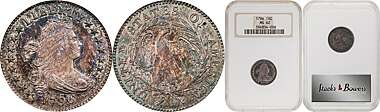
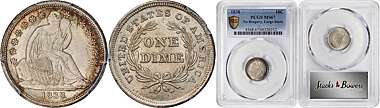
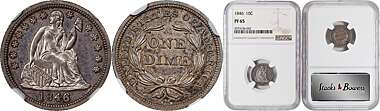
  • 起拍价:
    1 USD
    0 EUR
    0 GBP
    0 CHF

    仅取整数近似值日期: 2026/11/06
拍品
拍品 2088. 1838 Gobrecht Silver Dollar. Name Removed. Cabinet Coin Restrike. Judd-85, Pollock-94. Rarity-7+. Silver. Plain Edge. Die Alignment III. Proof-65 (PCGS). CAC. DTS Die State B. A beautifully toned, highly appealing Gem that will serve with distinction in the finest collection of silver dollars or Liberty Seated coinage. Dominant mauve-gray patina yields to gently mottled sandy-gold and antique silver tinting over much of Liberty's portrait at central obverse, as well as in the right field on that side of the coin. Both sides also exhibit kaleidoscopes of vivid underlying iridescence in golden-apricot, salmon-pink and powder blue as the surfaces rotate into direct lighting - very attractive. Fully impressed with razor sharp definition, this feature combines with the truly exceptional level of preservation to provide outstanding visual appeal. As with all known examples of Judd-85, this coin was struck in Die Alignment III, Liberty's head opposite the letter N in ONE. The eagle flies level following a normal coin turn. The dies are the same as those of Judd-84, but here the edge is plain rather than reeded.For the collector assembling a complete date set of Gobrecht dollars, the 1838 will likely prove to be the most challenging to acquire. While traditional numismatic wisdom states that a small number of originals were struck that year in Die Alignment I, modern scholarship has discounted this theory. In fact, no Die Alignment I examples of this date are known to exist. The Die Alignment I-II reverse die cup was already starting to deteriorate on late die state 1836 Gobrecht dollars, so it seems likely that the Mint simply abandoned it in favor of the Die Alignment IV cup when it came to striking the 1838 coins. An example of this issue in Die Alignment IV is part of the National Numismatic Collection in the Smithsonian Institution, suggesting that this is the alignment used to strike originals of this date. Those coins were made as patterns to illustrate the revised Gobrecht dollar design with 13 stars added to the obverse periphery and the 26 stars omitted from the reverse field.Original 1838 Gobrecht dollars were exceedingly rare in their time, as they are now, leading the Mint to create restrikes for sale to contemporary collectors. These pieces were struck in both Die Alignment III and IV with either a reeded (Judd-84) or plain (Judd-85) edge and display light cracks through some of the peripheral letters on the reverse. The present specimen was struck circa April 1869, near the end of Henry R. Linderman's first term as mint director (April 1867-May 1869), an era during which many restrikes and other numismatic delicacies are known to have been produced expressly for distribution to collectors. Mintages were not recorded as these are not regular issues, although with fewer than a dozen specimens known in two die states - all of which are in Die Alignment III - the variety now known as Judd-85 was obviously produced in small numbers. The offered coin represents DTS Die State B, the obverse die lightly polished, removing most of the rust lumps and patches from Liberty's portrait and the field, but now with a tiny crack on Liberty's left hand just below the wrist and into drapery at left. According to the gobrechtdollars.com website:This is the last use of the 1838 die. The wrist crack likely indicates a sub-surface die flaw and the die probably cracks severely during or just after this use.All examples of this Judd number were produced after the latest Judd-84 Restrikes with a reeded edge.As one of the finest certified Judd-85 specimens known to PCGS, this is an outstanding representative of one of the rarest Gobrecht dollar varieties. Property from an Alabama Family. Earlier from Heritage's Long Beach Signature Auction of February 2013, lot 3862. PCGS# 11354. NGC ID: BLXU. PCGS Population: 2; with a single Proof-65+ finer in this category.CAC Stickered Population: unclear as, strangely, no stickering events are reported on the current online version of the CAC Population Report. Exceptional Gem Proof 1838 Judd-85 Gobrecht Silver Dollar Ca. April 1869 Cabinet Coin Restrike with a Plain Edge
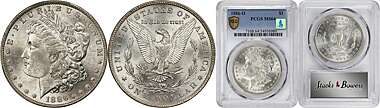
  • 起拍价:
    1 USD
    0 EUR
    0 GBP
    0 CHF

    仅取整数近似值日期: 2026/11/06
拍品
拍品 2089. 1846 Liberty Seated Silver Dollar. JD-1, OC-P1. Rarity-7-. Top 30 Variety. Repunched Date. Proof-64 (NGC). CAC. A striking example of this rarely offered issue in the early Proof Liberty Seated dollar series. Bathed in glossy olive-charcoal patina, the surfaces readily reveal more vivid undertones of cobalt blue, pale pink and reddish-rose iridescence as the coin rotates into direct lighting. The strike is impressively sharp overall, most features fully rendered and crisp, and the finish alternates between soft reflectivity in the fields and delicate frosting to the design elements. Close inspection with a loupe is required to discern a few trivial handling marks, leaving the in-hand appearance pleasingly smooth and highly attractive.In a subseries populated exclusively with leading numismatic rarities, the 1846 stands out as one of the most elusive Proof Liberty Seated dollars from the 1840s. John W. Dannreuther (United States Proof Coins, 2025 volume) allows for only nine or 10 survivors from an estimated mintage of 15 coins, a more limited estimate than he provides for the 1840, 1844, 1845, 1847 and 1848. Prior to this offering we had not handled a Proof 1846 for auction since 2008, which confirms that this issue is not only exceedingly rare in an absolute sense, but equally rare from a market availability standpoint. A fleeting opportunity, indeed, and one that deserves an aggressive bidding strategy. Property from an Alabama Family. Earlier ex F.C.C. Boyd; Numismatic Gallery's sale of "World's Greatest Collection" (Boyd), Part I, January 1945, lot 135; Numismatic Gallery's Adolphe Menjou Catalogue, June 1950, lot 2091; John Jay Pittman; David W. Akers' sale of the John Jay Pittman Collection, Part II, May 1998, lot 1674; later, David Lawrence's sale of the Richmond Collection, Part III, November 2004, lot 1511; Heritage's sale of the Jack Lee Collection, III, November 2005 Dallas Signature Auction, lot 2234. PCGS# 6987. NGC ID: 24ZW. NGC Census: 9; 0 finer. The corresponding PCGS Population is 2/3 in this category (Proof-66 finest).CAC Stickered Population: 2; 1. Rarely Encountered Proof 1846 Dollar The Boyd-Pittman-Richmond Collection Specimen
  • 起拍价:
    1 USD
    0 EUR
    0 GBP
    0 CHF

    仅取整数近似值日期: 2026/11/06
拍品
拍品 2090. 1852 Liberty Seated Silver Dollar. Restrike. JD-2, OC-P3. Rarity-6. Proof-65+ (PCGS). This is a wonderfully original and aesthetically pleasing Gem Proof silver dollar that is sure to appeal to Liberty Seated specialists, advanced Set Registry participants, or anyone else who appreciates the finest of the fine, the rarest of the rare. Razor sharp in strike, both sides display glassy reflectivity in the fields as the surfaces rotate under a light. Vivid blue, mauve and apricot undertones backlight silver-olive toning on the obverse. On the reverse, splashes of underlying cobalt blue and lilac support gently mottled sandy-gray patina. Expertly preserved and virtually pristine.This elusive issue owes its existence to the low mintage, key date status of the circulation strike 1852 silver dollar. The Philadelphia Mint struck only 1,100 silver dollars for commercial use in 1852, a fact that was not lost on contemporary numismatists. By the end of that decade the 1852 (along with the 1851) had established a reputation as a rare and desirable date in the silver dollar series. In 1859 (and perhaps as early as 1858), the Mint began producing Proof restrikes of the 1852 silver dollar. These coins are not an official issue, but rather were offered privately by Mint personnel. Several striking periods are supposed, continuing into the 1860s, and possibly as late as the 1870s. The earliest known auction appearance of a restrike Proof 1852 silver dollar was in Edward Cogan's Simon Gratz Collection sale of May 1, 1859. Since then, the popularity of this issue has grown as new generations of collectors have sought high grade examples of this key date Liberty Seated dollar.Just a single obverse die was used to strike all 1852-dated issues, including circulation strikes, original Proofs, and Proof restrikes. The JD-2 variety, represented here, is the more frequently encountered of the two confirmed die marriages used to strike 1852-dated Proof restrikes. Osburn and Cushing (2018) also list a third restrike die marriage that was previously proposed by Q. David Bowers, but this has yet to be confirmed. The JD-2 variety features a reverse die that some researches believe was first used on original Proofs of 1859. It is identifiable by the presence of several die rust lumps within the eagle's right wing, not far in from the tip.Estimates on the number of restrike Proof 1852 dollars produced varies by source (usually in the range of 40 to 100 coins), with Osburn and Cushing putting forth a mintage of about 65 coins, of which perhaps 40 survive. PCGS CoinFacts is more conservative with an estimate of 30 to 35 restrikes extant, John W. Dannreuther (2025) in general agreement with Osburn-Cushing with estimates of 60 and 40 to 45, respectively. Most of these were struck from the JD-2 die marriage; only a half dozen or so examples of the JD-3 variety are thought to survive, including the dazzling PCGS/CAC/CMQ Proof-64+ specimen that realized $52,800 in our Spring 202 Auction, lot 4167.The offering of any 1852 Liberty Seated dollar - circulation strike, original Proof, or Proof restrike - is a significant event in the numismatic market. This exquisite Gem Proof is the finest restrike certified by PCGS and would be difficult to improve upon in an example of this highly coveted date. It is destined to serve as a highlight in an advanced collection of Liberty Seated silver dollars or wider assemblage of 19th century U.S. Mint Proof coinage. Property from an Alabama Family. Earlier from our (Stack's) sale of the Robison Collection, February 1982, lot 1907; our sale of the Blue Moon Collection, Part I, March 2017 Baltimore Auction, lot 2568. The plate coin for the reverse of the JD-2 attribution in the 2025 volume in the Dannreuther United States Proof Coins reference series, p. 1009. PCGS# 6995. NGC ID: 2526. PCGS Population: 1 in all categories; 0 finer. Restrike Proof 1852 Silver Dollar Rarity Finest Certified at PCGS
  • 起拍价:
    1 USD
    0 EUR
    0 GBP
    0 CHF

    仅取整数近似值日期: 2026/11/06
拍品
拍品 2091. 1854 Liberty Seated Silver Dollar. OC-1. Rarity-3+. Repunched Date. AU-58 (PCGS). OGH. This sharply struck and minimally circulated 1854 dollar retains much of the frosty to modestly reflective mint finish. Wispy hairlines are noted for accuracy, as is a touch of glossiness to the texture, but both sides have retoned in iridescent gold that provides plenty of eye appeal.The 1854 is one in a long line of Philadelphia Mint silver dollar issues beginning with the 1850 and continuing through the end of the Liberty Seated series in 1873 that were made exclusively for use in the export trade. The mintage of 33,140 circulation strikes that year was achieved using silver bullion obtained from Mexico and deposited with the Mint for coinage into dollars. Ten thousand examples were shipped to San Francisco from Philadelphia on November 11, 1854, and sent to China by merchants in San Francisco in exchange for goods such as tea and silk. These and other U.S. silver dollars were taken at a discount at the treaty ports compared to Spanish colonial and Mexican 8 reales, and subsequently were melted.It is a lesser known fact that many Liberty Seated dollars also suffered attrition through domestic melting during the 1850s. The government's obligation to provide free coinage of silver dollars at the request of bullion depositors who brought their silver to the mints for that purpose remained in force even after passage of the Act of February 21, 1853. The new subsidiary silver coins, however, could only be paid out by the mints for gold, or so the Act required. As early as May 1853, however, Mint officials circumvented the law by purchasing silver bullion with subsidiary coins. This process accelerated when James Ross Snowden, who was appointed Mint director in June 1853, set an artificially high purchase price for silver. Since there was a profit to be made by taking advantage of this situation, many Liberty Seated dollars that were held by banks and bullion brokers in the East and Midwest were sold to the Mint during Snowden's tenure and melted to provide bullion for the large mintages of subsidiary silver coins achieved from 1853 through the mid to late 1850s. While these were almost exclusively earlier dated coins from the 1840s that had returned from Europe in payment for American goods, examples of some recently delivered issues like the 1854 were undoubtedly also included.With an extant population of just 130 to 170 coins in circulated grades (per Q. David Bowers, 2016), the 1854 is the rarest Philadelphia Mint Liberty Seated dollar after the legendary 1851 and 1852. Choice About Uncirculated examples are particularly elusive and usually appear at auction only once in a very long while. We anticipate strong competition for this piece among astute collectors specializing in Liberty Seated coinage or silver dollars. From a Collection of American Silver Classics. PCGS# 6942. NGC ID: 24YT. Rare Key Date 1854 Liberty Seated Dollar
  • 起拍价:
    1 USD
    0 EUR
    0 GBP
    0 CHF

    仅取整数近似值日期: 2026/11/06
拍品
拍品 2092. 1871-CC Liberty Seated Silver Dollar. OC-1, FS-301. Rarity-4+. Top 30 Variety. Misplaced Date. EF-40 (PCGS). The 1871-CC is the second of only four Liberty Seated dollar issues struck at the Carson City Mint and, with just 1,376 pieces produced, it has the lowest mintage in this highly select group. While the final year 1873-CC is rarer, the 1871-CC is certainly rare in its own right. Carson City Mint expert Rusty Goe (2020) provides an estimate of 105 to 135 coins extant, just 42 to 55 of which are in EF and AU grades. With most survivors obviously well worn, and only a handful in Mint State, this EF would serve as a highlight in any numismatic cabinet. It offers deeply toned, generally olive and steel gray surfaces that reveal underlying rose-gold and powder blue iridescence as the coin rotates into direct lighting. Somewhat subdued overall to confirm a long-ago cleaning, which we mention for accuracy, although there are no sizeable handling marks to distract the unaided eye. Boldly defined throughout. From a Collection of American Silver Classics. PCGS# 6967. NGC ID: 24ZH. Fabled 1871-CC Liberty Seated Dollar Rarity Popular Low Mintage Issue
  • 起拍价:
    1 USD
    0 EUR
    0 GBP
    0 CHF

    仅取整数近似值日期: 2026/11/06
拍品
拍品 2093. 1872-CC Liberty Seated Silver Dollar. OC-1. Rarity-3+. MS-61 (PCGS). As one of the few Uncirculated survivors of this elusive Carson City Mint issue, this coin stands tall among our extensive Liberty Seated dollar offerings through the years. Predominantly bright silver gray in appearance, both sides also reveal blushes of vivid cobalt blue and reddish-gold iridescence at the borders. The strike is well executed with bold to sharp detail over most design elements. Glossy in texture also lightly hairlined to confirm a long-ago cleaning, although the in-hand appearance is attractive with no sizeable marks to distract the unaided eye.The Carson City Mint produced only 3,150 silver dollars in 1872. Repeating a standard scenario for early gold and silver issues from this coinage facility, the 1872-CC dollars were routinely released into local and regional commerce. Probably some were eventually shipped to China, where there was a great appetite for silver metal. Writing in his 2020 reference The Confident Carson City Coin Collector, CC-Mint expert Rusty Goe estimates that 250 to 300 exist today in all grades. A similar estimate by Dick Osburn and Brian Cushing (2018) suggest just 250 surviving pieces in total. The latter acknowledge a small hoard of about 100 examples having been distributed in 2015 through 2017, though in general market appearances for straight-graded EF and AU examples tend to be few and far between. For Mint State survivors they are even fewer, not surprising since Rusty Goe asserts that only 17 to 20 coins are extant at this level. Advanced specialists in Liberty Seated dollars and Carson City Mint coinage would be wise to take full advantage of this significant opportunity. From Numismatic Gallery's sale of February 1950, lot 163; our (Stack's) sale of the Harold L. Bareford Collection, October 1981, lot 430. PCGS# 6969. NGC ID: 24ZK. PCGS Population: 3; 9 finer (MS-65 finest). Rare Mint State 1872-CC Liberty Seated Dollar Ex BarefordNumismatic Provenance to 1950
  • 起拍价:
    1 USD
    0 EUR
    0 GBP
    0 CHF

    仅取整数近似值日期: 2026/11/06
拍品
拍品 2094. 1873-CC Liberty Seated Silver Dollar. OC-1. Rarity-4+. EF-40 (PCGS). This is a high grade example of a well known key date issue that is elusive at all levels of preservation. It will make a great addition to a high grade Liberty Seated collection. Both sides retain plenty of bold to sharp striking detail that is most impressive on the central devices, including Liberty's portrait on the obverse and the eagle on the reverse. Quite appealing for a lightly circulated CC-Mint Liberty Seated dollar, direct lighting reveals a somewhat glossy texture and pale pink and powder blue undertones that point to an old cleaning. Overall, the surfaces display silver and olive patina that provides nice eye appeal. A find for advanced collectors of Liberty Seated or Carson City Mint coinage, and sure to see spirited bidding at auction.Although the 1871-CC has a lower mintage (1,376 vs. 2,300 pieces), the final year 1873-CC is the rarest of the four Carson City Mint Liberty Seated dollars. The entire mintage was achieved in just two deliveries: 1,000 coins in January and 1,300 pieces in February. It is presumed that although 2,300 were struck, most were melted. Based upon the ratio of surviving pieces, Dave Bowers, working with R.W. Julian in Silver Dollars and Trade Dollars of the United States: A Complete Encyclopedia, 1993, estimated that no more than 1,000 reached circulation, and the number may have been closer to 750.As is the case with 1871-CC, the desirability of the 1873-CC was recognized at an early date, and quite a few were taken from circulation. Otherwise, the issue would be on the "rarest of the rare" list today. As it is, there are very few 1873-CC silver dollars to be had in any grade, and a great deal of patience is often required to locate one. Facts are scarce and the resubmission of expensive and rare coins such as this to third-party certification services tends to inflate estimates. The most recent information on the subject was in Rusty Goe's 2020 reference The Confident Carson City Coin Collector, in which he provided an estimate of 85 to 100 survivors. The rarity and desirability of the issue will certainly result in keen bidder interest in the present offering. From a Collection of American Silver Classics. PCGS# 6972. NGC ID: 24ZN. Classic 1873-CC Liberty Seated Dollar Rarity
  • 起拍价:
    1 USD
    0 EUR
    0 GBP
    0 CHF

    仅取整数近似值日期: 2026/11/06
拍品
拍品 2095. 1886-O Morgan Silver Dollar. MS-64 (PCGS). CMQ. This is a noteworthy, attractive MS-64 to represent the conditionally challenged 1886-O Morgan silver dollar issue. Sharply struck with fulsome mint luster, both sides also possess a generally brilliant appearance with just a hint of golden patina as the coin turns under a light.Illustrative of one of the situations that make the Morgan dollar series so appealing to numismatists, this issue is far scarcer in Mint State than the 1883-O, 1884-O and 1885-O despite having a higher mintage (10,710,000 coins for the 1886-O as opposed to, for example, 9,185,000 pieces for the 1885-O). Given that the 1886-O is plentiful in worn condition, millions of examples likely found their way into circulation beginning in the late 19th century. Millions more, probably more than half of the mintage, were almost certainly kept in storage until melted under the terms of the 1918 Pittman Act. Today the conditionally challenged nature of this New Orleans Mint issue is well known, as is the prevalence of poorly struck coins among the relatively few Uncirculated survivors. Exceptionally well produced and preserved, the impressive example offered here is sure to see spirited bidding. PCGS# 7168. NGC ID: 254W. Scarce Choice Uncirculated 1886-O Dollar Conditionally Challenged Morgan Issue
  • 起拍价:
    1 USD
    0 EUR
    0 GBP
    0 CHF

    仅取整数近似值日期: 2026/11/06
拍品
拍品 2096. 1889-CC Morgan Silver Dollar. Unc Details--Cleaned (PCGS). With razor sharp strike detail and strong mint luster in a brightly frosted to semi-prooflike finish, there is much to recommend this coin to the advanced collector of Carson City Mint and/or Morgan silver dollars. Concentrations of hairlines and a somewhat chrome-like appearance explain the PCGS qualifier, but both sides are free of singularly mentionable marks. Brilliant with flashy silver-white surfaces, there is a lot of "coin" here for the assigned grade, and the key date status of the 1889-CC Morgan dollar is sure to garner even more attention for this significant Mint State example. From a mintage of 350,000 coins - limited for the type - the vast majority of which are circulated to one degree or another. From the Grossman Collection. PCGS# 7190. NGC ID: 2559. Noteworthy Mint State 1889-CC Morgan Dollar
  • 起拍价:
    1 USD
    0 EUR
    0 GBP
    0 CHF

    仅取整数近似值日期: 2026/11/06
拍品
拍品 2097. 1890 Morgan Silver Dollar. MS-65 DMPL (PCGS). An elusive finish for this Philadelphia Mint Morgan dollar issue, we note an uncommon degree of reflectivity in the fields of this boldly struck example. Wisps of pale silver and, over the left quarter of the obverse, champagne-gold iridescence are noted. Writing in his celebrated Morgan & Peace Dollar Textbook, Wayne Miller observes:The 1890-P [sic] has become very scarce in prooflike condition. Most specimens, although exhibiting deep mirror surfaces, are usually heavily bagmarked or lacking in brilliance. Many prooflikes exhibit a soft strike, particularly over Liberty's ear. A gem prooflike specimen will command a significant premium.As confirmed by current PCGS population data, these comments are as true today as when Miller penned them in the early 1980s. PCGS# 97197. NGC ID: 255C. PCGS Population: 13; 0 finer in this category. Very Rare Gem DMPL 1890 Dollar
  • 起拍价:
    1 USD
    0 EUR
    0 GBP
    0 CHF

    仅取整数近似值日期: 2026/11/06
拍品
拍品 2098. 1891-CC Morgan Silver Dollar. VAM-3. Top 100 Variety. Spitting Eagle. MS-66 (PCGS). This is an exceptionally well preserved, highly attractive example of a conditionally challenged Carson City Mint Morgan dollar issue. Sharply struck throughout, both sides are toned in rich reddish-orange and russet iridescence that is confined to the peripheries and the protected areas around the central design elements. With a full endowment of billowy mint luster and a silky smooth appearance, this coin is a delight to behold and will please even the most discerning numismatist.Despite a more generous mintage of 1,618,000 pieces, the 1891-CC is scarcer in Mint State than the lower mintage 1880-CC, 1881-CC and 1885-CC Morgan dollars, to say nothing of the 1882-CC, 1883-CC and 1884-CC issues. Even so, the 1891-CC is readily available in grades up to MS-64, although even low end Uncirculated coins are in high demand because of the coveted CC mintmark. Gems in MS-65 are scarce, and those certified any finer are decidedly rare. Among the finest known to PCGS, this gorgeous premium Gem would serve as a highlight in an advanced collection of Morgan dollars or Carson City Mint coinage.Morgan dollar specialists dearly love their varieties and the 1891-CC Spitting Eagle is popular among them. Often in numismatics an interesting nickname will project a coin into greater importance than a die variety notation. That said, the present condition rarity is of further desirability for the interesting variety, which is attributable by the presence of a tiny reverse die chip in the field below the opening in the eagle's beak. PCGS# 7206. NGC ID: 255H. PCGS Population (all die varieties of the issue): 57; 13 finer in this category (MS-67 finest). Condition Rarity 1891-CC Morgan Dollar Here you can find the Video-Tour.
  • 起拍价:
    1 USD
    0 EUR
    0 GBP
    0 CHF

    仅取整数近似值日期: 2026/11/06
拍品
拍品 2099. 1891-O Morgan Silver Dollar. MS-66 (PCGS). An exceptional strike and condition rarity that will impress even the most discerning Morgan dollar enthusiast. Sharply defined elsewhere, the hair curls over Liberty's ear, the eagle's breast feathers, and the border denticulation on both sides exhibit emerging to bold detail. Brilliant apart from the lightest peripheral toning on the obverse, both sides are highly lustrous with a smooth satin texture. A delight to behold, and sure to sell for a premium bid.One of the most interesting Morgan dollars from the standpoint of coinage history, the 1891-O is the only issue in this series struck under three different authorizations: the Bland-Allison Act of 1878, the Sherman Silver Purchase Act of 1890, and the Trade Dollar Recoinage Act of 1891. The New Orleans Mint used bullion supplied by all three of these pieces of legislation to strike 7,954,529 coins. As a whole the coiners at the Louisiana branch mint did a very poor job with this issue, the typical example so bluntly struck over the central high points as to be aesthetically unappealing. Indeed, the 1891-O is a strong contender for the title of poorest struck Morgan dollar, Q. David Bowers (1993) stating that, "Many are nearly as flat as the proverbial pancake." Due to this feature the 1891-O is often overlooked in today's market, the issue holding little appeal for type purposes and considered somewhat of a necessary evil by date collectors. Most numismatists in the latter category opt for a lustrous and overall smooth MS-64, accepting a more or less soft strike as par for the course. Since an above average to full strike is an important requirement at the Gem grade level, PCGS and NGC have certified only a handful of 1891-O dollars in MS-65 and MS-65+. The present example, with exceptionally full detail and outstanding surface preservation, represents one of only seven grading events in MS-66 as certified by PCGS. It is an impressive coin that would serve as a focal point in the finest Morgan dollar cabinet. PCGS# 7208. NGC ID: 255J. PCGS Population: 7; 0 finer. Premium Gem 1891-O Dollar Extraordinary Condition Rarity
  • 起拍价:
    1 USD
    0 EUR
    0 GBP
    0 CHF

    仅取整数近似值日期: 2026/11/06
拍品
拍品 2100. 1892-S Morgan Silver Dollar. AU-58 (PCGS). Virtually complete mint luster and overall full striking detail add to the appeal of this conditionally rare 1892-S Morgan dollar. The finish is predominantly frosty, albeit with hints of reflectivity evident in the fields under a light. Lightly toned around the peripheries in reddish-gold iridescence with strong visual appeal.The legendary 1892-S is one of the rarest silver dollars of this type in Mint State and very few examples remain at that level of preservation. These are so costly as to be out of reach for most buyers in today's market. (The PCGS/CAC MS-67 offered in our Summer 2025 Global Showcase Auction realized $456,000.) Attractive Choice AU survivors, as here, represent a desirable alternative, but they are becoming increasingly scarce as coins are snatched up by astute collectors. Don't let this important bidding opportunity pass by. PCGS# 7218. NGC ID: 255P. Noteworthy Choice AU 1892-S Morgan Dollar Lustrous and Sharply Defined
  • 起拍价:
    1 USD
    0 EUR
    0 GBP
    0 CHF

    仅取整数近似值日期: 2026/11/06
拍品
拍品 2101. 1893-S Morgan Silver Dollar. MS-62 (NGC). Needing no introduction, even among more casual collectors, the 1893-S is the lowest mintage and, in terms of total number of coins extant, also the rarest unequivocal circulation strike Morgan silver dollar. A number of factors explain the sharp reduction in silver dollar production at all U.S. coinage facilities in 1893. The most significant is the onset of a serious economic depression that would eventually be known as the Panic of 1893. This downturn would help keep yearly silver dollar mintages depressed through 1895. In 1893 the San Francisco Mint struck only 100,000 circulation strike Morgan silver dollars.The existence of several thousand worn survivors points to distribution into commercial channels for the 1893-S issue. Although traditional numismatic wisdom states that these coins entered circulation during the final years of the 19th century, the economic situation at that time, combined with the fact that most such examples grade Fine or Very Fine, argues for a later distribution. Q. David Bowers (1993) surmises that most examples may have circulated beginning in the mid 1920s, this theory based in part on a report from numismatist E.S. Thresher in 1925 which told of his inability to find an 1893-S in circulation despite searching since 1919. Regardless of when they entered circulation, many 1893-S dollars found their way back into government storage at some point, for as late as the 1950s and early 1960s mixed bags of circulated dollars released from Treasury Department stocks were apt to contain a few worn examples of the 1893-S. Today, circulated coins are all that keep the 1893-S from being a virtually noncollectible issue. In fact, Bowers states that the 1893-S is the rarest silver dollar of this design type in worn condition after only the 1885-CC, 1903-O and 1898-O, all of which are far more common than the 1893-S in Mint State.In Mint State the 1893-S is the rarest Morgan silver dollar, eclipsing even the famous 1892-S. Bowers states, "I have never personally seen a quantity of Mint State 1893-S dollars," and the author is silent on the subject of significant releases from government vaults as there were no such releases of 1893-S dollars. Given the great rarity of this issue in Mint State, it is easy to conclude that tens of thousands of examples - likely more than half of the mintage - was destroyed through melting under provision of the Pittman Act in 1918. "Significant" finds for Mint State 1893-S dollars that Bowers has been able to confirm are confined to 20 examples included in a bag of 1894-S dollars that surfaced in Great Falls, Montana in the early 1950s, and a single (!) BU roll handled by Aaron Stollman in the early 1970s (as reported to Maurice Rosen).Wayne Miller (1982) credits the Great Falls, Montana find with many of the Mint State coins on the market in the early 1980s, noting further that those coins had been "dispersed over a twenty year period, one or two at a time." The tremendous increase in price experienced by the 1893-S in Mint State from 1972 to 1980 brought no more than a dozen or so coins into the market. Miller also stated, "most of the mint state 1893-S dollars which have appeared in the past five years [leading up to 1982] have been unappealing specimens." There were exceptions, however, and Miller discusses at length the four finest examples of the 1893-S known to him when his Morgan and Peace Dollar Textbook was published in 1982. These were the Paramount Coin Corporation specimen acquired at the November 1973 Grand Central Show in New York, the coin sold to a New York collector by Colonial Coins, an example acquired by John Love and Joel Rettew at a Chicago coin show in 1974, and the Amon G. Carter, Jr. specimen obtained from famous Fort Worth, Texas dealer B. Max Mehl's Golden Jubilee Sale in 1950.One of only two Morgan dollar issues included in 100 Greatest U.S. Coins (Jeff Garrett and Ron Guth, 2019 edition), in which it is ranked #42, the 1893-S is a landmark rarity. Mint State examples at all levels are eagerly sought and have long featured as highlights in renowned Morgan dollar collections and major numismatic auction sales. That offered here is somewhat subdued beneath dusky, mottled sandy-silver and steel-blue patina to help explain the BU grade from NGC, but it is impressively well struck with razor sharp detail throughout the design. A significant coin that will surely be treasured by its next owner for years to come. Property from an Alabama Family. PCGS# 7226. NGC ID: 255U. NGC Census: 8; 15 finer (MS-66 finest). Mint State 1893-S Silver Dollar Rarest Unequivocal Circulation Strike Issue in the Morgan Series
  • 起拍价:
    1 USD
    0 EUR
    0 GBP
    0 CHF

    仅取整数近似值日期: 2026/11/06
拍品
拍品 2102. 1893-S Morgan Silver Dollar. AU-50 (PCGS). Desirable About Uncirculated preservation for this legendary key date Morgan dollar issue. Minimally toned surfaces are brilliant apart from a blush of iridescent gold that is more discernible on the obverse. Plenty of mint luster remains to shine forth nicely as the coin rotates under a light. We note only a trace of high point rub and a touch of light friction overall to confirm the AU-50 grade from PCGS, but the overall detail remains suitably sharp. Free of all but wispy marks, there is much to recommend this coin to Morgan dollar specialists who still need to represent the challenging 1893-S in their set. PCGS# 7226. NGC ID: 255U. Appealing Lightly Circulated 1893-S Dollar
  • 起拍价:
    1 USD
    0 EUR
    0 GBP
    0 CHF

    仅取整数近似值日期: 2026/11/06
隐私设置隐私设置