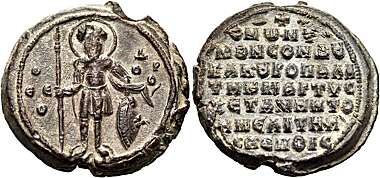
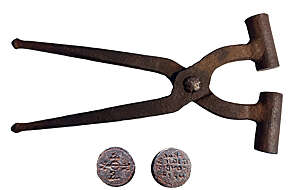
ロット 434. BYZANTINE SEALS. Basil, Excubitor, circa 7th century. Seal Boulloterion (Iron), 330mm x 133 mm; sealing area: 25mm. A plier-shaped implement used for pressing two-sided official or personal seals, usually in lead. This one consists of two 'S'-shaped parts: each consists of a long handle, with a conical end, that continues to a top bearing a cylinder with a die at its inner end, and a plain surface (which could serve as an anvil) at its outer end. These two handles are joined at the 'S' crossing by an iron bolt, allowing the boulloterion to be opened and closed. Its height is c. 330 mm from the handle ends to the top of the cylinders; its width ranges from 50 mm at the bottom to 133 at the top; the sealing area has a diameter of 25 mm. Sealing area: Obv. Cruciform monogram formed by the letters of ΘΕΟΤΟΚΕ ΒΟΗΘΕΙ (Mother of God please aid); all within a border of dots. Rev. +BAC/IΛΙΩ ΕΞ/ΚΟΥΒΙΤ/ΟΡΙ+ (the Excubitor, Basil) in four lines; all within a border of dots. For seals struck presumably from this boulloterion, see the example from the collection of Robert Hecht, Triton XI, 2008, 1122 and DNA 3, 2019, 442. For later boulloteria see: Nomos 37, 2025, 317 (dated to the 8th-9th century), Zacos Boulloterion 1 &; Zacos, Boulloterion 2 = Spink 135, 1999, Zacos III, 331 = Geneva p.13 (both dated in the 11th century), and Harvard 1951.31.6 (dated to 9th-12th century). For other Boulloteria, see Campagnolo-Pothitou &; Cheynet, Genéve p. 13, note 4. An extremely rare and exceptionally well-preserved boulloterion; possibly the earliest boulloterion known. Good very fine. From a collection in Switzerland acquired prior to 2005. Although the amount of lead seals that have survived from the Byzantine period is truly massive (regardless of the fact that their survival rate is extremely low), this is definitely not the case for the tools used to strike them, the Boulloteria. Fewer than 20 boulloteria are known to have survived, the majority of which are currently located and occasionally displayed in public institutions and museums, with only very few examples -including the present piece- currently in private hands. This extremely low survival rate is due to a few obvious problems: the survival rate of iron tools from antiquity is extremely low, due to iron's rapid oxidizing (i.e. they rust into dust); additionally, the boulloteria had a certain amount of iron which could easily be reused in order to be reforged to something more practical (like bougatza moulds and kefteda pans), especially as they were very personal items, which after the death of their owners - or the change in his titles - had no use as a tool, but their metal was certainly valuable. The survival of this boulloterion in such fine condition is thus a very pleasant surprise, especially as it is also one of the earliest known. The fact that two lead seals from this boulloterion have also survived is without any doubt truly extraordinary. The Excubitors were members of the imperial guard, a unit of immense strength and influence, especially in the 6th and 7th century. For a good discussion of how this implement was used, see Gary Vikan and John Nesbitt, Security in Byzantium: Locking, Sealing and Weighing. Dumbarton Oaks, Washington, D.C., 1980 (passim).
開始価格:
8'000 CHF
8'716 EUR
7'267 GBP
9'788 USD
四捨五入された近似値のみ日付:
2026/11/04
 consentmanager.net