ライブ入札に登録する
Stack’s Bowers and Ponterio Logo
ロット
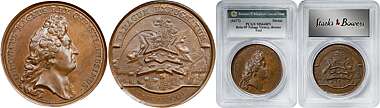
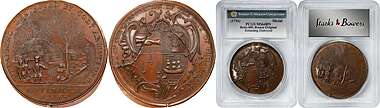
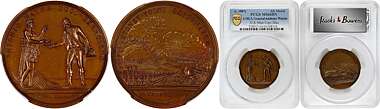
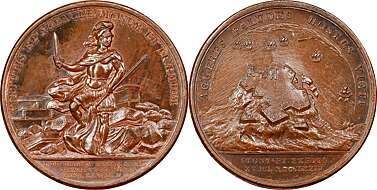
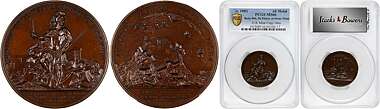
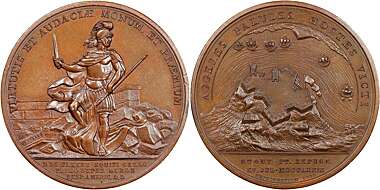
ロット 1001. 1677 Tobago Taken by Assault Medal. Betts-59A. Bronze. MS-64 BN (PCGS). 41.3 mm. One of the most magnificent designs of this series, showing a single mortar exploding at the heart of an exquisitely rendered star fort and a harbor full of ships in the foreground. Lustrous medium brown with original mint color still framing peripheral legends. A very choice example of this scarce and impressive medal.Unlike the action commemorated on Betts-52, the battle depicted on this medal really was a French victory, albeit a lucky one. A lucky mortar round happened to hit the Dutch powder magazine, destroying the Dutch fortification and killing the commander and more than 260 officers and enlisted men. The French took the island but were unable to hold it for a long duration. Ex A.H. Baldwin & Sons, Ltd., June 1969; John J. Ford, Jr.; our (Stack's) sale of the John J. Ford, Jr. Collection, Part XIII, January 2006, lot 746; Bill McKivor; Sydney F. Martin; our sale of the Sydney F. Martin Collection, Part IV, August 2023 Global Showcase Auction, lot 8019.
  • 開始価格:
    1 USD
    0 EUR
    0 GBP
    0 CHF

    四捨五入された近似値のみ日付: 2026/11/06
ロット
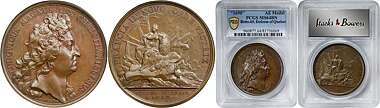
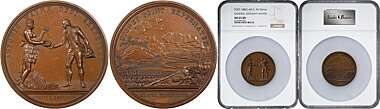
ロット 1002. 1690 Quebec Preserved Medal. Betts-69. Bronze. MS-64 BN (PCGS). 41.0 mm. Betts-69 was struck using several different obverse dies; this one has a short, sharp indent at the midpoint of the bust truncation and a single upturned hair curl at the front of the neck. Frosty to semi-reflective surfaces are mostly chestnut and autumn-orange brown on the obverse, revers a bit more warmly patinated in olive-brown. This piece shows unusually good eye appeal for this important type, represented by Betts numbers 68 through 73.Though a French medal on a Canadian subject, the commemorated event is thoroughly American: the 1690 attack was not from England but from Massachusetts, with the invading force consisting entirely of colonists under the command of Sir William Phips. Phips, the hero of the salvage expedition commemorated by Betts-67, became the first royal governor of Massachusetts in 1692 and oversaw the Salem Witch Trials.
  • 開始価格:
    1 USD
    0 EUR
    0 GBP
    0 CHF

    四捨五入された近似値のみ日付: 2026/11/06
ロット
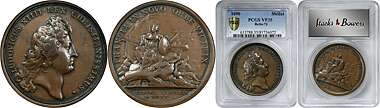
ロット 1003. 1690 Quebec Preserved Medal. Betts-73. Bronze. VF-35 (PCGS). 41.1 mm. Handsome glossy orange-brown surfaces with warmer olive-copper peripheral highlights. Evenly worn but never abused. The hallmark of the Betts-73 die pairing is the star at the end of the obverse legend, following CHRISTIANISSIMUS. This is a more affordable, yet highly attractive example of the type. Ex Dr. Ouellet, April 1984; our (Bowers and Merena's) Collections of Phillip Flannagan, Dr. Robert I. Hinkley, Dr. John C. Wong, and Tree Many Feathers sale, November 2001, lot 5202; Heritage's sale of the John W. Adams Collection, January 2013 FUN Signature Auction, lot 3638; Heritage's sale of the Costa Family Collection, Part III, May 2026 Certified American Tokens & Medals Showcase Auction, lot 53032.
  • 開始価格:
    1 USD
    0 EUR
    0 GBP
    0 CHF

    四捨五入された近似値のみ日付: 2026/11/06
ロット
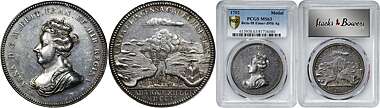
ロット 1004. 1702 German Copy of English Queen Anne Vigo Victory Medal. Betts-98, Eimer-395b. Silver. MS-63 (PCGS). 40.5 mm. A bit glossy with faint hairlines and a few light marks from ancient numismatic handling, yet presenting nicely at the Select Mint State grade level. The motifs are sharply struck and frosty, the fields with considerable reflectivity. Hints of champagne-pink peripheral iridescence provide further visual appeal. In his 2022 reference The Early Betts Medal Companion Christopher R. McDowell describes this type as:Only known in silver. Very rare. This unsigned medal is a copy of No. 97 by the ingenious German medalist Christian Wermuth (1661-1739). Ex Downey-Lepczyk sale of September 1987, lot 1100; Heritage's sale of the John W. Adams Collection, January 2013 FUN Signature Auction, lot 3675; Heritage's sale of the Costa Family Collection, Part III, May 2026 Certified American Tokens & Medals Showcase Auction, lot 53034.
  • 開始価格:
    1 USD
    0 EUR
    0 GBP
    0 CHF

    四捨五入された近似値のみ日付: 2026/11/06
ロット
ロット 1005. 1716 Happiness of France Medal. Adams S-5. Silver. Mint State. 42.8 mm. 35.90 grams. Plain edge. Smoky sandy-gray patina and peripheral charcoal-blue highlights give way to brighter antique gold, reddish-orange and steel blue iridescence as the surfaces dip into a light. The strike is sharp throughout, and there is also plenty of luster to greet the viewer as the medal is appreciated with the aid of direct lighting. A bit subdued to suggest a lower Mint State numeric grade, but free of rub, and with only minor handling marks that are buried in the toning. The reverse depiction of a cornucopia dumping coins led to a hopeful interpretation of this being related to the founding of John Law's Banque Generale in 1716, but Adams successfully sleuthed the real intent of this medal's reverse, which was to celebrate the "golden age" of France. We have offered a couple of bronze impressions from these dies in recent years; this is the first silver example, an old friend of our firm that we have handled on two other occasions going back 25 years. From the Jonathan H. Kagan Collection. Earlier from Sotheby's sale of the Duke of Northumberland Collection, December 1980, lot 306; our (Bowers and Merena's) sale of the Cabinet of Lucien M. LaRiviere. Part II, March 2001, lot 2045; our (Stack's) sale of the John J. Ford, Jr. Collection, Part XIII, January 2006, lot 618.
  • 開始価格:
    1 USD
    0 EUR
    0 GBP
    0 CHF

    四捨五入された近似値のみ日付: 2026/11/06
ロット
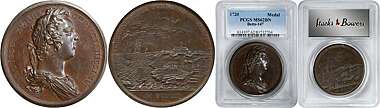
ロット 1006. 1720 Louisbourg Fortified Medal. Adult Bust. Betts-147. Bronze. MS-62 BN (PCGS). 41.6 mm. An attractive piece with dominant chestnut brown patina on the obverse, reverse a bit more deeply toned in olive-brown. There is a stain in the right obverse field - an ideal identifier for provenance purposes - the surfaces also with a bit of corrosion in isolated areas. Ex Henry Christensen, September 1967, lot 198; Heritage's sale of the John W. Adams Collection, January 2014 FUN Signature Sale, lot 3045; Heritage's sale of the Costa Family Collection, Part III, May 2026 Certified American Tokens & Medals Showcase Auction, lot 53035. The plate medal for the type in the 2022 Betts medal companion by Christopher R. McDowell, p. 275.
  • 開始価格:
    1 USD
    0 EUR
    0 GBP
    0 CHF

    四捨五入された近似値のみ日付: 2026/11/06
ロット
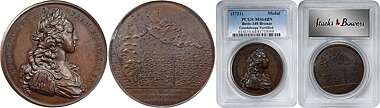
ロット 1007. 1721 Guadeloupe Fortified Medal. Betts-148. Bronze. MS-64 BN (PCGS). 41.5 mm. A genuinely elusive medal, far rarer than the Betts-listed Louis XIV medals that were spread far and wide when his successes were widely commemorated after his death. Nice chestnut and copper brown with hints of underlying rose and blue as well as strong frosty luster. Scattered little marks are seen, mostly in the expansive obverse field, but none are in any way distracting. The design of this medal features an interesting use of negative space, which is to say the reverse has none except in the exergue. This medal appeals to Betts and West Indies collectors, but also to collectors of maps on medals for its depiction of Guadeloupe. We sold Syd Martin's PCGS MS-63 BN for $840 in August 2023, as well as another PCGS MS-63 BN example for $720 in April 2025. This one is clearly superior to both. Ex World Art, December 1984; Heritage's sale of the John W. Adams Collection, January 2014 FUN Signature Auction, lot 3046; Heritage's sale of the Costa Family Collection, Part III, May 2026 Certified American Tokens & Medals Showcase Auction, lot 53036.
  • 開始価格:
    1 USD
    0 EUR
    0 GBP
    0 CHF

    四捨五入された近似値のみ日付: 2026/11/06
ロット
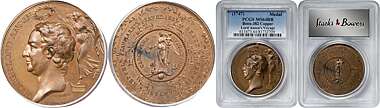
ロット 1008. 1747 French Fleet Defeated Off Cape Finisterre / Lord Anson's Voyage Around the World Medal. Betts-382, Eimer-616. Copper. MS-64 RB (PCGS). 43.4 mm. Edge markings, if any, not visible through the PCGS holder. Lightly toned in wisps of olive and steel-brown with plenty of warm mint orange color retained. Direct lighting calls forth not only vivid pink and blue undertones, but also appreciable semi-reflective qualities in the fields. Sharply struck, frosty in finish, and nicely composed despite the presence of a presence of a few faint, widely scattered spots. One of the most recognizable medals in the Betts series, the Anson medal was struck in large numbers to celebrate the four year (1740-1744) circumnavigation of the globe by Commodore George Anson. Pingo's classical design celebrates both Anson's circumnavigation of the globe and the later naval victory over the French fleet off Cape Finisterre, Spain. The captain of one of the ships involved in the circumnavigation, Vice Admiral John Campbell, had the distinction of having his name misspelled "CAMPHEL" on the original die, and later spelled incorrectly again in a second die, this time omitting the final L of his last name, as on this specimen. This fix was apparently close enough, as a perfect die was never produced.Examples of this type were struck in gold, silver and copper. The gold specimens were undoubtedly reserved for Anson and the six officers who commanded his ships during the circumnavigation. Silver specimens would have gone to rank and file sailors and VIPs connected either with the battle off Cape Finisterre or the earlier circumnavigation. The copper specimens were likely made available to the public and, while the number of survivors suggests a fairly large distribution, precious few have come down to the present day with the quality and eye appeal offered here. Ex Leonard Finn, December 1983; Heritage's sale of the John W. Adams Collection, January 2014 FUN Signature Auction, lot 3059; Heritage's sale of Costa Family Collection, Part III, May 2026 Certified American Tokens & Medals Showcase Auction, lot 53037.
  • 開始価格:
    1 USD
    0 EUR
    0 GBP
    0 CHF

    四捨五入された近似値のみ日付: 2026/11/06
ロット
ロット 1009. "1756" Kittanning Destroyed Medal. Restrike. Betts-400. Bronze. MS-64 BN (PCGS). 45.6 mm. A superb example, struck at the U.S. Mint from a seriously advanced state of the dies. Choice mahogany patina with superb eye appeal and no defects. The reverse is covered with a network of cracks, and the obverse shows a heavy crack from 12 o'clock. (PCGS has mounted this medal backwards in the holder.) These dies were the very first medal dies produced in what would become the United States, and by the mid-19th century they had nearly come to pieces yet remained in use producing restrikes like this at the Philadelphia Mint. In an even later state, the central swelling would become too advanced to even leave detail on a hockey puck-thick planchet. This one's eye appeal and eye-catching die state make it particularly desirable, as the thickness of these late state pieces made them particularly prone to damage and wear. Ex our (Bowers and Ruddy's) sale of the Springfield Collection, Part II, December 1981, lot 4191; Anthony Terranova, April 2017; Sydney F. Martin; our sale of the Sydney F. Martin Collection, Part IV, August 2023 Global Showcase Auction, lot 8085.
  • 開始価格:
    1 USD
    0 EUR
    0 GBP
    0 CHF

    四捨五入された近似値のみ日付: 2026/11/06
ロット
ロット 1010. 1758 Oswego Captured Medal. Betts-415. Silver. EF-40 (PCGS). 30.8 mm. 175.6 grains. Reeded edge. The only medal in the French and Indian War series that commemorates a French victory - Montcalm's successful reduction and capture of Fort Oswego in upstate New York. Ideal deep antique gray toning show undertones of gold. Scattered with light marks, but free of major defects and offering superb visual appeal. The Oswego Captured medal is sometimes collected alongside the Franco-American jeton series, owing to its French origin and jeton-like size. But this medal also seems to have been used as a jeton: most are circulated, the edge is always reeded, and plentiful contact marks are the norm. Once considered a classic and desirable rarity, this medal has been underappreciated in recent years. Ex John Kraljevich Americana, August 2019; Sydney F. Martin; our sale of the Sydney F. Martin Collection, Part IV, August 2023 Global Showcase Auction, lot 8097; our June 2026 Showcase Auction, lot 1001.
  • 開始価格:
    1 USD
    0 EUR
    0 GBP
    0 CHF

    四捨五入された近似値のみ日付: 2026/11/06
ロット
ロット 1011. 1758 Goree Taken Medal. MI-691/415. Copper. MS-65 RB (PCGS). 39.5 mm. Edge lettered WILLIAM PITT ADMINISTRING. Strong luster and some mint color mix with mellowed tones in the fields. Some hairlines are fairly prominent on both sides, but the overall visual appeal is very nice. This is a very scarce medal and is rarely seen with mint color. Ex Jacques Schulman, June 1971; John J. Ford, Jr.; our (Stack's) sale of the John J. Ford, Jr. Collection, Part XIV, May 2006, lot 129; Sydney F. Martin; our sale of the Sydney F. Martin Collection, Part IV, August 2023 Global Showcase Auction, lot 8096.
  • 開始価格:
    1 USD
    0 EUR
    0 GBP
    0 CHF

    四捨五入された近似値のみ日付: 2026/11/06
ロット
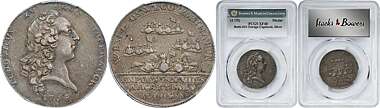
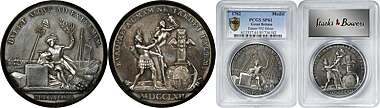
ロット 1012. 1762 Peace of Europe Medal. Betts-442, Eimer-702. Silver. Specimen-61 (PCGS). 45.0 mm. Generally brilliant silver surfaces, but with subtle iridescent toning hugging the design elements on both sides. Nicely lustrous, hairlined on both sides, sharp and attractive. Struck from dies by Johann Georg Holtzhey to mark the resumption of European commerce after the end of hostilities on the Continent. The iconic native princess representing America lifts Fame to place an emblem of peace atop the stand of arms on the obverse. This medal is only seen in silver, usually in this kind of quality. From Heritage's sale of the John W. Adams Collection of French and Indian War Medals, January 2012 FUN Signature Auction, lot 3930; Heritage's sale of the Costa Family Collection, Part III, May 2026 Certified American Tokens & Medals Showcase Auction, lot 53045.
  • 開始価格:
    1 USD
    0 EUR
    0 GBP
    0 CHF

    四捨五入された近似値のみ日付: 2026/11/06
ロット
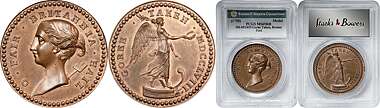
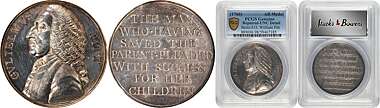
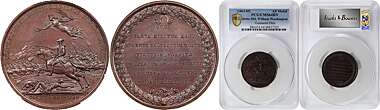
ロット 1013. Undated (1863) William Pitt Medal. Betts-515. Silver. Unc Details--Repaired (PCGS). 40.4 mm. Sharply struck and crisp, the minimally toned surfaces are nicely semi-reflective in appearance. Hairlines are noted, however, which join several marks over and before Pitt's cheek and perhaps a bit too much "brightness" to support a Details grade, as returned by PCGS. The Betts listings have been the source of misinformation and confusion for years. All pieces categorized as Betts-515 were actually struck in New York in 1863. Among those cataloged as Betts-516, with the T. PINGO F. signature on the bust, some were struck in 1766, but others from a different die with a crude rendition of the signature were also made in New York in 1863. An article in the MCA Advisory issue of January/February 2016 by our own John Kraljevich lays out the die marriages of this small but intricate series. According to Edward Groh, writing in the American Journal of Numismatics in 1901, this piece was made "at No. 29 Rose Street on a large screw press, operated by a German, in the year 1863."
  • 開始価格:
    1 USD
    0 EUR
    0 GBP
    0 CHF

    四捨五入された近似値のみ日付: 2026/11/06
ロット
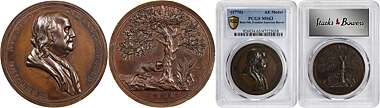
ロット 1014. "1776" (ca. 1807) Benjamin Franklin American Beaver Medal. Betts-546, Julian CM-8, Greenslet GM-80. Bronze. MS-63 (PCGS). 40.2 mm. Lustrous light brown and gold over subtly reflective surfaces. This piece was struck early in the life of this issue and boasts a much different look than the later strikes from these dies that exhibit heavy mahogany bronzing. The detail on both sides is superb, and no serious flaws are noted. Magnified scrutiny finds some trivial hairlines and a bit of harmless encrustation within the leaves of the tree, but the eye appeal is excellent.Influential Philadelphian Joseph Sansom conceived this medal along with three others as a series celebrating the History of the American Revolution, struck at the U.S. Mint between 1805 and 1808. Of the four medals struck in the series, this was the third medal completed and seems to have been struck in the autumn of 1807. Newspaper advertisements first announced its production in December 1807, namechecking George Clymer and Dr. Benjamin Rush, who received specimens as surviving signers of the Declaration of Independence living in Philadelphia. The reverse design is described as "the American Beaver nibbling at the Overshadowing Oak of the British Power on the Western Continent" in a newspaper piece that appeared in Philadelphia on December 1 and Annapolis on December 10. Another advertisement, of December 14, 1807, gives the brief explanatory description including "upon the Declaration of Independence," which could certainly have been the intent of the beaver just beginning to gnaw at the tree. The beaver would ultimately succeed, but at the time of the signing of the Declaration, there was still a long road ahead.
  • 開始価格:
    1 USD
    0 EUR
    0 GBP
    0 CHF

    四捨五入された近似値のみ日付: 2026/11/06
ロット
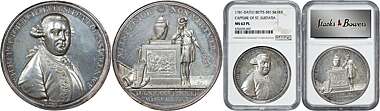
ロット 1015. 1781 Death of Admiral Crul at Saint Eustatius Medal. Betts-581. Silver. MS-62 PL (NGC). 45.0 mm. Highly reflective in finish, this minimally toned example also sports pale silver and iridescent pale pink overtones. Fully struck with only wispy handling marks precluding a higher numeric grade. Crul became a martyr to the Dutch and the American cause after his death on February 4, 1781, in the aftermath of the British attack on St. Eustatia. The Dutch island was the principal West Indies entrepot for goods smuggled from the Netherlands for the American war effort. Ex J. Schulman, August 1958; our November 2020 Auction, lot 3019.
  • 開始価格:
    1 USD
    0 EUR
    0 GBP
    0 CHF

    四捨五入された近似値のみ日付: 2026/11/06
ロット
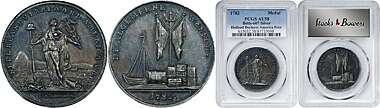
ロット 1016. 1782 Holland Declares America Free Medal. Betts-607. Silver. AU-58 (PCGS). 34.2 mm. Attractive steel and pewter gray with iridescent undertones. There is some light roughness in the planchet, mostly around the peripheries. Scattered hairlines and minor marks are consistent with the assigned grade. Certainly an appealing specimen of this scarce medal by Lageman. From Heritage's sale of the Skyler Liechty Collection, January 2014 FUN Signature Auction, lot 3180; Heritage's sale of the Costa Family Collection, Part III, May 2026 Certified American Tokens & Medals Showcase Auction, lot 53057.
  • 開始価格:
    1 USD
    0 EUR
    0 GBP
    0 CHF

    四捨五入された近似値のみ日付: 2026/11/06
ロット
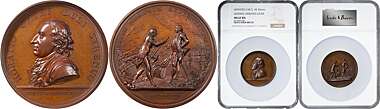
ロット 1017. "1777" (ca. 1885) General Horatio Gates at Saratoga Medal. Original Obverse, U.S. Mint Copy Reverse. Betts-557, Julian MI-2. Copper, Bronzed. MS-67 BN (NGC). 55.7 mm. Beautiful autumn-orange brown fields contrast with somewhat darker reddish-copper and mahogany devices. Impressively preserved with premium eye appeal and no problems of note. This variety, a product of the Philadelphia Mint, was struck from the original Paris obverse die and a replacement reverse die accomplished by William Barber after 1885. The new reverse may be discerned by the more modern typeface of the legends and its lack of a die flaw near 3 o'clock. According to the cataloger of the NASCA Kessler-Spangenberger sale, one of the most important reference catalogs for American medals, only 76 specimens were struck in copper from these dies. Survivors remain important and sought-after rarities in the Mint medal and Comitia Americana series. From the Henry Mitchell Collection. Earlier ex NASCA's sale of July 1981, lot 37; our (Bowers and Merena's) sale of the Cabinet of Lucien M. LaRiviere, Part III May 2001, lot 1064; John Kraljevich, April 2009.
  • 開始価格:
    1 USD
    0 EUR
    0 GBP
    0 CHF

    四捨五入された近似値のみ日付: 2026/11/06
ロット
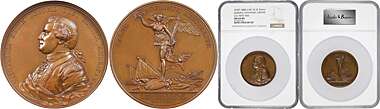
ロット 1018. "1779" (post-1887) General Anthony Wayne at Stony Point Medal. U.S. Mint Copy Dies. Betts-565, Julian MI-3. Bronze. MS-66 BN (PCGS). 53.0 mm. The Anthony Wayne medal is one of the rarities of the Comitia Americana series as the Paris Mint did not produce restrikes of this issue and the originals are great rarities, indeed. Just 47 are believed to have been made to meet collector demand in the late 19th century, and the premium Gem offered here would be very difficult to improve upon. Bathed in beautiful light autumn-orange and olive-brown patina, both sides are fully struck with a smooth, frosty to modestly semi-reflective finish.
  • 開始価格:
    1 USD
    0 EUR
    0 GBP
    0 CHF

    四捨五入された近似値のみ日付: 2026/11/06
ロット
ロット 1019. "1779" (post-1887) General Anthony Wayne at Stony Point Medal. U.S. Mint Copy Dies. Betts-565, Julian MI-3. Bronze. MS-65 BN (NGC). 52.8 mm. Beautiful Gem Mint State quality with rich orange and olive-brown patina overall. Our multiple offerings in this sale notwithstanding, this is a rare 19th century strike of one of the key entries in the Comitia Americana series. From the Henry Mitchell Collection. Earlier ex Presidential Coin and Antique Co., Inc.'s Nathan Eglit Collection sale, June 1992, lot 308; John Kraljevich, July 2009.
  • 開始価格:
    1 USD
    0 EUR
    0 GBP
    0 CHF

    四捨五入された近似値のみ日付: 2026/11/06
ロット
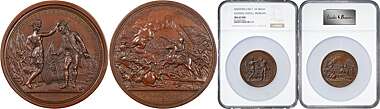
ロット 1020. Electrotype Copy 1779 François-Louis Teissèdre de Fleury Assault on Stony Point Medal. Original Dies. After Betts-566. Copper. As Made. 46.5 mm. 50.37 grams. This piece is well-executed with sharp design elements on both sides. The texture is frosty and smooth, the color warm medium brown with mottled charcoal-olive peripheral highlights. The Adams-Bentley census (2007) lists only five original de Fleury medals in silver, and nine in bronze. Ten of the latter are known to us as of this writing, only eight of which are held privately. No wonder, then, that high quality copies such as this are always in demand among collectors. From the Henry Mitchell Collection. Purchased from John Kraljevich, May 2012.
  • 開始価格:
    1 USD
    0 EUR
    0 GBP
    0 CHF

    四捨五入された近似値のみ日付: 2026/11/06
ロット
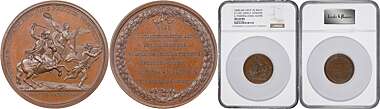
ロット 1021. "1880" (1880-1904) Francois-Louis Teissedre de Fleury, Assault on Stony Point Medal. U.S. Mint Copy Dies. Betts-566, Julian MI-4. Bronze. MS-66 (PCGS). 46.0 mm. Lustrous and lightly reflective, with rich copper-brown surfaces highlighted with autumn-orange and mahogany. Double struck to bring up the exacting relief, even the most intricate design elements are fully rendered and crisp. Very attractive, though a few trivial blemishes are seen, the most readily evident of which is a small, out of the way carbon spot at the obverse border between the letters RT in VIRTUTIS. One of the most elusive Philadelphia Mint medals of the Comitia Americana series, with a mintage of just 45 pieces between 1882 and 1904. The copy dies were prepared in 1880 but not put into use until the second half of 1882; the initial mintage of 20 must have sold out quickly, as two more medals were struck the following year.According to Julian, Mint Superintendent A. Loudon Snowden borrowed a silver original De Fleury medal from a New York collector named Robert Stuart in March 1880. After new dies were produced, copying their central motifs from Stuart's medal but composed with new punches and lettering, "Snowden returned the silver medal along with a newly-struck bronze copy on June 24, 1880." Interestingly, no bronze medal was listed on the 1880 roster of medals manufactured at the Philadelphia Mint, suggesting that those mintage figures can perhaps be taken with a grain of salt. Regardless of the precise figure, this is a very scarce U.S. Mint medal, one that challenges even those collectors who have decided to forego acquisition of a Paris original.
  • 開始価格:
    1 USD
    0 EUR
    0 GBP
    0 CHF

    四捨五入された近似値のみ日付: 2026/11/06
ロット
ロット 1022. "1880" (1880-1904) Francois-Louis Teissedre de Fleury, Assault on Stony Point Medal. U.S. Mint Copy Dies. Betts-566, Julian MI-4. Copper. Mint State. 46.0 mm, 4.3 to 4.4 mm thick. Plain square edge. Lustrous and lightly reflective, with light brown surfaces highlighted with rose and gold. Double struck to bring up the exacting relief, with some doubling seen among the reverse legends. Very attractive, though a few trivial marks are noted, including a couple on the raised rim above the letter MI in PRAEMIUM. A spot of corrosion is hidden on the edge below 3 o'clock, relative to the obverse, but invisible from either side. One of the most elusive Philadelphia Mint medals of the Comitia Americana series, with a mintage of just 45 between 1882 and 1904. From the Henry Mitchell Collection. Earlier ex Dr. Paul Patterson, June 1986; John W. Adams; our sale of the John W. Adams Collection, November 2019 Baltimore Auction, lot 2027.
  • 開始価格:
    1 USD
    0 EUR
    0 GBP
    0 CHF

    四捨五入された近似値のみ日付: 2026/11/06
ロット
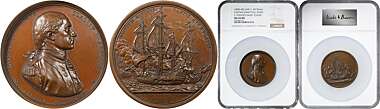
ロット 1023. "1779" (1845-1860) Captain John Paul Jones, Bonhomme Richard vs. Serapis Medal. Paris Mint Restrike from Original Dies. Betts-568. Copper, Bronzed. MS-65 BN (NGC). 56.9 mm. Edge marked (pointing hand) CUIVRE. Die rust identifies the original dies, rounded rims are wide with the reverse showing hand-trimmed wire edge at top. Deep reddish-mahogany patina. From the Henry Mitchell Collection. Earlier from our (Stack's) Rich Uhrich Collection sale, February 2008, lot 3599.
  • 開始価格:
    1 USD
    0 EUR
    0 GBP
    0 CHF

    四捨五入された近似値のみ日付: 2026/11/06
ロット
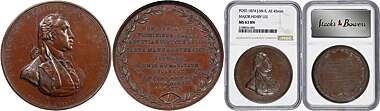
ロット 1024. "1779" (post-1874) Henry Lee at Paulus Hook Medal. Original Obverse, U.S. Mint Copy Reverse. Betts-575, Julian MI-5. Copper, Bronzed. MS-63 BN (NGC). 45.7 mm. Rich mahogany bronzed surfaces are typical of U.S. Mint productions in copper of this era. Nicely struck and well preserved, showing not just the fine details of Wright's obverse, but each of the relics of the die's survival and recovery: scattered rust, the substantial break, the raised file marks, and the ground repairs to the buckling behind the head. Choice and problem free, a nicer than usual specimen of this scarce restrike. Through 1904, just 66 bronze Lee medals were struck, including those with the blank reverse die and those struck with a new copy obverse die produced upon the failure of Wright's original obverse. The usual mintage given for this die marriage is a mere 35 pieces, which fits with its rarity in the market today. From the Henry Mitchell Collection. Earlier ex Presidential Coin and Antique Co., Inc.'s Arlie Slabaugh Collections sale, June 2001, lot 280; John Kraljevich, July 2009.
  • 開始価格:
    1 USD
    0 EUR
    0 GBP
    0 CHF

    四捨五入された近似値のみ日付: 2026/11/06
ロット
ロット 1025. "1781" (post-1839) General Daniel Morgan, Battle of the Cowpens Medal. Dies by Jean-Jacques Barre, after Dupre. Betts-593, Julian MI-7. Bronze. MS-63 BN (NGC). 56.0 mm. An endearing example of one of the most celebrated early American medals, struck from the dies faithfully duplicated in Paris for use by the Philadelphia Mint. Rich mahogany-brown patina overall, the finish is satiny, the surfaces with only small, widely scattered carbon flecks precluding a higher numeric grade.As the era of the American Revolution continues to be celebrated through the semi-quincentennial and beyond, the 1781 Battle of Cowpens is worth particular recognition. Though small and fought in an isolated clearing in South Carolina, the battle spurred the Continental Congress to award three medals, of which this type was the only one awarded to a general. The remarkable story of the loss and replacement of General Morgan's own gold medal has been presented to a worldwide audience after our record-setting sale of the gold medal given to Morgan's heirs in 1839, the very medal that caused these dies by Barre to be made in the first place. As that medal's fame continues to soar, examples like this one will continue to see significant demand. From the Henry Mitchell Collection. Purchased from John Kraljevich, February 2008.
  • 開始価格:
    1 USD
    0 EUR
    0 GBP
    0 CHF

    四捨五入された近似値のみ日付: 2026/11/06
ロット
ロット 1026. "1781" (post-1789) Lieutenant Colonel William Washington, Battle of the Cowpens Medal. Original Paris Mint Striking. Betts-594. Bronze. Unc Details--Cleaned (NGC). 46.0 mm. Plain edge. Sharply struck and crisp, this piece has considerable eye appeal relative to the assigned grade. The surfaces show some nice gloss, as well as plenty of handsome copper-rose color, although they are a tad bright with an intermingling of curious olive, gold and powder blue to further explain the NGC qualifier. The rims have been neatly filed, as made, to obscure the crumbling at the die edge. This is a relatively plentiful Comitia Americana medal in original format; the dies remained at the Paris Mint for decades, and demand swelled early for strikes from these dies from collectors on both sides of the Atlantic. Those restrikes made after 1842 are marked on the edge, and any made before then are generally deemed "originals," distinguished by age only by difficult to see aspects like the concavity of the edge. The edge of this piece is relatively square, designating it (along with the filed rims) as probably not made in 1789, but just how much later it may have been struck can only be speculated upon. Those made after 1842, in addition to CUIVRE and a privy mark on the edge, are generally highly reflective and have perfectly square edges. From the Henry Mitchell Collection.
  • 開始価格:
    1 USD
    0 EUR
    0 GBP
    0 CHF

    四捨五入された近似値のみ日付: 2026/11/06
ロット
ロット 1027. "1781" (post-1863) Lieutenant Colonel William Washington, Battle of the Cowpens Medal. U.S. Mint Gunmetal Dies. Betts-594, Julian MI-8. Copper. Plain Edge. MS-64 BN (PCGS). 45.0 mm. Beautiful deep mahogany with lustrous surfaces, glossy in some areas, frosty in others. Ideally detailed and very nicely preserved. The "gunmetal dies" strikes of the William Washington, John Paul Jones, Washington Before Boston, and John Eager Howard represent the very first American-made strikings of these Comitia Americana medals, breaking the Paris Mint monopoly on selling restrikes to avid collectors in the mid-19th century. This one was lovingly cared for by its initial and subsequent owners and splendidly represents the type From our Spring 2024 Auction, April, lot 2024.
  • 開始価格:
    1 USD
    0 EUR
    0 GBP
    0 CHF

    四捨五入された近似値のみ日付: 2026/11/06
ロット
ロット 1028. "1781" (1845-1860) Lieutenant Colonel John Eager Howard, Battle of the Cowpens Medal. Paris Mint Restrike from Original Dies. Betts-595. Bronze. MS-66 BN (NGC). 46.4 mm. Edge marked (pointing hand) CUIVRE, indicating that this medal was struck at the Paris Mint between the years given. Exceptionally choice for the type with subtly reflective fields supporting frosty, fully struck design elements. A lone, minor carbon in the upper right obverse field is noted, but otherwise this premium quality Gem approaches numismatic perfection. From the Henry Mitchell Collection. Earlier ex Presidential Coin and Antique Co., Inc.'s Dan Hansen Collection sale, November 2002, lot 451; John Kraljevich, July 2009.
  • 開始価格:
    1 USD
    0 EUR
    0 GBP
    0 CHF

    四捨五入された近似値のみ日付: 2026/11/06
ロット
ロット 1029. "1781" (post-1886) General Nathaniel Greene at Eutaw Springs Medal. U.S. Mint Dies. Betts-597, Julian MI-10. Copper, Bronzed. MS-64 BN (NGC). 56.03 mm. One of just 40 struck from the U.S. Mint copy dies, patterned on the nearly uncollectible originals by Dupre. Exceptional orange-tan bronzed patina over smooth, reflective surfaces. The surfaces and patina of this piece are a perfect exemplar of what these should look like, a decided contrast from the peanut bronze 20th century strikings that occasionally end up misinterpreted as 19th century strikes despite looking nothing like them. Multiply struck to bring up high relief, with some doubling evident in the obverse legends. Superb aesthetic appeal, with ideal color and no issues more significant than the occasional light mark or wispy hairline. This is a great looking example of a scarce, important medal.With only 24 originals struck in 1787, and no restrikes ever made from the original dies, most collectors depend upon this issue to fill the Nathaniel Greene hole in their Comitia Americana collections. It would be difficult to replace or improve upon this one. From the Henry Mitchell Collection. Earlier ex Presidential Coin and Antique Co., Inc., July 17, 1990; our Chicago ANA Auction of August 2013, lot 1031.
  • 開始価格:
    1 USD
    0 EUR
    0 GBP
    0 CHF

    四捨五入された近似値のみ日付: 2026/11/06
ロット
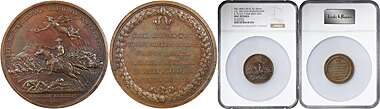
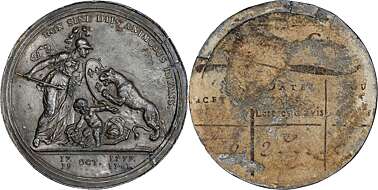
ロット 1030. "1781" (ca. March 1783) Libertas Americana Medal. Reverse Cliché. Original. Workshop of Augustin Dupre. As Betts-615. White Metal. Repaired. 48.1 mm, 0.7 mm to 1.6 mm thick. 191.3 grains. Called somewhat mishandled by John Ford while in his collection, as late as our June 2022 offering an arc of the outer rim of this piece was broken away from roughly 2 o'clock to 4:30. Since the original broken-off piece remained with the item all along, it has now been reattached through skillful repair, creating a pleasing whole during in-hand appreciation. The surfaces are deep gray and pleasing, original and attractive despite assorted marks, some old wax that remains present, and as-made surface roughness. The backing paper is a part-printed scrap, perhaps a bill of some sort, upon which the words and others are visible, along with a manuscript note.Despite the repair, this is a specimen of resounding historical importance, produced for Franklin's personal inspection as a final draft of the finished but as yet unhardened reverse die of the Libertas Americana medal. It was apparently this state, indeed a cliche essentially identical to this one, that Franklin sent to Sir William Jones in March 1783 with a note stating, "the engraving of my medal, which you know was projected before the peace, is but just finished. None are yet struck in hard medal, but will be in a few days." Unhardened dies are incredibly susceptible to damage, as 18th century die steel (and modern steel today) is brittle before it is hardened by quenching. Once a die is hardened, modification becomes very difficult, so if changes need to be made, they need to be done in that fragile, unhardened state. Engravers in major mints - Paris especially - were accustomed to making soft metal impressions as something of a proofreading copy, enabling the negative die to be viewed in the positive in rough draft form. Wax impressions were liable to leave bits of wax in the interstices of design elements, thus engravers settled upon tin (usually called "white metal" in modern numismatic circles) as the best medium. Tin melts at 450 degrees Fahrenheit, a low enough melting point to be accomplished in any small workshop. A ladle full of molten tin poured onto a surface will cool and harden fairly quickly, but it will remain soft long enough that a die can be easily pushed into it by hand, leaving a relatively durable impression in medal. Most often, medalists would find a piece of scrap paper - a note, a newspaper, a book page - to pour the tin atop, thus preventing their workspace from getting scorched and making the tin sheet somewhat easier to lift and trim. These splashers were not intended to be medals, or even permanent, but simply a temporary way to display the state of the die in the positive before its devices were rendered immovable. Each was personally crafted by the engraver in his shop.In the case of the Comitia Americana medals, the epreuves made by Duvivier, Dupre, and Gatteaux were ultimately intended to be viewed and handled by themselves and those close to the process. Benjamin Franklin's first experience with this form appears to have been his review the epreuves of the De Fleury medal, made between April 20 and May 4, 1780, prior to his recommendations regarding the lettering in that medal's obverse exergue. Engraver Augustin Dupre retained many of his splashers in his personal collection, some of which found their way into institutions in France and the United States. Thomas Jefferson used cliches as a spendthrift (and lightweight) way to collect all the medals of the Comitia Americana series, assembling a set for himself and another for his Virginia countryman James Madison. The exact history of this cliche is unknown, but its rarity is clear. The only other Libertas Americana reverse cliche from this finished state in private hands is the framed and inscribed piece last sold in our August 2012 Philadelphia ANA Auction, though we would not be surprised if at least a few exist, unrecognized. Ex Ted Craige collection; Ted Craige estate, October 4, 1982; John J. Ford, Jr.; our (Stack's) sale of the John J. Ford, Jr. Collection, Part XIV, May 2006, lot 288; our sale of the Cardinal Collection Educational Foundation, June 2022 Auction, lot 1014. Extremely Rare Libertas Americana Reverse Cliché One of Just Two Known from the Completed Die
  • 開始価格:
    1 USD
    0 EUR
    0 GBP
    0 CHF

    四捨五入された近似値のみ日付: 2026/11/06
ロット
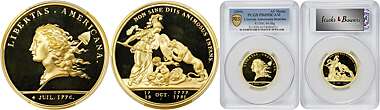
ロット 1031. "1781" (2000) Libertas Americana Medal. Modern Paris Mint Dies. Gold. No. 041/500. Proof-69 Deep Cameo (PCGS). With Original Case. 45.96 mm. 64.06 grams. As struck and visually stunning. Accompanied by the original case, cardboard box, descriptive card, and Certificate of Authenticity as issued by Monnaie de Paris. (Total: 1 medal; 1 case) From the Mack C. Chase Collection.
  • 開始価格:
    1 USD
    0 EUR
    0 GBP
    0 CHF

    四捨五入された近似値のみ日付: 2026/11/06
ロット
ロット 1032. "1814" Major General Peter B. Porter Medal. Original Dies. Julian MI-18. White Metal. Unc Details--Bent (PCGS). 64.5 mm. Brilliant light silver gray with deep reflectivity in the fields. Slight friction seen on the high points of both sides, especially light hairlines, scattered minor contact marks including a cloud of tiny nicks in the left reverse field and some scratches in the right reverse field. Quite nicely preserved for this composition, free of rim bruises and retaining a nice mirrored appearance. Collaring mark or "witness line" at precisely 12 o'clock, crisp early die state congruent to the earliest known strikings. A specimen of this medal in white metal in the Ford Collection sold for $3,600. At the time, the Ford cataloger noted a population of five specimens. A prize for Mint medal and War of 1812 aficionados. From Paul Bosco's sale of November 2000, lot 645; our (Stack's) Americana Sale of January 2009, lot 5580.
  • 開始価格:
    1 USD
    0 EUR
    0 GBP
    0 CHF

    四捨五入された近似値のみ日付: 2026/11/06
ロット
ロット 1033. "1814" Brigadier General Eleazer W. Ripley Medal. Julian MI-19. Copper, Bronzed. MS-65 BN (NGC). 65.0 mm. Beautiful reddish-mahogany brown patina blankets both sides of this smartly impressed, frosty to semi-reflective example. Carefully preserved and free of troublesome blemishes. Due to numerous delays for reasons that included Ripley's refusal to furnish a profile portrait of himself and dispute over his part in the two battles of Erie fought in 1814, the dies for this type were not finished until 1836, with the gold medal finally struck in March of 1838. From the Henry Mitchell Collection.
  • 開始価格:
    1 USD
    0 EUR
    0 GBP
    0 CHF

    四捨五入された近似値のみ日付: 2026/11/06
ロット
ロット 1034. "1818" Governor Isaac Shelby, Battle of the Thames Medal. Original. Julian MI-21. White Metal. AU-55 (NGC). 61.5 mm. Deep pewter gray with lighter silver gray tones at obverse periphery and bright reflective luster remaining around the reverse. The central obverse shows wear, and some scattered marks are seen, including a light rim bruise at 5 o'clock. The reverse is nicer, with few marks and good detail in the intricate battle scene. A rare medal, one of just a handful known of this design in white metal. The white metal strikings of War of 1812 medals date to the earliest era of the medals' production, in this case sometime between 1822 when the dies were finished and 1824 when the gold striking was presented to Shelby himself. White metal strikings, which cost very little at the time, were distributed by the awardee to friends and those involved in the battle, but generally only very few were struck, perhaps a dozen or two. This piece shows the collaring mark at 12 o'clock that is a hallmark of originals. This medal, though worn, is an earlier and rarer form than the beautiful copper examples struck for collectors from these dies in the decades that would follow. From the Henry Mitchell Collection. Earlier from our (Stack's) New York Americana Sale of January 2010, lot 4777; our Philadelphia ANA Auction of August 2012, lot 4124.
  • 開始価格:
    1 USD
    0 EUR
    0 GBP
    0 CHF

    四捨五入された近似値のみ日付: 2026/11/06
ロット
ロット 1035. "1848" Major General Zachary Taylor, Battle of Buena Vista Medal. Julian MI-24. Copper, Bronzed. MS-63 BN (NGC). 89.5 mm. Outstanding autumn-orange and mahogany-brown surfaces exhibit a hard frosty finish from the dies. Overall smooth and highly appealing, a few widely scattered blemishes hardly detract, especially since none are singularly distracting. One of the most impressive types in the entire United States Mint medal series, with a remarkably detailed battle scene from the Mexican-American War accomplished by Charles Cushing Wright dominating the reverse. From the Henry Mitchell Collection. Earlier from Presidential Coin and Antique Co., Inc.'s Benj Fauver Collections sale, July 2006, lot 338.
  • 開始価格:
    1 USD
    0 EUR
    0 GBP
    0 CHF

    四捨五入された近似値のみ日付: 2026/11/06
ロット
ロット 1036. Undated (1847) State of Louisiana Medal to Major General Zachary Taylor. Julian MI-25. Bronze. MS-61 BN (NGC). 76.3 mm. Sharply struck on a thick planchet. Both sides exhibit blended autumn-orange and olive-brown patina. Scattered field marks and a few faint carbon spots are consistent with the assigned grade, but most are singularly inconspicuous during in-hand appreciation. There is plenty of eye appeal, as one would perhaps expect for such a large-size medal with outstanding design features.Produced in antebellum New Orleans through contract with the firm of H[orace] E. Baldwin & Co., silversmiths, the dies were created by America's most famed medalist of the period - Charles Cushing Wright - with the design assistance of New Yorker Peter Paul Duggan, an historian and professor of drawing at New York's Free Academy. The same design team accomplished the Washington Allston medal struck by the Mint in this era. The military scene on the reverse is reminiscent of the finest work of Dupre or Furst and is glorious in its fine detail. It is unclear if H.E. Baldwin & Co. had the means to strike such a substantial medal themselves or subcontracted its actual coining.Taylor received a gold striking and at least one in silver. Other silver medals were presented to Taylor's staff, while copper examples like this were probably either sold to collectors or distributed to other VIPs. Today, the silver and copper medals are similarly rare. In the last 20 years (including the January 2005 Ford sale), we've offered a silver example on seven occasions, including two individual medals in the Ford sale and four total offerings of two other medals since. Ford also owned two copper specimens, and we've sold seven other copper ones in the 20 years since, not counting the one in the present sale. From the Henry Mitchell Collection. Earlier from Presidential Coin and Antique Co., Inc.'s Benj Fauver Collections sale, July 2006, lot 339.
  • 開始価格:
    1 USD
    0 EUR
    0 GBP
    0 CHF

    四捨五入された近似値のみ日付: 2026/11/06
ロット
ロット 1037. 1849 Lieutenant Colonel Bliss, Mexican-American War Medal. Julian MI-28. Bronze. MS-61 BN (NGC). 70.5 mm. Perhaps the rarest entry in the Julian Military medal series for the Mexican-American War. Superb choice chocolate brown with glossy surfaces and hints of pale blue. Ideal surface quality, a single tiny mark is noted on Bliss's jaw, minor rim bruise above the letters TA in VISTA on the reverse. The last specimen of this medal we offered, in our June 2026 Showcase Auction, brought $5,368. In total our online archives going back at least 20 years include only three entries for MI-28, including an earlier appearance of the specimen offered here. Rare. From the Henry Mitchell Collection. Earlier from our Baltimore Auction of March 2014, lot 28.
  • 開始価格:
    1 USD
    0 EUR
    0 GBP
    0 CHF

    四捨五入された近似値のみ日付: 2026/11/06
ロット
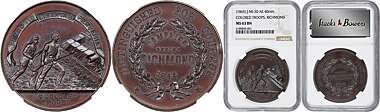
ロット 1038. 1864 U.S. Colored Troops Before Richmond Medal. Julian MI-30. Copper, Bronzed. MS-63 BN (NGC). 40.0 mm. A classic rarity in the U.S. Mint's military medal series, and represented here by a handsome piece dressed in dominant mahogany-brown patina. Direct lighting calls forth pale iridescent undertones of golden-apricot and powder blue, as well as semi-reflective tendencies from the fields. Fully struck and otherwise choice, a minor reverse edge bruise just before 3 o'clock is noted. Our last offering of a bronze example, in our Summer 2022 Global Showcase Auction, brought $12,600. An awarded specimen in silver, from our (Stack's) January 2009 Americana Sale, sold for a record $34,500. Were this medal as famous among numismatists as it is among historians, they might have brought considerably more. From the Henry Mitchell Collection. Purchased from John Kraljevich, March 2015. Exceedingly Rare Copper Julian MI-30 U.S. Colored Troops Medal Only 11 Struck
  • 開始価格:
    1 USD
    0 EUR
    0 GBP
    0 CHF

    四捨五入された近似値のみ日付: 2026/11/06
ロット
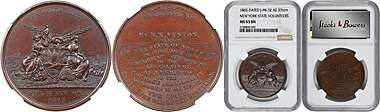
ロット 1039. 1865 New York State Civil War Volunteers Medal. Julian MI-32. Copper, Bronzed. MS-63 BN (NGC). 37.4 mm. Uninscribed. Beautiful rich mahogany-brown patina on frosty to semi-reflective surfaces. Sharply struck and otherwise choice, some muting to the finish at lower reverse explains the Select Mint State assessment from NGC. An unusual and rare medal, with a listed mintage of 5,300 pieces but a surviving population of perhaps a dozen today. Joe Levine's offering of this exact piece in 2013 was accompanied by the notation that he had recorded just seven auction records in the 20 years leading up to that sale, including multiple offerings of the same piece. Just one of those was inscribed. He cited the work of Paul Till in his The Military Awards of the Empire State, who noted that this medal was awarded not to every volunteer, but to the commander of each regiment, which would help explain its rarity. An underappreciated entry among U.S. Mint military medals. From the Henry Mitchell Collection. Earlier from our (Bowers and Ruddy's) New York Public Library Collection sale, October 1982, lot 2655; Presidential Coin and Antique Co., Inc.'s Richard B. Dusterberg Collection sale, October 2000, lot 498; Presidential Coin and Antique Co., Inc.'s Auction Eighty-Three, June 2013, lot 315.
  • 開始価格:
    1 USD
    0 EUR
    0 GBP
    0 CHF

    四捨五入された近似値のみ日付: 2026/11/06
ロット
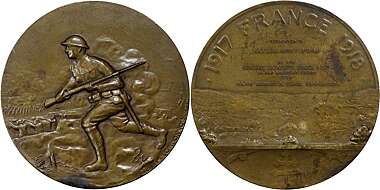
ロット 1040. 1920 Barney Flood Award Medal. By M. Lourdonnois, Struck by Dieges & Clust. Bronze. About Uncirculated, Spot. 63.0 mm. Obv: World War I trench warfare scene with soldier running left in foreground, signed and dated by artist (copyright) M. LOURDONNOIS. 1919 along lower right border. Rev: Cross of Lorraine and bridge below map of French World War I battlefields (including Verdun) with legend above 1917 FRANCE 1918 / PRESENTED TO / MAJ. GEN. JOHN F. O'RYAN / BY THE / GENERAL LAFAYETTE POLICE POST / NO. 460 AMERICAN LEGION / 1920 / MAJOR BERNARD A. FLOOD, COMMANDER. Edge: Marked DIEGES & CLUST BRONZE at 1 o'clock, with another illegible mark at 7 o'clock. This is a French medal repurposed as an award medal. Olive-brown patina overall with a few light spots on both sides, edge with dark carbon spot at 7 o'clock that extends into the lower left obverse.Lieutenant Colonel Bernard A. "Barney" Flood (1877-1933) was a prominent New York City police detective and U.S. Army military police officer who received several high honors both during his lifetime and posthumously. These included the U.S. Army Distinguished Service Medal in October 1922, from General John J. "Black Jack" Pershing, and the NYPD's highest honor, the Medal of Honor with Gold Bar, awarded posthumously in 1935.
  • 開始価格:
    1 USD
    0 EUR
    0 GBP
    0 CHF

    四捨五入された近似値のみ日付: 2026/11/06
ロット
ロット 1041. "1814" (1818-1878) Lieutenant Stephen Cassin Medal. Original Dies. Julian NA-8. Copper, Bronzed. MS-65 BN (NGC). 65.0 mm. Delightful reddish-mahogany brown patina overall. These are the original dies, the reverse distinguished from Charles E. Barber's replacement die introduced in 1878 by the lack of his initials C.B. on the left exergue line. From the Henry Mitchell Collection. Purchased from John Kraljevich, October 2013. Earlier from a Baldwins' auction in 1954.
  • 開始価格:
    1 USD
    0 EUR
    0 GBP
    0 CHF

    四捨五入された近似値のみ日付: 2026/11/06
ロット
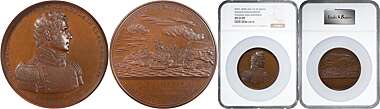
ロット 1042. "1813" (1820-1866) Master Commandant Jesse D. Elliott, Battle of Lake Erie Medal. Julian NA-10. Copper, Bronzed. MS-64 BN (NGC). 65.0 mm. This is one of the nicest, most visually pleasing bronze strikings of this more elusive entry in the U.S Mint naval medal series that we can recall handling. It is sharply defined overall with no significant blemishes to surfaces dressed in blended autumn-orange and mahogany-brown. The reverse of this type was also used for Oliver Hazard Perry's medal (NA-17), and these two officers conducted a vigorous feud for decades over each other's roles at Erie on September 10, 1813. Elliott was defended by writer James Fennimore Cooper and a medal was privately struck to celebrate Elliott's defense. From the Henry Mitchell Collection. Purchased from John Kraljevich, October 2013. Earlier from a Baldwin's auction in 1954.
  • 開始価格:
    1 USD
    0 EUR
    0 GBP
    0 CHF

    四捨五入された近似値のみ日付: 2026/11/06
ロット
ロット 1043. "1814" Lieutenant Robert Henley, Battle of Lake Champlain Naval Medal. Julian NA-11. Copper, Bronzed. MS-65 BN (NGC). 65.0 mm. Beautiful lustrous mahogany with exceptional eye appeal and nearly pristine fields. Easily among the nicest examples we have seen. Struck from the original dies, reverse now showing cuds around much of the rim. From the Henry Mitchell Collection. Earlie from our Chicago ANA Auction, August 2014, lot 3059.
  • 開始価格:
    1 USD
    0 EUR
    0 GBP
    0 CHF

    四捨五入された近似値のみ日付: 2026/11/06
ロット
ロット 1044. "1812" Captain Isaac Hull, USS Constitution vs. HMS Guerriere Medal. Julian NA-12. Copper, Bronzed. MS-65 BN (NGC). 65.0 mm. Deep, rich antique mahogany and autumn-orange brown color blankets both sides of this frosty to appreciably semi-reflective example. Fully struck throughout, expertly preserved, and distraction free apart from a trivial handling mark in he upper right obverse field. The prominent rim cud on the reverse at 10 o'clock is in a similar state to that seen on the specimen in the West Point collection, struck circa 1885. From the Henry Mitchell Collection. Purchased from John Kraljevich, January 2013.
  • 開始価格:
    1 USD
    0 EUR
    0 GBP
    0 CHF

    四捨五入された近似値のみ日付: 2026/11/06
ロット
ロット 1045. "1814" (post-1878) Master Commandant Thomas Macdonough / Battle of Lake Champlain Medal. Julian NA-15. Bronze. MS-66 BN (NGC). 65.0 mm. Beautiful olive-orange and light mahogany patina on fully impressed, frosty to semi-reflective surfaces. A few faint carbon flecks in the expansive obverse field area are all that stand in the way of perfection for this exceptionally well-composed example. A scarce medal struck to mark MacDonough's victory on Lake Champlain, here struck from Charles E. Barber's replacement die prepared in 1878, with his initials C.B. on the exergue line at left. From the Henry Mitchell Collection. Purchased from John Kraljevich, October 2013. Earlier from a Baldwin's auction in 1954.
  • 開始価格:
    1 USD
    0 EUR
    0 GBP
    0 CHF

    四捨五入された近似値のみ日付: 2026/11/06
ロット
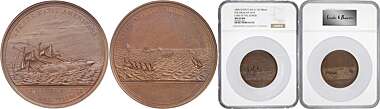
ロット 1046. 1846 Loss of the Somers Medal. Julian NA-24. Bronze. MS-63 BN (NGC). 58.0 mm. Even chestnut brown on the obverse, attractively blended gold and violet over light brown on the reverse. A famed Mexican War medal by C.C. Wright, depicting the setting of the wreck of the Somers in exacting detail. A few minor marks, none serious. Perfect rims. From the Henry Mitchell Collection. Earlier from our Baltimore Auction of March 2014, lot 33.
  • 開始価格:
    1 USD
    0 EUR
    0 GBP
    0 CHF

    四捨五入された近似値のみ日付: 2026/11/06
ロット
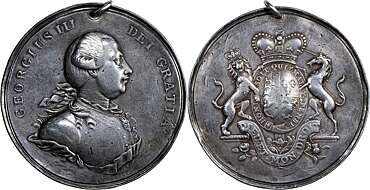
ロット 1047. Undated (1776-1814) George III Indian Peace Medal. Solid Struck Silver. First Size. Unsigned. Adams 7.3. Very Fine. 76.2 mm. 87.9 grams. Original ornamented hanger lost and replaced by a simple silver ring. A fairly typical example of this historic medal, showing the usual evidence of respectable use, as intended. Medium to light silver gray with some deeper patina outlining the design features. The immediately visible marks are mostly small, but some were fairly heavy blunt impacts that slightly dented the medal, mostly toward the rims. As a result, the medal has a slightly wavy appearance. The usual scratches are also seen, but in spite of all of this, the medal is rather pleasant looking and precisely how a used George III should appear.From the Niagara frontier to the Canadian Maritimes, to the drainage of the Mississippi River and the western reaches of the Great Lakes, these medals were distributed by King George's agents to Native Americans who agreed to allegiance with the British during the Revolution, the War of 1812, and in the rough and uncertain period in between. That their survivorship numbers are so high - Adams counted 86 and surely missed more than a few - is a testament to not only the massive effort the British establishment invested into their native alliances, but the extent to which these medals were cherished by their recipients. While British medals were often swapped out for American medals among tribes whose loyalty was demanded of advancing Americans, those tribes that remained in British-controlled territory (mostly north of the modern Canada - U.S. border) had no reason to ever give theirs up.
  • 開始価格:
    1 USD
    0 EUR
    0 GBP
    0 CHF

    四捨五入された近似値のみ日付: 2026/11/06
ロット
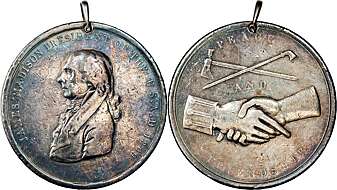
ロット 1048. 1809 James Madison Indian Peace Medal. Silver. Second Size. Julian IP-6, Prucha-40. Very Fine. 62.8 mm. 100.6 grams. Neatly pierced for suspension at 12 o'clock, as is consistent with all issued Madison medals of this size. Though the original suspension loop is lost, it was apparently long ago replaced. The replacement loop is not simply a soldered single band, but a band with looped ends through which it is closed by a small pin. This is similar to the construction of the original loops on George III medals and those of the Andrew Johnson administrations. The initial impression is pleasing for an obviously issued and worn medal. It is clear that the piece was cared for by its recipient, a tale told by the polished surfaces, but the silver has nicely toned over the years with pleasant steel blue close to the rims and some lighter golden brown mottling elsewhere. Up close the surfaces show all of the evidence of a worn medal, with myriad small nicks and scratches. A series of heavier scratches, obviously of considerable age, are noted behind Madison's head, suggesting that something might have been removed-perhaps an added artistic element or something that might have identified a past owner. However, those lines are clearly worn from years of continued use after the fact. Nice detail and pleasing overall.This obverse die seems to have begun to crumble very early, perhaps during the hardening process, as rim breaks are seen on the medal between the large raised rim and inner border, intermittently around three quarters of the circumference. These breaks are seen to varying degrees (somewhat limited by illustration quality) on all images of silver originals we have seen.Though the Madison medals are dated 1809, corresponding to the president's first term, no Madison medals were finished and delivered until 1814. Contemporary reports, according to Prucha, indicate that 100 were certainly made of this size (in 1815). It is also possible that a small number were among those dozen first finished and delivered in 1814.Carl Carlson recorded 11 auction appearances of the second-size Madison in his study, published in 1986. When the Ford Collection was cataloged it was estimated that fewer than 25 survived. The present writer's own survey has revealed 19 distinct known specimens with six of these in institutional collections. This has not been offered at auction in two decades. Ex Estes G. Hawkes; our (Stack's) sale of the John J. Ford Collection, Part XVI, October 2006, lot 115. Scarce Second Size Madison Peace Medal in Silver
  • 開始価格:
    1 USD
    0 EUR
    0 GBP
    0 CHF

    四捨五入された近似値のみ日付: 2026/11/06
ロット
ロット 1049. 1837 Martin Van Buren Indian Peace Medal. Silver. Second Size. Julian IP-18, Prucha-44. AU-55 (NGC). 62.4 mm. 93.75 grams. Neatly pierced for suspension at 12 o'clock, as issued, with what appears to be the original U.S. Mint loop. A most handsome medal with pleasing medium gray obverse surfaces accented by light gold and blue, especially toward the rims. The reverse is somewhat lighter gray overall with traces of similar color. A very aesthetically pleasing medal though upon closer inspection in carries the many small markers of an issued and worn medal. There are no serious or particularly distracting flaws though ancient hairlines are evident under the toning. Nice detail throughout as suggested by the NGC grade.Though 112 of the second-size Van Buren medals are believed to have been struck, the number of survivors is considerably smaller. There are 13 or 14 known (one is questionable as a silver original). Carl Carlson found 12 auction appearances of this size in silver in his 1986 study, yet the Ford Collection remarkably yielded only a single example, this one, which seems to have been off the market since. Four of the known medals are in institutional collections. Ex W.W.C. Wilson; Wayte Raymond's sale of the Wilson Collection, November 1925, lot 961; F.C.C. Boyd; John J. Ford, Jr.; our sale of the John J. Ford, Jr. Collection, Part XVI, lot 134. Handsome Second Size Van Buren Peace Medal Ex W.W.C. Wilson, 1925
  • 開始価格:
    1 USD
    0 EUR
    0 GBP
    0 CHF

    四捨五入された近似値のみ日付: 2026/11/06
ロット
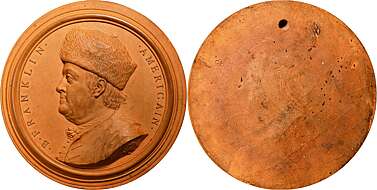
ロット 1050. 1777 B. Franklin Américain Portrait Medallion. Fur Cap without Spectacles. By Jean-Baptiste Nini. Margolis-11, Baiardi-Sibille 94, Greenslet GM-5, Storelli-LXII, Villers-Unlisted. Terracotta. 121.0 mm, approximately 9.4 mm at the edge. 264.0 grams. Obverse with incuse signature and date, NINI / F 1777 on truncation, left of coat of arms. B FRANKLIN AMERICAIN around, separated by five stops, with raised plain border. Small pellet in border at 12 o'clock, corresponding to a small fleur de lys impressed in the reverse inward from 10 o'clock. Made with a suspension hole from the top edge through to the back, as typical.Oblique edges finished in a fairly pronounced but thin bevel around the reverse rim. Handsome light orange-brown terracotta is uniform in tone across the entire face. Sharply defined with a uniformly smooth surface texture typical of Nini originals. A small obverse edge chip is noted just past 2 o'clock affecting only the outer border, while the reverse is free of any such impairment. Rare, and nicer than most seen of these earlier high-relief types.Small-diameter medallions in higher relief like this are believed to predate the lower-relief designs that saw wider distribution. There are multiple variants, yet all are very rare and command significant premiums over the more widely distributed Margolis-17 type, in low relief. In Margolis' detailed study, he located only five of this variety, including this, discovered in a secondary find of his holdings (along with the M-17 in the sale), explaining why it was not included in the primary offering of his Nini medallions in our Spring 2024 sale. Others were noted at the Musee des Beaux-Arts, Blois, France; the Fogg Art Museum at Harvard University and in another private collection, the latter example curiously missing its reverse fleur de lys. A direct comparison with an example of Margolis-10, this same type but without the obverse pellet at 12 o'clock and fleur de lys, reveals that they were made with precisely the same mold. If this is true of all Margolis-10 and 11 medallions, then they are numbered in exactly the sequence of production - all bearing the pellet, an addition to the mold, were made after all those without it. From the Richard Margolis Collection. Earlier from our (Stack's) Americana Sale of January 2009, lot 5657. Extremely Rare High-Relief Small Module Franklin One of Five Recorded by Margolis
  • 開始価格:
    1 USD
    0 EUR
    0 GBP
    0 CHF

    四捨五入された近似値のみ日付: 2026/11/06
ロット
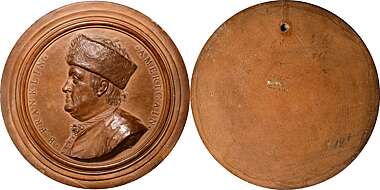
ロット 1051. 1777 B. Franklin Américain Portrait Medallion. Fur Cap without Spectacles. By Jean-Baptiste Nini. Margolis-17, Baiardi-Sibille 94, Greenslet GM-15, Storelli-LXI, Villers-43#var. Terracotta. 112.5 mm, approximately 7.2 mm at the edge. 167.0 grams. Obverse with incuse signature and date NINI / F 1777 on truncation, left of coat of arms. Secondary date 1777 below, in relief. B FRANKLIN AMERICAIN around, separated by four rosettes and a single stop, with raised plain border. Made with a suspension hole from the top edge through to the back, as typical. Oblique edges finished in a somewhat softly defined bevel around the reverse rim.Pleasing and uniform deep leather brown surfaces. A few tiny chips are detected in the outermost border and have little visual impact without close study. A slight unevenness is noted in the piece overall, which is a byproduct of the firing of the clay. A pleasing example of this most common type produced in large quantity with the express purpose of shipping them to America for distribution in 1779.Margolis gives the recorded weights of 40 different examples of this type in his study of Nini's Franklin medallions. This is the second lightest among them, and close study of the surfaces and details reveals that this medallion does not seem to be as refined in nature as other obvious originals seen. The surfaces are less smooth overall and the crispness of the detail seems somewhat inferior, though not as much as one might see on a 19th century Balon copy. In Richard Margolis' study of the Franklin medallions, Benjamin Franklin in Terra Cotta, he discusses contemporary references to early copies from Nini's original molds. Jacques Mercier, who leased the pottery works of Chaumont shortly after Nini's death in 1786 was said to have (translated from French) "made some money using medals of the celebrated artist." Other accounts point to later productions as well. The notary who handled the Nini estate stated in 1788 that he personally had medallions made by men at the workshop which were not under the direction or review of Nini, and that he sold three or four hundred pounds of them - a volume that seems impossible to support by surviving evidence, but there might be some medallions attributable to his statement of activity. Such medallions might not be distinguishable from Nini's originals, unless they are of slightly less refined quality, as here, made by the same artisans of Nini's shop, but without benefit of his clearly critical and exacting eye. From the Richard Margolis Collection.
  • 開始価格:
    1 USD
    0 EUR
    0 GBP
    0 CHF

    四捨五入された近似値のみ日付: 2026/11/06
ロット
ロット 1052. "1776" (ca. 1873-1885) Washington Before Boston Medal. First U.S. Mint Issue. Gunmetal Dies. Musante GW-09-US1, Baker-49, Julian MI-1. Bronze. MS-64 BN (NGC). 69.0 mm. Beautiful reddish-orange brown surfaces are glossy with a nice, hard, frosty texture to the finish. A few faint spots are scattered about, mostly notably in the upper reverse field area and at the lower right obverse border, after the word LIBERTATIS. There are no other blemishes of note and, in fact, this piece is uncommonly attractive for a type that is often seen with very dark bronze patinas. An earlier strike from these dies which crumbled early between the reverse legend and rim. This is seen on this medal, but it is not nearly as extensive as seen on other examples. Further, the surface texture shows many fine finishing line and other subtle artifacts indicative of fairly fresh die surfaces. From the Henry Mitchell Collection. Purchased from Presidential Coin and Antique Co., Inc., December 2004.
  • 開始価格:
    1 USD
    0 EUR
    0 GBP
    0 CHF

    四捨五入された近似値のみ日付: 2026/11/06
ロット
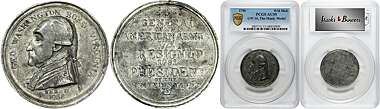
ロット 1053. 1790 Manly Medal. Original. Musante GW-10, Baker-61A. White Metal. AU-55 (PCGS). 48.7 mm. Handsome and fairly smooth pewter gray surfaces are gently glossy and exhibit some less patinated lighter gray accents through the protected areas of the fields. No serious flaws are noted, though there are some minor rim bumps and other scattered surface marks that are all but unavoidable on this soft metal composition. The Manly signature at the lower reverse is ghostly, though it does not seem to have been removed as seen on some examples. Here, it is simply weak, but it is the only area that this can be said about as the details otherwise are quite clear. A very appealing specimen of this classic medal in a very scarce composition and from a famous collection that has for decades been a frequent cataloger's reference point for medals. From our (Bowers and Merena's) sale of the David W. Dreyfuss Collection, April 1986, lot 5604; our (Bowers and Merena's) sale of the Sebring & Garbe Collections, March 1996, lot 3566; Classical Numismatic Group's sale of the Sand Collection, Keystone #13, August 2023, lot 214; our Spring 2024 Auction, April, lot 2112.
  • 開始価格:
    1 USD
    0 EUR
    0 GBP
    0 CHF

    四捨五入された近似値のみ日付: 2026/11/06
ロット
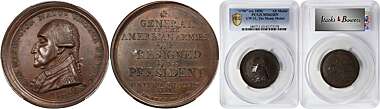
ロット 1054. "1790" (ca. 1858) Manly Medal. Second Obverse. Reissue. Musante GW-11, Baker-62B. Copper. MS-62 BN (PCGS). 49.0 mm. An outstanding example of this classic Washington medallic issue, rated as "S" (for scarce) in copper by Musante (2016). Scarce in an absolute sense, for sure, but with the quality and eye appeal offered here this variety of the manly Medal is rare. Satiny surfaces are hard, tight, and bathed in richly original toning. The obverse exhibits wisps of olive-gray to dominant copper-rose patina, the reverse dressed in a subtle marbling of olive-gray and autumn-brown. Sharply rendered design elements are framed by broad, thick rims, the border a bit more expansive from 9 to 11 o'clock on the obverse than elsewhere. A few wispy handling marks are evident on Washington's forehead, cheek, and on the reverse around the letters RAL in GENERAL, although overall the surfaces are remarkably smooth and blemish free for both the type and the assigned grade. A short, shallow reverse planchet void at the letters S in PRESIDENT and T in THE is as made. Truly a lovely piece, and destined for inclusion in a high quality Washingtoniana cabinet.These reissued pieces were struck in the 1850s using the original Manly reverse, paired with a different obverse. As presented by Neil Musante, Manly died in 1795 and it was recorded that he had one son residing in London, his only living heir. In early auction catalogs this version of the Manly medal was occasionally referred to as from "English dies" or from "Lincoln's dies," the latter in E.L. Mason's sale of November 1878. London coin dealer W.S. Lincoln was the distributor. It seems likely that the dies were part of Manly's estate and were transferred to his son along with any other remaining personal property. What remains unknown is whether the new obverse die was accomplished in England, or if it was an unused version that traveled across the Atlantic alongside the original reverse. We suspect the former for two reasons: first, had Brooks engraved both obverses, he would have done so within a time span of about five years (from the first offering of the medal, to Manly's death). In such a short time span, it seems unlikely that he would have used a different set of letter punches and, further, that he would have signed his name differently on the truncation of the bust. Secondly, we note that Washington's date of birth is given in European style, with the day first, then month and year on the second obverse, while it is in the American style on the original. This might be little more than artistic license, but it may also be a clue pointing to English or otherwise European origin.Copper impressions of this reissue type are usually seen with varying degrees of die cracks. The present example is unusual (and also rare) in that, while there is light spalling in the field above and below the letters AM in AMERICAN, the reverse is free of die cracks. Additionally, the often-seen bisecting crack through the letter S in NATUS is not evident on the obverse. From our Baltimore Auction of November 2021, lot 1028.
  • 開始価格:
    1 USD
    0 EUR
    0 GBP
    0 CHF

    四捨五入された近似値のみ日付: 2026/11/06
ロット
ロット 1055. "1797" (ca. 1816) Halliday Medal. Musante GW-57, Baker-70C. Copper, Bronzed. Plain Rims. Mint State. 53.7 mm. A superior quality, visually appealing example of this exceptionally well-rendered medal. The obverse is mottled with olive-gray patina to a base of deep autumn-orange brown color. The reverse is superficially similar, although the olive-gray overtones are largely confined to the periphery. Both sides assume a bright, even chestnut brown appearance when viewed with the aid of direct lighting, under which circumstances appreciable semi-reflectivity can be discerned in the fields. Otherwise frosty in finish, the surfaces are hard and tight with small, wispy marks scattered about in the expansive field areas, most of which are easily overlooked during in-hand appreciation, and none of which are significant enough to be considered detracting. There is a bit of trivial carbon build up in the upper right obverse field, also on the reverse in the date area, which we mention solely for accuracy's sake. Expertly produced with sharp strike detail throughout, this is an originally and nicely preserved example of an extremely popular Washington medallic type, a piece that will see spirited bidding as it transitions into the next specialized cabinet.
  • 開始価格:
    1 USD
    0 EUR
    0 GBP
    0 CHF

    四捨五入された近似値のみ日付: 2026/11/06
ロット
ロット 1056. 1798 Washington Seasons Medal. The Home. Late Reverse Die State. Musante GW-69, Baker-172A, Julian IP-52. Copper. AU Details--Tooled (PCGS). 48.2 mm. Original suspension loop lost, but a small nib remains. An invitingly sharp example of this rare and historic medal designed and struck during the Washington presidential administration. The details throughout are exceptional. To this point, it is worth nothing that the spinner shows traces of facial features, but this was a presented medal to be sure as it carries all of the typical scars that come from the intended usage including numerous small marks scattered about and numerous light to moderate scratches on both sides that explain the "tooling" qualifier from PCGS. When turned in the light, some of these come into view, but they are really not as distracting as they might sound on such a sharp survivor. They are old, and the overall patina serves to blend them into the aesthetic about as well as can be hoped for. The obverse is a fairly uniform steely brown while the reverse has some very pleasing mahogany highlights through the center. Some hard and obviously stable oxidation deposits are seen in the wreath, serving as a further indication that this was an awarded medal, worn as a mark of pride before being lost. A couple of moderate rim marks would be very good provenance identifiers with even decent photographs to work from. However, this seems to be a new specimen to the census of known medals and the 18th bronze "Spinner' known.The most recent example of the Spinner in bronze to sell at auction was the present writer's (John Pack) specimen, graded EF-40 by PCGS, in our November 2025 sale. That realized $43,200, and while it was the only example known with its original hanger, this medal offers slightly more detail.Of the known medals, at least three were collector's strikes never intended or used for Native American distribution, and three more are in the museum holdings of the American Numismatic Society, Massachusetts Historical Society and Yale University Art Gallery.About The Seasons MedalsThough the Seasons medals do not bear a portrait of Washington, they are inextricably tied to him, his administration and his memory. The direct inspiration for the designs of these medals was from George Washington's own pen. On August 29, 1796, George Washington wrote a letter to the Cherokee Nation, the complete text of which is easily found on the website of the National Archives. The letter was meant to address relations with the Cherokee by way of instruction as to how they might improve their standing as peaceful neighbors of the white settlers. It is a fascinating read for its insights into Washington's thoughtful manner, but also into the decidedly inconsiderate and absolute approach the administration took toward Native peoples. Washington was specific and presented his own personal desires to retire to his plantation as guidance for how the Cherokee might best live in peace and prosperity. He described the advantages of expanding livestock and crops and that "your wives and daughters can soon learn to spin and to weave," relating directly to the presently offered medal. He summarized his detailed proposals as follows:What I have recommended to you I am myself going to do. After a few moons are passed, I shall leave the great town, and retire to my farm. There I shall attend to the means of increasing my cattle, sheep, and other useful animals, to the growing of corn, wheat & other grain, and to the employing of women in spinning and weaving: all which I have recommended to you, that you may be as comfortable & happy as plenty of food, cloathing [sic] & other good things can make you.Herein lie the direct inspirations for the Seasons medals, reinforced as such by the following passage from the same letter:…before I retire, I shall speak to my beloved man, the Secretary of War, to get prepared some medals, to be given to such Cherokees as by following my advice, shall best deserve them. For this purpose, Mr. Dinsmoore [Washington's Agent to the Cherokee Nation] is from time to time to visit every town in your Nation. He will give instructions to those who desire to learn what I have recommended. He will see what improvements are made; who are most industrious in raising cattle, in growing corn, wheat, cotton & flax, & in spinning and weaving: and on those who excel the rewards are to be bestowed.Less than two months later, on October 10, 1796, the Secretary of War wrote to Rufus King, the Washington administration's Minister to Great Britain, to procure the desired medals using sources in England. King called upon John Trumbull, the famous Revolutionary-era artist to design the medals, presumably based on a copy of Washington's letter to the Cherokee or notes taken therefrom, as Trumbull's sketches undeniably directly represent Washington's words.Unfortunately, by the time John Adams had been inaugurated president, on March 4, 1797, the Seasons medals were still not completed, much to the discomfort of then Secretary of War James McHenry. McHenry wrote on December 4, 1797, to Rufus King, "My poor Indians are very clamorous for their medals; more so indeed than for their plows."The medals were completed in 1798, and arrived from England in July of that year. There were reportedly 500 struck in silver and 200 struck in copper. According to Prucha, the first shipment included 326 silver medals. It is unclear which types were represented, but it was certainly an uneven distribution as this is not divisible by three. It is unknown when the copper impressions arrived. As the Seasons medals arrived so late, no new medals were specifically produced for the Adams administration, which must have distributed at least some of the Seasons medals. Some or all of those that remained on hand are known to have been distributed under the Thomas Jefferson administration by the hands of Lewis and Clark. As such, the Seasons medals are tied not just to Washington, but to the first three presidential administrations as well as the journey of America's two most famous early explorers.Both silver and copper examples were issued with suspension loops that proved fragile, while at least a few of each were struck for medal cabinets, and never looped. The ANS has a set of the latter in silver, as does the British Museum. The Virgil Brand Estate produced a fabulous cased six-piece set (once in the Stickney cabinet). The copper specimens in the Baker Collection seem to have been such a presentation set as well.As far as we are aware, it is undocumented who first called these "Seasons Medals," but whoever it was didn't consider that these designs really have nothing to do with seasons, other than perhaps the spring planter. Augustus B. Sage did not use the term in his 1859 Henry Bogert sale, but by 1862 the term had been coined, as W. Elliot Woodward used it, in quotes, in his November sale of the Finotti Collection. Important Original Seasons Medal in Copper The Home
  • 開始価格:
    1 USD
    0 EUR
    0 GBP
    0 CHF

    四捨五入された近似値のみ日付: 2026/11/06
ロット
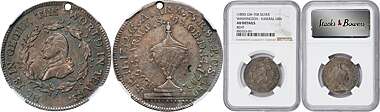
ロット 1057. "1799" (ca. 1800) Washington Funeral Urn Medal. Musante GW-70, Baker-166A, Fuld Dies 3-B. Silver. AU Details--Bent (NGC). 29.3 mm. Neatly pierced just right of 12 o'clock, as issued. A perfectly lovely example of this immensely historic and well-loved issue. Deep olive-gray is accented by soft pastel undertones in gold, pink and powder blue. Remnants of luster linger close to the lettering. Clearly an example worn in 1800 as a visible tribute to the recently deceased president, but one that exhibits fewer of the abuses often seen, such as aggressive marks or even engraved initials. Certainly a few scattered marks and small abrasions are noted on both sides, but one must expect this from an example that was actually used as intended. A small, dark pit in the lower right reverse field is more noticeable, but the bend referenced on the NGC insert is not easily discerned through the holder. The eye appeal is quite nice for one of these, and the details remain bold except for at the highest points of the urn. The all-important GW at central reverse and the portrait of Washington are sharp, as is all of the lettering.
  • 開始価格:
    1 USD
    0 EUR
    0 GBP
    0 CHF

    四捨五入された近似値のみ日付: 2026/11/06
ロット
ロット 1058. "1799" (ca. 1800) Victor Sine Clade Medal. Musante GW-76, Baker-164. White Metal. EF Details--Tooled (PCGS). 56.0 mm. Pierced for suspension just past 12 o'clock, the hole broken through, obviously in response to this piece having been well used. A rather pleasing example of this rare and historic medal. As usually seen, the surfaces exhibit areas of pesting, but to a far lesser extent than typical, and most noticeable at the right obverse border and on the reverse at and below the base of the pedestal. The rims are uncommonly smooth with no major blemishes, surfaces with numerous small scratches and marks scattered about that include a pin scratch meandering through the upper date in the exergual area on the reverse. Most of these marks are of a type that are oddly common on examples of this medal. It is clear from study of nearly all of the known survivors that these medals were well used, but it is unclear how precisely they were used. It seems to have been an issue with a purpose beyond a symbol of Washington's passing. What is less common is the overall sharpness seen here, with the fine sunburst detail over Washington's head being clearly defined. Where the surfaces are not pested, they have good integrity and the eye appeal overall is well above the median example.As reported by Neil Musante, this medal, designed and struck in Newburyport, Massachusetts, was advertised for sale in the Massachusetts Mercury on February 11, 1800, perhaps intentionally corresponding to the Masonic funeral procession for Washington in Boston on that day. With the notice written to appeal to Masons specifically, beginning with "A National and Masonic Medal…," and with sentiments running favorably during such a day of mourning, it might well have seemed the ideal day to announce such a medal. However, though the medals were made available in eight locations specified in the notice, it seems that precious few were sold, as the medal is very rare today.
  • 開始価格:
    1 USD
    0 EUR
    0 GBP
    0 CHF

    四捨五入された近似値のみ日付: 2026/11/06
ロット
ロット 1059. "1799" (ca. 1800) Westwood Medal. First Reverse. Musante GW-82, Baker-81A. Fire-Gilt Copper. MS-62 (PCGS). 40.7 mm. Stunning fire gilt surfaces with the brilliant gilding completely intact. Boldly prooflike in the fields with soft satiny luster on the boldly struck devices. Some faint hairlining in the fields, but the overall appearance of this piece is probably finer than any other we have seen. Exceptionally crisp definition of the finest details, while the reflective fields make the small die break within the spray of arrows at the upper reverse very easy to see, this perhaps being the feature that necessitated the cutting of a new die used on the second Westwood variant. While Baker had assigned this variety the higher attribution number, he does not seem to have taken die states into careful consideration. Neil Musante corrected this, placing this variety first in the emission sequence as it clearly should be. Our 2019 sale of the William Spohn Baker Collection did not include a fire gilt specimen of this variety. From our sale of the E Pluribus Unum Collection, November 2020 Auction, lot 4310.
  • 開始価格:
    1 USD
    0 EUR
    0 GBP
    0 CHF

    四捨五入された近似値のみ日付: 2026/11/06
ロット
ロット 1060. "1799" (ca. 1800) Washington Resumed Command Medal. By Thomas Wyon. Musante GW-85A (unlisted muling of GW-85 obverse and GW-86 reverse), Baker-67. White Metal. VF-30 (PCGS). 37.2 mm. Deep gray surfaces with the motifs a bit lighter which, on the reverse, increases the visual clarity of the small legends. This is a fairly well-handled specimen with numerous small nicks, scratches and bumps, many of which are old enough that they have been smoothed by wear. Apparently, this was carried as a prized memento for a time (and dropped more than once!). Still, while there are a few minor deposits close to the rim, the surfaces really aren't pested and the marks are consistent with the grade for a piece in this soft composition. Overall, this is a rather nice example and it is very rare.In 2002 it was discovered by George Fuld ("Early Washington Medals" in the American Journal of Numismatics 14) that there were three different die marriages for this type, while just two were cataloged in the most recent revision of Medallic Portraits of Washington (1999). Detailed examinations of the dies are given in our catalogs of the Ford and Norweb examples. In brief, the obverses are known with a space above the portrait or with WASHI(NGTON) above, and with two different date of death representations, 14 DECEMBER or DECEMBER 14, respectively. The two reverse dies differ in placement of the letters of the legend, though the text is identical. One has the letter G in GENERAL directly over the letter T in THE, while the other has the G over the space between TH(E). There are other differences as well. It is curious that two dies were cut for each side, yet the medal is among the rarest of the era today.Just four of this die pairing (Baker-67) are known, and the only one with a bronzed surface is the Mickley-Garrett-Steinberg medal that most recently appeared as lot 1148 in our Summer 2026 Global Showcase Auction. Only the Lucien LaRiviere specimen from our (Bowers and Merena's) November 1999 sale is finer than the Garrett piece. The other two known are the somewhat rough William Spohn Baker Collection specimen from our November 2019 sale, reoffered here, and the well worn, badly scratched and holed one in the Smithsonian. For some yet unexplained reason, the various Wyon medals in this series are all both rare and more often than not in unusually rough condition. They are all very challenging issues for collectors, and rare enough that until relatively recently the various existing die combinations had been incompletely documented. Ex William Spohn Baker Collection, to the Historical Society of Pennsylvania by bequest, November 15, 1897; our sale of Washingtoniana from the Collections of the Historical Society of Pennsylvania featuring the Collection of William Spohn Baker, November 2019 Baltimore Auction, lot 20072. Extremely Rare Baker-67 Variant of Wyon's Resumed Command Medal Only Three Confirmed in Private Hands
  • 開始価格:
    1 USD
    0 EUR
    0 GBP
    0 CHF

    四捨五入された近似値のみ日付: 2026/11/06
ロット
ロット 1061. "1783" (ca. 1808) Washington - Franklin / Treaty of Paris Sansom Medal. Musante GW-92, Baker-58A, Greenslet GM-82, Betts-617, Julian CM-5. Copper, Bronzed. Unc Details--Corrosion Removed (PCGS). 40.0 mm. A very historic issue from the early Mint, conceived and designed by Philadelphia Quaker Joseph Sansom, who himself was an accomplished silhouette artist. Sansom successfully petitioned James Madison to have John Reich cut his dies and the Mint to strike his medals. This design, the last of four issued in his complete series, had been "intended" but was not yet ready for sale, as of December 14, 1807, so it was probably struck early in 1808. It was struck in commemoration of the Peace of 1783, the treaty that brought an end to the American Revolution and final acknowledged victory to a new nation. The offered example is generally medium brassy-olive gold, but with areas of dark charcoal-russet associated with remaining surface scale. Sharply struck and with some nice gloss to a generally soft satin texture.
  • 開始価格:
    1 USD
    0 EUR
    0 GBP
    0 CHF

    四捨五入された近似値のみ日付: 2026/11/06
ロット
ロット 1062. 1808 Washington Benevolent Society Medal. Musante GW-94, Baker-327, Julian RF-23. Silver. AU-50 (PCGS). 42.0 mm. Pierced for suspension. Attractive light silver gray surfaces are suitably lustrous for the grade. Wispy handling marks include no singularly mentionable blemishes, although a minor planchet flaw in the field behind the "good samaritan" and a small carbon spot in the right field area on the same side are noted for accuracy. A lightly, and generally gently handled example of this important society badge, struck at the U.S. Mint from dies by John Reich. The integral hanger is lost, as is frequently the case with these. From the Eleventh Annual C-4 Convention Sale, November 2005, lot 443; our sale of the Ken Beukelaer Collection of Washington Pieces, August 2023 Global Showcase Auction, lot 2071.
  • 開始価格:
    1 USD
    0 EUR
    0 GBP
    0 CHF

    四捨五入された近似値のみ日付: 2026/11/06
ロット
ロット 1063. 1819 Series Numismatica Medal by Vivier. WASHINGTON. Musante GW-98, Baker-132, Pack V2-A. Bronze. MS-66 BN (NGC). 41.0 mm. The edge is not visible through the NGC holder, and its style is not noted on the insert. This is a richly original, evenly toned example with a smooth, frosty texture that includes modest hints of semi-reflectivity in the fields. A lovely Gem specimen of this early entry into the expansive Series Numismatica, medals that celebrated more than 150 famous persons. As a group, they are generally considered common, but this attractive Washington portrait piece is among the most desired in the entire series. Additionally, this is a considerably rarer die pairing of the issue. A study of auction appearances found 15 offerings of the V1-A die pairing compared with just seven of this variant. It was struck from the same reverse but a different obverse featuring the following identifiers:OBVERSE V2WASHINGTON-W of WASHINGTON is two V punches, overlapping, but very tightly so-W of WASHINGTON close to hair, but does not touch-Small signature beneath truncation-Stand of I stand points just under nose-No curl point hooks upward under tip of N From our Summer 2022 Global Showcase Auction, August, lot 1044.
  • 開始価格:
    1 USD
    0 EUR
    0 GBP
    0 CHF

    四捨五入された近似値のみ日付: 2026/11/06
ロット
ロット 1064. 1824 Lafayette Visit Medalet. Musante GW-112, Baker-198A, Fuld-LA.1824.12. Silver. VF Details--Bent (PCGS). 14.0 mm. The loop is almost always missing from tokens of this type, as here. Handsome olive-gray patina overall, both sides with universally bold detail at the assigned grade level. The vintage and purpose of these medalets are undisputed. They were struck to mark the occasion of the Marquis de Lafayette's return to the United States for an American tour in 1824. He arrived on August 15 and across the following 14 months, he visited each of the States of the Union where he was met with all manner of fanfare, from the casual donning of thematic gloves, badges, belts, combs, chains, socks, silks and anything else one might imagine, to more formal engagements such as visits to Mount Vernon. Though a French National, he was arguably the second greatest celebrity in the United States, with only George Washington ahead of him.The matter of who made these medalets presents quite the opposite situation. For most of the last 199 years, these medalets have been attributed to Charles Cushing Wright, though a proposal in 2008 that they were made by a Joseph Lewis seems to have stuck quickly. This is not a proper attribution, however, and we discussed this in some depth in our offering of the Sydney F. Martin Collection specimen in our Winter 2022 sale, lot 2128.Despite the lingering questions, these medalets have long been prized for their unique historic significance marking Lafayette's American tour. They are quite rare today. Our online archives include about a dozen different examples sold over the last 15 years or so, while Heritage seems to have sold only a couple. Even the ANS Collection seems to be missing the type. From Presidential Coin and Antique Co., Inc.'s Auction Eighty-One, June 2011, lot 226.
  • 開始価格:
    1 USD
    0 EUR
    0 GBP
    0 CHF

    四捨五入された近似値のみ日付: 2026/11/06
ロット
ロット 1065. "1799" (ca. 1832) Birth Centennial Medal. By Wright and Bale. Original Reverse. Musante GW-127A, Baker-74A. White Metal. Specimen-62 (PCGS). 44.8 mm. An incredible specimen of this very rare variety and one of the nicest we have ever seen. In fact, it is one of the very few we have ever seen. Only two white metal impressions from these dies exist in our online archives, one of which represents an earlier offering of the specimen featured here. We can't find a single example in the major collections of Washington medals we sold in earlier decades except for in the Gil Steinberg sale, where one was unplated and lotted with two other medals. We did note one misidentified as this early variant and wonder if the Steinberg entry was another such error. The collections without one include Stanley Scott, Garrett, Stewart Witham, David Dreyfuss, Jack Collins, the Fairfax Collection, Lucien LaRiviere, Western Reserve Historical Society, John J. Ford, Jr., the Patriot Collection, Norweb, and Charles Wharton. This is undeniably an extraordinary list of cabinets to be missing this medal.It is as attractive as it is rare. Bold prooflike fields accentuate the sharp satiny devices. Mostly brilliant with a small area of dark mottling behind Washington's head and at the base of the bust. A little hairlined in the fragile fields, but no marks worthy of mention are seen. Heavy filing on the reverse rim may have been done by the maker and thus part of the finishing. Either way, it is forgivable on a medal like this.In our November 2019 sale of the William Spohn Baker Collection we elected to make a small adjustment in the ordering of this series (breaking slightly with the order established in Musante) by placing the GW-127A medals before GW-127. That order is the proper and somewhat surprising sequence of striking for these medals.This white metal specimen is the earliest die state among the three we had available for study in 2019, and it bears the crack in the reverse die that likely eventually necessitated its replacement. The tiny break may be seen on the lower right oak leaf, the second upward from the bow. At the tip of the leaf, there is a small piece out of the die that connects to the rim, and extends in a fine crack across it. It extends in the opposite direction through the middle leaf of that group and terminates at the inner leaf. A thin branch crack arcs from the small lump upward to the acorn above. Ex William Spohn Baker Collection, to the Historical Society of Pennsylvania by bequest, November 15, 1897; our sale of Washingtoniana from the Collections of the Historical Society of Pennsylvania featuring the Collection of William Spohn Baker, November 2019 Baltimore Auction, lot 20099, where it realized $3,840.
  • 開始価格:
    1 USD
    0 EUR
    0 GBP
    0 CHF

    四捨五入された近似値のみ日付: 2026/11/06
ロット
ロット 1066. 1832 Philadelphia Civic Procession Medal. Original. Musante GW-130, Baker-160. Silver. AU Details--Tooled (PCGS). 37.14 mm. Medallic alignment. A handsome unpierced specimen of this historic issue. Generous medium pewter and olive-gray on both sides, with intermingled cobalt blue and antique gold iridescence that shines forth nicely as the surfaces dip into a light. Slightly prooflike in the fields, and boldly defined with just a touch of rub to the central obverse high point. Scattered handling marks in the fields on both sides include some faint scratches at left obverse and reverse that explain our qualifier.The medals of the Gold and Silver Artificers are the best known of the 1832 memorial medals, as they are the most commonly seen. This is due to a large number of restrikes taken from the dies in the late 1850s, making the design seem unfairly ubiquitous. However, a silver original, as offered here, has always been something desired above and beyond the rest. It is rare and its specific purpose holds a degree of mystery. The originals in white metal were struck during the parade and tossed to spectators along the route, but silver ones would have been struck under more controlled circumstances and presumably designated for a select group. They may have been carried or worn by those operating the float, or gifted to the 13 marshals of the event, or both. This is but speculation, but we know that silver originals are rare, and they certainly had some distinctive purpose in February 1832.According to a notice in The United States Gazette, June 2, 1832, those responsible for the disposition of the banner and dies used by the Artificers had "deposited them in the Hall of the Franklin Institute for safe keeping." Ex Stanley Scott Collection, June 1975; our August 2024 Global Showcase Auction, lot 4055.
  • 開始価格:
    1 USD
    0 EUR
    0 GBP
    0 CHF

    四捨五入された近似値のみ日付: 2026/11/06
ロット
ロット 1067. 1859 Declaration of Independence Plaque. By Samuel H. Black of New York. Copper Electrotype, Plated with Silver-Colored Metal. Nearly As Made, and Choice. 7.25 inches x 8 inches. With triangular hanger on back, near top. An exceptionally well preserved example of this classic type, with minimal evidence of handling and lovely olive toning to the "silver" wash. There are no blemishes of even a trivial nature, confirming this as one of the nicest examples of the type that your cataloger (JLA) has seen over the last two decades or more. The plaque is dominated by a central medallion, about 86 mm, depicting the signing of The Declaration of Independence, while the entire text and signatures of that document are reproduced surrounding it. The Declaration of Independence signing scene is a physical copy of C.C. Wright's masterwork that appears on two enormous and very rare struck medals, the ca. 1851 George Washington Declaration of Independence medal (GW-181) and GW-183, the Declaration of Independence/Historical Tablet medal. There are 86 lines of text, followed by 8 lines of facsimile signatures. Below the text and signatures appears Black's copyright legend ENTERED ACCORDING TO ACT OF CONGRESS, IN THE YEAR 1859 BY S.H. BLACK IN THE CLERK'S OFFICE OF THE DISTRICT COURT OF THE UNITED STATES FOR THE SOUTHERN DISTRICT OF NEW YORK. Samuel Black was a master electrotyper active during the 1850s and was known for his plates, plaques and other items. In the numismatic world, he is remembered for his series of electrotype store cards in the style of contemporary Braided Hair large cents (Miller-NY 61 through 68).
  • 開始価格:
    1 USD
    0 EUR
    0 GBP
    0 CHF

    四捨五入された近似値のみ日付: 2026/11/06
ロット
ロット 1068. "1853" (ca. 1886) Fill Blessed Sun Medal. Musante GW-185, Baker E-96A. White Metal. Specimen-61 (PCGS). 53.6 mm. Hints of prooflike character remain throughout the fields and is especially pronounced on the reverse. The devices are satiny and offer some contrast when viewed under direct lighting conditions. The impressive bold high-relief portrait of Washington, after the Houdon Bust executed by C.C. Wright, is fully appreciable here. Light hairlining is evident overall, the generally silver gray surface also somewhat muted in appearance to further explain the PCGS-assigned grade. This type is extremely rare, many years can pass between offerings. One of just nine known to the writer in white metal. Strikes in silver, copper and brass are likely unique; the copper one was the penultimate offered anywhere that we are aware of, in our November 2021 sale of the E Pluribus Unum Collection; it was followed more recently by our November 2025 sale of the John M. Pack white metal example that realized $2,640 as PCGS Specimen-63. Prior to that the most recent sale of a white metal example was more than a decade ago, also in one of our sales. William Spohn Baker was unaware of the type when he wrote his extensive study of Washington pieces in 1885, almost certainly because it had not yet been made, despite its date! By 1914 it had come to light, and the Chapman brothers called it "very rare" in their sale of the Parsons Collection that year. By the time the Fuld-Rulau revision of Baker was published, just three were known to the editors.Charles Ira Bushnell commissioned the medal of Charles Cushing Wright, apparently in 1853, but as none were known to Baker three decades later, they were likely not struck. The dies were sold in the Bushnell Sale in 1882 (lot 2817), and that is the first occasion that the possibility of these medals was published. The Chapmans commented that no impressions were known to them at the time, and they purchased the dies. It is believed that they are responsible for the few pieces that did get struck. The first struck medals we are aware of appeared in the George M. Parsons sale in June 1914.This medal was missing from many great cabinets of Washington pieces, including those of the Garrett Family, David Dreyfuss, Lucien LaRiviere and, remarkably, that of the Norweb Family.
  • 開始価格:
    1 USD
    0 EUR
    0 GBP
    0 CHF

    四捨五入された近似値のみ日付: 2026/11/06
ロット
ロット 1069. 1853 Crystal Palace Medal. By Alexander C. Morin and Anthony Paquet. Musante GW-191, Baker-361. Bronze. MS-62 BN (PCGS). 52.0 mm. Dark chocolate brown with areas of lighter walnut brown in the gently reflective fields. A bit handled, commensurate with the grade, yet free of singularly mentionable blemishes. Beautifully designed and intricately detailed, with all features brought up sharply; there is just a hint of cabinet friction to the high points that is consistent with the assigned grade. The obverse was cut by Alexander Morin, and the reverse by Anthony Paquet, but their compositions work nicely together. Close study of the reverse central motif virtually puts one on the ground before New York's majestic Crystal Palace. Though silver impressions naturally command significant premiums, all compositions are likely of equal rarity. According to the June 1864 Edward Cogan sale, just 35 sets of these medals were struck, and he specified that all three metals were included. These are very rare today.
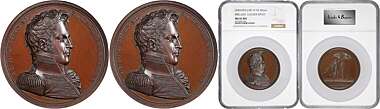
  • 開始価格:
    1 USD
    0 EUR
    0 GBP
    0 CHF

    四捨五入された近似値のみ日付: 2026/11/06
ロット
ロット 1070. 1860 U.S. Mint Cabinet Medal. Musante GW-241, Baker-326, Julian MT-23. Silver. MS-60 PL (NGC). 59.0 mm. 97.5 grams. Beautiful fully reflective pearl gray fields on both sides with far fewer contact marks, rim nicks and abrasions than typically found on these large medals. The strike is sharp and fully defined overall, with even the details of the medals in the case below Washington's bust fully expressed. Just a slight touch of cabinet friction on the highest locks of Washington's hair keeps this medal from a Mint State designation.This is a very rare type in silver, with a reported mintage of 122 pieces (versus 201 for the bronze impressions), but despite the mintage records, in today's market bronze examples easily outnumber the seldom seen silver pieces 10 to one. Rulau lists silver examples as Rarity-8, and Musante designates it as VS (i.e., Very Scarce). We offered a slightly worn, pleasantly toned specimen in our (Stack's) September 2006 sale that realized $2,530, while a nice Mint State piece brought $3,737.50 in our (Stack's) September 2010 Americana Sale. In our February 2015 Americana Sale, a Mint State specimen with a very distracting test mark in the obverse field brought $1,115.25. More recently, our May 2019 sale of the Q. David Bowers Collection resulted in $1,800 paid for an attractively toned Mint State example. Notably, none were present in our various Ford sales. From the Henry Mitchell Collection. Earlier from our (Bowers and Ruddy's) January 1983 sale of the Roy Harte Collection, Part III, lot 3532; our Baltimore Auction of March 2017, lot 65.
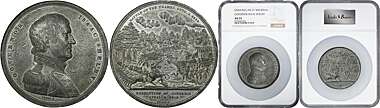
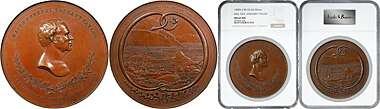
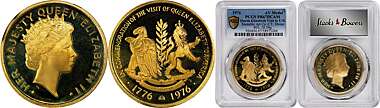
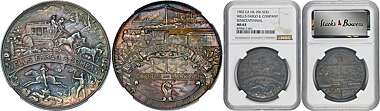
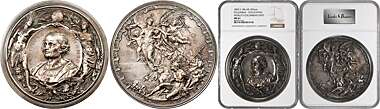
  • 開始価格:
    1 USD
    0 EUR
    0 GBP
    0 CHF

    四捨五入された近似値のみ日付: 2026/11/06
ロット
ロット 1071. Undated (ca. 1859) Dickeson's Coin and Medal Safe Store Card. Musante GW-257, Baker-530D, Rulau Pa-Ph 33. White Metal. MS-61 (PCGS). 32.0 mm. Brilliant and gently prooflike. Fairly scarce in any composition. From our Spring 2022 Auction, April, lot 7063.
  • 開始価格:
    1 USD
    0 EUR
    0 GBP
    0 CHF

    四捨五入された近似値のみ日付: 2026/11/06
ロット
ロット 1072. 1859 Non Nobis Solum Medal. By George Hampden Lovett. Musante GW-309, Baker-289E. White Metal, Gilt. MS-65 (NGC). 51.0 mm. Splendid frosty surfaces are even medium gold overall. Sharply struck and crisp with nary a distracting blemish to either side. William Spohn Baker did not add much commentary specific to these medals in his 1885 reference, but did seem to delight in describing this reverse die in great detail in 16 lines of text, going well beyond the "masonic symbols" descriptors many writers have used! This is the only gilt white metal impression from these dies that we have in our online archives going back at least 20 years - rare. From our December 2021 Tokens & Medals Collectors Choice Online Auction, lot 70033.
  • 開始価格:
    1 USD
    0 EUR
    0 GBP
    0 CHF

    四捨五入された近似値のみ日付: 2026/11/06
ロット
ロット 1073. Undated (ca. 1865) Washington and Lincoln Medal by John Marr. Musante GW-769, Baker-231, Cunningham 30-1280W, King-837. White Metal. AU-58 (PCGS). 32.1 mm. Warmly and originally toned in olive and mauve-gray with pretty underlying blue and gold. Wear is trivial, but both sides are peppered with small to moderate size marks and nicks that confirm the Choice AU grade from PCGS. A very rare medal. According to Rulau and Fuld, just 10 were struck in white metal. While they cite no source, we have no reason to think otherwise as we have only one in our archives, the William Spohn Baker Collection specimen that realized $2,640 in our November 2019 Baltimore Auction, as PCGS MS-62. We also handled one in vulcanite (Baker-231A), from the John J. Ford, Jr. holdings, which brought just over $1,100 in our September 2013 sale.
  • 開始価格:
    1 USD
    0 EUR
    0 GBP
    0 CHF

    四捨五入された近似値のみ日付: 2026/11/06
ロット
ロット 1074. 1876 I.F. Wood's Monument Medal. First Reverse. Musante GW-833, Baker-321, Unlisted SCD-223. Silver. MS-62 (PCGS). 39.6 mm. A very pleasing example of this very rare medal. Though a bit of light handling is visible under close inspection, the first impression is very nice. Softly frosted motifs and slightly prooflike in the fields, with rich charcoal and pewter gray toning over both sides. According to Woodward, writing the November 1878 sale of the Henry W. Holland collection, there were just 30 of these struck in silver. Based on our experience, the number might be smaller, as we have just three examples in our online archives covering about 20 years of sales. According to Musante, Frossard stated somewhere that just one was struck in silver, but that is clearly not the case. Either way, it is very rare and very desirable for its so-called dollar connection. Baker did not have this medal in silver.
  • 開始価格:
    1 USD
    0 EUR
    0 GBP
    0 CHF

    四捨五入された近似値のみ日付: 2026/11/06
ロット
ロット 1075. 1885 Gen. Geo. Washington - National Monument Medal. Musante GW-1025, Baker-Unlisted. White Metal. MS-61 (PCGS). 35.0 mm. Pierced for suspension at slightly past 12 o'clock. Appreciably reflective in the fields to contrast with satiny motifs, although some hairlines and haziness in the former areas clouds the mirrors and largely explains the MS-61 grade from PCGS. The strike is sharp with all design elements crisp. This type does not appear in our online archives going back at least 20 years, so it has been at least that long since we have brought an example to auction. Very rare.
  • 開始価格:
    1 USD
    0 EUR
    0 GBP
    0 CHF

    四捨五入された近似値のみ日付: 2026/11/06
ロット
ロット 1076. 1889 Centennial Inauguration Equestrian Medal. Musante GW-1104, Douglas-13. Bronze. MS-66 BN (NGC). 44.0 mm. Lovely autumn-orange brown surfaces are smooth, satiny, and fully deserving of the premium Gem grade from NGC. Semi-reflective fields reveal a couple of faint spots at right obverse that are hardly worth mentioning. Fully struck and expertly preserved to tempt the discerning Washingtoniana collector. Born in Germany in 1847 and emigrating to the United States in 1856, this medal's issuer Edward A. Kretschman eventually settled in Philadelphia, where he maintained a studio at 1418 Chestnut Street. From our Winter 2022 Auction, November, lot 3018.
  • 開始価格:
    1 USD
    0 EUR
    0 GBP
    0 CHF

    四捨五入された近似値のみ日付: 2026/11/06
ロット
ロット 1077. Undated (1882-) U.S. Mint Lincoln and Garfield Medal. First Size. Julian PR-40, Cunningham 22-520X, King-524. Gold. Extremely Fine, Jewelry. 25.0 mm. 15.15 grams, XRF tested .8946 fine, 0.4356 troy ounces AGW. Looped and suspended from a black cloth ribbon, approximately 110.0 mm in length when folded, as intended, with metal bar and clasp for suspension. The medal is polished and bent, indicating considerable handling as a jewelry item.
  • 開始価格:
    1 USD
    0 EUR
    0 GBP
    0 CHF

    四捨五入された近似値のみ日付: 2026/11/06
ロット
ロット 1078. MCMV (1905) Theodore Roosevelt Official Inaugural Medal. By Augustus Saint-Gaudens. Dusterberg-OIM 2B74, MacNeil-TR 1905-2, Levine-TR 1905-2, Baxter-78, Dryfhout-197. Bronze, Cast. Tiffany Edge Mark. MS-64 (PCGS). 74.0 mm. Edge boldly marked TIFFANY & CO. just right of 6 o'clock. An especially beautiful example of this legendary American medal, the first collaboration between President Theodore Roosevelt and America's leading sculptor of the era, Augustus Saint-Gaudens. The patina is even and unspotted, far prettier than most of these, with rich chestnut brown perfectly applied and well preserved on both sides. The edge mark is crisp and complete, bolder than some others seen; it's also nicely visible in the PCGS holder. With its immaculate surfaces and fine details, this medal could seemingly be graded a point or two higher, but the as-made surface of a cast medal rarely receives such plaudits at the grading services. PCGS has only graded one Roosevelt Inaugural medal higher than this one, a Specimen-65 example (from when PCGS still used the SP moniker instead of MS) that brought $57,600 in our November 2021 sale. It is altogether one of the most desirable examples we've ever seen, outpacing the PCGS MS-61 example in our June 2026 sale at $41,480.The provenance of this piece is of interest, and it serves to underscore the importance of this medal as a work of American art. This piece was sold by Spink in London as part of a framed display given by former Secretary of State James A. Baker III to Saudi Prince Bandar. The prince's full title "HRH Bandar Bin Sultan Al Saud" appears on the PCGS label. While we weren't able to find the story of this medal's presentation - it didn't make the papers at the time - we can narrow it down a bit. Baker served as Secretary of State from January 1989 to August 1992. He also served as White House Chief of Staff for both Ronald Reagan (1981-1985) and George H.W. Bush (1992-1993). Prince Bandar was a close ally of the Reagan White House and developed especially close friendships with members of the Bush family. As Saudi Ambassador to the United States from 1983 to 2005, Prince Bandar developed a close relationship with Baker as their careers continued to coincide. So while it is difficult to pinpoint the exact occasion for the gift, the thoughtfulness of a medal this beautiful and important suggests how close the friendship became. Perhaps coincidentally, Reagan's White House Chief of Protocol, who worked on many royal visits and the gifts that would attend to them, was Selwa Roosevelt, who married Teddy's grandson Archibald Roosevelt, Jr. (Roosevelt certainly met Prince Bandar at Reagan White House events, but may have already known him from his long high ranking CIA career in the Middle East.)Institutions hold a large proportion of the survivors of this medal, a testament to Saint-Gaudens' stature and the importance of this medal in his career. Only 150 of these were authorized for production by Tiffany, though it's unknown if the examples of this medal that lack the edge mark were been included in that number. This has always been among the most desirable American inaugural medals for specialists, but its close association with Saint-Gaudens' later Indian $10 reverse and the well documented connection between the sculptor and the sitter makes this medal desirable to a broader audience than most. If this one is fit for a prince, it's bound to be the centerpiece in any numismatic cabinet. PCGS Population: 2; 1 finer (Specimen-65). Choice 1905 Theodore Roosevelt Inaugural Medal by Saint-Gaudens A Legendary American Artwork with a Royal Provenance
  • 開始価格:
    1 USD
    0 EUR
    0 GBP
    0 CHF

    四捨五入された近似値のみ日付: 2026/11/06
ロット
ロット 1079. 1844 Henry Clay Medal. DeWitt-HC 1844-Unlisted. Silver. Very Fine. 22.2 mm. Original Suspension Loop missing. An extremely rare medal, this is only the second one we have handled since we began maintaining digital records of offerings in our sales. The other was in Part XXIV of our series of sales featuring the extensive John J. Ford, Jr. Collection, in September 2013. Like this one, the original suspension loop, originally affixed in exactly the same position, was lost. Both examples were clearly well used in their day, but this is undeniably the finer survivor, with much better details. Pleasing gray patina with marks commensurate with the grade.A simple design prepared on occasion of Clay's death in 1852, and dedicated by THE CITIZENS OF CALIFORNIA / TO THE MEMORY OF HENRY CLAY on the reverse. As noted in our 2013 sale, this variety (probably the Ford example, as this one is entirely new to the numismatic marketplace) was cataloged by Thomas Elder and published in the March 1918 edition of The Numismatist in association with the reprint of his paper given before the ANS in January 1918. Considering the "citizens of California" in 1852 in concert with the small D.N. beneath the bust probably goes far in explaining the rarity.The D.N. maker's mark is similar in style and placement to the mark of California small denomination gold coin makers M. Deriberpie and Antoine Nouizillet, who produced round half dollars dated 1852 and 1853 (BG-408 and 409). It is almost unthinkable that this piece was made in a different shop considering the circumstances, placing this medal's birth squarely in San Francisco, and probably at 58 Kerny Street, where "Nouizillet & Co." advertised their location in the December 1852 directory. In 1852, though having had a ballooning of population due to the Gold Rush, the city of San Francisco was only a town of around 35,000, and it was an outpost far from the political centers of the east. The local interest in such a medal was likely very small, and the number made was probably rather trivial to begin with. Extremely Rare Henry Clay Medal in Silver
  • 開始価格:
    1 USD
    0 EUR
    0 GBP
    0 CHF

    四捨五入された近似値のみ日付: 2026/11/06
ロット
ロット 1080. 1848 Zachary Taylor Portrait Piece. DeWitt-ZT 1848-Unlisted. White Metal. Very Choice About Uncirculated. 23.0 mm x 31.0 mm. A splasher-type portrait in very soft metal, with traces of paper on the back. Uncertain purpose, but interesting and nicely executed. Likely unique. Ex Wayte Raymond; F.C.C. Boyd estate; John J. Ford, Jr.; our sale of the John J. Ford, Jr. Collection, Part XXIV, September 2013, lot 10598.
  • 開始価格:
    1 USD
    0 EUR
    0 GBP
    0 CHF

    四捨五入された近似値のみ日付: 2026/11/06
ロット
ロット 1081. "1859" (ca. 1860) John Brown Memorial Medal. By Jean Wurden. Bronze. MS-65 (PCGS). 58.0 mm. Obv: Bust of the martyred abolitionist with peripheral inscription JOHN BROWN, NE A / TORRINGTON LE 9 MAI 1800. Signed by the artist J. WURDEN under bust truncation. Rev: Multi-line inscription in French describing Brown's life and adventures, which may be read as, ''To the memory of John Brown, judicially assassinated at Charleston on December 2, 1859, and to that of his dead sons and companions, victims of their devotion to the cause of liberty for the blacks.'' Handsome, generally mahogany-brown surfaces also exhibit a mottled intermingling of medium sandy-brown. A few trivial carbon flecks in the fields, mostly at right obverse, are the only obvious impediment to an even higher Gem Mint State grade. One gold medal was struck and presented to Brown's widow. Silver medals were sold by subscription, but in limited numbers. Unknown rarity for these in bronze, probably not as rare as the silver ones, although still very infrequently seen offered for sale; the fact that this is our third offering for a bronze since 2022 should be seen as highly atypical.
  • 開始価格:
    1 USD
    0 EUR
    0 GBP
    0 CHF

    四捨五入された近似値のみ日付: 2026/11/06
ロット
ロット 1082. 1898 Photographers Association of America Medal. By Victor David Brenner, Struck by R. Stoll. Smedley-22, var. Gold. Mint State. 49.5 mm, scalloped. 46.33 grams, XRF tested 17.2 karat, 1.067 troy ounces AGW. Obv: Full-length portraits of female figures with shields at left and right, holding wreath above camera sitting atop column, peripheral legend PHOTOGRAPHERS ASSOCIATION OF AMERICA. Rev: Virtually identical wreath design to that of Smedley-19, open left field with text and inscription CLASS B / WESTERN DIVISION / FIRST PRIZE / AWARDED TO / CELORON / JULY 11-16 1898, maker's mark R. STOLL: N.Y. / SOLID GOLD at lower right border. There's is no artist's signature, but the style is clearly that of Brenner, who worked as a die cutter for New York seal and die maker Robert Stoll, circa 1897. Bright medium gold surfaces with faint hairlines, yet no sizeable marks, and strong eye appeal. From the Charles Prioleau Collection.
  • 開始価格:
    1 USD
    0 EUR
    0 GBP
    0 CHF

    四捨五入された近似値のみ日付: 2026/11/06
ロット
ロット 1083. 1866 Lincoln Memorial Medal. Reduction by J.S. and A.B. Wyon. Miller-1, Cunningham 9-720S, King-252. Silver. MS-63 (NGC). 35.5 mm. Using their new reducing machine, the London firm of J.S. and A.B. Wyon made reductions of the Lincoln Memorial ANS medal in 7, 16 and 35-mm formats. Despite the fact that only six reductions were initially authorized Scott H. Miller (2015) reports that, "The Society eventually authorized the purchase of twenty-five sets of reductions for its members." This is the first silver reduction in the 35-mm size that your cataloger (JLA) can recall ever handling. It is originally and attractively toned and comes with an impressive numismatic provenance. From the Charles Prioleau Collection. Earlier from our (Bowers and Ruddy's) sale of the Virgil M. Brand Collection, Part II, June 1984, lot 1364.
  • 開始価格:
    1 USD
    0 EUR
    0 GBP
    0 CHF

    四捨五入された近似値のみ日付: 2026/11/06
ロット
ロット 1084. 1883 George Washington (Evacuation Day) Medal. By Charles Osborne, Engraved by Lea Ahlborn. Miller-6, Musante GW-981, Baker S-319. Bronze. Gem Mint State. Housed in the Original Brown Leather Book Case, Without CCNY. 57.0 mm, medal; 110.0 mm x 129.0 mm, case. Designed in America by Charles Osborne, but struck at the Royal Mint in Stockholm, Sweden. Although plans for a medal for the Centennial of Evacuation Day were set into motion well before the event, the backdated medals were not produced until late the following year and into the next. In all, 332 bronze specimens were produced. They feature an unusual concave obverse depicting the George Washington statue on the steps of the Sub-Treasury Building on Wall Street. The reverse with a more traditional rendering of the seals of the City of New York, the New York City Chamber of Commerce, and the American Numismatic Society. A medal very popular with competing groups of Washington collectors and ANS medal collectors.The front cover of the original case is printed in gilt lettering TO COMMEMORATE THE / CENTENNIAL CELEBRATION / NOVEMBER 26, 1883 / OF THE / EVACUATION OF NEW YORK / BY THE BRITISH / AND THE ERECTION OF THE / STATUE OF WASHINGTON / IN WALL STREET. Unlike other cases of this general type that we have offered, the back of this one is blank without the CCNY monogram. The interior of the case, front and back, provides information on the Committee for the Celebration of the Day. The case is nicely preserved, spine with minor wear from use, but fully intact, corners fairly crisp.(Total: 1 medal; 1 case) From the John P. Burnham Collection.
  • 開始価格:
    1 USD
    0 EUR
    0 GBP
    0 CHF

    四捨五入された近似値のみ日付: 2026/11/06
ロット
ロット 1085. Undated Portrait Medallion. Uniface. By Salathiel Ellis. Bronze. Nearly As Made. 8.75 inches. Bust of man right, signed by the artist S. ELLIS [illegible] along truncation. The bust is set in an open field, with an inner raised border that slopes down to the outer border. The back is blank, and painted green. A simple, if nicely executed work, well preserved apart from a few spots of oxidation on the front, over and around the neck. Collectors of U.S. Mint medals will recognize many of Ellis' works, including the Life Saving medal Julian LS-1 and the Indian Peace medals Julian IP-30, IP-31 and IP-36.
  • 開始価格:
    1 USD
    0 EUR
    0 GBP
    0 CHF

    四捨五入された近似値のみ日付: 2026/11/06
ロット
ロット 1086. 1964 William Shakespeare 400th Anniversary of Birth Medal. First Size. By Paul Vincze. Gold. No. 66. Gem Mint State. With Original Case. 57.0 mm. 121.04 grams, XRF tested .9957 fine, 3.875 troy ounces AGW. Obv: Bust left with peripheral legend WILLIAM SHAKESPEARE / 400TH ANNIVERSARY, below bust (copyright symbol) / THE SHAKESPEARE / BIRTHPLACE TRUST . 1964, signed by the artist P. VINCZE in right field. Rev: Central scene of man holding torch and book at left, woman holding theater mask in each hand at right, both kneeling and facing each other, peripheral legend WE SHALL NOT LOOK UPON HIS LIKE AGAIN, dates 1564-1964 below in exergue, signed by the artist P. VINCZE at lower border. Edge: Marked with (maker's marks) and NO. 66 at 6 o'clock. The blue and gilt-trimmed exterior, blue felt and white silk interior case measures 93.2 mm x 94.5 mm x 24.0 mm closed, and is as issued. (Total: 1 medal; 1 case) From our (Coin Galleries') sale of July 1998, lot 1260. A Series Of Paul Vincze Shakespeare Medals in Gold
  • 開始価格:
    1 USD
    0 EUR
    0 GBP
    0 CHF

    四捨五入された近似値のみ日付: 2026/11/06
ロット
ロット 1087. 1964 William Shakespeare 400th Anniversary of Birth Medal. Second Size. By Paul Vincze. Gold. No. 11. Gem Mint State. With Original Case. 38.0 mm. 51.41 grams, XRF tested .9950 fine, 1.644 troy ounces AGW. Obv: Bust left with peripheral legend WILLIAM SHAKESPEARE / 400TH ANNIVERSARY, below bust (copyright symbol) / THE SHAKESPEARE / BIRTHPLACE TRUST . 1964, signed by the artist P. VINCZE in right field. Rev: Central scene of man holding torch and book at left, woman holding theater mask in each hand at right, both kneeling and facing each other, peripheral legend WE SHALL NOT LOOK UPON HIS LIKE AGAIN, dates 1564-1964 below in exergue, signed by the artist P. VINCZE at lower border. Edge: Marked FINE GOLD (maker's marks) NO. 11 at 6 o'clock. The blue and gilt-trimmed exterior, blue felt and white silk interior case measures 68.5 mm x 69.0 mm x 22.0 mm closed, and is as issued. Accompanied by the original certified as issued by the Shakespeare Birthplace Trust in Stratford-Upon-Avon. (Total: 1 medal; 1 case; 1 certificate) From our (Coin Galleries') sale of July 1998, lot 1262.
  • 開始価格:
    1 USD
    0 EUR
    0 GBP
    0 CHF

    四捨五入された近似値のみ日付: 2026/11/06
ロット
ロット 1088. 1964 William Shakespeare 400th Anniversary of Birth Medal. Second Size. By Paul Vincze. Gold. No. 15. Gem Mint State. With Original Case. 38.0 mm. 52.39 grams, XRF tested .9946 fine, 1.672 troy ounces AGW. Obv: Bust left with peripheral legend WILLIAM SHAKESPEARE / 400TH ANNIVERSARY, below bust (copyright symbol) / THE SHAKESPEARE / BIRTHPLACE TRUST . 1964, signed by the artist P. VINCZE in right field. Rev: Central scene of man holding torch and book at left, woman holding theater mask in each hand at right, both kneeling and facing each other, peripheral legend WE SHALL NOT LOOK UPON HIS LIKE AGAIN, dates 1564-1964 below in exergue, signed by the artist P. VINCZE at lower border. Edge: Marked FINE GOLD (maker's marks) NO. 15 at 6 o'clock. The blue and gilt-trimmed exterior, blue felt and white silk interior case measures 68.5 mm x 69.0 mm x 22.0 mm closed, and is as issued. Accompanied by the original certified as issued by the Shakespeare Birthplace Trust in Stratford-Upon-Avon. (Total: 1 medal; 1 case; 1 certificate) From our (Coin Galleries') sale of July 1998, lot 1261.
  • 開始価格:
    1 USD
    0 EUR
    0 GBP
    0 CHF

    四捨五入された近似値のみ日付: 2026/11/06
ロット
ロット 1089. 1964 William Shakespeare 400th Anniversary of Birth Medal. Second Size. By Paul Vincze. Gold. No. 18. Gem Mint State. With Original Case. 38.0 mm. 52.39 grams, XRF tested .9943 fine, 1.675 troy ounces AGW. Obv: Bust left with peripheral legend WILLIAM SHAKESPEARE / 400TH ANNIVERSARY, below bust (copyright symbol) / THE SHAKESPEARE / BIRTHPLACE TRUST . 1964, signed by the artist P. VINCZE in right field. Rev: Central scene of man holding torch and book at left, woman holding theater mask in each hand at right, both kneeling and facing each other, peripheral legend WE SHALL NOT LOOK UPON HIS LIKE AGAIN, dates 1564-1964 below in exergue, signed by the artist P. VINCZE at lower border. Edge: Marked FINE GOLD (maker's marks) NO. 18 at 6 o'clock. The blue and gilt-trimmed exterior, blue felt and white silk interior case measures 68.5 mm x 69.0 mm x 22.0 mm closed, and is as issued. Accompanied by the original certified as issued by the Shakespeare Birthplace Trust in Stratford-Upon-Avon. (Total: 1 medal; 1 case; 1 certificate) From our (Coin Galleries') sale of July 1998, lot 1263.
  • 開始価格:
    1 USD
    0 EUR
    0 GBP
    0 CHF

    四捨五入された近似値のみ日付: 2026/11/06
ロット
ロット 1090. 1964 William Shakespeare 400th Anniversary of Birth Medal. Third Size. By Paul Vincze. Gold. No. 16. Gem Mint State. With Original Case. 32.0 mm. 26.74 grams, XRF tested .9982 fine, 0.858 troy ounces AGW. Obv: Bust left with peripheral legend WILLIAM SHAKESPEARE / 400TH ANNIVERSARY, below bust (copyright symbol) / THE SHAKESPEARE / BIRTHPLACE TRUST . 1964, signed by the artist P. VINCZE in right field. Rev: Central scene of man holding torch and book at left, woman holding theater mask in each hand at right, both kneeling and facing each other, peripheral legend WE SHALL NOT LOOK UPON HIS LIKE AGAIN, dates 1564-1964 below in exergue, signed by the artist P. VINCZE at lower border. Edge: Marked with (maker's marks) and NO. 16 at 6 o'clock. The blue and gilt-trimmed exterior, blue felt and white silk interior case measures 68.5 mm x 69.0 mm x 19.5 mm closed, and is as issued. Accompanied by the original certified as issued by the Shakespeare Birthplace Trust in Stratford-Upon-Avon; the certificate is torn and tattered. (Total: 1 medal; 1 case; 1 certificate) From our (Coin Galleries') sale of July 1998, lot 1264.
  • 開始価格:
    1 USD
    0 EUR
    0 GBP
    0 CHF

    四捨五入された近似値のみ日付: 2026/11/06
ロット
ロット 1091. 1882 Great Seal Centennial Medal. By Charles E. Barber. Julian CM-20. Copper, Bronzed. MS-63 (NGC). 62.0 mm. A richly original mahogany-brown example with satin to modestly semi-reflective surfaces. The strike is fully executed and all features are sharp. Medals of this type were struck in recognition of the centennial of the adoption of the Great Seal of the United States in 1782. Though the mint director at the time was against the idea of this piece being created, Superintendent Snowden obtained approval from the secretary of the Treasury and the project moved forward rapidly. The dies were cut by Charles Barber in 1882, and the medals were available to the public by early September of the same year. One silver and 45 bronze were reported struck in 1882, with additional pieces to fill orders in later years. The earliest pieces have smooth prooflike fields, as here; it is unclear when examples with the granular finish were actually made, although striking periods in the late 19th and/or early 20th century are likely. All are rare. From the Henry Mitchell Collection.
  • 開始価格:
    1 USD
    0 EUR
    0 GBP
    0 CHF

    四捨五入された近似値のみ日付: 2026/11/06
ロット
ロット 1092. 1976 Queen Elizabeth II U.S. Bicentennial Visit Commemorative Medal. By Frank Gasparro, Struck by Medallic Art Co. Gold. No. 014. Proof-68 Deep Cameo (PCGS). With Original Case. 38.0 mm. 40.61 grams. Obv: Head right with name and title around periphery HER MAJESTY QUEEN ELIZABETH II. Rev: Branch divides U.S. Federal eagle and British lion with peripheral legend IN COMMEMORATION OF THE VISIT OF QUEEN ELIZABETH TO AMERICA, dates 1776 and 1976 below, divided by tiny Monticello, the home of Thomas Jefferson which the queen visited on this occasion. Deep, rich, orange-gold color with beautiful overlying toning in iridescent reddish-rose. Accompanied by the original case from Medallic Art Co., with a plate on the inside marked to JILL T. RINEHART. A handwritten note included with this lot states that Jill Rinehart was a member of the 1976 Bicentennial Commission. Also included are the original Certificate of Authenticity and descriptive card. (Total: 1 medal; 1 case; 1 COA; 1 card) From the Collection of William Alonzo Rinehart IV. Earlier ex Jill T. Rinehart, a member of the 1976 Bicentennial Commission.
  • 開始価格:
    1 USD
    0 EUR
    0 GBP
    0 CHF

    四捨五入された近似値のみ日付: 2026/11/06
ロット
ロット 1093. 1976 Queen Elizabeth II U.S. Bicentennial Visit Commemorative Medal. By Frank Gasparro, Struck by Medallic Art Co. Gold. No. 03. Proof-67 Deep Cameo (PCGS). 38.0 mm. 38.59 grams. Obv: Head right with name and title around periphery HER MAJESTY QUEEN ELIZABETH II. Rev: Branch divides U.S. Federal eagle and British lion with peripheral legend IN COMMEMORATION OF THE VISIT OF QUEEN ELIZABETH TO AMERICA, dates 1776 and 1976 below, divided by tiny Monticello, the home of Thomas Jefferson which the queen visited on this occasion. With subtle hazy tinting on deeply prooflike surfaces. Accompanied by a photocopy of the Certificate of Authenticity and original descriptive card. (Total: 1 medal; 1 copy COA; 1 card) From the Collection of William Alonzo Rinehart IV.
  • 開始価格:
    1 USD
    0 EUR
    0 GBP
    0 CHF

    四捨五入された近似値のみ日付: 2026/11/06
ロット
ロット 1094. 1902 Wells Fargo & Company Semicentennial Medal. HK-296. Rarity-7. Silver. MS-63 (NGC). 40.0 mm. Both sides of this handsome medal are originally and deeply toned in charcoal-gray, direct light also revealing iridescent highlights of mauve, blue and pinkish-gold. A scarce HK number, and always in demand.
  • 開始価格:
    1 USD
    0 EUR
    0 GBP
    0 CHF

    四捨五入された近似値のみ日付: 2026/11/06
ロット
ロット 1095. 1892 World's Columbian Exposition Cristoforo Colombo Medal. By Luigi Pogliaghi (designer) and Angelo Cappucio (engraver). Eglit-106, Rulau-B10, var. Silver, Solid. MS-61 (NGC). 101.6 mm. 451.48 grams, .999 fine, 14.5 troy ounces ASW. Known as the Stefano Johnson medals for the firm that produced them in Milan, Italy, this medal in its three sizes and various metallic compositions is generally regarded as the most beautiful of all Columbian medals. This is an interesting and particularly desirable example in a fabric that we can only recall offering twice before. The size is the same as that attributed as Eglit-106, Rulau-B10, although usually we see only bronze and white metal impressions. Solid silver impressions are far rarer, and as of this writing we can confirm only the following examples:1 - Ex our (Stack's) Gilbert Steinberg Collection sale, May 1992, lot 354. Mint State, with original leather case. 483.6 grams.2 - Ex our sale of the Jonathan H. Kagan Collection of American Medallic Art, November 2025 Showcase Auction, lot 4327. NGC MS-63. 442.0 grams.3 - "Sold at European auction for slightly over $7,000," as related by Steve A. Starlust in his recently published book Referencing Columbiana. 465.45 grams. The author incorrectly describes that example as "Unique Silver Award Medal" and "the only known piece in this weight in Silver."4 - Ex NGSA VI, lot 1060. 451.48 grams. The present example.We have also offered a hollow silver example of Eglit-106, in March 2021, which medal was earlier in our March 2020 Auction. The Jonathan H. Kagan specimen in solid silver, NGC MS-63, realized $9,600 in our November 2025 Showcase Auction.This handsome piece is lightly toned in silver-olive iridescence. Signs of handling are few and confined to faint, wispy hairlines in the central obverse and surrounding reverse field areas. Fully struck, crisply rendered, and free of troublesome marks, this impressive piece is a highlight of the important medallic offerings in this sale and will certainly see spirited bidding among advanced Columbiana enthusiasts. Ex NGSA VI, lot 1060. Exceedingly Rare Eglit-106 in Solid Silver
  • 開始価格:
    1 USD
    0 EUR
    0 GBP
    0 CHF

    四捨五入された近似値のみ日付: 2026/11/06
ロット
ロット 1096. 1949 The Philadelphia Award Medal. By Violet Oakley. Bronze. Choice Mint State. With Original Case. 75.5 mm. Obv: William Penn in armor, holding sword and shield, with peripheral legend THE PHILADELPHIA AWARD / FOUNDED 1921 BY EDWARD W. BOK. Field inscribed to recipient TO FREDERICK H. / ALLEN / 1949. Rev: Christ washing the feet of one of the disciples with peripheral legend I AM AMONG YOU AS HE THAT SERVETH. Housed in the original deluxe wooden case, as issued, that measures 6.25 inches x 7.5 inches x 2.0 inches when closed. The lid has a brass clasp, fully functional, surrounded by a circular brass plate that reads THE PHILADELPHIA AWARD. The top of the case opens to reveal a felt-lined tray on which the medal sits, which itself lifts out to reveal a card on heavy paper stock that provides information on the award and presents this specific medal to Frederick H. Allen in 1949. An impressive presentation overall!Established by Edward Bok (1863-1930), retired editor of the Ladies Home Journal, in 1921, each year The Philadelphia Award honors one or more Philadelphians for service "to advance the best and largest interests of Philadelphia," and who have lived Bok's favorite motto: "Make the world a bit more beautiful and better because you have been in it." (Total: 1 medal; 1 case)
  • 開始価格:
    1 USD
    0 EUR
    0 GBP
    0 CHF

    四捨五入された近似値のみ日付: 2026/11/06
ロット
ロット 1097. United States Department of Defense Gold Barter Kit for World War II Military Personnel. This historic item is a 95.2 mm x 114.0 mm black rubber case that contains gold coins and heavy gold rings that were intended to allow pilots and clandestine military personnel who found themselves cut off behind enemy lines to barter their way to safety. Both sides of the case have the inscription IF FOUND RETURN TO / COM NAV AIR LANT (CNAL 34) / NORFOLK, VIRGINIA. One side also bears the serial number 2240, scratched in near the lower border. We have sold five of these in recent years, one of which was opened, revealing a British sovereign, two half sovereigns, and one example each of the French 20 and 10 franc gold coins. Also included were three heavy gold rings. The kit offered in this lot has also been opened, and it includes the same contents as the other opened set we sold with one exception: the French 20 franc gold coin is missing from this set. Still a remarkable item for the collector of World War II memorabilia. (Total: 5 gold coins; 3 gold rings; 1 case)
  • 開始価格:
    1 USD
    0 EUR
    0 GBP
    0 CHF

    四捨五入された近似値のみ日付: 2026/11/06
ロット
ロット 1098. American Numismatic Association Ladder Badge of F.C.C. Boyd. Bronze. Extremely Fine. 32.0 mm uniface medal with ANA logo at bottom, double looped and suspended from (35) bars dated 1925 to 1979, each for a different ANA yearly convention. An additional pinback bar marked A.N.A. on the front is at the very top of the ladder. 19.0 inches in length overall. Really a neat item! From the John P. Burnham Collection.
  • 開始価格:
    1 USD
    0 EUR
    0 GBP
    0 CHF

    四捨五入された近似値のみ日付: 2026/11/06
ロット
ロット 1099. Lot of (3) Numismatic Convention Badges of F.C.C. Boyd. Included are: 1938 Columbus, Ohio ANA Convention; 1941 Philadelphia ANA Convention; and 1955 Metropolitan New York Numismatic Convention, with Honorary Chairman and Park Sheridan Hotel ribbons. All are in base metals, looped and suspended from ribbons with thin metal pin backs at top, each with paper insert showing Boyd's name. Nearly as issued, except for heavy folds to the two extra ribbons of the final-listed medal. From the John P. Burnham Collection.
  • 開始価格:
    1 USD
    0 EUR
    0 GBP
    0 CHF

    四捨五入された近似値のみ日付: 2026/11/06
ロット
ロット 1100. 1860 PRESIDENTS HOUSE / NO SUBMISSION TO THE NORTH Token. Fuld-510A/514 a. Rarity-8. Copper. Plain Edge. MS-64 RB (NGC). 19.0 mm. A very scarce die pairing, and the first example of this Fuld number that we can recall handling in recent years. Surfaces are generally light golden-brown, direct lighting revealing both mottled lilac-blue undertones as well as much pinkish-orange mint color. An old, light spot on the obverse involves the letters PR in PRESIDENTS, and is the only mentionable blemish on otherwise smooth-looking surfaces. Boldly struck with much eye appeal.
  • 開始価格:
    1 USD
    0 EUR
    0 GBP
    0 CHF

    四捨五入された近似値のみ日付: 2026/11/06
プライバシー設定プライバシー設定