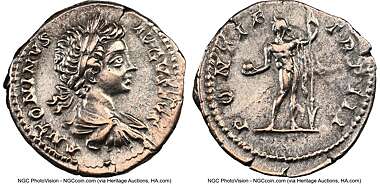
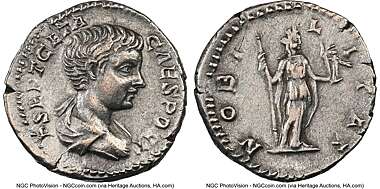
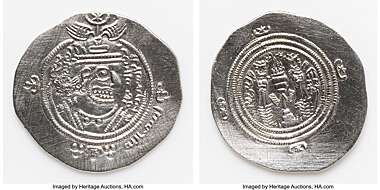
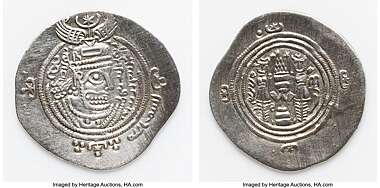
Зарегистрироваться для участия онлайн
Heritage Auctions, Inc. Logo
Лот
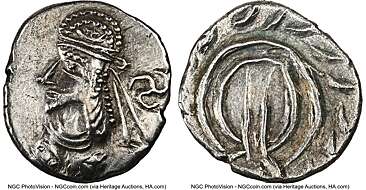
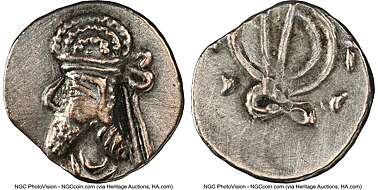
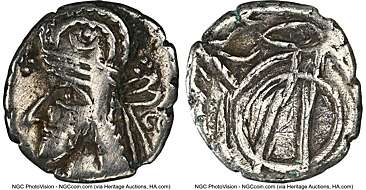
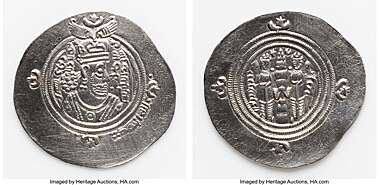
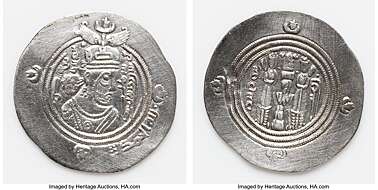
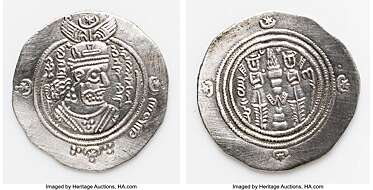
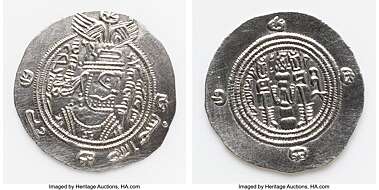
Лот 21101. Ancients PERSIS KINGDOM. Uncertain King (ca. 1st century AD). AR hemidrachm (14mm, 1.66 gm, 7h). NGC Choice VF, brushed. Diademed, draped bust of uncertain king left, with pointed beard, wearing Parthian tiara with ear flap, adorned with crescent and pellet; triskeles behind / Diadem. Sunrise 644 var. (drachm). From the Khanum Jan Collection HID05401242017 © 2026 Heritage Auctions | All Rights Reserved www.HA.com/TexasAuctioneerLicenseNotice
  • Стартовая цена:
    1 USD
    0 EUR
    0 GBP
    0 CHF

    Примерные оценкиДата: 05.11.2026
Лот
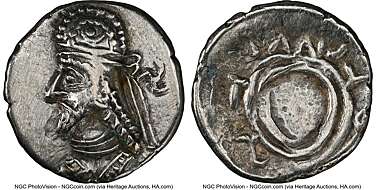
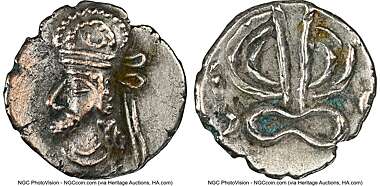
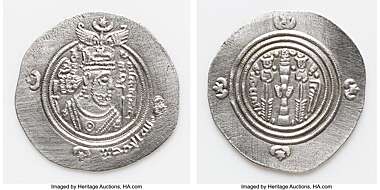
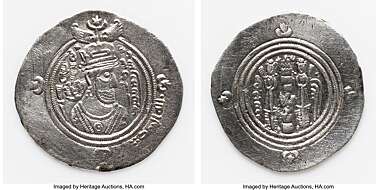
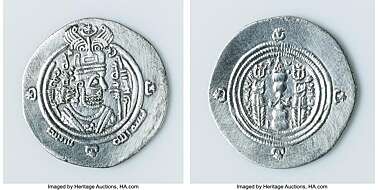
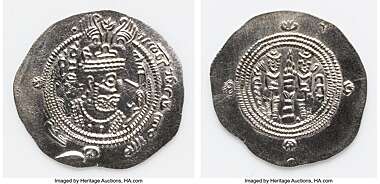
Лот 21102. Ancients PERSIS KINGDOM. Uncertain King (ca. 1st century AD). AR hemidrachm (13mm, 10h). NGC Choice VF, brushed. Diademed, draped bust of uncertain king left, with pointed beard, wearing Parthian tiara with ear flap, adorned with crescent and pellet; triskeles behind / Diadem. Sunrise 644 var. (drachm). From the Khanum Jan Collection HID05401242017 © 2026 Heritage Auctions | All Rights Reserved www.HA.com/TexasAuctioneerLicenseNotice
  • Стартовая цена:
    1 USD
    0 EUR
    0 GBP
    0 CHF

    Примерные оценкиДата: 05.11.2026
Лот
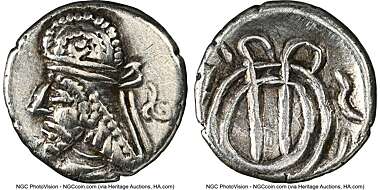
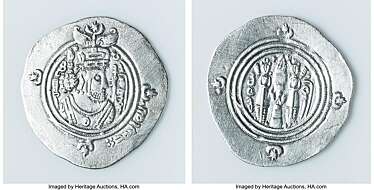
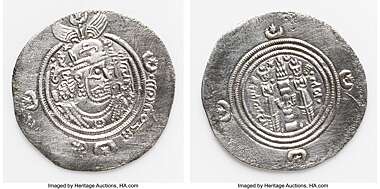
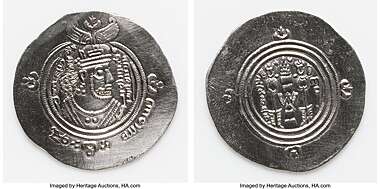
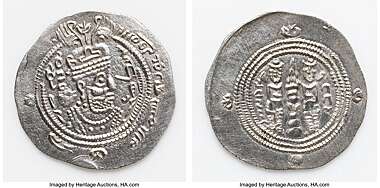
Лот 21103. Ancients PERSIS KINGDOM. Uncertain King (ca. 1st century AD). AR hemidrachm (12mm, 1.51 gm, 10h). NGC Choice VF, brushed. Diademed, draped bust of uncertain king left, with pointed beard, wearing Parthian tiara with ear flap, adorned with crescent and pellet; triskeles behind / Diadem. Sunrise 644 var. (drachm). From the Khanum Jan Collection HID05401242017 © 2026 Heritage Auctions | All Rights Reserved www.HA.com/TexasAuctioneerLicenseNotice
  • Стартовая цена:
    1 USD
    0 EUR
    0 GBP
    0 CHF

    Примерные оценкиДата: 05.11.2026
Лот
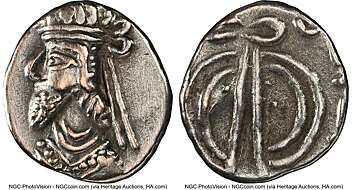
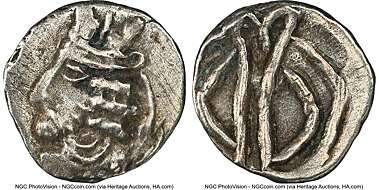
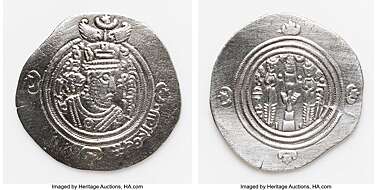
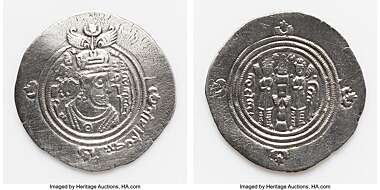
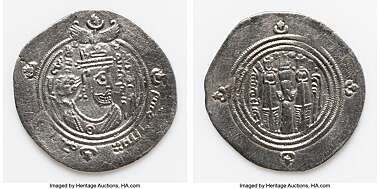
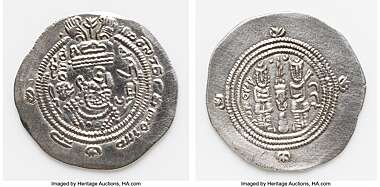
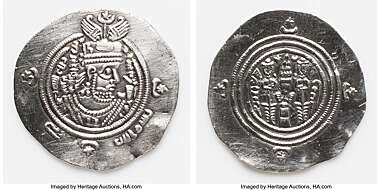
Лот 21104. Ancients PERSIS KINGDOM. Uncertain King (ca. 1st century AD). AR hemidrachm (12mm, 1.27 gm, 7h). NGC Choice VF, brushed. Diademed, draped bust of uncertain king left, with pointed beard, wearing Parthian tiara with ear flap, adorned with crescent and pellet / Diadem. Sunrise -, cf. 647 (triskeles behind). From the Khanum Jan Collection HID05401242017 © 2026 Heritage Auctions | All Rights Reserved www.HA.com/TexasAuctioneerLicenseNotice
  • Стартовая цена:
    1 USD
    0 EUR
    0 GBP
    0 CHF

    Примерные оценкиДата: 05.11.2026
Лот
Лот 21105. Ancients PERSIS KINGDOM. Uncertain King (ca. 1st century AD). AR hemidrachm (13mm, 1.36 gm). NGC Choice VF, brushed. Diademed, draped bust of uncertain king left, with pointed beard, wearing Parthian tiara with ear flap, adorned with crescent and pellet / Diadem. Sunrise -, cf. 647 (triskeles behind). From the Khanum Jan Collection. HID05401242017 © 2026 Heritage Auctions | All Rights Reserved www.HA.com/TexasAuctioneerLicenseNotice
  • Стартовая цена:
    1 USD
    0 EUR
    0 GBP
    0 CHF

    Примерные оценкиДата: 05.11.2026
Лот
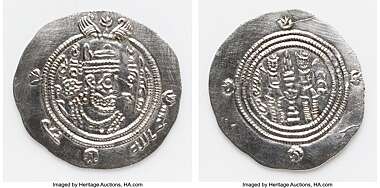
Лот 21106. Ancients PERSIS KINGDOM. Uncertain King (ca. 1st century AD). AR hemidrachm (12mm, 1.01 gm, 11h). NGC Choice VF, brushed. Diademed, draped bust of uncertain king left, with pointed beard, wearing Parthian tiara with ear flap, adorned with crescent and pellet / Diadem. Sunrise -, cf. 647 (triskeles behind). From the Khanum Jan Collection. HID05401242017 © 2026 Heritage Auctions | All Rights Reserved www.HA.com/TexasAuctioneerLicenseNotice
  • Стартовая цена:
    1 USD
    0 EUR
    0 GBP
    0 CHF

    Примерные оценкиДата: 05.11.2026
Лот
Лот 21107. Ancients PERSIS KINGDOM. Uncertain King (ca. 1st century AD). AR hemidrachm (13mm, 1h). NGC Choice VF, edge bend, die shift, brushed. Diademed, draped bust of uncertain king left, with pointed beard, wearing Parthian tiara with ear flap, adorned with crescent and pellet / Diadem. Sunrise -, cf. 647 (triskeles behind). From the Khanum Jan Collection HID05401242017 © 2026 Heritage Auctions | All Rights Reserved www.HA.com/TexasAuctioneerLicenseNotice
  • Стартовая цена:
    1 USD
    0 EUR
    0 GBP
    0 CHF

    Примерные оценкиДата: 05.11.2026
Лот
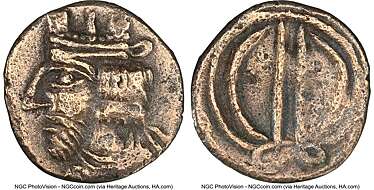
Лот 21108. Ancients PERSIS KINGDOM. Uncertain King (ca. 1st century AD). AR hemidrachm (12mm, 7h). NGC VF, brushed. Diademed, draped bust of uncertain king left, wearing torque and mural crown / Diadem. Cf. Sunrise 650 (obol). From the Khanum Jan Collection HID05401242017 © 2026 Heritage Auctions | All Rights Reserved www.HA.com/TexasAuctioneerLicenseNotice
  • Стартовая цена:
    1 USD
    0 EUR
    0 GBP
    0 CHF

    Примерные оценкиДата: 05.11.2026
Лот
Лот 21109. Ancients PERSIS KINGDOM. Uncertain King (ca. 1st century AD). AR hemidrachm (12mm, 1.15 gm, 1h). NGC VF, brushed. Diademed, draped bust of uncertain king left, wearing torque and mural crown / Diadem. Cf. Sunrise 650 (obol). From the Khanum Jan Collection. HID05401242017 © 2026 Heritage Auctions | All Rights Reserved www.HA.com/TexasAuctioneerLicenseNotice
  • Стартовая цена:
    1 USD
    0 EUR
    0 GBP
    0 CHF

    Примерные оценкиДата: 05.11.2026
Лот
Лот 21110. Ancients PERSIS KINGDOM. Uncertain King (ca. 1st century AD). AR hemidrachm (12mm, 1.66 gm, 7h). NGC VF, brushed, die shift. Diademed, draped bust of uncertain king left, with pointed beard, wearing Parthian tiara with ear flap, adorned with crescent and pellet; triskeles to right, three pellets on either side of tiara / Diadem. Sunrise 647 var. (pellet placement). From the Khanum Jan Collection. HID05401242017 © 2026 Heritage Auctions | All Rights Reserved www.HA.com/TexasAuctioneerLicenseNotice
  • Стартовая цена:
    1 USD
    0 EUR
    0 GBP
    0 CHF

    Примерные оценкиДата: 05.11.2026
Лот
Лот 21111. Ancients PERSIS KINGDOM. Uncertain King (ca. 1st century AD). AR hemidrachm (13mm, 10h). NGC Choice Fine, brushed. Diademed, draped bust of uncertain king left, wearing torque and mural crown / Diadem. Cf. Sunrise 650 (obol). From the Khanum Jan Collection HID05401242017 © 2026 Heritage Auctions | All Rights Reserved www.HA.com/TexasAuctioneerLicenseNotice
  • Стартовая цена:
    1 USD
    0 EUR
    0 GBP
    0 CHF

    Примерные оценкиДата: 05.11.2026
Лот
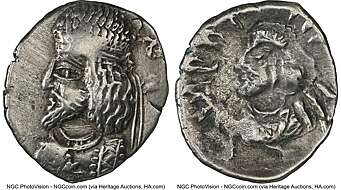
Лот 21112. Ancients PERSIS KINGDOM. Ardaxsir (Artaxerxes) III (ca. 1st-2nd centuries AD). AR drachm (17mm, 5h). NGC VF, brushed. Bearded bust left, wearing diadem with two ties / Radiate bust of Mithra left. Van't Haaf, Type 631. From the Khanum Jan Collection. HID05401242017 © 2026 Heritage Auctions | All Rights Reserved www.HA.com/TexasAuctioneerLicenseNotice
  • Стартовая цена:
    1 USD
    0 EUR
    0 GBP
    0 CHF

    Примерные оценкиДата: 05.11.2026
Лот
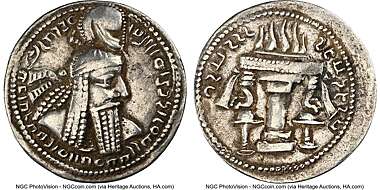
Лот 21113. Ancients SASANIAN KINGDOM. Ardashir I (AD 223/224-240). AR drachm (25mm, 4h). NGC VF. Mint B ("Hamadan"), Phase 3, ca. AD 233/234-238/239. Draped bust of Ardashir I right, wearing diadem with decorated ends (type R) and close fitting headdress with korymbos / Fire altar (flames 2) with decorated diadem ends (type R). Sunrise 703. Göbl type III/2. From the Khanum Jan Collection. Ardashir I overthrew the Arsacid dynasty of the Parthian Empire and installed himself onto the imperial throne at Ctesiphon in 224 AD, founding the Sassanian Empire that would last for four hundred years. In a break from his Parthian predecessors, Ardashir I's royal portraiture introduces the crown globus (korymbos)--a billowing cloth stuffed with the curled locks of the emperor-which would become canonical on Sasanian coinage. The legend often reads "The Mazdean Lord Ardashir, King of Kings of Iran who has lineage from the gods". The new emperor began his reign by shrewdly consolidating control over the eastern Persian provinces of Sakastan, Balochistan, and Merv. His rule was marked by further military expansion and confrontations at the western frontiers, invading the Roman province of Mesopotamia in 231 AD. The Roman Emperor Alexander Severus launched a successful counter-invasion two years later, hoping to link his own reputation with that of the homonymous Hellenistic world conqueror by accusing Ardashir I of intending to restore the Achaemenid Empire. Despite this setback, Ardashir I was able to take over the Roman client-kingdom of Hatra after a siege in 240 AD, laying the groundwork for further Roman-Sasanian wars under his successors. HID05401242017 © 2026 Heritage Auctions | All Rights Reserved www.HA.com/TexasAuctioneerLicenseNotice
  • Стартовая цена:
    1 USD
    0 EUR
    0 GBP
    0 CHF

    Примерные оценкиДата: 05.11.2026
Лот
Лот 21114. Ancients SASANIAN KINGDOM. Zamasp (AD 497-499). AR drachm (28mm, 2h). NGC XF, brushed. Draped bust of Zamasp right, wearing earring and mural crown with inner crescent, korymbos set on second crescent, ribbon on left shoulder; small bust of Ahura Mazda left with wreath before / Fire altar with ribbon; altar flanked by attendant on either side, turned inward, star in upper left field, crescent in upper right field. Cf. Sunrise 963 for type. Göbl I/1. From the Khanum Jan Collection. HID05401242017 © 2026 Heritage Auctions | All Rights Reserved www.HA.com/TexasAuctioneerLicenseNotice
  • Стартовая цена:
    1 USD
    0 EUR
    0 GBP
    0 CHF

    Примерные оценкиДата: 05.11.2026
Лот
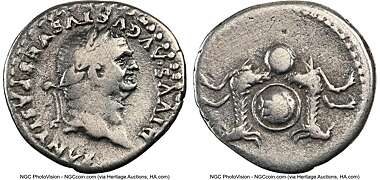
Лот 21115. Ancients Vespasian (AD 69-79). AR denarius (18mm, 6h). NGC Fine, brushed. Rome, AD 80-81. DIVVS AVGVSTVS VESPASIANVS•, laureate head of Divus Vespasian right / Two capricorns back-to-back supporting shield decorated with S C; banded globe below. RIC II.1 (Titus) 357. From the Khanum Jan Collection. The death and deification of Vespasian in AD 79 was marked by an extensive commemorative coinage struck by his son and successor Titus. The Roman biographer Suetonius records a remarkable foreshadowing witticism which had been made by the late emperor while he was suffering from the severe dysentery that would take his life shortly thereafter: "Vae, puto deus fio" ("Woe's me, I think I'm becoming a god"). The use of Capricorn as a common reverse type for the posthumous coinage of Vespasian is unusual--as it was not the late emperor's astrological sign--however this choice is not without explanation. Most likely the Capricorn is an allusion to the emperor Augustus, his deification, and the divine inevitability of the success of his imperial dynasty. Suetonius reports a relevant anecdote in The Lives of the Twelve Caesars, where a famous astrologer throws himself at Augustus' feet in awe of the emperor's fortuitous zodiac sign: "From that time on Augustus had such faith in his destiny, that he made his horoscope public and issued a silver coin stamped with the sign of the constellation Capricornus, under which he was born." HID05401242017 © 2026 Heritage Auctions | All Rights Reserved www.HA.com/TexasAuctioneerLicenseNotice
  • Стартовая цена:
    1 USD
    0 EUR
    0 GBP
    0 CHF

    Примерные оценкиДата: 05.11.2026
Лот
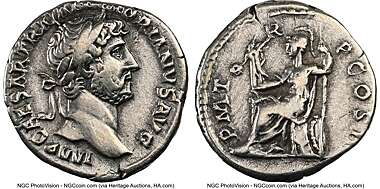
Лот 21116. Ancients Hadrian (AD 117-138). AR denarius (17mm, 7h). NGC Choice Fine, brushed. Rome, ca. AD 121-123. IMP CAESAR TRAIAN HADRIANVS AVG, laureate head of Hadrian right / PM T-R-P-COS III, Roma seated left on cuirass, Victory in outstretched right hand, grounded spear in left, shield behind. RIC II.3, 541. From the Khanum Jan Collection. Publius Aelius Hadrianus was born in AD 76, the son of a distinguished Spanish senator and related through his mother to the future Emperor Trajan, who took him into his household when Hadrian was nine years old. After Trajan's accession, Hadrian held a series of civilian posts, including a consulship in AD 108, and commanded legions during the Dacian and Parthian wars. Hadrian was not formally adopted until Trajan lay on his deathbed in August, AD 117; after succeeding to the throne, Hadrian abandoned many of Trajan's over-ambitious conquests and engaged in a policy of peace abroad and reform at home. He spent most of his 21-year reign traveling, visiting every province of the Roman Empire. Under his patronage, Roman art and sculpture reached its creative peak. Hadrian came to see himself as a "second Augustus," providing the empire with a new foundation as a vast commonwealth of nations under Rome's guiding hand. HID05401242017 © 2026 Heritage Auctions | All Rights Reserved www.HA.com/TexasAuctioneerLicenseNotice
  • Стартовая цена:
    1 USD
    0 EUR
    0 GBP
    0 CHF

    Примерные оценкиДата: 05.11.2026
Лот
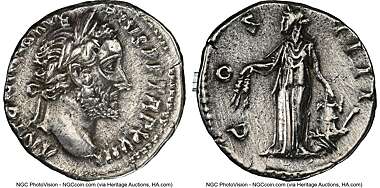
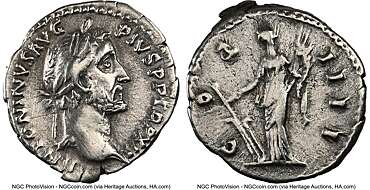
Лот 21117. Ancients Antoninus Pius (AD 138-161). AR denarius (17mm, 1h). NGC XF, brushed. Rome, AD 151-152. ANTONINVS AVG-PIVS P P TR P XVIII, laureate head of Antoninus Pius right / C-OS-IIII, Annona standing facing, head left, grain ears in outstretched right hand, left hand on modius set on prow behind. RIC III 204. From the Khanum Jan Collection. Born in AD 86 as T. Aurelius Fulvius Boionius Antoninus to a wealthy family from Nemausus in Gaul. His grandfather and father had each risen to Consul, and like them, he entered the Senate at the appropriate age and enjoyed a distinguished career. Around AD 120, he married Annia Galeria Faustina, an aristocratic lady of Spanish descent with family ties to the emperors Trajan and Hadrian. He earned a consulship in AD 130 and served as the Proconsul of Asia. Tall, handsome, and widely admired for his sober judgment, he soon attracted the attention of Hadrian, who made him a close advisor. When Hadrian's intended successor, Aelius, died early in AD 138, the ailing emperor settled on the 52-year-old Antoninus as his replacement. Hadrian died on July 10, and Antoninus succeeded without serious opposition. Unlike the restless Hadrian, Antoninus never left Italy and was content to rule from Rome. Stability and equanimity were his watchwords, and his policies kept the Empire on an even keel for 24 years. He put no one to death, friend or foe. Only minor flare-ups in northern Britain and northern Africa disturbed the general peace. The frontiers were maintained and defended, with his decision to build a new wall in Britain 90 miles north of the Hadrian's Wall the only instance of imperial expansion. He carefully groomed Marcus Aurelius as his successor but neglected to provide him with any military training. In fact, the mild, civilian character of his reign may have unwittingly allowed storm clouds to gather and strengthen both within and beyond the frontiers. Nevertheless, later generations viewed Antoninus as the perfect emperor, and the tranquility of his reign took on the sheen of a lost golden age. HID05401242017 © 2026 Heritage Auctions | All Rights Reserved www.HA.com/TexasAuctioneerLicenseNotice
  • Стартовая цена:
    1 USD
    0 EUR
    0 GBP
    0 CHF

    Примерные оценкиДата: 05.11.2026
Лот
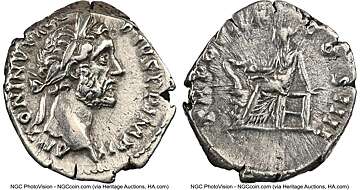
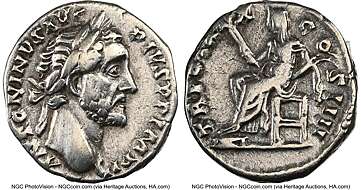
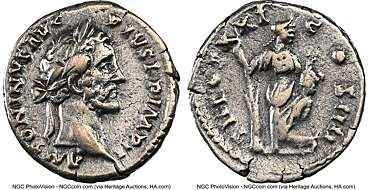
Лот 21118. Ancients Antoninus Pius (AD 138-161). AR denarius (18mm, 1h). NGC Choice VF, brushed. Rome, AD 155-156. ANTONINVS AVG-PIVS P P IMP II, laureate head of Antoninus Pius right / TR POT XX-COS IIII, Salus seated left, feeding serpent rising from altar at feet before from patera in outstretched right hand, left arm resting on back of throne. RIC III 264. From the Khanum Jan Collection. Born in AD 86 as T. Aurelius Fulvius Boionius Antoninus to a wealthy family from Nemausus in Gaul. His grandfather and father had each risen to Consul, and like them, he entered the Senate at the appropriate age and enjoyed a distinguished career. Around AD 120, he married Annia Galeria Faustina, an aristocratic lady of Spanish descent with family ties to the emperors Trajan and Hadrian. He earned a consulship in AD 130 and served as the Proconsul of Asia. Tall, handsome, and widely admired for his sober judgment, he soon attracted the attention of Hadrian, who made him a close advisor. When Hadrian's intended successor, Aelius, died early in AD 138, the ailing emperor settled on the 52-year-old Antoninus as his replacement. Hadrian died on July 10, and Antoninus succeeded without serious opposition. Unlike the restless Hadrian, Antoninus never left Italy and was content to rule from Rome. Stability and equanimity were his watchwords, and his policies kept the Empire on an even keel for 24 years. He put no one to death, friend or foe. Only minor flare-ups in northern Britain and northern Africa disturbed the general peace. The frontiers were maintained and defended, with his decision to build a new wall in Britain 90 miles north of the Hadrian's Wall the only instance of imperial expansion. He carefully groomed Marcus Aurelius as his successor but neglected to provide him with any military training. In fact, the mild, civilian character of his reign may have unwittingly allowed storm clouds to gather and strengthen both within and beyond the frontiers. Nevertheless, later generations viewed Antoninus as the perfect emperor, and the tranquility of his reign took on the sheen of a lost golden age. HID05401242017 © 2026 Heritage Auctions | All Rights Reserved www.HA.com/TexasAuctioneerLicenseNotice
  • Стартовая цена:
    1 USD
    0 EUR
    0 GBP
    0 CHF

    Примерные оценкиДата: 05.11.2026
Лот
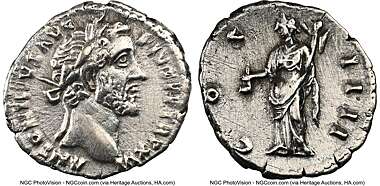
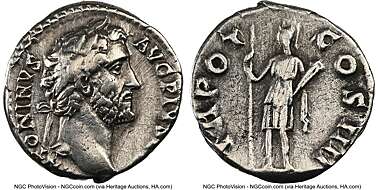
Лот 21119. Ancients Antoninus Pius (AD 138-161). AR denarius (18mm, 5h). NGC Choice VF, brushed. Rome, AD 152-153. ANTONINVS AVG-PIVS P P TR P XVI, laureate head of Antoninus Pius right / COS-IIII, Vesta standing facing, head left, simpulum in outstretched right hand, palladium cradled in left arm. RIC III 219. From the Khanum Jan Collection. Born in AD 86 as T. Aurelius Fulvius Boionius Antoninus to a wealthy family from Nemausus in Gaul. His grandfather and father had each risen to Consul, and like them, he entered the Senate at the appropriate age and enjoyed a distinguished career. Around AD 120, he married Annia Galeria Faustina, an aristocratic lady of Spanish descent with family ties to the emperors Trajan and Hadrian. He earned a consulship in AD 130 and served as the Proconsul of Asia. Tall, handsome, and widely admired for his sober judgment, he soon attracted the attention of Hadrian, who made him a close advisor. When Hadrian's intended successor, Aelius, died early in AD 138, the ailing emperor settled on the 52-year-old Antoninus as his replacement. Hadrian died on July 10, and Antoninus succeeded without serious opposition. Unlike the restless Hadrian, Antoninus never left Italy and was content to rule from Rome. Stability and equanimity were his watchwords, and his policies kept the Empire on an even keel for 24 years. He put no one to death, friend or foe. Only minor flare-ups in northern Britain and northern Africa disturbed the general peace. The frontiers were maintained and defended, with his decision to build a new wall in Britain 90 miles north of the Hadrian's Wall the only instance of imperial expansion. He carefully groomed Marcus Aurelius as his successor but neglected to provide him with any military training. In fact, the mild, civilian character of his reign may have unwittingly allowed storm clouds to gather and strengthen both within and beyond the frontiers. Nevertheless, later generations viewed Antoninus as the perfect emperor, and the tranquility of his reign took on the sheen of a lost golden age. HID05401242017 © 2026 Heritage Auctions | All Rights Reserved www.HA.com/TexasAuctioneerLicenseNotice
  • Стартовая цена:
    1 USD
    0 EUR
    0 GBP
    0 CHF

    Примерные оценкиДата: 05.11.2026
Лот
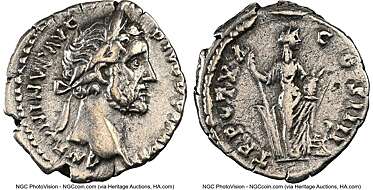
Лот 21120. Ancients Antoninus Pius (AD 138-161). AR denarius (18mm, 7h). NGC VF, brushed. Rome, AD 148-149. ANTONINVS AVG PI-VS P P TR P XII, laureate head of Antoninus right / COS-IIII, Fortuna standing facing, head left, right hand resting on rudder, cornucopia in left. RIC III 179. From the Khanum Jan Collection. Born in AD 86 as T. Aurelius Fulvius Boionius Antoninus to a wealthy family from Nemausus in Gaul. His grandfather and father had each risen to Consul, and like them, he entered the Senate at the appropriate age and enjoyed a distinguished career. Around AD 120, he married Annia Galeria Faustina, an aristocratic lady of Spanish descent with family ties to the emperors Trajan and Hadrian. He earned a consulship in AD 130 and served as the Proconsul of Asia. Tall, handsome, and widely admired for his sober judgment, he soon attracted the attention of Hadrian, who made him a close advisor. When Hadrian's intended successor, Aelius, died early in AD 138, the ailing emperor settled on the 52-year-old Antoninus as his replacement. Hadrian died on July 10, and Antoninus succeeded without serious opposition. Unlike the restless Hadrian, Antoninus never left Italy and was content to rule from Rome. Stability and equanimity were his watchwords, and his policies kept the Empire on an even keel for 24 years. He put no one to death, friend or foe. Only minor flare-ups in northern Britain and northern Africa disturbed the general peace. The frontiers were maintained and defended, with his decision to build a new wall in Britain 90 miles north of the Hadrian's Wall the only instance of imperial expansion. He carefully groomed Marcus Aurelius as his successor but neglected to provide him with any military training. In fact, the mild, civilian character of his reign may have unwittingly allowed storm clouds to gather and strengthen both within and beyond the frontiers. Nevertheless, later generations viewed Antoninus as the perfect emperor, and the tranquility of his reign took on the sheen of a lost golden age. HID05401242017 © 2026 Heritage Auctions | All Rights Reserved www.HA.com/TexasAuctioneerLicenseNotice
  • Стартовая цена:
    1 USD
    0 EUR
    0 GBP
    0 CHF

    Примерные оценкиДата: 05.11.2026
Лот
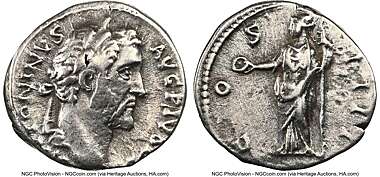
Лот 21121. Ancients Antoninus Pius (AD 138-161). AR denarius (17mm, 12h). NGC VF, brushed. Rome, AD 145-161. ANTONINVS-AVG PIVS P P, laureate head of Antoninus Pius right / CO-S-IIII, Concordia(?) standing facing, head left, with patera in outstretched right hand, grounded scepter in left. RIC III 129. From the Khanum Jan Collection. Born in AD 86 as T. Aurelius Fulvius Boionius Antoninus to a wealthy family from Nemausus in Gaul. His grandfather and father had each risen to Consul, and like them, he entered the Senate at the appropriate age and enjoyed a distinguished career. Around AD 120, he married Annia Galeria Faustina, an aristocratic lady of Spanish descent with family ties to the emperors Trajan and Hadrian. He earned a consulship in AD 130 and served as the Proconsul of Asia. Tall, handsome, and widely admired for his sober judgment, he soon attracted the attention of Hadrian, who made him a close advisor. When Hadrian's intended successor, Aelius, died early in AD 138, the ailing emperor settled on the 52-year-old Antoninus as his replacement. Hadrian died on July 10, and Antoninus succeeded without serious opposition. Unlike the restless Hadrian, Antoninus never left Italy and was content to rule from Rome. Stability and equanimity were his watchwords, and his policies kept the Empire on an even keel for 24 years. He put no one to death, friend or foe. Only minor flare-ups in northern Britain and northern Africa disturbed the general peace. The frontiers were maintained and defended, with his decision to build a new wall in Britain 90 miles north of the Hadrian's Wall the only instance of imperial expansion. He carefully groomed Marcus Aurelius as his successor but neglected to provide him with any military training. In fact, the mild, civilian character of his reign may have unwittingly allowed storm clouds to gather and strengthen both within and beyond the frontiers. Nevertheless, later generations viewed Antoninus as the perfect emperor, and the tranquility of his reign took on the sheen of a lost golden age. HID05401242017 © 2026 Heritage Auctions | All Rights Reserved www.HA.com/TexasAuctioneerLicenseNotice
  • Стартовая цена:
    1 USD
    0 EUR
    0 GBP
    0 CHF

    Примерные оценкиДата: 05.11.2026
Лот
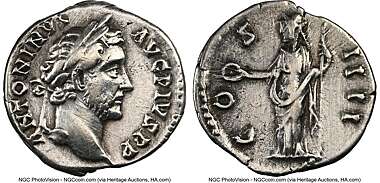
Лот 21122. Ancients Antoninus Pius (AD 138-161). AR denarius (18mm, 5h). NGC VF, brushed. Rome, AD 145-161. ANTONINVS-AVG PIVS P P, laureate head of Antoninus Pius right / CO-S-IIII, Concordia(?) standing facing, head left, with patera in outstretched right hand, grounded scepter in left. RIC III 129. From the Khanum Jan Collection. Born in AD 86 as T. Aurelius Fulvius Boionius Antoninus to a wealthy family from Nemausus in Gaul. His grandfather and father had each risen to Consul, and like them, he entered the Senate at the appropriate age and enjoyed a distinguished career. Around AD 120, he married Annia Galeria Faustina, an aristocratic lady of Spanish descent with family ties to the emperors Trajan and Hadrian. He earned a consulship in AD 130 and served as the Proconsul of Asia. Tall, handsome, and widely admired for his sober judgment, he soon attracted the attention of Hadrian, who made him a close advisor. When Hadrian's intended successor, Aelius, died early in AD 138, the ailing emperor settled on the 52-year-old Antoninus as his replacement. Hadrian died on July 10, and Antoninus succeeded without serious opposition. Unlike the restless Hadrian, Antoninus never left Italy and was content to rule from Rome. Stability and equanimity were his watchwords, and his policies kept the Empire on an even keel for 24 years. He put no one to death, friend or foe. Only minor flare-ups in northern Britain and northern Africa disturbed the general peace. The frontiers were maintained and defended, with his decision to build a new wall in Britain 90 miles north of the Hadrian's Wall the only instance of imperial expansion. He carefully groomed Marcus Aurelius as his successor but neglected to provide him with any military training. In fact, the mild, civilian character of his reign may have unwittingly allowed storm clouds to gather and strengthen both within and beyond the frontiers. Nevertheless, later generations viewed Antoninus as the perfect emperor, and the tranquility of his reign took on the sheen of a lost golden age. HID05401242017 © 2026 Heritage Auctions | All Rights Reserved www.HA.com/TexasAuctioneerLicenseNotice
  • Стартовая цена:
    1 USD
    0 EUR
    0 GBP
    0 CHF

    Примерные оценкиДата: 05.11.2026
Лот
Лот 21123. Ancients Antoninus Pius (AD 138-161). AR denarius (17mm, 7h). NGC VF, brushed. Rome, AD 155-156. ANTONINVS AVG PIVS P P IMP II, laureate head of Antoninus Pius right / TR POT X-X CO-S IIII, Ceres seated left, with torch in right hand and grain ears cradled in left. RIC III 259. From the Khanum Jan Collection. Born in AD 86 as T. Aurelius Fulvius Boionius Antoninus to a wealthy family from Nemausus in Gaul. His grandfather and father had each risen to Consul, and like them, he entered the Senate at the appropriate age and enjoyed a distinguished career. Around AD 120, he married Annia Galeria Faustina, an aristocratic lady of Spanish descent with family ties to the emperors Trajan and Hadrian. He earned a consulship in AD 130 and served as the Proconsul of Asia. Tall, handsome, and widely admired for his sober judgment, he soon attracted the attention of Hadrian, who made him a close advisor. When Hadrian's intended successor, Aelius, died early in AD 138, the ailing emperor settled on the 52-year-old Antoninus as his replacement. Hadrian died on July 10, and Antoninus succeeded without serious opposition. Unlike the restless Hadrian, Antoninus never left Italy and was content to rule from Rome. Stability and equanimity were his watchwords, and his policies kept the Empire on an even keel for 24 years. He put no one to death, friend or foe. Only minor flare-ups in northern Britain and northern Africa disturbed the general peace. The frontiers were maintained and defended, with his decision to build a new wall in Britain 90 miles north of the Hadrian's Wall the only instance of imperial expansion. He carefully groomed Marcus Aurelius as his successor but neglected to provide him with any military training. In fact, the mild, civilian character of his reign may have unwittingly allowed storm clouds to gather and strengthen both within and beyond the frontiers. Nevertheless, later generations viewed Antoninus as the perfect emperor, and the tranquility of his reign took on the sheen of a lost golden age. HID05401242017 © 2026 Heritage Auctions | All Rights Reserved www.HA.com/TexasAuctioneerLicenseNotice
  • Стартовая цена:
    1 USD
    0 EUR
    0 GBP
    0 CHF

    Примерные оценкиДата: 05.11.2026
Лот
Лот 21124. Ancients Antoninus Pius (AD 138-161). AR denarius (17mm, 7h). NGC VF, brushed. Rome. ANTONINVS-AVG PIVS P P, laureate head of Antoninus Pius right / TR POT-COS IIII, Virtus standing facing, grounded spear in right hand, parazonium cradled in left. RIC III 154. From the Khanum Jan Collection. Born in AD 86 as T. Aurelius Fulvius Boionius Antoninus to a wealthy family from Nemausus in Gaul. His grandfather and father had each risen to Consul, and like them, he entered the Senate at the appropriate age and enjoyed a distinguished career. Around AD 120, he married Annia Galeria Faustina, an aristocratic lady of Spanish descent with family ties to the emperors Trajan and Hadrian. He earned a consulship in AD 130 and served as the Proconsul of Asia. Tall, handsome, and widely admired for his sober judgment, he soon attracted the attention of Hadrian, who made him a close advisor. When Hadrian's intended successor, Aelius, died early in AD 138, the ailing emperor settled on the 52-year-old Antoninus as his replacement. Hadrian died on July 10, and Antoninus succeeded without serious opposition. Unlike the restless Hadrian, Antoninus never left Italy and was content to rule from Rome. Stability and equanimity were his watchwords, and his policies kept the Empire on an even keel for 24 years. He put no one to death, friend or foe. Only minor flare-ups in northern Britain and northern Africa disturbed the general peace. The frontiers were maintained and defended, with his decision to build a new wall in Britain 90 miles north of the Hadrian's Wall the only instance of imperial expansion. He carefully groomed Marcus Aurelius as his successor but neglected to provide him with any military training. In fact, the mild, civilian character of his reign may have unwittingly allowed storm clouds to gather and strengthen both within and beyond the frontiers. Nevertheless, later generations viewed Antoninus as the perfect emperor, and the tranquility of his reign took on the sheen of a lost golden age. HID05401242017 © 2026 Heritage Auctions | All Rights Reserved www.HA.com/TexasAuctioneerLicenseNotice
  • Стартовая цена:
    1 USD
    0 EUR
    0 GBP
    0 CHF

    Примерные оценкиДата: 05.11.2026
Лот
Лот 21125. Ancients Antoninus Pius (AD 138-161). AR denarius (17mm, 12h). NGC VF, brushed. Rome, AD 157. ANTONINVS AVG-PIVS P P IMP II, laureate head of Antoninus right / TR POT XXI-COS IIII, Fortuna-Annona standing facing, left foot raised and resting on prow, right hand resting on rudder, modius cradled in left. RIC III 275. From the Khanum Jan Collection. HID05401242017 © 2026 Heritage Auctions | All Rights Reserved www.HA.com/TexasAuctioneerLicenseNotice
  • Стартовая цена:
    1 USD
    0 EUR
    0 GBP
    0 CHF

    Примерные оценкиДата: 05.11.2026
Лот
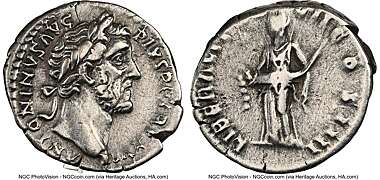
Лот 21126. Ancients Antoninus Pius (AD 138-161). AR denarius (18mm, 7h). NGC VF, brushed. Rome, AD 152-153. ANTONINVS AVG-PIVS P P TR P XVI, laureate head of Antoninus Pius right / LIBERALITAS-VII COS IIII, Liberalitas standing facing, head left, emptying coins out of cornucopia held in both hands. RIC III 228. From the Khanum Jan Collection. Born in AD 86 as T. Aurelius Fulvius Boionius Antoninus to a wealthy family from Nemausus in Gaul. His grandfather and father had each risen to Consul, and like them, he entered the Senate at the appropriate age and enjoyed a distinguished career. Around AD 120, he married Annia Galeria Faustina, an aristocratic lady of Spanish descent with family ties to the emperors Trajan and Hadrian. He earned a consulship in AD 130 and served as the Proconsul of Asia. Tall, handsome, and widely admired for his sober judgment, he soon attracted the attention of Hadrian, who made him a close advisor. When Hadrian's intended successor, Aelius, died early in AD 138, the ailing emperor settled on the 52-year-old Antoninus as his replacement. Hadrian died on July 10, and Antoninus succeeded without serious opposition. Unlike the restless Hadrian, Antoninus never left Italy and was content to rule from Rome. Stability and equanimity were his watchwords, and his policies kept the Empire on an even keel for 24 years. He put no one to death, friend or foe. Only minor flare-ups in northern Britain and northern Africa disturbed the general peace. The frontiers were maintained and defended, with his decision to build a new wall in Britain 90 miles north of the Hadrian's Wall the only instance of imperial expansion. He carefully groomed Marcus Aurelius as his successor but neglected to provide him with any military training. In fact, the mild, civilian character of his reign may have unwittingly allowed storm clouds to gather and strengthen both within and beyond the frontiers. Nevertheless, later generations viewed Antoninus as the perfect emperor, and the tranquility of his reign took on the sheen of a lost golden age. HID05401242017 © 2026 Heritage Auctions | All Rights Reserved www.HA.com/TexasAuctioneerLicenseNotice
  • Стартовая цена:
    1 USD
    0 EUR
    0 GBP
    0 CHF

    Примерные оценкиДата: 05.11.2026
Лот
Лот 21127. Ancients Antoninus Pius (AD 138-161). AR denarius (17mm, 6h). NGC VF, brushed. Rome, AD 157. ANTONINVS AVG-PIVS PP IMP II, laureate head of Antoninus Pius right / TR POT XX-COS IIII, Annona standing facing, head right, left leg on prow, rudder on globe in right hand, modius in left. RIC III 260. From the Khanum Jan Collection. HID05401242017 © 2026 Heritage Auctions | All Rights Reserved www.HA.com/TexasAuctioneerLicenseNotice
  • Стартовая цена:
    1 USD
    0 EUR
    0 GBP
    0 CHF

    Примерные оценкиДата: 05.11.2026
Лот
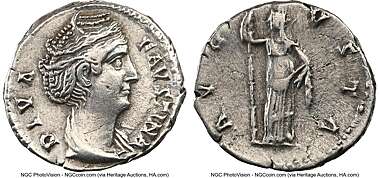
Лот 21128. Ancients Diva Faustina Senior (AD 138-140/141). AR denarius (18mm, 12h). NGC VF, brushed. Rome, AD 141-161. DIVA-FAVSTINA, draped bust of Diva Faustina Senior right, seen from front, hair elaborately waved in several loops around head, braided, drawn up and coiled on top with pearls / AVG-VSTA, Ceres (or Aeternitas) standing facing, head left, grounded long lit torch in right hand, fold of stola in left. RIC III (Antoninus Pius) 362. From the Khanum Jan Collection. HID05401242017 © 2026 Heritage Auctions | All Rights Reserved www.HA.com/TexasAuctioneerLicenseNotice
  • Стартовая цена:
    1 USD
    0 EUR
    0 GBP
    0 CHF

    Примерные оценкиДата: 05.11.2026
Лот
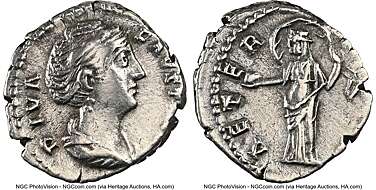
Лот 21129. Ancients Diva Faustina Senior (AD 138-140/141). AR denarius (17mm, 5h). NGC VF, brushed. Rome, AD 141-161. DIVA FAV-STINA, draped bust of Diva Faustina Senior right, seen from front, hair elaborately waved in several loops around head under thin band, braided, drawn up and coiled on top with pearls / AETE-R-NITAS, Providentia (Aeternitas) standing facing, head left, globe in outstretched right hand, veil in left hand billowing behind. RIC III (Antoninus Pius) 351. From the Khanum Jan Collection. Annia Galeria Faustina was born into an aristocratic Roman senatorial family of Spanish descent. Her father and one brother achieved the rank of Consul; her other brother, Marcus Annius Verus, became Praetor and was father to the future Emperor Marcus Aurelius. Her maternal uncle was the Emperor Hadrian. In about AD 115, she married Titus Fulvius Antoninus, a respected Senator, and through her connections he became a close advisor to Hadrian. When Hadrian's intended successor, Aelius Caesar, died early in AD 138, the ailing emperor settled on the 52-year-old Antoninus as his replacement. Antoninus succeeded to the throne later that year and Faustina was acclaimed as Augusta, or Empress. Antoninus honored her extensively on the coinage and her vivacity, fashion sense and compassion for the poor made her very popular. Her distinctive hairstyle, with a plait wrapped in a tight coil atop her head, was copied by women throughout the Empire. While the staid Roman historians of later eras criticized her lack of "gravitas," Antoninus was devoted to her. The couple had four children, two sons and two daughters. Although both male children died in infancy, the daughters lived well into adulthood, and one, Faustina the Younger, married Marcus Aurelius and became Augusta herself. Only two years into Antoninus' reign, Faustina died of an unknown illness. The grief-stricken Antoninus secured her deification and issued an immense coinage in her name, the largest for any Roman woman to that point. HID05401242017 © 2026 Heritage Auctions | All Rights Reserved www.HA.com/TexasAuctioneerLicenseNotice
  • Стартовая цена:
    1 USD
    0 EUR
    0 GBP
    0 CHF

    Примерные оценкиДата: 05.11.2026
Лот
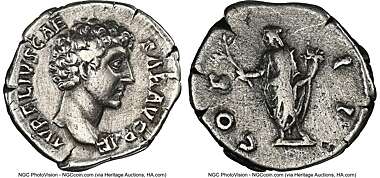
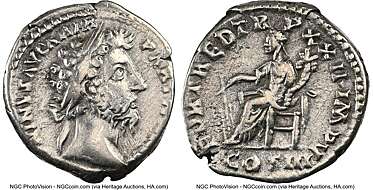
Лот 21130. Ancients Marcus Aurelius, as Caesar (AD 161-180). AR denarius (19mm, 7h). NGC Choice Fine, brushed. Rome, AD 145-147(?). AVRELIVS CAE-SAR AVG PII F, bare head of Marcus Aurelius right / COS-II, Honos standing facing, head left, flower in outstretched right hand, cornucopia cradled in left arm. RIC III (Antoninus Pius) 429a. From the Khanum Jan Collection. Originally given the name Marcus Annius Verus, the future Marcus Aurelius was born in AD 121 into a patrician family of Spanish origin. Gaining the favor of Emperor Hadrian early on, he was educated at the Imperial court and adopted by Antoninus Pius at 17, alongside Lucius Verus, as part of Hadrian's succession plan. Upon Antoninus Pius's ascension to the throne in AD 138, Marcus was elevated to Caesar, marking the start of his prominent role in governance. As emperor, Marcus Aurelius navigated the Roman Empire through numerous military conflicts, including the Marcomannic Wars, and faced a devastating plague that significantly impacted the Roman population. His tenure is notably marked by his Stoic philosophy, as captured in his work "Meditations," which remains influential. Despite the lack of military training, his leadership during these tumultuous times reflected a deep commitment to his duties and philosophical principles. Marcus Aurelius died in AD 180, leaving a legacy as a philosopher-king, revered for his wisdom and the stoic fortitude with which he governed the Roman Empire. HID05401242017 © 2026 Heritage Auctions | All Rights Reserved www.HA.com/TexasAuctioneerLicenseNotice
  • Стартовая цена:
    1 USD
    0 EUR
    0 GBP
    0 CHF

    Примерные оценкиДата: 05.11.2026
Лот
Лот 21131. Ancients Marcus Aurelius, as Caesar (AD 161-180). AR denarius (16mm, 7h). NGC Choice Fine, brushed. Rome, AD 158-159. AVRELIVS CAES ANTON AVG PII F, bare head of Marcus Aurelius right / TR POT XIII COS II, Spes advancing left, flower in outstretched right hand, raising skirt with left. RIC III 479a. From the Khanum Jan Collection. HID05401242017 © 2026 Heritage Auctions | All Rights Reserved www.HA.com/TexasAuctioneerLicenseNotice
  • Стартовая цена:
    1 USD
    0 EUR
    0 GBP
    0 CHF

    Примерные оценкиДата: 05.11.2026
Лот
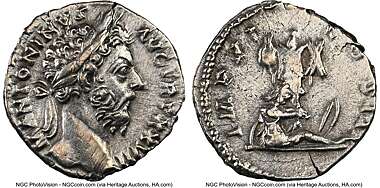
Лот 21132. Ancients Marcus Aurelius, as Augustus (AD 161-180). AR denarius (18mm, 7h). NGC XF, brushed. Rome, ca. AD December 172 - June 173. M ANTONINVS-AVG TR P XXVII, laureate head of Marcus Aurelius right / IMP VI-COS III, German captive seated right at foot of trophy, surrounded by various weapons. RIC III 278. From the Khanum Jan Collection. Originally given the name Marcus Annius Verus, the future Marcus Aurelius was born in AD 121 into a patrician family of Spanish origin. Gaining the favor of Emperor Hadrian early on, he was educated at the Imperial court and adopted by Antoninus Pius at 17, alongside Lucius Verus, as part of Hadrian's succession plan. Upon Antoninus Pius's ascension to the throne in AD 138, Marcus was elevated to Caesar, marking the start of his prominent role in governance. As emperor, Marcus Aurelius navigated the Roman Empire through numerous military conflicts, including the Marcomannic Wars, and faced a devastating plague that significantly impacted the Roman population. His tenure is notably marked by his Stoic philosophy, as captured in his work "Meditations," which remains influential. Despite the lack of military training, his leadership during these tumultuous times reflected a deep commitment to his duties and philosophical principles. Marcus Aurelius died in AD 180, leaving a legacy as a philosopher-king, revered for his wisdom and the stoic fortitude with which he governed the Roman Empire. HID05401242017 © 2026 Heritage Auctions | All Rights Reserved www.HA.com/TexasAuctioneerLicenseNotice
  • Стартовая цена:
    1 USD
    0 EUR
    0 GBP
    0 CHF

    Примерные оценкиДата: 05.11.2026
Лот
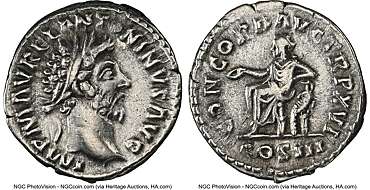
Лот 21133. Ancients Marcus Aurelius, as Augustus (AD 161-180). AR denarius (18mm, 12h). NGC Choice VF, brushed. Rome, AD 161-162. IMP M AVREL ANTONINVS AVG, bare head of Marcus Aurelius right / CONCORD AVG TR P XVI, Concordia enthroned left, patera in outstretched right hand, leaning on statue of Spes with left arm, cornucopia under throne; COS III in exergue. RIC III 35. From the Khanum Jan Collection. Originally given the name Marcus Annius Verus, the future Marcus Aurelius was born in AD 121 into a patrician family of Spanish origin. Gaining the favor of Emperor Hadrian early on, he was educated at the Imperial court and adopted by Antoninus Pius at 17, alongside Lucius Verus, as part of Hadrian's succession plan. Upon Antoninus Pius's ascension to the throne in AD 138, Marcus was elevated to Caesar, marking the start of his prominent role in governance. As emperor, Marcus Aurelius navigated the Roman Empire through numerous military conflicts, including the Marcomannic Wars, and faced a devastating plague that significantly impacted the Roman population. His tenure is notably marked by his Stoic philosophy, as captured in his work "Meditations," which remains influential. Despite the lack of military training, his leadership during these tumultuous times reflected a deep commitment to his duties and philosophical principles. Marcus Aurelius died in AD 180, leaving a legacy as a philosopher-king, revered for his wisdom and the stoic fortitude with which he governed the Roman Empire. HID05401242017 © 2026 Heritage Auctions | All Rights Reserved www.HA.com/TexasAuctioneerLicenseNotice
  • Стартовая цена:
    1 USD
    0 EUR
    0 GBP
    0 CHF

    Примерные оценкиДата: 05.11.2026
Лот
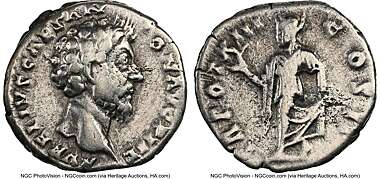
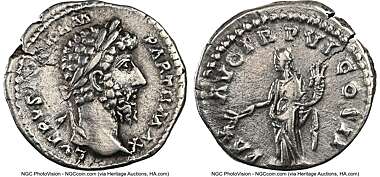
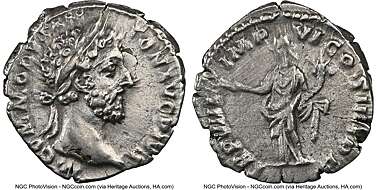
Лот 21134. Ancients Marcus Aurelius, as Augustus (AD 161-180). AR denarius (18mm, 10h). NGC VF, brushed. Rome, February-December AD 168. M ANTONINVS AVG ARM-PARTH MAX, laureate head of Marcus Aurelius right / FORT RED TR P XXII•IMP V, Fortuna seated left, rudder in right hand, cornucopia in left; COS III in exergue. RIC III 185. From the Khanum Jan Collection. HID05401242017 © 2026 Heritage Auctions | All Rights Reserved www.HA.com/TexasAuctioneerLicenseNotice
  • Стартовая цена:
    1 USD
    0 EUR
    0 GBP
    0 CHF

    Примерные оценкиДата: 05.11.2026
Лот
Лот 21135. Ancients Marcus Aurelius, as Augustus (AD 161-180). AR denarius (18mm, 11h). NGC VF, brushed. Rome, December AD 162-December AD 163. M ANTONINVS AVG IMP II, laureate head of Marcus Aurelius / PROV DEOR TRP XVII COS III, Providentia standing facing, head left, globe in right hand, cornucopia in left. RIC III 68. From the Khanum Jan Collection. HID05401242017 © 2026 Heritage Auctions | All Rights Reserved www.HA.com/TexasAuctioneerLicenseNotice
  • Стартовая цена:
    1 USD
    0 EUR
    0 GBP
    0 CHF

    Примерные оценкиДата: 05.11.2026
Лот
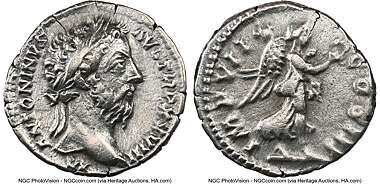
Лот 21136. Ancients Marcus Aurelius, as Augustus (AD 161-180). AR denarius (18mm, 11h). NGC VF, brushed. Rome, AD 174. M-ANTONINVS-AVG TR P XXVIII, laureate head of Marcus Aurelius right / IMP VII-COS III, Victory advancing right, wreath in outstretched right hand, palm over left shoulder. RIC III 301. From the Khanum Jan Collection. Originally given the name Marcus Annius Verus, the future Marcus Aurelius was born in AD 121 into a patrician family of Spanish origin. Gaining the favor of Emperor Hadrian early on, he was educated at the Imperial court and adopted by Antoninus Pius at 17, alongside Lucius Verus, as part of Hadrian's succession plan. Upon Antoninus Pius's ascension to the throne in AD 138, Marcus was elevated to Caesar, marking the start of his prominent role in governance. As emperor, Marcus Aurelius navigated the Roman Empire through numerous military conflicts, including the Marcomannic Wars, and faced a devastating plague that significantly impacted the Roman population. His tenure is notably marked by his Stoic philosophy, as captured in his work "Meditations," which remains influential. Despite the lack of military training, his leadership during these tumultuous times reflected a deep commitment to his duties and philosophical principles. Marcus Aurelius died in AD 180, leaving a legacy as a philosopher-king, revered for his wisdom and the stoic fortitude with which he governed the Roman Empire. HID05401242017 © 2026 Heritage Auctions | All Rights Reserved www.HA.com/TexasAuctioneerLicenseNotice
  • Стартовая цена:
    1 USD
    0 EUR
    0 GBP
    0 CHF

    Примерные оценкиДата: 05.11.2026
Лот
Лот 21137. Ancients Marcus Aurelius, as Augustus (AD 161-180). AR denarius (19mm, 1h). NGC VF, brushed. Rome, December AD 168-December AD 169. M ANTONINVS-AVG TR P XXIII, laureate head of Marcus Aurelius right / LIBERAL-AVG-V-COS III, Liberalitas standing facing, head left, tessera in outstretched right hand, cornucopia cradled in left arm. RIC III 206. From the Khanum Jan Collection. Originally given the name Marcus Annius Verus, the future Marcus Aurelius was born in AD 121 into a patrician family of Spanish origin. Gaining the favor of Emperor Hadrian early on, he was educated at the Imperial court and adopted by Antoninus Pius at 17, alongside Lucius Verus, as part of Hadrian's succession plan. Upon Antoninus Pius's ascension to the throne in AD 138, Marcus was elevated to Caesar, marking the start of his prominent role in governance. As emperor, Marcus Aurelius navigated the Roman Empire through numerous military conflicts, including the Marcomannic Wars, and faced a devastating plague that significantly impacted the Roman population. His tenure is notably marked by his Stoic philosophy, as captured in his work "Meditations," which remains influential. Despite the lack of military training, his leadership during these tumultuous times reflected a deep commitment to his duties and philosophical principles. Marcus Aurelius died in AD 180, leaving a legacy as a philosopher-king, revered for his wisdom and the stoic fortitude with which he governed the Roman Empire. HID05401242017 © 2026 Heritage Auctions | All Rights Reserved www.HA.com/TexasAuctioneerLicenseNotice
  • Стартовая цена:
    1 USD
    0 EUR
    0 GBP
    0 CHF

    Примерные оценкиДата: 05.11.2026
Лот
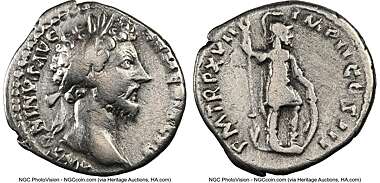
Лот 21138. Ancients Marcus Aurelius, as Augustus (AD 161-180). AR denarius (17mm, 6h). NGC Fine, brushed. Rome, AD 163-164. ANTONINVS AVG-ARMENIACVS, laureate head of Marcus right / P M TR P XVIII-IMP II COS III, Mars standing facing, helmeted head right, in full military dress, grounded reversed spear in right hand, resting left hand on grounded shield. RIC III 92. From the Khanum Jan Collection. Originally given the name Marcus Annius Verus, the future Marcus Aurelius was born in AD 121 into a patrician family of Spanish origin. Gaining the favor of Emperor Hadrian early on, he was educated at the Imperial court and adopted by Antoninus Pius at 17, alongside Lucius Verus, as part of Hadrian's succession plan. Upon Antoninus Pius's ascension to the throne in AD 138, Marcus was elevated to Caesar, marking the start of his prominent role in governance. As emperor, Marcus Aurelius navigated the Roman Empire through numerous military conflicts, including the Marcomannic Wars, and faced a devastating plague that significantly impacted the Roman population. His tenure is notably marked by his Stoic philosophy, as captured in his work "Meditations," which remains influential. Despite the lack of military training, his leadership during these tumultuous times reflected a deep commitment to his duties and philosophical principles. Marcus Aurelius died in AD 180, leaving a legacy as a philosopher-king, revered for his wisdom and the stoic fortitude with which he governed the Roman Empire. HID05401242017 © 2026 Heritage Auctions | All Rights Reserved www.HA.com/TexasAuctioneerLicenseNotice
  • Стартовая цена:
    1 USD
    0 EUR
    0 GBP
    0 CHF

    Примерные оценкиДата: 05.11.2026
Лот
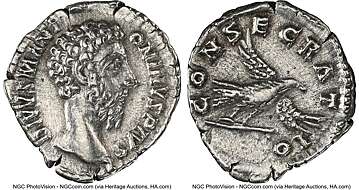
Лот 21139. Ancients Divus Marcus Aurelius (AD 161-180). AR denarius (19mm, 11h). NGC Choice VF, brushed. Rome, ca. AD 180. DIVVS M ANT-ONINVS PIVS, bare head of Divus Marcus Aurelius right / CONS-ECRAT-IO, eagle flying right, wings spread, scepter in claws. RIC III (Commodus) 268. From the Khanum Jan Collection. Originally given the name Marcus Annius Verus, the future Marcus Aurelius was born in AD 121 into a patrician family of Spanish origin. Gaining the favor of Emperor Hadrian early on, he was educated at the Imperial court and adopted by Antoninus Pius at 17, alongside Lucius Verus, as part of Hadrian's succession plan. Upon Antoninus Pius's ascension to the throne in AD 138, Marcus was elevated to Caesar, marking the start of his prominent role in governance. As emperor, Marcus Aurelius navigated the Roman Empire through numerous military conflicts, including the Marcomannic Wars, and faced a devastating plague that significantly impacted the Roman population. His tenure is notably marked by his Stoic philosophy, as captured in his work "Meditations," which remains influential. Despite the lack of military training, his leadership during these tumultuous times reflected a deep commitment to his duties and philosophical principles. Marcus Aurelius died in AD 180, leaving a legacy as a philosopher-king, revered for his wisdom and the stoic fortitude with which he governed the Roman Empire. HID05401242017 © 2026 Heritage Auctions | All Rights Reserved www.HA.com/TexasAuctioneerLicenseNotice
  • Стартовая цена:
    1 USD
    0 EUR
    0 GBP
    0 CHF

    Примерные оценкиДата: 05.11.2026
Лот
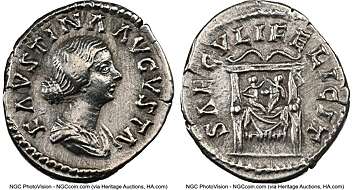
Лот 21140. Ancients Faustina Junior (AD 147-175/176). AR denarius (19mm, 5h). NGC Choice VF, brushed. Rome, AD 161-175/176. FAVSTINA-AVGVSTA, draped bust of Faustina Junior right, seen from front, wearing diadem, hair brushed in waves and gathered into small chignon at base of head / SAECVLI FELICIT, draped throne on which there are two children, Commodus and Annius Verus. RIC III (Marcus Aurelius) 712. From the Khanum Jan Collection. HID05401242017 © 2026 Heritage Auctions | All Rights Reserved www.HA.com/TexasAuctioneerLicenseNotice
  • Стартовая цена:
    1 USD
    0 EUR
    0 GBP
    0 CHF

    Примерные оценкиДата: 05.11.2026
Лот
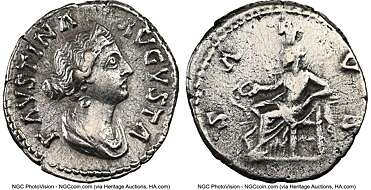
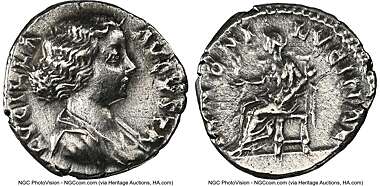
Лот 21141. Ancients Faustina Junior (AD 147-175/176). AR denarius (18mm, 7h). NGC VF, brushed. Rome, AD 161-175/176. FAVSTINA-AVGVSTA, draped bust of Faustina Junior right, seen from front, wearing stephane, hair brushed in waves and tucked in small chignon at base of head / SALVS, Salus seated left, feeding serpent rising from altar at feet before from patera in outstretched right hand, left arm resting on back of throne. RIC III (Marcus Aurelius) 714. From the Khanum Jan Collection. Annia Galeria Faustina the Younger was born in about AD 129 to Antoninus Pius and his wife, Faustina the Elder. When Antoninus was adopted by Hadrian as his successor in AD 138, the emperor arranged for her betrothal to Lucius Verus, also about eight, the son of the "heir consumptive" Aelius Caesar, who had died the same year. When Antoninus inherited the throne, he broke the engagement and instead betrothed her to his nephew (and adoptive son) Marcus Aurelius. They were wed in AD 145 to great rejoicing and went on to produce at least 13 children, of which only three or four survived to adulthood, among them the future emperor Commodus. Faustina seems to have been a free, fun-loving spirit in the mold of her mother, which earned the disapproval of staid Roman historians. Marcus Aurelius, after he became emperor in AD 161, spent long years on campaign, which must have strained the relationship. Faustina accompanied him on some of these and was given the honorific title "Mater Castrorum," or "Mother of the Camp." Nevertheless, there were rumors of adulteries with soldiers, sailors and gladiators, which do not seem to have altered her husband's devotion to her. More serious are allegations that she had some part in the abortive rebellion of the eastern general Avidius Cassius in AD 175. Whatever the truth, she died soon thereafter, either of illness or as the result of an accident. Reputation or no, Marcus grieved greatly and ordered her deification. The lifetime coinage of Faustina started at the time of her marriage and continued over 30 years, showing her from a fresh-faced princess to a mature matron, and providing a pageant of Roman feminine hairstyles over that span. HID05401242017 © 2026 Heritage Auctions | All Rights Reserved www.HA.com/TexasAuctioneerLicenseNotice
  • Стартовая цена:
    1 USD
    0 EUR
    0 GBP
    0 CHF

    Примерные оценкиДата: 05.11.2026
Лот
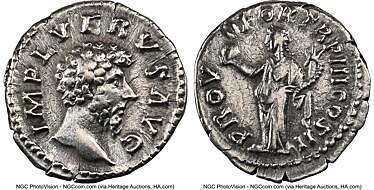
Лот 21142. Ancients Lucius Verus (AD 161-169). AR denarius (18mm, 11h). NGC Choice VF, brushed. Rome, December AD 162-December AD 163. IMP L VERVS AVG, bare head of Lucius Verus right / PROV-DEOR TR P III COS II, Providentia standing facing, head left, globe in outstretched right hand, cornucopia cradled in left arm. RIC III (Marcus Aurelius) 491. From the Khanum Jan Collection. Born Lucius Ceionius Commodus, Lucius Verus was the son of Aelius Caesar, the favored heir of Emperor Hadrian. Aelius's premature demise in AD 138 thrust Lucius into the uncertainty of imperial succession. Hadrian instead chose to adopt Antoninus Pius as his replacement, a seasoned senator who agreed to ascend to the throne on the condition of a more hereditarily adoptive line of succession by naming both Lucius--the son of Hadrian's initial choice as heir--and Hadrian's great-nephew Marcus Aurelius as his heirs. Following the death of Antoninus Pius in 161, the Senate planned to confirm Marcus alone, but he insisted on Lucius's elevation to Augustus. Lucius would take on Marcus' family name, "Verus". Their co-reign forged an unprecedented partnership at the zenith of Roman power, amidst the distant thunder of Parthian aggression. Lucius, with the mantle of military leadership thrust upon him, embarked on a campaign to repel the eastern threat. His notorious affair with a low-born mistress caused Marcus to fast-track Lucius' marriage to his thirteen-year-old niece, Lucilla, in 163. Although Lucius spent the duration of the war living a life of luxury and licentiousness in Asia Minor, the success of his generals in reconquering the Armenian capital at Artaxata and sacking the Parthian capital at Ctesiphon earned him a triumph in 166 and two new titles-Armeniacus and Parthicus Maximus. Yet these victories also sowed the seeds of catastrophe. As the Roman legions returned, they brought back with them an epidemic that would ravage the Empire-the Antonine Plague. Returning from the Germanic front in 169, Lucius succumbed to the merciless grip of smallpox, a victim of the very plague his victories had unwittingly unleashed. HID05401242017 © 2026 Heritage Auctions | All Rights Reserved www.HA.com/TexasAuctioneerLicenseNotice
  • Стартовая цена:
    1 USD
    0 EUR
    0 GBP
    0 CHF

    Примерные оценкиДата: 05.11.2026
Лот
Лот 21143. Ancients Lucius Verus (AD 161-169). AR denarius (19mm, 12h). NGC VF, brushed. Rome, AD 165/6. L VERVS AVG ARM PARTH MAX, laureate head of Lucius Verus right / PAX-AVG TR P VI COS II, Pax standing facing, head left, olive branch in right hand, cornucopia cradled in left. RIC III 555. From the Khanum Jan Collection. Born Lucius Ceionius Commodus, Lucius Verus was the son of Aelius Caesar, the favored heir of Emperor Hadrian. Aelius's premature demise in AD 138 thrust Lucius into the uncertainty of imperial succession. Hadrian instead chose to adopt Antoninus Pius as his replacement, a seasoned senator who agreed to ascend to the throne on the condition of a more hereditarily adoptive line of succession by naming both Lucius--the son of Hadrian's initial choice as heir--and Hadrian's great-nephew Marcus Aurelius as his heirs. Following the death of Antoninus Pius in 161, the Senate planned to confirm Marcus alone, but he insisted on Lucius's elevation to Augustus. Lucius would take on Marcus' family name, "Verus". Their co-reign forged an unprecedented partnership at the zenith of Roman power, amidst the distant thunder of Parthian aggression. Lucius, with the mantle of military leadership thrust upon him, embarked on a campaign to repel the eastern threat. His notorious affair with a low-born mistress caused Marcus to fast-track Lucius' marriage to his thirteen-year-old niece, Lucilla, in 163. Although Lucius spent the duration of the war living a life of luxury and licentiousness in Asia Minor, the success of his generals in reconquering the Armenian capital at Artaxata and sacking the Parthian capital at Ctesiphon earned him a triumph in 166 and two new titles-Armeniacus and Parthicus Maximus. Yet these victories also sowed the seeds of catastrophe. As the Roman legions returned, they brought back with them an epidemic that would ravage the Empire-the Antonine Plague. Returning from the Germanic front in 169, Lucius succumbed to the merciless grip of smallpox, a victim of the very plague his victories had unwittingly unleashed. HID05401242017 © 2026 Heritage Auctions | All Rights Reserved www.HA.com/TexasAuctioneerLicenseNotice
  • Стартовая цена:
    1 USD
    0 EUR
    0 GBP
    0 CHF

    Примерные оценкиДата: 05.11.2026
Лот
Лот 21144. Ancients Lucilla (AD 164-182). AR denarius (17mm, 6h). NGC XF, brushed. Rome, AD 163-169. LVCILLA-AVGVSTA, draped bust of Lucilla right, seen from front, hair waved and coiled at lower back of head in small chignon / IVNONI-LVCINAE, Juno seated left, flower in outstretched right hand, infant cradled in left arm. RIC III (Marcus Aurelius) 770. From the Khanum Jan Collection. Lucilla was a Roman noblewoman born in AD 148, the daughter of Emperor Marcus Aurelius and Empress Faustina the Younger. At a young age, she was married to Lucius Verus, her father’s co-emperor, becoming Augusta and enjoying high status in the imperial court. After Verus’ death in AD 169, Lucilla remained influential but reportedly grew resentful of her brother Commodus’s rule. In AD 182, she was implicated in a failed plot to assassinate Commodus and replace him with her lover. As a result, Lucilla was exiled and later executed on her brother’s orders. Her life reflects both the privileges and perils of imperial power. HID05401242017 © 2026 Heritage Auctions | All Rights Reserved www.HA.com/TexasAuctioneerLicenseNotice
  • Стартовая цена:
    1 USD
    0 EUR
    0 GBP
    0 CHF

    Примерные оценкиДата: 05.11.2026
Лот
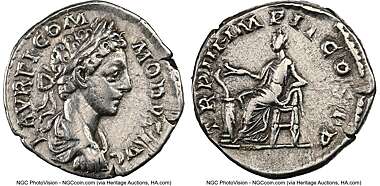
Лот 21145. Ancients Commodus (AD 177-192). AR denarius (18mm, 6h). NGC Choice VF, brushed. Rome, AD 178. L AVREL COM-MODVS AVG, laureate, draped, and cuirassed bust of Commodus right / TR P III IMP II COS P P, Salus enthroned left, feeding serpent rising from altar at feet to left from patera in outstretched right hand, resting left arm on back of throne. RIC III (Marcus Aurelius) 649. From the Khanum Jan Collection. The sole reign of Commodus, AD 180-192, is often viewed as the tipping point where the Roman Empire's long decline began. Commodus has thus been featured in novels, plays, and feature films as a villain, most recently in the cinema epics "Fall of the Roman Empire" (1964) and "Gladiator" (2001). The historians Dio and Herodian both describe him as exceptionally handsome, a picture borne out by his coin portraits and sculpture. Son of the greatly revered "Philosopher Emperor" Marcus Aurelius (AD 161-180), Commodus was the first emperor born "in the purple" in AD 161, and Marcus made him co-Augustus in AD 177. He accompanied Marcus on a military campaign against the Germans in AD 178; worn out by his exertions, Marcus died on 17 March AD 180. Freed of his dutiful father's control, Commodus immediately cut a deal with the Germans and abandoned all further plans of military conquest. Returning to Rome, he plunged into sensual pursuits and left governing to a succession of favorites who plundered the public purse and aggrandized themselves. While Commodus continued and worsened the debasement of Roman silver coinage begun by his father, the gold coinage remained of high purity, weight, and artistry. HID05401242017 © 2026 Heritage Auctions | All Rights Reserved www.HA.com/TexasAuctioneerLicenseNotice
  • Стартовая цена:
    1 USD
    0 EUR
    0 GBP
    0 CHF

    Примерные оценкиДата: 05.11.2026
Лот
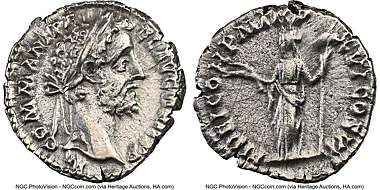
Лот 21146. Ancients Commodus (AD 177-192). AR denarius (18mm, 1h). NGC Choice VF, brushed. Rome, AD 190-191. M COMM ANT P F-EL AVG BRIT P P, laureate head of Commodus right / FIDEI COH P M TR P XVI COS VI, Fides standing facing, head left, grain ears in outstretched right hand, grounded standard in left. RIC III 220. From the Khanum Jan Collection. The sole reign of Commodus, AD 180-192, is often viewed as the tipping point where the Roman Empire's long decline began. Commodus has thus been featured in novels, plays, and feature films as a villain, most recently in the cinema epics "Fall of the Roman Empire" (1964) and "Gladiator" (2001). Son of the greatly revered "Philosopher Emperor" Marcus Aurelius (AD 161-180), Commodus was the first emperor born "in the purple" in AD 161. Marcus made him co-Augustus in AD 177. He accompanied Marcus on a military campaign against the Germans in AD 178; worn out by his exertions, Marcus died on 17 March AD 180. Freed of his dutiful father's control, Commodus immediately cut a deal with the Germans and abandoned all further plans of military conquest. Returning to Rome, he plunged into sensual pursuits and left governing to a succession of favorites who plundered the public purse and aggrandized themselves. While Commodus continued and worsened the debasement of Roman silver coinage begun by his father, the gold coinage remained of high purity, weight and artistry. The historians Dio and Herodian both describe him as exceptionally handsome, a picture borne out by his coin portraits and sculpture. HID05401242017 © 2026 Heritage Auctions | All Rights Reserved www.HA.com/TexasAuctioneerLicenseNotice
  • Стартовая цена:
    1 USD
    0 EUR
    0 GBP
    0 CHF

    Примерные оценкиДата: 05.11.2026
Лот
Лот 21147. Ancients Commodus, as Augustus (AD 177-192). AR denarius (17mm, 5h). NGC Choice VF, brushed. Rome, AD 183. M COMMODVS AN-TON AVG PIVS, laureate head of Commodus right / TR P VIII-IMP-VI COS IIII P P, Pax standing facing, head left, branch in outstretched right hand, cornucopia cradled in left arm. RIC III 64. From the Khanum Jan Collection. The sole reign of Commodus, AD 180-192, is often viewed as the tipping point where the Roman Empire's long decline began. Commodus has thus been featured in novels, plays, and feature films as a villain, most recently in the cinema epics "Fall of the Roman Empire" (1964) and "Gladiator" (2001s). Son of the greatly revered "Philosopher Emperor" Marcus Aurelius (AD 161-180), Commodus was the first emperor born "in the purple" in AD 161. Marcus made him co-Augustus in AD 177. He accompanied Marcus on a military campaign against the Germans in AD 178; worn out by his exertions, Marcus died on 17 March AD 180. Freed of his dutiful father's control, Commodus immediately cut a deal with the Germans and abandoned all further plans of military conquest. Returning to Rome, he plunged into sensual pursuits and left governing to a succession of favorites who plundered the public purse and aggrandized themselves. While Commodus continued and worsened the debasement of Roman silver coinage begun by his father, the gold coinage remained of high purity, weight, and artistry. This beautiful aureus, struck early in his sole reign, depicts him as a young man very much in the image of his father. The historians Dio and Herodian both describe him as exceptionally handsome, a picture borne out by his coin portraits and sculpture. The reverse evokes the "Security of the Public" in an uncertain age. HID05401242017 © 2026 Heritage Auctions | All Rights Reserved www.HA.com/TexasAuctioneerLicenseNotice
  • Стартовая цена:
    1 USD
    0 EUR
    0 GBP
    0 CHF

    Примерные оценкиДата: 05.11.2026
Лот
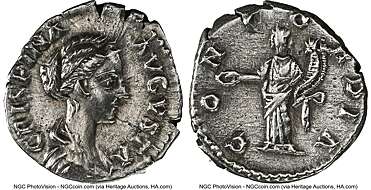
Лот 21148. Ancients Crispina (AD 177-182/183). AR denarius (18mm, 1h). NGC XF, brushed. Rome, AD 178-192. CRISPINA-AVGVSTA, draped bust of Crispina right, hair braided in rows and bound in large chignon at back / CO-NC-O-RDIA, Concordia standing facing, head left, patera in outstretched right hand, cornucopia cradled in left arm. RIC III (Commodus) 278. From the Khanum Jan Collection. Bruttia Crispina came from a politically rich family of Roman senators, thus it was no surprise when she married Commodus at just sixteen. Despite rumors of a pregnancy in AD 182 tied to competition with former empress Lucilla, she and Commodus never produced an heir. It would yield a dynastic crisis, leading to the execution of Lucius Antistius Burrus and Gaius Arrius Antoninus on suspicion of pretending the throne. Out of anger, Commodus would falsely accuse Crispina of adultery, banishing her to Capri where she would be executed in AD 191. Unfortunately for Commodus, his new mistress, Marcia, would have a hand in his assassination the following year. HID05401242017 © 2026 Heritage Auctions | All Rights Reserved www.HA.com/TexasAuctioneerLicenseNotice
  • Стартовая цена:
    1 USD
    0 EUR
    0 GBP
    0 CHF

    Примерные оценкиДата: 05.11.2026
Лот
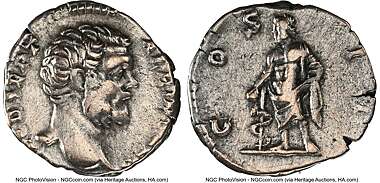
Лот 21149. Ancients Clodius Albinus, as Caesar (AD 193-195). AR denarius (18mm, 5h). NGC VF, brushed. Rome. D CLOD SEPT-ALBIN CAES, bare head of Clodius Albinus right / COS-II, Asclepius standing facing, head left, leaning upon serpent-entwined staff. RIC IV.I 2. From the Khanum Jan Collection. In the Year of the Five Emperors, AD 193, Clodius Albinus initially backed Septimius Severus. Severus appointed him co-Caesar so that Albinus could handle state matters while Severus fought against Pescennius Niger in a civil war, but after Niger was defeated, Severus and Albinus turned on each other. They engaged in another civil war resulting in Albinus's death in battle in AD 197. HID05401242017 © 2026 Heritage Auctions | All Rights Reserved www.HA.com/TexasAuctioneerLicenseNotice
  • Стартовая цена:
    1 USD
    0 EUR
    0 GBP
    0 CHF

    Примерные оценкиДата: 05.11.2026
Лот
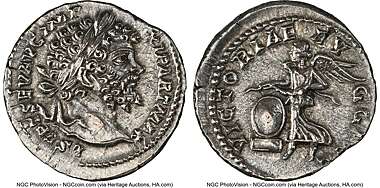
Лот 21150. Ancients Septimius Severus (AD 193-211). AR denarius (18mm, 6h). NGC AU, brushed. Laodicea, AD 198-202. L SEPT SEV AVG IMP-XI PART MAX, laureate head of Septimius Severus right / VICTORIAE-AV-GG FEL, Victory advancing left, holding open wreath in both hands over shield set on low base. RIC IV.I 516. From the Khanum Jan Collection. The first Roman emperor of African descent, Lucius Septimius Severus was born on 11 April AD 145 in the North African city of Leptis Magna. He entered the Senate during the reign of Marcus Aurelius and also served as an officer in the army under the general Pertinax, finding the soldier's life much to his liking. Talented and hardworking, Severus rose rapidly in the Senate hierarchy, becoming consul in AD 190 and proconsul of Pannonia Superior the following year. The assassination of Commodus on 1 January AD 193 brought his patron Pertinax to the throne, but within three months, Pertinax had been murdered by the Praetorians, who sold the throne to Didius Julianus. An outraged populace demanded that Pescennius Niger, governor of Syria, or Clodius Albinus, proconsul of Britain, depose Julianus. But Severus was much closer, in Pannonia, and he struck first. Placating Albinus with the junior title of Caesar, Severus marched on Rome and easily disposed of Julianus. He next marched against Niger and crushed his rebel regime in a brutally efficient campaign. Returning to Rome in AD 195, he raised his elder son Caracalla to the rank of Caesar, thus severing his pact with Clodius Albinus and igniting another civil war, which ended with Severus's victory in AD 197. A bloody purge of Albinus's supporters led many to call him "the Punic Sulla," but with his position secure, he ruled with moderation. Julia Domna's patronage stimulated Rome's arts and intellectual life, but the mutual hatred of their sons, Caracalla and Geta, caused the imperial couple no end of grief. Like Hadrian, Severus traveled incessantly, but his policy was expansion through conquest, and in AD 208, he launched an invasion of Scotland. But what was supposed to be a quick conquest turned into a long, bitter slog, which took its toll on the emperor's health. On his deathbed in York, Severus begged his sons to "be good to each other, pay the soldiers well, and the rest can to go to hell." He died on 4 February AD 211 at the age of 65. HID05401242017 © 2026 Heritage Auctions | All Rights Reserved www.HA.com/TexasAuctioneerLicenseNotice
  • Стартовая цена:
    1 USD
    0 EUR
    0 GBP
    0 CHF

    Примерные оценкиДата: 05.11.2026
Лот
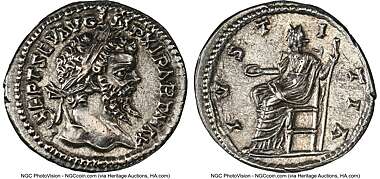
Лот 21151. Ancients Septimius Severus (AD 193-211). AR denarius (20mm, 11h). NGC AU, brushed. Laodicea ad Mare, AD 198-202. L-SEPT SEV AVG I-MP XI PART MAX, laureate head of Septimius Severus right / IVST-I-TIA, Justitia seated left, patera in outstretched right hand, grounded scepter in left hand. RIC IV.I 505. From the Khanum Jan Collection. The first Roman emperor of African descent, Lucius Septimius Severus was born on 11 April AD 145 in the North African city of Leptis Magna. He entered the Senate during the reign of Marcus Aurelius and also served as an officer in the army under the general Pertinax, finding the soldier's life much to his liking. Talented and hardworking, Severus rose rapidly in the Senate hierarchy, becoming consul in AD 190 and proconsul of Pannonia Superior the following year. The assassination of Commodus on 1 January AD 193 brought his patron Pertinax to the throne, but within three months, Pertinax had been murdered by the Praetorians, who sold the throne to Didius Julianus. An outraged populace demanded that Pescennius Niger, governor of Syria, or Clodius Albinus, proconsul of Britain, depose Julianus. But Severus was much closer, in Pannonia, and he struck first. Placating Albinus with the junior title of Caesar, Severus marched on Rome and easily disposed of Julianus. He next marched against Niger and crushed his rebel regime in a brutally efficient campaign. Returning to Rome in AD 195, he raised his elder son Caracalla to the rank of Caesar, thus severing his pact with Clodius Albinus and igniting another civil war, which ended with Severus's victory in AD 197. A bloody purge of Albinus's supporters led many to call him "the Punic Sulla," but with his position secure, he ruled with moderation. Julia Domna's patronage stimulated Rome's arts and intellectual life, but the mutual hatred of their sons, Caracalla and Geta, caused the imperial couple no end of grief. Like Hadrian, Severus traveled incessantly, but his policy was expansion through conquest, and in AD 208, he launched an invasion of Scotland. But what was supposed to be a quick conquest turned into a long, bitter slog, which took its toll on the emperor's health. On his deathbed in York, Severus begged his sons to "be good to each other, pay the soldiers well, and the rest can to go to hell." He died on 4 February AD 211 at the age of 65. HID05401242017 © 2026 Heritage Auctions | All Rights Reserved www.HA.com/TexasAuctioneerLicenseNotice
  • Стартовая цена:
    1 USD
    0 EUR
    0 GBP
    0 CHF

    Примерные оценкиДата: 05.11.2026
Лот
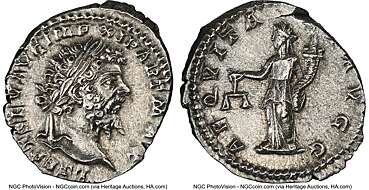
Лот 21152. Ancients Septimius Severus (AD 193-211). AR denarius (19mm, 7h). NGC AU, brushed. Laodicea ad Mare, AD 198-202. L SEPT SEV AVG IMP-XI PART MAX, laureate head of Septimius Severus right / AEQVITA-TI AVGG, Aequitas standing facing, head left, scales in outstretched right hand, cornucopia cradled in left arm. RIC IV.I 500. From the Khanum Jan Collection. The first Roman emperor of African descent, Lucius Septimius Severus was born on 11 April AD 145 in the North African city of Leptis Magna. He entered the Senate during the reign of Marcus Aurelius and also served as an officer in the army under the general Pertinax, finding the soldier's life much to his liking. Talented and hardworking, Severus rose rapidly in the Senate hierarchy, becoming consul in AD 190 and proconsul of Pannonia Superior the following year. The assassination of Commodus on 1 January AD 193 brought his patron Pertinax to the throne, but within three months, Pertinax had been murdered by the Praetorians, who sold the throne to Didius Julianus. An outraged populace demanded that Pescennius Niger, governor of Syria, or Clodius Albinus, proconsul of Britain, depose Julianus. But Severus was much closer, in Pannonia, and he struck first. Placating Albinus with the junior title of Caesar, Severus marched on Rome and easily disposed of Julianus. He next marched against Niger and crushed his rebel regime in a brutally efficient campaign. Returning to Rome in AD 195, he raised his elder son Caracalla to the rank of Caesar, thus severing his pact with Clodius Albinus and igniting another civil war, which ended with Severus's victory in AD 197. A bloody purge of Albinus's supporters led many to call him "the Punic Sulla," but with his position secure, he ruled with moderation. Julia Domna's patronage stimulated Rome's arts and intellectual life, but the mutual hatred of their sons, Caracalla and Geta, caused the imperial couple no end of grief. Like Hadrian, Severus traveled incessantly, but his policy was expansion through conquest, and in AD 208, he launched an invasion of Scotland. But what was supposed to be a quick conquest turned into a long, bitter slog, which took its toll on the emperor's health. On his deathbed in York, Severus begged his sons to "be good to each other, pay the soldiers well, and the rest can to go to hell." He died on 4 February AD 211 at the age of 65. HID05401242017 © 2026 Heritage Auctions | All Rights Reserved www.HA.com/TexasAuctioneerLicenseNotice
  • Стартовая цена:
    1 USD
    0 EUR
    0 GBP
    0 CHF

    Примерные оценкиДата: 05.11.2026
Лот
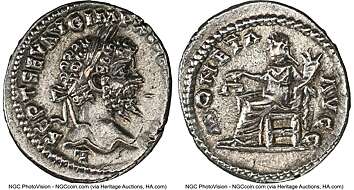
Лот 21153. Ancients Septimius Severus (AD 193-211). AR denarius (18mm, 1h). NGC Choice XF, brushed. Laodicea, AD 198-202. L-SEPT SEV AVG IMP XI PART MAX, laureate head of Severus right / MONETA-AVGG, Moneta seated left, scales in outstretched right hand, cornucopia cradled in left arm. RIC IV.I 510a. From the Khanum Jan Collection. The first Roman emperor of African descent, Lucius Septimius Severus was born on 11 April AD 145 in the North African city of Leptis Magna. He entered the Senate during the reign of Marcus Aurelius and also served as an officer in the army under the general Pertinax, finding the soldier's life much to his liking. Talented and hardworking, Severus rose rapidly in the Senate hierarchy, becoming consul in AD 190 and proconsul of Pannonia Superior the following year. The assassination of Commodus on 1 January AD 193 brought his patron Pertinax to the throne, but within three months, Pertinax had been murdered by the Praetorians, who sold the throne to Didius Julianus. An outraged populace demanded that Pescennius Niger, governor of Syria, or Clodius Albinus, proconsul of Britain, depose Julianus. But Severus was much closer, in Pannonia, and he struck first. Placating Albinus with the junior title of Caesar, Severus marched on Rome and easily disposed of Julianus. He next marched against Niger and crushed his rebel regime in a brutally efficient campaign. Returning to Rome in AD 195, he raised his elder son Caracalla to the rank of Caesar, thus severing his pact with Clodius Albinus and igniting another civil war, which ended with Severus's victory in AD 197. A bloody purge of Albinus's supporters led many to call him "the Punic Sulla," but with his position secure, he ruled with moderation. Julia Domna's patronage stimulated Rome's arts and intellectual life, but the mutual hatred of their sons, Caracalla and Geta, caused the imperial couple no end of grief. Like Hadrian, Severus traveled incessantly, but his policy was expansion through conquest, and in AD 208, he launched an invasion of Scotland. But what was supposed to be a quick conquest turned into a long, bitter slog, which took its toll on the emperor's health. On his deathbed in York, Severus begged his sons to "be good to each other, pay the soldiers well, and the rest can to go to hell." He died on 4 February AD 211 at the age of 65. HID05401242017 © 2026 Heritage Auctions | All Rights Reserved www.HA.com/TexasAuctioneerLicenseNotice
  • Стартовая цена:
    1 USD
    0 EUR
    0 GBP
    0 CHF

    Примерные оценкиДата: 05.11.2026
Лот
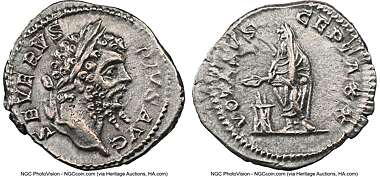
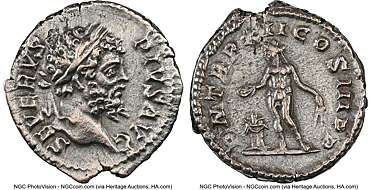
Лот 21154. Ancients Septimius Severus (AD 193-211). AR denarius (20mm, 12h). NGC XF, brushed. Rome, AD 198-202. SEVERVS-PIVS AVG, laureate head of Septimius Severus right / VOTA SVS-CEPTA XX, Septimius Severus, togate and veiled, standing facing, head left, patera in outstretched right hand over lit tripod at feet before. RIC IV.I 308. From the Khanum Jan Collection. HID05401242017 © 2026 Heritage Auctions | All Rights Reserved www.HA.com/TexasAuctioneerLicenseNotice
  • Стартовая цена:
    1 USD
    0 EUR
    0 GBP
    0 CHF

    Примерные оценкиДата: 05.11.2026
Лот
Лот 21155. Ancients Septimius Severus (AD 193-211). AR denarius (19mm, 7h). NGC XF, brushed. Rome, ca. AD 204. SEVERVS-PIVS AVG, laureate head of Septimius Severus right / PM TR P XII COS III P P, Genius standing facing, head left, patera in outstretched in right hand over lit altar at feet before, grain ears in outstretched left. RIC IV.I 195 var. (obverse legend). Cohen 464 var. (same). From the Khanum Jan Collection. The first Roman emperor of African descent, Lucius Septimius Severus was born on 11 April AD 145 in the North African city of Leptis Magna. He entered the Senate during the reign of Marcus Aurelius and also served as an officer in the army under the general Pertinax, finding the soldier's life much to his liking. Talented and hardworking, Severus rose rapidly in the Senate hierarchy, becoming consul in AD 190 and proconsul of Pannonia Superior the following year. The assassination of Commodus on 1 January AD 193 brought his patron Pertinax to the throne, but within three months, Pertinax had been murdered by the Praetorians, who sold the throne to Didius Julianus. An outraged populace demanded that Pescennius Niger, governor of Syria, or Clodius Albinus, proconsul of Britain, depose Julianus. But Severus was much closer, in Pannonia, and he struck first. Placating Albinus with the junior title of Caesar, Severus marched on Rome and easily disposed of Julianus. He next marched against Niger and crushed his rebel regime in a brutally efficient campaign. Returning to Rome in AD 195, he raised his elder son Caracalla to the rank of Caesar, thus severing his pact with Clodius Albinus and igniting another civil war, which ended with Severus's victory in AD 197. A bloody purge of Albinus's supporters led many to call him "the Punic Sulla," but with his position secure, he ruled with moderation. Julia Domna's patronage stimulated Rome's arts and intellectual life, but the mutual hatred of their sons, Caracalla and Geta, caused the imperial couple no end of grief. Like Hadrian, Severus traveled incessantly, but his policy was expansion through conquest, and in AD 208, he launched an invasion of Scotland. But what was supposed to be a quick conquest turned into a long, bitter slog, which took its toll on the emperor's health. On his deathbed in York, Severus begged his sons to "be good to each other, pay the soldiers well, and the rest can to go to hell." He died on 4 February AD 211 at the age of 65. HID05401242017 © 2026 Heritage Auctions | All Rights Reserved www.HA.com/TexasAuctioneerLicenseNotice
  • Стартовая цена:
    1 USD
    0 EUR
    0 GBP
    0 CHF

    Примерные оценкиДата: 05.11.2026
Лот
Лот 21156. Ancients Septimius Severus (AD 193-211). AR denarius (19mm, 6h). NGC Choice VF, brushed. Emesa, AD 193. IMP CAE L SEP S-EV PERT AVG, laureate head of Septimius Severus right / L-E-G VII C-L, legionary eagle left between two standards; TR P COS in exergue. RIC IV.I 10. From the Khanum Jan Collection. The first Roman emperor of African descent, Lucius Septimius Severus was born on 11 April AD 145 in the North African city of Leptis Magna. He entered the Senate during the reign of Marcus Aurelius and also served as an officer in the army under the general Pertinax, finding the soldier's life much to his liking. Talented and hardworking, Severus rose rapidly in the Senate hierarchy, becoming consul in AD 190 and proconsul of Pannonia Superior the following year. The assassination of Commodus on 1 January AD 193 brought his patron Pertinax to the throne, but within three months, Pertinax had been murdered by the Praetorians, who sold the throne to Didius Julianus. An outraged populace demanded that Pescennius Niger, governor of Syria, or Clodius Albinus, proconsul of Britain, depose Julianus. But Severus was much closer, in Pannonia, and he struck first. Placating Albinus with the junior title of Caesar, Severus marched on Rome and easily disposed of Julianus. He next marched against Niger and crushed his rebel regime in a brutally efficient campaign. Returning to Rome in AD 195, he raised his elder son Caracalla to the rank of Caesar, thus severing his pact with Clodius Albinus and igniting another civil war, which ended with Severus's victory in AD 197. A bloody purge of Albinus's supporters led many to call him "the Punic Sulla," but with his position secure, he ruled with moderation. Julia Domna's patronage stimulated Rome's arts and intellectual life, but the mutual hatred of their sons, Caracalla and Geta, caused the imperial couple no end of grief. Like Hadrian, Severus traveled incessantly, but his policy was expansion through conquest, and in AD 208, he launched an invasion of Scotland. But what was supposed to be a quick conquest turned into a long, bitter slog, which took its toll on the emperor's health. On his deathbed in York, Severus begged his sons to "be good to each other, pay the soldiers well, and the rest can to go to hell." He died on 4 February AD 211 at the age of 65. HID05401242017 © 2026 Heritage Auctions | All Rights Reserved www.HA.com/TexasAuctioneerLicenseNotice
  • Стартовая цена:
    1 USD
    0 EUR
    0 GBP
    0 CHF

    Примерные оценкиДата: 05.11.2026
Лот
Лот 21157. Ancients Septimius Severus (AD 193-211). AR denarius (17mm, 5h). NGC Choice VF, brushed. Rome, AD 197-198. L SEPT SEV PERT-AVG IMP X, laureate head of Septimius Severus right / VICT AVG-G-COS II P P, Victory advancing left, wreath raised in right hand, palm branch cradled in left. RIC IV.I 120c. From the Khanum Jan Collection. HID05401242017 © 2026 Heritage Auctions | All Rights Reserved www.HA.com/TexasAuctioneerLicenseNotice
  • Стартовая цена:
    1 USD
    0 EUR
    0 GBP
    0 CHF

    Примерные оценкиДата: 05.11.2026
Лот
Лот 21158. Ancients Julia Domna (AD 193-217). AR denarius (19mm, 11h). NGC XF, brushed. Laodicea ad Mare, AD 196-202. IVLIA-AVGVSTA, draped bust of Julia Domna right, seen from front, hair braided in waves and tucked in large chignon at back of head / IVNO-REGINA, Juno standing facing, veiled head left, patera in right hand, grounded scepter in left; peacock standing left, head right, at feet to left. RIC IV.I (Septimius Severus) 640. From the Khanum Jan Collection. Julia Domna was of Syrian-Arab ancestry, as the daughter of the hereditary high priest of Elagabal at Emesa, a wealthy caravan city in the Syrian desert. Beautiful, cultured, and highly educated, she was made even more of a "prize" by a horoscope that proclaimed she would marry a king. Septimius Severus probably encountered her family while serving as a general in Syria in the AD 180s; when he learned of the horoscope, he immediately wrote to her father and secured her hand in marriage. Upon Severus' ascension as Roman Emperor in AD 193, Julia was named Augusta and became his closest advisor and confidant. Her love of art, learning and philosophy manifested in a cultural Renaissance in Rome. In AD 217, Caracalla was assassinated. Julia Domna, who was already suffering from breast cancer, died by self-starvation. HID05401242017 © 2026 Heritage Auctions | All Rights Reserved www.HA.com/TexasAuctioneerLicenseNotice
  • Стартовая цена:
    1 USD
    0 EUR
    0 GBP
    0 CHF

    Примерные оценкиДата: 05.11.2026
Лот
Лот 21159. Ancients Caracalla, as Augustus (AD 198-217). AR denarius (18mm, 6h). NGC AU, brushed. Rome, ca. AD 210-213. ANTONINVS PIVS-AVG BRIT, laureate head of Caracalla right / MONETA AVG, Moneta standing facing, head left, scales in outstretched right hand, cornucopia cradled in left arm. RIC IV.I 224. From the Khanum Jan Collection. Born in Lugdunum in AD 188, while his father was serving as governor of Gaul, Lucius Septimius Bassianus started out life as a cheerful, affable youth whose character deteriorated as he gained more prestige and power. His father, Septimius Severus, seized the throne and defended it against all rival claimants during the civil wars of AD 193-197. Bassianus was named Caesar in AD 195 and was further elevated to co-Augustus with his father three years later, when he was only 10. His name was changed to Marcus Aurelius Antoninus in honor of the revered Antonine dynasty, but the boy preferred barbarian manners and fashions, and he soon earned a nickname after a type of hooded Germanic cloak he liked to wear - Caracalla (or, in modern terms, "hoodie"). Caracalla also arranged for the assassination of his brother, Geta, months after they took power as co-emperors following the death of their father. He was later assassinated by a disgruntled soldier after Caracalla had denied him a promotion. This soldier acted at the behest of Macrinus, who declared himself emperor three days later. HID05401242017 © 2026 Heritage Auctions | All Rights Reserved www.HA.com/TexasAuctioneerLicenseNotice
  • Стартовая цена:
    1 USD
    0 EUR
    0 GBP
    0 CHF

    Примерные оценкиДата: 05.11.2026
Лот
Лот 21160. Ancients Caracalla, as Augustus (AD 198-217). AR denarius (19mm, 5h). NGC Choice XF, brushed. Rome, AD 213. ANTONINVS PIVS AVG BRIT, laureate head of Caracalla right / P M TR P XVI-COS IIII P P, Serapis standing facing, polos on head left, raising right hand, transverse scepter cradled in left arm. RIC IV.I 208. From the Khanum Jan Collection. Born in Lugdunum in AD 188, while his father was serving as governor of Gaul, Lucius Septimius Bassianus started out life as a cheerful, affable youth whose character deteriorated as he gained more prestige and power. His father, Septimius Severus, seized the throne and defended it against all rival claimants during the civil wars of AD 193-197. Bassianus was named Caesar in AD 195 and was further elevated to co-Augustus with his father three years later, when he was only 10. His name was changed to Marcus Aurelius Antoninus in honor of the revered Antonine dynasty, but the boy preferred barbarian manners and fashions, and he soon earned a nickname after a type of hooded Germanic cloak he liked to wear - Caracalla (or, in modern terms, "hoodie"). Caracalla also arranged for the assassination of his brother, Geta, months after they took power as co-emperors following the death of their father. He was later assassinated by a disgruntled soldier after Caracalla had denied him a promotion. This soldier acted at the behest of Macrinus, who declared himself emperor three days later. HID05401242017 © 2026 Heritage Auctions | All Rights Reserved www.HA.com/TexasAuctioneerLicenseNotice
  • Стартовая цена:
    1 USD
    0 EUR
    0 GBP
    0 CHF

    Примерные оценкиДата: 05.11.2026
Лот
Лот 21161. Ancients Caracalla, as Augustus (AD 198-217). AR denarius (19mm, 6h). NGC Choice XF, brushed. Rome, AD 205. ANTONINVS PIVS AVG, laureate, draped bust of Caracalla right, seen from behind / PONTIF TR P-VIII COS II, Mars standing facing, head left, right hand resting on grounded shield, grounded reversed spear in left. RIC IV.I 81. From the Khanum Jan Collection. Born in Lugdunum in AD 188, while his father was serving as governor of Gaul, Lucius Septimius Bassianus started out life as a cheerful, affable youth whose character deteriorated as he gained more prestige and power. His father, Septimius Severus, seized the throne and defended it against all rival claimants during the civil wars of AD 193-197. Bassianus was named Caesar in AD 195 and was further elevated to co-Augustus with his father three years later, when he was only 10. His name was changed to Marcus Aurelius Antoninus in honor of the revered Antonine dynasty, but the boy preferred barbarian manners and fashions, and he soon earned a nickname after a type of hooded Germanic cloak he liked to wear - Caracalla (or, in modern terms, "hoodie"). Caracalla also arranged for the assassination of his brother, Geta, months after they took power as co-emperors following the death of their father. He was later assassinated by a disgruntled soldier after Caracalla had denied him a promotion. This soldier acted at the behest of Macrinus, who declared himself emperor three days later. HID05401242017 © 2026 Heritage Auctions | All Rights Reserved www.HA.com/TexasAuctioneerLicenseNotice
  • Стартовая цена:
    1 USD
    0 EUR
    0 GBP
    0 CHF

    Примерные оценкиДата: 05.11.2026
Лот
Лот 21162. Ancients Caracalla, as Augustus (AD 198-217). AR denarius (19mm, 7h). NGC XF, brushed. Rome, 209. ANTONINVS-PIVS AVG, laureate head of Caracalla right / PONTIF TR P XII COS III, Concordia seated left, patera in outstretched right hand, double cornucopia cradled in left arm. RIC IV.I 111. From the Khanum Jan Collection. Born in Lugdunum in AD 188, while his father was serving as governor of Gaul, Lucius Septimius Bassianus started out life as a cheerful, affable youth whose character deteriorated as he gained more prestige and power. His father, Septimius Severus, seized the throne and defended it against all rival claimants during the civil wars of AD 193-197. Bassianus was named Caesar in AD 195 and was further elevated to co-Augustus with his father three years later, when he was only 10. His name was changed to Marcus Aurelius Antoninus in honor of the revered Antonine dynasty, but the boy preferred barbarian manners and fashions, and he soon earned a nickname after a type of hooded Germanic cloak he liked to wear - Caracalla (or, in modern terms, "hoodie"). Caracalla also arranged for the assassination of his brother, Geta, months after they took power as co-emperors following the death of their father. He was later assassinated by a disgruntled soldier after Caracalla had denied him a promotion. This soldier acted at the behest of Macrinus, who declared himself emperor three days later. HID05401242017 © 2026 Heritage Auctions | All Rights Reserved www.HA.com/TexasAuctioneerLicenseNotice
  • Стартовая цена:
    1 USD
    0 EUR
    0 GBP
    0 CHF

    Примерные оценкиДата: 05.11.2026
Лот
Лот 21163. Ancients Caracalla (AD 198-217). AR denarius (19mm, 1h). NGC Choice VF, brushed. Rome, AD 200. ANTONINVS-AVGVSTVS, laureate, draped, and cuirassed bust of Caracalla right, seen from behind / PONTIF-TR P III, Sol standing facing, head left, nude save for chlamys over left shoulder, globe in outstretched right hand, grounded spear in left. RIC IV.I 30. From the Khanum Jan Collection. Born in Lugdunum in AD 188, while his father was serving as governor of Gaul, Lucius Septimius Bassianus started out life as a cheerful, affable youth whose character deteriorated as he gained more prestige and power. His father, Septimius Severus, seized the throne and defended it against all rival claimants during the civil wars of AD 193-197. Bassianus was named Caesar in AD 195 and was further elevated to co-Augustus with his father three years later, when he was only 10. His name was changed to Marcus Aurelius Antoninus in honor of the revered Antonine dynasty, but the boy preferred barbarian manners and fashions, and he soon earned a nickname after a type of hooded Germanic cloak he liked to wear - Caracalla (or, in modern terms, "hoodie"). Caracalla also arranged for the assassination of his brother, Geta, months after they took power as co-emperors following the death of their father. He was later assassinated by a disgruntled soldier after Caracalla had denied him a promotion. This soldier acted at the behest of Macrinus, who declared himself emperor three days later. HID05401242017 © 2026 Heritage Auctions | All Rights Reserved www.HA.com/TexasAuctioneerLicenseNotice
  • Стартовая цена:
    1 USD
    0 EUR
    0 GBP
    0 CHF

    Примерные оценкиДата: 05.11.2026
Лот
Лот 21164. Ancients Caracalla, as Augustus (AD 198-217). AR denarius (20mm, 12h). NGC Choice VF, brushed. Rome, AD 199-200. ANTONINVS-AVGVSTVS, laureate, draped, cuirassed bust of Caracalla right / RECTOR-ORBIS, Sol standing facing, head left, globe in outstretched right hand, grounded reversed spear in left. RIC IV.I 39. From the Khanum Jan Collection. Born in Lugdunum in AD 188, while his father was serving as governor of Gaul, Lucius Septimius Bassianus started out life as a cheerful, affable youth whose character deteriorated as he gained more prestige and power. His father, Septimius Severus, seized the throne and defended it against all rival claimants during the civil wars of AD 193-197. Bassianus was named Caesar in AD 195 and was further elevated to co-Augustus with his father three years later, when he was only 10. His name was changed to Marcus Aurelius Antoninus in honor of the revered Antonine dynasty, but the boy preferred barbarian manners and fashions, and he soon earned a nickname after a type of hooded Germanic cloak he liked to wear - Caracalla (or, in modern terms, "hoodie"). Caracalla also arranged for the assassination of his brother, Geta, months after they took power as co-emperors following the death of their father. He was later assassinated by a disgruntled soldier after Caracalla had denied him a promotion. This soldier acted at the behest of Macrinus, who declared himself emperor three days later. HID05401242017 © 2026 Heritage Auctions | All Rights Reserved www.HA.com/TexasAuctioneerLicenseNotice
  • Стартовая цена:
    1 USD
    0 EUR
    0 GBP
    0 CHF

    Примерные оценкиДата: 05.11.2026
Лот
Лот 21165. Ancients Geta, as Caesar (AD 209-211). AR denarius (18mm, 6h). NGC XF, brushed. Rome, AD 200-202. P SEPT GETA-CAES PONT, bareheaded, draped bust of Geta right, seen from behind / NOBI-L-ITAS, Nobilitas standing facing, head right, grounded scepter in right hand, palladium in outstretched left hand. RIC IV.I 13. From the Khanum Jan Collection. Publius Septimius Geta was born in AD 189 to Septimius Severus and Julia Domna. The younger brother to Caracalla, Geta tended to handle more of the administrative duties of the empire while his father and brother were away on military campaigns. Septimius Severus's succession plan was for Geta and Caracalla to share power, as can be seen on numerous issues of his and Julia Domna's coinage. Alas, this did not last long. After Septimius Severus's death, Geta and Caracalla could not be in the same room together unless their mother, Julia Domna, was present to mediate and they each had a full security detail for fear of assassination. Later that same year, Caracalla convinced Julia Domna to hold a peace meeting between them without guards in her apartments and had Geta murdered by centurions, dying in his mother's arms. Caracalla then issued an order of damnatio memoriae which removed evidence of Geta's life and legacy from all records. Nevertheless, his memory lives on through the numerous coins that were issued with his likeness. HID05401242017 © 2026 Heritage Auctions | All Rights Reserved www.HA.com/TexasAuctioneerLicenseNotice
  • Стартовая цена:
    1 USD
    0 EUR
    0 GBP
    0 CHF

    Примерные оценкиДата: 05.11.2026
Лот
Лот 21166. Islamic Dynasties Arab Sasanian - Umayyad. 'Abd al-Malik Drachm YE 63 (694/695) UNC, Likely Jahrōm mint, A-32, Malek-480. HID05401242017 © 2026 Heritage Auctions | All Rights Reserved www.HA.com/TexasAuctioneerLicenseNotice
  • Стартовая цена:
    1 USD
    0 EUR
    0 GBP
    0 CHF

    Примерные оценкиДата: 05.11.2026
Лот
Лот 21167. Islamic Dynasties Arab Sasanian - Umayyad. 'Abd al-Malik Drachm YE 65 (696/697) UNC, Likely Fars mint, A-32, Malek-509. HID05401242017 © 2026 Heritage Auctions | All Rights Reserved www.HA.com/TexasAuctioneerLicenseNotice
  • Стартовая цена:
    1 USD
    0 EUR
    0 GBP
    0 CHF

    Примерные оценкиДата: 05.11.2026
Лот
Лот 21168. Islamic Dynasties Arab Sasanian - Zubayrid. 'Umar b. 'Ubayd Allah Drachm AH 68 (687/688) AU, Bishapur mint, A-21, Malek-310. HID05401242017 © 2026 Heritage Auctions | All Rights Reserved www.HA.com/TexasAuctioneerLicenseNotice
  • Стартовая цена:
    1 USD
    0 EUR
    0 GBP
    0 CHF

    Примерные оценкиДата: 05.11.2026
Лот
Лот 21169. Islamic Dynasties Arab Sasanian - Zubayrid. 'Umar b. 'Ubayd Allah Drachm AH 70 (689/690) UNC, Bishapur mint, A-21, Malek-318. HID05401242017 © 2026 Heritage Auctions | All Rights Reserved www.HA.com/TexasAuctioneerLicenseNotice
  • Стартовая цена:
    1 USD
    0 EUR
    0 GBP
    0 CHF

    Примерные оценкиДата: 05.11.2026
Лот
Лот 21170. Islamic Dynasties Arab Sasanian - Zubayrid. 'Umar b. 'Ubayd Allah Drachm AH 70 (689/690) UNC, Bishapur mint, A-21, Malek-318. HID05401242017 © 2026 Heritage Auctions | All Rights Reserved www.HA.com/TexasAuctioneerLicenseNotice
  • Стартовая цена:
    1 USD
    0 EUR
    0 GBP
    0 CHF

    Примерные оценкиДата: 05.11.2026
Лот
Лот 21171. Islamic Dynasties Arab Sasanian - Zubayrid. 'Umar b. 'Ubayd Allah Drachm AH 70 (689/690) UNC, Bishapur mint, A-21, Malek-318. HID05401242017 © 2026 Heritage Auctions | All Rights Reserved www.HA.com/TexasAuctioneerLicenseNotice
  • Стартовая цена:
    1 USD
    0 EUR
    0 GBP
    0 CHF

    Примерные оценкиДата: 05.11.2026
Лот
Лот 21172. Islamic Dynasties Arab Sasanian - Zubayrid. 'Umar b. 'Ubayd Allah Drachm AH 70 (689/690) UNC, Bishapur mint, A-21, Malek-318. HID05401242017 © 2026 Heritage Auctions | All Rights Reserved www.HA.com/TexasAuctioneerLicenseNotice
  • Стартовая цена:
    1 USD
    0 EUR
    0 GBP
    0 CHF

    Примерные оценкиДата: 05.11.2026
Лот
Лот 21173. Islamic Dynasties Arab Sasanian - Zubayrid. 'Umar b. 'Ubayd Allah Drachm AH 70 (689/690) AU, Bishapur mint, A-21, Malek-317. HID05401242017 © 2026 Heritage Auctions | All Rights Reserved www.HA.com/TexasAuctioneerLicenseNotice
  • Стартовая цена:
    1 USD
    0 EUR
    0 GBP
    0 CHF

    Примерные оценкиДата: 05.11.2026
Лот
Лот 21174. Islamic Dynasties Arab Sasanian - Zubayrid. 'Umar b. 'Ubayd Allah Drachm AH 70 (689/690) AU, Bishapur mint, A-21, Malek-318. HID05401242017 © 2026 Heritage Auctions | All Rights Reserved www.HA.com/TexasAuctioneerLicenseNotice
  • Стартовая цена:
    1 USD
    0 EUR
    0 GBP
    0 CHF

    Примерные оценкиДата: 05.11.2026
Лот
Лот 21175. Islamic Dynasties Arab Sasanian - Zubayrid. 'Umar b. 'Ubayd Allah Drachm AH 70 (689/690) AU, Ardashir-Khurra mint, A-21, Malek-80. HID05401242017 © 2026 Heritage Auctions | All Rights Reserved www.HA.com/TexasAuctioneerLicenseNotice
  • Стартовая цена:
    1 USD
    0 EUR
    0 GBP
    0 CHF

    Примерные оценкиДата: 05.11.2026
Лот
Лот 21176. Islamic Dynasties Arab Sasanian - Zubayrid. 'Umar b. 'Ubayd Allah Drachm AH 70 (689/690) XF, Bishapur mint, A-21, Malek-318. HID05401242017 © 2026 Heritage Auctions | All Rights Reserved www.HA.com/TexasAuctioneerLicenseNotice
  • Стартовая цена:
    1 USD
    0 EUR
    0 GBP
    0 CHF

    Примерные оценкиДата: 05.11.2026
Лот
Лот 21177. Islamic Dynasties Arab Sasanian - Zubayrid. 'Umar b. 'Ubayd Allah Drachm AH 70 (689/690) XF, Bishapur mint, A-21, Malek-317. HID05401242017 © 2026 Heritage Auctions | All Rights Reserved www.HA.com/TexasAuctioneerLicenseNotice
  • Стартовая цена:
    1 USD
    0 EUR
    0 GBP
    0 CHF

    Примерные оценкиДата: 05.11.2026
Лот
Лот 21178. Islamic Dynasties Arab Sasanian. 'Uthman Drachm ND (644-656) VF, Sakastan mint, Malek-1148. Late Eastern Sistan type. HID05401242017 © 2026 Heritage Auctions | All Rights Reserved www.HA.com/TexasAuctioneerLicenseNotice
  • Стартовая цена:
    1 USD
    0 EUR
    0 GBP
    0 CHF

    Примерные оценкиДата: 05.11.2026
Лот
Лот 21179. Islamic Dynasties Arab Sasanian. 'Abd Allah Drachm AH 42 (662/663) XF, Bishapur mint, A-6-7, Malek-249. HID05401242017 © 2026 Heritage Auctions | All Rights Reserved www.HA.com/TexasAuctioneerLicenseNotice
  • Стартовая цена:
    1 USD
    0 EUR
    0 GBP
    0 CHF

    Примерные оценкиДата: 05.11.2026
Лот
Лот 21180. Islamic Dynasties Arab Sasanian. 'Abd Allah b. al-Zubayr Drachm YE 53 (684/685) UNC, Dārābjird mint, A-16, Malek-434. A curious issue from rival caliph 'Abd Allah b. al-Zubayr. HID05401242017 © 2026 Heritage Auctions | All Rights Reserved www.HA.com/TexasAuctioneerLicenseNotice
  • Стартовая цена:
    1 USD
    0 EUR
    0 GBP
    0 CHF

    Примерные оценкиДата: 05.11.2026
Лот
Лот 21181. Islamic Dynasties Arab Sasanian. 'Abd Allah b. al-Zubayr Drachm YE 53 (684/685) UNC, Dārābjird mint, A-16, Malek-436. HID05401242017 © 2026 Heritage Auctions | All Rights Reserved www.HA.com/TexasAuctioneerLicenseNotice
  • Стартовая цена:
    1 USD
    0 EUR
    0 GBP
    0 CHF

    Примерные оценкиДата: 05.11.2026
Лот
Лот 21182. Islamic Dynasties Arab Sasanian. 'Ubayd Allah b. Ziyad Drachm AH 57 (676/677) AU, Jayy (Media) mint, Malek-557. HID05401242017 © 2026 Heritage Auctions | All Rights Reserved www.HA.com/TexasAuctioneerLicenseNotice
  • Стартовая цена:
    1 USD
    0 EUR
    0 GBP
    0 CHF

    Примерные оценкиДата: 05.11.2026
Лот
Лот 21183. Islamic Dynasties Arab Sasanian. 'Ubayd Allah b. Ziyad Drachm AH 59 (678/679) UNC, Al-Basra mint, Malek-172. HID05401242017 © 2026 Heritage Auctions | All Rights Reserved www.HA.com/TexasAuctioneerLicenseNotice
  • Стартовая цена:
    1 USD
    0 EUR
    0 GBP
    0 CHF

    Примерные оценкиДата: 05.11.2026
Лот
Лот 21184. Islamic Dynasties Arab Sasanian. 'Ubayd Allah b. Ziyad Drachm AH 59 (678/679) AU, Al-Basra mint, Malek-169. HID05401242017 © 2026 Heritage Auctions | All Rights Reserved www.HA.com/TexasAuctioneerLicenseNotice
  • Стартовая цена:
    1 USD
    0 EUR
    0 GBP
    0 CHF

    Примерные оценкиДата: 05.11.2026
Лот
Лот 21185. Islamic Dynasties Arab Sasanian. 'Ubayd Allah b. Ziyad Drachm AH 59 (678/679) AU, Al-Basra mint, A-12, Malek-167. HID05401242017 © 2026 Heritage Auctions | All Rights Reserved www.HA.com/TexasAuctioneerLicenseNotice
  • Стартовая цена:
    1 USD
    0 EUR
    0 GBP
    0 CHF

    Примерные оценкиДата: 05.11.2026
Лот
Лот 21186. Islamic Dynasties Arab Sasanian. 'Ubayd Allah b. Ziyad Drachm AH 59 (678/679) AU, Al-Basra mint, Malek-169. HID05401242017 © 2026 Heritage Auctions | All Rights Reserved www.HA.com/TexasAuctioneerLicenseNotice
  • Стартовая цена:
    1 USD
    0 EUR
    0 GBP
    0 CHF

    Примерные оценкиДата: 05.11.2026
Лот
Лот 21187. Islamic Dynasties Arab Sasanian. 'Ubayd Allah b. Ziyad Drachm AH 59 (678/679) AU, Al-Basra mint, A-12, Malek-168. HID05401242017 © 2026 Heritage Auctions | All Rights Reserved www.HA.com/TexasAuctioneerLicenseNotice
  • Стартовая цена:
    1 USD
    0 EUR
    0 GBP
    0 CHF

    Примерные оценкиДата: 05.11.2026
Лот
Лот 21188. Islamic Dynasties Arab Sasanian. 'Ubayd Allah b. Ziyad Drachm AH 60 (679/680) UNC, Unknown (SYW) mint, Malek-1221. HID05401242017 © 2026 Heritage Auctions | All Rights Reserved www.HA.com/TexasAuctioneerLicenseNotice
  • Стартовая цена:
    1 USD
    0 EUR
    0 GBP
    0 CHF

    Примерные оценкиДата: 05.11.2026
Лот
Лот 21189. Islamic Dynasties Arab Sasanian. 'Abd Allah b. al-Zubayr Drachm AH 67 (686/687) UNC, Ardashir-Khurra mint, A-15 (R), cf. Malek-66-69 (three pellet ornament). HID05401242017 © 2026 Heritage Auctions | All Rights Reserved www.HA.com/TexasAuctioneerLicenseNotice
  • Стартовая цена:
    1 USD
    0 EUR
    0 GBP
    0 CHF

    Примерные оценкиДата: 05.11.2026
Лот
Лот 21190. Islamic Dynasties Arab Sasanian. 'Ubayd Allah b. Ziyad Drachm YE 62 (693/694) AU, cf. Malek-574 (star left and crescent right of flames). HID05401242017 © 2026 Heritage Auctions | All Rights Reserved www.HA.com/TexasAuctioneerLicenseNotice
  • Стартовая цена:
    1 USD
    0 EUR
    0 GBP
    0 CHF

    Примерные оценкиДата: 05.11.2026
Лот
Лот 21191. Islamic Dynasties Arab Sasanian. al-Muhallab b. Abi Sufra Drachm AH 76 (695/696) UNC, Dārābjird mint, A-31 (R mint), Malek-460. HID05401242017 © 2026 Heritage Auctions | All Rights Reserved www.HA.com/TexasAuctioneerLicenseNotice
  • Стартовая цена:
    1 USD
    0 EUR
    0 GBP
    0 CHF

    Примерные оценкиДата: 05.11.2026
Лот
Лот 21192. Islamic Dynasties Arab Sasanian. al-Muhallab b. Abi Sufra Drachm AH 76 (695/696) AU, Bishapur mint, A-31, Malek-334. HID05401242017 © 2026 Heritage Auctions | All Rights Reserved www.HA.com/TexasAuctioneerLicenseNotice
  • Стартовая цена:
    1 USD
    0 EUR
    0 GBP
    0 CHF

    Примерные оценкиДата: 05.11.2026
Лот
Лот 21193. Islamic Dynasties Arab Sasanian. al-Muhallab b. Abi Sufra Drachm AH 76 (695/696) AU, Bishapur mint, A-31, Malek-334. HID05401242017 © 2026 Heritage Auctions | All Rights Reserved www.HA.com/TexasAuctioneerLicenseNotice
  • Стартовая цена:
    1 USD
    0 EUR
    0 GBP
    0 CHF

    Примерные оценкиДата: 05.11.2026
Лот
Лот 21194. Islamic Dynasties Arab Sasanian. al-Muhallab b. Abi Sufra Drachm AH 76 (695/696) VF, Ardashir-Khurra mint, A-Unl, Malek-95. HID05401242017 © 2026 Heritage Auctions | All Rights Reserved www.HA.com/TexasAuctioneerLicenseNotice
  • Стартовая цена:
    1 USD
    0 EUR
    0 GBP
    0 CHF

    Примерные оценкиДата: 05.11.2026
Лот
Лот 21195. Islamic Dynasties Arab Sasanian. 'Ubayd Allah b. Abi Bakra Drachm AH 79 (698/699) UNC, Sakastan mint, A-37 (R), cf. Malek-1019 (there, with symbols flanking altar flame). HID05401242017 © 2026 Heritage Auctions | All Rights Reserved www.HA.com/TexasAuctioneerLicenseNotice
  • Стартовая цена:
    1 USD
    0 EUR
    0 GBP
    0 CHF

    Примерные оценкиДата: 05.11.2026
Лот
Лот 21196. Islamic Dynasties Arab Sasanian. 'Ubayd Allah b. Abi Bakra Drachm AH 79 (698/699) UNC, Sakastan mint, A-37 (R), Malek-1019. HID05401242017 © 2026 Heritage Auctions | All Rights Reserved www.HA.com/TexasAuctioneerLicenseNotice
  • Стартовая цена:
    1 USD
    0 EUR
    0 GBP
    0 CHF

    Примерные оценкиДата: 05.11.2026
Лот
Лот 21197. Islamic Dynasties Arab Sasanian. Anonymous Drachm YE 37 (668/669) UNC, Sakastan mint, cf. Malek-955 (there, type B6 breast ornament). Khusrau type. HID05401242017 © 2026 Heritage Auctions | All Rights Reserved www.HA.com/TexasAuctioneerLicenseNotice
  • Стартовая цена:
    1 USD
    0 EUR
    0 GBP
    0 CHF

    Примерные оценкиДата: 05.11.2026
Лот
Лот 21198. Islamic Dynasties Arab Sasanian. Anonymous Drachm YE 37 (668/669) UNC, Sakastan mint, Malek-955. Khusrau type. HID05401242017 © 2026 Heritage Auctions | All Rights Reserved www.HA.com/TexasAuctioneerLicenseNotice
  • Стартовая цена:
    1 USD
    0 EUR
    0 GBP
    0 CHF

    Примерные оценкиДата: 05.11.2026
Лот
Лот 21199. Islamic Dynasties Arab Sasanian. Anonymous Drachm YE 37 (668/669) UNC, Sakastan mint, cf. Malek-956 (there, without symbols flanking altar flames). Khusrau type. HID05401242017 © 2026 Heritage Auctions | All Rights Reserved www.HA.com/TexasAuctioneerLicenseNotice
  • Стартовая цена:
    1 USD
    0 EUR
    0 GBP
    0 CHF

    Примерные оценкиДата: 05.11.2026
Лот
Лот 21200. Islamic Dynasties Arab Sasanian. Anonymous Drachm AH 49 (669/670) XF, Bishapur mint, Malek-285. Khusrau type. HID05401242017 © 2026 Heritage Auctions | All Rights Reserved www.HA.com/TexasAuctioneerLicenseNotice
  • Стартовая цена:
    1 USD
    0 EUR
    0 GBP
    0 CHF

    Примерные оценкиДата: 05.11.2026
Настройки конфиденциальностиНастройки конфиденциальности