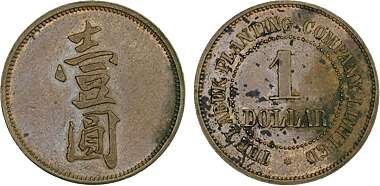
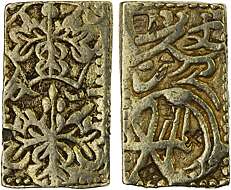
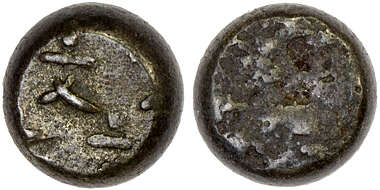
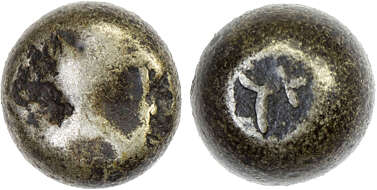
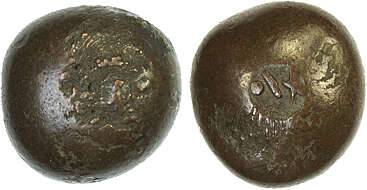
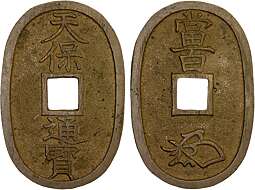
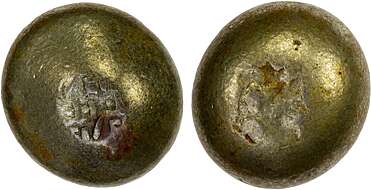
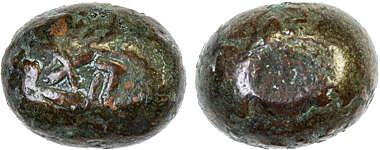
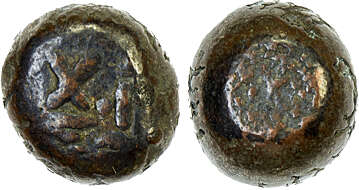
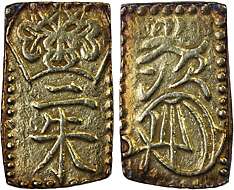
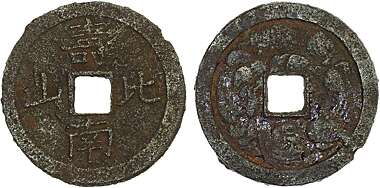
Лот 1402. BRITISH NORTH BORNEO: Plantation Tokens, AE dollar token, ND (ca. 1890), LaWe-679a, issued by the Labuk Planting Company, struck in copper, with denomination in Chinese on reverse, scattered hairlines, some dark spots on obverse, lightly lustrous, AU.
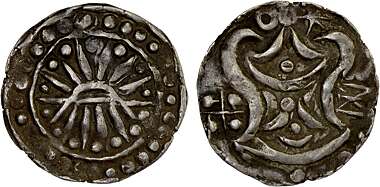
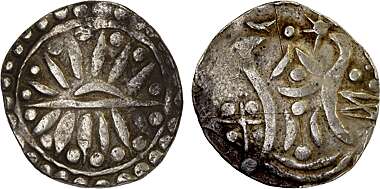
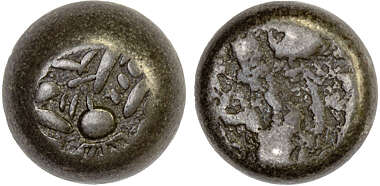
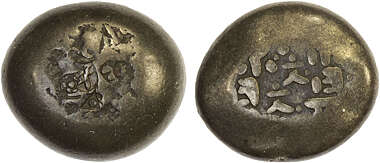
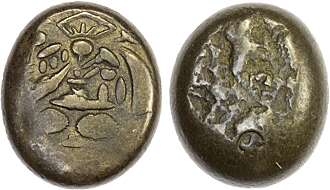
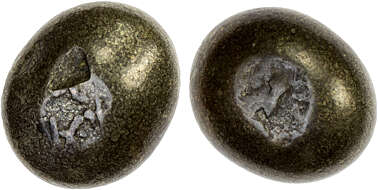
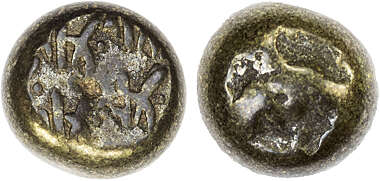
Лот 1403. BURMA: Kingdoms: Beikthano, ca. 9th-10th centuries, AR unit (9.29g), Mitch-SEA295, Mahlo-56 (var), stylized rising sun with 6 rays above and 6 rays below in a circle of beads // Srivatsa symbol; moon and sun above; flanked by bhadrapitha to right and swastika to left, VF-XF.
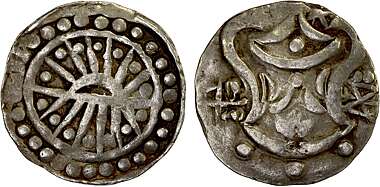
Лот 1404. BURMA: Kingdoms: Beikthano, ca. 9th-10th centuries, AR unit (9.12g), Mitch-SEA295, Mahlo-56 (var), stylized rising sun with 6 rays above and 6 rays below in a circle of beads // Srivatsa symbol; moon and sun above; flanked by bhadrapitha to right and swastika to left, VF-XF.
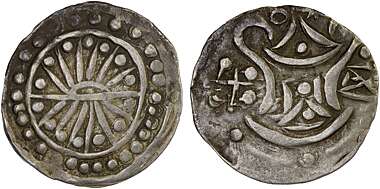
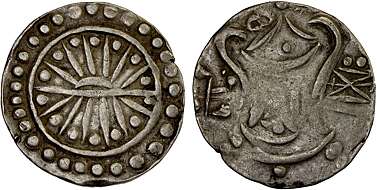
Лот 1405. BURMA: Kingdoms: Beikthano, ca. 9th-10th centuries, AR unit (8.18g), Mitch-SEA295, Mahlo-56 (var), stylized rising sun with 6 rays above and 6 rays below in a circle of beads // Srivatsa symbol; moon and sun above; flanked by bhadrapitha to right and swastika to left, VF-XF.
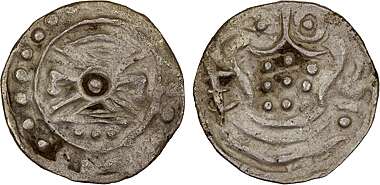
Лот 1406. BURMA: Kingdoms: Beikthano, ca. 9th-10th centuries, AR unit (9.34g), Mitch-SEA295, Mahlo-56 (var), stylized rising sun with 6 rays above and 6 rays below in a circle of beads // Srivatsa symbol; moon and sun above; flanked by bhadrapitha to right and swastika to left, VF-XF.
Лот 1407. BURMA: Kingdoms: Halin, ca. 5th-6th centuries, AR unit (9.12g), Mitch-SEA267, Mahlo-56 (var), stylized rising sun with 6 rays above and 6 rays below in a circle of beads // Srivatsa symbol; moon and sun above; flanked by bhadrapitha to right and swastika to left, VF-XF.
Лот 1408. BURMA: Kingdoms: Srikshetra, 8th-9th century, AR 1/4 unit (2.39g), Mahlo-14b.4, bhadrapitha, 5 lamps above // srivatsa, circle, with star & annulet above, thunderbolt left, sankh shell right, nine stupas in center, late style, bold VF, R.
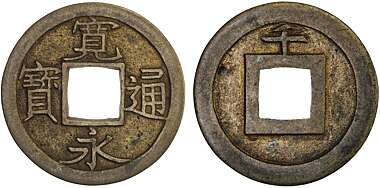
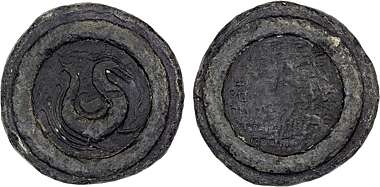
Лот 1409. BURMA: Kingdoms: Tenasserim-Pegu, lead weight (422.02g), 17th-18th century, Robinson Plate 5-6, 75mm, stylized hintha bird left, with fancy tail, long beak, and curled crest, both feet clear // traces of original Burmese-Mon legend, F-VF.
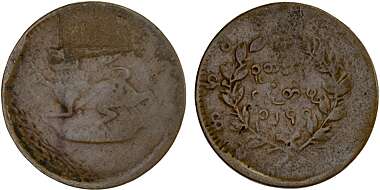
Лот 1411. BURMA: Thibaw Min, 1878-1885, AE 1/4 pe, CS1240 (1878), KM-25.2, mythical half lion-deer (To) // denomination and date within wreath, variety with flower petals at top of wreath diagonal, VG.
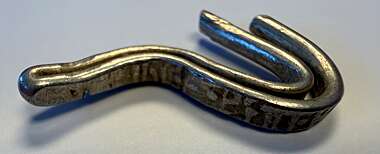
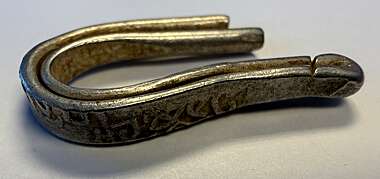
Лот 1412. CEYLON: Anonymous, ca. 16th-18th century, AR larin (4.63g), "fish hook" type, originally a blank larin, with stylized pseudo-Arabic added later, stamped on the edge before the second fold, XF.
Лот 1413. CEYLON: Anonymous, ca. 16th-18th century, AR larin (4.81g), "fish hook" type, originally a blank larin, with stylized pseudo-Arabic, stamped on the edge before the second fold, XF.
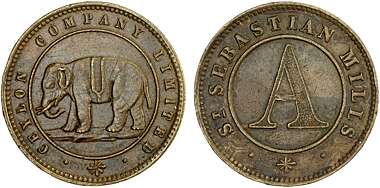
Лот 1415. CEYLON: Ceylon Company Limited, AE 2¼ pence token, ND (ca. 1866), Prid-19, 19mm bronze token, elephant walking left within solid circle with CEYLON COMPANY LIMITED around // large central A within solid circle with "St SEBASTIAN MILLS" around, plain edge, light marks, small scrape in reverse center, XF.
Лот 1422. EGYPT: Fuad I, King, 1922-1936, AR 10 piastres, 1923/AH1341-H, KM-337, an attractive nearly mint state example, NGC graded AU58, ex King's Norton Mint Collection.
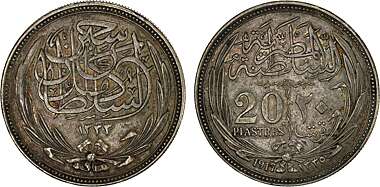
Лот 1424. EGYPT: Fuad I, King, 1922-1936, AR 20 piastres, 1923/AH1341-H, KM-338, harshly cleaned, NGC graded XF details, ex King's Norton Mint Collection.
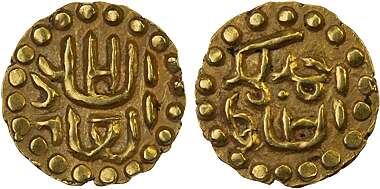
Лот 1428. INDONESIA: ACEH: Inayat Shah Zakiyat, 1678-1688, AR kupang (0.58g), Leyton-A19, legends paduka sri sultanah inayat shah // zakiat ad-din berdaulat shah, VF-XF.
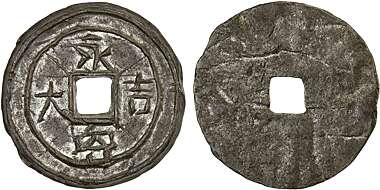
Лот 1429. INDONESIA: BANGKA ISLAND: tin jokoh (5.13g), ca. late 18-early 19th century, Harsono--, Zeno--, yong xing ji da, uniface, light attractive luster, AU-UNC Tentatively attributed to a Chinese mining operation on Bangka Island.
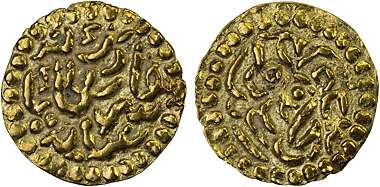
Лот 1430. INDONESIA: SAMUDRA-PASAI: Ahmad, ca. 1270-1295, AR kupang (0.62g), Leyton-SP1d, ahmad malik al-zahir // al-sultan al-'adil; pellet in obverse center, XF.
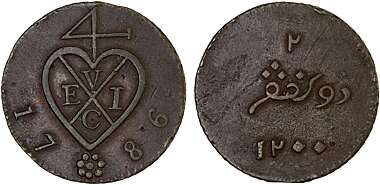
Лот 1431. INDONESIA: SUMATRA: British United East india Company, AE 2 kepings, 1786/AH1200, KM-258, with VEIC bale-mark, a few very light reverse scratches, Choice VF.
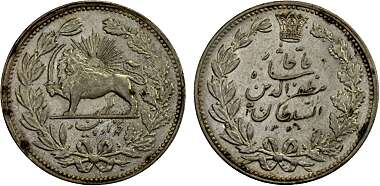
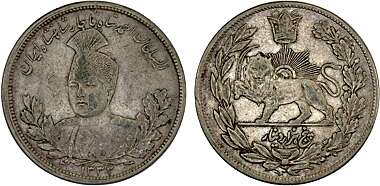
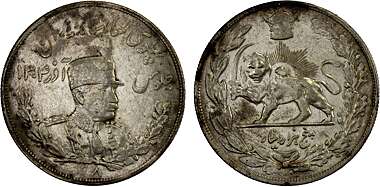
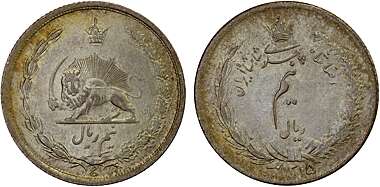
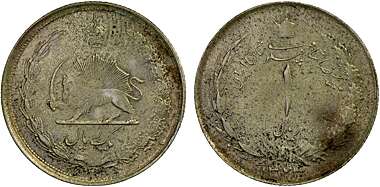
Лот 1435. IRAN: Reza Shah, 1925-1941, AR 1/4 rial, SH1315 (1936), KM-127, a fantastic quality example! NGC graded MS66. The second Iranian rial was introduced in 1932, replacing the older Qiran system. The silver denomination ¼ rial coin, colloquially or historically referred to in numismatic listings as the "robi" or "rob'i" (derived from the Persian word rub', meaning "one-fourth"), was standard circulation currency issued under the early Pahlavi dynasty.
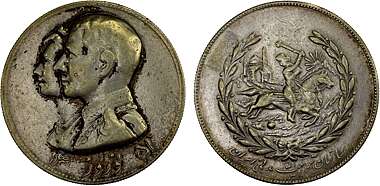
Лот 1437. IRAN: Mohammad Reza Shah, 1941-1979, AR medal (21.01g), AH1351, 36mm silver medal for the Persian New Year (Nowruz), conjoined busts of the Shah and his wife Farah with Persian text below and flanking date "13 - 51" // figure riding horse right swinging polo mallet at ball below with mosque behind, all within laurel wreath with Persian text below, lightly cleaned, starting to retone, reeded edge, VF.
Лот 1439. IRAN: Mohammad Reza Shah, 1941-1979, AR 75 rials, 1971/SH1350, KM-1186, 500th Anniversary of the Persian Empire - Stone of Cyrus II, struck at the Royal Canadian Mint, NGC graded PF66 Ultra Cameo.
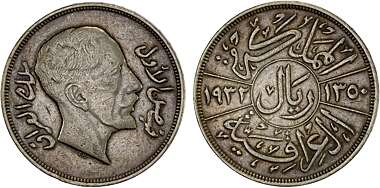
Лот 1440. IRAQ: Faisal I, 1921-1933, AR riyal, 1932/AH1350, KM-101, struck at the British Royal Mint, F-VF. Denomination on edge as 200 (fils) repeated six times.
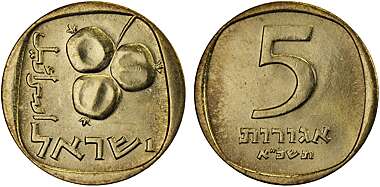
Лот 1441. ISRAEL: Republic, 5 agorot, JE5721 (1961), KM-25, Magnus-A5-2.a, ICI die with high date and serifs, better variety, Gem Unc, ex William M. Rosenblum.
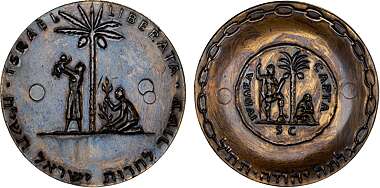
Лот 1442. ISRAEL: Republic, AE medal (121.1g), ND (1961), Magnus-SM-1e, 61mm bronze medal of Judaea Capta - Israel Liberata by Rothschild & Lippmann, date palm tree with woman to left holding infant aloft and to right, a farmer kneeling to plant a young tree, and with "ISRAEL - LIBERATA - (Hebrew text)" around // Roman Judaea Capta coin at center with chain border and Hebrew text at bottom, variety with plugs in the obverse fields, lightly cleaned, odd brushmarked appearance typical of this issue, prooflike, mintage of only 533 pieces, rare, STATE OF ISRAEL and Hebrew text on edge, Unc, ex William M. Rosenblum; ex William M. Rosenblum Mailbid Sale 32C, Lot 1190 (wth tag).
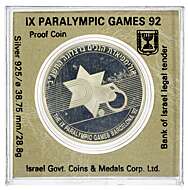
Лот 1443. ISRAEL: AR 2 new sheqalim, JE5752 (1992), KM-228, IX Paralympic Games in Barcelona, struck at the Staatliche Münze Stuttgart, in original case of issue, Proof, ex Charles Davalos Collection.
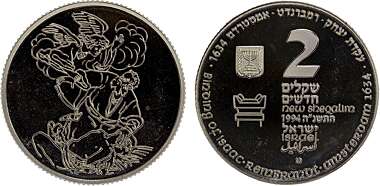
Лот 1444. ISRAEL: Republic, AR 2 new sheqalim, JE5755-1994, KM-257, Magnus-HS-28a, Biblical Art-Binding of Isaac, tiny reverse spot, mintage of only 4,439 pieces, scarce, Proof, ex William M. Rosenblum.
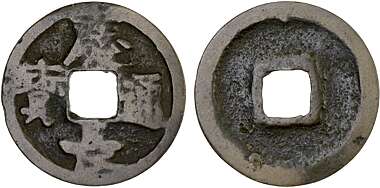
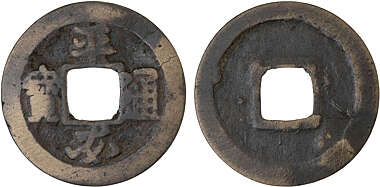
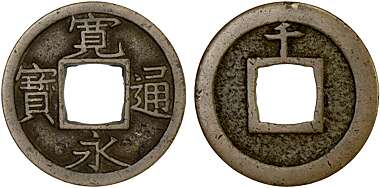
Лот 1445. JAPAN: Keicho, 1596-1615, AE mon (2.52g), H-3.40, keicho tsuho, cast in Keicho era year 11 (1606), Fine. The Keicho Tsuho was issued around 1606 during the early Edo period under Shogun Tokugawa Ieyasu. As part of efforts to unify the currency system, this coin was minted in copper, silver, and gold to stabilize the economy after the Battle of Sekigahara.
Лот 1446. JAPAN: Tokugawa, 1603-1868, AE mon (2.18g), H-3.134, JNDA-126.6, heian tsuho, clerical script, cast in 1624, Fine. According to Japanese numismatist Morishima Shotaro, this type is likely a Hosokawa-clan issue cast by the Daimyo Tadatoshi (1620-1633) of the Kokura Domain in Buzen Province.
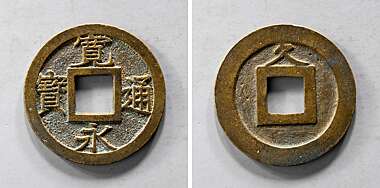
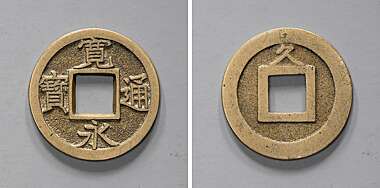
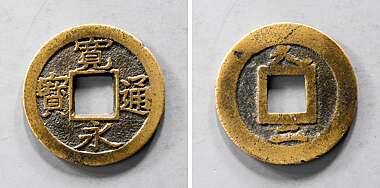
Лот 1449. JAPAN: Tokugawa, 1603-1868, AE mon, Kuji-gun Mint, Hitachi Province, H-4.211s, JNDA-133.67, Shin Kanei Tsuho type, ku above on reverse, no claw on kan variety, bronze bosen (seed or mother) coin for iron type, cast from 1768-72, graded 84 by CAG Grading Company, VF-XF.
Лот 1450. JAPAN: Tokugawa, 1603-1868, AE mon, Kuji-gun Mint, Hitachi Province, H-4.211s, JNDA-133.67, Shin Kanei Tsuho type, ku above on reverse, no claw on kan variety, bronze bosen (seed or mother) coin for iron type, cast from 1768-72, graded 82 by CAG Grading Company, VF.
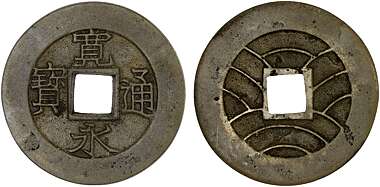
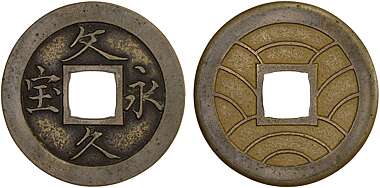
Лот 1454. JAPAN: Tokugawa, 1603-1868, AE 4 mon (3.63g), H-5.19, JNDA-138.3, Bunkyu sobun type, 11 waves, broad rim around hole, bronze bosen (seed or mother) coin, cast 1863-68, XF. The cursive script was written by the court councilor Matsudaira Yoshinaga.This type as minted at Asakusa and Kosuge.
Лот 1455. JAPAN: Hoei, 1704-1711, AE 10 mon (9.23g), Shichijo mint, Kyoto, H-5.1, JNDA-134.1, hoei tsuho // ei kyu sei yo, countermarked chin on rim, VF. In the 5th year of Hoei (1708) the Hoeitsuho coin was cast at the Shichijo mint. This type was often called "ozeni" due to its large size. The people found it inconvenient to use, although they were informed that they would be punished for not using it. This was hardly surprising as the government issued the coin with a nominal value of ten mon, but its intrinsic value was only about three mon. This example came from a small group of higher than average quality examples, boldly cast with clear reverse incuse characters.
Лот 1456. JAPAN: Genbun, 1736-1741, AV bu (3.29g), Edo mint, H-8.42, JNDA-09-37, Kiri crests top and bottom, denomination ichi bu either side // characters for the Mint Official and his signature, era name [Gen]bun, at top right, struck 1736-1818 in .653 fine gold with standard Japanese banker's marks, VF.
Лот 1457. JAPAN: Genbun, 1736-1741, AR mameita-gin (0.75g), H-9.40, JNDA-09-66, so-called "bean money", with characters bun with dot above in the fields, most of design off flan as usual for type, in .460 fine silver, struck 1736-1818, VF-XF. The Japanese "mameita-gin," also known as "bean money," is made from silver alloys using the "yudoko-buki" method: molten metal is poured into a cloth (such as linen) submerged in hot water. The designs were hammered into the cooling silver. "Mameita gin" were produced from around 1620 until the 1850s. The weight of the produced coins varied considerably, and they were used more like bullion rather than units of account.
Лот 1458. JAPAN: Genbun, 1736-1741, AR mameita-gin (2.35g), H-9.40a, JNDA-09-66, so-called "bean money", Daikoku, the God of Wealth, with character bun at center, struck 1736-1818, Fine.
Лот 1459. JAPAN: Genbun, 1736-1741, AR mameita-gin (8.47g), H-9.40a, JNDA-09-66, so-called "bean money", Daikoku, the God of Wealth, with character bun at center, in .460 fine silver, struck 1736-1818, Fine. The Japanese "mameita-gin," also known as "bean money," is made from silver alloys using the "yudoko-buki" method: molten metal is poured into a cloth (such as linen) submerged in hot water. The designs were hammered into the cooling silver. "Mameita gin" were produced from around 1620 until the 1850s. The weight of the produced coins varied considerably, and they were used more like bullion rather than units of account.
Лот 1460. JAPAN: Genbun, 1736-1741, AR mameita-gin (4.05g), H-9.40b, so-called "bean money", Daikoku, the God of Wealth, with character bun within, struck 1736-1818, VF. The Japanese "mameita-gin," also known as "bean money," is made from silver alloys using the "yudoko-buki" method: molten metal is poured into a cloth (such as linen) submerged in hot water. The designs were hammered into the cooling silver. "Mameita gin" were produced from around 1620 until the 1850s. The weight of the produced coins varied considerably, and they were used more like bullion rather than units of account.
Лот 1461. JAPAN: Genbun, 1736-1741, AR mameita-gin (12.06g), H-9.40f, JNDA-09-66, so-called "bean money", with character ho eft of Daikoku, the God of Wealth, with mint official name joze right, and many small characters bun in the fields, most of design off flan as usual for type, in .460 fine silver, struck 1736-1818, VF. The Japanese "mameita-gin," also known as "bean money," is made from silver alloys using the "yudoko-buki" method: molten metal is poured into a cloth (such as linen) submerged in hot water. The designs were hammered into the cooling silver. "Mameita gin" were produced from around 1620 until the 1850s. The weight of the produced coins varied considerably, and they were used more like bullion rather than units of account.
Лот 1462. JAPAN: Genbun, 1736-1741, AR mameita-gin (9.92g), H-9.42, JNDA-09-66, so-called "bean money", Daikoku, the god of Wealthwith character bun within, struck 1736-1818, VF.
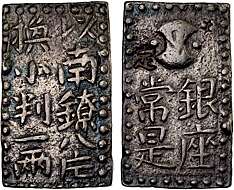
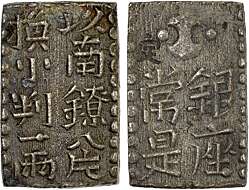
Лот 1463. JAPAN: Meiwa, 1764-1772, AR 2 shu (10.21g), Edo mint, H-9.71, JNDA-09-47, Ko Nanryo type, Japanese Kanji for "take eight pieces Nanryo to exchange for one ryo koban" // a Fundo (weight), stamped with single incuse character jo (guaranteed) above ginza (silver mint) and joze (mint official), all surrounded by pearl border, issued 1772-1824, VF.
Лот 1464. JAPAN: Bunsei, 1818-1830, AR mameita-gin (7.59g), H-9.46, JNDA-09-67, so-called "bean money", with character bun with stroke above in the fields, most of design off flan as usual for type, in .460 fine silver, struck 1820-37, VF. The Japanese "mameita-gin," also known as "bean money," is made from silver alloys using the "yudoko-buki" method: molten metal is poured into a cloth (such as linen) submerged in hot water. The designs were hammered into the cooling silver. "Mameita gin" were produced from around 1620 until the 1850s. The weight of the produced coins varied considerably, and they were used more like bullion rather than units of account.
Лот 1465. JAPAN: Bunsei, 1818-1830, AR mameita-gin (2.38g), H-9.46, JNDA-09-67, so-called "bean money", with character bun with stroke above in the fields, most of design off flan as usual for type, in .460 fine silver, struck 1820-37, VF. The Japanese "mameita-gin," also known as "bean money," is made from silver alloys using the "yudoko-buki" method: molten metal is poured into a cloth (such as linen) submerged in hot water. The designs were hammered into the cooling silver. "Mameita gin" were produced from around 1620 until the 1850s. The weight of the produced coins varied considerably, and they were used more like bullion rather than units of account.
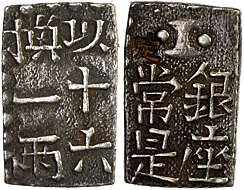
Лот 1466. JAPAN: Bunsei, 1818-1830, AR 2 bu (7.13g), Edo mint, H-9.75, JNDA-09-48, Shin Nanryo type ni shu gin, Japanese Kanji for "take eight pieces Nanryo to exchange for one ryo koban" // a Fundo (weight), stamped with single incuse character jo (guaranteed) above ginza (silver mint) and joze (mint official) all surrounded by pearl border, issued 1824-30, XF.
Лот 1467. JAPAN: Bunsei, 1818-1830, AR shu (2.53g), Edo, H-9.76, JNDA-09-49, Nanryo isshu gin, Japanese Kanji for "take sixteen pieces Nanryo to exchange for one ryo" // a Fundo (symbol for official weight with an incuse stamp, jo, to the left of it over ginza (silver mint) and joze (mint official) all surrounded by pearl border, issued 1829-37, XF.
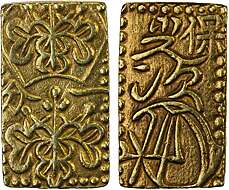
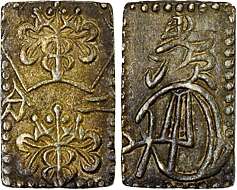
Лот 1469. JAPAN: Tenpo, 1830-1844, AV bu (2.81g), Kinza mint, Edo, H-8.44, JNDA-09-39, Ichibukin type, fan-shaped kiri crest above and below, ichi bu at center // Mitsutsugu signature, po at upper right, struck 1837-58, XF. This type is struck in 56.8% gold and 43.2% silver.
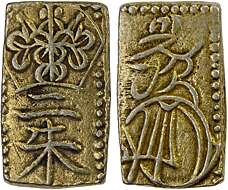
Лот 1470. JAPAN: Tenpo, 1830-1844, AV 2 shu (1.61g), H-8.50, JNDA-09-43, Kiri crests top, ni shu at center // characters for the Mint Official (Shozaburo Mitsutsugu) and his signature, struck 1832-58 in .298 fine gold, XF.
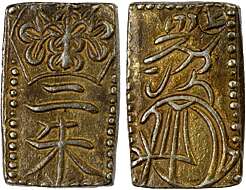
Лот 1471. JAPAN: Tenpo, 1830-1844, AV 2 shu (1.63g), H-8.50, JNDA-09-43, Kiri crests top, ni shu at center // characters for the Mint Official (Shozaburo Mitsutsugu), and his signature, struck 1832-58 in .298 fine gold, VF-XF.
Лот 1472. JAPAN: Tenpo, 1830-1844, AR mameita-gin (11.74g), H-9.52, JNDA-09-68, so-called "bean money", with many small characters po in the fields, most of design off flan as usual for type, in .260 fine silver, struck 1837-58, VF. The Japanese "mameita-gin," also known as "bean money," is made from silver alloys using the "yudoko-buki" method: molten metal is poured into a cloth (such as linen) submerged in hot water. The designs were hammered into the cooling silver. "Mameita gin" were produced from around 1620 until the 1850s. The weight of the produced coins varied considerably, and they were used more like bullion rather than units of account.
Лот 1473. JAPAN: Tenpo, 1830-1844, AR mameita-gin (4.78g), H-9.59, JNDA-09-69, so-called "bean money", with many small characters sei in the fields, most of design off flan as usual for type, in .135 fine silver, struck 1859-65, VF. The Japanese "mameita-gin," also known as "bean money," is made from silver alloys using the "yudoko-buki" method: molten metal is poured into a cloth (such as linen) submerged in hot water. The designs were hammered into the cooling silver. "Mameita gin" were produced from around 1620 until the 1850s. The weight of the produced coins varied considerably, and they were used more like bullion rather than units of account.
Лот 1474. JAPAN: Tenpo, 1830-1844, AR mameita-gin (2.01g), H-9.59, JNDA-09-69, so-called "bean money", with many small characters sei in the fields, most of design off flan as usual for type, in .135 fine silver, struck 1859-65, VF. The Japanese "mameita-gin," also known as "bean money," is made from silver alloys using the "yudoko-buki" method: molten metal is poured into a cloth (such as linen) submerged in hot water. The designs were hammered into the cooling silver. "Mameita gin" were produced from around 1620 until the 1850s. The weight of the produced coins varied considerably, and they were used more like bullion rather than units of account.
Лот 1475. JAPAN: Ansei, 1854-1860, AV 2 bu (5.65g), Edo mint, H-8.30, JNDA-09-27, fan-shaped kiri crest above and below, ni bu at center // Mitsutsugu signature, in .209 fine gold, struck 1856-60, scarce type, XF.
Лот 1476. JAPAN: Man'en, 1860-1861, AV 2 shu (0.84g), Edo mint, H-8.51, Cr-18a, JNDA-09-44, Kiri crests top, ni shu at center // characters for the Mint Official (Shozaburo Mitsutsugu), and his signature, struck 1860-69 in .229 fine gold, XF.
Лот 1477. JAPAN: Keio, 1865-1868, iron 25 mon (6.37g), H-7.5A, type known as a Mito Daikoku-sen (Mito Daikoku Coin) with Daikoku, the God of Wealth on reverse, likely a contemporary local issue cast in iron, F-VF. Legend translates as "Longevity as great as the South Mountain." These coins were first issued in 1864 by the Morioka-han in Mutsu Province (present day Iwate-ken).
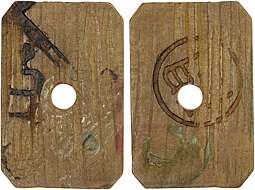
Лот 1478. JAPAN: 100 mon token, ink pressed wood token, Echigo-ku Kashiwazaki wholesale bill, shiro (white) // mon (gate), with center hole as made, VF. These wooden tokens of Kashiwazaki City, present-day Murakami City and Uonuma City, was is an area with a rich variety of wooden bills along with the Minamiuonuma area likely produced circa 1850-1870.
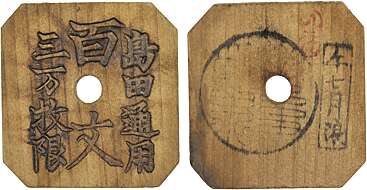
Лот 1479. JAPAN: 100 mon token, fire brand wood token, Kifuda Shimada-juku (for Shimada-dori Street), denomination at center, shimada tsuyo at right, san man-mai-gen at left, with center hole as made, ink stamps on reverse, VF. It is the local currency of Shimada-juku, a post station in Suruga Province (Shizuoka). Made at the end of the Edo period, circa 1850-1870, where this kind of wooden substitute coins were sometimes issued in areas where money was in short supply.
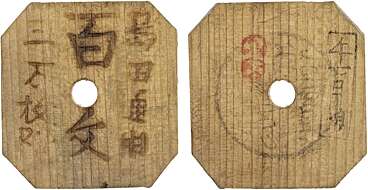
Лот 1480. JAPAN: 100 mon token, fire brand wood token, Kifuda Shimada-juku (for Shimada-dori Street), denomination at center, shimada tsuyo at right, san man-mai-gen at left, with center hole as made, ink stamps on reverse, VF. It is the local currency of Shimada-juku, a post station in Suruga Province (Shizuoka). Made at the end of the Edo period, circa 1850-1870, where this kind of wooden substitute coins were sometimes issued in areas where money was in short supply.
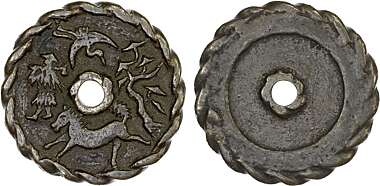
Лот 1481. JAPAN: AE e-sen (49.71g), Mitch-4644, cf. Zeno-142238, 50mm, farmer walking left, carrying axe, pine tree to right, horse galloping left below, crane flying right above, reverse blank, round hole in center with corded inner and outer borders on both sides, probably made in the late Tokugawa period, accompanied with old paper flip, light marks on reverse, VF.
Лот 1482. JAPAN: Meiji, 1868-1912, AV 2 bu (2.95g), Edo mint, H-8.32a, JNDA-09-29, fan-shaped Kiri crest above and below, ni bu at center // characters for the Mint Official (Mitsutsugu), and his signature, struck 1868-69 in .223 fine gold, VF-XF.
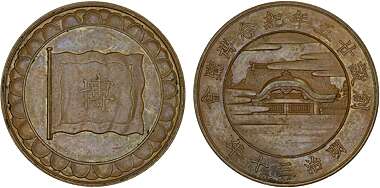
Лот 1486. JAPAN: Meiji, 1868-1912, AE medal (321.43g), year 30 (1897), 39mm bronze medal for the 25th Anniversary Exhibition of the Kyoto Chamber of Commerce and Industry; waving flag displaying the stylized kanji character haku (exhibition), enclosed inside an ornate scalloped floral border reminiscent of stylized lotus or chrysanthemum petals // sosetsu nijugo-nen kinen hakurankai (Exhibition Commemorating the 25th Anniversary of the Founding) at top, Meiji sanju-nen (Meiji year 30) below highly detailed relief engraving of a traditional Japanese building pavilion, framed under stylized clouds, AU.
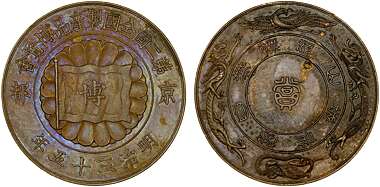
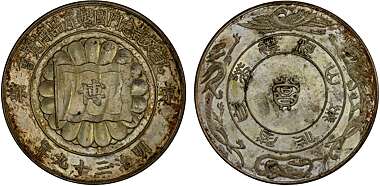
Лот 1487. JAPAN: Meiji, 1868-1912, AE medal (32.49g), year 35 (1902), 40mm bronze medal for the Second National Domestic Products Exhibition in Kyoto; large stylized Chrysanthemum Crest (Imperial Mon) surrounding a flag featuring the kanji character haku (exhibition), Dai-ni-kai Zenkoku Seisanhin Hakurankai above, Meiji Sanjugo Nen (Meiji year 35) below // stylized Tensho character sho (award) at center, traditional East Asian mythological and regional symbols, including a Phoenix at top, two dragons along the sides, and a coiled snake/tortoise pairing at the base, the inner ring depicts characters representing the compass directions or cyclical signs, attractive toned, AU.
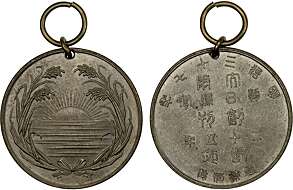
Лот 1488. JAPAN: Meiji, 1868-1912, AR medalete (5.02g), year 37 (1904), 22mm silver medal for the 25th Anniversary (Silver Jubilee) of the Asahi Shimbun Newspaper; rising sun with radiating beams rising over waves, entirely framed by two bundles of rice plants harvested and tied with a decorative ribbon at the base // inscription in Kanji, "Meiji 37th Year" / "Osaka Asahi Shimbun" / "25th Anniversary of the First Issue" / "Commemorative Medal" / "Made by the Mint Bureau." with original loop as made, Unc.
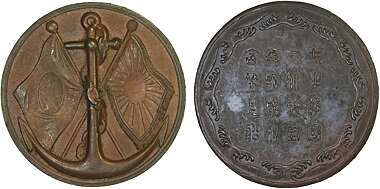
Лот 1489. JAPAN: Meiji, 1868-1912, AE medal, ND, 56mm bronze "Senbaku Hokoku" Slogan ("Serving the Nation through Shipping") medal; crossed National Flag of Japan (Hinomaru), and Japanese Merchant Marine Flag behind a large anchor // sixteen Tensho characters incorporating the "Senbaku Hokoku" Slogan, yo de fune kuni / ichi zenku baku / sai kokai ho / masurao kuni, few minor reverse dings, AU. When you read just the bottom reverse row horizontally from right to left, it forms the phrase Senbaku Hokoku, which means "Serving the Nation through Shipping." This was a heavily promoted national slogan following the Sino-Japanese War (1894-1895) and peaked dramatically during and immediately after the Russo-Japanese War (1904-1905). During this window, the Japanese government heavily decorated civilian crewmen (Masurao) who operated requisitioned merchant marine transport fleets to support the front lines. This type was likely struck circa 1900-1910 in the early Meiji era.
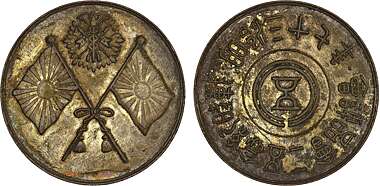
Лот 1490. JAPAN: Meiji, 1868-1912, silvered AE medal (31.42g), year 37 (1904), N-583586, 40mm silvered bronze medal for the Wartime Commemorative 25th Association Product Exhibition; two crossed Japanese military flags tied together at the handles with a ribbon. Hovering directly above the intersection of the flags is the Imperial Chrysanthemum Crest blended with an ornate military emblem or stylized star design // sen-ji ki-nen ni-go-kai hyo-pin-kai (Wartime Commemorative 25th Association Product Exhibition) at top, Meiji san-ju-nana nen (Meiji year 37) at bottom, with go (five) at center within wreath, AU.
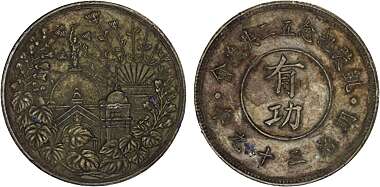
Лот 1491. JAPAN: Meiji, 1868-1912, AE medal (124.61g), year 39 (1905), 58mm bronze medal, exhibition building with Paulownia leaves and flowers // characters "yu-ko" (Merit) in central circle, date below, legend "Kika Go-ni Kyoshinkai" above, likely referring to a joint exhibition (Kyoshinkai) held by five cities or regions, likely including Kishiwada and Kaizuka, minor lamination defect striking error on reverse, a rare Meiji era medal, XF.
Лот 1492. JAPAN: Meiji, 1868-1912, silvered AE medal (33.08g), year 39 (1906), 40mm silvered bronze medal for the Third National Domestic Products Exhibition in Kyoto; large stylized Chrysanthemum Crest (Imperial Mon) surrounding a flag featuring the kanji character haku (exhibition), dai san-kai zenkoku seihin hakurankai above, Meiji sanjukyu-nen (Meiji year 35) below // stylized Tensho character sho (award) at center, traditional East Asian mythological and regional symbols, including a Phoenix at top, two dragons along the sides, and a coiled snake/tortoise pairing at the base, the inner ring depicts characters representing the compass directions or cyclical signs, attractively toned, Unc.
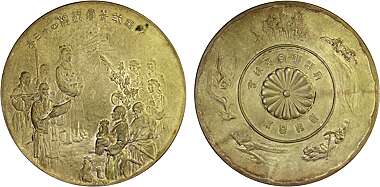
Лот 1493. JAPAN: Meiji, 1868-1912, silvered AE medal (160.46g), year 41 (1910), 64mm third-prize bronze award medal for a Prefectural Joint Fair sponsored by the Ministry of Agriculture & Commerce, designed by Unno Bisei, a possible auction scene on the obverse with the date and "third prize medal / bronze medal" above // Chrysanthemum Seal with surrounding legend at center, with forest, waves, dragon's head and pickaxe surrounding, hallmark on edge (engraver's name), AU. The sculptor of this medal, Unno Bisei, was the son of Moritoshi of Mito. He studied under Unno Shomin, and like his teacher taught at the Tokyo School of Fine Arts.
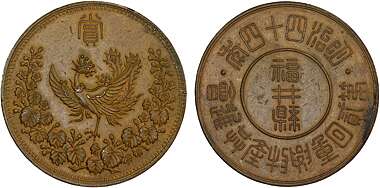
Лот 1494. JAPAN: Meiji, 1868-1912, AE medal (43.91g), year 44 (1911), 45mm bronze medal for the Fukui Prefecture Competitive Product Exhibition; a central design of a soaring Ho-o (Japanese Phoenix), heavily decorated and framed by symmetrical branches of flowering paulownia and chrysanthemum crest patterns // Meiji yonju-yon nen (Meiji year 44) at top, Tensho seal script inscription at bottom, Fukui-ken (Fukui Prefecture) at center, small reverse stain, XF.
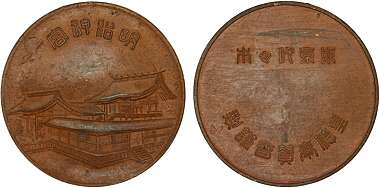
Лот 1497. JAPAN: Showa, 1926-1989, AE medal (29.76g), ND (1926), 45mm bronze medal for the Meiji Jingu Shrine in Tokyo; Kanji inscription "Meiji Jingu Shrine" above temple buildings // "Tokyo Yoyogi" (location of the temple) above and "Respectfully made by Emperor's Benevolence Eulogize Association" below, AU. The Meiji Shrine, located in Yoyogikamizonocho, Shibuya Tokyo, is the Shinto shrine that is dedicated to the deified spirits of Emperor Meiji and his wife, Empress Shoken. Construction began in 1915 (Taisho 4), it was formally dedicated in 1920, completed in 1921, and its grounds officially finished by 1926 (Showa 1).
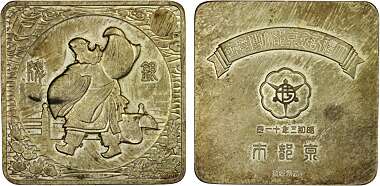
Лот 1498. JAPAN: Showa, 1926-1989, silvered AE medal (129.48g), year 3 (1928), 58mmm silvered bronze square medal for the Kyoto Great Grand Enthronement Exhibition - Silver Prize Medal; Daikokuten, one of the Japanese Seven Lucky Gods, dressed in traditional robes while carrying his iconic sack of treasures over his shoulder and a mallet // tairei kinen kyoto dai hakurankai (Great Enthronement Commemorative Kyoto Grand Exhibition) in upper band, Showa sannen juichigatsu (Showa year 3, November) below Kyoto City emblem, zoheikyoku sei (Manufactured by the Mint Bureau) at bottom, AU.
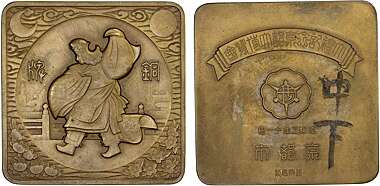
Лот 1499. JAPAN: Showa, 1926-1989, silvered AE medal (129.35g), year 3 (1928), 58mmm bronze square medal for the Kyoto Great Grand Enthronement Exhibition - Silver Prize Medal; Daikokuten, one of the Japanese Seven Lucky Gods, dressed in traditional robes while carrying his iconic sack of treasures over his shoulder and a mallet // tairei kinen kyoto dai hakurankai (Great Enthronement Commemorative Kyoto Grand Exhibition) in upper band, Showa sannen juichigatsu (Showa year 3, November) below Kyoto City emblem, zoheikyoku sei (Manufactured by the Mint Bureau) at bottom, with collector's hand inked mark chuge, AU.
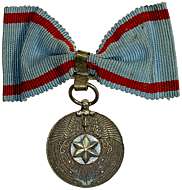
Лот 1500. JAPAN: Showa, 1926-1989, silvered AE badge, Imperial Soldiers' Relief Association 1935-1938 Supporting Member's Badge: traditional stylized cherry blossom or star emblem enveloped by the protective outspread wings of a sacred bird (often associated with the mythological Yatagarasu or three-legged raven? // Tensho script inscription reading "Imperial Soldiers' Relief Association — Supporting Member Badge," with original ribbon of issue, AU, ex Joseph E. Lang Collection.