实时出价注册
Numismatica Ars Classica, Zurich Logo
拍品
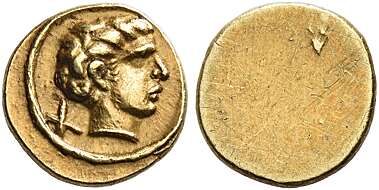
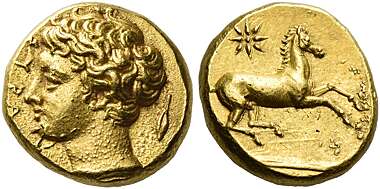
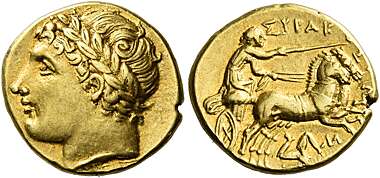
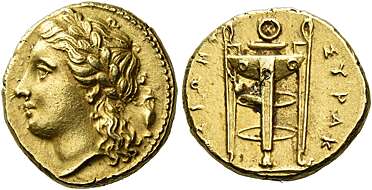
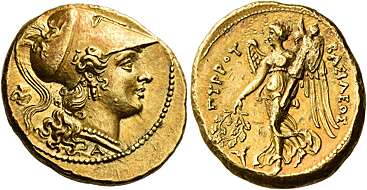
拍品 1. 10 units circa 300-250, AV 8 mm, 0.61 g. Male head r.; in l. field, X. Rev. Blank. Vecchi, Rasna VI, 1 (this coin). Jameson 19 (this coin). C. Gliwitzky, Aus Etruskern werden Römer - Geprägte Gold- und Silbermünzen, in: Jörg Gebauer (ed..), Die Etrusker - Von Villanova bis Rom, 2015, 282, 6.39 (this coin). EC 31.1 (this coin). Historia Numorum Italy 136. Very rare and in exceptional condition for the issue. A portrait of unusually fine style and a lovely light reddish tone. About extremely fine Ex Sangiorgi 15 April 1907, Strozzi (1810-1886), 535; NAC 7, 1994, 43 and Künker 295, 2017, 93 sales. Privately purchased from Edward J. Waddell on 12 February 2018. From the Jameson (1861-1942) and the Athos (1907-1993) and Dina Moretti collections. Please find here the video of the coin
  • 起拍价:
    1'600 CHF
    1'748 EUR
    1'457 GBP
    1'964 USD

    仅取整数近似值日期: 2026/11/05
拍品
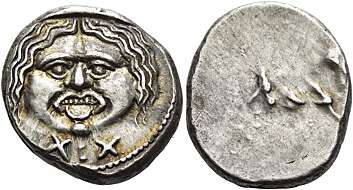
拍品 2. 20 asses circa 300-250, AR 21 mm, 8.61 g. Diademed facing head of Metus; below, X:X. Rev. 'poplv'. EC 37. Historia Numorum Italy 142. Struck on a very fresh metal and with a lovely iridescence. Extremely fine Ex Roma Numismatics XVI, 2018, 25; Roma Numismatics XIX, 2020, 197 and Gorny & Mosch 273, 2020, 17 sales. Please find here the video of the coin
  • 起拍价:
    1'200 CHF
    1'311 EUR
    1'092 GBP
    1'473 USD

    仅取整数近似值日期: 2026/11/05
拍品
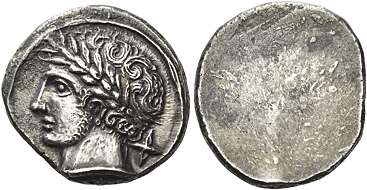
拍品 3. 10 asses circa 300-250, AR 18 mm, 4.17 g. Laureate male head l.; behind, X. Rev. Blank. Vecchi I, 11. EC 70.2 (this coin). AMB 14 (this coin). Gillet 6 (this coin). SNG Firenze 451 (this obverse die). Historia Numorum Italy 168. In exceptional condition for the issue, undoubtedly among the finest specimens known. A portrait of excellent style struck on fresh metal and with a superb old cabinet tone. Good extremely fine. Ex Hess-Leu 31, 1966, 15; NAC 13, 1998, formerly exhibited at the Antikenmuseum Basel, 14 and Leu Numismatik Winterthur 6, 2020, 23 sales. From the Charles Gillet (1879-1972) and the Athos (1907-1993) and Dina Moretti collections. Please find here the video of the coin
  • 起拍价:
    2'800 CHF
    3'059 EUR
    2'550 GBP
    3'438 USD

    仅取整数近似值日期: 2026/11/05
拍品
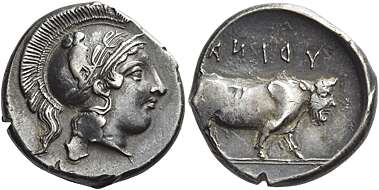
拍品 4. Didrachm circa 405-400, AR 21 mm, 7.29 g. Helmeted head of Athena r., decorated with olive wreath and owl. Rev. YPINA retrograde Man-headed bull advancing r. Rutter 2. SNG ANS 254 (these dies). Hurter 3 (these dies). Historia Numorum Italy 539. Very rare and in unusually fine condition for this difficult issue. Wonderful old cabinet tone, reverse slightly off-centre, otherwise good very fine Please find here the video of the coin
  • 起拍价:
    800 CHF
    874 EUR
    728 GBP
    982 USD

    仅取整数近似值日期: 2026/11/05
拍品
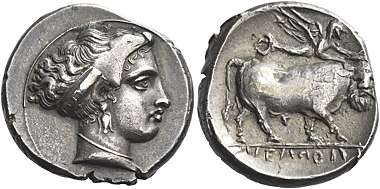
拍品 5. Didrachm circa 395-385, AR 22 mm, 7.52 g. Head of nymph Parthenope r., wearing diadem, earring and necklace. Rev. Man-headed bull advancing r., crowned by Nike flying r.; in exergue, NEOΠΟΛΙΤ. Jameson 1857 (this coin). SNG München 216 (this obverse die). Rutter 176. Historia Numorum Italy 563. An extremely rare issue with a portrait of masterly style struck in high relief. Superb old cabinet tone, an area of weakness on obverse and and slightly off-centre on reverse, otherwise about extremely fine / good very fine Ex Leu 30, 1982,1; Sternberg XX, 1988, 32; Leu 81, 2001, 3 and Ira & Larry Goldberg 106, 2018, 1008 sales. From the Jameson (1861-1942); Marchese Roberto-Venturi-Ginori, Robert Käpeli, and Lee Rousseau collections. In circa 470 BC, Cumae established a new colony on the coast of Campania to bolster the port settlement at Parthenope, which had existed since the seventh century BC. The new foundation was called Neapolis ("New City"), while in contrast Parthenope came to be known as Palaipolis ("Old City"). As a means of ensuring the survival of the Greek colony, the Neapolitans entered into alliances and friendly trade relationships with the neighbouring and warlike Italic peoples, most of whom were Samnites or related Oscan speakers. Unfortunately, as the rising power of Rome came into conflict with the Samnites, Neapolis found itself drawn into the fighting. The accusation that the Neapolitans were harbouring the Samnites responsible for attacking Romans in Campania triggered the Second Samnite War (327-301 BC). When Neapolis refused to surrender the guilty men, and instead accepted a Samnite garrison, the city was besieged by the forces of the Roman consul P. Publilius Philo. The city was valiantly defended, but at last starvation compelled the Neapolitans to trick the garrison into taking up a position in Palaiopolis and admit the Romans. Although Publilius celebrated a triumph in Rome for this somewhat less than glorious conquest, Neapolis was subsequently treated as an equal ally. The present didrachm was struck in the early fourth century BC before the beginning of the Roman Samnite Wars, when Neapolis was expanding its influence amongst its Italic neighbours. The head of the nymph Parthenope appears on the obverse in recognition of the original settlement that was absorbed to serve as the Palaipolis to the new settlement of Neapolis. The reverse features a man-faced bull - a type closely associated with Neapolis and Campania in general. Please find here the video of the coin
  • 起拍价:
    4'800 CHF
    5'244 EUR
    4'371 GBP
    5'894 USD

    仅取整数近似值日期: 2026/11/05
拍品
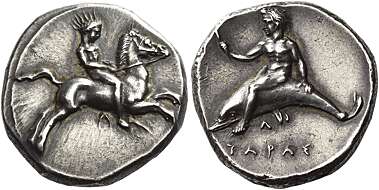
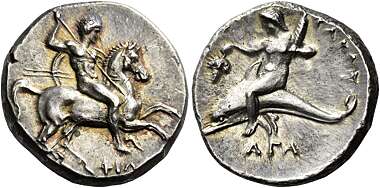
拍品 6. Nomos circa 390-380, AR 22 mm, 7.87 g. Ephebos naked on horseback r.; below, Λ. Rev. ΤΑΡΑΣ Dolphin rider l., holding akrostolion; below, Λ. Vlasto 367 (this coin). Fischer-Bossert 406b (this coin). Gillet 77 (this coin). Historia Numorum Italy 870. HGC 1, 768. Very rare and in exceptional state of preservation, undoubtedly the best specimen known of this type and one of the finest silver coins of Tarentum. Of masterly style and perfectly struck and centred on fresh metal. Wonderful old cabinet tone and good extremely fine Ex Leu-M&M 28 May 1974, Kunstfreund (1879-1972), 173; Morton & Eden 51, 2011, 5 and Morton & Eden 96, 2018, 301 sales. From the Santangelo, Vlasto (1874-1936), and Hermann Robinow collections. Graded AU* Strike: 5/5, surface: 4/5 - Fine style, brushed, NCG photo certificate number 8561100-006 Tarentum was famous as the only colony ever established by settlers from Sparta. It was founded in Magna Graecia at the foot of Italy in 706 BC by the Parthenians, a class of disenfranchised children of Spartan women. To improve their lot in Sparta, the Parthenians had plotted a revolution under the leadership of a man named Phalanthus. When the plot was uncovered prematurely, Phalanthus and his followers fled to southern Italy on the advice of the Delphic Oracle. On the way, Phalanthus is said to have been shipwrecked at sea, but his life was saved by the timely arrival of a dolphin who carried him to safety. Once in Italy, Phalanthus and the Parthenians settled a site called Satyrion until they discovered a better location, where they founded Tarentum. The dolphin rider who regularly appears on the reverse of Tarentine nomoi is often considered to represent Phalanthus. Alternatively, this figure on the coins has been thought to depict Taras, a son of Poseidon and the nymph Satyrion, who was shipwrecked in a storm while sailing in the Adriatic Sea. Just as Taras was about to be consigned to a watery grave, his divine father heard his cries and sent a dolphin to save him from drowning. The animal carried him to southern Italy, where Taras founded Tarentum to celebrate his escape from death. Unable to decide whether the dolphin rider depicts Phalanthus or Taras (he may, in fact, be intended to allude to both), coin cataloguers the world over regularly hedge their bets and describe him only as ”dolphin rider.” The reverse dies were frequently distinguished by objects held in the dolphin rider’s hand. Here, he holds an acrostolion, the curved ornament found on the prow of ancient ships. This ornament was traditionally cut from galleys defeated and captured in naval battles as a sign of victory. In a similar way, obverse dies of Tarentine nomoi, which invariably depicted a horseman, showed the horse and rider in varying attitudes and modes of dress. Here, the rider is a nude ephebe (a youth undergoing civic military training) charging right on a galloping horse. He is preparing for the day when he will be recognized as a full citizen and a member of the famed Tarentine cavalry. In the late Classical and Hellenistic periods, the Tarentine cavalry, known for its use of large, round shields and javelins on horseback, frequently served as mercenaries throughout the Greek world. Please find here the video of the coin
  • 起拍价:
    20'000 CHF
    21'851 EUR
    18'216 GBP
    24'560 USD

    仅取整数近似值日期: 2026/11/05
拍品
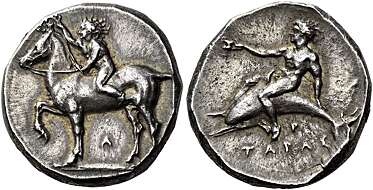
拍品 7. Nomos circa 385-380, AR 21 mm, 7.95 g. Nude youth on horse standing l., raising hand to crown horse with wreath; below, Λ. Rev. ΤΑΡΑΣ Dolphin rider l., holding cantharus; below, P. Vlasto 414 (these dies). Fischer-Bossert 457n (this coin). de Nanteuil 94 (this coin). SNG Lloyd 164 (these dies). SNG ANS 914 (these dies). Historia Numorum Italy 880. HGC 1, 778. Rare and in exceptional condition for the issue, among the finest specimens in private hands. Exceptionally complete for the issue and with a lovely light tone. An unobtrusive die-break on reverse, otherwise extremely fine Ex Hirsch XXX, 1911, 110; Hirsch XXXIV, 1914, 28; Hess-Leu 2 April 1958, 8 and Triton XXIII, 2020, 8 sales. From the Ionian Shore, Bruttium Hoard (IGCH 1916), and H. De Nanteuil (1876-1941) and Matthew Curtis collections. Please find here the video of the coin
  • 起拍价:
    2'400 CHF
    2'622 EUR
    2'185 GBP
    2'947 USD

    仅取整数近似值日期: 2026/11/05
拍品
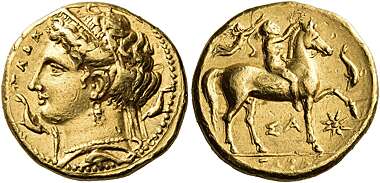
拍品 8. Stater circa 302, AV 19 mm, 8.57 g. Veiled head of Hera l., wearing stephane; three dolphins around. Rev. Youth on horseback r., crowning horse; above, Nike flying r. and crowning him. In r. field, dolphin and star and below, ΣΑ. Vlasto 24 (this obverse die). Fischer-Bossert G11e (this coin). De Luynes 237 (this obverse die), SNG ANS 1032 (this obverse die). Historia Numorum Italy 954. Very rare and in exceptional condition for the issue, undoubtedly among the finest specimens in private hands. A superb portrait in the finest style of the period struck on a very broad flan. A minor edge nick at ten o'clock on obverse, otherwise about extremely fine Ex Hirsch 4 May 1904, 25; Jean Vinchon, 14 April 1984, Comtesse de Behague (1870-1939), 6 and Jean Vinchon, 2019, 5 sales. Taras, the eponymous hero of Tarentum, was a son of Poseidon and the nymph Satyrion. He is said to have fallen into the sea when his ship was wrecked and was at the point of drowning when a dolphin miraculously appeared and carried him to safety on the shore of southern Italy. The hero celebrated his salvation by founding Tarentum near the site where he came to shore. Taras is most frequently depicted on Tarentine coins riding on the back of a dolphin – although there is some dispute as to whether this type might actually represent Phalanthos, the leader of the historical settlers of Tarentum who was also said to have been saved by a dolphin. On the reverse of this stater, however, he is shown crowning the horse that he rides. The Tarentines were known for their horsemanship in the Classical and Hellenistic periods and Tarentine cavalrymen frequently served abroad as mercenaries. Taras may also appear riding a horse due to his patrimony. Poseidon was not only the god of seas and earthquake, but also the father of horses. There is some dispute as to the identity of the goddess depicted on the obverse. In the absence of any additional attribute beyond a stephane and a veil, she has been variously identified as Hera, Amphitrite, Satyrion, or Persephone. The lack of any symbols related to grain makes Persephone seem a little unlikely, despite the known importance of the cult of Persephone at Tarentum. Hera is perhaps not implausible, but considering that the head of the goddess is surrounded by dolphins and the type is ultimately inspired by that of Euainetos' depiction of Arethusa on Syracusan coins, it seems most likely that we are dealing with a water nymph. Amphitrite, the consort of Poseidon, is certainly possible, but since the reverse type features Taras, it seems at least as likely that the goddess on the obverse represents his mother, Satyrion. Please find here the video of the coin
  • 起拍价:
    24'000 CHF
    26'221 EUR
    21'859 GBP
    29'472 USD

    仅取整数近似值日期: 2026/11/05
拍品
拍品 9. Nomos circa 281-270, AR 22 mm, 7.86 g. Horseman r., spearing downward with r. hand and holding shield and two more spears with l.; below, ΦΙΛ[ΟΤΑΣ]. Rev. ΤΑΡΑΣ Young dolphin rider l., holding bunch of grapes and distaff; in upper l. field, [EY] and below, ΑΓΑ. Vlasto 708. L. Brunetti, Nuovi orientamenti sulla zecca di Taranto, RIN 63 (1960), pl. IX, XXV.10. SNG ANS 1080 (this obverse die). Historia Numorum Italy 973. Lovely iridescent tone and extremely fine Ex NAC sale 64, 2012, 627. Please find here the video of the coin
  • 起拍价:
    1'000 CHF
    1'092 EUR
    910 GBP
    1'228 USD

    仅取整数近似值日期: 2026/11/05
拍品
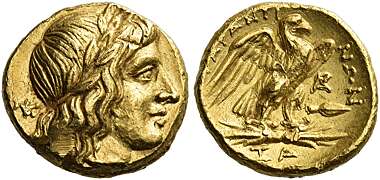
拍品 10. Quarter stater after 272, AV 11 mm, 2.14 g. Laureate head of Apollo r.; in l. field, NK ligate. Rev. TAPANTI-NΩN Eagle standing r., with open wings, on thunderbolt; in r. field, AP ligate on spearhead. Vlasto 53 (this coin). Fischer-Bossert G50a (this coin illustrated). Historia Numorum Italy 986. Rare and in exceptional condition for the issue. A superb portrait of fine style, Minor mark on obverse, otherwise extremely fine Ex Sambon & Canessa 18 November 1907, Nervegna, 250; Feuardent 17-19 December 1919, Collignon, 250; Glendining 10 December 1986, Knoepke, 26; New York XXVII, 2012, Prospero (1910-2001), 34 and NAC 116, 2019, Man in Love with Art part I, 13 sales. From the Vlasto (1874-1936) collection. Please find here the video of the coin
  • 起拍价:
    4'800 CHF
    5'244 EUR
    4'371 GBP
    5'894 USD

    仅取整数近似值日期: 2026/11/05
拍品
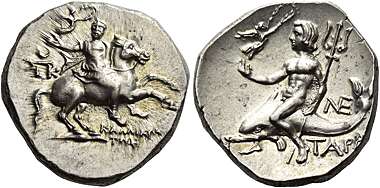
拍品 11. Nomos circa 240-228, AR 20 mm, 6.53 g. Horseman r. in military attire facing slightly l. and extending his r. hand; above, a small wreath-bearing Nike flying r. to crown him. In l. field, monogram, and beneath horse, KAΛΛΙΚΡΑ / ΤΗΣ. Rev. Taras on dolphin l., holding trident and a small wreath-bearing Nike; behind, NE ligate and beneath dolphin, ΤΑΡΑΣ. Vlasto 963. SNG Lloyd 230. SNG ANS 1260. Historia Numorum Italy 1059. Virtually as struck and almost Fdc From a private European collection. Graded Ch AU Strike: 5/5, Surface: 4/5, NCG photo certificate number 8561098-006 Please find here the video of the coin
  • 起拍价:
    1'200 CHF
    1'311 EUR
    1'092 GBP
    1'473 USD

    仅取整数近似值日期: 2026/11/05
拍品
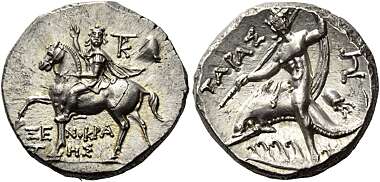
拍品 12. Nomos, magistrate Xenokrates circa 240-228, AR 21 mm, 6.55 g. Dioscuros on horseback l., head facing; below, ΞΕ – ΝΟΚΡΑ, above, monogram and pileus. Rev. ΤΑΡΑΣ Dolphin rider l., head turned r., brandishing trident; in r. field, monogram and cuttlefish, below, waves. Evans, Horseman type G.1. Vlasto 959-961. Historia Numorum Italy 1058. HGC 1, 904. Virtually as struck and almost Fdc From a private European collection Graded MS Strike 4/5 Surface 4/5, flan flaw, NCG photo certificate number 8561098-007 Please find here the video of the coin
  • 起拍价:
    1'200 CHF
    1'311 EUR
    1'092 GBP
    1'473 USD

    仅取整数近似值日期: 2026/11/05
拍品
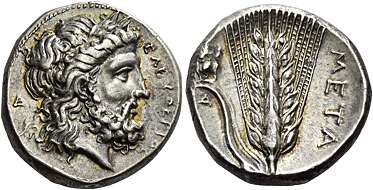
拍品 13. Nomos circa 340-330, AR 21 mm, 7.86 g. Laureate head of Zeus r.; in r. field, ΕΛΕΥΘΕΡΙΟΣ and in l. field, Δ. Rev. META Barley ear with leaf l.; above which, Silenus and below, Δ. Johnston, Class A, 2.1. SNG ANS 451 (these dies). SNG Lloyd 373 (this obverse die). SNG München 202 (these dies). Historia Numorum Italy 1557. HGC 1, 1057. Very rare and among the finest specimens known of this difficult issue. A coin of wonderful style struck in high relief on sound metal. Light iridescent tone and good extremely fine Ex NAC 4, 1991, 15; Roma Numismatics VIII, 2014, 9; NAC 72, 2015, 292 and Triton XXII, 2019, 38 sales. Although the city had enjoyed great prosperity in the sixth and fifth centuries BC due to its fertile agricultural hinterland, when this nomos was produced in the latter half of the fourth century BC, Metapontum was facing increasing difficulties. The city had managed to stave off earlier attacks by the Syracusan tyrants, but now the neighbouring Italic peoples, the Lucanians and Bruttians, were beginning to pose a serious threat. In an effort to defend itself, Metapontum allied with long-time rival Tarentum and Alexander the Molossian in 334 BC. Alexander and his mercenary army inflicted several major defeats on the Lucanians and the related Bruttians, but he was killed by treachery at the Battle of Pandosia in 331 BC. This disaster broke the alliance and left Metapontum (and the other Greek cities of southern Italy) to face the rising power of the indigenous Italic peoples alone. It is possible that Metapontum was also a member of the Italiote League in 344 BC when Tarentum invited the aid of Archidamus of Sparta, but this is uncertain. This nomos belongs to a much larger series of emissions featuring various deities on the obverse and a grain ear on the reverse, and may have been struck in part to finance the struggle against the Lucanians. The grain ear was an old badge of the city going back to the sixth century BC, while the obverse depicts and names [Zeus] Eleutherios ("Freedom"). The latter was especially popularised at Syracuse under Timoleon in the same period, and this coin may perhaps reflect some degree of Syracusan influence. It is also tempting to suggest that the Metapontine Eleutherios issue might have been intended to be paired with the unique nomos depicting and naming Damokratia, the personification of Democracy (cf. Triton VIII, lot 34). If so, they seem to advertise the cherished institutions of the city threatened by the encroachments of the Lucanians. Please find here the video of the coin
  • 起拍价:
    16'000 CHF
    17'481 EUR
    14'572 GBP
    19'648 USD

    仅取整数近似值日期: 2026/11/05
拍品
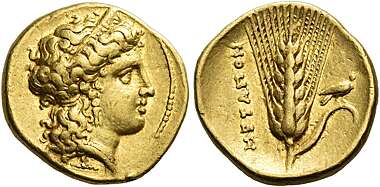
拍品 14. Tetrobol or Third of Stater circa 334-322, AV 14 mm, 2.61 g. Head of Hera r., wearing stephanos ornamented with palmettes, and single-pendant earring. Rev. METAΠON Barley ear of six grains; on r. field, bird standing on leaf. Johnston G1. SNG ANS 395. SNG Lockett 406. Dewing 377 (these dies). Gillet 203 (these dies). Historia Numorum Italy 1578. Rare. A portrait of superb style perfectly centred on a full flan. Good very fine Ex Leu 81, 2001, 19; Triton XIX, 2016, 2009; Triton XXII, 2019, 44 and Triton XXIII, 2020, 41 sales. From the Dr. Lawrence A. Adams, Gasvoda, and Jonathan P. Rosen collections. After its foundation by Greek colonists from Achaea in 720 BC, Metapontum profited greatly from the fertile lands that surrounded it, and so grew into one of the wealthiest Greek cities of southern Italy. However, in the fifth century BC, the city began to fall into decline. It managed to weather the ill-advised support for the doomed Athenian expedition against Syracuse in 414-413 BC, and later attacks by Dionysius I of Syracuse, but the city was no longer what it once was. In the fourth century BC, Metapontum and neighbouring cities of Magna Graecia were increasingly threatened by the Italic Lucanians. Indeed, their menace was so keenly felt that in 344 BC the city entered into alliance with its long-time rival, Tarentum, and the Molossian king, Alexander I, in the hope of breaking Lucanian power. Unfortunately, despite several victories, Alexander was betrayed and killed at the Battle of Pandosia (331 BC), thus leaving Metapontum and Magna Graecia at large without a defender. The exceptional appearance of Hera on a coin of Metapontum and the similarity of her head on this issue to the coins of Tarentum during the time of Alexander indicate that this coinage was struck when the city was allied with the Molossian. Please find here the video of the coin
  • 起拍价:
    2'800 CHF
    3'059 EUR
    2'550 GBP
    3'438 USD

    仅取整数近似值日期: 2026/11/05
拍品
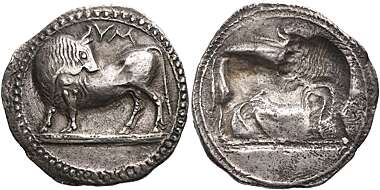
拍品 15. Nomos circa 550-510, AR 28 mm, 7.52 g. YM Bull standing l. with head reverted. Rev. The same type incuse. SNG München 1157. SNG ANS 817. SNG Copenhagen 1390. Historia Numorum Italy 1729. Struck on excellent metal and exceptionally well-centred and complete. Old cabinet tone and good very fine Ex Ira & Larry Goldberg 8, 2001, 2831; CNG Numismatic Review 26, 2001, 7; Triton XVII, 2014, 22 and CNG 109, 2018, 27 sales. From the RR, Phil Walick, and Gasvoda collections. Please find here the video of the coin
  • 起拍价:
    1'600 CHF
    1'748 EUR
    1'457 GBP
    1'964 USD

    仅取整数近似值日期: 2026/11/05
拍品
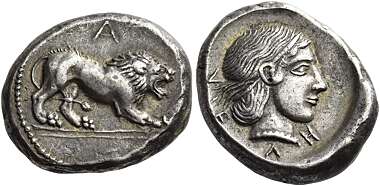
拍品 16. Didrachm circa 465-440, AR 19 mm, 8.00 g. Lion standing r.; above, A. Rev. V-E-Λ-H Head of the nymph Hyele r.; all within incuse circle. C.M. Kraay, A mid-fifth century hoard from South Italy, SNR 66, 29, 1 and pl. 5, 1 (this coin). Wiliiams 71a (this coin). Historia Numorum Italy 1264. HGC 1, 1303. Very rare and in exceptional condition for the issue, undoubtedly among the finest specimens in private hands. A portrait of excellent style and a lovely old cabinet tone. Extremely fine Ex Leu 2, 1972, 46; Leu 48, 1989, 25; Leu 81, 2001, 29 and CNG 109, 2018, 33 sales. In c. 535 BC, a combined fleet of Carthaginian and Etruscan ships appeared off the coast of Corsica to evict the island’s Greek colonists, who had arrived from Phokaia in Ionia and founded the city of Alalia. Against all odds, the Greeks of Alalia defeated their Carthaginian and Etruscan enemies, but realized that they were too exposed to attack on the island. They therefore set out to find new places to settle. Some of the colonists sailed for Gaul, where they founded the city of Massalia, while others took ship for Magna Graecia in southern Italy, where they established the city of Velia in the region of Lucania. The new city, which was also known as Hyele or Elea, was named after the nearby spring, whose beautiful nymph, Hyele, is depicted on the reverse of this early didrachm. Hyele, whose name means ”glassy,” refers both to the crystal-clear water of her spring and to the quality of her singing. According to Greek mythology, she was one of the 3,000 daughters of Oceanus and Tethys, chosen at age 9 to serve in the choir of 60 nymphs that accompanied the goddess Artemis. Despite the importance of Hyele as the source of water and namesake of Velia, in the city’s extensive series of didrachms struck from the fifth to the early third century BC, she only appears on two emissions. The reverses of Velian didrachm otherwise regularly feature the helmeted head of Athena.  The present coin is the earliest depiction of Hyele on a didrachm of Velia. An obverse type depicting a lion was standard for all didrachms struck at Velia, although the animal is shown in various attitudes, including on the prowl or devouring his prey. Here, the lion is shown at bay with his mouth wide open to give a ferocious roar. It is believed that the use of the lion, an animal not native to Italy in the fifth century BC, as an emblem of Velia reflects the eastern origin of the city’s colonists. Although they came from Phocaea in Ionia, a city best known for its use of a seal (phoke in Greek) as a canting badge, prolonged exposure to the Near Eastern iconography of the Persian Empire is thought to have led to the recognition of the lion as a symbol of power and authority. Thus, when the Phocaean colonists struck out to find new homes in the west, they brought this eastern symbol with them and used it on their coins. Interestingly, the lion appears not only on the coinage of Velia in Lucania, but also on that of its sister settlement, Massalia in Gaul. Please find here the video of the coin
  • 起拍价:
    6'400 CHF
    6'992 EUR
    5'829 GBP
    7'859 USD

    仅取整数近似值日期: 2026/11/05
拍品
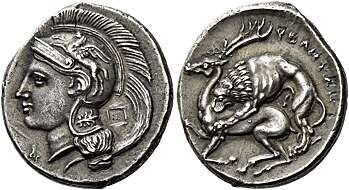
拍品 17. Didrachm circa 280, AR 23 mm, 7.36 g. Head of Athena l., wearing crested Attic helmet decorated with griffin on bowl; behind, IE within linear square and above, Φ. Rev. YEΛHTΩN Lion pulling down stag l. AMB 122 (this coin). Williams 541n (this coin). Historia Numorum Italy 1318. HGC 1, 1326. Rare and in excellent condition for the issue. Struck on a very broad and complete flan. Superb old cabinet tone and extremely fine Ex NAC 13, 1998, formerly exhibited at the Antikenmuseum Basel, 122; Busso-Peus 421, 2017, 1019 and Künker 318, 2019, 507 sales. From the Athos (1907-1993) and Dina Moretti collection. Please find here the video of the coin
  • 起拍价:
    4'000 CHF
    4'370 EUR
    3'643 GBP
    4'912 USD

    仅取整数近似值日期: 2026/11/05
拍品
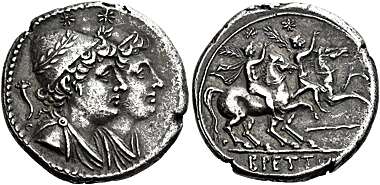
拍品 18. Reduced didrachm circa 215-205, AR 21 mm, 5.69 g. Jugate busts of Dioscuri r., wearing star-crowned laureate pilei; in l. field, cornucopiae and Γ. Rev. BPETTIΩN The Dioscuri riding r., holding palm-branches and r. hands raised; below horses, Γ and spear. Pfeiler, Die Münzprägung der Brettier, JNG 1964, pl. 1, 5 (these dies). SNG ANS 2 (these dies). Arslan p. 127, 2-1. Gillet 276 (this coin). Historia Numorum Italy 1941 (these dies). Very rare. A pleasant specimen of this important and desirable issue. Perfectly centred and with a delightful old cabinet tone. Good very fine Ex Hirsch 26, 1910, 312; Leu 18, 1977, 38; Sotheby's 19 June 1991, N. Bunker Hunt, 44 and NFA XXX, 1992, 3 sales. From the Charles Gillet (1879-1972) collection. After the defeat of the Romans at Cannae (216 BC), many southern Italian tribes threw their support behind the Carthaginians. Bruttium became a stronghold for Hannibal and a staging area for Carthaginian attacks on neighbouring regions and the Brettii some of his staunchest allies in Italy. The Brettii remained loyal to Hannibal even after 204 BC, when his former conquests and allies in Italy had been lost. Alas, Hannibal was not nearly so supportive of his allies. When he was recalled to defend Carthage in the following year he completely abandoned the Brettii to face the wrath of Rome alone. The Romans duly punished their faithless allies by seizing much of the territory of Bruttium, refusing to grant the Brettii a new treaty of alliance and establishing colonies to keep a perpetual watch over them. Interestingly, while the Brettii made themselves the enemies of Rome in the Second Punic War, this didrachm illustrates the great economic and cultural influence that the Romans had on them. The coin was struck to a weight standard that has been considered to reflect the declining weight of the Roman quadrigatus silver denomination. This denomination was finally destroyed by the financial pressures of the Second Punic War and replaced by the new denarius denomination in c. 211 BC. Ironically, the Brettian didrachm also prominently features the Dioscuri, the twin saviour gods who were said to have fought alongside the Roman forces at the Battle of Lake Regillus (c. 496 BC) early in the history of the Republic. The Dioscuri on the reverse echo the type chosen for the new denarius denomination, although here they are unarmed and holding palms, while on the denarius they charge with couched lances. The depiction of the draped busts of Castor and Pollux on the obverse is probably one of the finest in ancient Greek numismatics and may perhaps lie behind a very similar draped image of a single Dioscuros used more than a century later – when Rome's disgruntled Italian allies revolted and embarked upon the Social War (91-88 BC). Please find here the video of the coin
  • 起拍价:
    6'000 CHF
    6'555 EUR
    5'464 GBP
    7'368 USD

    仅取整数近似值日期: 2026/11/05
拍品
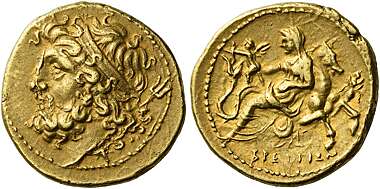
拍品 19. Drachm circa 213-205, AV 16 mm, 4.19 g. Bearded head of Poseidon l., wearing taenia, trident behind; below, bucranium. Rev. ΒΡΕΤΤΙΩΝ Hippocamp r. on which Amphitrite is seated l., holding Eros in extended r. hand, who stands l. drawing a bow; in r. field, ant. Scheu 1962, G 4a (this coin). BMC 2 var. (cornucopiae on reverse but this obverse die). de Luynes 652 var. (cornucopiae on reverse). Gulbenkian 118 var. (cornucopiae on reverse but this obverse die). Arslan p. 125, 2-3' (this coin listed). Historia Numorum Italy 1948. An extremely rare variety of a very rare type. Struck on a very large flan and complete, obverse with some die-breaks and from a rusty die, otherwise good very fine Ex Adolph Hess 89, 1902, 374; Egger 18, 1906, 29; Egger 40, 1912, Prowe part II, 218; Ars Classica VI, 1923, Bement (1843-1923), 255; Ars Classica XVI, 1933, 287 and Glendining 27-28 May 1936, 9 sales. Southern Italy's mountainous areas were home to several indigenous tribes, of which the Lucani were the most prominent. They started enslaving the Greek immigrants in the last part of the fifth century, and by 390 BC, they had imposed their Oscan language on the peninsula. The now-Oscanized indigenous inhabitants of the peninsula declared their independence in 356 BC and adopted the name Brettii. They became more and more Hellenised as they proceeded to conquer a number of Greek colonies along the coast. This coin is among the most beautiful Greek coins in terms of aesthetics. This Bruttian design, which is based on the Pyrrhic silver prototype that shows the sea-nymph Thetis on a hippocamp contemplating her son Achilles' shield, pairs Poseidon with his wife Amphitrite on the obverse and replaces the shield with an Eros. Because it replicated the principal motif of a Pyrrhic type, this piece was dated by the first scholars to approximately 282 BC. However, subsequent research has put this issue in the Second Punic War because it shares an engraver's mark with several Carthaginian silver issues. The obverse and reverse types are linked as an emblem of happy marriage, in this sense doubtlessly applicable to the alliance as between the two sea-powers of Carthage and the lesser Brettii; Poseidon and Amphitrite are themselves an ideal divine pair. The symbols in this issue are all indicative of loyalty, wealth and abundance. Please find here the video of the coin
  • 起拍价:
    4'000 CHF
    4'370 EUR
    3'643 GBP
    4'912 USD

    仅取整数近似值日期: 2026/11/05
拍品
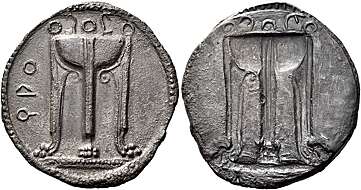
拍品 20. Nomos circa 530-520, AR 28 mm, 8.12 g. [koppa]PO Tripod. Rev. Same type incuse. SNG ANS 234. SNG Lockett 597. Historia Numorum Italy 2075. Dark tone and about extremely fine Ex Leu 36, 1985, 32 and NAC 7, 1994, 172 sales. Please find here the video of the coin
  • 起拍价:
    800 CHF
    874 EUR
    728 GBP
    982 USD

    仅取整数近似值日期: 2026/11/05
拍品
拍品 21. Nomos circa 380-350, AR 20 mm, 7.52 g. Head of Hera Lacinia facing three-quarters r., wearing stephane decorated with palmette flanked by two griffins; in r. field, Δ. Rev. KROTΩ Heracles seated l. on rock covered with lion's skin, holding cup in extended r. hand; above, club and bow. In l. field, tripod and in centre field, MΔ. SNG Copenhagen 1800. SNG ANS 382 (these dies). Historia Numorum Italy 2164. Rare and in unusually fine condition for the issue. Struck in high relief and with a lovely tone, a hairline flan-crack at ten o'clock on obverse, otherwise extremely fine / about extremely fine Ex Leu 54, 1992, 17 and NAC 6, 1993, 50 sales. Please find here the video of the coin
  • 起拍价:
    2'800 CHF
    3'059 EUR
    2'550 GBP
    3'438 USD

    仅取整数近似值日期: 2026/11/05
拍品
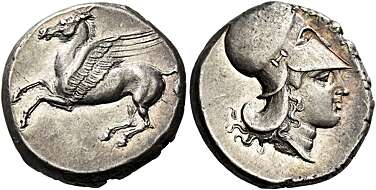
拍品 22. Corinthian stater circa 350-300, AR 20 mm, 8.62 g. Pegasus flying l. Rev. [Λ]Ο[Κ] Helmeted head of Athena r., wearing Corinthian helmet; behind, eagle's head r. SNG Ashmolean 1545. SNG ANS 509. Historia Numorum Italy 2340. Rare. Lovely iridescent tone and extremely fine Please find here the video of the coin
  • 起拍价:
    480 CHF
    524 EUR
    437 GBP
    589 USD

    仅取整数近似值日期: 2026/11/05
拍品
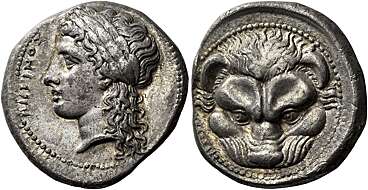
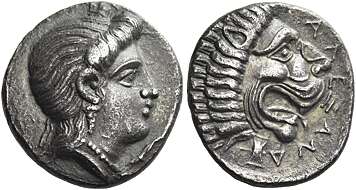
拍品 23. Tetradrachm circa 300-280, AR 26 mm, 16.69 g. PHΓINOΣ Laureate head of Apollo l., long hair falling in curls over neck. Rev. Lion's head facing. SNG ANS 676. Herzfelder 115bis. Historia Numorum Italy 2501. Very rare. A superb Hellenistic portrait of enchanting beauty, work of a very talented master engraver. Struck in high relief and with a lovely light iridescent tone. Good very fine / about extremely fine Ex NAC sale 6, 1993, 56. Perhaps during the 290s, but conceivably a decade before, Agathocles of Syracuse was involved in a poorly recorded campaign in Bruttium, in which he captured Hipponium and Croton. Given its enmity with Syracuse, which had burnt Rhegium nearly two centuries before, the city might be expected to have played some role in the conflict. Our coin seems closely related to certain issues from Syracuse and Punic Sicily, and moreover depicts the solar deity Apollo and a lion, which seem singularly appropriate to the typology favoured by the tyrants of the new Hellenistic world. These splendid dies could well have been engraved by the master who cut the best dies of the Agathocles Kore coinage, and those of the vastly rare Ptolemaic-type gold stater of the same ruler. Please find here the video of the coin
  • 起拍价:
    8'000 CHF
    8'740 EUR
    7'286 GBP
    9'824 USD

    仅取整数近似值日期: 2026/11/05
拍品
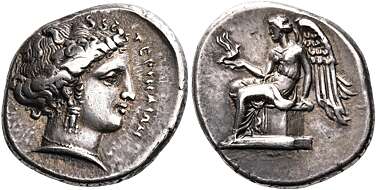
拍品 24. Nomos circa 380-360, AR 22 mm, 8.12 g. TEPINAIΩN Female head r., hair rendered in elaborate style, wearing earring and necklace. Rev. Nike seated on cippus l., holding a bird in r. hand and resting l. on cippus. Regling 83. Dewing 541. SNG ANS 852. Holloway-Jenkins 84 (this obverse die). Weber 1155 (these dies). Historia Numorum Italy 2629. Very rare. An elegant portrait of excellent style struck on a very large flan and with a lovely old cabinet tone. Minor areas of weakness on obverse, otherwise about extremely fine Ex Sotheby, Wilkinson & Hodge 15 June 1896, Sir Edward Herbert Bunbury (1811-1895), 242 (part of); Sotheby, Wilkinson & Hodge 3 February 1909, Frank Sherman Benson (1854-1907), 164; Hirsch XXIX, 1910, Jean P. Lambros (1843-1909), 67; Leu 30, 1982, 19; Morton & Eden 124, 2023, 71 and CNG 127, 2024, 17 sales. Please find here the video of the coin
  • 起拍价:
    6'000 CHF
    6'555 EUR
    5'464 GBP
    7'368 USD

    仅取整数近似值日期: 2026/11/05
拍品
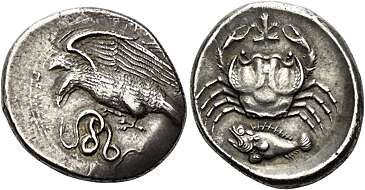
拍品 25. Didrachm circa 413-406, AR 24 mm, 8.66 g. [AKPAΓANTINON] Eagle standing l., with wings spread, attacking a coiled serpent held in its talons; behind, ΣTPA[TΩN]. Rev. Crab; above, a vine-leaf, and below, a fish l. Rizzo, pl. III, 2 (these dies). K. Schefold, Meisterwerke Griechische Kunst, 467 (this coin). Cahn, Kunstwerke der Antike, F53 (this coin). Jameson 512 (these dies) and 2416 (these dies). Kraay-Hirmer pl. 65, 182 (these dies). Gillet 357. AMB 262 (these dies). Gulbenkian 165 (these dies). SNG ANS 1001 (these dies). Westermark 602.3 (this coin). Extremely rare, only ten specimens known, of which only four are in private hands. An issue of exquisite style, the work of a very talented master engraver. Wonderful old cabinet tone and extremely fine Ex Hess/Leu 3, 1956, 65; Sotheby's 4 December 1990, Hunt (1926-2014), 22; New York XXVII, 2012, Prospero (1910-2001), 121 and NAC 116, 2019, Man in Love with Art part I, 40 sales. From the Käppeli collection. While Agrigentum had managed to remain neutral during the Sicilian Expedition of the Athenian fleet in 415-413 BC, in the aftermath of its failure a serious new threat began to emerge in the form of the Carthaginians. In 409 BC, a great Punic force attacked the neighbouring city of Selinous. Always ready to dispose of rivals, Agrigentum provided no military aid, but instead accepted its refugees, thereby adding to its population. Three years later, in 406 BC, the Carthaginians advanced to Agrigentum and besieged the city for eight long months, before it finally fell. The city was given over to plunder and all the inhabitants (who had not escaped to Gela and Leontinoi) were slaughtered in the streets. After spending the winter in the conquered city, the Carthaginian general Himilco ordered the destruction of Agrigentum. Nevertheless, under the terms of the Peace of Himilco that concluded the Punic advance in Sicily in 405 BC, Agrigentine refugees were permitted to return and rebuild their city as tributary subjects of Carthage. This didrachm may have been struck in order to finance the defence of Agrigentum by strengthening fortifications and hiring mercenaries. Indeed, we know from Diodorus Siculus that Agrigentum had employed a band of Spartan mercenaries at the time of the siege. Likewise, the additional but ultimately pointless military support provided by Dionysios I of Syracuse is not likely to have come cheaply. It is worth noting that when the present coin was produced, Agrigentum had not struck didrachms for almost fifty years, yet the types still adhered to the traditional model in which an eagle appears on the obverse and a crab on the reverse. The old didrachms depict a static bird with folded wings, whereas the late fifth-century issue features a dramatic scene in which an eagle spreads its wings as it attacks a coiled serpent. The crab on the present coin also features a more detailed carapace than the earlier type, and is accompanied by a remarkably lifelike representation of a grouper fish. Please find here the video of the coin
  • 起拍价:
    80'000 CHF
    87'406 EUR
    72'864 GBP
    98'241 USD

    仅取整数近似值日期: 2026/11/05
拍品
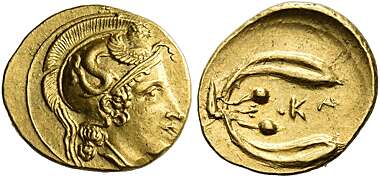
拍品 26. Diobol circa 405, AV 11 mm, 1.15 g. Head of Athena r., wearing crested Attic helmet decorated with hippocamp. Rev. KA Olive sprig with two berries. Raymond, The J. Pierpont Morgan Collection: Catalogue of Greek and Roman Coins, p. 6, 11 (this coin). SNG Lloyd 905. SNG ANS 1209. Westermark-Jenkin 206.11 (this coin). Extremely rare, especially considering most sold in auction over the last ten years are not genuine, and in unusually fine condition for the issue. Good extremely fine Ex Sangiorgi 15 April 1970, Strozzi (1810-1886), 1300; Hess-Leu 2 April 1958, 51; Hess-Leu 12-13 April 1962, 52 and Auktionen Münzhandlung Sonntag 34, 2021, 7 sales. From the J. Pierpont Morgan (1837-1913) collection. Graded Ch AU Strike 4/5 Surface 4/5, Fine style, NCG photo certificate number 8561097-006 Please find here the video of the coin
  • 起拍价:
    4'000 CHF
    4'370 EUR
    3'643 GBP
    4'912 USD

    仅取整数近似值日期: 2026/11/05
拍品
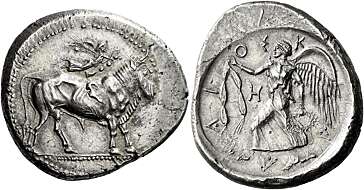
拍品 27. Tetradrachm circa 465-450, AR 30 mm, 17.18 g. The river-God Amenanos as bearded man-headed bull standing r.; above, flying Nike holding taenia r. Rev. K – A – T – A – N – AI – O – N retrograde Nike, wearing long chiton, striding l. and holding taenia in outstretched r. hand and wreath in l. hand; in inner l. field, H. Rizzo pl. IX, 6 (these dies). SNG Copenhagen 174 (this obverse die). Biucchi, ANS NS 18, 73. Extremely rare and in exceptional condition for the issue, possibly the finest specimen known. A very fascinating issue struck on fresh metal on an exceptionally large flan and with a light iridescent tone. An obverse of enchanting beauty, the work of a very skilled master-engraver, and a finely engraved reverse die. Absolutely insignificant areas of weakness, otherwise virtually as struck and almost Fdc Ex Roma Numismatics sale 5, 2013, 91. In c. 729 BC, Sicilian Naxos had become so populous that a body of colonists was dispatched to settle the site of Catana in the shadow of Mount Aetna. Over the course of the sixth and fifth centuries BC, the Catanians developed a reputation for moral uprightness through the famous examples of men like Charondas and the brothers Amphinomus and Anapius. The Pythagorean lawgiver Charondas composed excellent laws for the city entirely in verse, but then duly committed suicide after he unthinkingly walked into the assembly wearing his sword, thereby breaking one of his own laws. Amphinomus and Anapius, often described simply as "the Catanian Brothers," became popular symbols of filial piety after they carried their elderly parents on their shoulders in order to save them from an eruption of Mount Aetna. They later provided the model for Roman depictions of Aeneas carrying Anchises to safety from burning Troy. Despite the moral high ground occupied by Catana, the city was frequently challenged by the neighbouring city of Syracuse. Conflicts frequently arose due to the expansionist policies of Syracuse and its tyrants and the old ethnic feud between Chalcidian Greeks like the Catanians and Dorian Greeks like the Syracusans. Hiero I of Syracuse forced the Catanians to leave their city in 476 BC and gave it over to Dorian Greek colonists. The dispossessed Catanians returned to avenge themselves around 465 BC, violently expelling Hiero's settlers and reclaiming their homes. Nevertheless, as one might expect, the restored Catanians continued to nurse a grudge towards Syracuse and ultimately joined Leontini in supporting the disastrous Athenian expedition against Syracuse in 415-413 BC. This extremely rare tetradrachm was struck in the period immediately following the return of the Catanians to their original city and strongly illustrates their love of their homeland. On the obverse, the river Amenanos, which flows by Catana, appears in the guise of a man-headed bull in typical Greek Sicilian fashion while Silenus capers nearby as an indication of the wealth that accrued to the city from viticulture. The sea monster below alludes to Catania's location on the eastern coast of Sicily and its access to the Mediterranean Sea. In connection with the obverse type, it is tempting to understand the Nike on the reverse as an advertisement of the recent victory of the returning Catanians over the Syracusan interlopers in their city. On the other hand, Nike here might also merely belong to the general agonistic theme popular for coins struck by many Sicilian cities in the fifth century BC. Please find here the video of the coin
  • 起拍价:
    60'000 CHF
    65'554 EUR
    54'648 GBP
    73'681 USD

    仅取整数近似值日期: 2026/11/05
拍品
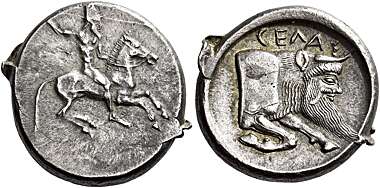
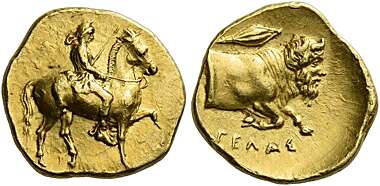
拍品 28. Didrachm circa 490/85-480/75, AR 21 mm, 8.63 g. Naked horseman r., hurling javelin from upraised r. hand. Rev. CEΛΑΣ Forepart of man-headed bull (the river-god Gelas) r. SNG Lockett 758 (these dies). Boston, MFA 242 (these dies). Jenkins, Gela 34A (this coin listed). Lovely old cabinet tone. Weakly struck on obverse, otherwise extremely fine Ex Hess-Leu 19, 1962, R.A. von Every, 58; Leu 15, 1976, 57; Sotheby's 19-20 June, 1991, Hunt (1926-2014) part IV, 63; CNG XXXIV, 1995, 22 and NAC 114, 2019, 39 sales. Please find here the video of the coin
  • 起拍价:
    2'000 CHF
    2'185 EUR
    1'821 GBP
    2'456 USD

    仅取整数近似值日期: 2026/11/05
拍品
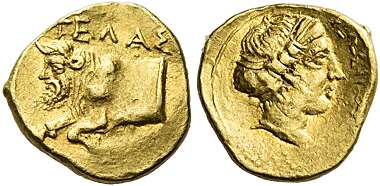
拍品 29. Dilitron circa 406-405, AV 12 mm, 1.73 g. Rider on horse pacing r., wearing chiton, Phrygian helmet and boots, holding in r. hand reins and in l. spear. Rev. ΓΕΛΑΣ Forepart of man-headed bull (the river-god Gelas) r.; above, barley grain. Rizzo pl. XIX, 6 (these dies). AMB 292 (this coin). Jenkins 490.4 (this coin). Of the highest rarity, only four specimens known of which only two are in private hands. A very interesting issue of excellent style perfectly struck and centred on a full flan. Extremely fine Ex Hess-Leu 27 March 1956, 100; NAC 13, 1998, formerly exhibited at Antike Musum Basel, 292 and NAC 114, 2019, 47 sales. From the Athos (1907-1993) and Dina Moretti, and Harald Salvesen (1928-2016) collections. Graded AU* Strike 5/5 Surface 4/5, Fine style, brushed, NCG photo certificate number 8561099-001 Despite the rising power of Syracuse as the fifth century progressed, Gela still retained much influence among the Greek cities of Sicily. In 415 B.C., a congress at Gela established an alliance that thwarted Athenian attempts to conquer the island and ultimately led to the destruction of the Athenians at the siege of Syracuse in 413 B.C. Thanks to Gela, the Greek cities of Sicily had weathered the storm and remained independent of the faltering Athenian Empire. Unfortunately, a new menace loomed on the horizon in the form of the Carthaginians. When a great Punic army marched against Agrigentum and destroyed it in 406 B.C., the Geloans gave refuge to the survivors. Knowing that their wealthy city would be the next target, the Geloans begged for assistance from Dionysios I, the ruling tyrant of Syracuse. The Carthaginians lay siege to Gela in 405 B.C. and probably would have taken the poorly fortified city immediately if not for the bravery of the defenders. The Geloans managed to hold out until Dionysios I arrived with an army, but when this was defeated they were forced to surrender the city to plunder and destruction by the Carthaginians, escaping with their families to Leontini. This gold dilitron was struck as an emergency issue in the dark days as the Punic noose began to tighten around Gela. Please find here the video of the coin
  • 起拍价:
    20'000 CHF
    21'851 EUR
    18'216 GBP
    24'560 USD

    仅取整数近似值日期: 2026/11/05
拍品
拍品 30. 1 1/3 litra circa 415-405, AV 11 mm, 1.13 g. ΓΕΛΑΣ Forepart of man-faced bull running l. Rev. ΣΩΣΙΠΟ[ΛΙΣ] Head of Sosipolis r., wearing sphendone. Pozzi 444 (this coin). McClean 2264 (these dies). AMB 494 (this obverse die). Jenkins, Gela 493.7 (this coin). Very rare. A pleasant specimen of this interesting and desirable issue. Minor areas of weakness, otherwise good very fine Ex Sambon-Canessa 24 March 1902, 10; Naville I, 1921, Pozzi (1846-1918), 444; Hess-Leu 28, 1965, 61; CNG 26, 1993, 23 and Busso-Peus 425, 2019, 219 sales. From the Aurum Graecum collection. Please find here the video of the coin
  • 起拍价:
    6'000 CHF
    6'555 EUR
    5'464 GBP
    7'368 USD

    仅取整数近似值日期: 2026/11/05
拍品
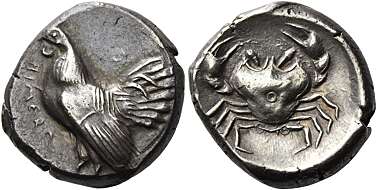
拍品 31. Didrachm circa 483-472, AR 20 mm, 8.57 g. HIMEPA Cock standing l. Rev. Crab. SNG München 53. SNG ANS 159 (these dies). Westermark, Himera, 52.2 (this coin). HGC 2, 438. Struck on excellent metal and with a wonderful light old cabinet tone. Extremely fine Ex Sotheby 19-20 June 1991, Bunker Hunt (1926-2014), 67; Schweizerischer Bankverein 35, 1994, 15; M&M Fixed Price List 584, 1995, 19; Künker 35, 1997, 69 and Nomos 19, 2019, 46 sales. From the Trausnitz collection. In the early years of the 5th Century B.C. Sicily was rife with conflict involving not only the competing indigenous and Greek powers, but also the Carthaginians, who for centuries had been present in the western part of the island. In the eastern part of Sicily, the Syracusan tyrant Gelon had successfully transformed his city and its dependencies into a regional power. As part of his efforts Gelon had allied himself with Theron, the tyrant of Acragas, on the southern coast of central Sicily. In 483 B.C., Theron captured Himera, a Greek settlement in central Sicily, though far to the north. The ousted tyrant of Himera, Terillus, along with Anaxilas of Rhegium, appealed to the Carthaginians for assistance. Though it took three years for them to commit and mobilise, the Carthaginians assembled a massive army and navy with which they hoped to liberate Himera and halt the brazen expansion of Syracusan-Acragantine authority so near their territories. In 480, the same year that the Persians led their second invasion of Greece, Carthaginians under the general Hamilcar besieged Himera. Theron, who led the defence of his newly acquired city, appealed to Gelon for aid. Gelon responded with a large relief force that proved critical in defeating the Carthaginian siege effort, though different accounts exist of the course of victory. Herodotus indicates there was a pitched battle in which the Greeks emerged victorious and forced Hamilcar to commit suicide. Diodorus offers a different and more detailed version in which the Syracusan ca- valry infiltrated the Carthaginian camps in the guise of friendly reinforcements from Selinus, allowing the Greeks to triumph in the fighting that followed. This monumental defeat ushered in an enduring period of Syracusan authority and peace with the Carthaginians, who were allowed to maintain their settlements in the West. It is in the context of these great events that the cock-crab didrachms of Himera are thought to have been struck – a theory that appears to be supported by hoard evidence. The conspicuous adoption of the crab as a reverse type at Himera has been seen as a reflection of Theron's intervention of 483, and of the conflict with Carthage that followed. The standing cock (which on earlier issues had been paired with reverse a punch die of the mill-sail pattern) clearly was a badge for Himera in the same way that the standing eagle was for Acragas. Both must have represented deities – the eagle of Acragas for Zeus, and the cock of Himera almost certainly for Asclepius, who likely was worshipped at the famous healing baths near the city. Please find here the video of the coin
  • 起拍价:
    2'800 CHF
    3'059 EUR
    2'550 GBP
    3'438 USD

    仅取整数近似值日期: 2026/11/05
拍品
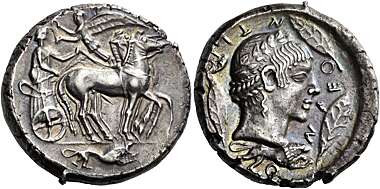
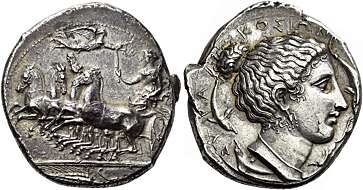
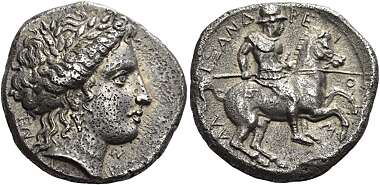
拍品 32. Tetradrachm of the Demareteion type circa 470, AR 28 mm, 17.10 g. Slow quadriga driven r. by charioteer holding kentron and reins; above Nike flying l. to crown him. In exergue, lion springing r. Rev. LEO – NTIN – O – N Laureate head of Apollo r.; hair plated behind the neck. Around, three laurel leaves; below neck truncation, lion springing r. Rizzo pl. XXII, 14 (these dies). SNG ANS 217 (these dies). Dewing 623 (these dies). Gulbenkian 211 (these dies)/ Biucchi, ANS NS 18, 88-89 (these dies). Rare and in exceptional condition for the issue, among the finest specimens in private hands. A portrait of fine Archaic style struck on superb metal and with a superb iridescent tone. Good extremely fine Ex Roma Numismatics sale 5, 2013, 79. In the late eighth century BC, colonists were dispatched from Sicilian Naxos to found Leontini near Mount Aetna. Unfortunately, political discord that developed in the new city over the course of the seventh century BC resulted in the establishment of a tyranny in ca. 608 BC. A certain Panaetius ruled as the tyrant in Leontini – the first tyrant ever to seize power in a Sicilian city. His success had the dubious result of inspiring many others to try their hands at tyranny in their own cities. While tyrannies largely ceased as a viable form of government in mainland Greece in the fifth century BC, they lived on much longer in Sicily, where they did not die out until the third century BC and the rise of Rome. Despite hosting the original Sicilian Greek tyranny, in the fifth century BC Leontini found itself under the domination of a series of foreign tyrants. In 496/5 BC, the city was conquered by Hippocrates, the tyrant of Gela, and in 476 BC, fell to Hieron I as the first tyrant of Syracuse. As part of his policy of population redistribution, the Syracusan tyrant emptied the cities of Naxos and Catana of their inhabitants and forcibly resettled them all at Leontini. Despite the obvious burdens that this must have placed on their city, the Leontines hosted their dispossessed fellow Chalcidian Greeks until 467 BC, when the death of Hieron I finally made it possible for the Naxians and Catanians to return to their original homes and Leontini again became an autonomous city free from Syracusan control. This beautiful tetradrachm was struck at Leontini during the period of Syracusan domination and may very well have been produced in connection with the expenses related to housing and feeding the refugees from Catana and Naxos. Perhaps not surprisingly, the types echo those used at Syracuse in the early fifth century BC. The slow quadriga is drawn directly from Syracusan tetradrachms struck under Hieron I while the head of Apollo is modelled on the Arethusa type of Syracuse. Just as the head of Arethusa is regularly encircled by four dolphins, here the head of Apollo is encircled by three laurel leaves. A lion (leon in Greek) has also been added to both the obverse and reverse to serve as a punning badge of the city and to visually advertise the identity of the issuing authority. Please find here the video of the coin
  • 起拍价:
    24'000 CHF
    26'221 EUR
    21'859 GBP
    29'472 USD

    仅取整数近似值日期: 2026/11/05
拍品
拍品 33. Tetradrachm circa 412-408, AR 28 mm, 17.24 g. The nymph Messana driving slow biga of mules l.; above, Nike flying r. and in exergue, two confronted dolphins. Rev. ΜΕΣΣΑΝΙΩΝ Hare springing r.; below, dolphin above waves. SNG Lloyd 1102 (these dies). SNG Locket 834 (these dies). Caccamo Caltabiano 619. Rare. Two finely engraved dies struck on a very large flan with a superb old cabinet tone. An insignificant area of weakness on obverse, otherwise about extremely fine / extremely fine Ex Bisman sale Rouen 28 October 2017, 23. One of the greatest cities of Sicily, Messana, had a long and turbulent history. Founded during the sixth century B.C. as Zankle, and named after its sickle-shaped harbour, the city enjoyed a burgeoning prosperity owing to its convenient position on the north-eastern coast of Sicily opposite the mainland town of Rhegion. Together the two cities controlled the flow of shipping through the Strait of Messina, and provided safe anchorage during unpredictable weather over the waters, as well as a place to rest and replenish before venturing further afield. The city's first coinage, in the name Zankle, was struck on the Euboic standard with a tridrachm stater weighing c.17.2 g. The obverse of these types featured a dolphin leaping within the sickle-shaped harbour, sometimes adorned with buildings, and on the reverse a patterned die with the central device of a scallop shell. This issue was short-lived, however, and was soon replaced by an Attic standard tetradrachm of Samian types, depicting a facing lion's scalp on the obverse and a prow on the reverse after the city was captured by Samian fugitives from Ionia fleeing the Persian onslaught in the wake of the Ionian Revolt. These fugitives had been invited by the local Zanklaians to join them in the colonisation of Kale Akte ("Beautiful Beach"), but had been encouraged in their duplicity by Anaxilas, the tyrant of Rhegion. It was not long however before Anaxilas tired of the Samians and drove them out of Zankle, settling a group of ethnically mixed followers in their stead and renaming the settlement Messene in honour of his ancestral home in the Peloponnese. With Messene under the political thumb of Anaxilas, the designs on the coinage were changed again. At first, they imitated the types found at Rhegion, a facing lion's head on the obverse and a calf's head on the reverse, but these were soon replaced by types that would remain a characteristic feature of the coinage of Messene: the muleteer driving a biga on the obverse, and a bounding hare on the reverse. The depiction of the muleteer served to advertise Anaxilas's victory at the apane (the mule race at the great Olympic festival) in either 484 or 480 B.C., whilst the hare depicted on the reverse was sacred to Pan, a god revered at both Rhegion and Messana. In 461 B.C. the city threw off the yoke of the Anaxilid tyrants, and soon took the Dorian name of Messana. With one brief interlude – an extremely rare tetradrachm issue depicting Zeus Ithomatas brandishing a thunderbolt on the obverse and a dolphin leaping over a scallop shell on the reverse, and also in the name of Zankle – the tetradrachms of Messana continued until the end of the fifth century B.C. with the types of the seated muleteer and springing hare. Around 425 B.C., the muleteer was replaced with the figure of the eponymous nymph Messana, shown standing and often being presented a fillet by the winged goddess of Victory, Nike, flying above. Please find here the video of the coin
  • 起拍价:
    4'800 CHF
    5'244 EUR
    4'371 GBP
    5'894 USD

    仅取整数近似值日期: 2026/11/05
拍品
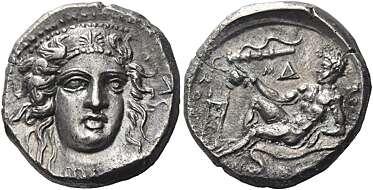
拍品 34. Chalcidian drachm circa 500, AR 18 mm, 5.92 g. Ivy-wreathed head of Dionysus l., with pointed beard and hair in form of dots, falling in waves over neck. Rev. NAXION Bunch of grapes hanging from stalk between two leaves. SNG ANS 514. BMC 2. SNG Lockett 838. Cahn, Naxos 36. Very rare. A magnificent portrait in the finest Archaic style struck on unusually good metal and with a superb old cabinet tone. A minor area of weakness on reverse, otherwise about extremely fine Ex M&M 53, 1977, 29; Spink & Son 20, 1986, 85 and M&M GmbH 49, 2020, 70 sales. The coinage of Naxos is especially useful as a guide to Greek art style on coinage down to about 400 B.C. The four major issues present different styles of art - a feature unequalled in so compact a manner at any other Greek mint. This first issue is fully Archaic, the second, attributed to the Aetna Master, combines the qualities of the late Archaic and the early Classical, the third is fully Classical, and the fourth offers a significantly different version of a familiar composition, as Dionysus is shown as an effeminate young man with his hair drawn into a bun at the nape of the neck. It is hard to imagine a more perfect male head of the Archaic age than the one on this early coin of Naxos. It compares so favourably with Athenian Black Figure paintings of c. 575-525 B.C. (especially works of the Heidelberg Painter), that we must consider them to be a source of inspiration for this engraver. We should also see this coin as an archaising effort, as naturalism of form had already begun to find its place in Greek art by the time this coin was struck. The viewer's attention is drawn to the eye, mouth, nose and cheek of Dionysus, as they are perfectly rendered and framed by the roughly hewn hair and spearlike beard. The reverse is interesting for its comparative simplicity: an ideal composition is achieved with the grape cluster and the peripheral decoration of the vine, leaves and ethnic. By representing the grapes in full, yet the grape leaves only in outline, the engraver has added an arresting twist to his design. Please find here the video of the coin
  • 起拍价:
    24'000 CHF
    26'221 EUR
    21'859 GBP
    29'472 USD

    仅取整数近似值日期: 2026/11/05
拍品
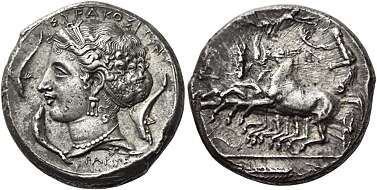
拍品 35. Tetradrachm after 409, AR 26 mm, 16.90 g. zyz Fast quadriga r., charioteer crowned by Nike flying l. above; in exergue, hippocamp r. Rev. Head of Tanit l., wearing earrings and necklace; around, four dolphins. Rizzo pl. LXIV, 28 (these dies). SNG lloyd 1584 (these dies). de Luynes 1084 (these dies). Jenkins, Punic part 1, 33 (this coin cited). Very rare and in unusual condition for the issue. A very interesting and unusual portrait inspired by the Syracuse decadrachm engraved by Kimon. Struck on fresh metal and with a lovely old cabinet tone. Good very fine Ex Naville IV, 1922, 290; Vinchon 29 April 1974, Peyrefitte, 24; UBS 52, 2001, 20 and Ira & Larry Goldberg 106, 2018, 1023 sales. From the Lee Rousseau collection. Please find here the video of the coin
  • 起拍价:
    4'000 CHF
    4'370 EUR
    3'643 GBP
    4'912 USD

    仅取整数近似值日期: 2026/11/05
拍品
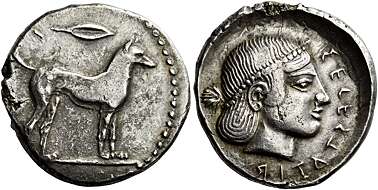
拍品 36. Didrachm circa 455-440, AR 24 mm, 8.86 g. Hound standing r.; above, barley corn. Rev. ΣΕΓΕΣΤΑΖΙΒ retrograde Head of Aigiste r. Rizzo pl. 61, 9 rev. (this coin). Hurter 77a (this coin). AMB 400 (this coin). HGC 2, 1128. Rare. Struck on an exceptionally large flan and unusually complete for the issue. light old cabinet tone, minor area of weakness on obverse, otherwise about extremely fine Ex NAC 13, 1998, formerly exhibited at the Antikenmuseum Basel, 400 and Hirsch 355, 2020, 1608 sales. From the Athos (1907-1993) and Dina Moretti collection. Please find here the video of the coin
  • 起拍价:
    2'400 CHF
    2'622 EUR
    2'185 GBP
    2'947 USD

    仅取整数近似值日期: 2026/11/05
拍品
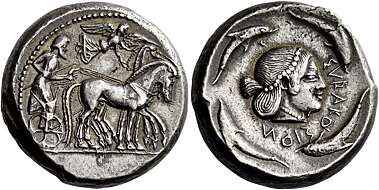
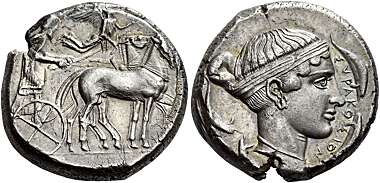
拍品 37. Tetradrachm circa 480-475, AR 25 mm, 17.32 g. Slow quadriga driven r. by charioteer, holding kentron and reins; above, Nike flying r. to crown horses. Rev. SVRAKO - ΣION Head of nymph Arethusa r., wearing pearl diadem, earring and necklace; around, four dolphins swimming clockwise. SNG ANS 43 (these dies). Randazzo 325 (this coin). Boehringer 154. Well struck in high relief with a delightful iridescent tone, extremely fine Ex Sotheby 25 October 1993, 12; Gemini V, 2009, 345; NAC 54, 2010, 51 and Gemini XII, 2015, 43 sales. From the John D. Leggett, Jr. collection. (1906-1995). (Ex ANS 1997.9.21) Please find here the video of the coin
  • 起拍价:
    4'000 CHF
    4'370 EUR
    3'643 GBP
    4'912 USD

    仅取整数近似值日期: 2026/11/05
拍品
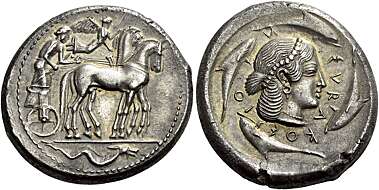
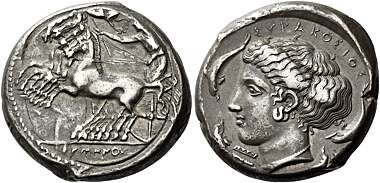
拍品 38. Tetradrachm circa 466-450, AR 27 mm, 17.26 g. Charioteer driving slow quadriga r., holding kentron and reins; above, Nike flying r. to crown horses and in exergue, ketos swimming r. Rev. ΣVRAKOΣION Head of nymph Arethusa r., wearing pearl diadem, hoop earring and pearl necklace; around, four dolphins swimming clockwise. Pozzi 573 (this reverse die). Boehringer 413. SNG ANS –. HGC 2, 1309. A portrait of fine style struck on an exceptionally large flan with a lovely light tone. Good extremely fine Ex Tkalec 28 February 2013, 25; Lanz 156, 2013, 57; Rauch 98, 2015, 34; NGSA 16, 2022, 12 and Nomos 32, 2024, 361 sales. Graded Ch AU* Strike 5/5 Surface 4/5, NCG photo certificate number 8561100-002 Please find here the video of the coin
  • 起拍价:
    12'000 CHF
    13'110 EUR
    10'929 GBP
    14'736 USD

    仅取整数近似值日期: 2026/11/05
拍品
拍品 39. Tetradrachm circa 450-440, AR 27 mm, 17.27 g. Charioteer driving slow quadriga r., above, Nike flying r., crowning horses with wreath. In exergue, sea-monster swimming r. Rev. ΣVPA-KO-ΣI-O-N Diademed head of nymph Arethusa r., wearing earrings and necklace; around, four dolphins. Boston, MFA 372 (these dies). SNG Lockett 936 (these dies). AMB 439 (these dies). Boehringer 533. In unusually fine condition for the issue and among the finest specimens in private hands. A portrait of excellent style struck in high relief on excellent metal. Wonderful old cabinet tone, obverse slightly centre and, as usual for this issue, from a rusty die, otherwise extremely fine / good extremely fine Ex M&M 32, 1966, 54; UBS 45, 1998, 148 and CNG e-409, 2017, 48 sales. Please find here the video of the coin
  • 起拍价:
    6'000 CHF
    6'555 EUR
    5'464 GBP
    7'368 USD

    仅取整数近似值日期: 2026/11/05
拍品
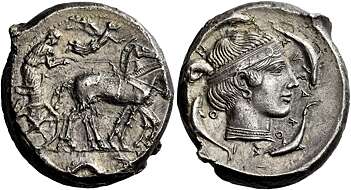
拍品 40. Tetradrachm circa 430-420, AR 25 mm, 17.30 g. Charioteer, wearing a long chiton and holding a kentron and reins, driving a quadriga r.; above, Nike flying r. to crown the horses. Rev. ΣVPAKOΣION Head of nymph Arethusa r., her hair tied with a taenia, wearing earring and necklace; around, four dolphins. AMB 446 (these dies). SNG Lockett 950 (these dies). Jameson 770 (these dies). SNG ANS 203 (these dies). Boehringer 634. Rare and in exceptional condition for the issue, among the finest specimens in private hands. Of lovely style and struck on a very fresh metal. Wonderful iridescent tone, obverse, as usual for this issue, slightly off-centre, otherwise extremely fine Ex Sternberg XX, 1988, 367; New York XXX, 2013, 41 and Maison Palombo 21, 2023, 15 sales. Please find here the video of the coin
  • 起拍价:
    10'000 CHF
    10'925 EUR
    9'108 GBP
    12'280 USD

    仅取整数近似值日期: 2026/11/05
拍品
拍品 41. Tetradrachm signed by Eumenos and Eukleidas circa 415-410, AR 26 mm, 17.32 g. Prancing quadriga driven l. by clean-shaven charioteer, wearing long chiton and leaning forward to restrain horses, while holding kentron and reins; above, Nike flying r. to crown him. In exergue, EVMHNOV. Rev. ΣVPAKOΣIOΣ Head of nymph Arethusa l. wearing earring and necklace; hair caught up at back of head and styled in waves above the brow. Beneath chin, diptych with tablet inscribed EVKΛ. At either side of head, two pairs of dolphins snout to snout. Rizzo pl. XLII, 13 (these dies), reverse enlarged pl. XLVI, 1 (this reverse die). Boston, MFA 401 (this coin). Kraay-Hirmer pl. 32, 99 (this reverse die) and 100 (this obverse die). Tudeer 24. Coins, Artists and Tyrants 24b (this coin). Very rare. A masterpiece of early classical style signed by two celebrated master-engravers. Magnificent old cabinet tone, obverse slightly off-centre and from a worn die, otherwise good very fine / about extremely fine Ex Leu 20, 1978, 45; NAC 77, 2014, 12; Stack's 2018, 2013 and NAC Spring 2020, 153 sales. From the David Walsh collection and the duplicates of the Boston Museum of Fine Arts. Please find here the video of the coin
  • 起拍价:
    10'000 CHF
    10'925 EUR
    9'108 GBP
    12'280 USD

    仅取整数近似值日期: 2026/11/05
拍品
拍品 42. Tetradrachm, unsigned but attributed to Eukleidas circa 413-399, AR 26 mm, 17.01 g. Driving fast quadriga driven by charioteer l; above, Nike flying r. crowning him. In exergue, barley ear. Rev. [ΣΥΡΑΚΟΣΙΩ]Ν Head of nymph Arethusa r.; behind, retrograde K. Around, four dolphins. BMC 222 (these dies). Tudeer 64. Gillet 633 (this coin). Coins, Artists and Tyrants 64b (this coin). Exceedingly rare, only three specimens listed by Fisher-Bossert. A portrait of enchanting beauty, the work of a talented and celebrated master-engraver. Delicate old cabinet tone, the die-break on reverse at a very early stage, otherwise very fine / good very fine Ex Schlessinger 13, 1935, duplicates of Hermitage Museum, 359 and Morton & Eden 100, 2019, 216 sales. From the Charles Gillet (1879-1972) collection. Please find here the video of the coin
  • 起拍价:
    4'000 CHF
    4'370 EUR
    3'643 GBP
    4'912 USD

    仅取整数近似值日期: 2026/11/05
拍品
拍品 43. Tetradrachm, in the style of Eukleidas, circa 405, AR 24 mm, 17.51 g. Fast quadriga driven l. by charioteer, holding kentron in r. hand and reins in both; above, Nike flying r., crowning him; in exergue, dolphin r. Rev. [ΣY] – PAK – OΣ – IΩ – [И] Head of Arethusa l., hair in bands, wearing double-loop earring and plain necklace with frontal pendant; and four dolphins around. Rizzo pl. XLVIIII, 15. SNG Lloyd 1405 (these dies). SNG Fitzwilliam 1253 (these dies). Tudeer 96. Coins, Artists and Tyrants 96f (this coin). Rare and in exceptional condition for the issue. Struck on exceptionally good metal and with a delightful old cabinet tone. Good extremely fine Ex Sotheby, Wilkinson & Hodge 28 May 1900, 146; NFA-Leu 16 October 1984, Garrett part II, 137; Sotheby's 5 July 1995, Two Hundred Important Greek and Roman coins, 28 and NAC 106, 2018, 199 sales. Privately purchased from W. Raymond on 1st January 1923. Please find here the video of the coin
  • 起拍价:
    12'000 CHF
    13'110 EUR
    10'929 GBP
    14'736 USD

    仅取整数近似值日期: 2026/11/05
拍品
拍品 44. Tetradrachm, unsigned dies in style of Eukleidas circa 405, AR 28 mm, 17.28 g. Fast quadriga driven l. by female charioteer holding reins in l. hand and torch in raised r.; in field above, Nike flying r. to crown her. In exergue, ear of barley. Rev. ΣΥ – ΡΑΚΟΣΙΩΝ Head of nymph Arethusa r., hair brought up to crown of head and tied, forming a tuft of loose strands, wearing triple-pendant earring and necklace with pendant. Around, four dolphins. Rizzo pl. XLVII, 8 (these dies) and reverse enlarged pl. XIX, 6 (this die). Gulbenkian 284 (these dies). AMB 466 (this coin). Tudeer 62. SNG Lloyd 1385 (these dies). Coins, Artists and Tyrants 62h (this coin). Very rare and in exceptional condition for the issue, among the finest specimens known. An interesting and unusual portrait of Arethusa of excellent style struck on a very fresh metal and with a light iridescent tone. Almost invisible traces of over-striking on reverse, otherwise good extremely fine Ex NAC 13, 1998, formerly exhibited at the Antikenmuseum Basel, 466; NGSA 5, 2008, 42; NGSA 9, 2015, 16 and CNG XX, 2017, 74 sales. From the Athos (1907-1993) and Dina Moretti collection. This tetradrachm is a tour de force from the greatest age of creativity at the Syracuse mint. Though the portrait on the reverse is a sublime masterpiece, it is the obverse that demands our attention, for it is perhaps the most daring and inventive of all chariot scenes produced at Syracuse. Only about a decade before these dies were cut, the chariot scene on Syracusan tetradrachms had evolved from a sombre, canonical depiction inspired by an Attic vase painting into an explosive scene in which the horses were shown in high action. With this innovation the scene was shown at a slight angle so the artist could dwell on the physiognomies of the horses and could show the chariot with a new perspective. The style of the chariot scene in the century prior to these innovations was formulaic: though the position of the Nike varied, the chariot was shown in profile, with only the slight overlapping of the horses and the separation of their heads to indicate that more than one was present. Very few dies from that initial century diverged even slightly from the standard formula (see Boehringer dies V45, V107, V286, V291, V326), with the work of a single artist in about 440 B.C. (Boehringer dies Boeh. V295 and V296) being noteworthy, if not especially accomplished. Once we enter this dynamic period of about 415 to 385 B.C., some extraordinarily talented artists energised Syracusan coins with a level of innovation that had never been seen. Not surprisingly, several of these artists signed their dies and produced works that were influential far beyond the shores of Sicily. Leading the way was Euainetos, who seems to have been the first to express complete freedom in the way he depicted the chariot at an angle, as if it was turning the bend (Tudeer die 10). This particular die, Tudeer die 21, takes Euainetos' inventiveness to a new level by adding unexpected elements to the scene. Here we have a snapshot of a calamity: one of the reins has been pulled from the driver's hand and the horses trample upon a wheel that has broken away from a competing chariot. The fact that our charioteer is being crowned by Nike is all the confirmation we need that he and his team emerged victorious - at the expense of a competitor whose chariot overturned in close proximity. Please find here the video of the coin
  • 起拍价:
    28'000 CHF
    30'592 EUR
    25'502 GBP
    34'384 USD

    仅取整数近似值日期: 2026/11/05
拍品
拍品 45. Tetradrachm signed by Parmenides circa 405-400, AR 25 mm, 17.16 g. Fast quadriga, about to turn l., driven l. by charioteer holding kentron and reins; in field above, Nike flying r. to crown him. Beneath the hooves of the foreground horse, a wheel; in exergue, barley ear l. Rev. ΣΥ – ΡAKOΣIΩN Head of the nymph Arethusa l., wearing ampyx and sphendone decorated with stars, triple-pendant earring and necklace. Around, three dolphins, a fourth emerging from neck truncation. Below, ΠΑΡΜΕ. Jameson 836 (these dies). AMB 472 (these dies). SNG Lockett 976 (these dies). Boston, MFA 416 (these dies). SNG ANS 287 (these dies). Tudeer 77. Coins, Artists and Tyrants 77. Very rare and in unusually fine condition. Obverse, as usual for this issue, from a worn die. Minor areas of oxidation, otherwise about extremely fine / extremely fine Ex Bertolami Fine Arts 15, 2015, 90 and NAC 134, 2022, 199 sales. This tetradrachm belongs to the most celebrated period of Syracusan numismatic art - the period of the signing artists (ca. 413-400 B.C.). During this period, a large new series of tetradrachms was struck from silver captured from the Athenians following their unsuccessful siege of Syracuse and especially from ransom payments made to repatriate about 2,300 Athenian hoplites who had survived the debacle – captured by the Syracusans and imprisoned under awful circumstances in the city's stone quarry. The Athenian money was melted down and re-struck as a new, celebratory tetradrachm series featuring a racing quadriga on the obverse and the head of Arethusa, the patron nymph of Syracuse, on the reverse. Some of the best artists in Sicily produced dies for this new coinage. Filled with pride in their work, which often pushed the boundaries of Classical Greek numismatic representations and involved artistic experimentation, many of the artists signed their dies. This particular coin is a rarity for the period in that the Arethusa die is not signed with the artist's name, but instead features the small head of a satyr beneath the neck truncation. This may have been the personal emblem of the artist, or perhaps a pun on his name. The obverse type is the usual racing chariot that was traditional for Syracusan coinage, going back to the second quarter of the fifth century B.C., but now infused with a dynamism not seen before. Whereas the horses of earlier chariots were arranged one on top of each other in cookie-cutter fashion, here each horse is an individual, each with its own distinct leg and head positions. The potential monotony of four horses heads in a row is skilfully alleviated by turning the head of the third horse from the right, which is also associated with a broken rein that trails below. Through these small but important details, the die engraver draws us into the exciting story of the race. Please find here the video of the coin
  • 起拍价:
    8'000 CHF
    8'740 EUR
    7'286 GBP
    9'824 USD

    仅取整数近似值日期: 2026/11/05
拍品
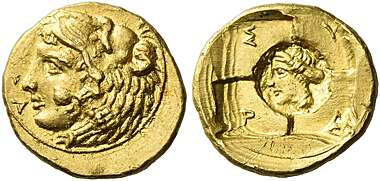
拍品 46. Tetradrachm or 20 litrae circa 405-400, AV 11 mm, 1.15 g. [ΣY]PA Head of Heracles l., wearing lion's skin headdress. Rev. Quadripartite incuse square, Σ –Y – P – A in quarters; in deeper incuse circle in centre, small female head (Arethusa?) l., wearing necklace. Bérend pl. VIII, 5. Boehringer, Münzprägungen, pl. I, 6. Boehringer, Finanzpolitik pl. 38, 13. SNG ANS 355. Good extremely fine Ex Roma Numismatics 2, 2011, 83 and Triton XVI, 2013, 229 sales. Please find here the video of the coin
  • 起拍价:
    4'000 CHF
    4'370 EUR
    3'643 GBP
    4'912 USD

    仅取整数近似值日期: 2026/11/05
拍品
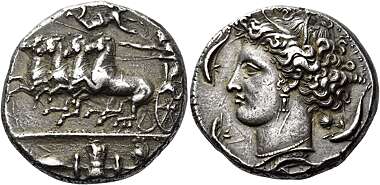
拍品 47. Decadrachm unsigned work by Euainetos circa 400, AR 35 mm, 43.27 g. Fast quadriga driven l. by charioteer, holding reins and kentron; in field above, Nike flying r. to crown him. In exergue, display of military harness set on two steps and below l., [AΘΛA]. Rev. [ΣY – PA – K – O] – ΣΙΩΝ Head of nymph Arethusa (Kore- Persephone) l., wearing barley-wreath, triple pendant earring and beaded necklace; behind, scallop shell. Around three dolphins, while a fourth makes dorsal contact with neck truncation. Regling, Sammlung Warren 359 (these dies). SNG ANS 372 (these dies). Gallatin E. I / R. XI, 8 (this coin). A very attractive specimen of this prestigious and desirable issue. Struck in high relief and with a magnificent old cabinet tone, about extremely fine Ex Hirsch XXXII, 1912, Virzi, 325; Naville IV, 1922, Alexandre Michailovitch, 365; NGSA 4, 2006, 50 and NAC 110, 2018, 12 sales. From the Gustav Philipsen (1853-1925) collection. Coins of the artist Euainetos are among the most exquisite works of art from the ancient Greek world. Of special value are his decadrachms, which must have been distributed widely, for they were influential to artists in regions far removed from the shores of Sicily. It is unlikely that many were exported through the normal channels of commerce, and we might suggest that, much like the staters of Olympia, some were acquired as keepsakes and were carried to a variety of destinations. The decadrachms of Kimon and Euainetos were introduced early in the reign of the tyrant Dionysius I (405-367 B.C.), and those of Euainetos continued to be struck for decades, perhaps even beyond the 360s. We might presume that Dionysius took a personal interest in producing such large coins of fine style to evince his patronage of the arts and to promote the success of his rule. There is also good reason to believe that after Euainetos' initial contributions, die cutting for the series was eventually carried out by understudies and successors. In some cases, Euainetos' signature appears to have been retained as a fixed element of the design until about midway through, when it was lost altogether. In general, these understudies meticulously copied the work of the master engraver. Gallatin notes that the entire series "...shows a most amazing repetition of the details of the arrangement of the hair, locks and curls being slavishly repeated". Though a precise context has not been convincingly established for the Syracusan decadrachms of Kimon and Euainetos, it is tempting to associate their introduction with a military victory. The display of armour and weaponry that appears in the exergue is militant, and the inscription AΘΛA, which indicates prizes, for at least agonistic contests, only adds to that prospect. Since it was a common practice of Greek soldiers to engrave dedicatory inscriptions on captured armour, a connection might be drawn between that phenomenon and what is presented on the decadrachms. The obverse also appears to allude to victory with its vivid scene of a charioteer guiding his team through a bend. Please find here the video of the coin
  • 起拍价:
    24'000 CHF
    26'221 EUR
    21'859 GBP
    29'472 USD

    仅取整数近似值日期: 2026/11/05
拍品
拍品 48. Decadrachm or 50 litrae circa 400, AV 11 mm, 2.90 g. ΣYPA Young male head l. (the river-god Anapos?); behind, barley grain. Rev. Horse prancing r.; above, star. de Ciccio 60 (these dies). SNG Lockett 986 (these dies). SNG Lloyd 1424 (these dies). SNG ANS 348 (these dies). Bérend, Denyse I, 12.15 (this coin). In exceptional condition for the issue. Obverse, as usual for this issue, from a rusty die. Good extremely fine Ex Santamaria 24-28 February 1958, 1008 and Gorny & Mosch 244, 2017, 94 sales. From the Conte Brunacci collection. Graded Ch AU* Strike 5/5 Surface 4/5, brushed, NCG photo certificate number 8561098-011 Please find here the video of the coin
  • 起拍价:
    4'000 CHF
    4'370 EUR
    3'643 GBP
    4'912 USD

    仅取整数近似值日期: 2026/11/05
拍品
拍品 49. Drachm or half stater circa 317-310, AV 16 mm, 4.26 g. Laureate head of Apollo l. Rev. ΣΥΡ – Α – Κ[Ο] – ΣΙΩΝ Prancing biga driven r. by charioteer holding reins and kentron; below, triskeles. Bérend, Studies Price, pl. 9, 1. SNG München 1191. SNG ANS 549. Dewing 935. About extremely fine Ex Triton X, 2002, 1233 and Triton XXIII, 2020, 139 sales. From the Weise collection. Please find here the video of the coin
  • 起拍价:
    2'400 CHF
    2'622 EUR
    2'185 GBP
    2'947 USD

    仅取整数近似值日期: 2026/11/05
拍品
拍品 50. 25 litrae circa 317-289, EL 15 mm, 3.57 g. Laureate head of Apollo l.; behind, amphora. Rev. ΣΥΡΑΚ – ΟΣΙΩΝ Tripod. de Luynes 1627 (this obverse die). SNG ANS 621 (this obverse die). BAR Issue 10. Jenkins, Essays Robinson, Group B. Extremely fine Please find here the video of the coin
  • 起拍价:
    2'000 CHF
    2'185 EUR
    1'821 GBP
    2'456 USD

    仅取整数近似值日期: 2026/11/05
拍品
拍品 51. Stater struck under Pyrrhus circa 278-276, AV 20 mm, 8.54 g. Head of Athena r., wearing triple-crested Corinthian helmet, bowl decorated with pegasus, triple-pendant earring and pearl necklace; behind, owl and beneath neck truncation, A. Rev. BAΣIΛEΩΣ – ΠYPPOY Nike alighting l., holding oak wreath in her r. hand and a trophy in her l.; at her feet, on l., bucranium. BMC 1 and pl. XX, 7 (these dies). Jameson 1124 (these dies). Gulbenkian 910 (this obverse die). Kraay-Hirmer pl. 151, 475 (these dies). AMB 522 (this coin). Buttrey, NC 1973, pl. 2, 42 (these dies). HGC 3.1, 259. Extremely rare and among the finest specimens in private hands. An interesting and fascinating issue with a lovely portrait of excellent style and a finely engraved reverse composition. Wonderful reddish tone, absolutely unobtrusive marks on reverse field, otherwise extremely fine Ex NAC 13, 1998, formerly exhibited at the Antikenmuseum Basel, 522 and Heritage 3089, 2021, 31012 sales. From the Athos (1907-1993) and Dina Moretti, and Penn collections. Graded Ch AU Strike 5/5 Surface 3/5, Fine Style, marks, NCG certificate number 4241981-004 (previously graded and no longer in holder) In 280 BC, Pyrrhus of Epirus accepted the request of Tarentum to defend it and the other cities of Magna Graecia from the expanding power of Rome. The Epirote king defeated the Romans at both Herakleia (280 BC) and at Asculum (279 BC), but at such high cost that it became clear his army would soon be destroyed. In 278 BC, while considering his options, the Syracusans begged him to come and fight the Carthaginians who had always been at war with the Greek cities for control of Sicily. As a break from the problematic Roman war, Pyrrhus accepted this diversion and was so successful that by 277 BC he had all but driven the Carthaginians from the island and claimed the title King of Sicily. All that remained was to expel the Punic garrison from Lilybaeum, but because of its location, the only means was through a naval blockade. To obtain the necessary ships, Pyrrhus required money from the Greek cities to build and man a proper fleet. When they balked at this, Pyrrhus imposed his own garrisons. This development immediately destroyed the king's previous popularity in Sicily and the Greek cities began negotiating with the Carthaginians against him. Realising that Sicily would be nothing but trouble to rule, Pyrrhus inflicted one further defeat on a new Punic army and then returned to Italy for a second round against the Romans. This stunning gold stater was struck at Syracuse in the context of Pyrrhus' wars against the Carthaginians. It is a true work of art, having taken the standard Athena and Nike types introduced by Alexander the Great in c. 334 BC, and run with the high Hellenistic sculptural style and the manipulation of the details specific to Pyrrhus. Whereas a fairly stiff Nike usually proffers the laurel wreath of victory on traditional Alexandrine staters, here she holds the oak wreath of Zeus. This is a specific reference to the Epirote kingdom and its famous oracular shrine of Zeus at Dodona, and is in keeping with other issues struck at Syracuse during Pyrrhus' Sicilian campaigns which feature reverse types surrounded by oak wreaths. Likewise, whilst Nike usually carries a stylus indicative of naval victory on Alexandrine staters, here she carries a trophy that directly refers to Pyrrhus' Italian campaign. The trophy includes a distinctive oblong shield which can hardly be anything but the scutum shield regularly used by Roman soldiers ever since they adopted it from the Gauls in the fourth century BC. The obverse head of Athena also represents an artistic leap forward from the basic design of Alexander's staters, with increased modelling of the face and the addition of new details, like the tiny owl behind her head and the hound decorating the bowl of her helmet. As with the modifications to the Alexandrine reverse type, the hound also represents a means of advertising Pyrrhus and his Epirote origin. The helmet of Athena on standard Alexandrine staters is usually decorated with a coiled serpent, a griffin, sphinx, or bird, but here we find a hound. This almost certainly refers to the Epirote district of Molossis, which was famous for the hunting dogs bred there. Please find here the video of the coin
  • 起拍价:
    60'000 CHF
    65'554 EUR
    54'648 GBP
    73'681 USD

    仅取整数近似值日期: 2026/11/05
拍品
拍品 52. Hemistater, struck under Pyrrhus circa 278-276, AV 17 mm, 4.23 g. Draped bust of Artemis r., quiver over shoulder; in r. field, torch. Rev. BAΣIΛEΩΣ – ΠYPPOY Nike alighting l., holding oak wreath in her r. hand and a trophy in her l.; in lower l. field, thunderbolt. BMC 2 and pl. XX, 8 (these dies). Rutter, Greek Coinages of Southern Italy and Sicily, 205. Jameson 1125 (these dies). Boston, MFA –. SNG Delepierre –. Extremely rare, one of very few specimens known and among the finest in private hands. An interesting and unusual portrait struck on a very broad flan. About extremely fine Ex Hess 12 March 1906, Duplicates of the Berlin Münzkabinett, 458; Egger XL, 1912, Prowe, 855 and Leu Numismatik Winterthur 7, 2020, 1135 sales. From the Gustav Adolf von Rauch (1805-1877) and Peyrefitte (1907-2000) collections. In 280 BC, Pyrrhus of Epirus accepted the request of Tarentum to defend it and the other cities of Magna Graecia from the expanding power of Rome. The Epirote king defeated the Romans at both Heraclea (280 BC) and Asculum (279 BC), but at such high cost that he is said to have remarked, ”If we are victorious in one more battle with the Romans, we shall be utterly ruined.” Ever since then, victories won at exceedingly high cost have been known as ”Pyrrhic victories.” In 278 BC, while considering his options for continuing the war against the Romans, the Syracusans begged him to come and fight the Carthaginians, who again threatened the freedom of the Greek cities of Sicily. As a break from the problematic Roman situation, Pyrrhos accepted this diversion and was so successful that by 277 BC, he had almost entirely expelled the Carthaginians from the island and claimed the title of King of Sicily for himself. All that remained was to drive the Punic garrison from Lilybaeum. Unfortunately, because of its heavily fortified location, the only way to do this was through a naval blockade, and the only way to obtain the ships for the blockade was to collect money from the Greek cities to build and man a proper fleet. When the cities balked at this necessity, Pyrrhus imposed his own garrisons. This development immediately destroyed the king’s previous popularity in Sicily, and the Greek cities began negotiating with the Carthaginians against him! Realizing that Sicily would be nothing but trouble to rule, Pyrrhus inflicted one further defeat on a new Punic army and then returned to Italy for a second round against the Romans. This impressive gold hemistater was struck at Syracuse during Pyrrhos’ wars against the Carthaginians, possibly using metal plundered from the enemy. It is a true work of art in the way that it has modified the types of the gold stater popularized by Alexander the Great. Whereas Alexander’s imperial stater (and the stater of Pyrrhus struck in parallel with the present hemidrachm) featured the head of Athena on the obverse, she is here replaced by Artemis, an important goddess at Syracuse. Leto is said to have given birth to Artemis on the Syracusan island of Ortygia, which became the site of an Ionic temple dedicted to the goddess in the sixth century BC. Like Alexander’s and Phyrrus’ staters, the present hemistater features the figure of Nike on the rreverse. However, unlike the somewhat stiff Alexandrine model who proffers the laurel wreath of victory, here Nike holds the oak wreath of Zeus. This is a specific reference to the Epirote kingdom and its famous oracular shrine of Zeus at Dodona.  Other issues struck at Syracuse during Pyrrhus’ Sicilian campaigns also feature reverse types surrounded by oak wreaths, alluding to their connection to the king of Epirus. Likewise, while Nike usually carries a stylus indicative of naval victory on Alexandrine staters, here she carries a trophy that directly refers to Pyrrhus’ Italian campaign. The trophy includes a distinctive oblong shield, which can hardly be anything but the scutum shield regularly used by Roman soldiers ever since they adopted it from the Gauls in the fourth century BC.Missing note Please find here the video of the coin
  • 起拍价:
    20'000 CHF
    21'851 EUR
    18'216 GBP
    24'560 USD

    仅取整数近似值日期: 2026/11/05
拍品
拍品 53. Decadrachm circa 220-217, AV 16 mm, 4.28 g. Head of Kore-Persephone l., wearing barley wreath; behind, hippocamp. Rev. Fast biga driven l. by charioteer holding kentron and reins; below, monogram and in exergue, ΙΕΡΩΝΟΣ. BAR issue 55. Carroccio 41. HGC 2, 1539. Slightly double struck on reverse, otherwise good extremely fine / extremely fine Ex Hirsch 28, 1961, 1500 and Gorny & Mosch 257, 2018, 215 sales. Please find here the video of the coin
  • 起拍价:
    2'800 CHF
    3'059 EUR
    2'550 GBP
    3'438 USD

    仅取整数近似值日期: 2026/11/05
拍品
拍品 54. 12 Litrae circa 214-212, AR 23 mm, 10.28 g. Head of Athena l. in Corinthian helmet with serpent on the bowl. Rev. ΣΥΡΑΚΟΣΙΩΝ Artemis standing l., drawing her bow; hound running l. at feet; in l. field, ΞΑ. BAR issue 84. Burnett, Enna Hoard 24. SNG ANS 1040. HGC 2, 1412. Wonderful iridescent tone and good extremely fine Ex M&M 47, 1972, 432; The Numismatic Auction 1, 1982, 43; Gorny & Mosch 207, 2012, 86 and Nomos 17, 2018, 62 sales. Please find here the video of the coin
  • 起拍价:
    1'200 CHF
    1'311 EUR
    1'092 GBP
    1'473 USD

    仅取整数近似值日期: 2026/11/05
拍品
拍品 55. Tetradrachm, Entella circa 407-398, AR 24 mm, 17.64 g. qrthdst in Punic characters Forepart of bridled horse r. crowned by Victory flying r.; in r. field, barley-grain. Rev. mh –nt in Punic characters Palm tree with two clusters of dates. Viola, Corpus Nummorum Punicorum, 646 (this coin listed). Jenkins, Punic part II, 14 (this coin listed). de Luynes 1430 (these dies). HGC 2, 258. Rare and in unusually fine condition for this difficult issue. Wonderful old cabinet tone, struck on a narrow flan, otherwise about extremely fine Ex Sotheby, Wilkinson & Hodge 23 May 1894, Carfrae I, 350; M&M 43, 1970, 12 Ira & Larry Goldberg 96, 2017, 1535 and Triton XXI, 2018, 333 sales. Privately purchased from CNG in 1990. From the Shirley Hanberry and J.L. Gomer collections. Please find here the video of the coin
  • 起拍价:
    4'000 CHF
    4'370 EUR
    3'643 GBP
    4'912 USD

    仅取整数近似值日期: 2026/11/05
拍品
拍品 56. Tetradrachm, uncertain mint circa 350-330, AR 26 mm, 17.43 g. Head of Tanit-Persephone r., wearing wreath of grain leaves, triple-pendant earring and pearl necklace; in r. field, thymiaterion and pellet. Rev. Horse prancing r.; in r. field, Nike flying l., above kerykeion, below horse, HB in Punic characters and in l. field, ΣΩ. Behind, palm tree. SNG Lloyd 1623 (these dies). Jenkins, Punic Sicily part III, 100 (this coin illustrated). Struck on a very large flan and exceptionally complete. Lovely old cabinet tone and extremely fine Ex Hess-Leu sale 12 April 1962, 132. Please find here the video of the coin
  • 起拍价:
    3'200 CHF
    3'496 EUR
    2'914 GBP
    3'929 USD

    仅取整数近似值日期: 2026/11/05
拍品
拍品 57. Tetradrachm, uncertain mint in Sicily circa 350-320, AR 25 mm, 17.01 g. Head of Tanit (Kore-Persephone) l., wearing barley wreath, earring and pearl necklace; around, three dolphins. Rev. Unbridled horse advancing r.; in background, palm tree with two clusters of dates. Giesecke pl. 8, 1 (this coin). SNG Copenhagen 83 (this obverse die). SNG Lockett 1035 (this obverse die). SNG Lloyd 1614 (this obverse die). Jenkins, Punic Sicily III, 128 (this coin illustrated). Very rare. A superb portrait of excellent style perfectly struck in high relief, wonderful old cabinet tone and extremely fine Ex Hirsch 14, 1915, Giesecke, 601; M&M 43, 1970, 22; Leu 48, 1989, 82; NGSA 7, 2012, 96 and NAC 120, 2020, 327 sales. From the Charles Gillet (1879-1972) and Herbert Cahn (1915-2002) collections. Please find here the video of the coin
  • 起拍价:
    10'000 CHF
    10'925 EUR
    9'108 GBP
    12'280 USD

    仅取整数近似值日期: 2026/11/05
拍品
拍品 58. Stater, Carthage circa 320-310, EL 20 mm, 7.69 g. Wreathed head of Tanit l. Rev. Horse standing r. MAA 9. Jenkins-Lewis, Group IVc, 211 (this coin). Well struck in high relief and perfectly centre. Good extremely fine. Ex Sotheby & Co. 9 March 1936, 146; Hess-Leu 31, 1966, 180; Leu 57, 1993, 46 and Leu Numismatik Winterthur 6, 2020, 92 sales. Possibily from the Orrestano hoard of 1925. From the Captain S. Mavrojani of Clyro Court and Kleinkunst collections. Graded AU* Strike 5/5 Surface 4/5, NCG photo certificate number 8561100-007 Please find here the video of the coin
  • 起拍价:
    6'000 CHF
    6'555 EUR
    5'464 GBP
    7'368 USD

    仅取整数近似值日期: 2026/11/05
拍品
拍品 59. Stater, Carthago (?) circa 290-280, EL 19 mm, 7.48 g. Head of Tanit (Kore-Persephone) l., wearing barley-wreath, bar and triple pendant earring. Rev. Unbridled horse standing r. Jenkins-Lewis group VII, –, cf. 345. A portrait of excellent style and a wonderful reddish tone. Minor marks in field and on edge, otherwise extremely fine Please find here the video of the coin
  • 起拍价:
    2'000 CHF
    2'185 EUR
    1'821 GBP
    2'456 USD

    仅取整数近似值日期: 2026/11/05
拍品
拍品 60. Trihemistater, Carthago circa 270-260, AV 22 mm, 12.49 g. Head of Tanit-Persephone l., wearing wreath of barley and reeds, triple-drop earring and necklace with pendants. Rev. Horse standing r., looking backwards. Kraay-Himer pl. 74, 210. AMB 569. Gulbenkian 384. MAA 26. Jenkins-Lewis, Group IX, 382. Rare. Minor edge marks, otherwise about extremely fine This piece belongs to the group IX of the Jenkins-Lewis' series. The gold of that group was, until 1948, known only by the unique piece in the de Luynes collection; but a hoard discovered at Tunis in that year brought to light at least thirty-five, if not as many as sixty further specimens. On this group, the style of the Tanit head is rich, beautiful, and characteristic, in excess of anything previously seen on the Carthaginian coinage. Tanit was the primary deity of Carthage: a celestial divinity with some fertility aspects, a North African equivalent of Astarte. She is always depicted on the coinage wearing a wreath of grain which may have been borrowed from Demeter and Persephone, as the Carthaginians assimilated the Sicilian culture into their own during the various Punic excursions to the island. On the reverse, the horse, is also related to the Carthaginian tradition. Müller suggests that the horse at Carthage is a symbol of Libya, or Poseidon. There is also the possibility that it is a symbol of the war-god Hadad-Ba'al, or the sun-god. However, it cannot be excluded that the horse may be a piece of nationalistic (rather than religious) symbolism, though perhaps associated with Tanit herself. Indeed, according to Virgil's Aeneid, the Phoenician colonists who founded Carthage were told by Juno (or Tanit) to establish the new colony at the place where they discovered a horse's head in the ground. Another theory is that the obverse head is actually Demeter or Persephone, whose worship was introduced to Carthage in 396 BC to make amends for the destruction of their temples outside Syracuse by the Carthaginian army. Please find here the video of the coin
  • 起拍价:
    10'000 CHF
    10'925 EUR
    9'108 GBP
    12'280 USD

    仅取整数近似值日期: 2026/11/05
拍品
拍品 61. 5 shekel, Carthage circa 260,  AR 42 mm, 37.80 g.  Head of Tanit (Kore-Persephone) l., wearing barley wreath and earring.  Rev. Pegasus flying r.; below, b'rst (in the land) in Punic characters.  Kraay-Hirmer 211.  SNG Fitzwilliam 1512.  SNG Lloyd 1665.  SNG Lockett 1064.  Jenkins, Punic Sicily IV, 451 (this coin listed).  Jenkins-Lewis pl. 27, 2.  Viola, Corpus Nummorum Punicorum, 350.  HGC 2, 1664. Rare. A pleasant specimen of this impressive and desirable issue. Perfectly centred on a very large flan and with a light old cabinet tone. Obverse from a slightly rusty die, minor oxidation and a metal flaw on reverse, otherwise about extremely fine Ex Hess-Leu 31, 1966, 182; Hess-Leu 45, 1970, 85; Leu 45, 1988, 77 and Triton XXI, 2018, 360 sales. Struck in the earliest phase of the First Punic War (264-241 B.C.), this issue represents a strict departure from earlier Punic coinages in Sicily. The bulk of the earlier types were struck in the Greek Attic weight standard, whereas this coin employs the Punic weight standard, being five of its shekels. The head of the goddess is undoubtedly Tanit, rather than a modified Artemis-Arethusa, although the Pegasus must have been derived from Corinthian-type staters of the Syracusan King Agathocles (317-289 B.C.). Most importantly, the designs are engraved in a somewhat abstract style that is uniquely Carthaginian. Jenkins translates the Punic legend 'b'rst' as meaning 'in the land' or 'in the territories', noting that it might be an effort by Carthage to stake its claim as rightful occupant of Sicily over the Romans, who were newcomers. On the basis of hoard evidence, he also suggests that these coins were minted in Sicily, citing the inscription and, perhaps most persuasively, the die axes, which are irregular on these five-shekel pieces and their related issues. By comparison, the much larger and more enduring series of coins assigned to Carthage are struck with the upright die alignment of a 'medal turn'. In the centuries leading up to the First Punic War, Carthaginians and Romans had pursued a relationship of indifference, for their realms of influence did not overlap in any meaningful way. Their first treaty appears to have been made in 509 B.C., and they peacefully coexisted for centuries. The Romans were perhaps less sophisticated than the worldly Carthaginians in these early diplomatic ventures, as Carthage continually got what it desired: an assurance that Rome would not intervene in Carthaginian affairs in the Western Mediterranean. In return, Rome was immune from potential conflict, being quite occupied with its own efforts for regional conquest. The principal cause of Rome's first war with Carthage is uncertain – perhaps it was a fear that Carthage would gain control of the north-eastern part of Sicily, or simply a desire to reap the spoils of victory from a Sicilian expedition. In a larger sense, however, conflict was inevitable in light of Rome's meteoric expansion in central and southern Italy by the mid-3rd Century B.C. It seems there was no long-term plan on either side of the war, simply an escalation as Rome and Carthage became embroiled in partisan events in Sicily. The root cause was the disposition of the city of Messana, which had been violently taken by Mamertine mercenaries, who found an ally in Rome. Meanwhile, in opposition, the Carthaginians had formed a partnership with Hieron II, who had recently become king of Syracuse. The Romans successfully laid siege to Syracuse and, through their merciful treatment of Hieron, gained a staunch ally. This development alarmed the Carthaginians, who responded in 262 with an invasion of Sicily. After a particularly violent sack of Agrigentum, an ally of Carthage, hostilities continued on both land and sea, and by the mid 250s had even extended to North Africa, where the Romans occupied Tunis, only to have their victorious army virtually annihilated. Fortunes teetered from one side to the other in a series of violent encounters in Sicily, North Africa, and Southern Italy. By 241 it was apparent that the Romans would not yield, despite their mounting losses; after a final naval disaster near the Aegates Insulae, the Carthaginian general Hamilcar Barca sued for peace. As the spoils of victory, Rome gained control (with Hieron II) over Sicily and its adjacent islands, and was to receive from Carthage an indemnity of 3,200 talents over the next decade. Carthage was left broken, and still had to wage war on the home front against unpaid mercenaries and Libyans. In subsequent years, Romans also took control of Sardinia, which forced the Carthaginians to expand their interests in Spain and eventually gave rise to the Second Punic War (218-201 B.C.). Please find here the video of the coin
  • 起拍价:
    24'000 CHF
    26'221 EUR
    21'859 GBP
    29'472 USD

    仅取整数近似值日期: 2026/11/05
拍品
拍品 62. Trihemistater, Carthage circa 264-241, EL 22 mm, 10.94 g. Head of Tanit l. Rev. Horse standing r.; above, radiate sun disc flanked by two uraei. Jenkins-Lewis, Group Xa, 413. Prospero 642 (this coin). SNG Copenhagen 182. MAA 30. Rare and in exceptional condition for the issue. Lovely reddish tone and extremely fine Ex NFA 25, 1990, 42; New York XXVII, 2012, Prospero (1910-2011), 642 and Nomos 18, 2019, 61 sales. Please find here the video of the coin
  • 起拍价:
    6'000 CHF
    6'555 EUR
    5'464 GBP
    7'368 USD

    仅取整数近似值日期: 2026/11/05
拍品
拍品 63. Tetradrachm circa 480-470, AR 29 mm, 17.56 g. Lion, r., attacking bull crouching l., biting into its hindquarter; in upper l. field, Θ, above, Δ and in exergue, floral ornament. Rev. Quadripartite incuse square. Desneux –, cf. 48-68. (unlisted dies). AMNG III/2, 4. SNG ANS 10. SNG Copenhagen 2. BMC 3. Perfectly struck and centred on a large flan and with a magnificent iridescent tone. Good extremely fine Ex Busso-Peus 351, 1997, 104; Leu 83, 2002, 160 and Triton XIV, 2011, 59 sales. Please find here the video of the coin
  • 起拍价:
    4'800 CHF
    5'244 EUR
    4'371 GBP
    5'894 USD

    仅取整数近似值日期: 2026/11/05
拍品
拍品 64. Tetradrachm circa 425, AR 29 mm, 17.24 g. Bull collapsing l., head lowered, attacked and mauled by lion upon his back r.; in exergue, tunny fish l. Rev. AKA – N – ΘIO – N in shallow incuse around quadripartite square, the quarters raised and granulated. Desneux 97. AMNG III, 2, 21. HGC 3.1, 385. Of superb style and struck in high relief on excellent metal. Light iridescent tone and extremely fine Ex Roma Numismatics e-sale 70, 2020, 502. Please find here the video of the coin
  • 起拍价:
    4'000 CHF
    4'370 EUR
    3'643 GBP
    4'912 USD

    仅取整数近似值日期: 2026/11/05
拍品
拍品 65. Tetradrachm circa 480, AR 32 mm, 16.85 g. Cow standing l., head r., licking hoof of raised l. hindleg; above, sea swallow l; in exergue, [eight-pointed star]. Rev. Octopus within incuse square. Asyut 255 var. (cow r.). Boston, MFA 542 var. = AMNG III pl. XIII, 24 var. (cow r.) An apparently unique variety of an exceedingly rare type. A very fascinating issue of superb late Archaic style perfectly centred on a full flan and with a delightful old cabinet tone. Two minor marks on reverse field, otherwise extremely fine / about extremely fine Ex Leu 28, 1981, 66 and Sotheby's 4 April 1991, 40 sales. From the Viscount Ivor Fox-Strangways Guest (1939-1993) collection. Dikaia (literally ”City of Justice”) was a coastal settlement established by Euboean Greek colonists from Eretria in the northeastern Chalcidian Peninsula of Macedonia. It is sometimes confused with the homonymous Greek city of Dikaia founded in the territory of the Bistonian Thracians further to the east. The circumstances that led to the name of these settlements are, unfortunately, entirely unknown, although one suspects that something ”unjust” took place in the home cities of the colonists, prompting them to leave and seek justice in new cities. The coinage of Dikaia in Macedonia makes it abundantly clear that the city’s founders came from Eretria on the island of Euboea. Not only does this wonderful tetradrachm employ the Euboic weight standard used on that island, but it also features types closely copied from the contemporary coinage of Eretria.   Just as on the present coin, Eretrian tetradrachms of the late sixth and early fifth centuries BC regularly depicted a cow attempting to scratch her snout with her hind leg on the obverse, while on the reverse an octopus was depicted within an incuse square. The Dikaian issue is almost identical, including the sea swallow perched on the cow's back. Only the somewhat linear style of the cow, the treatment of the octopus, and the absence of an abbreviated ethnic give it away as an issue of Dikaia rather than Eretria. Eretrian tetradrachms regularly include a letter E below the cow (and sometimes also on the reverse) to identify them as issues of Eretria. This particular issue of Dikaia was struck around the time of the Persian invasion of mainland Greece under Xerxes I in 480-479 BC. It is unclear whether it might have been struck in support of the Persians or the Greek resistance to the invasion. At the time, Macedonia and Thrace had been absorbed into the Persian satrapy of Skudra, possibly implying Dikaia's involvement on the Persian side. On the other hand, as Eretria was a sworn enemy of Persia and had already been destroyed in 490 as punishment for its support of the Ionian Revolt (499–493 BC), Dikaia may have struck coins like this tetradrachm to finance resistance to the Persians in solidarity with its rebuilt mother city. Please find here the video of the coin
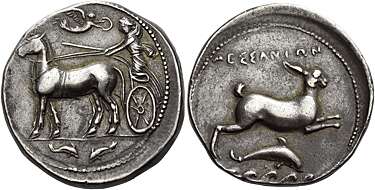
  • 起拍价:
    60'000 CHF
    65'554 EUR
    54'648 GBP
    73'681 USD

    仅取整数近似值日期: 2026/11/05
拍品
拍品 66. Tetradrachm circa 450-425, AR 28 mm, 16.99 g. Elderly Dionysus, wearing ivy wreath and himation, reclining on mule's back l., holding cantharus with r. hand and thyrsos with l.; below, branch. Rev. MEN – ΔA – IO – N around linear square containing vine with four bunches of grapes; all within incuse square. Locker-Lampson 147 (these dies). SNG Lockett 1347 (these dies). Noe, Mende 61. HGC 3.1, 546. Very rare. A wonderful specimen of this desirable and interesting issue of excellent Classical style. Light old cabinet tone, minor areas of weakness on reverse, otherwise extremely fine / about extremely fine Ex Lanz 70, 1994, Margaretha Ley, 51; Lanz 72, 1995, 170; Kricheldorf 49, 2017, 65 and Künker 312, 2018, 2188 sales. From the Prof. Wiemers collection. Mende excelled in the wine trade, rivalling Thasos, Maronea, Naxos, Lesbos and Chios. The ancient authorities Cratippus, Athenaeus, Menander, Hermippus of Smyrna and Demosthenes all speak of the quality and fame of Mende wine. Thus, it is not surprising that on its principal trade coin, the tetradrachm, Mende would choose a design that celebrated wine production. Indeed, most coins of the city bear designs that refer to wine production or to the retinue of Dionysus, the god of wine. On this example we see an elderly Dionysus in luxurious repose on the back of an ass, clutching a cantharus of wine. As shown here, he usually relaxes with his left arm downward, but on occasion (Mende (Kaliandra) Hoard no. 65) he assumes an even more decadent pose with his left arm propped upon the head of the ass; on other examples the god’s identification is further secured by the fact that he holds a thrysus (Mende (Kaliandra) Hoard nos. 60, 61, 63). Hardly a more appropriate image exists of this god, famed for his wild indulgences and his appreciation for the fruit of the vine. Of great interest is the contrast between the god and the ass: the stiff, servile attitude of the mount contrasts sharply with the decadent, reclining figure of Dionysus. While the ass is focused and dedicated to his workaday task, with its musculature taut and well defined, Dionysus appears unconcerned and soft in his physical form. In that sense we have two completely different works of art compressed into one scene. The contrast can hardly be accidental, and it must have provided the die engraver with the challenge of unifying these disparate elements into seamless coexistence. Please find here the video of the coin
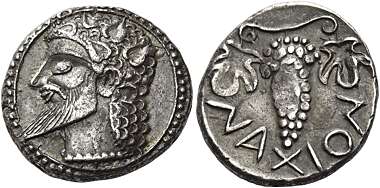
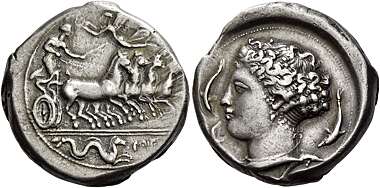
  • 起拍价:
    20'000 CHF
    21'851 EUR
    18'216 GBP
    24'560 USD

    仅取整数近似值日期: 2026/11/05
拍品
拍品 67. Drachm circa 500-480, AR 17 mm, 4.18 g. Facing gorgoneion with protruding tongue. Rev. Quadripartite incuse square. AMNG III.2, 7. SNG ANS 420. HGC 3.1, 584. Very rare and in exceptional condition for the issue. Of superb style and with a lovely old cabinet tone. Minor flan cracks, otherwise good extremely fine Ex Harlan J. Berk Buy or Bid sale 99, 1997, 92 and CNG Numismatic Review XLIV.2, Summer 2019, 495008. Privately purchased from Edward J. Waddell in 2015. From the Gasvoda and Antiquarium Group collections. Graded Ch AU* Strike 5/5 Surface 4/5, NCG certificate number 4284629-004 (previously graded and no longer in holder) Please find here the video of the coin
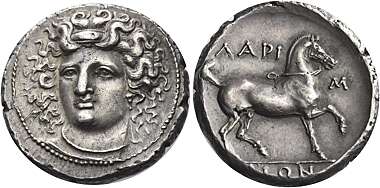
  • 起拍价:
    4'800 CHF
    5'244 EUR
    4'371 GBP
    5'894 USD

    仅取整数近似值日期: 2026/11/05
拍品
拍品 68. Tetradrachm circa 356-345, AR 25 mm, 14.29 g. Head of young Heracles r., wearing lion skin headdress. Rev. ΦIΛIΠΠΩ[N] Tripod with three handles; from the two handles at the sides, two fillets ending in three bunches. In field above, laurel branch and in field l., club and in exergue, HPA. Traité IV 1186 and pl. 324, 18 (these dies). Le Rider pl. 93, 8 (this coin illustrated). Bellinger, Philippi in Macedonia, ANS MN 11, 21 (this coin listed). Extremely rare. Of lovely style and with a wonderful old cabinet tone, surface somewhat porous, otherwise about extremely fine Ex F. Schlessinger 13, 1935, Hermitage duplicates, 604; Hess-Leu 7, 1957, 178; Leu 7, 1973, 131; Sotheby's 21-22 June 1990, Hunt (1926-2014), 354; New York XXVII, 2012, Prospero (1910-2001), 287 and NAC 116, 2019, Man in Love with Art, 70 sales. From the Jameson (1861-1942) collection. Philippi, near Mount Pangaeus, was to the Macedonian kings what Laurium had long been to the Athenians – a seemingly inexhaustible source of wealth, the only difference being the mines near Philippi yielded both silver and gold. The Pangaean mines had been exploited in earlier times by Thracians, Athenians and Thasians, only to be claimed by the Macedonian king Philip II (359-336 B.C.) early in his reign. Before Philip's intervention the city was known as Crenides or Datum, but in 356, Philip renamed it Philippi. He greatly enriched and improved the city, which he repopulated and made a 'free' Greek city within his kingdom. At the time Philip II claimed the Pangaean region, the Thasians were working the mines and striking coins with the Heracles/tripod design and the inscription 'of the Thasians on the mainland'. The Macedonian issues that followed bore the same design, but were inscribed with the new name of the city. The Macedonians produced a full range of denominations in seemingly two phases, c. 356-330 B.C., and c. 330-323 B.C. – gold staters, silver tetradrachms, drachms and hemidrachms, and bronzes of at least two sizes. The first phase probably comprised six issues, with this tetradrachm belonging to the inaugural striking in 356, when the city was renamed. Though all gold coins of Philipi adhered to the Attic standard, the earliest silver (such as this tetradrachm) was struck at what Morkholm calls "a rather light variant of Philip's silver standard". Bellinger believes this was done to "compete for the influence in the Paeonian region," where the standard was lower. A lighter weight was perhaps needed to discourage their export, and thus keep them around as local currency. In either case, the silver of the second phase of Philippi's Macedonian coinage (seemingly limited to tetradrachms) was struck to the full weight of regal silver. Please find here the video of the coin
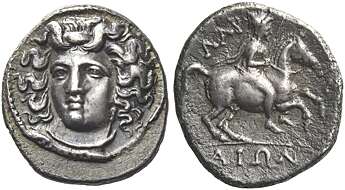
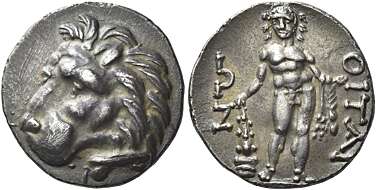
  • 起拍价:
    40'000 CHF
    43'703 EUR
    36'432 GBP
    49'120 USD

    仅取整数近似值日期: 2026/11/05
拍品
拍品 69. Tetradrachm circa 479-450, AR 25 mm, 17.33 g. ΣΠΑ Poseidon Hippios on horseback l., holding trident pointed downward in r. hand; below, dolphin and in l. field, uncertain letter. Rev. Quadripartite incuse square divided into triangles. U. Wartenberg, Coinage in the Chalkidike in the late Archaic and early Classical period: The case of Potidaia and Spartolos, Jahrbuch für Numismatik und Geldgeschichte 74, 50. J. Alexander, The coinage of Potidaea, in Mylonas, Studies presented to David Moore Robinson Vol. 2, Period IIA, a.1 corr. (legend misdescribed as ΠOT). HGC 3.1, 641 corr. (legend misdescribed as ΠOT). Extremely rare and in exceptional condition for the issue, possibly the finest specimen in private hands. Struck in high relief on fresh metal and with a lovely iridescent tone. Minor area of weakness on obverse, otherwise good extremely fine Ex Rauch sale 111, 2020, 465 Ute Wartenberg has now credited this series to Spartolos, the principal city of the Bottiaeans, which features a magnificent style of Poseidon Hippios. Around 460 BC, this very rare coin series was made by this early Delian League member, possibly as tribute payments. It is interesting to note that its reverse is connected to multiple series of nearby Potidaia, to which it has typically been assigned. The three Greek letters ΣΠΑ on the obverse makes this new attribution certain. Please find here the video of the coin
  • 起拍价:
    20'000 CHF
    21'851 EUR
    18'216 GBP
    24'560 USD

    仅取整数近似值日期: 2026/11/05
拍品
拍品 70. Tetradrachm circa 490-480, AR 29 mm, 17.51 g. Wine-jug with two bunches of grapes at sides. Rev. Quadripartite incuse square. Traité pl. LII, 15. AMNG III, 2 and pl. XXII, 8. C.M. Kraay, NC 1954, 6. Hardwick, Essays Price 4, pl. 29 (this obverse die). HGC 3.1, 704 (this coin illustrated). Very rare and undoubtedly among the finest specimens known. Struck on a very broad flan and with a superb old cabinet tone, unobtrusive areas of oxidation on reverse, otherwise extremely fine Ex NFA XXII, 1989, 256; New York XXVII, 2012, Prospero (1910-2001), 289 and NAC 106, 2019, Man in Love with Art, 71 sales. The archaic tetradrachms of Terone, a prosperous city in Chalcidice, are rarely encountered and so finely preserved that we can fully appreciate their design. Wine was one of the most important trade goods in the ancient Mediterranean world, with evidence from a myriad of archaeological, literary and art-historical sources. Though Terone must have been a significant producer, we have no evidence of this beyond its coinage. This tetradrachm shows a pointed amphora with a large capacity, somewhere between 5 and 20 gallons, with vine-shoots and grape clusters adorning the neck of the vessel. A similar contemporary tetrobol depicts Silenus holding an oenochoe, which only confirms the city's most valued export. Archaic Macedonian coins such as this are found throughout the eastern Mediterranean, notably in Egypt, the Levant and southern Asia Minor, which suggests Terone was known to a broad audience of international trade contacts. Please find here the video of the coin
  • 起拍价:
    20'000 CHF
    21'851 EUR
    18'216 GBP
    24'560 USD

    仅取整数近似值日期: 2026/11/05
拍品
拍品 71. Stater, Pella circa 340-328, AV 18 mm, 8.61 g. Laureate head of Apollo r. Rev. ΦΙΛΙΠΠOY Charioteer driving biga r., holding reins in his l. hand and goad in his r.; below horses, Nike flying r. holding wreath. Le Rider 363 (these dies). SNG ANS 157 (this obverse die). HGC 3.1, 847. Good extremely fine Ex Nomos sale 15, 2017, 61. Graded AU Strike 5/5 Surface 3/5, Fine style, brushed, NCG photo certificate number 8561097-001 Please find here the video of the coin
  • 起拍价:
    3'200 CHF
    3'496 EUR
    2'914 GBP
    3'929 USD

    仅取整数近似值日期: 2026/11/05
拍品
拍品 72. Quarter stater, Pella circa 336-328, AV 11 mm, 2.04 g. Head of Heracles r., wearing lion skin headdress. Rev. ΦΙΛΙΠΠΟΥ Club and bow; below, trident. Le Rider 84. ANG ANS 224. HGC 3.1, 851. In exceptional condition for the issue. Minor marks, otherwise good extremely fine Ex CNG 61, 2002, 405 and Triton XXIII, 2020, 201 sales. Privately purchased from CNG in 2012. From the M.J.W. collection. Graded Ch AU Strike 5/5 Surface 3/5, brushed, NCG photo certificate number 8561097-007 Please find here the video of the coin
  • 起拍价:
    1'600 CHF
    1'748 EUR
    1'457 GBP
    1'964 USD

    仅取整数近似值日期: 2026/11/05
拍品
拍品 73. Tetradrachm, Amphipolis circa 336-323, AR 25 mm, 17.22 g. Head of Heracles r., wearing lion skin headdress. Rev. ΑΛΕΞΑΝΔΡΟΥ Zeus seated l., holding eagle on outstretched r. hand, sceptre in l. hand; in l. field, quiver. Price 38. HGC 3.1, 910a. Virtually as struck and almost Fdc Ex Harlan J. Berk 78, 1993, 65 and Heritage 3083, 2020, 32016 sales. Graded MS Strike 5/5 Surface 4/5, NCG certificate number 5745624001 (previously graded and no longer in holder) Please find here the video of the coin
  • 起拍价:
    1'200 CHF
    1'311 EUR
    1'092 GBP
    1'473 USD

    仅取整数近似值日期: 2026/11/05
拍品
拍品 74. Distater, Salamis circa 332-323, AV mm, 17.28 g. Head of Athena r., wearing Corinthian helmet decorated with coiled snake. Rev. AΛEΞANΔPOY Nike standing to l., holding stylis in l. hand and wreath in r.; below, eagle standing r. Price –, cf. 3129 (stater). Apparently unique and unpublished and the only distater known for the mint of Salamis. A portrait of fine style perfectly struck on a very broad flan, virtually as struck and almost Fdc Graded AU* Strike 5/5 Surface 4/5, NCG photo certificate number 8561099-005 This distater of Salamis is apparently unique and unpublished because the predominance of gold distater production was in Macedon after c. 330 BC and it suggests that much of the gold plundered from treasuries captured by Alexander and his army as they made their way eastwards, conquering the Persian Empire, was actually sent back to Macedon for coining. As the Persian Great Kings regularly stored their precious metals as ingots and only coined them as the need arose, it would not have been overly difficult from a logistical perspective for Alexander to ship the captured gold to Macedon. However, much of the silver, which was more urgent for use as pay for the army was coined as necessary at cities as the campaign continued. Distaters were an exceptionally large denomination for the fourth century BC and could only have been struck with a plentiful supply of gold. This was provided to Alexander in 330 BC, when he captured the Persian capital at Susa and discovered that its treasury contained some 40,000 talents of gold in addition to 50,000 talents of silver. The staggering value of the metal can be visualized by the fact that one silver talent was equivalent to 6,000 drachms, which was itself equal to sixteen years' pay for a skilled workman. At the beginning of his reign in 336 BC, Alexander the Great was considered to be deeply in debt because the Macedonian treasury owed some 500 talents of silver. One can almost imagine the collective jaw-dropping that must have taken place when Alexander and his commanders broke open the seals of the treasury at Susa and saw what was inside. When the captured Persian gold reached its destination in Macedon, it was coined into Attic-weight distaters and staters featuring the head of Athena on the obverse and Nike on the reverse. Athena may have been chosen due to the crusade-like character that Alexander gave to his invasion of the Persian Empire. In Greece he liked to give the impression that his conquest was not merely undertaken so that he could become the greatest ruler that the Mediterranean world and the Near East had ever seen, but because he was avenging the Persian invasion of Greece under Xerxes I in 480 BC. As the Persians had plundered Athens and destroyed the temple of Athena on the Acropolis during the invasion, Athena must surely have gloated that under Alexander her image was struck on gold taken from the destroyers of her temple. Likewise, the Nike on the reverse is shown carrying a ship's stylis, which would seem to indicate a naval victory. Since the campaigns of Alexander did not involve many sea battles, it has been suggested that Nike here was intended to be shown passing on the victory won by the Greeks over the Persians at the Battle of Salamis (480 BC) to the Macedonian king. Yet, others scholars see it as a reflection of Alexander's actions, perhaps his crossing of the Hellespont in the spring of 334 or his capture of Tyre in the summer of 332. Please find here the video of the coin
  • 起拍价:
    60'000 CHF
    65'554 EUR
    54'648 GBP
    73'681 USD

    仅取整数近似值日期: 2026/11/05
拍品
拍品 75. Stater, Sardis circa 330-323, AV 17 mm, 8.57 g. Head of Athena r., wearing triple-crested Corinthian helmet; bowl decorated with coiled snake. Rev. AΛEΞANΔΡOΥ Nike standing l., holding wreath and stylis; in outer l. field, stag's head. Price 2531. Of lovely style and virtually as struck and almost Fdc Graded Ch AU Strike 5/5 Surface 4/5, Fine style, NCG photo certificate number 8561097-010 Please find here the video of the coin
  • 起拍价:
    4'000 CHF
    4'370 EUR
    3'643 GBP
    4'912 USD

    仅取整数近似值日期: 2026/11/05
拍品
拍品 76. Tetradrachm of 2 shekels, Babylon circa 327, AR 24 mm, 15.72 g. Elephant advancing r., carrying two figures, one turning to look l. and holding a standard, the other, in front, holding a goad. Rev. Charioteer driving fast quadriga r., an archer stands in the chariot beside the driver, drawing a bow. Price, Mnemata p. 70, 26 (this coin). Prospero 306 (this coin). Mitchiner Type 21i. Of the highest rarity, one of the finest of only very few specimens known. An issue of tremendous importance and fascination. Light iridescent tone and about very fine Ex New York XXVII, 2012, Prospero (1910-2001), 306 and NAC 114, 2019, 124 sales. Previously privately purchased from Spink & Son. This tetradrachm is closely related to the preceding piece in the "Porus Medallion" series, but of an even higher degree of rarity. The coin is also especially notable as the first specimen of the type discovered by Martin Price in 1989. As with the archer/elephant piece, this tetradrachm features types related to Alexander the Great's Indian campaign (327-325 BC), likely intended to commemorate the Macedonian victory over the regional Punjabi king Porus in 326 BC. Here the obverse type depicts a war elephant complete with driver and a figure, carrying what appears to be a type of flag or standard whilst a war chariot appears on the reverse. Both chariots and elephants are recorded to have been fielded by Porus at the battle of the Hydaspes River. The elephant advances while the standard bearer turns his head to look for the enemy behind him, and the chariot seems to move at breakneck speed, pulled by galloping horses in step with each other. Please find here the video of the coin
  • 起拍价:
    24'000 CHF
    26'221 EUR
    21'859 GBP
    29'472 USD

    仅取整数近似值日期: 2026/11/05
拍品
拍品 77. Stater, Abydus circa 323-317, AV 18 mm, 8.60 g. Head of Athena r., wearing crested Corinthian helmet decorated with serpent. Rev. ΦΙΛΙΠΠΟΥ Nike standing l. holding wreath and stylis; in l. field, pentagram and coiled snake. Thompson, ANSMS 19, 157. Price P38 var. (monogram over pentagram). Virtually as struck and almost Fdc Ex Gorny & Mosch sale 249, 2017, 209. Graded MS* Strike 5/5 Surface 4/5, Fine Style, NCG photo certificate number 8561097-002 Please find here the video of the coin
  • 起拍价:
    4'000 CHF
    4'370 EUR
    3'643 GBP
    4'912 USD

    仅取整数近似值日期: 2026/11/05
拍品
拍品 78. Tetradrachm, Amphipolis circa 227-221, AR 30 mm, 17.06 g. Head of Poseidon r., wreathed with seaweed. Rev. ΒΑΣΙΛΕΩΣ / ΑΝΤΙΓΟΝΟΥ Apollo seated l. on prow l., testing arrow; below, monogram. K. Panagopoulou, The early Antigonids: Coinage, money and the economy, ANSNS 37, 134. SNG Ashmolean 3264. SNG München 1121. HGC 3.1, 1051. A bold portrait of fine style. Light iridescent tone and good extremely fine Ex Kricheldorf 49, 2017, 74 and Gorny & Mosch 249, 2017, 217 sales. Privately purchased from Kricheldorf in 1993. Please find here the video of the coin
  • 起拍价:
    2'800 CHF
    3'059 EUR
    2'550 GBP
    3'438 USD

    仅取整数近似值日期: 2026/11/05
拍品
拍品 79. Tetradrachm, Aesillas quaestor, uncertain mint circa 95-70, AR 31 mm, 16.79 g. Μ[ΑΚΕΔΟΝΩ]Ν Head of defied Alexander III r. Rev. AESILLAS Club, money chest (kista), and a quaestor's chair; in r. field, Q. All within laurel wreath. Bauslaugh, Numismatic Studies 22, Group I, dies 3/11, c (this coin). HGC 3, 1110. A portrait of excellent style for the series and a wonderful old cabinet tone. An encrustation at five o'clock on obverse field and minor areas of weakness, otherwise extremely fine Ex Ars Classica V, 1923, 1500 and CNG 111, 2019, 129 sales. Privately purchased from CNG in 1994. Please find here the video of the coin
  • 起拍价:
    480 CHF
    524 EUR
    437 GBP
    589 USD

    仅取整数近似值日期: 2026/11/05
拍品
拍品 80. Octodrachm circa 475-465, AR 31 mm, 28.50 g. CΙΣΑΛΤΙΚΩΝ Warrior, wearing causia and holding two spears, standing behind horse. Rev. Quadripartite incuse square. AMNG III/2, 4 var. (different arrangement of legend). Svoronos, Hellénisme Primitif, 4 var. (different arrangement of legend). Peykov A3060 (arrangement of legend). A.R. Tzamalis, Les ethné de la région "Thraco-Macédonienne". Étude d'histoire et de Numismatique. (Fin du VIe - Ve siècle), 47. HGC 3.1, 274. Rare. Perfectly centred on a full flan and complete. Lovely iridescent tone, the obverse upper field crystallised, otherwise about extremely fine Ex Empire Coins 74, 1995, 26; Noble Numismatics 49, 1995, 1987; Noble Numismatics 68, 2001, 1828; Triton VI, 2003, 203; Noble Numismatics 79, 2005, 3379 and Gorny & Mosch 249, 2017, 179 sales. From the Ronald J. Hansen (1948-2012) collection. The Bisaltae were a Thracian or Pelasgian tribe inhabiting the reaches of the lower Strymon river valley in eastern Macedonia bordering the lands of Thrace to the east. The economy was one of pastoral-nomadism, although the aristocracy certainly exploited the silver mines in the mountainous region and the territory of the Krestones and Mygdones to their west, the bullion of which produced this handsome octodrachm. An interesting feature of these large coins, and also the larger issues of the Derrones as well as of Alexander I in Macedonia, is their manufacturing process. From the flattening that is always present on the reverse, it appears that the striking occurred in two distinct stages with the reverses and obverses having being stuck individually. First, the reverse die, which served merely as an ornamental device rather than having the functional purpose of pushing metal into the obverse die, was hammered against the planchet, then the planchet was turned over and struck again from the obverse die. This second striking caused some flattening on the reverse of the coin, as can be seen here in the slight flattening of the raised portions of the four inner divisions of the larger incuse square. The purpose of this unusual manufacturing process is not certain, but probably should be seen in the context of the massive size of the coins themselves. During Xerxes' invasion of Greece in 480 B.C., the Bisaltae refused assistance to the large Persian army. After they vacated the region following their costly campaign against the Greeks, Alexander I of Macedonia conquered and annexed the Bisaltaian homeland. As such he came to control the rich silver mines of the Pangaean district and subsequently struck his first coinage, copying the Bisaltaian octodrachms (except inscribed with his own name). Please find here the video of the coin
  • 起拍价:
    4'000 CHF
    4'370 EUR
    3'643 GBP
    4'912 USD

    仅取整数近似值日期: 2026/11/05
拍品
拍品 81. Stater circa 490, AR 21 mm, 9.83 g. Nude ithyphallic satyr grasping r. arm of nymph, trying to move away from him; in field above, pellet. Rev. Quadripartite incuse square. Svoronos, Hellénisme Primitif 21f (this coin) and pl. VIII, 23 (this coin illustrated). SNG Spencer-Churchill 128 (these dies). Dewing 1025 (these dies). Very rare and amongst the finest specimens known of this desirable issue. Of superb Archaic style, perfectly struck and centred on a large flan and with an enchanting old cabinet tone. An unobtrusive mark on obverse field, otherwise good extremely fine Ex Leu 77, 2000, 147; NAC 88, 2015, 390 and NAC 110, 2018, 65 sales. From the duplicates of the British Museum. For a coinage that clearly was important in its time, and which today is known in a considerable variety of styles, it is remarkable that the mint identification is still a matter of debate. Even if we do not know where exactly these coins were struck, we know in some cases where they ended up, having been found in documented hoards from Thrace, Rhodes, Syria, Jordan, Bactria, Egypt, and Southern Italy (18 were amongst the coins of the 1911 Taranto hoard; ICGH 1874). On the rare occasion inscriptions are present on these coins, they seem to be retrograde and faintly engraved, and are thus difficult to read. An apparent misreading in the 19th Century as 'Letaion' led to an enduring attribution to Lete, a Macedonian city about 15 miles north of Thessalonica. That tentative identification has been used by generations of scholars. Recently however, some authorities have come to accept Svoronos' reading as 'Sirinon', the ethnic of Siris, a town in the region of Mt. Pangaeus. Kraay agreed with Svoronos' reading, and thus associated these coins with the Satrai, a tribe also in the Pangaion region. Please find here the video of the coin
  • 起拍价:
    40'000 CHF
    43'703 EUR
    36'432 GBP
    49'120 USD

    仅取整数近似值日期: 2026/11/05
拍品
拍品 82. Stater circa 411-385, AR 22 mm, 12.69 g. Griffin seated l. with right paw raised. Rev. APIΣ-TΩN-A-Ξ Horse standing r. within incuse square. May, Abdera –. cf. Spink sale 5014, 2005, 80. HGC 3.2, 1176 (this coin illustrated). Extremely rare, possibly only the third specimen known. Light iridescent tone and about extremely fine Ex Hirsch 176, 1992, 97; Roma Numismatics III, 2012, 175 and Roma Numismatics XIX, 2020, 388 sales. Please find here the video of the coin
  • 起拍价:
    3'200 CHF
    3'496 EUR
    2'914 GBP
    3'929 USD

    仅取整数近似值日期: 2026/11/05
拍品
拍品 83. Stater, magistrate Telemachos circa 358, AR 22 mm, 11.47 g. ABΔH Griffin crouching l. Rev. [EΠ]I THΛEMA[ΞO] Heracles advancing r., wearing lion skin on l. extended arm and holding club and bow; in. r. field, shell. All within incuse square. May, Abdera 402 (these dies). C-N, p. 127, period VII. Very rare. Struck in high relief and with a superb old cabinet tone. Good extremely fine Ex Giessener Münzhandlung 46, 1989, 59; Lanz 70, 1994, 35; Lanz 72, 1195, 135; Lanz 76, 1996, 152; Lanz 86, 1998, 75; Ira & Larry Goldberg 63, 2011, 2438 and NAC 114, 2019, 151 sales. Please find here the video of the coin
  • 起拍价:
    4'800 CHF
    5'244 EUR
    4'371 GBP
    5'894 USD

    仅取整数近似值日期: 2026/11/05
拍品
拍品 84. Stater circa 412-404, AR 22 mm, 9.10 g. Ithyphallic satyr advancing r., carrying off protesting nymph; in upper r. field, I. Rev. Quadripartite incuse square. Le Rider, Thasiennes 6 var. (different letter on obverse). Svoronos, Hellénisme Primitif, pl. X, 27–8 var. (different letter on obverse). cf. Triton sale XXII, 2019, 166. (these dies). An extremely rare variety with Iota on obverse. Of excellent Classical style, exceptionally complete and perfectly centred on a large flan. Light tone and extremely fine Ex NAC sale 134, 2022, 220. Please find here the video of the coin
  • 起拍价:
    8'000 CHF
    8'740 EUR
    7'286 GBP
    9'824 USD

    仅取整数近似值日期: 2026/11/05
拍品
拍品 85. Tetradrachm circa 411-340, AR 24 mm, 15.39 g. Ivy-wreathed head of Dionysus l. Rev. ΘΑΣΙΟΝ Heracles, wearing lion's skin headdress, kneeling r. and drawing bow; in r. field, bipennis. All within square frame. West, ANSNM 40, 32 bis. Hurter Pixodaros Hoard pl. 21, 28a (this coin illustrated). Le Rider, Group p. 187 and pl. II, cf. 23. Very rare and in unusually fine condition for this very difficult issue. A portrait of superb style struck in high relief and with a wonderful old cabinet tone. Obverse slightly off-centre and with a small die-break, otherwise extremely fine Ex M&M sale 72, 1987, 550. From the Pixodaros Hoard. The island of Thasos may have been the site of a Phoenician colony dedicated to extracting mineral resources in the ninth or early eighth century BC, but by the end of the eighth or the beginning of the seventh century BC, these early colonists had disappeared and were replaced by Greek settlers from Paros. The new Greek colony grew wealthy from the control of rich silver mines on the Thracian mainland facing Thasos and a brisk trade in the high-quality wine produced on the island. At the height of Thasian prosperity, the mines reportedly produced between 200 and 300 talents of silver per year. Due to the constant influx of silver into the coffers of Thasos, it is not surprising that the city produced an extensive coinage beginning already in the last quarter of the sixth century BC. From the very beginning, the standard type for Thasian staters featured an ithyphallic satyr carrying off a protesting nymph on the obverse and a quadripartite incuse square on the reverse. The wide regional recognition of Thasian coinage encouraged typological conservatism and Thasos retained the same stater type for more than a century, changing to new types featuring Dionysus and Heracles only in circa 410 BC. Similar to the finest heads of Zeus found on Olympian coinage, the head of Dionysos on this coin exhibits a calm and power that is especially magnificent and majestic. This may actually be Zeus himself if it were not for the ivy wreath he is wearing. Dionysos's wild side is not hinted at here, nor is it implied that his adherents include elemental beings like satyrs, maenads, or silens, or that he may overindulge in alcohol, as he seems to have done on certain matters pertaining to the neighboring city of Mende. The face is style seems to be a Classical reworking of a more archaic original; the hair's proximity to the head, almost like a cap, suggests an earlier precursor, possibly a cult statue that was somewhat updated in its coin copy. Please find here the video of the coin
  • 起拍价:
    20'000 CHF
    21'851 EUR
    18'216 GBP
    24'560 USD

    仅取整数近似值日期: 2026/11/05
拍品
拍品 86. Tetradrachm, Lamspacus circa 297-281, AR 29 mm, 17.13 g. Diademed head of deified Alexander r., with horn of Ammon. Rev. ΒΑΣΙΛΕΩΣ / ΛΥΣΙΜΑΧΟΥ Athena seated l., resting arm on shield and holding Nike with wreath; behind, spear, in inner l. field, monogram and below, star. Thompson, Essay Robinson 45. HGC 3.2, 1750b. A portrait of enchanting beauty and a lovely iridescent tone. Good extremely fine Ex Hess-Leu 28, 1965, 134; Leu 15, 1976, 168; The Numismatic Auction 2, 1983, 68; Tradart 2, 1983, 68; The Bru Sale 1, 2012, 10 and iBelgica 27 March 2019, 99 sales. From the Richard Arnold van Every (1924-1974) collection. Graded Ch AU Strike 5/5 Surface 4/5, Fine Style, light marks, NCG photo certificate number 8561100-003 Before the Battle of Ipsus in 301 BC, Lysimachus seems only to have issued bronzes and small silver coins (tetrobols or 1/5th tetradrachms) with the resurrected types of Philip II. Furthermore, most of these coins, which bear the first two letters of Lysimachus' name, appear to have been struck on his behalf by his benefactor and ally, the Macedonian King Cassander. The defeat of Antigonus Monopthalmus and his son Demetrius Poliorcetes at the epic battle meant their vast territories were divided among the victors, Lysimachus, Cassander and Seleucus I. Lysimachus received the western part of Asia Minor, and retained his traditional realm in Thrace. Many cities within his acquired lands had established active mints, thus providing a springboard for Lysimachus to coin on a large scale. Thompson lists twenty mints in her study of the lifetime coinage of Lysimachus, and others may have existed. Initially, he adopted the types of Alexander, which had been dutifully struck by Antigonus and were popular in commerce. The earliest of his issues bore both the types and inscription of Alexander, but they usually can be distinguished by the symbol of the forepart of a springing lion. In the next phase, the types were still of Alexander, but the inscriptions were devoted to Lysimachus. The final step was the introduction of a new type, unique to Lysimachus, yet still indebted to the legacy of Alexander. It shows on its obverse a portrait of the deified Alexander, wearing a royal diadem and the horns of Zeus-Ammon. The reverse shows Athena enthroned, holding a figure of Nike, who crowns Lysimachus' name. These coins were issued in great quantity, with the gold stater often referred to as a chrysous ('golden'), with the idea that it was a stater being understood. It seems clear enough why he chose to portray Alexander, but the explanation for Athena is less obvious. Price suggested that Athena and Nike were borrowed from the gold staters of Alexander, which portrayed Athena on the obverse and a standing Nike on the reverse; he also reasoned that Nike crowning Lysimachus' name was a reference to the triumph at Ipsus. Please find here the video of the coin
  • 起拍价:
    4'800 CHF
    5'244 EUR
    4'371 GBP
    5'894 USD

    仅取整数近似值日期: 2026/11/05
拍品
拍品 87. Tetradrachm, Pergamum circa 287-282, AR 29 mm, 17.14 g. Diademed head of deified Alexander r., with horn of Ammon. Rev. ΒΑΣΙΛΕΩΣ / ΛΥΣΙΜΑΧΟΥ Athena seated l., resting arm on shield and holding Nike with wreath; behind, spear, in outer l. field, crescent, in inner l. field, cult statue and in exergue, monogram. Thompson, Essay Robinson 222. HGC 3.2, 1750m. A portrait of masterly style, undoubtedly one of the finest of the whole series. Wonderful old cabinet tone, minor marks, otherwise extremely fine Ex Spink 121, 1997, 331 and Ira & Larry Goldberg 106, 2018, 1047 sales. From the Lee Rousseau collection. Please find here the video of the coin
  • 起拍价:
    3'200 CHF
    3'496 EUR
    2'914 GBP
    3'929 USD

    仅取整数近似值日期: 2026/11/05
拍品
拍品 88. Stater, King Eminakos circa 450-425, AR 21 mm, 11.19 g. Beardless Heracles kneeling r., stringing bow; in r. field, [ΕΜΙΝΑΚΟ]. Rev. Four-spoked wheel surrounded by four dolphins within corners of incuse square. SNG Stancomb 342 (this coin). Rosen 147. Jameson 2536. Traitè IV, 1771 and pl. 355, 21. SNG BM Black Sea 358. Perykov G0040 (these dies). HGC 3.2, 1929. Extremely rare. An issue of great fascination struck on an irregular flan and with a pleasant dark tone. Very fine Ex Hess-Leu 45, 1970, 91 and Roma Numismatics XVIII, 2019, 328 sales. Privately purchased from Feuardent Frères in 1911-1937 and Spink & Son in 1972. From the William Stancomb collection. This rare stater is signed in Greek by a mysterious individual named Eminakos, who is only known from numismatic evidence. Some scholars have considered him a civic magistrate in Olbia, who had his name inscribed on the coinage to advertise his involvement in its production – perhaps as the provider of the silver or the tools and dies. Others, however, have interpreted Eminakos as a Scythian king or governor established in Olbia. The dating of Eminakos' coinage has been the subject of some dispute. While the staters bearing his name are most commonly dated to the period c. 450-425 BC, it has been argued recently that if Eminakos was indeed a Scythian ruler with authority over Olbia, his staters cannot have been struck later than 437 BC, when Perikles and the Athenians undertook an expedition into the Black Sea and are presumed to have enrolled Olbia as a member of the Delian League. The case for a date before 437 BC is rather slight, considering that Olbia never appears in the Athenian Tribute Lists and there is scholarly disagreement over whether the Black Sea expedition ever really took place. Regardless of the chronology for Eminakos, it seems fairly clear from the obverse type that his staters do indeed have some Scythian context. Here a wonderfully archaic figure of Heracles crouches right to string his bow, probably alluding to the Greek mythological tradition that made him the ancestor of the Scythians. During his tenth labour, carrying off the cattle of Geryon, Heracles was forced to sleep with a half-woman half-serpent in Scythia, in order to gain the return of his stolen horses. When it was revealed that the serpent-woman was pregnant he gave her his belt and bow and advised her to test her sons with them. Whichever one could wear the belt and string the bow was strong enough to rule Scythia. As it turned out, Scythes, her eldest son by Heracles was able to perform this feat, and thus became the ruler of Scythia and the eponymous ancestor of the Scythian people. The wheel reverse seems to advertise the mint city responsible for the coinage of Eminakos. Wheels are a prominent reverse type on the large cast bronze coins produced in Olbia in the fifth century BC. Please find here the video of the coin
  • 起拍价:
    6'000 CHF
    6'555 EUR
    5'464 GBP
    7'368 USD

    仅取整数近似值日期: 2026/11/05
拍品
拍品 89. Obol circa 340-300, AR 12 mm, 0.79 g. Horse r., about to roll. Rev. Κ Ι – Ε Warrior r., wearing conical helmet, holding oval shield with his l. and horizontal lance with his r., leaning forward in fighting attitude. Weber 2798 = Jameson 2031 (this coin). BCD Thessaly II, 96 (this coin). HGC 4, 671. In exceptional state of preservation for the issue. Wonderful old cabinet tone, about extremely fine / good very fine Ex Leu-M&M 3-4 December 1965, Niggeler (1878-1964), 252; Hesperia Art Bullettin XXXVII, 1966, 25a; Leu 36, 1985, 119 and Triton XV, 2012, BCD, 96 sales. From the Jameson (1861-1942) and Weber (1823-1918) collections. Please find here the video of the coin
  • 起拍价:
    600 CHF
    655 EUR
    546 GBP
    736 USD

    仅取整数近似值日期: 2026/11/05
拍品
拍品 90. Drachm circa 450-420, AR 21 mm, 6.11 g. Thessalos, with petasos and chlamys hanging around neck, restraining bull l. by band held around its head. Rev. ΛΑΡΙΣΑ / AI Horse prancing l. BCD Thessaly II, 176 (these dies). SNG Ashmolean 3866 (these dies). HGC 4, 421 (these dies). Superb old cabinet tone, minor marks under patina, otherwise extremely fine Ex Ars Classica XIII, 1928, 700; Harlan J. Berk Buy or Bid 206, 2018, 69 and CNG 114, 2020, 150 sales. Please find here the video of the coin
  • 起拍价:
    1'200 CHF
    1'311 EUR
    1'092 GBP
    1'473 USD

    仅取整数近似值日期: 2026/11/05
拍品
拍品 91. Drachm circa 380-370, AR 19 mm, 6.08 g. Head of the nymph Larissa l., wearing pearl necklace and triple drop earring, her hair raised and bound at the top of her head. Rev. ΛΑΡΙ – ΣΑΙ – ΩΝ Bridled horse trotting r., tail in an upright curl. Lorber, Thessalian Hoards and the Coinage of Larissa, AJN 20, 100. BCD Thessaly II, 184 (this coin). HGC 4, 448. A portrait of lovely style struck and with a delightful light iridescent tone. Traces of double-striking on reverse, otherwise about extremely fine Ex Triton XV, 2012, BCD, 184; Roma Numismatics XII, 2016, 125 and Triton XXIII, 2020, BCD, 236 sales. From the Jonathan P. Rosen and Ambrose collections. Please find here the video of the coin
  • 起拍价:
    1'000 CHF
    1'092 EUR
    910 GBP
    1'228 USD

    仅取整数近似值日期: 2026/11/05
拍品
拍品 92. Drachm circa 380-365, AR 20 mm, 6.29 g. Head of nymph Larissa three-quarters facing left, wreathed with grain. Rev. ΛA - P - I - ΣAI - [ΩN] Helmeted warrior on horseback r. L-S series 5, dies O1/R2, a (this coin). BCD Thessaly II, 292 (these dies). HGC 4, 446. A lovely portrait of fine style perfectly struck and centred on a broad flan and with a lovely old cabinet tone. About extremely fine / extremely fine Ex Leu 22, 1979, 85; CNG 90, 2012, 80 and Gemini XII, 2015, 106 sales. Privately purchased from NAC in 2018. From the BCD collection and the Atrax hoard. Please find here the video of the coin
  • 起拍价:
    3'200 CHF
    3'496 EUR
    2'914 GBP
    3'929 USD

    仅取整数近似值日期: 2026/11/05
拍品
拍品 93. Stater circa 356-336, AR 24 mm, 12.21 g. Head of the nymph Larissa three-quarter facing l., wearing ampyx. Rev. ΛΑΡΙ / Σ / [Α]ΙΩΝ Bridled horse prancing r. Lorber, Thessalian Hoards and the Coinage of Larissa, in AJN 20, pl. 46, 112. BCD Thessaly II, 311 (this coin). HGC 4, 409. Struck in high relief on a very broad flan and with a lovely light old cabinet tone. Obverse from slightly rusty die and almost invisible metal flaws, possibly from over-striking, otherwise extremely fine Ex Triton sale XV, 2012, BCD, 311. Please find here the video of the coin
  • 起拍价:
    4'000 CHF
    4'370 EUR
    3'643 GBP
    4'912 USD

    仅取整数近似值日期: 2026/11/05
拍品
拍品 94. Trihemiobol circa 344-337, AR 12 mm, 1.39 g. Head of the nymph Larissa facing three-quarters l., wearing ampyx, pendant earring, and necklace. Rev. ΛAP – IΣ – AIΩN Thessalian horseman, wearing petasus and chlamys, advancing r. and holding staff. Herrmann pl. VI, 1. SNG Copenhagen 134. BCD Thessaly 1162 (this coin). Rare and in exceptional condition for the issue. Wonderful old cabinet tone, reverse surface somewhat porous, otherwise extremely fine Ex Nomos 4, 2011, BCD, 1162 and NAC 123, 2021, Man in Love with Art part II, 353 sales. Please find here the video of the coin
  • 起拍价:
    400 CHF
    437 EUR
    364 GBP
    491 USD

    仅取整数近似值日期: 2026/11/05
拍品
拍品 95. Didrachm after 167, AR 22 mm, 7.65 g. Lion's head l. with spear in its jaws. Rev. OITAI / ΩN Youthful Heracles standing facing, wearing ivy-wreath, holding club and lion skin. de Nanteuil 850 (this coin). SNG Copenhagen 179. Valassiadis, The Coinage of the Oitaeans, in Obolos 7, 10. BCD Thessaly I, 1217 (this coin). BCD Thessaly II, –. HGC 4, 132 (this coin illustrated). Extremely rare and possibly the finest specimen in private hands. Struck on excellent metal and with a superb old cabinet tone. Minor marks on obverse field, otherwise extremely fine Ex Hess/Leu 31, 1966, 285; McSorley-Adams Fixed Price List 2, 1968, 49; Nomos 4, 2011, BCD, 1217 and NAC 116, 2019, Man in Love with Art part I, 109 sales. Privately purchased from S. Boutin in July 1968. From the de Nanteuil (1876-1941) collection. The types of this didrachm of the Oitaioi focus on the mythology of Heracles because it was within their territory that the greatest of all Greek heroes met his tragic end and subsequently ascended to the gods. Deianeira, the wife of Heracles, was almost carried off by the Centaur Nessos as she attempted to cross the Euenos River. She was saved by the timely arrival of her husband, who shot the Centaur with a poisoned arrow. However, as Nessos lay dying, he told Deianeira to make a potion from his blood that he said would ensure the fidelity of her husband – Heracles had the unfortunate habit of fathering children with other women throughout Greece, Italy, the Near East, and North Africa. Deianeira followed his instructions and soaked her husband's shirt in the blood, not realising that it was contaminated with the poison (the venom of the Lernean Hydra) of the arrow that killed Nessos. When Heracles put on the shirt, the poison immediately began to burn his flesh and realising that it would ultimately kill him, Heracles ascended Mount Oita, the mountain from which the Oitaioi derived their name, and built his own funeral pyre at the summit. Casting himself onto the flaming pyre, Heracles destroyed his mortal self, but freed his immortal self to rise to join the Olympian gods. Please find here the video of the coin
  • 起拍价:
    16'000 CHF
    17'481 EUR
    14'572 GBP
    19'648 USD

    仅取整数近似值日期: 2026/11/05
拍品
拍品 96. Drachm, signed by the engraver Telephantos late V-mid IV century BC, AR 20 mm, 6.03 g. Head of Athena r., wearing pearl necklace and a crested Attic helmet adorned with a figure of Scylla r.; behind neck, [ΤI / ΜΙ]. Rev. Φ – Α / Ρ – Σ partially retrograde Thessalian horseman galloping r., on horse, B branded on its haunch and an Φ on its shoulder, wearing hisos, chlamys and chiton, and brandishing a lagobolon; below, MTH. Lavva 154 corr. Gillet 878 (this coin). BCD Thessaly II, 642 (this coin). In exceptional condition for the issue, possibly the finest specimen in private hands. A portrait of excellent style and a very elegantly engraved reverse die. Superb old cabinet tone, obverse from rusty die and an almost invisible area of corrosion at six o'clock, otherwise extremely fine Ex Leu 15, 1976, 208; Adams Fixed Price List September 1976, 8; Sternberg XVII, 1986, 110 and Triton XV, 3 January 2012, BCD, 642 sales. Privately purchased from CNG in 2018. From the Charls Gillet (1879-1972) and Dr John Hewitt Judd (1899-1986) collections. This spectacularly beautiful drachm was struck in the late fifth to mid fourth century BC, possibly in the context of growing conflicts between Pharsalus and Pherae for control of the Thessalian League. In the aftermath of the Persian invasion of Greece (480-479 BC), Larissa was punished for the medizing of its leading citizens and Pharsalus became the dominant city of the league and is said to have directly ruled a number of lesser Thessalian cities and villages. Pharsalus and the tyrants that ruled it were frequently in competition with the city and tyrants of Pherae, who wished to lead the Thessalian League themselves. The Pharsalian tyrants successfully managed to resist Pheraean attempts to supplant them until 375/4 BC, when Polydamas, the tyrant of Pharsalus, was abandoned by his allies during a conflict with Jason, the tyrant of Pherae. Left with little other choice, Polydamas accepted Jason and Pherae as the new leaders of the Thessalian League. However, when Jason was murdered in 370 BC, the fear of a resurgent Pharsalus was so great that Polydamas and the other important men of Pharsalus were executed by the Pheraeans. Pharsalus (and Thessaly in general) was only freed from Pheraean domination after the defeat of a combined Pheraean and Phocaean army by Philip II of Macedon at the Battle of Crocus Field in 353/2 BC. The present coin features the head of Athena wearing an extremely ornate Attic helmet on the obverse and a representation of a mounted Thessalian hunter on the reverse. The lagobolon that the hunter carries suggests that he is hunting rabbits or other small game. His mounted aspect and wide-brimmed petasus clearly identify him as a Thessalian. The engravers were justifiably proud of their work and have signed both the obverse and reverse dies. The signing of the dies combined with details of the helmet decorations on other Pharsalian issues has led to speculation that the skilled engravers of the drachm series may have come from Sicily or Magna Graecia. Please find here the video of the coin
  • 起拍价:
    8'000 CHF
    8'740 EUR
    7'286 GBP
    9'824 USD

    仅取整数近似值日期: 2026/11/05
拍品
拍品 97. Drachm signed by the artists TH and AMN circa 420-350, AR 20 mm, 6.29 g. Head of Athena r., wearing Attic helmet decorated with wreath; cheek guard turned up. Behind the neck, TH. Rev. Φ – Α – Ρ– Σ in part retrograde Forepart of a horse r.; behind truncation AM and in r. field, N retrograde. Jameson 2471 (this coin). Gillet 193 (this coin). Lava 78a (this coin). BCD Thessaly I, 1283 (this coin). BCD Thessaly II, –. Of the highest rarity, only the second and finest specimen known. An important issue with attractive portrait and a lovely old cabinet tone, minor marks on obverse field and an unobtrusive scuff on reverse, otherwise extremely fine Ex Leu/M&M 28 May 1974, Kunstfreund, 193; Nomos 4, 2011, BCD, 1283 and NAC 116, 2019, Man in Love with Art part I, 116 sales. From the Jameson (1861-1942) and Charls Gillet (1879-1972) collections. Pharsalus was one of the pre-eminent cities of Thessaly and enjoyed some fame as one of the few Thessalian cities to oppose the advance of the Persian army in 480 BC. Thanks to their loyalty to the Greek cause, when Spartan forces arrived to punish Larissa and the other medizing cities of Thessaly, Pharsalus was established as head of the Thessalian League and came to dominate much of the lesser cities of Thessaly in the late fifth and early fourth centuries BC. Later, when the beleaguered Spartans ended their support of Pharsalus and its tyrant, Polydamos, in 375/4 BC, Polydamos was forced to cede Pharsalian leadership of the League to Jason, the powerful tyrant of Pherai.This extremely rare and beautiful drachm of Pharsalus probably belongs to the late period of Pharsalian supremacy. Both the head of Athena and the forepart of the galloping horse are beautifully rendered. Feeling justifiable pride in their art, the engravers responsible for these two exquisite dies have gone so far as to sign their dies with their names - a practice more commonly found in Sicily. The artist 'TH' was responsible for the Athena of the obverse, and 'AMN' for the reverse. Please find here the video of the coin
  • 起拍价:
    20'000 CHF
    21'851 EUR
    18'216 GBP
    24'560 USD

    仅取整数近似值日期: 2026/11/05
拍品
拍品 98. Drachm circa 459-439, AR 21 mm, 5.89 g. The hero Thessalos, naked but for petasos hanging down his back, restraining a leaping bull r. by means of a band held by both his hands and passing under the animal’s horns. In l. field, [Γ]ΛΑ retrograde. Rev. Θ – E – R – A – I Bridled horse cantering r. on dotted ground line, his rein trailing below; above l., lion’s head fountain spout with water pouring from its mouth; all in incuse square. Jameson 1105 (this coin). SNG Lockett 1608 (these dies). BCD Thessaly II, 682 (this coin). Rare and in unusually good condition for the issue. Struck on an extremely broad flan and with a lovely old cabinet tone. Minor marks, otherwise good very fine Ex Leu-M&M 3-4 December 1965, Nieggeler (1878-1964), 263; M&M 54, 1978, 208 and Triton XV, 2012, BCD, 682 sales. From the Jameson (1861-1942) collection. Please find here the video of the coin
  • 起拍价:
    2'000 CHF
    2'185 EUR
    1'821 GBP
    2'456 USD

    仅取整数近似值日期: 2026/11/05
拍品
拍品 99. Stater struck under tyrant Alexander circa 369-358, AR 24 mm, 11.92 g. ΕΝ – ΝΟΔ – ΙΑΣ Laureate head of Ennodia r., wearing earrings and pearl necklace. Rev. ΑΛ – ΕΞΑΝΔ – ΡΕ – Ι – Ο – Σ Alexander on horseback galloping r., holding reins and spear; on horse's rump, double axe. Wartenberg 17 (this coin). BCD Thessaly I, 1308 (this coin). BCD Thessaly II, –. Apparently unique. A very important and interesting issue with a wonderful portrait, the work of a very talented master engraver. Surface somewhat corroded, otherwise about extremely fine Ex Nomos 4, 2011, BCD 1308 and NAC 116, 2019, Man in Love with Art part I, 118 sales. Alexander came to power after his father Jason, the powerful tyrant of Pherae and tagos of the Thessalian League was assassinated in 370/69 BC. Due to his youth, he was at first overlooked to succeed in Pherae, and his uncles' Polydoros and Polyphron immediately assumed power as joint tyrants. This arrangement did not last long. In 369 BC, Polyphron first poisoned Polydorus and then later Alexander struck down Polyphron with a spear. Through this act of murder Alexander became sole tyrant of Pherae, and established his reputation for unnatural violence. It was even rumoured that Alexander established a shrine and worshipped as a god the spear that killed his uncle. Jason had managed to weld together the disparate interests of the cities of Thessaly into a strong Thessalian League through force and diplomacy, but Larissa, the traditional rival of Pherae, had always hoped to exert its own influence over the direction of the league. Alexander's bloody seizure of power at Pherae created a deep rift in the league membership and caused the Thessalian League to break into two opposing leagues, one led by Alexander as tagos and another, led by the Aleuadai family of Larissa, who refused to recognise the authority of the Pheraean tyrant. Alexander struggled to restore the unified Thessalian League by force through most of the 360s BC. He was often poised to crush Larissa but failed, due to timely military interventions by Alexander II of Macedon and the Boeotian League. Although the tyrant of Pherae did manage to capture the famous Boeotarch Pelopidas in 368/7 BC, and even killed him in battle in 364 BC, Alexander was forced to give up his claim to the leadership of the Thessalian League. Despite having lost much of his power in Thessaly, Alexander continued to express his violent and lawless character. In 362 BC, he assembled a pirate fleet and used it to plunder the Cycladic islands and the Aegean coast. Alexander was even so brazen as to attack the Piraeus of Athens, but this act called down the ire of the Athenian fleet which drove him from the sea. By this point, Pherae had grown quite weary of its violent but not particularly successful tyrant. At last, in 358 BC, Alexander was murdered in his bed by his own brothers, with the assistance of his own wife (who was also his half-sister), and his corpse thrown to the dogs in the streets of Pherae. The obverse of this stater depicts Ennodia, the patron goddess of Pherae whose cult the tyrants of Pherae attempted to promote as an expression of Thessalian identity in general. She was a deity associated with roads, cemeteries and ghosts - characteristics that caused her to be identified with Hecate outside of Thessaly. The reverse depicts Alexander of Pherae on horseback and should be considered an early, full-figure dynastic portrait. This type of mounted portrait influenced the development of the king on the coinage of the neighbouring Macedonian kingdom under Philip II. Please find here the video of the coin
  • 起拍价:
    10'000 CHF
    10'925 EUR
    9'108 GBP
    12'280 USD

    仅取整数近似值日期: 2026/11/05
拍品
拍品 100. Drachm struck under tyrant Alexander circa 369-358, AR 18 mm, 5.66 g. Laureate head of Ennodia r., wearing grape-cluster earring and pearl necklace; in field r., torch. Rev. AΛEΞANΔ Lion’s head r., with open jaws; below, double axe sideways to r. SNG Lockett 1475 (this coin). Pozzi 1255 (this coin). BCD Thessaly II, 698 (this coin). Rare. Struck in high relief and with a lovely old cabinet tone. Good very fine Ex Naville I, 1921, Pozzi, (1846-1918), 1255; Ars Classica XVII, 1934, 442; Glendining's 12 February 1958, Lockett (1873-1950), 1475; M&M Fixed Price List 182, 1958, 30; Leu 33, 1983, 305 and Triton XV, 2012, BCD, 698 sales. Please find here the video of the coin
  • 起拍价:
    4'000 CHF
    4'370 EUR
    3'643 GBP
    4'912 USD

    仅取整数近似值日期: 2026/11/05
隐私设置隐私设置