Registrati per le aste live
Numismatica Ars Classica, Zurich Logo
Lotto
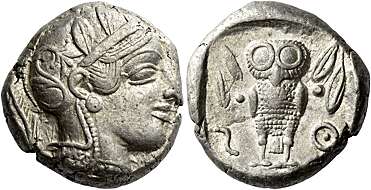
Lotto 201. Philistia (Palestine).   Tetradrachm, Gaza mid V century-333 BC, AR 23 mm, 17.36 g. Helmeted head of Athena r., decorated with olive wreath and palmette. Rev. A – Z in Phoenician Facing owl, closed wings, at sides, two olive sprays. All within incuse square. BMC Palestine pl. 42, 1. Boston, MFA 2203. SNG ANS 6. HGC 10, 532. Extremely rare, apparently eight specimens known of which only five are in private hands. A coin of great interest and fascination struck on very fresh metal and, as usual for the issue, on a narrow flan. About extremely fineGraded Ch XF* Strike: 4/5, Surface: 4/5, NGC photo certificate number 4884086-001 Ex Heritage 3075, 2019, 32034, MDC 6, 2020, 81 and NGSA 20, 2024, 1018 sales. It is suspected that the territory of Philistia was originally settled by elements of the Greek migrant groups known to the Egyptians as the Sea Peoples in the turmoil surrounding the end of the Bronze Age around 1200 BC.  In the early Iron Age, the city of Gaza emerged as one of the major cities of the Philistian Pentapolis. It played a prominent role in the story of Samson and Delilah in the biblical book of Judges, and grew wealthy as the Mediterranean coastal node of the Arabian incense trade. The South Arabian Qedarite kings, who regularly used Gaza’s port to export their goods, reportedly paid an annual tribute of 1,000 talents (25,000 kg) of frankincense to the Persian kings, who permitted them access to Gaza in the fifth century BC. If this was the tribute, one can only imagine the vast quantities of incense that poured out through Gaza to the profit of the city. The trade of Gaza had long been carried on using cut and weighed out pieces of silver (Hacksilber), but around the middle of the fifth century BC, the city began to produce its own coinage in response to the vast influx of Greek coins—especially from Athens—to the Near East through trade and war. By adopting coinage, Gaza and the other cities of Philistia became more integrated into neighboring coin-using economies and into the wider economy of the Achaemenid Persian Empire, to which they belonged. As Athenian coinage was widely accepted throughout the empire, especially in Egypt, a major trading partner for Gaza, the city frequently imitated Athenian types when it began to produce its own coinage, often giving them a local flair. This exceptional coin is known for less than specimens. It was struck at Gaza, probably during the final third of the fifth century BCE, although a somewhat later date cannot be excluded. The issue closely imitates established Athenian monetary types, reflecting the extensive circulation of Athenian silver throughout the Mediterranean, and particularly in the Levant. The obverse bears the head of Athena, rendered in close conformity with the representations found on the abundant Athenian tetradrachms of the third quarter of the fifth century BC. The treatment of the eye in frontal perspective, together with the form of the Attic helmet, demonstrates the close dependence of the Gaza type upon its Athenian prototypes. The reverse, however, presents a notable departure from the standard tetradrachm type. In place of the customary owl standing to right, the Gaza issue depicts a frontal owl, a motif attested on contemporary Athenian triobols. The choice of this particular reverse type is significant and raises the question of whether Athenian triobols of this period circulated in the region of ancient Palestine. If so, they may plausibly have provided the immediate prototype for the reverse design of the Gaza coin. The reverse inscription consists of the letters ?ayin and 'zayin, read from right to left, constituting an abbreviated rendering of the city name Gaza, more conventionally represented in antiquity as ?Aza. Of particular palaeographic interest is the form of the ?ayin, which incorporates a central pellet. This feature appears to have been introduced in an attempt to assimilate the letter to the corresponding grapheme employed on contemporary Athenian coinage. The inscription therefore provides not only an abbreviated civic ethnic but also further evidence for the deliberate adaptation of Athenian numismatic conventions within the local monetary tradition of Gaza. Missing Note Please find here the video of the coin
  • Base d’asta:
    20'000 CHF
    21'851 EUR
    18'216 GBP
    24'560 USD

    Solo stime arrotondateData: 05/11/2026
Lotto
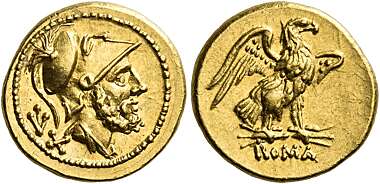
Lotto 202. 60 asses circa 211-207, AV 16 mm, 3.36 g. Bearded and draped head of Mars r., wearing Corinthian helmet; in l. field, mark of value VX. Rev. Eagle standing r., with spread wings, on thunderbolt; below, ROMA. Bahrfeldt 4. Sydenham 226. RBW 160. Crawford 44/2. In exceptional state of preservation. Virtually as struck and almost Fdc Ex Busso Peus 369, 2001, 278; Tkalec 26 October 2007, 81 and NGSA 22, 2025, 145 sales. Roman coinage was forever changed by the invasion of Italy by Hannibal, the Carthaginian general who ran the length of Italy with his armies and brought his soldiers to the walls of Rome. The Romans had never before issued gold coins, but this crisis merited it twice. The first issue of staters and half-staters was struck c. 218-216 B.C., when Rome had suffered crushing defeats to Hannibal’s army. These coins show the jugate head of the Dioscuri and an oath scene meant to shore up the traditional alliance between Rome and its Italian allies. The second coinage, to which this piece belongs, was issued c. 211-208 B.C., when the Carthaginian army was still menacing Italy, but the tide of war had shifted in favour of Rome. They were the last Roman gold coins until the Imperatorial period, when aurei were struck for Sulla in the late 80s B.C. The issue is comprised of coins denominated 60, 40 and 20 asses. The martial nature of the coinage is made clear with the designs – the helmeted head of Mars, the god of war, and the eagle of the supreme god Jupiter, standing upon his thunderbolt. Various resources were tapped to create this coinage, including special levies and loot from Syracuse, which had fallen to the Romans in 212. Meanwhile, in 211, the Romans had forced Capua into submission, denying Hannibal his main supply depot in Southern Italy. Unlike the first gold coinage (which seems to have been struck on a small scale, perhaps on a single occasion), this second was much larger and was struck in enough variety to suggest that regional or moving mints were used in addition to Rome. Please find here the video of the coin
  • Base d’asta:
    6'000 CHF
    6'555 EUR
    5'464 GBP
    7'368 USD

    Solo stime arrotondateData: 05/11/2026
Lotto
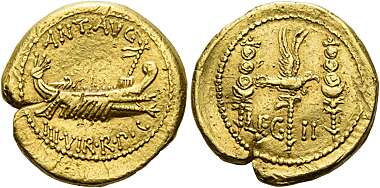
Lotto 203. Marcus Antonius. Aureus, mint moving with M. Antonius 32-31, AV 20 mm, 8.04 g. ANT·AVG Galley r. with sceptre tied with fillet on prow; below, III·VIR·R·P·C. Rev. LEG – II Aquila between two standards. Babelon –. C –. Sydenham –. Sear Imperators 349a (this coin). Biaggi 53 (this coin). Crawford –. Calicó 92 (this coin). Apparently unique and possibly the finest of only eleven legionary aurei known. An issue of tremendous importance and fascination. Flan crack at nine o'clock on obverse and minor marks, otherwise about extremely fine / good very fineGraded XF, Strike: 5/5, Surface: 2/5, NGC photo certificate number 6711260-001 Ex Sotheby's 21-22 June 1990, Hunt, 663; Sotheby's 26 October 993, 90; NAC 70, 2013, Student and his Mentor, 199; NAC 99, 2017, 2 and NAC 150, 2024, 767 sales. Privately purchased from Bank Leu in January 1955. From the Leo Biaggi de Blasys collection and from a Scandinavian private collection. Marc Antony struck his 'legionary' coinage in very large quantities as he and Queen Cleopatra VII prepared for war with Octavian and Agrippa. In the end, however, all of their efforts were futile. Upon realising they would not win the day at Actium, Antony and Cleopatra fled the battle and sailed separately to the territories of Egypt. Both chose suicide over dealing with the consequences that would have been enforced by Octavian. Twenty-three legions are named on Antony's 'legionary' coinage. Of the numbered legions, most are indicated strictly with Roman numerals. However, the first legion is named PRI, and three legions are honoured with supplementary issues that also list their honorific title: XII Antiqvae, XVII Classicae and XVIII Lybicae. Antony struck untold millions of debased denarii, yet this cannot be said of his high-purity aurei, for which only a handful of examples survive. Aurei are known for just seven numbered legions and the named units of the cohortes speculatorum and the cohortes praetoriarum. It is possible that aurei were struck as companions to every denarius issue, but that a low survival rate has left us with an incomplete record. Antony began coining his issues in 32 B.C., precisely 50 years after the imperator C. Valerius Flaccus had produced an issue of denarii (Cr. 365/1) with a reverse design that many researchers believe was the prototype of Antony's iconic reverse design. The design, which features a legionary eagle between two legionary standards, was later recycled on several occasions. In A.D. 68-69, one century after Antony's production, a flood coinage was struck that copied this memorable reverse type. Nero introduced it on his denarii in A.D. 67-68, and in the rebellions that followed his overthrow this type was used by Galba, Vitellius, Clodius Macer and by some of those who struck anonymous 'Civil Wars' coinages. One hundred years after that – apparently in honour of the bicentennial of Actium – Marcus Aurelius and Lucius Verus restored Antony's legionary types in a remarkable issue of denarii. The type remained popular even without commemorative occasions. It was a mainstay for Imperial cistophori in Asia Minor, and all three Flavians struck middle bronzes with reverse types inspired by this design. Trajan used it for coins in all metals. Quadrantes with this type were struck 'anonymously' and by Hadrian (whose issue of c. A.D. 118 may commemorate the 150th anniversary of Actium) and Antoninus Pius. Still other coinages that copied Antony's legionary reverse were struck by the later emperors Clodius Albinus, Septimius Severus, Caracalla, Elagabalus, Gallienus, Constantine I, Maximinus Daia, Licinius I and Alexander of Carthage. Please find here the video of the coin
  • Base d’asta:
    100'000 CHF
    109'258 EUR
    91'080 GBP
    122'801 USD

    Solo stime arrotondateData: 05/11/2026
Lotto
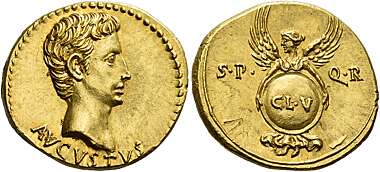
Lotto 204. Octavian as Augustus, 27 BC – 14 AD.   Aureus, Caesaraugusta 19-18, AV 19 mm, 7.84 g. AVGVSTVS Bare head r. Rev. S·P· – Q·R Victory facing, head l., holding before her a round shield inscribed CL·V. Bahrfeldt –. C –. BMC –. RIC –, cf. 62. CBN –, cf. 1092. Calicó 287 (these dies). cf. NAC sale 94, 2016, 57 (these dies). Of the highest rarity, the finest of only three specimens known. A portrait of superb style struck in high relief on a very large flan and a finely engraved reverse composition. Minor marks and a banker's mark on reverse, otherwise virtually as struck and almost FdcGraded MS* Strike: 5/5, Surface: 3/5 - banker's marks, NGC photo certificate number 8558293-003 Ex Stack's sale 3 December 1996, Michael F. Price, 105 and MDC 18, 2026, 205 sales. There are only three additional specimens known of this extremely rare coin of Augustus. All are remarkably well preserved and are produced from the same obverse and reverse dies as our coin. Additionally, all four coins also have a small M or Σ stamped on them in the field of the reverse, and which is occasionally encountered on other coins of Augustus (see, for instance, Triton XI, 2008, 761, an aureus of Augustus from Emerita in a similar state of preservation, also depicting the clipeus virtutis on the reverse). The inescapable conclusion is that all of these aurei must have originated from a single source. Whether that source was a collection (in the Triton sale it was postulated that the small stamp on the coins is an "owner's mark") where the coins were accumulated at different times and from different sources, or whether the coins all originated from the same find, is unfortunately not known. Our coin has sales provenances going back into the mid-1990s; the specimen illustrated in Calicó first appeared at auction in 1989, and the other aureus mentioned above exhibiting the same stamp on the reverse also appeared at auction in the mid-1990s. Before Augustus visited Lugdunum in 16 B.C. and established there the principal imperial mint for precious metal coinage, several imperial mints were already operating in Spain. Although there is still much that is unknown about these mints, based on stylistic and also historical grounds, it appears that there were at least two, possibly even three, and that they were most likely located at the important Roman centers of Emerita and Tarraco. The themes presented on the reverses of these Spanish issues are typically military in nature – just as on the coin offered here which boasts of Augustus's victory over Mark Antony and Cleopatra at Actium by way of the clipeus virtutis, the golden shield of valor awarded to the emperor in 26 B.C. by a most grateful and somewhat sycophantic Roman senate – which is no wonder considering that Spain hosted four legions at this time. The great abundance of Imperial gold and silver issues from Spanish mints at this time was due to the many gold and silver mines conveniently located throughout the province. Please find here the video of the coin
  • Base d’asta:
    80'000 CHF
    87'406 EUR
    72'864 GBP
    98'241 USD

    Solo stime arrotondateData: 05/11/2026
Lotto
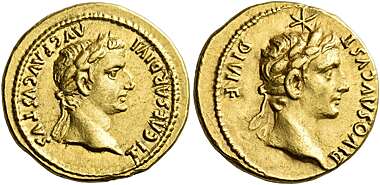
Lotto 205. Tiberius augustus, 14 – 37.   Aureus, Lugdunum 14-16, AV 20 mm, 7.82 g. TI CAESAR DIVI – AVG F AVGVSTVS Laureate head of Tiberius r. Rev. DIVOS AVGVST – DIVI F Laureate head of Augustus r., six-pointed star above. C 3. BMC 29. RIC 24. CBN 1. Calicó 311. Very rare. Two lovely portraits struck on an exceptionally large flan and unusually well-centred for the issue. Extremely fineGraded Ch XF, Strike: 5/5, Surface: 4/5, NGC photo certificate number 8494936-001 Ex Rollin & Feuardent 20 April 1896, Montagu (1844-1895), 122; Bourgey 15-16 March 1926, dr. Ernest Poncet, 12; Leu 13, 1975, 389 and Künker 419, 2025, 369 sales. This aureus testifies to the definitive adoption and the ensuing appointment of Tiberius as Augustus' heir. It is worth mentioning how the minting of this extremely rare issue occurred so shortly before the death of the emperor, of whose demise various leading inferences have been made. We indeed know from sources that Augustus retired to Nola and, suspicious of his entourage, would eat only figs from his gardens. All the same, this cautious diet did not save him from a possible death by poisoning. Some have suggested the involvement of Livia, a powerful and controversial personality who may have been the shadowy orchestrator behind at least some of the inexplicable deaths of many heirs previously appointed by Augustus. The first to succumb to a sudden and questionable disease, in 23 BC, was his nephew Marcellus, son of the emperor's sister Octavia and most loved potential heir. Next in line for succession was now Agrippa, but he also was not to outlive the Emperor, for an untimely albeit natural death took him in 12 BC. Then it was the turn of Agrippa's sons Lucius Caesar, who died of a suspicious illness in Gaul in 2 AD, his brother Gaius having died two years previously of a fatal wound while at war in the East. Agrippa Postumus, younger brother of Gaius and Lucius, thus became the last male descendant of the Emperor who, if the truth be told, despised him for his intractability and madness, to the point of promoting a "senatus consultum" to have him transferred to an island, in perpetual isolation and surrounded by a body of soldiers (Suet., Augusti Vita, 65). However, after Augustus' death the position of Agrippa, next of blood, as legitimate heir – madness notwithstanding – could not be challenged and so he was immediately disposed of by one of his guardians. Tiberius' path to the throne was finally clear. Please find here the video of the coin
  • Base d’asta:
    12'000 CHF
    13'110 EUR
    10'929 GBP
    14'736 USD

    Solo stime arrotondateData: 05/11/2026
Lotto
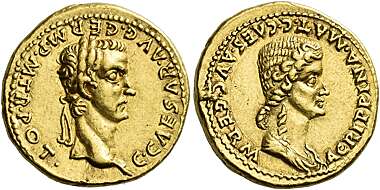
Lotto 206. Gaius augustus, 37 – 41.   Aureus 37-38, AV 20 mm, 7.72 g. C CAESAR AVG GERM P M TR POT Laureate head of Gaius r. Rev. AGRIPPINA MAT C CAES AVG GERM Draped bust of Agrippina r. C Agrippina Senior and Gaius 1. BMC 14. RIC 13. CBN 22. Calicó 326. Extremely rare and in unusually fine condition for this difficult issue. Two portraits of fine style perfectly centred on a very large flan, about extremely fineGraded Ch XF*, Strike: 5/5, Surface: 4/5, NGC photo certificate number 8494937-001 Ex Sotheby's 10 November 1972, Metropolitan, 29 and Künker 419, 2025, 378 sales. When Caligula became emperor he did so as the lone-surviving male of the lines of Augustus and Germanicus; though his three sisters were still alive, he had lost both parents and both brothers during the reign of Tiberius. His father had died under mysterious circumstances and the rest fell during the family's contest for power against Tiberius and his prefect Sejanus. Since Caligula's claim to power rested upon his membership in the Julio-Claudian family, early in his reign he tried to curry favour by taking a journey to the islands of Potnia and Pandateria to gather the ashes of his mother Agrippina and his eldest brother Nero Caesar. (His brother Drusus Caesar died of starvation in prison, and none of his remains survived.) The seas were stormy, and the perilous nature of his journey only amplified the appearance of Caligula's devotion to the memory of his family. As part of this programme of honouring his ill-fated relatives, Caligula issued this aureus with the portrait of his mother, who for the decade after Germanicus' death had been Tiberius' greatest critic, and his most persistent opponent. On this aureus her facial features are similar to those of Caligula – a feature that seems to combine family resemblance and a programmatic desire to show the kinship between the new emperor and his mother. Please find here the video of the coin
  • Base d’asta:
    60'000 CHF
    65'554 EUR
    54'648 GBP
    73'681 USD

    Solo stime arrotondateData: 05/11/2026
Lotto
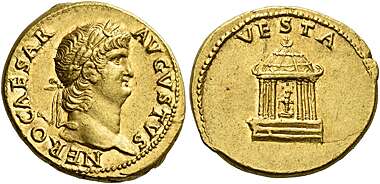
Lotto 207. Nero augustus, 54 – 68.   Aureus 65-66, AV 19 mm, 7.31 g. NERO CAESAR – AVGVSTVS Laureate head r. Rev. VESTA Domed hexastyle temple; within which, statue of Vesta seated facing, holding patera and long sceptre. C 334. BMC 101. RIC 61. CBN 229. Calicó 448. Very rare and in exceptional condition for the issue. A portrait of magnificent style and a finely detailed reverse composition perfectly centred on a very broad flan. Good extremely fineGraded Ch AU*, Strike: 5/5, Surface: 4/5, NGC photo certificate number 2149035-001 Ex MDC sale 17, 2025, 175. Vesta was the hearth goddess of ancient Rome, whose sacred fire was tended by four or six priestesses who were sworn to celibacy during their period of office (usually 30 years beginning from age 6-10) and were known as Vestal Virgins. These women had the extremely important task of making sure that Vesta’s sacred fire never went out, for if it did it would be an omen of destruction for the city of Rome. In return for this important service, the Vestal Virgins were accorded numerous special privileges. They were considered sacrosanct, meaning that any injury to their persons was punishable by death, their mere touch could free prisoners, their testimony was accepted without requiring an oath, and they were entrusted with wills and official treaties. However, if they were found to have broken their vow of chastity, Vestal Virgins could be condemned to an horrific death by being buried alive. Although it is described as a temple in English, the sacred precinct of Vesta was not really a temple in the ancient Roman sense. Ancient authors like Ovid and Plutarch all agree that the shrine of Vesta did not house a cult statue like a regular temple, but only the hearth of the city and the sacred fire. This description has led to questions about the reverse type of this attractive aureus, which seems to clearly depict an image of Vesta within the tetrastyle enclosure. Hill suggested that the building might not represent the traditional hearth of Rome, but rather a secondary shrine, known as the Aedicula Vestae, which was given to the Vestal Virgins by Augustus from his own property on the Palatine Hill. Regardless of whether the type represents the sanctuary of Vesta or only the Aedicula Vestae, the building almost certainly appears here because it was destroyed in the great fire of AD 64 and subsequently rebuilt by Nero. Please find here the video of the coin
  • Base d’asta:
    20'000 CHF
    21'851 EUR
    18'216 GBP
    24'560 USD

    Solo stime arrotondateData: 05/11/2026
Lotto
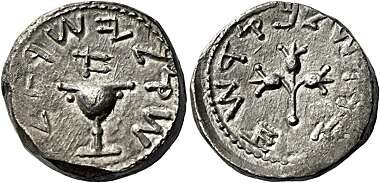
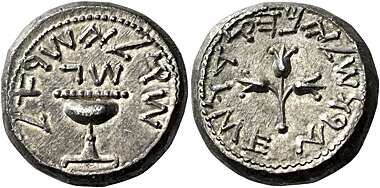
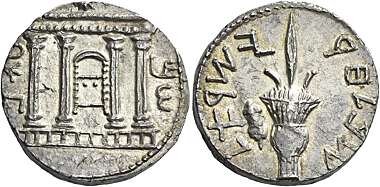
Lotto 208. Judaea, The Jewish War, 66 – 70.   Shekel, Jerusalem 66-67 (year 1), AR 22 mm, 13.72 g. In Paleo-Hebrew characters  Temple vessel with date above.  Rev. Jerusalem the Holy in Paleo-Hebrew characters  Stem with three pomegranate fruits.  Meshorer, Jewish Coins 187.  AJC 3a.  Kadman 2.  Sofaer 2.  Archaeological Centre, The Arnold Spaer Collection of Ancient Jewish Coins, 163.  Hendin 6383. Struck on excellent metal and with a light tone. Minor areas of weakness, otherwise good extremely fineGraded AU, Strike: 4/5, Surface: 5/5, NGC photo certificate number 4161178-001 Ex Heritage 3018, 2012, Shoshana, 20107 and Heritage 3119, 2024, 30014 sales. In AD 66, decades of heavy taxation, cultural misunderstandings, outright abuse, and a growing sense of nationalism combined to ignite the First Jewish War (AD 66-70). Beginning with rioting over the abuses of the procurator Gessius Florus, unrest in Judaea turned into open revolt when Jewish rebels seeking freedom from Rome defeated three legions sent by Cestius Gallus, the Roman legate of Syria, to restore order. Realizing that this Jewish military victory marked the definitive break with Rome, an independent provisional Jewish government was established in Jerusalem while the hardened general Vespasian and his son Titus were sent to crush the rebellion. In 67, the largely Zealot defenders in Galilee were defeated, and in 68-69, the Romans marched down the coast, capturing Caesarea and other settlements. At last, in 70, Jerusalem was captured after factional divisions broke the central Jewish leadership, and Titus subjected it to a terrible siege. The city and its Temple were destroyed, and their wealth was carried off to adorn the triumph of Vespasian and Titus in Rome in 71. Over the course of this conflict, the provisional government in Jerusalem struck its own silver and bronze coinage despite increasing factionalism as the war progressed and the city was placed under siege. The silver coinage consisted of the shekel and half shekel—standard denominations inherited from the coinage of Tyre, which was traditionally considered the only money appropriate for the payment of Jewish taxes to the Temple. However, whereas Tyrian coins regularly featured the head of the local god Heracles-Melqart on the obverse and an eagle on the reverse in contravention of the Jewish prohibition of graven images, the new shekels and half shekels of Jerusalem strictly adhered to Jewish religious custom, depicting a cup on the obverse and a sprig with three pomegranate buds. It is generally agreed that the cup represents the Omer Cup, a sacred golden vessel in the Temple used to hold a ritual measure of grain on the second day of the Passover festival. The meaning of the pomegranate sprig has been somewhat less straightforward. Early numismatists misinterpreted the design, believing it depicted the miraculous rod of Aaron, which spontaneously sprouted blossoms and almonds as a sign that the tribe of Levi alone should provide the priestly class for the Israelites, according to Numbers 17:23. The rod was subsequently stored in the Ark of the Covenant. As the Ark and its contents disappear from the biblical account already in the seventh century BC, and there is no indication that they were still in the Temple to be carried off by the Romans at the end of the siege in AD 70 (whether they are sitting at the bottom of a snake pit in Egypt must remain conjectural), modern numismatists tend to understand the reverse of Jewish War silver issues as a sprig with three pomegranate buds. The pomegranate served as a symbol of both the Jerusalem Temple and its priesthood. The robe worn by the high priest featured a hem of pomegranates, and the capitals of the Temple's sacred pillars were adorned with carved pomegranates. Later Rabbinic tradition held that the pomegranate was associated with the Temple and the priestly class because it was believed to contain 613 seeds—one for each commandment in the Torah. The legends are written entirely in Paleo-Hebrew script and name the city of issue, “Jerusalem the Holy,” mimicking the Greek legends on Tyrian silver that identify them as “of Tyre the Holy and Inviolable.” Additional Paleo-Hebrew legends identify the denomination (shekel or half shekel) and give the date in years of the revolt. Please find here the video of the coin
  • Base d’asta:
    5'600 CHF
    6'118 EUR
    5'100 GBP
    6'876 USD

    Solo stime arrotondateData: 05/11/2026
Lotto
Lotto 209. Judaea, The Jewish War, 66 – 70.   Shekel, Jerusalem 68-69 (year 3), AR 23 mm, 13.74 g. In paleo-Hebrew characters  Cup with pearled rim; above, "Y[ear] 3" (in paleo-Hebrew characters). Rev. Jerusalem [the] Holy in paleo-Hebrew characters  Sprig of three pomegranates.  Kadman 20.  Meshorer, Jewish Coins 202.  Sofaer 29.  Archaeological Centre, The Arnold Spaer Collection of Ancient Jewish Coins, 174.  AJC II 18.  Hendin 6390. In exceptional condition for the issue, undoubtedly among the finest specimens known. Struck on a very fresh metal and virtually as struck and almost FdcGraded Ch AU*, Strike 5/5: Surface: 4/5, NGC photo certificate number 8213409-002 Ex Heritage sale 3119, 2024, 30020. Please find here the video of the coin
  • Base d’asta:
    8'000 CHF
    8'740 EUR
    7'286 GBP
    9'824 USD

    Solo stime arrotondateData: 05/11/2026
Lotto
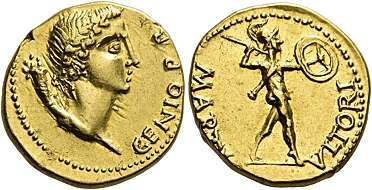
Lotto 210. The Civil War, 68 – 69.   Aureus, Spain 68-69, AV 19 mm, 7.97 g. GENIO P R Head of Genius r., wearing berried wreath; behind, cornucopia. Rev. MARTI VLTORI Mars advancing r. naked but for helmet and parazonium slung around his chest, holding javelin and shield. C –, cf. 384 (denarius). BMC –, cf. 2 and p. 288, † note (denarius). RIC –, cf. 18 (denarius). Martin –, cf. 34 (denarius). Calicó –. C. Gollnow: Die Anonymen Münzen des Vierkaiserjahres 68/69 n. Chr. (unpublished draft) 44. cf. Leu Winterthur sale 9, 2021, 1002. Of the highest rarity, only the third and by far the finest specimen known. An issue of tremendous importance and fascination in an exceptional state of preservation. Almost invisible marks, otherwise good extremely fineGraded AU, Strike: 4/5 Surface: 4/5 – brushed, NGC photo certificate number 8559870-005 Ex NAC sale 165, 2026, 488. From a Scandinavian collection. In March AD 68, C. Julius Vindex, the senatorial governor of Gallia Lugdunensis, raised his forces in rebellion against Nero's tax policies in the province. To strengthen his position, Vindex gained the support of Servius Sulpicius Galba, the governor of Hispania Tarraconensis, whom he suggested should become emperor in Nero's place. Galba appears to have welcomed this idea and raised his own province in revolt, perhaps partly out of necessity. Suetonius reports that Nero was plotting his death because he had failed to report earlier on Vindex's disaffection. On 2 April, the legions at Carthago Nova hailed Galba as imperator, but he initially eschewed the imperial title, instead preferring to describe himself only as legatus senatus populi Romani ("legate of the Senate and People of Rome"), in contrast with Nero, whose reign was characterised as tyrannical by the senatorial elite. Galba subsequently spent his time raising money and military support for his cause, in part by selling Spanish estates owned by Nero. The republican presentation of the revolts of Vindex and Galba soon caused Ti. Julius Alexander, the prefect of Egypt, to throw his support behind Galba, praising both rebel leaders as men concerned for "the safety of mankind". It also inspired Clodius Macer, the governor of Africa, to raise an independent revolt. Likewise, although L. Verginius Rufus crushed the revolt of Vindex in May 68 and was hailed imperator by his Rhine legions, he refused to accept imperial power. Galba despaired of his own revolt in the aftermath of Vindex's defeat, but little did he know that the ongoing uprisings, combined with the anticipation of rich rewards, had caused the prefect of the Praetorian Guard to declare for him and had driven Nero first to flee and then to commit suicide. Under these circumstances, on 8 June 68, Galba was recognised by the Senate as emperor – the first in the bloody Year of the Four Emperors (AD 69). This extremely rare aureus belongs to a series struck in Spain during the period of Galba's revolt. Although it is customarily attributed to an uncertain mint in Spain, it seems likely that it was struck at Tarraco – the seat of Galba's power as governor of Hispania Tarraconensis. Unlike the Spanish denarii produced during the revolt, which followed the reduced weight standard introduced by Nero in 64, the aurei were struck to the heavier standard used prior to the Neronian monetary reforms. The types of the present aureus (also known for a parallel series of denarii) are highly appropriate to Galba's propaganda programme, appealing to republican sentiment and consciously avoiding the representation of Galba as a new emperor. Here, the obverse depicts the Genius Populi Romani ("Spirit of the Roman People"), whom Galba professed to serve when he designated himself legatus senatus populi Romani rather than imperator at the beginning of his revolt. The reverse type honours Mars Ultor ("the Avenger"), a deity whose meaning could be interpreted in various ways. He may be understood as symbolising the overthrow of Nero as an act of vengeance on behalf of the Roman people, or as a continued assertion of Galba's position as a mere magistrate. It was from his temple in Rome that magistrates were dispatched at the beginning of their terms, and it was also the place where the Senate met to deliberate on questions of peace and war. Mars Ultor also hints at Galba's latent interest in becoming emperor. The temple of Mars Ultor in Rome was originally dedicated by Augustus, the first Roman emperor, in 2 BC, in fulfilment of a vow made in 42 BC. At that time, he had sworn to build a great temple for the god if granted victory and vengeance over Brutus, Cassius, and the other assassins of his adoptive father, Julius Caesar. Through Augustus' association with Mars Ultor, the aureus subtly casts the unnamed Galba as a new emperor, modelled on the vaunted Augustus, in contrast to the disastrous reign of Nero. The god on the reverse may also reflect Galba's own vow in the hope that he would be granted victory over his enemies in the developing civil war. Unfortunately, while he achieved victory and recognition on 8 June 68, this success was short-lived. On 15 January 69, Galba was murdered by elements of the Praetorian Guard seeking revenge for his failure to provide them with a substantial donative and for his execution of their praetor, Nymphidius Sabinus. Their actions elevated M. Salvius Otho to the imperial purple – a man who sought revenge on Galba for overlooking him as his heir in favour of the hapless L. Calpurnius Piso Frugi Licinianus as his designated successor. Mars Ultor could indeed be a fickle god. Please find here the video of the coin
  • Base d’asta:
    60'000 CHF
    65'554 EUR
    54'648 GBP
    73'681 USD

    Solo stime arrotondateData: 05/11/2026
Lotto
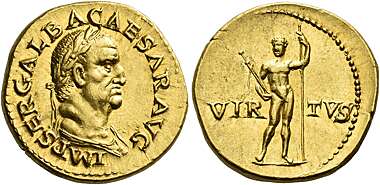
Lotto 211. Galba, 68 – 69.   Aureus 68-69, AV 20 mm, 7.33 g. IMP SER GALBA CAESAR AVG Laureate and draped bust r. Rev. VIR – TVS Virtus nude, standing, facing, holding parazonium in r. hand and spear in l. C 345. BMC p. 316 and pl. 52, 25 (this coin illustrated). RIC 222. Calicó 518 (this coin). Biaggi 268 (this coin). Extremely rare and probably the finest specimen known of this issue and among the finest aurei of Galba in private hands. A bold portrait struck on an exceptionally large flan and an interesting reverse representation. Virtually as struck and almost FdcGraded Ch AU*, Strike: 5/5, Surface: 4/5, NGC photo certificate number 6711261-002 Ex Bourgey 16-18 December 1913, Vidal Quadras (1818-1894), 109; Glendining 1951, Ryan, 1670; Rauch 102, 2016, 46 and NGSA 20, 2024, 1036 sales. Servius Sulpicius Galba had served in various capacities under Caligula and Claudius and was virtually retired for most of Nero's reign until he received command of the province of Hispania Tarraconensis in AD 59 or 60. When Nero committed suicide on 9 June AD 68, Galba assumed the imperial title and marched on Rome in October. There, he established himself as the first emperor of the bloody Year of the Four Emperors (AD 69) despite his advanced age. Unfortunately, he lacked wide popularity with the army, and on 1 January 69, the German legions refused to swear their loyalty to him and instead chose Aulus Vitellius as a rival emperor. The reverse of this gold aureus features Virtus, the Roman personification of valor, in an effort to project an illusory air of legitimacy. The use of Virtus seems to have been intended to imply that, despite his seventy years, Galba was still vigorous and capable of ruling the empire. It also may have been meant to suggest the existence of broader military backing than he actually had, or to vainly appeal to the army that chose Vitellius over him. Galba’s response to the crisis was rather less valorous than his coinage would seem to indicate. He immediately panicked and adopted the young and ambitious senator Lucius Calpurnius Piso Licinianus as his heir in an attempt to bolster his faltering image of legitimacy in Rome. Unfortunately, this only made matters worse, as it offended many other ambitious and wealthy men in the city. Most notable among these was M. Salvius Otho, who bribed the Praetorian Guard to provide the military backing for his own bid for the imperial purple. This coup d’etat further unnerved Galba, who took to the streets in a hopeless attempt to stir up popular support for himself. Little support materialized, and both Galba and Piso were killed in the Forum by the Praetorian Guard, leaving Otho as the new emperor in Rome. In an ironic twist, Galba was later avenged when a list of 100 men claiming to have struck his death blow fell into the hands of Vitellius. They had all made this claim to ingratiate themselves with Otho, but after he was overthrown, Vitellius ordered their execution. Missing note Please find here the video of the coin
  • Base d’asta:
    200'000 CHF
    218'516 EUR
    182'161 GBP
    245'603 USD

    Solo stime arrotondateData: 05/11/2026
Lotto
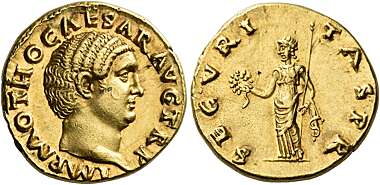
Lotto 212. Otho, 69.   Aureus January-April 69, AV 19 mm, 7.15 g. IMP M OTHO CAESAR AVG TR P Bare head r. Rev. SECVRI – TAS P R Securitas standing l., holding wreath and sceptre. C 16. BMC 13. RIC 7. CBN 7. Calicó 531c (this coin). Very rare and in exceptional condition for the issue. A portrait of magnificent style perfectly struck and centred on a full flan and with a superb light reddish tone. An almost invisible mark on obverse, otherwise good extremely fineGraded AU, Strike: 5/5, Surface: 3/5 - brushed, NGC photo certificate number 6711260-003 Ex Christie's 8th October 1985, 30; Stack's 1990, Walker, 30; Rauch 102, 2016, 48 and NAC 150, 2024, 803 sales. Privately purchased from Baldwin's in 1941. From the P.S. Hamilton collection and froma Scandinavian private collection. In the emperor Otho, as in his successor Vitellius, one can find little to admire. As a youth Otho was a drunkard, and he achieved the high office of emperor only through bribery and treachery. Indeed, there had been many 'firsts' of late: Claudius achieved his office through open support of the praetorian, Galba was the first non-Julio-Claudian emperor and the first emperor hailed outside of Rome, and now Otho was the first to openly attain his office through the murder of his predecessor. (Even if we believe Caligula suffocated Tiberius, or Nero had a hand in Claudius' death, these were achieved behind closed doors.) Otho had been governor of Lusitania (Portugal) when the Spanish governor Galba was hailed Imperator, so it was natural that Otho – long since tired of his cultural isolation – would join Galba on his trek to Rome. From this Otho had two great hopes: to exact revenge on Nero (who sent him to Lusitania to keep him far from his former companion Poppaea) and to be adopted as son and successor of the 70-year-old Galba. When neither of these goals came to fruition, Otho went heavily into debt in order to bribe the praetorian guardsmen to murder Galba, under whom they were suffering. After Galba had been brutally murdered in public view, the terrified senate hailed Otho emperor. Few in Rome would have wanted to be emperor since the German governor Vitellius was leading his army toward Italy at a rapid pace. Otho's reign was as brief, chaotic and desperate as it was degrading. It culminated in a battle in the north of Italy in which as many as 40,000 Roman soldiers died. Having lost the battle to Vitellius' army, and no doubt disheartened at the carnage, Otho committed suicide some two days later. Please find here the video of the coin
  • Base d’asta:
    140'000 CHF
    152'961 EUR
    127'513 GBP
    171'922 USD

    Solo stime arrotondateData: 05/11/2026
Lotto
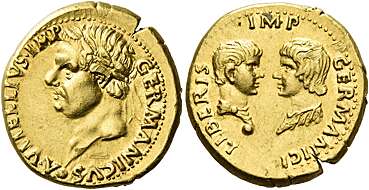
Lotto 213. Vitellius, January – 20th December 69.   Aureus, Tarraco (?) 2 January-18 April 69, AV 19 mm, 7.34 g. A VITELLIVS – IMP GERMANICVS Laureate head l. with globe at point of bust. Rev. LIBERIS IMP GERMANICI Busts of Vitellius' children: on l., a boy, bare-headed and draped with a globe at point of bust and on r., a girl, bare headed and draped. C 8. BMC p. 386 note §. RIC 8. CBN –. Calicó 561. Extremely rare and in exceptional condition for the issue. Three very interesting portraits struck on a very large flan, a minor scuff on obverse, otherwise about extremely fineGraded Ch XF, Strike: 5/5, Surface: 2/5 - scuffs, NGC photo certificate number 2183753-002 Ex MDC sale 18, 2026, 216. In A.D. 68 Nero's turbulent reign fell apart and took the entirety of the Roman world with it. C. Julius Vindex, the governor of Gallia Lugdunensis, had raised a dangerous, but ultimately failed, revolt in an attempt to topple the emperor, which led the way for Servius Sulpicius Galba, the governor of Hispania Tarraconensis, to ascend the throne. In June, when the Praetorian Guard also declared for Galba, the Senate announced Nero as an enemy of the state and forced him to flee the capital. Realising that there was nowhere to run, the hapless emperor committed suicide, leaving Galba to enter Rome as its liberator from the excesses of the Neronian age. Love of Galba was fleeting. He cancelled Nero's reforms that had benefited many wealthy and influential individuals in Rome, and either destroyed or imposed crippling fines on towns that did not recognise him immediately. Most dangerous of all, however, was his failure to reward either the Praetorian Guard for their loyalty or to address the concerns of the German legions, who had no love for Galba. The latter, now under the command of Aulus Vitellius, the governor of Germania Inferior, were incensed by accusations that they had stood in Galba's way during the revolt of Vindex when they had, in fact, loyally put down a rebellion against the state. Thus, on 1 January A.D. 69 when the entire Roman army swore the traditional oath of loyalty to the emperor, the German legions refused, hailing Vitellius as rival emperor on the following day. So began the disastrous Year of the Four Emperors. Attempting to shore up his position in Rome, Galba had adopted Lucius Calpurnius Piso Licinianus – a young and ambitious senator with an illustrious ancestry – as his heir. This carefully considered political move did not quite turn out how Galba expected as it offended many other ambitious and wealthy men in the city, most notably Marcus Salvius Otho, who bribed the Praetorian Guard to provide the military muscle for his own bid for the imperial purple. This coup d'état further unnerved Galba, who took to the streets in a foolish attempt to incite popular support for himself. Little public interest materialized and both Galba and his heir were killed in the Forum by the Praetorian Guard, leaving Otho as the new emperor in Rome. To his credit, Otho attempted to avoid further bloodshed by offering to marry Vitellius' daughter, thereby establishing an Othonian-Vitellian imperial dynasty, but events were already out of hand. Upon being elevated by his soldiers, Vitellius had sent half of his legions south to take possession of Rome. Otho initially won several small victories against the Vitellian forces, but suffered a severe defeat at the First Battle of Bedriacum on 14 April A.D. 69. Instead of attempting to regroup and resist the advance of the German legions, Otho abandoned hope and committed suicide on 16 April. At this point, Vitellius was the undisputed emperor, but as with his immediate predecessors, his reign would be short. Once in Rome, Vitellius reportedly drained the imperial coffers with constant banqueting and triumphal processions and then attempted to raise new funds by engineering the deaths of wealthy flatterers who had named him as their heir. It turned out to be an exceptionally bad time for the state finances to be in such disarray as Vespasian, the commander of the Syrian legions charged with repressing the Great Jewish Revolt, was proclaimed rival emperor in Alexandria on 1 July. Vespasian was soon also supported by Marcus Antonius Primus, commander of the Danubian legions, who began a march on Rome. Vitellius' forces met them in battle at the Second Battle of Bedriacum on 24 October A.D. 69 but were soundly defeated by the hardened Danubian legions. As Otho before him, Vitellius knew that he had little hope of retaining power. After the defeat at Bedriacum, Vitellius sent an embassy to Primus to negotiate his peaceful abdication in favour of Vespasian. Primus is said to have accepted this arrangement, but the Praetorian Guard intercepted Vitellius on his way to deposit the imperial insignia in the Temple of Concord and forced him to return to the palace instead of surrendering to Primus and recognising Vespasian. When Rome was taken at last by Primus in December of A.D. 69, Vitellius attempted to hide, but was captured. He was taken to the Gemonian Stairs-a traditional site of execution in the city since at least the time of Tiberius-where he was killed. Shocked at this fatal turn of events, before the executioner ended his life Vitellius is reported to have remarked, "Yet I was once your emperor." His body was thrown into the Tiber and his head paraded through the city. Just to be sure that no scions of the house of Vitellius would later arise to oppose the new Flavian dynasty of Vespasian, both the brother and young son of Vitellius were also executed. This extremely rare aureus attempts to contrast the intended reign of Vitellius with that of Nero and to give reassurance that the chaotic power vacuum that developed after Nero's suicide would be avoided with a new Vitellian dynasty. Whereas Nero had killed himself with no male member of the Julio-Claudian house to take his place as emperor, this coin shows that Vitellius was well-stocked with children who could be used to create a stable imperial house. His son, named Aulus Vitellius Germanicus Novis ("the Younger"), is depicted on the left with his draped bust terminating in a globe just like the bust of his father on the obverse. The shared treatment of the busts visually establishes the son as the intended successor of his father. Vitellius' daughter, Vitellia, appears on the right. Her depiction alludes to political stability as well, as she was used to establish a marriage alliance with Decimus Valerius Asiaticus, the governor of Gallia Belgica. This connection was pleasing not only to the western legions who had declared for Vitellius (Valerius had previously been military legate in Gallia Belgica under Nero), but also to the Senate, which had found itself abused and ignored under Nero (Valerius was of the senatorial class). It even may have been intended to smooth over Gallic discontent with the government in Rome (the father of Valerius was of Allobrogian Gallic origin). After all, Nero's tax policy in Gaul had been the catalyst for the revolt of Vindex that brought about the Year of the Four Emperors in the first place. Although this aureus is usually tentatively attributed to the Spanish mint of Tarraco, the reverse dynastic type almost certainly refers to events that took place in April of A.D. 69 while Vitellius was in Lugdunum. Cassius Dio (LXV.2a) tells us that when Vitellius learned of Otho's death he placed his six-year-old son on the tribunal at Lugdunum and at that point gave him the titles of imperator and Germanicus-the very titles that appear on the reverse with the portrait of Vitellius' son. It was also at this same time that Vitellia was betrothed to Decimus Valerius Asiaticus. Despite the tentative mint attribution, the coin is a beautifully tragic piece of Roman numismatic history for it answers the desperate hope for a new stable imperial dynasty to rule over Rome and the Empire, but in actual fact this was not to be provided by Vitellius and his family, but rather by his rival, Vespasian whose Flavian dynasty lasted for 37 years. Please find here the video of the coin
  • Base d’asta:
    28'000 CHF
    30'592 EUR
    25'502 GBP
    34'384 USD

    Solo stime arrotondateData: 05/11/2026
Lotto
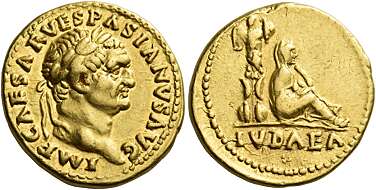
Lotto 214. Vespasian augustus, 69 – 79.   Aureus December 69-early 70, AV 18 mm, 7.44 g. IMP CAESAR VESPASIANVS AVG Laureate head r. Rev. IVDAEA Jewess seated r., head resting on hand, in attitude of mourning; behind, trophy. C 225. BMC 11. RIC 1. CBN 22. Hendin 6492. Calicó 643. Very rare. A bold portrait struck in high relief, minor marks, otherwise about extremely fineGraded Ch VF, Strike: 5/5, Surface: 2/5 - Brushed, NGC photo certificate number 8237594-001 Ex Rauch sale 118, 2024, 317. Vespasian's greatest triumph was the war in Judaea he waged at the end of Nero's reign. The campaign was difficult and taxing, and though the Roman victory was not complete when Vitellius came to the throne in April 69, neither that nor his great distance from Rome deterred Vespasian from making his bid for power. He entrusted the final leg of the campaign - the siege of Jerusalem - to his eldest son Titus while he joined his ally, the prefect Alexander, in Alexandria, and another of his compatriots, the Syrian governor Mucianus, to lead an army of 20,000 soldiers overland from Syria to Italy. The combination of Vespasian's choke-hold on the Egyptian grain supply and the slowly advancing armies of Mucianus caused panic in Rome. Further complicating matters was a preemptive strike against Vitellius led by a rogue Danubian commander named Primus: he overwhelmed Vitellius, whose forces were defeated in Northern Italy. The armies of Primus soon marched on Rome with the massive army of Mucianus only days behind. Vitellius was overthrown and Mucianus was able to establish Vespasian's authority. Mucianus ousted Primus and his legions, and ruled Rome on Vespasian's behalf until he finally arrived in October, 70 - wholly 15 months after he was hailed emperor by his soldiers. Meanwhile, the gruelling siege of Jerusalem had just ended in September, and Titus returned with spoils in unimaginable quantities. A large part of Vespasian's early coinage, including this rare aureus from his accession year, is devoted to the Judaean victory. Please find here the video of the coin
  • Base d’asta:
    12'000 CHF
    13'110 EUR
    10'929 GBP
    14'736 USD

    Solo stime arrotondateData: 05/11/2026
Lotto
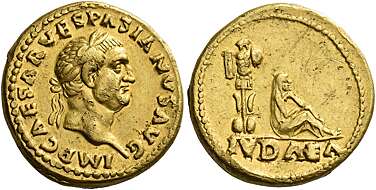
Lotto 215. Vespasian augustus, 69 – 79.   Aureus December 69-early 70, AV 18 mm, 7.04 g. IMP CAESAR VESPASIANVS AVG Laureate head r. Rev. IVDAEA Jewess seated r., head resting on hand, in attitude of mourning; behind, trophy. C 225. BMC 11. RIC 1. CBN 22. Hendin 6492. Calicó 643. Very rare, A bold portrait struck in high relief, several marks and scratches, otherwise about extremely fineGraded Ch XF, Strike: 5/5, Surface: 2/5 – scuffs, NGC photo certificate number 6369734-001 Ex New York sale XLVIII, 2020, 198; Ira & Larry Goldberg 116, 2020, 958 and Gorny & Mosch 306, 2024, 424 sales Vespasian's greatest triumph was the war in Judaea he waged at the end of Nero's reign. The campaign was difficult and taxing, and though the Roman victory was not complete when Vitellius came to the throne in April 69, neither that nor his great distance from Rome deterred Vespasian from making his bid for power. He entrusted the final leg of the campaign – the siege of Jerusalem – to his eldest son Titus while he joined his ally, the prefect Alexander, in Alexandria, and another of his compatriots, the Syrian governor Mucianus, to lead an army of 20,000 soldiers overland from Syria to Italy. The combination of Vespasian's choke-hold on the Egyptian grain supply and the slowly advancing armies of Mucianus caused panic in Rome. Further complicating matters was a preemptive strike against Vitellius led by a rogue Danubian commander named Primus: he overwhelmed Vitellius, whose forces were defeated in Northern Italy. The armies of Primus soon marched on Rome with the massive army of Mucianus only days behind. Vitellius was overthrown and Mucianus was able to establish Vespasian's authority. Mucianus ousted Primus and his legions, and ruled Rome on Vespasian's behalf until he finally arrived in October, 70 - wholly 15 months after he was hailed emperor by his soldiers. Meanwhile, the gruelling siege of Jerusalem had just ended in September, and Titus returned with spoils in unimaginable quantities. A large part of Vespasian's early coinage, including this rare aureus from his accession year, is devoted to the Judaean victory. Please find here the video of the coin
  • Base d’asta:
    12'000 CHF
    13'110 EUR
    10'929 GBP
    14'736 USD

    Solo stime arrotondateData: 05/11/2026
Lotto
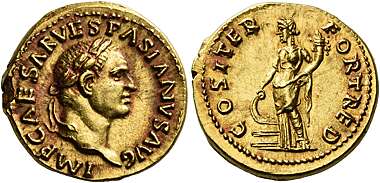
Lotto 216. Vespasian augustus, 69 – 79.   Aureus 70, AV 19 mm, 7.36 g. IMP CAESAR VESPASIANVS AVG Laureate head r. Rev. COS ITER – FORT RED Fortuna standing l., holding cornucopia; in l. field, prow. C 83. BMC –, cf. 353 (Tarraco). RIC 18. CBN 6. Calicó 601b. Rare and in an exceptional state of preservation. A very interesting and unusual portrait and a spectacular reddish Boscoreale tone. Virtually as struck and FdcGraded Ch AU*, Strike: 5/5, Surface: 4/5, NGC photo certificate number 8209498-001 Ex NAC sale 135, 2022, 278. The reverse type of this rare gold aureus features Fortuna Redux, the Roman goddess responsible for overseeing safe returns, often from long and perilous journeys. In this case, she appears to celebrate the arrival of the new emperor Vespasian in Rome in October of AD 70. He had been away a long time and much had happened while he was gone. In AD 67, he departed for Judaea after he was given command of the Jewish War and spent much of that year crushing opposition in Galilee. In AD 68, he began the campaign against the Jewish rebels in Samaria and Judaea, but then in the late summer it was discovered that back in Rome, Nero had committed suicide and Galba had claimed the imperial purple. The bloody Year of the Four Emperors that followed saw Galba murdered and quickly succeeded by Otho on 15 January, who was then defeated by Vitellius on 16 April. On 1 July, Vespasian decided that he had the military might to challenge Vitellius and in August the Danubian legions declared their support for him. These forces, which were much closer than Vespasian who was in Syria, marched on Rome. Vitellius was murdered on 20 December and on the following day the Senate recognized Vespasian as emperor. However, it was only after the siege of Jerusalem was well under way and firmly overseen by his son Titus in AD 70, that Vespasian made the long journey back to Rome. The obverse portrait of this coin suggests that it may have been struck for distribution as largesse upon the arrival of the new emperor. The rather idealized features and the general lack of the heavy facial features that typify later portraits of Vespasian seem to indicate that the obverse die of this issue was engraved before official images of the new emperor had been disseminated. At the same time that this issue celebrates the safe return of Vespasian, it may also have been intended to celebrate a safe return for Rome and the empire as a whole after the Year of the Four Emperors blew them both so terribly off course. Vespasian and his Flavian dynasty firmly anchored their propaganda in the fact that they had brought an end to the civil war sparked by the failed Julio-Claudians and restored peace and stability to the empire with the successful conclusion of the Jewish War. As such, the present aureus may be considered one of the earliest expressions of that propaganda. The attractive red toning of this aureus is regularly found on coins from the famous Boscoreale hoard that was uncovered in the Villa della Pisanella near Pompeii in 1895. This treasure was secreted in a vaulted box in a room used for pressing wine shortly before the catastrophic eruption of Mount Vesuvius in AD 79 that buried the villa and Pompeii in volcanic ash. The hoard included 109 pieces of silverware, various pieces of gold jewellery and over 1000 Roman aurei. The red toning was imparted to the coins from this hoard through their exposure to the intense heat of Vesuvius' eruption. Please find here the video of the coin
  • Base d’asta:
    32'000 CHF
    34'962 EUR
    29'145 GBP
    39'296 USD

    Solo stime arrotondateData: 05/11/2026
Lotto
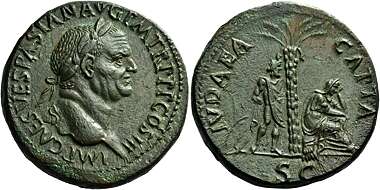
Lotto 217. Vespasian augustus, 69 – 79.   Sestertius 71, AE 33 mm, 26.53 g. IMP CAES VESPASIAN AVG P M TR P P P COS III Laureate head r. Rev. IVDAEA – CAPTA Jewess seated r. on cuirass under palm tree in attitude of mourning; behind palm, Jew standing r., hands tied behind his back; in l. field, shields. In exergue, S C. C 232. BMC 532. RIC 159. CBN 489. Hendin 6530. Rare and in exceptional condition for the issue. A superb portrait struck in high relief and a finely detailed reverse type. Wonderful green patina, minor area of weakness on reverse, otherwise good extremely fine Ex NAC-CNG-NGSA sale 144, 2024, Cope, 1047. Vespasian's greatest military triumph was the war he and his son Titus waged in Judaea at the end of Nero's reign. The campaign was so difficult that the Flavians celebrated its conclusion with triumphal processions, games, a triumphal arch and an uncommonly extensive series of coins. This sestertius is one of the most remarkable examples to have survived, with even the smallest details perfectly preserved. Most impressive is the miniature portrait of Vespasian on the reverse, the engraving of which would have tested the skills of even the most gifted artist. With dual sympathies, the chronicler Josephus wrote an in-depth narrative of the Roman campaign in Judaea. We are told of great suffering by both Jews and Romans, though in the final analysis the Jews bore the lion's share of the consequences. The Roman dead numbered in the tens of thousands, and Josephus counts the number of Jewish dead in the millions, with most having succumbed to famine or pestilence. Josephus describes what the Romans encountered when they breached the walls of Jerusalem and began to search the subterranean portion of the city: "So horrible was the stench from the bodies which met the intruders, that many instantly withdrew, but others penetrated further through avarice, trampling over heaps of corpses; for many precious objects were found in these passages" In the aftermath, Josephus reports that the Romans "selected the tallest and most handsome of the youth and reserved each of them for the triumph; of the rest, those over seventeen years of age he sent in chains to the mines in Egypt, while multitudes were presented to Titus in the various provinces, to be destroyed in the theatres by the sword or by wild beasts; those under seventeen were sold." Please find here the video of the coin
  • Base d’asta:
    20'000 CHF
    21'851 EUR
    18'216 GBP
    24'560 USD

    Solo stime arrotondateData: 05/11/2026
Lotto
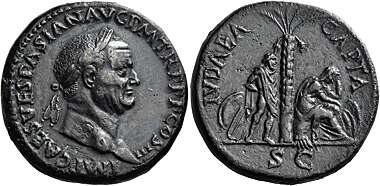
Lotto 218. Vespasian augustus, 69 – 79.   Sestertius 71, Æ 33 mm, 26.33 g. IMP CAES VESPASIAN AVG P M TR P P P COS III Laureate head r. Rev. IVDAEA – CAPTA Jewess seated r. on cuirass under palm tree in attitude of mourning; behind palm, Jew standing r., hands tied behind his back; in l. field, shields. In exergue, S C. C 232. BMC 535. RIC 159. CBN 490. Hendin 6530. Rare. Dark tone, fields gently smoothed, otherwise good very fine Ex Noonans sale 139, 2017, 39. Privately purchased from Spink in March 1938. Please find here the video of the coin
  • Base d’asta:
    1'200 CHF
    1'311 EUR
    1'092 GBP
    1'473 USD

    Solo stime arrotondateData: 05/11/2026
Lotto
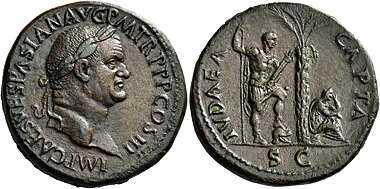
Lotto 219. Vespasian augustus, 69 – 79.   Sestertius 71, Æ 34 mm, 24.96 g. IMP CAES VESPASIAN AVG P M TR P P P COS III Laureate head r. Rev. IVDAEA – CAPTA female Jewish captive seated r. on cuirass under palm-tree in attitude of mourning. Behind, palm-tree, Emperor standing r. with l. foot on helmet, holding spear and parazonium; in exergue, S C. C 239. BMC 543. RIC 167. CBN 497. Hendin 6573. Rare. A very attractive portrait of excellent style and a lovely brown-green patina gently smoothed, otherwise about extremely fine Ex Vinchon 23-24 April 1976, 46; Künker 270, 2015, 8650; Künker 318, 2019, 1093; Künker 402, 2024, 860 sales. Please find here the video of the coin
  • Base d’asta:
    12'000 CHF
    13'110 EUR
    10'929 GBP
    14'736 USD

    Solo stime arrotondateData: 05/11/2026
Lotto
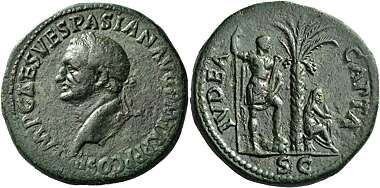
Lotto 220. Vespasian augustus, 69 – 79.   Sestertius 71, Æ 34 mm, 27.13 g. IMP CAES VESPASIAN AVG P M TR P P P COS III Laureate head l. Rev. IVDEA – CAPTA Jewess seated r. on cuirass under palm-tree in attitude of mourning. Behind, palm- tree, Emperor standing r. with l. foot on helmet, holding spear and parazonium; in exergue, S C. C –. BMC –. RIC 169. CBN –. Hendin 6573a. Extremely rare. A very interesting and unusual portrait and a lovely green patina, minor cleaning marks in fields, otherwise very fine / good very fineGraded Ch VF, Strike: 4/4, Surface: 2/5 - smoothing, NGC photo certificate number 6029852-001 Ex Künker sale 334, 2020, 2300. In AD 66, the legions of C. Cestius Gallus, the Roman governor of Syria, were soundly defeated by Jewish rebels at the outbreak of the Jewish War (66–70). In an attempt to crush the revolt, Nero called the experienced commander Vespasian out of retirement to lead the Roman legions in the East. Vespasian arrived at the port city of Ake-Ptolemais with his son Titus, also a trained military leader, in 67. Together, they spent the year crushing the forces of the Zealot rebel faction led by John of Gischala in Galilee. Once Roman control of Galilee was restored, Vespasian took Caesarea Maritima in 68 and began recapturing the coastal cities of Judaea, as well as Samaria, Idumaea, and Peraea, from the Jewish rebels. By this point, it was becoming increasingly clear that the war would end in a Roman victory, but the advance against the rebels was paused after Nero committed suicide on 9 June 68, and the usurpers Galba, Otho, and Vitellius vied with each other for imperial power throughout 69, the Year of the Four Emperors. After a period of confusion, on 1 July 69, the legions under Vespasian’s command proclaimed him Augustus in opposition to Vitellius. At the same time, Titus was hailed as Caesar. Additional support from the Pannonian legions under M. Antonius Primus allowed Vespasian to remove Vitellius and claim Rome before he could physically take the city. Once Rome was taken, Vespasian departed for the Eternal City, leaving the conduct of the Jewish War in the hands of his capable son. Titus spent AD 70 tightening the noose around the Jewish insurgents and, at last, forcing them to endure a horrific siege for almost five months. In the end, the walls were breached, and the city, together with its Temple, was destroyed in an orgy of violence and plunder. In 71, Titus returned to Rome, where he joined his father in a spectacular triumphal procession showcasing the great wealth of money, goods, and slaves seized from the defeated rebels. As part of the triumphal celebrations and to advertise the great victory in the years that followed, Vespasian struck an extensive series of coins with types related to the triumph, commonly known as the Judaea Capta series after the legend that frequently appears on them. This attractive sestertius, which was probably struck for distribution as public largesse during the triumphal celebrations in 71, features the quintessential reverse type of the Judaea Capta series. A date palm tree, symbolic of Judaea, stands in the center while Vespasian stands to the left holding a scepter and parazonium, probably to favorably compare him to Virtus, the Roman personification of valor, who was depicted similarly on coins. The seated female figure to the right of the tree is the personification of Judaea, weeping for her terrible fate at the hands of Vespasian and his son. A remarkable sestertius type struck by Titus in 80-81 and previously sold by NAC (51, 5 March 2009, lot 234) shows that the type of the present sestertius represents a statue group that was later installed in the Colosseum, the great Roman amphitheater whose construction was financed by the plunder carried off at the end of the Jewish War. Missing note Please find here the video of the coin
  • Base d’asta:
    6'000 CHF
    6'555 EUR
    5'464 GBP
    7'368 USD

    Solo stime arrotondateData: 05/11/2026
Lotto
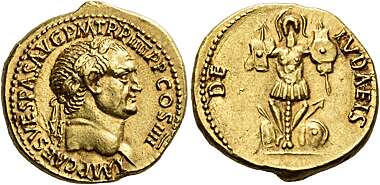
Lotto 221. Vespasian augustus, 69 – 79.   Aureus, Lugdunum 72, AV 20 mm, 7.30 g. IMP CAES VESPAS AVG P M TR P IIII P P COS IIII Laureate head r. Rev. DE – IVDAEIS Trophy; below, pile of arms. C 139. BMC 402. RIC 1179. CBN 305. Calicó 627. Hendin 6504. Very rare and in exceptional condition for the issue, possibly the finest specimen in private hands. A coin of great historical importance and fascination. Struck on a very broad flan and with a lovely reddish tone. A minor mark on reverse, otherwise extremely fineGraded Ch AU, Strike: 5/5, Surface: 3/5 - scratches, NGC photo certificate number 6645971-002 Ex Künker 204, 2012, 569; Hess-Divo 324, 2013, 17; Hess-Divo 330, 2016, 32; Künker 351, 2021, 328 and NAC 141, 2023, 215 sales. Vespasian fought in Claudius' invasion of Britannia in AD 43 and served as a proconsular governor of Africa in AD 63, yet his personal conflicts with powerful figures made his early career difficult. He incurred the enmity of Agrippina, the wife of Claudius, and deeply offended Nero when he fell asleep during one of the Emperor's long and uninspired lyric recitals. Despite these problems and a failing family fortune that compelled him to enter the mule trade, in AD 66 he was given command of the Jewish War (AD 66–73) after it became clear that the Syrian legate C. Cestius Gallus could not handle the rebels on his own. Together with his son Titus, Vespasian spent AD 67 repressing the Zealot Jewish rebels in Galilee and becoming acquainted with Josephus, the captured rebel who would go on to write the history of the war. In the following year Vespasian conquered the coastal cities of Judaea as well as Samaria, Idumaea, and Peraea and began to prepare for a final push to take the rebel stronghold of Jerusalem. Then it happened- the increasingly erratic and embattled Nero committed suicide on 9 June AD 68 and plunged the entire Empire into a bloody civil war known as the Year of the Four Emperors. The year AD 69 was largely taken up by the struggles of the usurpers Galba, Otho, and Vitellius to claim the imperial purple. At last, in July, the legions under Vespasian proclaimed him Augustus in opposition to Vitellius. Under these circumstances, Vespasian left the siege of Jerusalem in the hands of Titus and departed for Rome, where the forces of Vitellius were easily defeated. Titus captured and destroyed Jerusalem in August AD 70 after a gruelling siege of four months. The glory of this victory redounded on the new Emperor, who had begun the war and under whom it had been brought to a successful conclusion. Thus, in AD 71, Vespasian celebrated a grand triumph in Rome together with the victorious Titus and his younger son Domitian. This saw vast quantities of booty and equally large numbers of prisoners paraded through the streets of Rome as commemorated in the surviving relief panels of the Arch of Titus and described in the history of Josephus. Epigraphic evidence indicates that the value of the spoils was so great that it financed the construction of the Colosseum. This monument in Rome became a memorial of the triumph of Vespasian and Titus, and a centrepiece of Flavian propaganda, focusing on the victory in the Jewish War. The present aureus, which was struck in the years following the triumph of AD 71, still makes a point of harping on the victory over the Jewish rebels by depicting a trophy of arms with a surrounding Latin legend identifying them as "taken from the Jews". One wonders whether the inscription refers only to the trophy or if it might also have served to label the coin as produced from gold plundered from Jerusalem. This seems not at all unlikely considering the metallurgic studies of Roman Republican coins that suggest that the vast majority of coins were struck from metal plundered or otherwise extracted from the provinces. In this case one can only imagine what possible treasure the metal of this coin may have belonged to before it was melted down and struck into this rare and exceptionally preserved coin of Vespasian. One also wonders whether this coin may have been struck in part to pay for Vespasian's construction of the Colosseum and other monuments as part of his rebuilding program in Rome. It is a coin of artistic merit and great historical interest from every angle. Please find here the video of the coin
  • Base d’asta:
    100'000 CHF
    109'258 EUR
    91'080 GBP
    122'801 USD

    Solo stime arrotondateData: 05/11/2026
Lotto
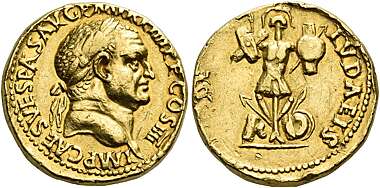
Lotto 222. Vespasian augustus, 69 – 79.   Aureus, Lugdunum 72, AV 18 mm, 7.20 g. IMP CAES VESPAS AVG P M TR P IIII P P COS IIII Laureate head r. Rev. DE – IVDAEIS Trophy; below, pile of arms. C 139. BMC 402. RIC 1179. CBN 305. Calicó 627a (this coin). Hendin 6504. An extremely rare variety of a very rare type. Several heavy traces of mounting, otherwise good very fineGraded Ch XF, Strike: 4/5, Surface: 2/5 - ex jewelry, NGC photo certificate number 615866-002 Ex NFA XXX, 1992, 232; Triton XXV, 2022, 822 and Heritage 3121, 2025, 33063 sales. From the dr. Jay M. Galst collection. Please find here the video of the coin
  • Base d’asta:
    6'400 CHF
    6'992 EUR
    5'829 GBP
    7'859 USD

    Solo stime arrotondateData: 05/11/2026
Lotto
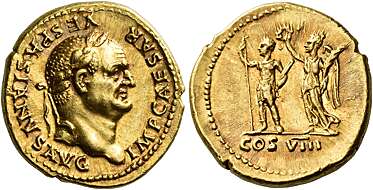
Lotto 223. Vespasian augustus, 69 – 79.   Aureus 77-78, AV 19 mm, 7.35 g. IMP CAESAR – VESPASIANVS AVG Laureate head r. Rev. Vespasian standing l., holding long sceptre in r. hand and parazonium in l., crowned by Victory standing l. behind him, holding palm in l. hand; in exergue, COS VIII. C 130. BMC 204. RIC 935. CBN 181. Calicó 624a. A magnificent portrait of superb style and a wonderful reddish tone. Virtually as struck and almost FdcGraded Ch AU, Strike: 5/5, Surface: 4/5, NGC photo certificate number 6711260-004 Ex Sternberg XV, 1985, 361; Stack's 3 December 1996, M. F. Price, 147; Leu 72, 1998, 423; Triton XVIII, 2015, 1048; NAC 150, 2024, 812 and Nomos 17, 2018, 238 sales. From the collection of the Money Museum. This exquisite gold aureus was struck in the year of Vespasian’s eighth consulship (AD 77-78), perhaps for distribution as largesse when he took up the magistracy in January 77. Although his victory in the Year of the Four Emperors (AD 69) that brought him to power and the triumphant conclusion of the Jewish War (AD 66–71) were increasingly far in the past, even late in his reign, Vespasian still made a point of constantly placing his victories before the eyes of the Romans in order to maintain the image of legitimacy for the Flavian dynasty. Whereas the Julio-Claudian dynasty, which ended with Nero and the Year of the Four Emperors, was considered legitimate through its familial relationship with Augustus, the first Roman emperor, Vespasian had no connection to the original imperial household. Instead, he was a career military man of the equestrian class who gained the consulship in AD 51, but then retired after inspiring the anger of Agrippina, the wife of Claudius. He came out of retirement to govern the Roman province of Africa in 63. While serving at this post, he amassed a fortune from his involvement in the mule trade, for which he was often derided as “the muleteer.” Although Vespasian offended Nero by falling asleep during one of his lyrical performances, he was dispatched to the east to repress the Jewish Revolt in 68. Vespasian’s background provided him with little that he could use to establish himself as a legitimate ruler in the line of Augustus, and so, like any good general, he simply worked with what he had and used victory as the basis for his legitimacy. After all, who would not want their ruler to be a favorite of Victory? Suetonius notes that when Vespasian assumed imperial power, he was lacking in auctoritas and maiestas. He spent the entirety of his reign appealing to Victory in order to make up for this shortfall. It has been estimated that out of all the coins struck by Vespasian during his ten-year reign, at least a third of the types were devoted to themes of victory in some way. While Vespasian’s victory types frequently allude to the Jewish War, specifically, more general reverse types were also employed, as on the present piece. Here, the emperor appears in his military attire, holding a sceptre and a parazonium in a pose suspiciously similar to that of Virtus, the Roman personification of valor, while Victory crowns him from behind. Please find here the video of the coin
  • Base d’asta:
    28'000 CHF
    30'592 EUR
    25'502 GBP
    34'384 USD

    Solo stime arrotondateData: 05/11/2026
Lotto
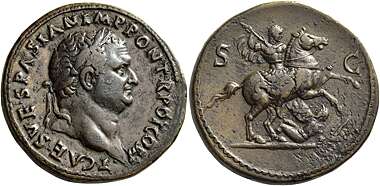
Lotto 224. Titus augustus, 79 – 81.   Sestertius 72, Æ 34 mm, 26.76 g. T CAES VESPASIAN IMP PON TR POT COS II Laureate head r. Rev. S – C Titus on horseback r., spearing fallen Jewish soldier clutching sword and shield. C 236. BMC Vespasian 634. RIC Vespasian 430. CBN Vespasian 622. Hendin 6554a. Very rare and in exceptional condition for the issue, possibly the finest specimen in private hands of this interesting and difficult issue of the Judean series. A portrait of superb style and an incredibly detailed reverse composition. Lovely brown tone, minor areas of weakness and an insignificant area of corrosion on reverse field, otherwise extremely fineGraded Ch VF*, Strike: 5/5, Surface: 3/5 - Fine style, NGC photo certificate number 6029812-003 Ex NAC sale 120, 2020, 730. When Vespasian was acclaimed Emperor by the eastern legions on July 1, AD 69, he left his son Titus in command of ongoing operations to repress the Jewish Revolt (AD 66-73). Like his father, Titus was a skilled general and by April AD 70 had forced the rebels and many civilians to seek safety behind the walls of Jerusalem. These he placed under a close siege that dragged on for four months and brought the defenders to extremities of starvation. At last, in August, the forces under Titus stormed the city and set it ablaze along with the Temple. Although mopping up operations against surviving rebel elements continued in Judaea until AD 73, Titus travelled to Rome in AD 71 to celebrate a formal triumph alongside his father and his brother Domitian. Vespasian had destroyed his rivals in AD 69 and upon becoming sole Emperor had named Titus as Caesar. The Roman victory over the Jewish rebels subsequently became a keystone of the numismatic propaganda deployed on coins struck by both Vespasian and Titus. The reverse of this sestertius belongs to this Flavian propaganda program in its depiction of Titus on horseback riding down a fallen Jewish rebel. The mounted Roman ruler slaying his fallen enemies was a standard image used to advertise the ruler as a great warrior that continued in use on Roman imperial coins down to the fourth century. The message of Vespasian's type was so clear that no associated inscription is provided except for the abbreviated senatus consultum authorising the issue. Hendin has attempted to associate the type with an anecdote told by Josephus (BJ 5.2), in which Titus is said to have fought his way out of a Jewish ambush under divine protection and "rode his horse over the fallen foes". However, the image on the sestertius seems to be intended to present a more general image of Titus as warrior rather than to record a specific incident. Josephus explicitly says that when ambushed Titus had been reconnoitring the defences of Jerusalem and therefore "wore neither helmet nor cuirass". The mounted Titus on the reverse of this wonderfully preserved sestertius clearly shows him wearing a cuirass. Rather than the story in Josephus, the reverse type is far more likely to represent a statue group erected in Rome to honour Titus for his triumph. Please find here the video of the coin
  • Base d’asta:
    20'000 CHF
    21'851 EUR
    18'216 GBP
    24'560 USD

    Solo stime arrotondateData: 05/11/2026
Lotto
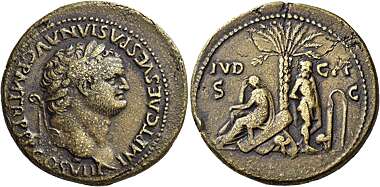
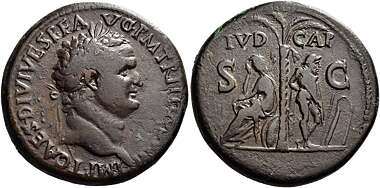
Lotto 225. Titus augustus, 79 – 81.   Sestertius 80-81, Æ 34 mm, 25.82 g. IMP T CAES VESPASIAN AVG P M TR P P P COS VIII Laureate r. Rev. IVD – CAP / S – C the personification of the mourning Judaea is seated on a pile of weapons at the l. side of a palm tree with two date clusters; a Jewish prisoner of war is standing on the r. side of the tree, his hands are bound behind his back, in front of him a big shield and a helmet. C –. BMC –. RIC 133 var. (IVDAEA CAPTA). CBN –. Hendin 6620a (this coin illustrated). An apparently unique variety of a very rare type. Struck on a very broad flan and with a lovely brown tone. Very fineGraded VF Strike: 5/5, Surface: 3/5 - Flan flaw, NGC photo certificate number 6029812-001 Ex Künker sale 334, 2020, 2340. On 1 July AD 69, when Vespasian was acclaimed as Augustus by the eastern legions in opposition to Vitellius, he immediately appointed Titus, his eldest son and colleague in the ongoing Jewish War (AD 66–73), as Caesar. In order to press his claims to the purple against those of Vitellius, Vespasian then departed from Judaea and left the conduct of the war in the hands of Titus. By 70, Vespasian had secured his place as the first Flavian emperor of the Roman Empire, and Titus was rolling back the Jewish rebels until they were forced to seek refuge behind the walls of Jerusalem. On 14 April, Titus placed the city under a close siege, which dragged on until August. During this time, the inhabitants of the overcrowded city suffered acutely from starvation and outbreaks of violence between the different rebel factions. When Jerusalem finally fell, the city was utterly destroyed along with its famous Temple. Its treasures and religious equipment were carried off to Rome to adorn a great triumph celebrated by Vespasian and Titus in 71. This attractive sestertius belongs to an extensive series of coins—the famous Judaea Capta series— struck in the aftermath of the Jewish War to advertise Vespasian and Titus as the authors of Roman victory. Many of these coins may have been thrown to the crowds as largesse during the triumphal procession and at subsequent celebrations of Flavian achievements in Judaea. Their metal content probably came from the melted-down plunder carried off from Jerusalem. Thanks to the large diameter of the sestertius denomination, the engraver has provided a more elaborate treatment of the standard denarius and aureus Judaea Capta reverse types featuring a palm tree with the weeping personification of Judaea and a captive. The date palm was prominent as a symbol of Judaea on the Judaea Capta coinage, representing the rich agricultural produce of the conquered province. While Judaean dates were a prized regional export, in Jewish tradition, the date palm was considered one of the Seven Species of plants native to the Land of Israel. It appeared as a decorative element on both the destroyed Second Temple and on synagogues, while its branches were used at the important Jewish harvest festival of Sukkot. To the left of the palm tree, the despondent personification of Judaea weeps atop a pile of shields and helmets taken by the Romans from the defeated Jewish rebels. The discarded weapons represent not only the rebels' defeat but also the vast plunder the Romans took with them once the fighting was over. The captive with bound arms who stands to the right of the palm tree also simultaneously represents the Jewish defeat as well as Roman plunder. According to Josephus, some 97,000 captives were carried off as slaves after the fall of Jerusalem. Many of these were sold throughout the empire or brought to Rome to work on monumental building projects, such as the great Flavian Amphitheater, more commonly known today as the Colosseum. Please find here the video of the coin
  • Base d’asta:
    8'000 CHF
    8'740 EUR
    7'286 GBP
    9'824 USD

    Solo stime arrotondateData: 05/11/2026
Lotto
Lotto 226. Titus augustus, 79 – 81.   Sestertius, uncertain mint (in Thrace or Bithynia ?) circa 80-81, Æ 34 mm, 25.54 g. IMP T CAES DIVI VESP F AVG P M TR PPP COS VIII Laureate head r. Rev. IVD - CAP / S - C Judaea, in an attitude of mourning, seated l. on pile of arms before palm tree; in r. field, bound Jewish captive standing r., head turned to l.; around, various arms. C –. BMC p. 433. RIC 500. RPC 503. Hendin 6627. Very rare. Brown tone and very fine The campaign led by Vespasian and Titus in Judaea was a costly and difficult affair. The Romans lost tens of thousands and, according to chronicler Josephus, the Jewish dead numbered in the millions, with most of those victims having succumbed to famine or pestilence. The war was so difficult that its conclusion was celebrated with triumphal processions, games, the erection of a triumphal arch and the minting of extensive series of coins. The majority of these coins date to 70–71 AD, following the Roman victory in which the spoils of Judaea were paraded through the streets of Rome. They were struck from the immediate aftermath of the war in 69 AD to the reign of Titus. There are two different variations of this historically significant kind. In the more popular form, the standing Jewish prisoner faces ahead and looks to the right, while Judaea is seated to the right under the palm tree. However, in the less common version shown above, the figures are inverted, and the prisoner looks back at the grieving Judaea by turning his head over his shoulder. With a particularly powerful and emotive face of Titus and both reverse figures—Judaea and the captive—rendered with remarkable clarity and detail, the design is still distinct and captivating despite natural wear. Please find here the video of the coin
  • Base d’asta:
    2'000 CHF
    2'185 EUR
    1'821 GBP
    2'456 USD

    Solo stime arrotondateData: 05/11/2026
Lotto
Lotto 227. Domitian augustus, 81 – 96.   Aureus 95-96, AV 19 mm, 7.41 g. DOMITIANVS – AVGVSTVS Bare head r. Rev. GERMANICVS COS XVII Minerva standing l., holding spear. C 165. BMC p. 343 note*. RIC 780 (this coin ?). CBN –. Calicó 856. Very rare. A bold and unusual bare portrait in the finest style of the period struck in high relief and good extremely fineGraded AU, Strike: 5/5, Surface: 4/5 – Fine Style, NGC photo certificate number 8567766-003 Ex NAC 71, 2013, Huntington, 227 and NAC 141, 2023, 220 sales. Ex HSA 22280. Minerva, the goddess of war, was the patron of Domitian. He had a shrine for her in the palace, dedicated at least two temples to her in Rome and, beginning in 83, he used her image on what would seem to be the majority of his coins. The emperor declared himself to be the son of Minerva, and the relationship between them is a recurring theme of Martial's epigrams. The poet Statius, who was a firsthand observer in the reign of Domitian, even describes the emperor as wearing a toga that Minerva had woven for him. His patronage of Minerva can be understood in the context of the Flavian dynasty, whose members took pride in their success in war: Vespasian had emerged triumphant in the Civil War of A.D. 68-69, Titus was victorious against the Jews, and Domitian – whose resentment and inferiority complex made him eager to exceed his father and brother – launched campaigns against the Germans, Dacians, Sarmatians and other foes. In all, he accepted twenty-three Imperial salutations – more than Augustus himself, and he staged at least two triumphal processions. On most of Domitian's coins Minerva is shown standing in what Carson identifies as four distinct varieties. Sometimes she holds only a spear, or a spear and a thunderbolt, but more commonly she holds both a shield and a spear. Other times she rests a foot on a ship's prow and is accompanied by an owl. Please find here the video of the coin
  • Base d’asta:
    28'000 CHF
    30'592 EUR
    25'502 GBP
    34'384 USD

    Solo stime arrotondateData: 05/11/2026
Lotto
Lotto 228. Trajan augustus, 98 – 117.   Aureus 114, AV 20 mm, 7.14 g. IMP TRAIANO OPTIMO AVG GER DAC P M TR P Laureate, draped and cuirassed bust r. Rev. AVGVSTI Trajan on horseback r., holding spear; behind, three soldiers and in front, another soldier with shield and spear. In exergue, PROFECTIO. C 40 var. (not cuirassed). BMC 512. RIC 297. CBN –. Woytek 496f. Calicó 986. Very rare and in exceptional condition for the issue, possibly the finest specimen known. A very attractive portrait of fine style and a very appealing reverse type. Good extremely fineGraded AU*, Strike: 5/5, Surface: 3/5 – Fine Style, NGC photo certificate number 8567766-002 Ex NAC sale 135, 2022, 286. Marcus Ulpius Trajanus was born at Italica in Spain and after several important military victories, he was eventually appointed governor of Upper Germany by Nerva who later adopted him as the heir to the throne. On his succession, Trajan decided that the time was ripe for territorial expansion and he successfully undertook the conquest of Dacia which then became a Roman province. In the latter part of his reign, Trajan turned his attention to the Eastern frontier. Trajan departed from Rome in October, 113, to launch his last great campaign in the East. After rejecting a proposal by a Parthian embassy in Athens, Trajan moved onto Antioch, where he wintered in preparation for the anticipated Armenian campaign of 114. After the successful conclusion of this initial campaign, Trajan once again wintered in Antioch, and in the spring of 115 led his army into northern Mesopotamia and Adiabene; he found success in both places and added the former to the Empire. Trajan's greatest triumph, however, did not come until 116, when he once again left Antioch, initially to revisit Adiabene, and then to march down the Tigris and sack the Parthian capital Ctesiphon. The campaign was an enormous success: the capital was stripped of its legendary wealth and by mid-116 the defeat of Parthia seemed complete. Afterward, Trajan felt sufficiently secure to make a brief excursion to the Persian Gulf. However, he soon realized his gains were ephemeral, and in an effort to preserve some control over the Parthians he installed the pro-Roman king Parthamaspates on the throne, but his puppet-king did not fare well. At the end of Trajan's long and productive life, he witnessed the consequences of his decades of expansionism, as revolts erupted in Armenia, Mesopotamia, Cyprus, Egypt, Cyrene, western North Africa and the Empire's northern borders in Europe. Before Trajan could march westward to address some of these uprisings, he died while encamped in Cilicia. His successor, Hadrian, scaled back Trajan's expanded empire to a more manageable size and as a result enjoyed a relatively peaceful reign. The profectio type illustrated on this aureus refers to the departure of Trajan from Rome, the occasion that marked the opening of the Parthian campaign. An innovative composition is present on the coin: Trajan, in military dress, clasping a spear, rides on horseback surrounded by soldiers. Whereas traditional coin reverse types typically featured two figures, here the emperor is seen accompanied by and interacting directly with his subjects in a much larger compositional scene. Please find here the video of the coin
  • Base d’asta:
    28'000 CHF
    30'592 EUR
    25'502 GBP
    34'384 USD

    Solo stime arrotondateData: 05/11/2026
Lotto
Lotto 229. Hadrian augustus, 117 – 138.   Rome 117, AV 20 mm, 7.20 g. IMP CAES TRAIAN HADRIANO OPT AVG G D PART. Laureate and cuirassed bust of Hadrian r., with drapery on l. shoulder. Rev. DIVO TRAIANO – PATRI AVG Laureate, draped and cuirassed bust of Trajan r. C 2. BMC 44. RIC 28. Calicó 1412 (these dies) Very rare and possibly the finest specimen known. Two superb portraits perfectly struck and centred on a full flan. Virtually as struck and almost FdcGraded Ch AU, Strike: 5/5, Surface: 3/5 – Fine Style, brushed, NGC photo certificate number 8567762-007 Ex M&M 43, 1970, 337; Leu 87, 2003, Perfectionist, 23 and NAC 100, 2017, 478 sales. This extraordinary coin fits in the controversial and fascinating theme of Hadrian's adoption by Trajan; a deed greatly wanted and backed by Plotina and repeatedly postponed by the Emperor, who would only consent to the adoption, to the detriment of other claimants to the throne, on his deathbed. On this event two versions have come down to us: the first pretends that the decision of the adoption was ascribed to an actual conviction, albeit belated, of Trajan; the second, instead, suggests a plot, engineered by Plotina, who would have delayed the spreading of the news of her husband's death, with the intent of arranging documentary evidence substantiating Trajan's free will in adopting Hadrian. Various inferences have been made on the nature of the relationship between Hadrian and Plotina, in fact some have even conjectured that the Empress was in love with her husband's protégé, whom she assisted throughout his reign. Surely, she played an instrumental role in the unhappy marriage between Sabina, Trajan's nephew, and Hadrian. In our opinion this issue must be considered the only one struck by Hadrian as Caesar; despite the obverse legend suggesting Trajan is still alive and hence the issuing authority, in reality we believe the coin to have been struck after the demise of the old Emperor and therefore a ruse devised by Plotina and Hadrian to prove the occurrence of the adoption of the latter by Trajan. Please find here the video of the coin
  • Base d’asta:
    40'000 CHF
    43'703 EUR
    36'432 GBP
    49'120 USD

    Solo stime arrotondateData: 05/11/2026
Lotto
Lotto 230. Hadrian augustus, 117 – 138.   Aureus late 128, AV 20 mm, 6.92 g. HADRIANVS AVGVSTVS P P Bare head r. Rev. COS – III Hadrian on horse pacing r., raising r. hand. C 408. BMC 502. RIC 929 (this coin listed). Calicó 1219. In exceptional state of preservation. A wonderful portrait of excellent style, struck on a very broad flan. Virtually as struck and almost FdcGraded Ch AV* Strike: 5/5 Surface 4/5 Fine Style, NGC photo certificate number 2183882-001 Ex Stack's 12 January 2009, Golden Horn, 2297; Ira & Larry Goldberg 55, 2009, 165; Nomos 23, 2021, 220 and MDC 18, 2026, 223 sales. In 86, when Hadrian was only ten years old, his parents died, and Trajan, then a military commander on the Rhine frontier, became his guardian. Trajan provided for his aristocratic education in Rome, which instilled in Hadrian a deep love of Greek literature and culture, earning him the derisive epithet Graeculus (“Greekling”) in some circles. Hadrian benefited greatly when Trajan succeeded Nerva as emperor in 98. He received important offices and even became directly connected to the imperial family through a marriage to Trajan’s grandniece Vibia Sabina in 101, engineered by the emperor’s wife, Pompeia Plotina. Trajan is thought to have questioned Hadrian’s qualifications as an heir, since he never designated him as his successor; yet when he died on 8 August 117, a document was suddenly produced naming Hadrian as Trajan’s adoptive son and heir. This was later suspected to be a forgery, since it was signed by Plotina (supposedly on Trajan’s behalf) rather than by the dying Emperor himself, and was dated the day after his death. Hadrian, who was serving as governor of Syria at the time, was hailed as Augustus by the legions three days later, before the document had been verified and the senate consulted. By then, Hadrian’s authority was unassailable, since challenging an emperor recognized by the army was to court the return of civil war. His reign had a rocky start thanks to his immediate execution of four leading men of consular rank, whom he considered to be potential threats. However, once they had been removed and Hadrian had accepted the everlasting odium their deaths brought him in the senate, he embarked on a reign that reimagined the figure of the Roman emperor and established limits on the empire itself. He spent most of his reign securing the extant borders rather than expanding them (as Trajan had done), organizing the provinces, and centralizing the imperial administration. As part of this organization, Hadrian undertook frequent tours of the provinces, spending far more of his time outside Rome than any of his imperial predecessors had. In 121–122, he toured the western provinces and made provision for the defense of the Rhine frontier as well as for the construction of a great wall to protect Britannia. Over the course of 123–125 Hadrian toured the eastern provinces, where he was concerned with the fortification of the Danube frontier and the border with the Parthian Empire. He also worked to unify these provinces by promoting their shared Greek culture. Hadrian undertook a second tour of North Africa and the Greek East in 128–136. This was marred by the mysterious death of Antinous, the emperor’s youthful favorite, while in Egypt in 130, and by the outbreak of the Bar Kokhba Revolt (132–136) in Judaea. This rebellion was sparked by Hadrian’s decision to refound the ruins of Jerusalem as the pagan city of Aelia Capitolina and pushed the capabilities of the Roman army to their limits. Among the successes of Hadrian’s second grand tour was the completion and dedication of the colossal Temple of Olympian Zeus at Athens, which had been unfinished since construction first began in 520 BC, and the creation of the Panhellenion, a federal council intended to unify Greek culture and support the self-governance of cities within the imperial framework. The present gold aureus was struck to celebrate Hadrian’s departure from Rome at the outset of his second tour of the provinces in 128. Although the reverse features no descriptive legend but only indicates his third consulship (held in 109), the type depicting the emperor on horseback raising his arm in greeting was regularly used to indicate his departure for a tour. On other issues, such a departure is described in military terms as an expeditio. Please find here the video of the coin
  • Base d’asta:
    28'000 CHF
    30'592 EUR
    25'502 GBP
    34'384 USD

    Solo stime arrotondateData: 05/11/2026
Lotto
Lotto 231. Hadrian augustus, 117 – 138.   Sestertius, Roma 130-133, Æ 32 mm, 26.50 g. HADRIANVS – AVG COS III P P Bare head r. Rev. [EX]ERC BRITANNI/[CV]S Hadrian standing r. on low platform, holding scroll and raising hand; before him, three soldiers with standards. In field, S – C. C 555 var. (bare head and cuirassed). BMC 1673. RIC 1918. L. D'Orazi, La collezione Numismatica di Prospero Sarti e il Mistero del Ripostiglio di Bolsena, in Quaderni di Studio XV, 2020, p. 146 (this coin illustrated). SCBC 637 (this coin illustrated). Extremely rare and by far the finest of very few specimens known. An issue of tremendous fascination and historical importance with a portrait of enchanting beauty, the work of a very talented engraver, and a finely engraved reverse composition, with a miniature portrait of the Emperor showcasing great craftsmanship. Undoubtedly one of the most desirable sestertii to have survived from antiquity. Wonderful brown tone and good extremely fineGraded AU*, Strike: 5/5, Surface: 5/5 - Fine style, NGC photo certificate number 8235162-002 Ex Sangiorgi 7 May 1906, Sarti, 428; Leu 25, 1980, 305 and NAC-CNG-NGSA 144, 2024, Cope, 1064 sales. Although Hadrian is only known for certain to have personally visited the province of Britannia in 122, this remarkable sestertius and other related issues suggest a second visit at some time between 130 and 137. The reverse type appears to celebrate an appearance made by Hadrian before the military forces present in Britannia since the exergue legend identifies the EXERCITVS BRITANNICVS. The scene is of the typical adlocutio type, in which the emperor is shown on a podium addressing the troops. In this particular case, the listeners are legionary standard bearers wearing their full armour. The two closest to Hadrian even wear animal skins on their heads – a means of increasing their visibility to the soldiers who followed them into battle – but it is unclear whether they are intended as lion, panther, or bear skins. All three are known to have been worn by Roman standard bearers. The standard bearer closest to Hadrian is an aquilifer, the soldier responsible for carrying the aquila, or eagle, standard of the legion while the soldier behind him is the signifer, who carries the signum standard of a Roman cohort. It is easily distinguished by its composition of ornamental disks topped by an open hand emblematic of the oath of loyalty sworn by the legionary to the emperor. Holding a transverse standard behind the signifer is the vexillarius, the soldier responsible for carrying the vexillum banner of a Roman maniple. Together the movements of these men and their standards combined with shouted orders allowed the legion and its parts to fight with great skill and overcome great enemies. As an issue of the 130s, the coin most likely depicts the emperor congratulating the men of legio II Augusta, legio VI Victrix, and legio XX Valeria Victrix for their completion of the great fortification network known as Hadrian's Wall. In 122, during Hadrian's first visit to Britannia, he had ordered the construction of the wall in order to increase the security of the province. From the initial invasions of Julius Caesar and Claudius up to the reign of Hadrian, the Roman conquest had primarily focused on the regions that are now modern England and Wales and was generally successful. With the exception of revolts by some local Celtic rulers in the mid-first century AD, by 100, England and Wales were fully connected by Roman roads and controlled by permanent military camps. However, northern England and Scotland remained an area of concern. The Caledonians of the north remained a threat that could not be easily crushed. Even the great military emperor Trajan decided to avoid becoming bogged down in an extended war with the Caledonians and fixed the northern border of Britannia between what is now Newcastle-upon-Tyne and Carlisle. Hadrian's Wall served to strengthen Trajan's border with the extended network of forts and wall as a means of preventing Caledonian incursions and of discouraging potential revolt in the northern part of the province. It took about 15,000 men six years to construct the entire fortification system over some 80 Roman miles. Although it was originally envisioned as a long stone curtain wall punctuated by gates, towers and forts in order to fully cut off the Celtic lands of the north from the Roman province of Britannia, at some point Hadrian changed his plans and the eastern 30-mile section of Hadrian's Wall was only constructed from turf. Perhaps the cost of the stone fortification was deemed excessive or it was considered a waste of military manpower that was needed elsewhere. Whatever the case, the entire system was complete by 128 and the legionaries who had worked on its construction were deserving of a rest and reward. One can almost imagine Hadrian praising the troops for a job well done before ordering the distribution of sestertii as a donative. This coin is not only spectacular for its succinct encapsulation of a specific important moment in both Roman military history and British national history, but also for its pedigree to the hallowed collection of the British Museum. Please find here the video of the coin
  • Base d’asta:
    280'000 CHF
    305'922 EUR
    255'026 GBP
    343'845 USD

    Solo stime arrotondateData: 05/11/2026
Lotto
Lotto 232. Judaea, The Bar Kokhba War.   Sela, Judah 133-134 (year 2), AR 35 mm, 13.59 g. Shimon in Paleo-Hebrew characters Façade of the Temple in Jerusalem, above, star. Rev. Year two of the freedom of Israel in Paleo- Hebrew characters Lulav with etrog on l. Meshorer, Jewish Coins, 233. Mildenberg, 42. Hendin 6417. Struck on exceptionally fresh metal and with a lovely light iridescent tone, an almost invisible trace of overstriking, otherwise good extremely fineGraded Ch AU, Strike: 4/4, Surface: 5/5 - overstruck, NGC photo certificate number 8213374-002 Ex NFA XXVI, 1991, 161; New York XXXIX, 2017, 90 and Heritage 31119, 2024, 30025 sales. From the Miller collection. Unlike most coinages of the ancient world, those produced by Jewish rebels during the Bar Kochba War were overstruck on Roman coins. The surfaces of the host coins were hammered or filed down in an effort to obliterate most of their design and, thus, to make them more suitable planchets. But in many cases the hammering and or filing – and even the subsequent mining process – did not eliminate all traces of the undertype. The hosts coins generally used for the sela were provincial tetradrachms of Antioch, whereas imperial denarii or a provincial drachms were used as planchets for the smaller silver coin, the zuz. Please find here the video of the coin
  • Base d’asta:
    4'800 CHF
    5'244 EUR
    4'371 GBP
    5'894 USD

    Solo stime arrotondateData: 05/11/2026
Lotto
Lotto 233. Sabina, wife of Hadrian.   Aureus circa 130-133, AV 19 mm, 7.29 g. SABINA AVGVSTA – HADRIANI AVG P P Draped bust l., hair in stephane and in long tail at back. Rev. CONCOR – DIA AVG Concordia seated l., holding patera in extended r. hand and resting l. elbow on statue of Spes; below the throne, cornucopia. C 13. BMC Hadrian 901. RIC Hadrian 2499. Calicó 1430 (this coin). Biaggi 676 (this coin). Very rare. A magnificent portrait of excellent style well struck in high relief, good extremely fineGraded Ch AU*, Strike: 5/5, Surface: 5/5 - fine style, NGC photo certificate number 2183882-002 Ex Leu 25, 1980, 306; Leu 48, 1989, 352; Sotheby’s 5 July 1995, 126; NAC 24, 2002, European Nobleman, 84; NAC 46, 2008, 572 and MDC 18, 2026, 225 sales. From the Leo Biaggi de Blasys collection. While Sabina’s mother, Matidia, may have been quite fond of Hadrian, the same cannot be said of his wife Sabina. Their marriage in 100 essentially guaranteed Hadrian as successor to Trajan, but it did not bring with it domestic bliss. Hadrian was a flagrant adulterer, both with married women and handsome youths such as his favourite companion, the Bithynian youth Antinoüs. Hadrian, however, would not tolerate such behaviour from his wife; in 121 or 122 he dismissed his praetorian prefect Septicius Clarus and the historian Suetonius, both court officials with whom Sabina had developed close relationships. After an unpleasant thirty-six year marriage, Sabina died in 136 or 137. It was widely rumoured that her husband, knowing that his death was not far off, either poisoned her or forced her to commit suicide. Please find here the video of the coin
  • Base d’asta:
    32'000 CHF
    34'962 EUR
    29'145 GBP
    39'296 USD

    Solo stime arrotondateData: 05/11/2026
Lotto
Lotto 234. Lucius Verus augustus, 161 – 169.   Aureus December 161-162, AV 20 mm, 7.29 g. IMP CAES L VERVS AVG Bare-headed, draped and cuirassed bust r. Rev. PROFECTIO AVG TR P II Verus on horseback r., holding spear; in exergue, COS II. C –. BMC 200. RIC M. Aurelius 480. Calicó 2145 (this coin illustrated). Perfectly struck and centred in high relief. Virtually as struck and almost FdcGraded AU*, Strike: 5/5, Surface: 5/5, NGC photo certificate number 849436-002 Ex Rollin & Feuardent 25-30 April 1887, Ponton d’Amécourt (1825-1888), 340; Gadoury Spring 2022, Fernand David (1861-1927), 53 and Künker 419, 2025, 481 sales. Lucius Aelius Aurelius Commodus may well have been Hadrian's grandson, and in 138, as part of Hadrian's appointment of Antoninus Pius as the heir to the throne, the 7 years old Lucius was, along with Marcus Aurelius, adopted by Pius as his son and destined for the throne. Soon after his accession a new war with Parthia broke out and Verus was sent with an army to repel them (the reverse of this coin shows Verus setting out, profectio, on the march). He seems to have been entirely successful, earning a great victory over the Parthians and settling affairs in Armenia as well. Please find here the video of the coin
  • Base d’asta:
    12'000 CHF
    13'110 EUR
    10'929 GBP
    14'736 USD

    Solo stime arrotondateData: 05/11/2026
Lotto
Lotto 235. Lucius Verus augustus, 161 – 169.   Aureus 163-164, AV 20 mm, 7.32 g. L VERVS AVG – ARMENIACVS Bare head r. Rev. TR P III – I – IMP II COS II L. Verus seated l. on platform; behind and before him respectively, officer and soldier. Below platform, King Soahemus standing l. and raising r. hand to his head. In exergue, REX ARMEN / DAT. C 158. BMC M. Aurelius 300 note. RIC M. Aurelius 512. Calicó 2154 (these dies). Perfectly struck and centred on a full flan, almost invisible marks, otherwise virtually as struck and almost FdcGraded MS, Strike: 5/5, Surface: 4/5 – Fine Style, NGC photo certificate number 4373308-003 Ex Busso-Peus 314, 1985, 428; LHS 97, 2006, Grabert, 33; Leu Winterthur 5, 2019, 395; Leu Winterthur 11, 2022, 270 and Künker 438, 2026, 677 sales. From the Everglades collection. From the Aventine hoard, 1892. With the reign of Antoninus Pius having been the high-water mark of Rome's era of peace and prosperity, it must have caused great alarm when the reigns of his joint-successors Marcus Aurelius and Lucius Verus began in crisis. The Parthians under Vologases IV had broken their treaty with Rome, overrun Roman defences, and captured Armenia. This forced a decision by which the new emperors found it necessary to part company. Marcus Aurelius remained in Rome to deal with domestic concerns and to keep a wary eye on Upper Germany and Rhaetia, where the Chatti had crossed the limes, while Verus marched eastward to confront the Parthians. In the summer of 162 Verus sailed to Asia Minor, where he took on the formidable task of bringing the Syrian army into fighting shape. He is said to have been a tireless commander who tolerated no lax behaviour among his officers and soldiers. Even if he was not directly involved in leading much of the warfare, Verus is said to have made a point of visibly sharing in his men's privations. Amid the great task at hand, though, Verus indulged some of his personal interests, which included taking on a mistress named Panthea. An Ionian Greek from Smyrna, she is described by Lucian as 'a woman of perfect beauty' who was more impressive than any statue of Phidias or Praxiteles. She also possessed almost every other charm, including that of persuasion, for at one point she even convinced Verus to shave his beard – an act that excited much commentary from the Syrians. Verus and his generals eventually led the Roman army to victory within its former territories and followed up with a successful counteroffensive in which the Parthian capital was razed to the ground. The result was the recovery of Armenia and Syria, the sack of Ctesiphon and Seleucia, and the conquest of Media and Mesopotamia. It was one of the most successful of all Roman military efforts east of the Euphrates, and a large coinage was issued in commemoration. Among them is this aureus of 163-164 which celebrates the crowning of a certain Sohaemus as king of Armenia. This Arsacid prince was thoroughly Romanized, being a senator and a consul, and he must have spent the lion's share of his life in Rome in anticipation of just such an occasion. Verus returned to Rome late in 166 to host his triumph jointly with Marcus Aurelius. However, the celebration was tempered by the fact that his army had brought with them a plague that would terrorise the people of the Roman Empire for the next decade and beyond. Please find here the video of the coin
  • Base d’asta:
    12'000 CHF
    13'110 EUR
    10'929 GBP
    14'736 USD

    Solo stime arrotondateData: 05/11/2026
Lotto
Lotto 236. Lucilla, daughter of Marcus Aurelius and wife of Lucius Verus.   Aureus 164-169 or 183 (?), AV 21 mm, 7.26 g. LVCILLAE AVG – ANTONINI AVG F Draped bust r. Rev. VOTA / PVBLI / CA within wreath. C 97. BMC M. Aurelius 327. RIC M. Aurelius 790. Calicó 2219a (this reverse die). In an exceptional state of preservation, possibly the finest aureus of Lucilla in private hands. A very elegant portrait of fine style struck in high relief. A perfect FdcGraded AU*, Strike: 5/5, Surface: 5/5, NGC photo certificate number 6711260-005 Ex Ars Classica XVI, 1933, 1910 and NAC 150, 2024, 867 sales. Lucilla was the second of six daughters born to the emperor Marcus Aurelius and his wife Faustina II. She was a twin of Titus Aurelianus Antoninus, but he died within a year of their birth. When the emperor Antoninus Pius died in 161 and was succeeded by Lucilla's father and his co-heir Lucius Verus, Lucilla was betrothed to Verus in a gesture meant to tie the two emperors along family lines as well as by their collective Imperial duties. However, since she was just twelve years old, the marriage was delayed until 164, when Lucilla was fifteen or sixteen. At that time her prospective husband was in Asia Minor leading a campaign against the Parthians, so she sailed east and he took leave of campaign to marry her at Ephesus. The imperial couple had at least one child, but the fate of it or any others they may have had is unknown. After Verus' unexpected death in 169, Lucilla's personal life worsened. The young woman was next married to an elderly senator and she engaged in frequent infidelities. A decade later Lucilla was involved in the plot to assassinate her only surviving brother Commodus, who had become unstable and despotic as emperor. However, her role was discovered in the plot before it came to fruition, and in 182 or 183 she was banished to Capri where she subsequently was executed. Please find here the video of the coin
  • Base d’asta:
    24'000 CHF
    26'221 EUR
    21'859 GBP
    29'472 USD

    Solo stime arrotondateData: 05/11/2026
Lotto
Lotto 237. Commodus augustus, 177 – 192.   Aureus 191-192, AV 21 mm, 7.17 g. L AEL AVREL COMM AVG P FEL Head r., wearing lion skin headdress. Rev. HER – CVL / RO – MAN / AV – GV at sides of club. All within wreath. C 188. BMC 339 note. RIC 251. Calicò 2259. Extremely rare and in exceptional condition for the issue, possibly the finest specimen in private hands. A very impressive portrait of superb style struck in high relief. Virtually as struck and amost FdcGraded AU*, Strike: 5/5, Surface: 4/5, NGC photo certificate number 8494937-002 Ex Künker sale 419, 2025, 493. Few Roman coins excite as much commentary as those of Commodus which show him possessed of Hercules. Not only do they present an extraordinary image, but they offer incontrovertible support to the literary record. The reports of Commodus’ megalomania and infatuation with Hercules are so alarming and fanciful that if the numismatic record was not there to confirm, modern historians would almost certainly regard the literary record as an absurd version of affairs, much in the way reports of Tiberius’ depraved behaviour on Capri are considered to be callous exaggerations. Faced with such rich and diverse evidence, there can be no question that late in his life Commodus believed Hercules was his divine patron. Indeed, he worshipped the demigod so intensely that he renamed the month of September after him, and he eventually came to believe himself an incarnation of the mythological hero. The Herculian imagery on this famous coin type is arresting. Though the concept of an emperor donning a lion’s scalp was novel to coinage, it would have compared favourably to the countless images throughout the empire of Hercules in his mature, bearded incarnation. The reverse depicts familiar instruments of the hero: the club, bow, and quiver with arrows. By tradition, Hercules had fashioned his knotted club from a wild olive tree that he tore from the soil of Mount Helicon and subsequently used to kill the lion of Cithaeron when he was only 18 years old. Probably the most familiar account of his bow and arrows was his shooting of the Stymphalian birds while fulfilling his sixth labour. The reverse inscription HERCVL ROMAN AVG (‘to the August Roman Hercules’) makes the coin all the more interesting, especially when it is put into context with those of contemporary coins inscribed HERCVLI COMMODO AVG, which amounts to a dedication ‘to Hercules Commodus Augustus’. Please find here the video of the coin
  • Base d’asta:
    100'000 CHF
    109'258 EUR
    91'080 GBP
    122'801 USD

    Solo stime arrotondateData: 05/11/2026
Lotto
Lotto 238. Manlia Scantilla, wife of Didius Julianus.   Aureus March-June 193, AV 20 mm, 6.82 g. MANL SCAN – TILLA AVG Stolate bust r., hair dressed in two flowing waves and caught up behind in loose chignon. Rev. IVNO·R– EGINA Juno, draped and veiled, standing l., holding patera in r. hand and sceptre in l.; at her feet, peacock l. C 1. BMC D. Julianus 10 and pl. III, 13 (this obverse die). RIC D. Julianus 7a and pL. I, 16 (this obverse die). A.M. Woodward, NC 1961, 1 and pl. VI, 9 (these dies). Calicó 2400. Very rare and undoubtedly among the finest specimens known of this difficult issue. A very appealing portrait of fine style struck in high relief. Good extremely fineGraded Ch AU, Strike: 5/5, Surface: 4/5, NGC photo certificate number 6556714-020 Ex NAC 135, 2022, 317 and Heritage 3129, 2026, 34085. Manlia Scantilla was a woman of the second century AD belonging to the gens Manlia – one of the most illustrious patrician families of Rome going back to the days of the early Republic. At some point before AD 153, she married the wealthy Didius Julianus, an accomplished general who had campaigned against the Germanic tribes and held the posts of governor in Bithynia and North Africa. Around AD 153, she gave birth to their daughter, Didia Clara, who gained a reputation for her natural beauty. Following the murder of Pertinax, the Praetorian Guard began an auction for the imperial title. When Julianus learned of this base development, he hurried to the Praetorian Camp and shouted his bids over the walls. At last, on 28 March AD 193, he managed to purchase the title of emperor at the cost of a whopping 25,000 sestertii (6,250 denarii) per soldier. As part of the deal, Manlia Scantilla and Didia Clara both received the title of Augusta. Indeed, the scandal-mongering Historia Augustae claims that it was really mother and daughter who pushed Julianus to buy the imperial title so that they could both be empresses. Unfortunately, the scandal of Julianus' rise to power convinced the rival military commanders Septimius Severus, Clodius Albinus and Pescennius Niger to march against him and each other. On 1 June AD 193, as the forces of Septimius Severus approached Rome, the Senate revoked Julianus' authority and recognized Severus as the new emperor. The following day, Julianus was murdered in the imperial palace. Septimius Severus stripped Manlia Scantilla and Didia Clara of their status as Augustae, but gave them the body of Julianus for a decent burial. They buried him in the tomb of his great grandfather and Scantilla died a month later in obscurity. Please find here the video of the coin
  • Base d’asta:
    120'000 CHF
    131'109 EUR
    109'297 GBP
    147'362 USD

    Solo stime arrotondateData: 05/11/2026
Lotto
Lotto 239. Septimius Severus, 193 – 211.   Aureus, possibly struck in India circa 193-211, AV 20 mm, 7.15 g. IMPER A EL SEPTI – SEVER PERT III Laureate head r. Rev. CONCORDI ΛVGVSRVM RTP III Marcus Aurelius and Lucius Verus, each bareheaded, togate, and holding rolls, standing vis-à-vis, clasping hands; in exergue, COS IIIII. C –. BMC –. RIC –. Calicó –. cf. NAC sale 102, 2017, 531 (these dies). Of the highest rarity, apparently the second specimen known of a previously unpublished type. An interesting portrait and a fascinating and symbolic reverse composition. Perfectly struck and centred on a full flan. Virtually as struck and FdcGraded Ch MS, Strike: 5/5, Surface: 5/5, NGC photo certificate number 8218933-001 This lustrous and unique aureus is notable for its peculiar legends and for its reverse type, which seems to imitate earlier CONCORDIA AVGVSTOR aurei of Marcus Aurelius and Lucius Verus. Septimius Severus' usual dynastic CONCORDIA AVGVSTORVM types depict Severus and his eldest son Caracalla clasping hands with Victory between them or the brothers Caracalla and Geta (both beardless) clasping hands in an attempt to gloss over the fraternal hatred between them. Both of these Severan types look back to the Aurelius and Verus type represented on the present coin, but no other Severan issue copies the earlier type exactly. This has led to the suggestion that the present coin is actually an imitative hybrid struck by a facility copying dies for both Severan and Antonine aurei. This possibility is reinforced by the errors in the legends. The obverse titulature identifies Severus as PERT III, probably representing the abbreviated name of Pertinax, the assassinated emperor whom he succeeded, and the total corruption of the expected title AVG to III (since Septimius Severus is already described as IMPER at the beginning of his titulature on this coin, it excludes the possibility of the III as an indicator of imperatorial acclamation). Severus was acclaimed imperator for the third time in A.D. 194, and almost immediately after, again for the fourth time in 194/5. Thus IMPER III may be incompatible with the TRP III (misspelled as RTP III) of the reverse. Severus held tribunician powers (tribunicia potestas) for the third time in 195, and the consular date COS IIIII is simply nonsensical (like Marcus Aurelius, Severus only held the consulship three times). The aureus of Aurelius upon which the reverse is based is dated in the exergue to his second consulship. The main inscription of the reverse also reads AVGORVM rather than the expected AVGVSTORVM. Please find here the video of the coin
  • Base d’asta:
    20'000 CHF
    21'851 EUR
    18'216 GBP
    24'560 USD

    Solo stime arrotondateData: 05/11/2026
Lotto
Lotto 240. Septimius Severus, 193 – 211.   Aureus 196-197, AV 20 mm, 7.44 g. L SEPT SEV PERT – AVG IMP VIII Laureate head r. Rev. ADVENTVI AVG FELI – CISSIMO Septimius Severus on horseback r., raising r. hand in salute; in front, a soldier advancing r., looking l., leading the emperor's horse and holding standard. C 5. BMC 150 note. RIC 73 var. (drapery on l. shoulder). Calico 2426 var. (drapery on l. shoulder). Extremely rare and possibly the finest specimen known. A magnificent portrait and a very interesting and important reverse type. Virtually as struck and FdcGraded Ch MS*, Strike: 5/5, Surface: 5/5, NGC photo certificate number 8567768-001 Ex NAC 106, 2018, 988 and NAC 135, 2022, 320 sales. Despite somewhat obscure equestrian origins in the provincial Libyan city of Leptis Magna, Septimius Severus gained senatorial rank under Marcus Aurelius (A.D. 161-180) and worked his way through the cursus honorum until he was appointed governor of Pannonia Superior by Aurelius' son and successor, Commodus, in A.D. 191. At the end of A.D. 192, Commodus was assassinated and the position of emperor was given to Pertinax, the Urban Prefect of Rome. However, when he failed to buy the loyalty of the Praetorian Guard, he too was murdered three months into his reign. When the death of Pertinax became known, the forces under Severus' command proclaimed him the new emperor. Severus immediately marched on Rome in order to consolidate his position in the capital. Meanwhile, the Praetorian Guard auctioned off the imperial title at Rome to the wealthy Didius Julianus. Public outrage at this shameful development caused Clodius Albinus and Pescennius Niger, commanders in Britannia and Syria, respectively, to proclaim themselves as rivals. Thus A.D. 193 became known as the Year of the Five Emperors. As Septimius Severus neared Rome, Julianus was murdered, permitting him to claim the capital without resistance. Concerned about facing simultaneous enemies in the West and the East, Severus negotiated with Albinus, offering him the position of Caesar (junior co-emperor) in return for support against Niger. Albinus agreed and thus freed Severus to defeat Niger at the Battle of Issus in A.D. 194. A military man to the core, in A.D. 195, Septimius Severus made war on the Parthian Empire in response to interference in the Roman client-kingdoms of Mesopotamia. Returning to Rome in triumph, Severus appointed his eldest son, Caracalla, as Caesar (junior co-emperor) before marching against his former ally, Clodius Albinus, who had declared himself emperor and invaded Gaul in A.D. 196. Albinus was defeated near Lugdunum and committed suicide the following year, leaving Septimius Severus the undisputed master of the Roman world. The business of the Year of the Five Emperors was finally at an end. In A.D. 198, Severus raised Caracalla to the position of Augustus (full co-emperor) and made his younger son, Geta, Caesar before embarking upon a grand new war in the East. This conflict, which continued until A.D. 199, achieved the capture of the western Parthian capital at Ctesiphon and a negotiated relationship with the Arab caravan kingdom of Hatra. At the conclusion of the war, Severus and his family returned to Rome via Syria and Egypt. He spent the next several years celebrating the Saecular Games and settling the affairs of North Africa. Problems in Britannia led Severus and his sons to campaign against the northern tribes of the island in A.D. 208. Together they pushed back the Caledonians and reoccupied the Antonine Wall. Thanks to this northern advance and the gains made in the East, the Roman Empire reached its greatest territorial extent under Septimius Severus. Unfortunately, the emperor had gained the world at the cost of his family. It became increasingly apparent to Severus that jealousy had deeply poisoned the relationship between Caracalla and Geta. When he fell ill at Eboracum (York) in A.D. 210, he hoped in vain that his sons would carry on and work together for the good of the empire. He died on 4 February A.D. 211. Before the end of the year Geta had joined him in the Underworld, murdered at the order of Caracalla. This wonderful gold aureus celebrates the arrival (adventus) of Severus at Rome following his first Parthian war in A.D. 196. On the reverse of the coin, Septimius Severus, now the undisputed emperor of the Roman world, enters Rome on horseback, raising his hand in greeting and led by a figure often described as a soldier, but who is clearly Roma, the personification of Rome. She is distinguished by her Amazonian dress and bared breast - features not in line with the common Roman soldier of the second century. Similar adventus scenes, in which emperors on foot greet or are accompanied by Roma are known from earlier coins of Hadrian (A.D. 117-138) and a relief panel from the Arch of Marcus Aurelius. As such, the reverse type of Severus' aureus casts him in the tradition of the "good" emperors of the second century, but his mounted depiction gives his entry into Rome a somewhat greater triumphal quality than the earlier representations of Hadrian and Marcus Aurelius on foot. Please find here the video of the coin
  • Base d’asta:
    32'000 CHF
    34'962 EUR
    29'145 GBP
    39'296 USD

    Solo stime arrotondateData: 05/11/2026
Lotto
Lotto 241. Septimius Severus, 193 – 211.   Aureus 201, AV 22 mm, 7.45 g. SEVERVS AVG – PART MAX Laureate head of Septimius Severus r. Rev. IVLIA – AVGVSTA Draped bust of Julia Domna r. C –. BMC 192 note. RIC 161a. Calicó 2588 (this coin). Very rare and in exceptional condition for the issue, undoubtedly among the finest specimens known. Two magnificent portraits of excellent style and a superb reddish tone. Virtually as struck and almost Fdc Ex Sotheby's 9 June 1983, Brand, 368; CNA 5, 1988, 415; NFA 26, 1991, 277; NAC 52, 2009, 507; Nomos 24, 2022, 417 and MDC 16, 2025, 697 sales. Privately purchased from Spink & Son in 1910. Possibly from the Karnak hoard of 1901. This aureus, struck in AD 201, has the dual purpose of celebrating the victory of Septimius Severus in his wars against the Parthian Empire and of advertising the illusory stability of the Severan dynasty. In AD 195 he won victories over the Parthian vassal states of Osrhoene and Adiabene, and in AD 197-199 continued the conflict by striking at the very heart of the Parthian empire and even managing to sack the capital at Ctesiphon. Following this signal victory, Severus assumed the honorific title of Parthicus Maximus and returned to Rome, where he celebrated a great triumph in AD 200. This coin may have been struck from booty carried off by the victorious legions of Severus. It was almost certainly produced in the aftermath of the Parthian triumph as a reward for the army that had brought victory to the emperor. The obverse legend emphasizes the victory by omitting other imperial titulature in order to give adequate space for PART MAX. The reverse, however, features a portrait of Severus' wife, the Augusta Julia Domna. She had been married to Severus since before he seized imperial power in AD 193 and frequently followed him with the army while on campaign. She was beloved by the soldiery and in AD 195 received the honorary title of Mater Castrorum. It is believed that Domna accompanied her husband during the Parthian war of 195-199 and therefore participated to some limited extent in the victory. Her prominence on the coin also serves to conjure images of a stable dynasty and therefore future security for the Roman Empire, since she had provided Severus with two male heirs, Caracalla and Geta (Caracalla had also participated in the Parthian war.) Unfortunately, the Severan family was not so happy as coin types liked to make out. The sons of Severus and Domna actually hated each other and after the death of their father, Caracalla arranged the murder of his brother. Please find here the video of the coin
  • Base d’asta:
    48'000 CHF
    52'443 EUR
    43'718 GBP
    58'944 USD

    Solo stime arrotondateData: 05/11/2026
Lotto
Lotto 242. Septimius Severus, 193 – 211.   Aureus 201, AV 20 mm, 7.43 g. SEVERVS AVG – PART MAX Laureate bust of Septimius Severus r., lion's skin over shoulders. Rev. IVLIA – AVGVSTA Draped bust of Julia Domna r. C 1. BMC 192. RIC 161b. Calicó 2587b (these dies). Very rare and in exceptional condition for the issue. Two portraits of magnificent style perfectly struck and on a full flan. Virtually as struck and almost FdcGraded AU*, Strike: 5/5, Surface: 5/5 – Fine Style, NGC photo certificate number 8585307-001 Ex Hess-Divo 340, 2022, 96 and Aureo & Calicó 448, 2025, 16 sales. This attractive aureus belongs to the dynastic series struck by Septimius Severus in A.D. 200-201. The purpose of the series was to advertise the stability of the imperial family and the preparations for a smooth transition of power from Severus to his sons that would save the Roman world from yet another destructive civil war. Here, Severus depicts his loyal and strong-willed wife, Julia Domna, on the reverse. She was an important figure throughout Severus' reign. During his campaigns against the rival emperors Clodius Albinus and Pescennius Niger, she had followed her husband to war and was proclaimed Mater Castrorum (Mother of the Camp) and later Mater Patriae (Mother of the Fatherland). Later, when the mutual jealousy of her sons Caracalla and Geta threatened to destabilize Severus' work, Julia Domna was the mediator between them. Indeed, this role was deemed so important by Severus that he stipulated in his will that when he died and full imperial power devolved upon Caracalla and Geta, Julia Domna would continue to have power to mediate in their disputes. Unfortunately, she was quickly relieved of this duty when Caracalla had Geta killed less than a year after the death of Septimius Severus (AD 211). Severus' portrait on the obverse is also notable, not only for the wonderful execution of the hair and beard, but for the message that it is intended to convey. The imperial titulature identifies Severus as Parthicus Maximus, a title he was awarded after the successful eastern campaigns that he undertook in AD 197. These saw Roman assaults on the important Parthian cities of Seleucia on the Tigris, Babylon, and the western Parthian capital at Ctesiphon, and the formation of a new Roman province of Mesopotamia. Upon his return to Rome, Severus celebrated a great triumph. This was commemorated by the Arch of Septimius Severus which still stands in the Roman Forum today. The portrait of the emperor goes a step further and depicts him wearing a large aegis - the scaly goatskin shield of Jupiter and Minerva emblazoned with the head of Medusa. Severus wears it here not so much to illustrate the protection accorded to him by these deities but to associate himself with Alexander the Great, the most famous conqueror of eastern lands. One of the popular portrait types of the Macedonian conqueror in the Hellenistic and Roman periods was that of Alexander Aegiochos (Alexander wearing the aegis) in which Alexander the Great wears a chlamys-sized aegis. Here we seem to have Severus Aegiochos as the victor over a latter-day Persian Empire. Please find here the video of the coin
  • Base d’asta:
    36'000 CHF
    39'332 EUR
    32'789 GBP
    44'208 USD

    Solo stime arrotondateData: 05/11/2026
Lotto
Lotto 243. Septimius Severus, 193 – 211.   Aureus 202-210, AV 21 mm, 7.27 g. SEVERVS – PIVS AVG Laureate head r. Rev. VOTA SVSCEPT – A XX S. Severus, veiled, standing r., sacrificing out of patera over altar, facing him Caracalla facing l. holding staff (?); between them, flute player. C 793. BMC 376. RIC 309. Calicó 2584. Very rare. An attractive portrait and a very interesting reverse composition struck in high relief on a very large flan. Good extremely fineGraded Ch AU, Strike: 5/5, Surface: 4/5 – Fine Style, NGC photo certificate number 8583631-002 Ex NAC sale 154, 2025, 1428. In AD 193, public outcry over the murder of Pertinax and the Praetorian Guard’s sale of the imperial title to Didius Julianus sparked a revolt in the provinces. Septimius Severus, the governor of Pannonia Superior, was proclaimed emperor by the forces under his command, as were Clodius Albinus in Britannia and Pescennius Niger in Syria. The close proximity of his province to Italy meant that Severus reached Rome first and could claim the capital before his rivals. Julianus had been murdered beforehand, making it unnecessary for Severus to take the city by force, leaving only Albinus and Niger to deal with. Once in Rome, Septimius Severus neutralised the threat of Albinus by offering him the subordinate imperial title of Caesar in return for his support against Niger. With Albinus as an ally, Severus then marched on Syria with the full might of the western Roman legions at his command to defeat Pescennius Niger at Issus in 194. Almost immediately after this victorious conclusion of the bloody Year of the Five Emperors, in 195, Severus made war on the Parthian Empire in response to interference in the Roman client-kingdoms of Mesopotamia. Returning to Rome in triumph, he was forced to march against Albinus in the following year after he proclaimed himself as a rival emperor. Albinus was defeated near Lugdunum and committed suicide in 197, thus leaving Septimius Severus as the sole master of the Roman world. With the corpse of Clodius Albinus barely cold, Severus then returned to the Parthian frontier with his sons Caracalla and Geta. This second Parthian campaign, which continued until 199, resulted in the capture of the Parthian capital at Ctesiphon and a negotiated relationship with the Arab caravan kingdom of Hatra. At the conclusion of the war, Severus and his family returned to Rome via Syria and Egypt. In 202, Severus celebrated a triumphal decennalia (10-year anniversary of his reign) in Rome with lavish games and distributions of public largesse to mark a decade of success and triumph over imperial rivals and external enemies. This wonderful gold aureus was produced for distribution during the decennalia celebrations that began at the Roman New Year. Although the coin does not explicitly mention the decennalia, which was usually expressed in terms of the emperor's annual vows (vota) to safeguard the Roman state, the reverse legend indicates that Severus had undertaken new vows in anticipation of his vicennalia (20-year anniversary). The reverse type depicts him in the solemn act of sacrifice as he made these public vows. Unfortunately, he never fulfilled them. After falling ill while campaigning against the Caledonians in Britannia, Severus died on 4 February 211, a year short of his vicennalia. Please find here the video of the coin
  • Base d’asta:
    9'600 CHF
    10'488 EUR
    8'743 GBP
    11'788 USD

    Solo stime arrotondateData: 05/11/2026
Lotto
Lotto 244. Septimius Severus, 193 – 211.   Aureus 210, AV 20 mm, 6.96 g. SEVERVS PIVS AVG BRIT Laureate head r. Rev. VIRTVS AVGVSTORVM Septimius Severus, Caracalla (in foreground r.), and Geta (in background l.) on horses galloping l., raising their r. hands in salute. C 770 var. (without BRIT). BMC p. 260, *. RIC 305 var. (without BRIT). Calicó 2577 (these dies). Very rare. Loverly reddish tone and about extremely fineGraded XF, Strike: 5/5, Surface: 4/5, NGC photo certificate number 8769673-001 Ex Nomisma 50, 2014, 30; Hess-Divo 328, 2015, 247; Hess-Divo 330, 2016, 40; Rauch 103, 2017, 421; Oslo Myntgalleri 13, 2017, 839 and Oslo Myntgalleri 41, 2025, 863 sales. The reverse of this splendid aureus is sharply struck and shows quite clearly the individual facial features of each of the riders. Closest to the viewer is Caracalla, cloaked and wearing a military breastplate, with boyish looks and a laureate crown. Next is Severus, with much facial hair and a laureate crown. Finally, there is Geta, young and slim, with smooth cheeks and lacking his crown. Each is posed with his arm extended as if receiving an ovation, and is very similar to the Adventus type with emperor on horseback which was to become very common on later coinage until the reign of Constantine the Great. The significance of the type here, though, is different, and is proclaimed in the legend, VIRTVS AVGVSTORVM, or "bravery of the emperors." This relates to Severus' campaigns in northern Britain after A.D. 209, where he took his wife and two sons to wage war against the Caledonians of northern Britain. He did so in part because of the genuine threat that these northern peoples presented, but his primary interest in doing so seems to have been to provide a constructive outlet for the near constant quarrelling of his two sons. He felt it would be better if they focused their attentions on an enemy of Rome rather than each other, and in the process gain invaluable command experience. Based at Eboracum (modern York), Severus sent his sons to lead the troops. He also used this opportunity to elevate Geta to the rank of Augustus. However, while in Britain Severus fell ill and died in A.D. 211, leaving behind two sons who were still intent on eliminating one another. Please find here the video of the coin
  • Base d’asta:
    6'000 CHF
    6'555 EUR
    5'464 GBP
    7'368 USD

    Solo stime arrotondateData: 05/11/2026
Lotto
Lotto 245. Julia Domna, wife of Septimius Severus.   Aureus 193-196, AV 18 mm, 7.17 g. IVLIA DO – MNA AVG Draped bust r. Rev. VENER – I V– ICTR Venus standing r., leaning l. elbow on column and holding apple in r. hand and palm in l. C 193. BMC S. Severus 47. RIC S. Severus 536. Calicó 2641. Extremely fine / good extremely fineGraded Ch AU, Strike: 5/5, Surface: 5/5, NGC photo certificate number 8769673-002 Ex NAC 24, 2002, European Nobleman, 136; NAC 31, 2005, 70 and Rauch 102, 2016, 119 sales. Of all the Severan types commemorating victory in Britain, this aureus of Septimius Severus is among the rarest and most attractive. Though Mattingly, Sydenham, Carson and Hill all describe Victory as dragging a captive, the tenor of the scene seems less oppressive: rather than Victory dragging an unwilling or dejected captive, she appears to be leading a willing, immature figure. Since the Romans had gone to war against Caledonians, a people who lived beyond the frontier who the Romans considered culturally juvenile, this type probably was meant to symbolise Rome's introduction of a backward people into the light of civilisation. Coins referencing the war were struck in the names of all three Severan men, though the campaign was led by Septimius and Caracalla, and when Septimius fell ill in the course of events, Caracalla took supreme command. Severus' exclusion of Geta from a senior command probably was a practical decision based upon his performance in the early engagements of the war. While Caracalla continued to fight at his father's side, Geta remained with his mother at the base camp at York. One can only imagine how this must have intensified the already bitter rivalry between the brothers. When Septimius died early in 211, Caracalla made an unfavorable peace with the Caledonians that required the Romans to withdraw to Hadrian's Wall, which would serve as the border. Even though it had not been a great success, this 'victory' was celebrated on coinage with a wide variety of types in all metals. Please find here the video of the coin
  • Base d’asta:
    6'000 CHF
    6'555 EUR
    5'464 GBP
    7'368 USD

    Solo stime arrotondateData: 05/11/2026
Lotto
Lotto 246. Julia Domna, wife of Septimius Severus.   Aureus 196-211, AV 20 mm, 7.40 g. IVLIA – AVGVSTA Draped bust of Julia Domna r. Rev. ANTONINVS AVG – PONT TR P IIII Laureate and draped bust of Caracalla r. C –. BMC p. 158, 9 note. de Sartiges 257 (this coin). RIC S. Severus 543. Calicò 2654 (these dies). Of the highest rarity, possibly the finest of very few specimens known. Two superb portraits perfectly struck and centred on a full flan. A perfect FdcGraded MS*, Strike: 5/5, Surface: 5/5, NGC photo certificate number 8567765-001 Ex Ars Classica XVIII, 1938, de Sartiges, 331; Maison Palombo 20, 2022, 65 and NGSA 16, 2022, 64 sales. While serving as a commander in the Roman army in AD 187, Septimius Severus married Julia Domna, the daughter of one of the hereditary priests of El-Gabal, the sun god of Emesa, in response to an oracle foretelling his future rise to imperial power. Julia Domna had a warm relationship with her husband and bore him two sons, L. Septimius Bassianus (popularly known as Caracalla) and P. Septimius Geta. She also regularly accompanied Severus on his various military campaigns. Julia Domna was with him even during the tumultuous Year of the Five Emperors (AD 193), which ended when Severus assumed power in Rome and fulfilled the promise of the oracle. She received the title of Augusta at the same time that Severus became Augustus, and in AD 195, she was honored as Mater Castrorum (“Mother of the Camps”) in recognition of her frequent presence with Severus in the field. This remarkable aureus features a beautiful obverse portrait of Julia Domna as Augusta and a reverse type depicting Caracalla after he was appointed co-Augustus with his father on 28 January 198, at the age of nine. Portraits of Severus’ wife and children were a staple of Severan coinage, used to advertise the family as a new, stable dynasty that would provide security for Rome and the empire after years of conflict. What could look better to people fearful of the return of civil war than a strong emperor with a dutiful wife and sons trained and prepared to take over and rule when their father died? Unfortunately, the strong united family image created by this and other related Severan coins was illusory. Over time, Caracalla and his younger brother Geta grew to hate each other because of the disparity in power their father allotted them, and Julia Domna was forced to spend her time and energy trying to make peace between them. While Severus lived, she was able to hold the family together, but after his death in AD 211, everything fell apart. While overseeing a supposed reconciliation between her sons, members of the praetorian guard burst in and murdered Geta at the order of Caracalla. Despite this bloody trauma, Julia Domna went on to serve in the imperial chancery under Caracalla, but after he was assassinated in AD 217 she took her own life in despair. Please find here the video of the coin
  • Base d’asta:
    120'000 CHF
    131'109 EUR
    109'297 GBP
    147'362 USD

    Solo stime arrotondateData: 05/11/2026
Lotto
Lotto 247. Caracalla augustus, 198 – 217.   Aureus, Laodicea 198, AV 22 mm, 7.24 g. IMP CAE M AVR A – NT AVG P TR P Laureate and draped bust r. Rev. MINE – R – V – ICT – RIX Minerva standing l., holding Victory and sceptre; in r. field, trophy. C 158. BMC S. Severus 639. RIC 336a. Calicó 2695 (these dies). Rare. A very interesting issue and an unusual portrait, virtually as struck and almost FdcGraded Ch AU, Strike: 5/5, Surface: 5/5, NGC photo certificate number 8567764-001 Ex NAC sale 71, 2013, Huntington, 252. Ex HSA 30116. Like many Severan issues of A.D. 198, this Minerva Victrix aureus of Caracalla makes reference to the successful war that the royal family had waged against the Parthians. After the Roman army sacked the capital of Ctesiphon late in January, Severus took the title Parthicus Maximus, raised his eldest son Caracalla – then nine years old – from Caesar to Augustus and promoted his youngest son, Geta, to the rank of Caesar. The timing could not have been better scripted, for it occurred on January 28, 198, a century after Trajan had been hailed Parthicus Maximus during his equally impressive campaign against the Parthians. This aureus belongs to one of the first issues struck for Caracalla as emperor. The themes of the reverse types used for his earliest aurei are limited to the new emperor's place in the Severan dynasty and the Parthian victory. However, cause for celebration by the royal family ended soon after the assumption of honors, for on the return journey, Dio tells us Severus made two efforts to take the Arab caravan city of Hatra. Then ruled by King Barsemius, well garrisoned, and defended by massive double walls some four miles long, it had also resisted Trajan's attempts to take it a century before. The first effort in February or March failed quickly, with the burning of siege engines and the death and injury of a great many Roman soldiers; the second effort in the fall or winter of that year was a virtual repeat of the first. Though Severus was unable to take Hatra by force, the larger Roman agenda may have been served, as a few decades later a Roman cohort was stationed there, and some scholars believe it was installed not long after Severus departed. Please find here the video of the coin
  • Base d’asta:
    16'000 CHF
    17'481 EUR
    14'572 GBP
    19'648 USD

    Solo stime arrotondateData: 05/11/2026
Lotto
Lotto 248. Caracalla augustus, 198 – 217.   Aureus 199-200, AV 20 mm, 7.42 g. ANTONINVS – AVGVSTVS Laureate, draped and cuirassed bust r. Rev. RECTOR – ORBIS Sol standing facing, head l., holding globe and sceptre. C 541. BMC 163. RIC 39a. Calicó 2804. A coin in an exceptional state of preservation. A charming portrait perfectly struck in high relief. Virtually as struck and FdcGraded Ch AU*, Strike: 5/5, Surface: 5/5 - Fine Style, NGC photo certificate number 8237651-005 Ex NAC 71, 2013, 253 and NAC 146, 2024, 2364; MDC 17, 2025, 194 sales. From the Huntington collection (Ex HSA 22234). Caracalla, the eldest son of Septimius Severus and Julia Domna, was given the name of L. Septimius Bassianus when he was born on 4 April 188, before his father’s rise to imperial power. However, after Severus’ defeat of his competitors in the Year of the Five Emperors (AD 193) and his assumption of power as Augustus, he began to establish his own imperial dynasty. He worked to establish it as a continuation of the happy days of the Antonine emperors. To this end, in 196, he elevated Bassianus to the rank of Caesar and renamed him M. Aurelius Antoninus. Although coins, like the present gold aureus, regularly name him as [M. Aurelius] Antoninus, the Caesar acquired the popular nickname Caracalla from a type of hooded Gallic cloak that he habitually wore on campaign. Although he had not yet reached his tenth birthday, on 28 January 198, Caracalla was elevated even further by his father, who granted him the full imperial title of Augustus. At the same time, Severus also appointed his younger son, Geta, to the lesser position of Caesar, although he was born only a year after Caracalla. A year later, Caracalla had further honor heaped upon him when he was hailed by the senate as Pater Patriae (“Father of the Fatherland”). This was patently ridiculous. Not only had the young emperor not yet reached puberty and was unlikely to be the father of anyone, let alone the entire Roman people, but he also had done nothing in the political sphere to warrant such an honor. Nevertheless, he received it just the same as part of his father’s efforts to establish his family as an imperial dynasty. By piling titles and honors onto a son too young to make real use of them, Severus marked Caracalla as his immediate heir and designated successor. This had the double benefit of providing the underpinnings for the continuation of Severan power and reassuring Rome and the empire that they would not be plunged into a new civil war upon Severus' death. This aureus was struck in the years immediately following Caracalla’s elevation as Augustus and belongs to the sycophantic dynastic milieu that surrounded it. The reverse type depicts the sun god, Sol, who is described as RECTOR ORBIS (“Ruler of the World”). It has been suggested that this should be understood as an indicator that peace had returned to the East in the aftermath of the Parthian War undertaken by Severus, accompanied by Caracalla, in AD 197-198, and the type does appear on coins featuring the portrait of Severus and Caracalla, as here. However, it is very likely that we are intended to make a comparison between Sol and Caracalla and Septimius Severus, the rather less allegorical rulers of the [Roman] world. Early in the Year of the Five Emperors (AD 193), Didius Julianus had used an identical reverse legend on his coins but, in his typically unsubtle way, depicted himself on the reverse wearing a toga instead of Sol. Please find here the video of the coin
  • Base d’asta:
    16'000 CHF
    17'481 EUR
    14'572 GBP
    19'648 USD

    Solo stime arrotondateData: 05/11/2026
Lotto
Lotto 249. Caracalla augustus, 198 – 217.   Aureus 199-200, AV 20 mm, 7.13 g. ANTONINVS PIVS – AVG PON TR P IIII Laureate, draped and cuirassed bust of Caracalla r. Rev. P SEPT GETA – CAES PONT Bare headed, draped and cuirassed bust of Geta r. C 6. BMC 261 (these dies). RIC 53. Calicó 2864 (these dies). Very rare and in exceptional condition, among the finest specimens in private hands. Two extraordinary portraits in the finest style of the period, virtually as struck and almost FdcGraded Ch AU*, Strike: 5/5, Surface: 5/5, NGC photo certificate number 8769674-001 Ex NAC 71, 2013, Huntington, 255; Künker 333, 2020, 1125 and Oslo Myntgalleri 41, 2025, 866 sales. (Ex HSA 30074). Among the least ornate, yet the most beautiful of the Severan dynastic aurei is this issue with the bust of Caracalla on the obverse and that of his younger brother Geta on the reverse. Although the two boys were relatively close in age, Caracalla was hailed Augustus in 198, whereas Geta remained Caesar until 209. This piece was struck quite early in their Imperial experience, and the hatred that existed at this point was probably viewed as simple boyhood competitiveness rather than the true disdain into which it later evolved. By that time each had their own faction of supporters in Rome and throughout the empire, and after Caracalla had murdered Geta in their mother's arms, he wasted no time in tracking down and murdering a great many other people who had been loyal to Geta. Beyond that Caracalla went to great lengths to destroy busts and images of his brother, even to the point of having his portrait chiselled off of dual-portrait coins struck in the provinces. Please find here the video of the coin
  • Base d’asta:
    32'000 CHF
    34'962 EUR
    29'145 GBP
    39'296 USD

    Solo stime arrotondateData: 05/11/2026
Lotto
Lotto 250. Caracalla augustus, 198 – 217.   Aureus 198-201, AV 19 mm, 7.23 g. M AVRELIVS – ANTON AVG Laureate, draped and cuirassed bust of Caracalla r. Rev. P SEPT GETA – CAES PONT Bare headed, draped and cuirassed bust of Geta r. C Caracalla and Geta 6. BMC 121. RIC 17. Calicó 2863. Very rare. Two lovely portraits of fine style perfectly centred on a large flan. About extremely fineGraded Ch XF*, Strike: 5/5, Surface: 5/5, NGC photo certificate number 8583608-003 Ex MDC sale 17, 2025, 196. Please find here the video of the coin
  • Base d’asta:
    20'000 CHF
    21'851 EUR
    18'216 GBP
    24'560 USD

    Solo stime arrotondateData: 05/11/2026
Lotto
Lotto 251. Caracalla augustus, 198 – 217.   Aureus 210-213, AV 21 mm, 7.22 g. ANTONINVS – PIVS AVG BRIT Laureate head r. Rev. SECVRITATI PERPETVAE Securitas seated r. by altar, propping head on r. hand and holding sceptre. C 575. BMC 101. RIC 229a. Calicó 2813. Rare. A bold portrait of fine style struck on a very broad flan. About extremely fine / extremely fineGraded Ch XF, Strike: 5/5, Surface: 4/5, NGC photo certificate number 8360704-002 Ex MDC sale 18, 2026, 242. Unfortunately, this extremely rare gold aureus lacks Caracalla’s full imperial titulature, making it difficult to date more precisely than the period from AD 210 to 213. The reverse type and legend indicate that the coin was dedicated to the perpetual security of the Roman state, but there are many occasions in the period of issue to which this might apply. On February 4, 211, Septimius Severus fell ill and died while campaigning in Britannia, leaving Caracalla and his brother Geta to succeed him. The transition of power was always worrisome to Rome and the empire, as it increasingly involved violence in the late second and third centuries. Thus, a type advertising perpetual security would have been appropriately reassuring immediately after the death of Severus. It also might have made sense at the beginning of 212 to allay concerns that his murder of Geta on December 26, 211, might cause instability or expand into a wider purge. Perpetual security might also refer to Caracalla’s enactment of the constitutio Antoniniana in 212. This edict granted full Roman citizen rights to almost every free inhabitant of the empire. While the edict increased security by giving provincials a sense of equal partnership in the Roman imperial project, its real goal was to improve the empire's weakening financial stability. It expanded the obligation of public service and increased revenue through inheritance and emancipation taxes, which were levied only on Roman citizens. Increased revenue was needed to keep up with military raises and other expenses, which ultimately forced Caracalla to debase the currency and introduce the antoninianus denomination (a double denarius with a silver content of only 1.5 denarii) in 215. The financial outlook of the imperial treasury in 212 and after would have made an appeal to perpetual security very timely. It is perhaps somewhat less likely that the invocation of perpetual security refers to Caracalla’s brief but successful campaign against the Alemanni in 213. At the time, the Alemanni posed no real threat to Rome or the empire (unlike several decades later). Caracalla is said to have responded to a request from the Alemanni for aid against their neighbors, only to turn on them, killing their warriors and seizing parts of their territory. While this aureus expresses Caracalla’s concern for perpetual security in the period from 210-213, he probably should have paid more attention to Securitas later in his reign, which was brought to an end by the sword of a disgruntled bodyguard while the emperor relieved himself at the side of a road. Please find here the video of the coin
  • Base d’asta:
    6'000 CHF
    6'555 EUR
    5'464 GBP
    7'368 USD

    Solo stime arrotondateData: 05/11/2026
Lotto
Lotto 252. Caracalla augustus, 198 – 217.   Aureus 213, AV 20 mm, 6.89 g. ANTONINVS PIVS AVG BRIT Laureate, draped, and cuirassed bust r. Rev. P M TR P XVI, COS IIII P P View of the Circus Maximus, with spina, metae, and obelisk in centre. C –. BMC p. 439, † corr. (reverse legend). RIC 211B (reverse legend). Calicó 2710 (this reverse die). Extremely rare and among the finest specimens in private hands of this important and fascinating issue. A portrait of excellent style and a finely engraved reverse die. About extremely fineGraded XF*, Strike: 5/5, Surface: 5/5, NGC photo certificate number 8567768-002. Ex Triton XX, 2017, 800 and Oslo Myntgalleri 39, 2024, 1284 sales. This impressive gold aureus was struck for distribution as public largesse in the early summer of AD 213, when Caracalla was present in Rome before setting out to make war on the Alemanni. Part of his need to be in the capital at this time stemmed from the celebration of the reopening of the Circus Maximus. In January, the emperor had begun a project to repair, renovate, and expand the famous Roman stadium to mark his assumption of the consulship for the fourth time. The Circus was in need of some work, especially considering that the last time it had received serious repairs and renovation was over a century earlier, in AD 103, during the reign of Trajan. Caracalla’s renovations significantly enlarged, embellished, and repaired the structure of the Circus Maximus. New, wider starting gates were installed to allow for better organization of four-horse chariot teams at the start of races. The entrance arches for spectators were also notably widened and decorated. Once all of the renovation and repair work was complete, the emperor, who was a great fan of chariot racing and an ardent supporter of the Blue faction, is said to have remarked only that he had made the Circus Maximus “adequate” for the Roman people. The detailed architectural reverse type of the present coin serves to advertise just how adequate the stadium was after Caracalla’s renovation. It shows a view of the Circus Maximus from the Palatine Hill. The starting gates are visible on the right, surmounted by statues. Looking around the stadium counterclockwise from the starting gates is the Arch of Titus surmounted by a quadriga, and the temple of Sol, to whom the Circus Maximus was dedicated. In the center of the stadium is the spina, which has three conical metae (turning posts) at each end. The center of the spina is ornamented with an obelisk of Seti I or Ramesses II, carried off from Egypt by Augustus in 10 BC, which now resides in Rome’s Piazza del Popolo. To the left of the obelisk stands a statue of the goddess Cybele riding on a lion while to its right stands the apparatus for the dolphin- and egg-shaped lap markers. It is truly a testament to the engraver's great skill that all of these well-known features of the Circus Maximus are clearly identifiable in the design of a coin with a diameter of only 20 millimeters. Please find here the video of the coin
  • Base d’asta:
    64'000 CHF
    69'925 EUR
    58'291 GBP
    78'593 USD

    Solo stime arrotondateData: 05/11/2026
Lotto
Lotto 253. Caracalla augustus, 198 – 217.   Aureus 214, AV 20 mm, 7.30 g. ANTONINVS PIVS – AVG GERM Laureate, draped and cuirassed bust r. Rev. LIBERAL·AVG·VIIII Caracalla seated l. on platform; behind him, lictor and in front, Liberalitas. At foot of platform, citizen mounting steps. C 138 var. (no drapery and cuirass). BMC –, cf. p. 444, note * (no drapery or cuirass). RIC 303 var. (no drapery or cuirass). Calicó 2693 var. (no drapery or cuirass). Very rare. A coin in exceptional state of preservation with a portrait of exquisite style struck on an extremely large flan. Virtually as struck and FdcGraded MS*, Strike: 5/5, Surface: 4/5, NGC photo certificate number 8558681-002 Ex Triton XXIX, 2026, 778. The reasons for Caracalla's military expedition to Upper Germany in 213 will probably never be known, for there is no evidence of destruction of Roman cities or fortresses in the region at that time. Perhaps it was a pre-emptive strike to head off trouble that was expected, or it was an exercise to prepare the legions that would lead the imminent campaign against the Parthians. Limited military encounters seem to have occurred in August and September of 213, for on October 6, in Rome, the Arval Brothers made sacrifices "for the safety and German victory of the emperor." Caracalla earned the title Germanicus maximus, and whatever measures he had taken were effective, for peace reigned on the German front for the next two decades. This aureus, with its platform scene, records the emperor's ninth largess, distributed in 214 for that victory. Dio indicates that the campaign was waged against the Alamanni, a confederation of Germanic tribes which had adopted the non-ethnic name ("all men"). This may be questioned because that portion of his work survives only as an epitome. The original name may have been exchanged for one more familiar to a contemporary audience. Caracalla did not assume the title Alamannicus, but Germanicus, and the first properly attested use of Alamanni does not occur until a panegyric of 289 in which the emperor Maximian is lauded for a victory over the Burgundiones et Alamanni. Even if the battles were few, the preparations and related activities were many. Not since the reign of Domitian had so large a Roman army gathered between the Rhine and Danube. The campaign was conducted from Raetia and Mainz, which apparently was the main base of operations. Commemorative inscriptions show there was much road repair and building activity in the region and it seems that the limes were improved, with the palisade being backed up with a bank and ditch. In some areas, stone walls were built like the ones that already existed along the Raetian limes, and inscriptions at some forts in Raetia show that Caracalla visited after the campaign. While in the region, Caracalla is said to have visited the temple of Apollo Grannus at Aquae Granni (Aachen) to seek a cure for his chronic illness. Some authorities suggest that the limited scale of the German campaign and the subsidies offered to the tribes afterward were a consequence of the emperor's health concerns. Soon afterward, on his trek through Asia Minor, Caracalla would invest much hope in the healing powers of the priests of the temple of Aesculapius in Pergamum. Please find here the video of the coin
  • Base d’asta:
    32'000 CHF
    34'962 EUR
    29'145 GBP
    39'296 USD

    Solo stime arrotondateData: 05/11/2026
Lotto
Lotto 254. Caracalla augustus, 198 – 217.   Aureus 215, AV 20 mm, 6.99 g. ANTONINVS – PIVS AVG GERM Laureate, draped and cuirassed bust r. Rev. P M TR P XVIII COS IIII P P Caracalla standing l., sacrificing over altar; behind, togate figure standing l. and before him vexillum. In front of tetrastyle temple within which statue of Aesculapius, holding serpent-wreathed wand, beside him, child (Telesphorus ?) holding wand. C 317. BMC 148. RIC 270 (misdescribed). Calicó 2732a. Extremely rare. An interesting and fascinating reverse composition and a lovely reddish tone. Minor marks, otherwise about extremely fineGraded XF, Strike: 5/5, Surface: 3/5, NGC photo certificate number 8567762-004 Ex Leu 87, 2003, Perfectionist, 64 and NAC 146, 2024, 2367 sales. The mental and physical health of Caracalla degenerated sharply toward the end of his reign, as is shown by ancient literary accounts and a great many Imperial and provincial coins. During the final stage of his life, in 214, the emperor prepared to invade the Parthian Kingdom – a campaign he hoped would enshrine him in the annals of history and would allow him to follow in the footsteps of his hero, Alexander the Great. This aureus presents a detailed scene of Caracalla sacrificing before the temple of Aesculapius in Pergamum, one of the great healing shrines of the Greek world. The fact that it was struck in Rome underscores Caracalla's desire that his eastward journey be documented in official media. The emperor's visit was even more thoroughly commemorated with a series of bronze medallions struck locally at Pergamum depicting variants of this scene, and others that related to Caracalla's sacrifices and the temples of the city. After leaving Asia Minor the army took an extraordinary detour to Egypt in 215 to visit the tomb of Alexander the Great in Alexandria, and after dealing rather harshly with civil unrest Caracalla prepared to launch his campaign in the following year. But before he could conquer the modern-day Persian Empire Caracalla was murdered along a remote stretch of road near Carrhae, victim of a coup led by his praetorian prefect Macrinus. Thus ended the life of Caracalla, the would-be Alexander novus, not as a victim of unseen dementia or illness, but in the more predictable manner of 3rd Century emperors. Please find here the video of the coin
  • Base d’asta:
    40'000 CHF
    43'703 EUR
    36'432 GBP
    49'120 USD

    Solo stime arrotondateData: 05/11/2026
Lotto
Lotto 255. Caracalla augustus, 198 – 217.   Aureus 217, AV 21 mm, 6.33 g. ANTONINVS PIVS AVG GERM Laureate and cuirassed bust r. Rev. P M TR P XX COS IIII P P Victory, draped at waist, seated r. on cuirass and shield, supporting shield with l. hand and l. knee and inscribing VOT/ XX on it in two lines with stylus held in r. hand; in r. field, trophy, composed of helmet, two shields, cuirass, and greaves, flanked by two captives seated at base, both with arms crossed. In exergue, VIC PART. C 649. BMC 197 note. RIC 297b. Calicó 2837. Of the highest rarity, possibly the second specimen known. A superb and unusual portrait of fine style and an interesting reverse type. Minor marks, otherwise about extremely fineGraded Ch XF, Strike: 5/5, Surface: 3/5 – brushed, NGC photo certificate number 8567762-003 Ex Triton sale XXVII, 2024, 823. In AD 216, Caracalla embarked on a great campaign against the Parthian Empire, which he envisioned as a war of conquest to bring him glory as a Roman version of Alexander the Great. As Alexander and his Macedonian army had overthrown the vast Achaemenid Persian Empire, Caracalla and his Roman legions would overthrow the empire of the Parthians, the latter-day heirs of the Persians. After assembling the army at Nicomedia in AD 215, he spent the remainder of the year in preparation, which included the training of Roman military units based on the Macedonian phalanx, and finding an appropriate excuse to go to war. His original pretext had been that the Parthian king, Vologases VI (AD 208-213), had refused to release hostages as promised, but when his successor, Artabanus V (AD 213-224), unexpectedly set them free, he was forced to find another casus belli. Caracalla then attempted to arrange a marriage between himself and the daughter of Artabanus V, but this became the opening of the war, either because the Parthian king refused or because the emperor used the occasion of the wedding banquet to massacre the Parthian elite and launch his military operations. Once the campaign had begun, Caracalla and his army spent most of their time sacking fortresses and committing atrocities in Mesopotamia and the Parthian client-kingdom of Adiabene. The main Parthian army waited in the mountains beyond the Tigris River while they prepared a counterattack to drive out the Romans. Despite never meeting the Parthians in a pitched battle, Caracalla wrote to the senate that he had defeated them. In celebration, the emperor was awarded the honorific title Parthicus Maximus, and his “great victory” was advertised on coins like this gold aureus. Here, Caracalla is depicted on the obverse wearing a cuirass intended to characterize him as a new Alexander, while the exergue legend on the reverse proclaims the Parthian victory (VICT PART), indicating the source of the trophy arms and the captives seated below. The figure of Victory inscribing a shield with VOT XX, indicates that coins like this aureus were produced for distribution at the Roman New Year in January 217, when Caracalla celebrated his twentieth year as emperor. While the emperor’s celebratory coins were being distributed in Rome, Caracalla and his army were wintering at Edessa, still without facing the Parthians in battle. When spring came, the enemy had still not appeared. The emperor marched with his army to Carrhae, where he intended to worship at the city’s famous shrine of the Mesopotamian moon god, Sin, and pray for divine support in the ongoing war. On 8 April 217, before reaching Carrhae, Caracalla dismounted to urinate by the roadside. While the emperor was indisposed, he was suddenly struck down by Julius Martialis, a bodyguard who had nursed resentment against Caracalla for passing him over for promotion. So ended the life of the would-be Roman Alexander and Parthicus Maximus, without ever directly facing the pseudo-Persian Parthians he was supposed to have conquered. Please find here the video of the coin
  • Base d’asta:
    12'000 CHF
    13'110 EUR
    10'929 GBP
    14'736 USD

    Solo stime arrotondateData: 05/11/2026
Lotto
Lotto 256. Geta caesar, 198 – 209.   Aureus 200-202, AV 20 mm, 7.39 g. P SEPT GETA CAES PONT Bare-headed, draped and cuirassed bust r. Rev. PR – INC – IVVE – NT Geta standing l., holding branch in r. hand and spear in l.; behind, trophy. C 156. BMC 228 and pl. 32, 13. RIC 16a. Calicó 2910. Extremely rare and in exceptional condition for the issue. A gentle portrait struck in high relief on a full flan. Virtually as struck and almost FdcGraded Ch AU, Strike: 5/5, Surface: 4/5, NGC photo certificate number 8748178-002 Ex Heritage sale 3132, 2026, 31038. P. Septimius Geta was the second son born to Septimius Severus and Julia Domna on 7 March 189. He was only four years old when his father defeated his rivals for power and assumed the imperial purple at the end of the bloody Year of the Five Emperors (AD 193). At first Severus ruled alone as sole Augustus, but the many administrative and military needs of the Empire caused him to elevate Caracalla, Geta's older brother to the rank of Augustus in AD 198, although he was only fifteen. At the same time, Geta, who was only one year younger than Caracalla, was given the lesser title of Caesar. Geta shared two consulships with Caracalla (in AD 205 and 208), but grew increasingly jealous that his brother was given a position of real power while he had only a minor role in ruling the Empire. This jealousy evolved into a deep hatred and resentment between the brothers that was only mollified by the frequent intervention of their mother. This inimical relationship became so bad that in AD 209 Septimius Severus finally elevated Geta to the position of Augustus, thereby making him equal to Caracalla. Afterwards the three Augusti made war on the Caledonians in Britannia, but the campaign was brought to an early conclusion when Severus fell ill and died at Eboracum (York) on 4 February AD 211. Upon the death of their father, Geta and Caracalla succeeded him as joint emperors, but their years of bitterness and hatred made it impossible for them to share power. They did not even last an entire year as co-rulers of the Roman Empire. On 26 December AD 211, Caracalla arranged a meeting with his brother, ostensibly to make peace with him, but instead had him murdered. Struck down by sword blows, Geta fell and died in his mother's arms. Please find here the video of the coin
  • Base d’asta:
    20'000 CHF
    21'851 EUR
    18'216 GBP
    24'560 USD

    Solo stime arrotondateData: 05/11/2026
Lotto
Lotto 257. Macrinus, 217 – 218.   Aureus 217-218, AV 20 mm, 7.40 g. IMP C M OPEL SEV – MACRINVS AVG Laureate, draped and cuirassed bust r. Rev. LIBERALITAS AVG Macrinus and Diadumenianus seated l. on platform; behind officer standing l.; before Liberalitas, holding abacus and cornucopiae. Below platform, citizen. C 43. BMC 71. RIC 79. Kent-Hirmer pl. 97, 414. Calicó 2947. Very rare and in exceptional condition for the issue. A spectacular portrait struck in high relief and a very interesting reverse composition. Virtually as struck and FdcGraded Ch MS, Strike: 5/5, Surface: 5/5 - Fine Style, NGC photo certificate number 8583630-001 Privately purchased from MDC. On 8 April AD 217, Caracalla was struck down by the sword of his bodyguard, Julius Martialus, while he stopped to relieve himself at the side of a road in Mesopotamia at the outset of his great Parthian campaign. Martialus was said to have murdered him out of anger that he was not promoted to the rank of centurion, but many suspected that he was merely the agent in a plot orchestrated by M. Opellius Macrinus, Caracalla’s praetorian prefect. Macrinus was proclaimed the new emperor on 11 April 217 and immediately set about ingratiating himself with the soldiery through gifts of money and by appointing his nine-year-old son Diadumenian as Caesar. At the same time he was trying to buy the loyalty of the campaigning army in Mesopotamia, Macrinus attempted to do the same in Rome to gain the support of the populace against potential rivals. This remarkable gold aureus was struck at Rome for the specific purpose of distribution to the populace, as indicated by the reverse type. It depicts Macrinus and Diadumenian seated on a platform, ready to give money to a citizen below, with the assistance of Liberalitas, the Roman personification of generosity and largesse. The detailed treatment of the platform, with its slightly raised base and circular ornamentation suggest that the engraver was thinking of a specific platform in Rome (evidently not the Rostra), giving the impression that Macrinus and Diadumenian might already be in the city or that their arrival was imminent when they were still far off in the eastern provinces. Unfortunately, it turned out that gold alone could not buy the army, the people, and the empire, as Macrinus had hoped. Despite his monetary distributions, he quickly made himself deeply unpopular through his other policies. He brought shame upon the army by negotiating a withdrawal from Parthian territory at the cost of a high indemnity and by accepting inglorious diplomatic settlements to ongoing conflicts in Armenia and Dacia. He also undercut the initial goodwill paid for by his largesse by debasing the standard of the empire’s silver coinage and by reducing the starting pay of the Roman legionary. While Macrinus was inadvertently turning his soldiers against him, Julia Maesa, the maternal aunt of the deceased Caracalla, was plotting in Syria to place her fourteen-year-old grandson, Varius Avitius Bassianus (later popularly known as Elagabalus), on the imperial throne and restore the Severan dynasty. When Macrinus learned of this rebellion, he dispatched his praetorian prefect, Ulpius Julianus, at the head of legio II Parthica with the expectation that they would crush Bassianus. Macrinus was disappointed in this expectation. Instead, Julianus was lynched by his legionaries, who then promptly joined the Severan cause against Macrinus and Diadumenian. Although father and son still retained some loyal troops at Antioch, they were unable to withstand the combined might of two full legions that now supported Julia Maesa and her grandson. Macrinus and Diadumenian were defeated in battle on 8 June AD 218 and then attempted to flee for their lives. Diadumenian made for the Euphrates River, but he was killed before he could find safety in the borderlands of the Roman and Parthian empires. Macrinus did only a little better than his son. He made his way through Asia Minor, planning to sail to Rome in the hope that he would still find support in the capital. Just as he was about to cross into Europe, Macrinus was captured by his enemies at Calchedon and executed. The Senate, which had recognized him with the titles of Pater Patriae and Parthicus Maximus a scant twelve months before, now decreed a damnatio memoriae for Macrinus and Diadumenian. Their statues were thrown down and their names stricken from monuments as if they had never existed. Please find here the video of the coin
  • Base d’asta:
    80'000 CHF
    87'406 EUR
    72'864 GBP
    98'241 USD

    Solo stime arrotondateData: 05/11/2026
Lotto
Lotto 258. Macrinus, 217 – 218.   Aureus December 217, AV 20 mm, 7.19 g. IMP C M OPEL SEV – MACRINVS AVG Laureate, draped and cuirassed bust r. Rev. P M TR P II COS P P Annona standing l., holding corn ears and cornucopiae; at her feet, modius containing corn ears. C 46. BMC –. RIC 25. Calicó 2948. Extremely rare and in exceptional state of preservation. A magnificent portrait of excellent style perfectly struck in high relief. Virtually as struck and FdcGraded Ch MS*, Strike: 5/5, Surface: 5/5 – Fine style, NGC photo certificate number 6827744-012 Ex Hirsch XXIV, 1929, Lambros, 1203; Stack's 20 November 1967, McCullough, 916 (illustrated on the front cover) and LHS 100, 2007, 532; NAC 141, 2023, 250 and Heritage 3121, 2025, 33083 sales. Probably from the Karnak Hoard of 1901. A trusted administrator under the Severans, Macrinus rose to become one of two praetorian prefects under the emperor Caracalla. He took a leading role in the plot to murder his benefactor, having himself enlisted the assassin. Three days after Caracalla's assassination, Macrinus was nominated Augustus by the soldiers after pretending to show sorrow for his master's death. For a time he continued the war against the Parthians, but soon tired of it and sued for peace, offering the enemy large payments in exchange for a non-aggression pact. This did not bode well with the soldiers, who perhaps wanted to pursue the campaign and have an opportunity to claim their share of the legendary wealth of the East. Thus, many soldiers soon deserted to the cause of a new rival, the 14-year-old grandnephew of Julia Domna, Elagabalus, who was alleged to be an illegitimate son of Caracalla. When the opponents finally clashed near a small Syrian village outside Antioch, the forces of Elagabalus got the upper hand and Macrinus fled the field. He made his way in disguise as far as Calchedon before he was captured and executed. Please find here the video of the coin
  • Base d’asta:
    64'000 CHF
    69'925 EUR
    58'291 GBP
    78'593 USD

    Solo stime arrotondateData: 05/11/2026
Lotto
Lotto 259. Macrinus, 217 – 218.   Aureus April–December 217, AV 21 mm, 7.23 g. IMP C M OPEL SEV MACRINVS AVG Laureate, draped and cuirassed bust r. Rev. PONTIF MAX T – R P COS P P Jupiter standing l., holding thunderbolt in r. hand and sceptre in l. C – . BMC 30. RIC 16. Calicó 2949. Very rare. A very attractive portrait struck in high relief, good extremely fineGraded Ch AU, Strike: 5/5, Surface: 4/5 – Fine Style, brushed, NGC photo certificate number 8585627-001 Ex SKA 31, 1980, 130; NAC 8, 1995, 886; NAC 24, 2002, European Nobleman, 153; NAC 54, 2010, 509; Rauch 103, 2017, 449; NGSA 20, 2024, 1047 and MDC 18, 2026, 244 sales. Macrinus, who was of Berber origin, was Rome's first emperor of equestrian background and was Rome's only emperor to hail from Mauretania. He was a prominent jurist and bureaucrat, such that when Caracalla ascended the throne upon the death of Septimius Severus he made Macrinus his praetorian prefect. As commander of the imperial bodyguard, Macrinus was with the emperor in the East during Caracalla's preparations for his planned invasion of Parthia, and it was at Macrinus' instigation that Caracalla was assassinated by one of his own soldiers, Justin Martialis. After Caracalla's murder, Macrinus proclaimed himself emperor, assuming the titles and powers that came with the position of supreme leadership without awaiting confirmation from the Senate in Rome. This along with his less than noble origins (all previous emperors had hailed from the senatorial class) did not especially endear him to the Roman Senate. Furthermore, unlike his predecessor, Macrinus was more circumspect with the imperial finances. Where Caracalla had increased the soldiers' yearly pay from 2000 to 3000 sestertii, Macrinus decreed that any newly recruited soldiers would receive the salary that had existed before the increase. This is understandable given the dire situation of the State's finances, and was an absolute necessity given that Caracalla's expensive military campaigns had all but depleted the state's coffers. The veteran soldiers, however, saw this as the precursor to their own eventual reduction in pay and privileges, and when the opportunity presented they revolted. That opportunity came because Macrinus had made the mistake of freeing the extended family of Caracalla, allowing them to return to their hometown of Emesa. Still based at Antioch – Macrinus never had the opportunity to visit Rome after becoming emperor – his safety became jeopardized when the scheming aunt of Caracalla, Julia Maesa, used her vast wealth to secure the allegiance of the soldiers of the legio III Gallica, who were stationed at nearby Raphanea. They proclaimed Maesa's 14 year-old grandson, Elagabal, emperor, and the boy's tutor led the troops to engage Macrinus who fled the field of battle and was soon captured and executed. Please find here the video of the coin
  • Base d’asta:
    40'000 CHF
    43'703 EUR
    36'432 GBP
    49'120 USD

    Solo stime arrotondateData: 05/11/2026
Lotto
Lotto 260. Severus Alexander, 222 – 235.   Aureus 226, AV 21 mm, 6.58 g. IMP C M AVR SEV – ALEXAND AVG Laureate and draped bust r. Rev. P M TR P V – COS II P P Nymphaeum of Severus Alexander above building of which both sides are seen in perspective; in centre, three arches, the central arch containing two statues, the side arches one statue; on roof facing quadriga, to l. and r. three pieces of statuary; below, open space with figure; underneath, five arches alternately large and small; on either side of space, wing of building in three tiers, in each wing, top and centre tiers of two arches, each containing statue; each wing is surmounted by standing figure; semi-circular basin in front of building. C 298. BMC 323 note. RIC 58. Calicó 3109. Of the highest rarity, apparently only the fourth specimen known. An issue of tremendous importance and fascination featuring a superb portrait and the only surviving image of this spectacular monument, which is today almost completely destroyed. Struck on an exceptionally large flan and extremely fineGraded AU*, Strike: 5/5, Surface: 4/5, NGC photo certificate number 8567769-002 Privately purchased from NGSA. When the Emperor Elagabalus was killed by the Praetorian Guard at the behest of his grandmother in A.D. 222, he was succeeded by his popular 13-year-old cousin, Severus Alexander. The reign of Severus Alexander, strongly influenced by his powerful mother, Julia Mamaea, was generally prosperous for Rome and the Empire, but miscalculations with respect to the army ultimately brought it to a bad end. In a conscious attempt to distance Severus Alexander from the excesses of Elagabalus, the young emperor was surrounded with able advisors like the famous jurist Ulpian and the senatorial historian Cassius Dio. Such men assisted him in reorganizing the municipal administration of the capital and in legal reforms, many of which were aimed at improving public morals and reducing displays of excessive luxury. New laws enacted under Severus Alexander also did much to protect the property rights of soldiers and their ability to pass on their possessions to heirs of their own choosing. In A.D. 229-230, he also raised the purity of the silver denarius from 43% at the outset of his reign to 45% and then 50.5%. In A.D. 230, Ardashir, the first of the Sasanian monarchs, invaded Roman Mesopotamia and besieged Nisibis, prompting Severus Alexander to lead a campaign against the upstart Sasanian Empire. The emperor arrived in Syria in A.D. 231, where he first attempted to negotiate a return to the borders that had existed under the late Parthians. When the negotiations collapsed in the following year, Severus Alexander and Ardashir moved on to open war. Several inconclusive battles were fought and the emperor was successful in forcing the Sasanian Persians to withdraw from Mesopotamia, but he could do nothing to overthrow Ardashir or his dynasty. In A.D. 233 Severus Alexander returned to Rome where he celebrated a grand triumph as a latter-day Alexander the Great, the conqueror of Persia. However, even while this was going on new trouble was brewing in the North. The Germanic Alemanni overran and destroyed the Roman limes (frontier fortifications) near the Black Forest, threatening invasion deeper into Roman territory. The emperor marched to the Rhine frontier to halt their advance, but once there he tried to put an end to their onslaught through diplomacy and bribery. This soft approach rankled with the legionaries, who thought such negotiation to be dishonorable, and on March 19, A.D. 235, members of Legio II Parthica and Legio XXII Primigenia mutinied and killed both Severus Alexander and his mother at Mogontiacum (Mainz). The mutineers proclaimed Maximinus Thrax, a rough and ready prefect of Legio II Parthica, to be the new emperor. The murder of Severus Alexander was a watershed moment for the Roman Empire. It not only brought an end to the dynasty founded by Septimius Severus in A.D. 193, but marked the beginning of the Crisis of the Third Century and the destructive age of the Barracks Emperors. This stunning and exceedingly rare aureus of Severus Alexander advertises some of his improvement works in Rome as it shows on the reverse the features of the Nymphaeum divi Alexandri, one of the three nymphaea explicity listed by name (the others are Nymphaea Tria on the Aventine and the Nymphaea Iovis beneath the present-day Piazza S. Silvestro) of the fifteen assessed in the city of Rome, according to the catalogue of the regionses of the fourth century AD. It was constructed in A.D. 226 as the terminus of a new aqueduct-the Aqua Alexandrina-built on the Esquiline Hill as part of a project to enlarge the old Baths of Nero. The castellum (tower) of the Nymphaeum is still visible in the Piazza Vittorio Emmanuelle to this day (at the fork of the Labicana and Collatina streets) and is fed by the Aqua Iulia (the "Mostra"). Originally, as depicted on the coin the Nymphaeum took the form of a triple triumphal arch surmounted by an image of the emperor riding in a quadriga, although in A.D. 226 Severus Alexander had yet to win a notable military victory or celebrate a triumph. Victories flank the main building while statues stand within the arches and in smaller arches below. The water from the fountain gathered in the pool enclosure at the base. The same Nymphaeum types also appeared on contemporary denarii, sestertii, and asses. Divergent details on some asses led to scholarly debate about whether some examples depicted the Nymphaeum and others the Baths until it was discovered that the "Baths" issues were really Nymphaeum asses with tooled modifications. Severus Alexander's achievements in civil engineering are summarised in the "Life of Alexander Severo" (Chap. 25) contained in the Historia Augusta, as follows: "He rebuilt the edificies raised by his predecessors and saw to the erecting of many others, including the Thermea named after him, sited next to the old Thermae of Nero and fed by the aqueduct now called Alexandrine". Please find here the video of the coin
  • Base d’asta:
    80'000 CHF
    87'406 EUR
    72'864 GBP
    98'241 USD

    Solo stime arrotondateData: 05/11/2026
Lotto
Lotto 261. Postumus, 259 – 268.   Aureus, Cologne January-June 266, AV 21 mm, 6.63 g. POSTVMVS PIVS FELIX AVG Jugate busts of Postumus and Hercules r. Rev. FELICITAS AVG Jugate busts r. of Victory, holding wreath and palm, and Pax, holding olive branch. C 45. Elmer 452. RIC 329.15 (this coin). Jameson 271. Schulte 109b (this coin). Calicó 3720. Extremely rare. A coin of great beauty with two impressive jugate portraits of excellent style struck on a very broad flan. Almost invisible marks, otherwise extremely fineGraded AU*, Strike: 5/5, Surface: 4/5, Fine Style, NGC photo certificate number 8494937-003 Ex Rollin & Feuardent 14-26 May 1988, de Quelen, 1750; Rollin & Feuardent 20-26 April 1896, Montagu, 656; Sotheby's 10 November 1972, Metropolitan, 188 and Künker 419, 2025, 535 sales. As the extravagant appearance of this aureus would suggest, it was struck at a moment of relative security in the western provinces ruled by the rebel Postumus. Its reverse trumpets the happiness of the emperor (FELICITAS AVG) and, in essence, depicts victory and peace in union, something rarely found on other ancient coins. Postumus had good grounds to make such claims, for he had ruled over the impoverished and vulnerable West more effectively than the ordained emperors Valerian and Gallienus, who were constantly distracted by crises elsewhere. But Postumus’ success did not prevent Gallienus from trying to remove him from power. Two attempts were made in quick succession in 265. The first failed, or perhaps was sabotaged by Gallienus’ cavalry commander Aureolus, who three years later became Postumus’ ally by holding Milan against Gallienus. Zonaras tells us the second attempt ended when Gallienus was wounded by an arrow during the siege of an unnamed Gallic town into which Postumus had been driven. This aureus was struck in 266, in the aftermath of Gallienus’ failed attempts. Thus, on the reverse we find the conjoined busts of victory and peace as a cheerful expression of the state of the union. On the obverse Postumus assimilates himself with the hero Hercules, his comes (companion) in preserving the empire. The accompanying inscription, which describes Postumus as the dutiful and happy (PIVS FELIX) emperor, is more explicit than usual, and was used by this emperor only on coins of special character, notably on pieces relating to his quinquennalia. It is worth noting that the secondary figure on the reverse, the diademed goddess who holds an olive branch, is described as Felicitas by most scholars (Mattingly and Sydenham, Carson, Schulte and Cohen), presumably because of the inscription. However, the main objects associated with Felicitas are a caduceus, cornucopia or a sceptre, and this goddess holds a branch, which clearly identifies her as Pax. This was the conclusion drawn by Kent (Roman Coins, no. 510). It would seem the inscription, FELICITAS AVG, merely expresses a general sentiment, and plays no role in the identification of the secondary figure. Please find here the video of the coin
  • Base d’asta:
    80'000 CHF
    87'406 EUR
    72'864 GBP
    98'241 USD

    Solo stime arrotondateData: 05/11/2026
Lotto
Lotto 262. Carus, 282 – 283.   Aureus, Alexandria (?) circa 282-283, AV 19 mm, 4.67 g. IMP CAESAR M AVR CARVS AVG Laureate and draped bust r. Rev. VICTO – R C – ARO Victory advancing r., holding wreath and palm. C –. RIC –. Calicó 4280a (this coin). Exceedingly rare. Almost invisible marks, otherwise virtually as struck and FdcGraded MS, Strike: 5/5, Surface: 3/5 – brushed, NGC photo certificate number 6828412-001 Ex CNG 42, 1997, 1086; Hirsch 200, 1998, 42; Künker 397, 2023, 2869 From the Robert Schuman (1953-2022) collection. The late 3rd Century A.D. was a time of great opportunity for aspiring soldiers, especially those who hailed from Illyria. A series of soldier-emperors, beginning with Claudius II 'Gothicus' in 268 and ending with Julian II of Pannonia in 285, claimed the throne for varying lengths of time. A successful emperor in this period lasted five or six years; usurpers often 'reigned' for only a month or two. One of the more productive emperors of the era was Marcus Aurelius Probus, formerly the commander of Tacitus' armies in the east. But like Aurelian before him, Probus' record of accomplishment was cut short when he was murdered by his soldiers. Filling his boots was Marcus Aurelius Carus, Probus' prefect who was hailed emperor by his own soldiers. Carus' regime differed from those of the previous six legitimate emperors, as he hailed from Gaul rather than Illyria, and he had two grown sons with whom he could share his burden. Carus took immediate advantage of the situation: he left his eldest son Carinus in command of the west as he marched eastward with his younger son Numerian to conduct the Persian campaign originally planned by Probus. En route they defeated the Quadi and Sarmatians, and in 283 they sacked the Sasanian capital Ctesiphon. Their great success came to a grinding halt, however, when Carus was discovered dead. Ancient historians tell us he died from a lightening strike, but modern historians are understandably suspicious, and most consider his death to have been a murder by his prefect Aper. Please find here the video of the coin
  • Base d’asta:
    8'000 CHF
    8'740 EUR
    7'286 GBP
    9'824 USD

    Solo stime arrotondateData: 05/11/2026
Impostazioni della privacyImpostazioni della privacy